“I THOUGHT we were to have had a science story before this, Aunt Ruth. Are we not to have a science story to-night?” asked the story-loving Harold.
“We have had a science story, my dear, and we will have another to-night. The science which the microscope reveals—the infinitesimal minuteness of our animal organism—is not less wonderful than the unthinkable magnitude of the universe of God, as faintly revealed by the telescope of the astronomer. Would you rather I would read to you of these wonders from the physiology, or describe them to you by parables?”
“Oh, tell us the parables,” chorused the children.
Their ears were attuned to mysteries, and their little active minds were alert for a clew, as Aunt Ruth began: “There is a wonderful trumpet which we will call the ‘aurophone.’ The outer rim of this trumpet is curiously bent to catch sound. In a wall this aurophone is set, all but the outer flaring rim. Over the small end of the trumpet is drawn a delicate membranous drum, which throbs and vibrates with every wave of sound. Beyond is an inner chamber which, like the sounding-board of a piano or guitar, confines the sound, and causes it to resound, as it did when you shouted into the barrel to-day, Harold. Through this echo-chamber the sound is carried, by three jointed vibrators, into an inmost secret chamber, hollowed out of the solid wall. There, upon a wonderful spiral harp of three thousand strings, the sound is caught up and reverberated in every variety of intonation, from the slightest whisper to the crash of the thunder-peal. The shrill creak of the well-pulley, the bleat of a lamb, the growl of a dog, the cry of a bird, or the grandest and most complicated harmonies known to the musical art, are perfectly reproduced on this wondrous auditory harp, whence they are sent by telephone direct to the central office of the owner.
“No musical instrument of man’s invention can at all compare, in gradation and variety of tone produced, with this wonderful coiled harp, which has the appearance of a snail-shell filled with hairs, which are the strings to the harp. Each of you is the possessor of two of these aurophones. You are all at this moment watching the telephone296for every echo of Aunt Ruth’s voice as it is caught up by the trumpets, thrilled on the drums, and then re-echoed on the wondrous nerve-harp of your—”
“Ears!” cried the children.
“O Aunt Ruth! is this the way we hear?” cried Edith, awe-struck at the wonder of the commonest acts of life.
“Yes, Edith, as near as it can be told. But there is one part of this exquisite apparatus that I have not told you of; namely, a little bag of sand, bristles, and stones that is floating in the liquid-filled labyrinth of the inmost ear-chamber, and which vibrates at the slightest throb of the ear-drum. No one but God could construct such wonders as these from the simple elements of air, water, and earth. Can you not see that nothing is too hard for him? All power is in his creative hand; all wisdom, judgment, and discretion are his to command; all love, mercy, and justice temper his every act; for his loving-kindness and tender mercies are over all his works.
“What fitting tribute can we render to our Father for the inestimable blessing of hearing? Could it be any less than to ask him to consecrate our ears forever to his service—to listen for his blessed voice—to harken to his word? Of such the Lord Jesus has said, ‘Blessed . . . are your ears, for they hear.’” RUTH GARDENER.
THE ORGANS OF RESPIRATION.
By Mrs. M. D. McKee
Before studying how to breathe, we should know what we breathe with; that is, what the organs of respiration are.
All things of life breathe—plants, animals, and man. The “breath of life” sustains them all. It is interesting to notice how, and by what means, life is taken into these organisms. Man and the animals have lungs with which to take in air; plants breathe through cells which cover all their leaves, and so they breathe over all the surface of their bodies. This is true of the human skin. There are cells all over our bodies, through which we breathe. But the organs of respiration are the air-passages,—the lungs, with the thorax, or chest, with its muscles and ribs. The mouth, nose, and nasal cavity are the beginning of the air-passages. Then the pharynx unites the back parts of the nasal and mouth cavities.
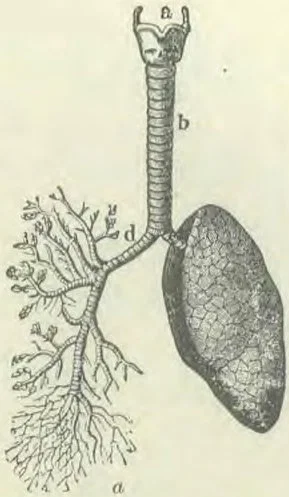
SHOWING THE BRONCHIA AND ONE LUNG.
The “soft palate” separates the pharynx from the mouth, and the “uvula” hangs pendent from the center of it. There are some “glands” here also, that we will study about under the subject of glands, when we shall have reached that subject in later articles.
The next organ in the throat on the way down, is the larynx, or “voice-box.” This is the upper portion of a tube of cartilage, like gristle, leading to the lungs. In the upper portion of this cartilage tube are the vocal cords, with which we make the sounds of speech. But as the esophagus, or tube for conveying food to the stomach, is very close to the larynx, being just behind it, we would get into serious difficulty by swallowing our food into the wrong tube, were it not for a little trap-door that fits down tight over the larynx, called the “epiglottis.” It is a spoon-shaped piece of cartilage, hinged at the root of the tongue, so that in swallowing, as the tongue is drawn back, the cover is drawn down tight. Sometimes we297are in a hurry to breathe and swallow at the same time. Then we get choked, and cough until the food or drink is expelled from the larynx, where it does not belong. The extension of this tube is called the trachea, or windpipe. It is composed of from sixteen to twenty rings of cartilage; and from the base of the trachea to the lungs is about four or five inches. It divides, at the upper part of the chest, into two branches, called the “bronchial tubes,” one going to the right and the other to the left side. Then these two branches divide and subdivide, like the branches of a tree. Imagine a tree turned upside down, and you will get an idea of the bronchial tubes as they run through the lungs.
The lungs are the two essential organs of respiration. They are composed of air-cells and tubes, and are light, spongy, and elastic. They are covered with a membrane called the “pleura.”
Both lungs weigh about forty-two ounces, the right lung being larger and heavier than the left. The right lung has three lobes; the left lung two.
The air-cells are bound together by connective tissue and considerable yellow elastic tissue, which gives to the lungs remarkable elasticity.
The chest cavity is called the thorax, and is composed of ribs and the muscles and tissues that cover them and fill the space between them.
The back-bone and the breast-bone help to form the thoracic cavity, in which are the lungs.
The diaphragm, a large muscle, closes the under side of the cavity, and divides the thoracic from the abdominal cavity. This important muscle will be described in connection with the process of breathing, in our next study.
MRS. M. D. McKEE.
A NEED SUPPLIED.
By William Brickey
Do you need a noble teacher
For your children and your youth?
Do you wish to have a preacher
That is full of gospel truth?
Do you want a bright professor,
Filled with wisdom from above,
Who is also a possessor
Of the fulness of God's love?
Do you want a missionary,
That will visit every week?
And whose messages will vary
To suit both the strong and weak?
Do you need a wise physician,
Who will not consume your wealth,
But will tell, in your condition,
How you may preserve your health?
Or a number-one mechanic,
Who can measure to the line,
And whose rule is not satanic,
But is nearer the divine?
If you do, the YOUTH'S INSTRUCTOR
Is the paper you should read;
Write to the business conductor,
He will send you what you need.
PLACES: Capernaum, the synagogue, home of Simon and Andrew, a solitary place, the towns of Galilee. PERSONS: Jesus, Simon, Andrew, James, John, Simon’s wife’s mother, a leper.
QUESTIONS AND NOTES.
1. The service in the synagogue having been broken up by the cries and healing of the demoniac, where did Jesus go? Mark 1:29; note . Of what was Jesus informed upon entering the house? V. 30. What did he do? V. 31. What did the woman do as soon as she had been restored to health? V. 31, last part. What does this teach us?—That health and strength are given us of God for service.
2. What happened at the close of the day? Matt. 8:16. Why did not the people bring their sick friends to be healed on the Sabbath? Note . What did Christ do for all who were brought to him? V. 16. What prophecy was thus fulfilled? V. 17; see also the fifty-third chapter of Isaiah. If Christ has borne our sicknesses and carried our infirmities, is it not our privilege to leave them with him now?
3. Before daylight the following morning, where did Jesus go? For what purpose? Mark 1:35. Who followed him to his retreat? V. 36. What did they tell him? V. 37. What urgent plea was made by the people of that place? Luke 4:42.
4. Would it not have been pleasant, from a human point of view, to remain under circumstances so favorable? What did Jesus decide to do? Luke 4:43. Where did he then labor for a time? Mark 1:39.
5. While on this circuit, who came to Christ to be healed? V. 40. What did this sick man say? What did the Saviour do and say in reply? V. 41. As the word was spoken, what immediately took place? V. 42. Was this leper, with his incurable disease, in a more helpless condition than the sinner?—No; and the same Saviour is needed298by both. See Isa. 1:5, 6, for the inspired description of a man who is sick with sin.
6. Before sending the man away healed, what charge did Jesus give him? Mark 1:43, 44; note . What did the man do? What was the result? V. 45.
THE NEAREST DUTY.
If you've any task to do,
Let me whisper, friend, to you,
Do it.
If you've anything to say,
True and needed, yea or nay,
Say it.
If you've anything to love,
As a blessing from above,
Love it.
If you've anything to give,
That another's joy may live,
Give it.
If you've any debt to pay,
Rest you neither night nor day,
Pay it.
If you've any joy to hold,
Near your heart, lest it grow cold,
Hold it.
TIME: A. D. 30. PLACE: The same as in the last lesson, the upper room in Jerusalem. PERSONS: Jesus and his disciples.
QUESTIONS.
Review.—What were the incidents of last week's lesson? Where did they take place? Who were the actors? What did Jesus desire to teach his disciples by these things? What two memorials had Jesus instituted? Which one of the disciples had now gone away? What had Jesus said which would cause the hearts of his disciples to be troubled? What had Peter said, and what had been predicted regarding him?
Introduction.—Who is speaking at the opening of this lesson? Who interrupts? Give the substance of the conversation between them. Who takes part in the conversation? What is said by Philip, and by Jesus in reply to him?
The Father's House.—What had Jesus said to cause the disciples' sorrow? What did he say to comfort them? Of what house did he speak? Where is that house? Who abides in it? Where was Jesus about to go?
The Way Thither.—What did Jesus say concerning the way? What did he say they knew? What reply did Thomas make? In what sense is Jesus the Way? In what sense the Truth? In what sense the Life?
The Father and the Son.—What remark did Philip make? What was the reply? How had they seen the Father? What promise did Jesus make? What great works did the apostles afterward do? What did he invite them to do in his name?
Never had been seen so great a triumph of love as the Saviour exemplified when comforting his disciples as he was about to be crucified. As he loved them then, so he loves them still. As he loves us, so does the Father; for the Father is in him as he is in the Father. The Father and the Son are one, and both love us with a love that passes all comprehension. Christ came to earth on a mission of mercy, ministered mercy here, died, and ascended to heaven impelled by mercy and love. He has gone to prepare a place for us in the Father's house—a home. Christ is the way there. There is no other way. He that would seek to enter in some other way is a thief and a robber. To reject him is to reject the Truth and the Life; to turn from heaven and immortality.
When the flood came, there was but one place of safety. When there was famine in all the world, there was but one man to whom they could go for food. So there is now but one name with power to save men—Jesus.
NOTE AND COMMENT
He is an enemy of mankind who presses upon the brow of labor a crown of thorns, that he himself may wear a crown of jeweled gems.
The wise man is he who follows the wisdom of God; the great man is he who lays hold of the power of God; and the good man is he who does the will of God.
Remarkable.—An extraordinary social fact of the present time is the remarkable increase of population in the cities. It is scarcely believable, but true, that of the sixty-five or more millions of inhabitants in the United States, fully one third of the number lives in cities.
An Unknown Flora.—The flora of Porto Rico is said to be almost unknown. It is thought that rare orchids, and other valuable, beautiful, and perhaps heretofore unknown, botanical species will be found when the island is thoroughly explored by scientific men.
Temperance at Paris Exposition.—Plans are maturing for making a great temperance object-lesson at the Paris Exposition in 1900, by opening on the grounds a very large temperance restaurant, together with what are termed “Kiosques de Temperance,” from which all alcoholic drinks will be excluded.
A Profitable River.—The Columbia River has been productive of greater wealth, from its salmon fisheries, than any other river in the world. The vast quantities of salmon taken yearly from its waters have enriched many men, while the fisheries and canning-factories have given profitable employment to thousands.
Results Unsatisfactory.—An exchange is authority for this statement: “From a bushel of corn a distiller gets four gallons of whisky, which retails at sixteen dollars; the government gets four dollars, the farmer who raised the corn gets forty cents, the railroad gets one dollar, the manufacturer gets $3.60, the retailer gets seven dollars,”—and, might it not be added, The user gets destruction?
Heaping up Wealth.—The marvelously rapid development of wealth in this country is shown by the fact that in two generations the Gould estate has increased to $125,000,000. In four generations the Astor estate has grown from $20,000,000 to $375,000,000. In four generations the Vanderbilt estate has gained in value $310,000,000, increasing from $90,000,000 to $400,000,000. This is certainly heaping up wealth in these last days.
The Force of Waves.—An instrument has been devised by which it is possible to measure the weight of the blow dealt by waves of the sea. This device has been tested at Skerrymore Rock, Scotland, which receives the full force of waves sweeping across the broad Atlantic. Here, during the winter storms, blows as heavy as one ton to the square foot were recorded. This gives an idea of the immense power of resistance required of sea-going vessels—and especially of lighthouses, piers, and breakwater structures.
Success.—With far too many the dollar sign is the emblem of success in life. Not wealth, but character, measures the real worth of life. A noted clergyman in a prayer-meeting talk gave utterance to these noble sentiments, which should be graven upon the heart of every young man, and made by him the standard of his hoped-for success: “I would rather be a preacher than a millionaire, and I wonder sometimes why all men do not become preachers. I think it is better to save souls than to gain a million. I would rather work in a small church, with a chance to do good, than sit upon a throne. It is not the question of making money: it is one of doing good.”
Dreyfus Is Well.—In the court of public opinion throughout the world, Dreyfus is regarded as an innocent man, though strong influences in France are firm in their opposition to him. His many friends and sympathizers are pleased to gain the information, given in the following paragraph from the Jewish Daily News: “From Cayenne, the capital of the penal servitude colony, it is reported that a court officer who was sent to interview Dreyfus has come back, and declares that Dreyfus enjoys the best health, but refuses to answer any questions put to him by the court of cassation, fearing his words will not be truthfully reported in Paris, and he will keep silent until he shall be brought back to Paris to defend himself.”
“THE COMING KING.”
By Uriah Smith
“Tell ye the daughter of Zion, Behold, thy King cometh unto thee.” Matt. 21: 5. This was the fulfilment of a prophecy telling what was to be proclaimed to the people at the first advent of Christ. Then he came in humility, a Man of Sorrows, to die a sacrifice. He is coming again, this time in power and glory, as King of kings, and Lord of lords. More imperative, then, is the obligation upon the people now to raise the cry to Zion, “Behold, thy King cometh!” Prophecies from every side shower down their glowing announcements in regard to this event. Men have taken up the proclamation. The best witness is the printed page, which can display its testimony to a hundred eyes at once, as well as to one. Such a book is now before the world. It is “The Coming King,” by J. E. White. It is having a marvelous sale; but it should be scattered as far as men dwell, who ought to know that the great King cometh.
The book is a neat and tasty volume of nearly three hundred pages, put up in style to please and satisfy the taste of those who desire a handsome volume, and filled with the very matter adapted to the wants of those who wish to be instructed in the great themes of the Bible. It is replete with illustrations, many of them full-page, and more marginal and textual. These, scattered profusely through the book, touch upon every salient point discussed in the text, and as with a magnifying-glass and flashing light, illuminate and make clear the important subjects brought under examination. No one can peruse this book without being profoundly impressed, not only that the King is coming, but how he is coming, and approximately when he will appear. No one can lay it down without a vivid impression of the time we are living in, the startling phenomena of nature, earthquakes, floods, fires, famines, the labor troubles, the abnormal accumulations of wealth, the intense antagonism between the rich and the poor, strikes, political corruption, abounding iniquity, false teachings, and multiplying deceptions, all of which show that the great and decisive day is at the door, and hasteth greatly. The condensed mass of information will more than repay the cost of the book to any one who wishes to be intelligent as to the present condition of the world.
URIAH SMITH,
Editor Advent Review and Sabbath Herald.
FROM SABBATH-SCHOOL SECRETARIES.
In a letter received from Mrs. Flora V. Dorcas, secretary and treasurer of the Iowa Sabbath-school Association, we find the following words of commendation for the INSTRUCTOR:—
“Glad that the Iowa INSTRUCTOR list is coming up. I wish that all our young people might have the benefit of this good paper published for them. We will surely do all we can to increase the circulation of the YOUTH'S INSTRUCTOR in our State.”
Another letter received from Jennie E. Nichols, secretary of the Missouri Sabbath-school Association, speaks of the INSTRUCTOR in the following terms:—
“I shall do my best to get this valuable magazine in our schools, and will encourage our Sabbath-schools to take the paper, and trust that many will do so. I do not see how they can afford to do without it.”
Another Sabbath-school worker writes:—
“Yours at hand, containing mailing-list for our State, which I am glad to have. I shall do all I can to promote the circulation of the INSTRUCTOR among our people. I am corresponding with our isolated brethren and sisters as much as possible, and as I learn of families with children old enough to be interested in the INSTRUCTOR, I shall urge them to have it. If you have sample copies you could send me, I might use them to good advantage. Hoping that I may see the number of our INSTRUCTOR subscribers increase soon, I remain,” etc.
Here are some words of commendation. The Iowa Tract Society writes as follows:—
“The INSTRUCTORS are very much appreciated. We can assure you of this fact; we can not get along without them, especially in our Sabbath-school work.”
IMPORTANT NOTICE!
By Editor
As the subscription price of the INSTRUCTOR is hereafter to be seventy-five cents a year, instead of $1, the subscriptions now on the mailing-list will be extended in proportion to the amount already paid for the same. We wish to assure our readers that this matter will be properly adjusted to the satisfaction of all concerned.
We also desire to call attention to the change in clubbing rates, as given in the announcement opposite first editorial page.
PUBLISHERS.
ANOTHER LETTER FROM INDIA.
By A. Abbott
MAZAGON, BOMBAY, Feb. 11, 1899.
REVIEW AND HERALD:
Dear Sirs: I am very thankful to receive January packages of the YOUTH'S INSTRUCTOR; for it is a promise for the coming year, I suppose.
I am going home on furlough, leaving next month, but the papers will be carefully distributed in my absence.
Thanking you much for your continued interest in the young men to whom I send the paper, I remain,
Yours sincerely,
A. ABBOTT.
AN APPEAL.
By C. V. S. Boettger
DEAR FRIENDS, YOUNG AND OLD: Would you not like to help in the work?—Of course you would. Well, here is an opportunity. Send me your YOUTH'S INSTRUCTORS or Our Little Friend, and I will gladly distribute them, and tell you of the result or experience. We have hundreds of orphans here, and many children in hospitals, who would rejoice to see and read your papers. Hundreds of men and women may thus be reached by them. You can help us; will you do it? Matt. 25:40. Please, dear friend, send me your mite; and the Lord's blessing will follow it and you.
C. V. S. BOETTGER.
218 Bank St., Christian Help Mission Ottawa, Ont.
The Heralds of the Morning
Actual size. 6½ x 9 inches.
First Edition 10,000 Copies.
THIS book deals entirely with the significance of current events. Its subtitle is “The Meaning of the Social and Political Problems of To-day, and the Significance of the Great Phenomena in Nature.”
That serious problems, both social and political, now confront the world, no one doubts; that the elements themselves are participating in the general unrest is everywhere apparent; but that these are signs of the times is not so generally known, therefore this phase of the question is given special attention.
Actual occurrences illustrating such subjects as: “The Prevalence of Crime a Sign of Our Times;” “Judgment Is Turned Away Backward;” “The Social Vice;” “The Earth is Filled with Violence;” etc., are cited, which indicate a far worse state of public morals than is generally thought to exist.
. . BY A. O. TAIT . .
The terrible condition of the poorer class in our large cities is vividly set forth by the author, and emphasized by the artist in a chapter entitled “Ye Have Heaped Treasure for the Last Days.”
“And the Nations Were Angry” is the title of a fully illustrated chapter on the stupendous preparations now being made for war.
“This Remarkable Century” relates more particularly to the wonderful inventions and discoveries of recent years.
There are other chapters—twenty-one of them—but they are all devoted to the one object of giving the significance of current events, and it will not be necessary to name them here. They are intensely interesting and of vital importance to every man, and woman, and child in the world. Remember, the book is less than a month old, and is entirely unlike anything you have ever read.
It contains nearly 300 pages and over 100 illustrations, and is issued in two styles of binding:—
Cloth, with side and back title in gold, - - $1.25
Cloth, gilt edges and titles, - - - - 1.50
Review and Herald Pub. Co., Battle Creek, Mich.
Pacific Press Pub. Co., Oakland, Cal.
The Coming King
By James Edson White
By JAMES EDSON WHITE
This Book is . .
Selling Rapidly
Actual size, 6 x 8 inches.
Agents Wanted
Everywhere . .
Over 45,000 copies of this book placed in the Homes of the People during the past 11 months
Christ is here shown to be the central figure in the plan of salvation, the Creator and Redeemer of the world, the Divine Lawgiver, the Leader of Israel, the Great Teacher, the Man of Sorrows, our Sacrifice, our Mediator, as well as “that Prophet” through whom comes to us definite knowledge concerning future as well as past events.
A considerable part of the book is devoted to the consideration of Christ’s great prophecy as recorded in Matthew, 24th chapter, and special attention is given to that portion relating to the persecution of the Church, darkening of the sun, falling of the stars, famines and pestilences, earthquakes, and tidal waves, etc. Historical quotations showing the exact fulfilment of these predictions are made in connection with each.
The author then discusses the significance of such present day topics as the amassing of wealth, labor troubles, distress of nations, coming conflict, etc., in a way that will attract and interest the reader.
Altogether it is a book that will inspire confidence in the Word of God, that will awaken many new thoughts concerning the Saviour and His work, that contains much valuable information concerning the times in which we live, and one that you will be pleased to have in your home and on your reading table.
It contains 288 pages and 180 illustrations. These illustrations are printed in colored ink, and present a unique and attractive appearance. The bindings are:—
Cloth, Plain Edges, - - - - - $1.00
Cloth, gilt top and title, - - - - 1.50
Review and Herald Pub. Co.,
Battle Creek, Mich.
Pacific Press Pub. Co.,
Oakland, Cal.
Free Booklet
Treating on Health and Hygiene ..
Mailed to your address . . .
Why Don't You Be Good to Yourself?
Stop taking drugs and patented poisons. Investigate the newer and saner method of curing diseases, by using—
The Kellogg Sanitas Folding Hot Air Medicated and Vapor Bath.
Adapted to the hygienic and physiological requirements of every man, woman and child. RECOMMENDED BY LEADING PHYSICIANS. CURES La Grippe, Colds, Rheumatism, Throat Affections, Aches, and Pains. Equalizes the circulation. Reduces flesh harmlessly and speedily, and beautifies the complexion.
Men and women make good wages managing agencies and bath parlors. Address with stamp.