I WAS just a boy about six years old. Like other boys of the same age, I was always finding something new to do. Having in some way acquired a taste for roasted coffee beans, whenever I could get them I filled my pockets and went about my work or play eating them.
My mother frequently had me run errands to the grocery store. I enjoyed doing this very much.
One day while I was at the store I made a discovery. I found several sacks of coffee along the counter on the floor. They were wide open and looked inviting to me. I thought here was a mine at my disposal.
However, there seemed to be something wrong when I thought of taking some of the coffee. I began to think of what the owner might say. What would he think of my taking the coffee and not paying for it? Something seemed to tell me that I had better not take any. Then I began to think he wouldn’t care or he wouldn’t have left the sacks open. I thought that he must have left those sacks there for the people to sample, and of course that was all I was going to do, just take a sample. I did not stop to think how much a sample of coffee was, and besides, what could be the difference if no one saw me? After much discussion with myself on the subject, I decided to help myself, and so when no one was looking I filled my pockets.
After I had made this discovery, I was anxious for my mother to send me on an errand to the store so that I could get more coffee.
Mother began to notice a change, and that I was always eating something; so one day, when I had just returned from an errand, she said, “Son, what are you eating?”
I did not want to tell her, so I merely answered, “Nothing.”
She knew then that something was wrong, so she said, “Son, come tell mother what you are eating.”
I kept silent.
Again she said, “Tell me what you are eating.”
I became frightened, and answered, “Coffee.”
“Where did you get it?”
“At the store.”
“What store?”
“Gotthelf’s.”
“Where did you get the money to buy it?”
“Nowhere.”
“Well, how did you get it?”
“I don’t know.”
“Now, my boy, tell mother everything you did, and how you got it.”
I had vivid recollections of a certain strap and its use, but I tearfully told her all about how I got the coffee. She said, “How much coffee have you left?”
I showed her. It was about a handful.
Then she said, “Now you go back to Gotthelf & Tarbell’s with that coffee. Take it to Mr. Tarbell and tell him how you got it, and ask him to forgive you.”
I had been expecting a whipping, but this was worse than any punishment of that sort. I thought I could not possibly do it, so I began crying very hard and refused to obey.
Mother spoke to me again, but I did not respond. Then she went to where she kept the strap. Taking it, she came to me and said, “Now you go and do what I told you to do.”
I put on my cap and started down the street. I wiped my eyes, for I couldn’t let any of the boys know that I had been crying. I walked all over the store, while Mr. Tarbell was waiting upon some customers. When he was alone I told him all about the coffee.
He rather sternly told me to show him where I got it. I took him to the sacks. He told me to put it back. Then he forgave me, and I left as quickly as I could.
When I arrived home, my mother questioned me severely, and told me that, besides being punished by having to repeat the experience I had just passed through, I would also be punished by my father, if I ever took any more coffee or anything else without the permission of the owner.
I promised to obey, and to this day I have not forgotten that lesson. I learned to respect other people’s property, so that I do not need to be warned by a “hands off” sign.
[One does not need to take things from the grocer by the handful to be trespassing upon property rights. It is a common thing to see persons help themselves to a nut, cooky, or piece of candy from the grocer’s box, when they have no idea of purchasing any of the commodity. All of these littles together amount to much from the grocer’s viewpoint. The “tasting” habit often deserves no milder term than that of stealing. Taste nothing unless you really wish to determine whether it is a desirable purchase.]
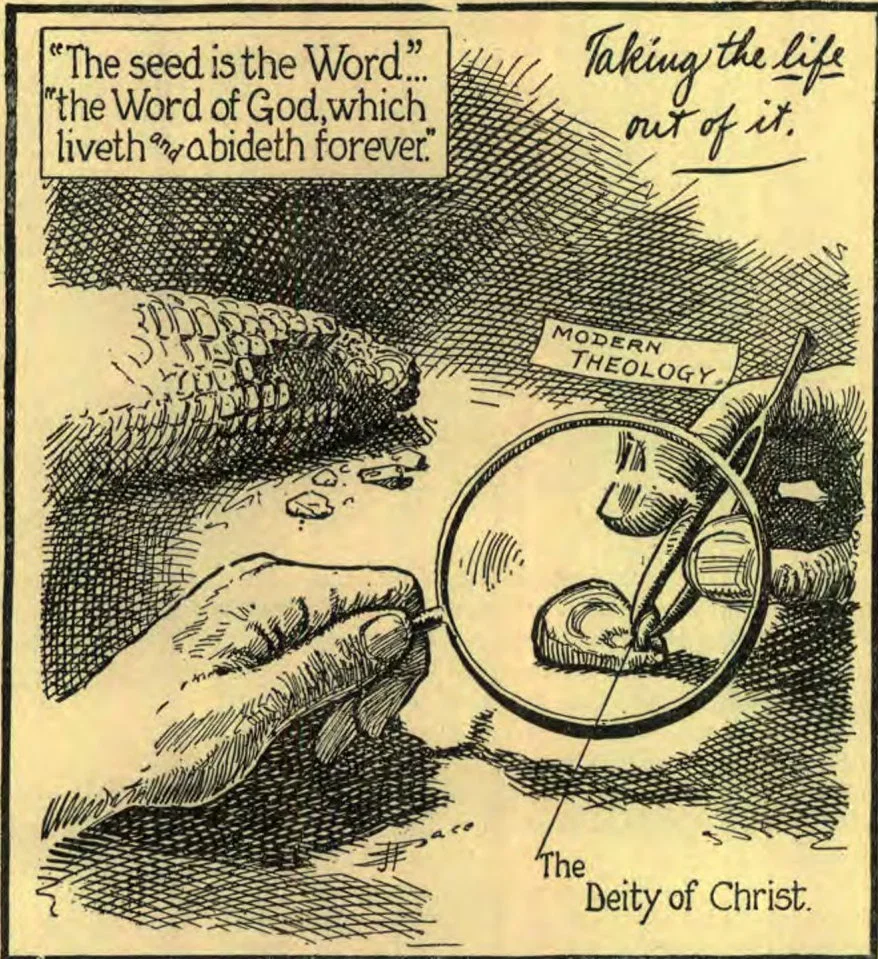
The Deity of Christ and the Life of God
Cartoon from the Sunday School Times
In every seed there is the embryo, the small plant which develops into the new plant. Remove this and you rob the seed of its life, of its power to reproduce another of its kind. Without this the acorn can no more grow into an oak than can a stone.
Christ is the seed of the woman which was to bruise the serpent’s head. He is the Word which was in the beginning with God, and “the Word was God.” The deity of Jesus is plainly indicated in the following texts: Matt. 1:23; 8:29; Luke 4:12; Isa. 9:6; Heb. 1:8.
It is the God, the divine life, in Christ which enables him to make a heart of flesh out of a heart of stone; it is the divine life that converts the sinner into a saint. There is nothing else but the life of God that can make these changes; so the modern theology which regards Christ as only a man and not God, robs him of the only thing that can save human beings, his divinity, or deity.
Letter from a Physician to His Daughter on Her Fifteenth Birthday
By H. N. Sisco
DEAR KATHLEEN: You are now fifteen. You are passing from childhood to youth. You are at life’s threshold. It is well at such a time, therefore, to estimate one’s present and plan for one’s future.
You are strong physically; faithfully obey the laws of life, in order that you may reap a harvest of health in all your later years. The feeble are a handicap to themselves and to the community.
You are in school. Be studious, for now your days are golden; apply yourself closely. Have system in your study. Teach your mind how to persist, and to penetrate. Learn all you can of everything. Education consists as much in acquiring a keen and powerful intellect as in the memory of facts.
Also learn all you can outside of school. Listen to instructive lectures. Tolerate only good music; read wholesome literature; know the news of the day. The individual without an education these days is at disadvantage in life’s conflict.
The normal person has but two hands—a right hand and a left hand; a few persons have a third hand. It is called a little behind hand. Therefore be punctual.
Procrastination is the thief of time, of opportunity, of life itself. Our lives are short enough at the longest. The wise man does not wait until tomorrow; never procrastinate.
Avoid slang in your conversation. Slang is the chaff among the wheat of pure English.
Court neatness and order—about the person, about the dress, at your desk, in your room. The condition found in corners, drawers, and closets often advertises the type of character.
Recreation is as necessary as hard work; a vacation is not always recreation. It is often dissipation. Recreation should relax the mind and body, and rest. It should make more efficient, instead of less so, for more hard work.
Always laugh without silliness, and have fun without foolishness.
In all that you do, work with as much speed as may be consistent with thoroughness and accuracy. Speed may be cultivated until it becomes habit.
Do not shun hard and humble work. The dishpan and the washtub are both ancient and honorable. They are the aristocrats of the kitchen. Despise them not. Be open. Be frank. Be honest. Be true, always to yourself and to others. He that covereth up a matter runneth the risk of a rude awakening.
You are optimistic, you are not given to much wrong. This is a valuable asset in life’s accounting. True optimism, however, is never blind to facts. Keep good company. Choose only helpful companions. Discriminate in your friendships; youth is profoundly influenced by its associates.
Read good books. Some fiction is worth while. Its diction is pure and its moral tone is elevating. Some magazine novels, though, are cheap; they represent impossible situations and false ideals. They excite, but do not instruct. They consume valuable time. They create a morbid appetite for thrills. They warp the emotional nature. Avoid them.
It has been remarked that you are now fifteen. This means that you are passing from girlhood into womanhood. This transition period is always accompanied by certain physical changes and emotional phenomena. Various feelings of unrest may come over one, tendencies to dissatisfaction, or questions or doubts. You are to guide these feelings. They are not to lead you astray. There may be an unconscious longing for companionship—the companionship of young men. This is normal and legitimate. It is the sex nature developing. But much wisdom is needed just here. Keep your equilibrium; maintain a dignified, womanly reserve, through which no trifler may penetrate. Mingle with the opposite sex, but allow no undue advances. Do not allow yourself to become in any way obligated to any. Undue advantage may be taken of it later. Do not encourage any intimate friendship without long and thorough acquaintance. Knowledge before love, not love before knowledge. Some girls have here made a misstep. They have been led along the questionable way. They have met disgrace. Think long before acting. Be self-controlled. Seek advice when necessary. So shall your choice for life be wise.
You should now begin to set some definite goal of accomplishment before you. Let it be for a day—a week—a month—a year—for life. Firmly resolve to reach it. Begin now to work for it. You should also now begin to prepare for some trade or profession by which you may later earn a livelihood. No young woman should enter life without the knowledge and ability to support herself, if necessity demands it.
And always remember that the moral life is superior to the physical or mental. Do not forget the religious teachings of earlier days. Belief in God and in the ultimate triumph of good in the world, is a pillar of success in any life, and the second commandment is like unto it—the love of one’s fellow men, both high and low, and the desire to do them good. Be true always to your best moral and religious convictions.
Read this birthday letter over once a month—and ponder.
Your father,
H. N. Sisco.
Captain Medical Corps U. S. Army, Somewhere in France, 1918.
Twelve Things to Remember
By Morris Lukens
THE Value of Time
The Success of Perseverance
The Pleasure of Working
The Dignity of Simplicity
The Worth of Character
The Power of Kindness
The Influence of Example
The Obligation of Duty
The Wisdom of Economy
The Virtue of Patience
The Improvement of Talent
The Joy of Originating
The above list occupied a conspicuous place some years ago in Marshall Field’s large department store in Chicago, and was written for the benefit of the employees. I trust it may be of benefit to many others.
MORRIS LUKENS.
Peace As the Product of Thoughtfulness and Self-Control
By H. W. Wilbur
PEACE is the product of thoughtfulness, of reason, of self-control.— H. W. Wilbur.
God’s Message in India
By E. A. I.
CAN you imagine boys and girls in India who wear the same kind of clothes that you do, read the same books, and speak the same language? If you were to go to Calcutta or Bombay, you might almost think you were in an American city; and if you went into some of the churches in these cities, you would be sure that you were in an American church, for the hymns and the sermon would be in English.
However, outside of these cities and some places in them—you would find things very different. Had you realized that there are almost as many different languages—they are called dialects—in the country we call India as there are in Europe? These people not only speak different languages, but dress very differently and vary in color from about the complexion of you boys and girls to almost black, though they are called the brown race.
Twenty-five years ago there was not a Seventh-day Adventist in all India, but in 1894 some of our canvassers pioneered the way for the gospel message by placing some of our books in many of its leading cities. Later, regular mission work was begun in Calcutta, and God’s special truth for these last days began to spread.
The medical work was soon opened up, and of course this did much to give the truth favor with the people, for they do not understand caring for the sick, and are eager for the treatments which our dispensaries and treatment-rooms furnish. Illness among the natives of India usually means terrible suffering. If something very serious is wrong with a child, his parents may send for the witch doctor, who, instead of helping the child by sensible treatments, does many dreadful things which only make him worse.
One little boy was getting better after a fever, but though the fever was gone, his eyes were still very sore. The witch doctor was sent for. When he came, he14did not bathe the sore, red eyes, nor do anything to soothe the pain; instead of that he burned the top of the wee boy’s black head, to pull the evil spirit out. So the poor little fellow had to bear the pain of the burn as well as the pain in his eyes. His father and mother let the poor eyes grow sorer and sorer until at last the lad was entirely blind.
This is just one of thousands of cases as pitiful. So you see there is great need of the medical work; and after our nurses and doctors have treated the poor suffering bodies of these people, then they can talk with them about Jesus, the Great Physician, who is able to heal their sin-sick souls and save them from eternal death.
We have eight dispensaries and three treatment-rooms in India, besides a food factory and a monthly health journal. The Seventh-day Adventist headquarters are located at Lucknow, where we have a large training school. We also have a good printing office here, which publishes papers in five of the languages of India, and also prints the Oriental Watchman and the Life and Health in English.
We have about fifteen mission stations in India, with ninety-one missionaries to carry on the work. But it takes a long time to win the natives to the truth. India has been called the Gibraltar of heathenism. You remember the great Rock of Gibraltar in southern Spain—well, India presents just such a stony barrier to the gospel of Christ. So you will not be surprised to learn that there are only six hundred Seventh-day Adventist believers in all India out of a population of three hundred million.
We are glad that there are even that number, but, O how much there is yet to be done! Besides workers it takes prayer and means to carry the gospel to these people. And this is where our Juniors can help. Jesus did not say, “Be sorry;” he said, “Go . . . preach the gospel to every creature.” Every one cannot go in person, but our prayers can ascend daily for India, and our money can go, and must go, as a duty we owe to Jesus. Let us give our missionary money to help bear the good tidings, that the “Sun of Righteousness” which is rising in dark India, may speedily shine into every heart.
E. A. I.
Missionary Volunteer Department Note on Anonymous Questions
By M. E. K.
NOTE.— The Missionary Volunteer Department does not publish answers to anonymous questions. Any one who wishes an answer to his questions should sign his name, and not such signatures as “A. S. D. A.”
Neither the name nor the initials of the individual will be published if it is so requested, but we must have the name and address as an evidence of good faith, and in order that we may answer by letter if thought best. M. E. K.
XI — Feeding on the Word
(June 14)*
GOLDEN TEXT: “Because thou hast kept the word of my patience, I also will keep thee from the hour of temptation, which shall come upon all the world, to try them that dwell upon the earth.” Rev. 3: 10.
LESSON HELP: “Steps to Christ,” chapter “A Knowledge of God.”
Questions
1. What is the bread of the spiritual life? Matt. 4: 4. Note 1.
13. How does the earnest Bible student come to regard the words of the Lord? Verse 103.
14. On what condition does the Lord promise to keep us in the time of trouble? Rev. 3: 10.
15. What eternal results come from a proper study of the Bible? 1 Tim. 4: 16. Note 8.
Notes
1. “The Word destroys the natural earthly nature, and imparts a new life in Christ Jesus. The Holy Spirit comes to the soul as a Comforter. By the transforming agency of his grace, the image of God is reproduced in the disciple; he becomes a new creature. Love takes the place of hatred, and the heart receives the divine similitude. This is what it means to live ‘by every word that proceedeth out of the mouth of God.’ This is eating the Bread that comes down from heaven.”—“The Desire of Ages,” p. 391.
2. “The prayer for daily bread includes not only food to sustain the body, but that spiritual bread which will nourish the soul unto life everlasting. . . . Our Saviour is the bread of life. . . . We receive Christ through his Word; and the Holy Spirit is given to open the Word of God to our understanding, and bring home its truths to our hearts. We are to pray day by day that as we read his Word, God will send his Spirit to reveal to us the truth that will strengthen our souls for the day’s need.”
“In teaching us to ask every day for what we need—both temporal and spiritual blessings—God has a purpose to accomplish for our good. He would have us realize our dependence upon his constant care; for he is seeking to draw us into communion with himself. In this communion with Christ, through prayer and the study of the great and precious truths of his Word, we shall as hungry souls be fed; as those that thirst, we shall be refreshed at the fountain of life.”—“The Mount of Blessing,” pp. 165, 166.
3. “We receive God’s Word as food for the soul, through the same evidence by which we receive bread as food for the body. Bread supplies the needs of our nature; we know by experience that it produces blood and bone and brain. Apply the same test to the Bible; when its principles have actually become the elements of character, what has been the result? what changes have been made in the life?—‘Old things are passed away; behold, all things are become new.’ In its power, men and women have broken the chains of sinful habit. They have renounced selfishness. The profane have become reverent, the drunken sober, the profligate pure. Souls that have borne the likeness of Satan, have been transformed into the image of God. This change is itself the miracle of miracles.”—“Education,” pp. 171, 172.
4. “Never should the Bible be studied without prayer. Before opening its pages we should ask for the enlightenment of the Holy Spirit, and it will be given. . . . Angels from the world of light will be with those who in humility of heart seek for divine guidance.”—“Steps to Christ,” p. 96.
5. “As we contemplate the great things of God’s Word, we look into a fountain that broadens and deepens beneath our gaze. Its breadth and depth pass our knowledge. As we gaze, the vision widens; stretched out before us we behold a boundless, shoreless sea. Such study has vivifying power. The mind and heart acquire new strength, new life.”—“Education,” p. 171.
6. “But the most valuable teaching of the Bible is not to be gained by occasional or disconnected study. Its great system of truth is not so presented as to be discerned by the hasty or careless reader. Many of its treasures lie far beneath the surface, and can be obtained only by diligent research and continuous effort. The truths that go to make up the great whole must be searched out and gathered up, ‘here a little, and there a little.’
“When thus searched out and brought together, they will be found to be perfectly fitted to one another. Each Gospel is a supplement to the others, every prophecy an explanation of another, every truth a development of some other truth. The types of the Jewish economy are made plain by the gospel. Every principle in the Word of God has its place, every fact its bearing. And the complete structure, in design and execution, bears testimony to its Author. Such a structure no mind but that of the Infinite could conceive or fashion.”—“Education,” pp. 123, 124.
7. “Not alone in searching out truth and bringing it together does the mental value of Bible study consist. It consists also in the effort required to grasp the themes presented. The mind occupied with commonplace matters only, becomes dwarfed and enfeebled. If never tasked to comprehend grand and far-reaching truths, it after a time loses the power of15growth. As a safeguard against this degeneracy, and a stimulus to development, nothing else can equal the study of God’s Word. As a means of intellectual training, the Bible is more effective than any other book, or all other books combined. The greatness of its themes, the dignified simplicity of its utterances, the beauty of its imagery, quicken and uplift the thoughts as nothing else can. No other study can impart such mental power as does the effort to grasp the stupendous truths of revelation. The mind thus brought in contact with the thoughts of the Infinite cannot but expand and strengthen.”—Id., p. 124.
“Received into the soul, it will prove a mighty barricade against temptation. ‘Thy word,’ the psalmist declares, ‘have I hid in my heart, that I might not sin against thee.’ ‘By the word of thy lips I have kept me from the paths of the destroyer.’”—Id., p. 196.
8. “The springs of heavenly peace and joy unsealed in the soul by the words of Inspiration will become a mighty river of influence to bless all who come within its reach. Let the youth of today, the youth who are growing up with the Bible in their hands, become the recipients and the channels of its life-giving energy, and what streams of blessing would flow forth to the world?—influences of whose power to heal and comfort we can scarcely conceive,—rivers of living water, fountains ‘springing up into everlasting life.’”—Id., p. 192.
MEMORY VERSE: “Honor thy father and thy mother: that thy days may be long upon the land which the Lord thy God giveth thee.” Ex. 20: 12.
STUDY HELPS: “Patriarchs and Prophets,” pp. 727-745; “Bible Lessons,” McKibbin, Book Two, pp. 90-95.
“There is no far nor near,
There is neither there nor here,
There is neither soon nor late,
In that chamber over the gate,
Nor any long ago
To that cry of human woe,
‘O Absalom, my son!’”
“That ’tis a common grief
Bringeth but slight relief;
Ours is the bitterest loss,
Ours is the heaviest cross;
And forever the cry will be,
‘Would God I had died for thee,
O Absalom, my son!’”
Questions
1. Describe the appearance of Absalom, one of David’s sons. 2 Sam. 14: 25, 26. Note 1.
2. What display of royalty did Absalom make to attract attention to himself? 2 Sam. 15: 1.
3. Where was it his custom to go to meet the people? How did he flatter those who thought they had been wronged? What did he do that still further turned the hearts of the people toward him? Verses 2-6. Note 2.
4. How did Absalom plan to rally the people to himself at Hebron? What successful start did the rebellion against David seem to have? Verses 10, 12, last part.
5. What message came to David? What did he say to his servants? What did they hurriedly do? Verses 13-18. Note 3.
6. How did David and those who were with him show their grief as they went from Jerusalem? Verse 30. Note 4.
7. What preparations for battle did David make? What did he himself plan to do? To what words of the people did he finally yield? 2 Sam. 18: 1-4.
8. What special charge did David give to the three commanders of his army? Verse 5. Note 5.
9. Describe the battle. Verses 6-8. Note 6.
10. What experience came to Absalom? To whom was this reported? What did Joab say? How did the soldier reply? Verses 9-13. Note 7.
11. What did Joab then do? How did he restrain the people from further pursuit of Absalom’s men? What manner of burial was given Absalom? Verses 14-17.
12. What request did Ahimaaz make? How did Joab reply? What was Cushi told to do? How did Ahimaaz urge his request? What permission was finally given? How did he manage to overtake Cushi? Verses 19-23.
13. Where was David waiting for tidings of the battle? What did the watchman report? What did the king conclude? Verses 24, 25.
14. What did the watchman again report? What did he say of the approaching man? What did the king reply? Verses 26, 27.
15. When Ahimaaz drew near, what did he call out? What report of the battle did he make? What question did the king ask? What was the reply? Verses 28-30.
16. How did Cushi give his message? What question did the king repeat? What well-worded reply did Cushi make? Verses 31, 32.
17. What effect did the tidings of the death of Absalom have upon the king? In what words did he express his great grief? Verse 33.
18. Into what was the day of victory turned? How did Joab reprove the king? 2 Sam. 19: 1-8. Note 8.
19. How long did David reign as king? What is said of his death? Who reigned in his stead? 1 Chron. 29: 26-28.
Lessons for the Youth of Today
The success of the wicked is short.
Sin is at first attractive, but in the end it is bitter.
True success does not come through disobedience to parents.
“No failure is so terrible as the failure of a life; no ruin like the ruin of a soul.”
They that sow the wind shall reap the whirlwind.
Notes
1. Absalom was born soon after David became king of all Israel. He was handsome, ambitious, strong of will, and altogether worldly. He evidently had no regard for the religion of his father.
2. “Absalom flatters each suitor, favors his scheme whether right or wrong, accuses his father of neglect. . . . Absalom feigned humility and condescension as well as justice.”
3. “Absalom was mustering his forces at Hebron, only twenty miles away. The rebels would soon be at the gates of Jerusalem. From his palace, David looked out upon his capital—‘beautiful for situation, the joy of the whole earth, . . . the city of the great King.’ He shuddered at the thought of exposing it to carnage and devastation. Should he call to his help the subjects still loyal to his throne, and make a stand to hold his capital? Should he permit Jerusalem to be deluged with blood? His decision was taken. The horrors of war should not fall upon the chosen city. He would leave Jerusalem, and then test the fidelity of his people, giving them an opportunity to rally to his support.”—Patriarchs and Prophets, p. 731.
4. “In humility and sorrow, David passed out of the gate of Jerusalem,—driven from his throne, from his palace, from the ark of God, by the insurrection of his cherished son. The people followed in long, sad procession, like a funeral train.”—Ibid.
It is generally understood that David composed the third psalm in commemoration of the experiences of the day he left Jerusalem. “It is easy to say in ordinary times, ‘I laid me down and slept; I awaked; for the Lord sustained me’ (Ps. 3: 5; 4: 8), but the circumstances of David at this time give a new meaning and power to the words, like sunlight shining through a stained-glass window.”—Peloubet.
5. “As Joab, leading the first column, passed his king, the conqueror of a hundred battlefields stooped his proud head to hear the monarch’s last message, as with trembling voice he said, ‘Deal gently for my sake with the young man, even with Absalom.’ And Abishai and Ittai received the same charge,—‘Deal gently for my sake with the young man, even with Absalom.’ But the king’s solicitude, seeming to declare that Absalom was dearer to him than his kingdom, dearer even than the subjects faithful to his throne, only increased the indignation of the soldiers against the unnatural son.”—Patriarchs and Prophets, p. 745.
6. “The place of battle was a wood near the Jordan, in which the great numbers of Absalom’s army were only a disadvantage to him. Among the thickets and marshes of the forest, these undisciplined troops became confused and unmanageable.”—Ibid.
7. “Absalom, seeing that the day was lost, had turned to flee, when his head was caught between the branches of a wide-spreading tree, and his mule going out from under him, he was left helplessly suspended, a prey to his enemies. In this condition he was found by a soldier.”—Ibid.
8. “Joab was filled with indignation. God had given them reason for triumph and gladness; the greatest rebellion that had ever been known in Israel had been crushed; and yet this great victory was turned to mourning for him whose crime had cost the blood of thousands of brave men. . . . Harsh and even cruel as was the reproof to the heart-stricken king, David did not resent it. Seeing that his general was right, he went down to the gate, and with words of courage and commendation greeted his brave soldiers as they marched past him.”—Id., p. 745.
A Prayer
By Bertha Sleighter
SAVIOUR, thou hast lived for me,
Hast died upon the cursed tree;
O may my life but be a blessing here!
BERTHA SLEIGHTER.
The Shower
By Margaret Veeder
A COOLING breeze
Stirred all the trees,
With music soft and sweet.
The raindrops fell
In the quiet dell,
Like the patter of fairy feet.
The flower held up
Its fragrant cup,
To catch the welcome rain.
Each lily bell
In the beautiful dell
Swung to the low refrain.
— Margaret Veeder.