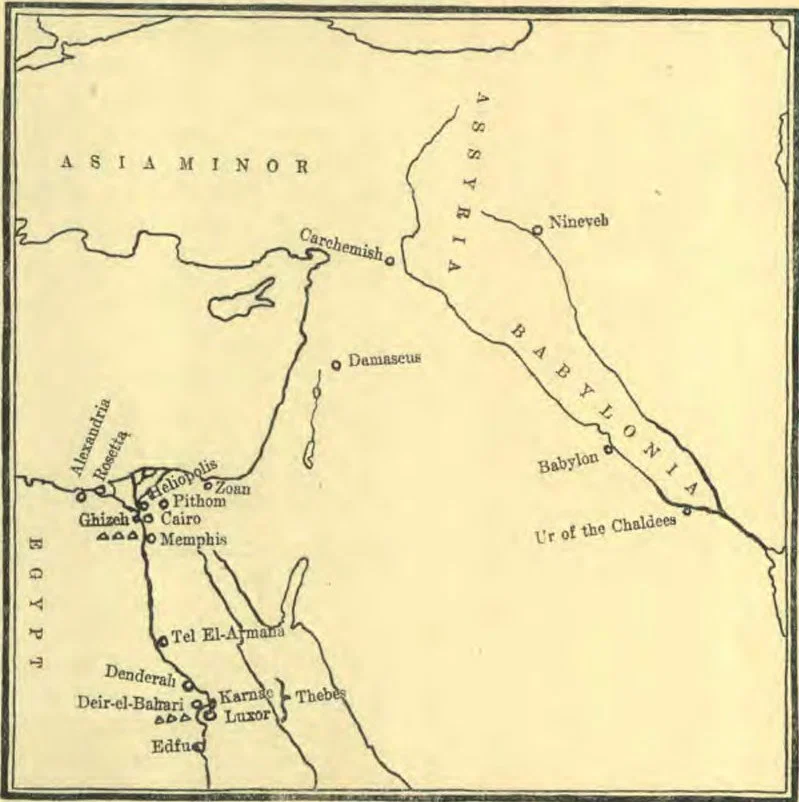
After the twelfth century, pyramid building in Egypt was supplanted by an entirely different kind of tomb. The seat of government had been transferred from Memphis, near which is the great pyramid field, to Thebes, about four hundred miles to the south. The tombs of all the kings who ruled here were underground palaces, hollowed in the foundations of a range of hills.
The kings themselves reared splendid temples near their tombs, and placed in front of each immense portrait statues, most frequently of themselves. Giant obelisks were often placed in front of these on each side of the gateway, while an avenue of sphinxes formed the approach to the temple.
The Spade as Teacher — No. 3
Other Glimpses into the Past
A graphic description of the old Theban tombs and temples is given by Burton Holmes, who says:
“These monarchs, . . . knowing that even the greatest pyramids of their predecessors had failed to preserve their royal remains from profanation, resolved that their own mummies should be, not buried under colossal artificial mountains like the pyramids, but hidden deep in the foundations of the everlasting hills. So they commanded their royal architects to dig and burrow, rather than to build. They tunneled into the cliffs, two hundred, three hundred, and in one case nearly seven hundred feet, descending in some places by inclined and in others by vertical shafts nearly two hundred feet below the point of entrance, which was always carefully concealed.”
“More than forty of these entrances have been discovered; more than forty underground burial palaces of the Theban Pharaohs have been cleared and carefully explored. They have found long corridors adorned with painted pictures, two or three thousand years of age, but bright and fresh as if they had been painted yesterday. They have found spacious ceremonial chambers—long suites of subterranean rooms, their walls alive with tinted illustrations of the royal lives lived by the men for whom these deep, eternal dwellings were devised. But they found here, as at the pyramids, that the royal graves were empty. A few mummies were discovered in the side chambers, but they were not those of the kings. The royal mummies of the mighty Pharaohs had been taken away secretly, at the command of one of their weak successors, in the days when the empire was tottering and the government powerless to protect the royal dead, and had been hidden altogether, as a matter of precaution, in a secret shaft, where they lay until discovered by modern grave robbers, who in placing royal trinkets on the modern market, betrayed themselves and inspired the search that resulted in bringing to light, in 1881, the marvelous array of mummies, including those of Seti I, Rameses the Great, and of the monarchs who had preceded and succeeded them upon the throne of Thebes. Thus both the royal bodies and the royal tombs of the great dynasties were found, but the bodies were not found in these tombs, save in the case of one king, Amenophis II.”
“One tomb was overlooked, both by the ancient ghouls and by the later Pharaoh who tried to save the bodies of his fathers by concealing them elsewhere. One tomb, therefore, remained untouched, until the men of science of our modern day, in 1898, found its hidden entrance, groped their way along its superbly decorated corridors, and, reaching the inmost mortuary chamber, looked on the face of one great king who had been lying there for three thousand three hundred thirty-four years. Here he was found just as his courtiers had left him on the day of his imposing funeral in the year 1436 B. C. This was to me the most impressive moment that came to me in Egypt, this moment when I stood, almost alone, in this royal presence, deep in the caverned mass of those Egyptian cliffs, face to face with one who had been king in Thebes more than a hundred years before Rameses the Great was born—one who had come directly from his golden throne in that now ruined city to this granite bed, beside which we, creatures of a day, stand dumb and silent, chilled by the sense of all the centuries that lie between this man and us.”
This finding of the forty royal mummies and six thousand other objects hidden in a pit in Deir-el-Bahari to escape the thieves who had plundered the more exposed sepulchers, is regarded as the greatest of all Egyptian discoveries. The remains of Ahmes I (1750 B. C.) were still wreathed with funeral garlands. Those of Rameses II, the Pharaoh of the oppression, and of Seti I, his father, were in good preservation, and are now in the museum at Cairo. The coffin that contained the body of Seti is said to be the most wonderful sarcophagus ever found. It was hewn from a solid block of pure alabaster, and was exquisitely sculptured. It is now in a London museum.
Where Egypt’s Wastebaskets Were Emptied
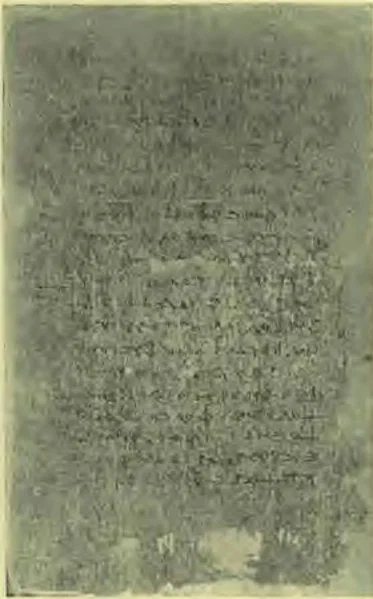
Two English explorers so late as 1897 made an interesting discovery of the rubbish heaps of an old Egyptian town about one hundred miles from Cairo. Here in the dry sand the people emptied their waste-paper baskets hundreds of years ago. This refuse paper has been well preserved for centuries. Among the interesting things found in this rubbish are two different leaves of papyrus on which are reported sayings of Jesus. Some of these are:
“Jesus said, A prophet is not acceptable in his own country, neither doth a physician work cures upon them that know him.”7
“Jesus saith, A city built on the top of a hill and firmly established can neither fall nor be hid.
“[Jesus saith,] Thou hearest with one ear, but the other thou hast closed.
“These are the [wonderful?] words which Jesus the living Lord spake [to the disciples] and to Thomas, and he said to them: Every one that hearkens to these words shall never taste of death.”
The Temple of Karnac
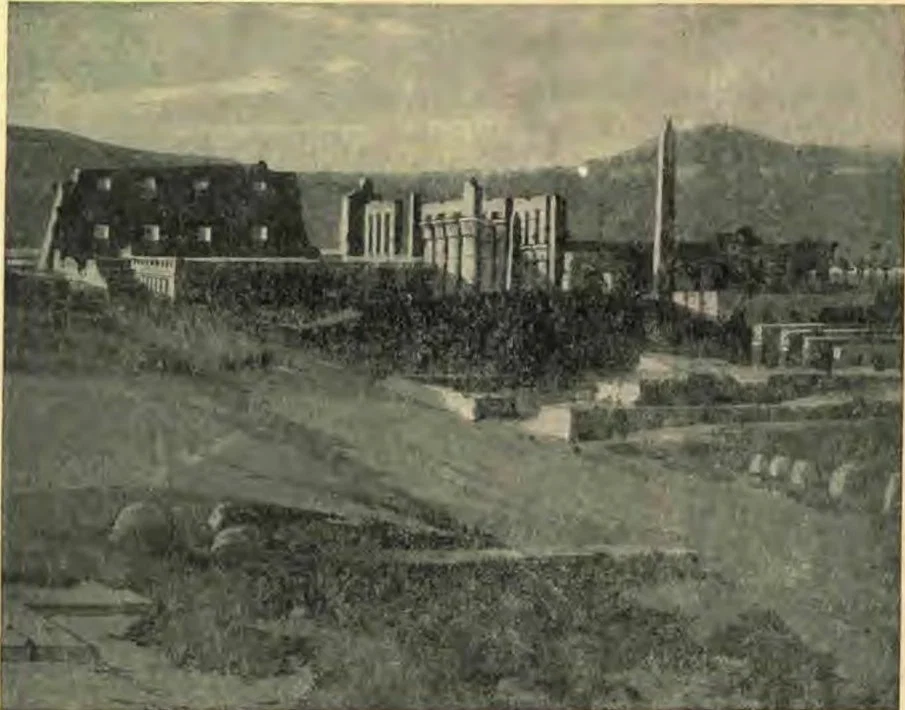
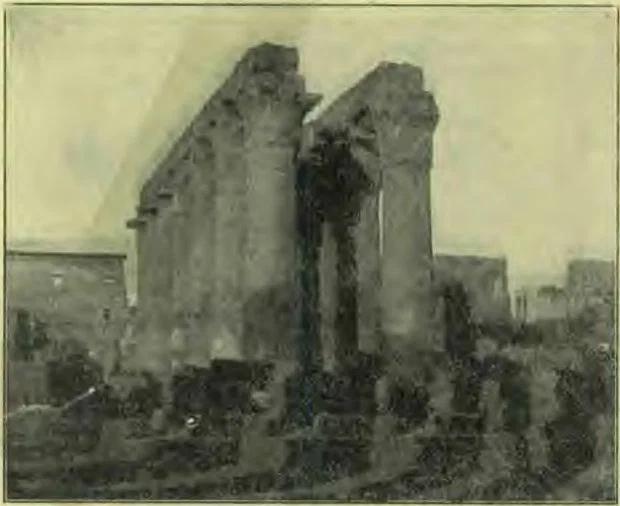
Karnac is near Thebes. It stands for immensity in structural lines; for the ruins of the great temple that once gave the city its glory present a stupendous building feat. One man rode for twenty minutes at full gallop to compass the temple site, which covers ten acres. The temple was built by successive monarchs, in the twelfth dynasty, the Hall of Columns, the most impressive part of the temple, being built by Seti I, a builder second to none but his son, Rameses II. His creations were not so enduring as those of some of the other kings, but they are accounted the most beautiful of Egyptian structures. It is said that “few art works are more perfectly preserved or fresher in color than the tinted reliefs upon the walls of Seti’s temple at Abydos, and yet these shapes were fashioned, these colors were applied, more than three thousand years ago.”
The Hall of Columns in the temple at Karnac is supported by more than one hundred massive stone pillars, pillars that are said to require six men with outstretched arms to reach around them. They are more than three thousand years old, and are the world’s hugest columns, being twelve feet thick and sixty-nine feet high. They are “beautifully proportioned and lavishly ornamented.” This was a temple built to the sun god Ammon. The temples at Abydos, Dendera, and Edfu are rivals of Karnac.
Queen Hatasu is given credit for setting up two obelisks at Karnac, each consisting of a single stone 100 feet tall, and weighing 368 tons, or 736,000 pounds. She said that this task was accomplished in seven months from the time the stone was cut in the quarries. Six hundred years before the Christian era an Assyrian king carried to Nineveh two of these great obelisks from Thebes.
Cleopatra’s Needles, two obelisks which at first stood at Heliopolis, were moved by Rameses II to Alexandria. One of these now stands in London, and the other in Central Park, New York City.
In 1 Kings 14:25, 26, we read that Shishak, of Egypt, during Rehoboam’s reign, came against Jerusalem, and carried away the treasures of the temple and of the king’s house. Here on the walls of the temple at Karnac were found sculptured scenes which pictured Shishak “as striking down with an immense club some Syrian captives. Upon the shields at his side are recorded the names of one hundred fifty-six cities or districts of Judah and Israel, which he captured.”
The Long-Lost Hittites
The Bible critic of other centuries refused to believe in the existence of such a people as the Hittites, since no reference was made to them in any of the world’s records except the Bible. It, however, made early and frequent mention of them.
Abraham bought the cave of Machpelah from Ephron, the Hittite, who seemed to have emigrated to southern Palestine from the north; Esau married a Hittite woman; so did Solomon. The Hittites were one of the seven nations conquered by the Israelites in Palestine. They occupied eastern Asia Minor to the north and east of Palestine, and Charchemish on the Euphrates was at one time their capital city. They were contemporary with Abraham, David, and Solomon, and with Rameses II, and several preceding and succeeding Egyptian dynasties. From Egyptian and Babylonian tablets and monuments it is known that both of these nations had much to do with the Hittites, who were liberty loving, though for years they had to pay heavy tribute to these nations as their conquerors. When the Hittites suffered subjugation, they sought for a favorable opportunity to break the bands of the conqueror, and they usually found it, though years of bloody war alone sufficed to free them.8
TEMPLE RUINS, KARNAC, EGYPT
Egyptian art presents marvelous portraits of this once great people. The Tel-el-Amarna letters contain more than thirty references to the Hittites.
The archeologist has also found a large number of Hittite tablets and monuments containing inscriptions in their own language; but these have never been fully deciphered. What interesting stories these would tell if only a Hittite Rosetta stone could be found! But enough has been learned of this early people to establish definitely their existence in Asia Minor during Bible times.
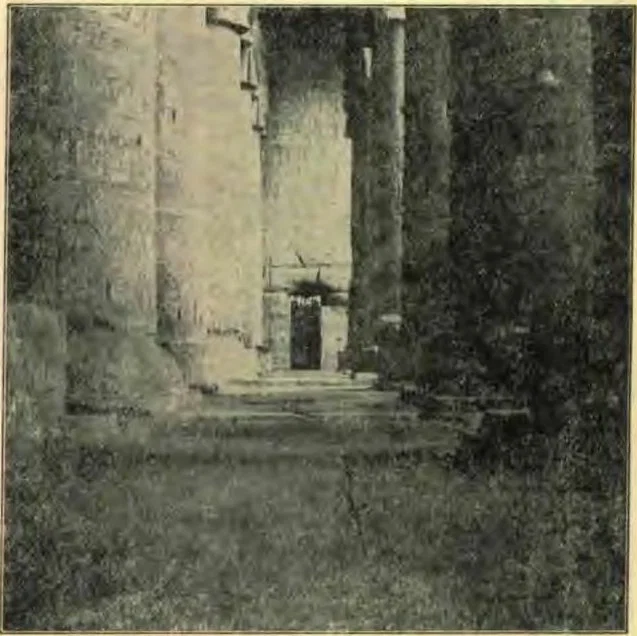
Vestibule of the Temple at Dendera, Egypt
The grandfather of Rameses II says that he was “the first of the Pharaohs who sought out the Hittites in the valley of Orontes.” Though the battle turned in favor of Rameses, the Hittite king so impressed the Egyptian ruler with his power that Rameses did not attempt to carry his arms farther, but entered into a treaty of peace and alliance. But this was later broken by one of the contracting parties, for the son of Rameses I also warred with the Hittites. An Egyptian sculpture describes the complete defeat of the Hittites, and the following song of praise was composed by Rameses I in commemoration of the victory:
“Pharaoh is a jackal which rushes leaping through the Hittite land; he is a grim lion which frequents the most hidden paths of all regions; he is a powerful bull with a pair of sharpened horns. He has struck down the Asiatics; he has thrown to the ground the Khita [the Hittites]; he has slain their princes.”
The Hittites were not satisfied with less than complete independence, so frequent rebellions kept up warfare between the two nations for more than a score of years. Finally, under Rameses II, after severe conflicts, a treaty of peace was proposed, accepted by both parties, and duly ratified. This document, written by the Hittite king, Hattusil, is a model of its kind, and is still in existence, though more than three thousand years old. It was engraved on a silver tablet, having on the back an image of the Hittite god of heaven, and consisted of about one thousand words written by the Hittite king himself. It reveals a high state of civilization among the natives of that remote period. This treaty was held sacred so long as these two kings lived, so friendly a relation having come to exist between them that Rameses II married a daughter of Hattusil. This ruler of the Hittites died before Rameses; so the Egyptian king and queen sent letters of sympathy to the widow of the deceased king.
Finally the power of the Hittites was broken by Assyria and Babylon. Nebuchadnezzar, in a recently found text, says:
“Chiefs of the land of the Hattim [Hittites], bordering on the Euphrates to the west, where by command of Nergal, my lord, I had destroyed their rule, were made to bring strong beams from the mountain of Lebanon to my city Babylon.”
The power of the Hittites continued to wane, until the race became extinct, and their name even lost to the world, except for the Bible. We are indebted to the spade, the archeologist’s symbol, for all our knowledge which supplements and establishes the Biblical record of this once powerful people. F. D. C.
Double Colonnade at Luxor, Egypt
Literary Prescriptions
FOR clearness, read Macaulay.
For logic, read Burke and Bacon.
For conciseness, read Bacon and Pope.
For sublimity of conception, read Milton.
Sayings of Our Lord, Written on Recently Discovered Papyrus
For imagination, read Shakespeare and Job.
For common sense, read Benjamin Franklin.
For elegance, read Vergil, Milton, and Arnold.
For simplicity, read Burns, Whittier, and Bunyan.
For smoothness, read Addison and Hawthorne.
For lofty, ennobling sentiment, for sympathy, candor, and honesty, for comfort and consolation in affliction, and for the promise of the life that now is and of the life which is to come, read the Bible.—The Religious Telescope.
Star Dust
GOD is always on the other end of the wire; take down the receiver.
When the lamp of faith was burning low, and the sense of God was distant from the soul, John Milton, the torch bearer of his generation, would walk out into the night, look starward, and dream of immortality.
When nerve energy is low, guard and control your activities. When life is at its fullest, guard and control your desires.
Law becomes love when written in the heart.
The longest way to transformation is reformation.
The shortest way to reformation is regeneration.
When Christ says, “Take my yoke upon you,” he suggests teamwork—all at it, all together at it, always at it. The kingdom of God will not tarry if we conform to this universal law.
If you can make “doing good” fascinating and fun for folks, you have solved the problem of evil.
Prayer accomplishes more than plans, communion more than conquest, and supplication more than the sword.
The measure of a great man is the way in which he treats little men.
I should rather trust the destiny of my soul to the author of a snowflake than I should my gold in trust of the strongest government.
It takes time and eternity to learn two lessons: love to God and love to man.—George E. Mayer.
Appropriate Graduation Gowns for Prospective Missionaries
By Bessie Mount
The time of graduation is long looked forward to by the student, with intense interest and satisfaction. It is the climax of the student career, representing years of patient study and persevering effort. It marks the completion of formal training in the confines of school, and the entrance into the great outside world, there to battle with the problems of life. It is but natural, therefore, that this time should be regarded as an important event in the student’s life.
In many schools of the world today, this event is made a time of elaborate exercises, and of lavish display and extravagance, especially in the matter of dress. Far different from this should be the standard in our schools, intrusted with the training of young people for the great work of carrying the last gospel message to the world. The exercises should be simple and dignified, and the dress of the graduates in harmony therewith.
The Bible plainly teaches modesty and simplicity in dress. God desires that his representatives “adorn themselves in modest apparel.” 1 Tim. 2:9. Far more precious in his sight than the “outward adorning of plaiting the hair, and of wearing of gold, or of putting on of apparel,” is the inward adorning of a pure, consecrated heart, “even the ornament of a meek and quiet spirit, which is in the sight of God of great price.” 1 Peter 3:3, 4.
The young woman whose heart has been cleansed by the precious blood of Christ, and who is preparing for his service, will have her mind occupied with vastly higher themes than adorning herself with showy, costly apparel and profuse ornamentation. Her first desire is to please her Master. She will not wish to deny him by worldly apparel, but in this, as in all other matters, to follow his example of simplicity and humility. To her, graduation will be a sacred time, because of the holy work to which she is looking forward. Humility, not display, should characterize her dress at this time, in keeping with the dignity and solemnity of the occasion—the setting apart of young lives for the Master’s use.
Let the words of Christ be taken as a guide: “Consider the lilies of the field: . . . I say unto you, That even Solomon in all his glory was not arrayed like one of these.” Matt. 6:28, 29. Surely the lily in its purity and simplicity is a fitting model for one whose life is dedicated to the service of God. Nothing could be more appropriate for the graduation garb than the gown of pure white, neatly but simply made, without costly or showy decoration—typical of purity of life and character. Thus gowned, the Christian young woman will appear natural and at ease, personifying the grace, simplicity, and purity which heaven values most.
Although the dress should be of good and durable quality, and of such material that it will be of service afterward, it should not be extravagant in cost. Money is a trust from God, to be used in his service, not in following worldly fashions in order to gratify self. The young woman who expects to give her life to God’s service, will not lavish on self the means that should be used in giving the gospel to earth’s needy millions. By the practice of economy and self-denial she will seek to fit herself for a life of self-sacrificing service.
Cannot our young people, to whom is committed the great work of giving the third angel’s message to the world in this generation, be original enough, independent enough, and, above all, Christlike enough, to follow the leading of God, and not the dictates of the world, in this matter? BESSIE MOUNT.
Graduation Gowns
By F. D. C.
A YOUNG girl recently asked the Washington Herald to name a good material for a graduation gown for a high school girl. Miss Virginia Lee answered the question as follows:
“The present tendency of the graduation frock is toward extreme simplicity. This is a reaction from the overelaboration of former years which too often led to foolish rivalry. The girls who are to be graduated from Central High School, Washington, D. C., this year have adopted an inexpensive uniform dress which will be useful all summer for sports wear. If your class is not willing to follow this excellent precedent, and you decide upon a frock of daintier texture, you will find organdie a popular fabric this season. Other good selections are voile, batiste, and dotted Swiss.”
Surely if extreme simplicity in dress is the tendency of the present style, let us as Christians, as prospective missionaries, follow the style.
This is one time when it would be worse than folly to be out of style. F. D. C.
Ten Commandments for Girls
The following “ten commandments” were recently given out by Rev. A. W. Williver, pastor of a Jersey City, New Jersey, church:
Thou shalt not delude thy mother.
Thou shalt not surrender thy modesty for the favor of unprincipled men.
Thou shalt not run wild and fall into the whirlpool of fashion and plunge thy family folk into the hopper of the nerve-grinding mill.
Thou shalt not allow the limber tongue of the flatterer to bewilder thy head and master thy strength.
Thou shalt not tattle.
Thou shalt not let frivolity of speech or manner unclothe thee of thy attractiveness and personal charm.
Thou shalt not think more of the clothing of thy feet than the culture of thy head.
Thou shalt not smoke; thou shalt not tamper with the liquor cup.
Thou shalt not be slothful while others in the home toil.
Thou shalt find real happiness in truthfulness, hopefulness, joyfulness, peacefulness, and in serving others in the spirit of the Great Master.
Hardly “the Correct Thing”
They were entertaining the minister at dinner, according to the London Telegraph, and after dessert little Johnny said:
“Won’t you take another piece of pie?”
The minister laughed. “Well, Johnny,” he said, “since you are so polite, I will have another.”
“Good!” said Johnny. “Now, ma, remember your promise. You said if it was necessary to cut into the second pie I could have another piece!”—Youth’s Companion.