Your ShelfYour Projects

Review and Herald, Vol. 82, No. 2.

Publishers' Page
Earlier text: The Support of Our Mission Work

Great Danger

T. E. BOWEN
WHEN passing along the street, did you ever see red lights ahead of you? What were they there for?—O, to warn you of danger. Some excavation had been made, and the workmen, on leaving the night before, had carefully posted danger-signals, that no one should be harmed.
Along the Christian pathway are signal lights set. The traveler will do well to heed them carefully.
Just before the end we are told that some will be putting off the day of the Lord too far. Befogged with the cares of this life, they lose their reckoning, and count on years that never will come.
In our “Duty in View of the Time of Trouble,” in “Early Writings,” pages 48, 49, are these words: “The Lord has shown me the danger of letting our minds be filled with worldly thoughts and cares. I saw that some minds are led away from present truth and a love of the holy Bible, by reading other exciting books; others are filled with perplexity and care for what they shall eat, drink, and wear. Some are looking too far off for the coming of the Lord. Time has continued a few years longer than they expected, therefore they think it may continue a few years more, and in this way their minds are being led from present truth, out after the world. In these things I saw great danger; for if the mind is filled with other things, present truth is shut out, and there is no place in our foreheads for the seal of the living God.”
It matters not to the enemy what it is that eclipses present truth in the minds of the remnant, whether it be a fine house, farms, merchandise, housework, studies, story-books, just anything,—things in and of themselves proper when used aright. The danger lies in letting our minds become so filled with these things as to shut out present truth. And if present truth is shut out, there will be found no place for the seal of God.
The great danger is (and if ever that danger has been, it is now) that the ‘brethren’—that class who are not in darkness—will reason like this: “We expected the end to have come before now, and possibly it is not quite so near, even now, as we have been wont to think, so we will invest in this enterprise and that, and try to make some money.” It is very possible that day will come upon such unawares.
My brother, beware! Take heed to the words of thy Master, and ‘watch.’ Somebody who professes now to love this present truth will be heard to say, with mourning: “The cause was languishing, God’s people were starving for the truth, and we made no effort to supply the lack; now our property is useless. O that we had let it go, and laid up treasure in heaven.”
If all humbly seek God for guidance, he will so direct each one in all his business enterprises that none need be deceived by losing sight of present truth.

The Guest of Every Day

HOMELY work is mine to-day,— Floors to sweep, and fires to lay, Plates to wash, and clothes to mend,— Work which never seems to end; Yet I pray, Jesus, be my Guest to-day.
Not as One to dwell apart In the spare room of my heart, But as One to whom my prayer May confide the smallest care, Thus I pray, Lord, be thou my Guest to-day!
He reproves me if I fret Over work unfinished yet, Checks me if I make a task Of some work he does not ask; My dear Guest Wishes me to work and rest.
At the closing of the day, When once more my heart shall say, In this busy life of mine: “All the glory, Lord, is thine! Christ, I pray, Be the Guest of every day!” —Selected.

The Free Use of Sugar

G. H. HEALD, M. D.
“The free use of sugar in any form tends to clog the system, and is not unfrequently a cause of disease.”—E. G. W.
PRACTICALLY all the heat and energy of the body is developed from the oxidation, or burning, of a form of sugar. This form of sugar is found in ripe fruits and in honey. It is produced from starch and from other forms of sugar by the processes of digestion; and may be produced artificially from starch, though in the artificial process the work is usually incomplete. By the process of heating with a dilute mineral acid, starch is turned into commercial glucose, a mixture of dextrose (sugar ready for absorption into the blood), maltose or malt sugar, and dextrin. Digestion must finish the process of converting the maltose and dextrin into dextrose.
By the process of malting, starch is largely converted into maltose, which must be converted by the digestive ferments into dextrose.
Cane-sugar, in order to be absorbed, must first be converted into a simpler form, but in this case two sugars are formed, dextrose and levulose.
Levulose, or fruit sugar, is generally believed to be superior to dextrose, for the reason that diabetic patients can use levulose when dextrose would produce unfavorable results. For this reason it would seem that cane-sugar might be somewhat superior to malt sugar. It has the disadvantage, however, that in concentration it is more irritant to the stomach than other forms of sugar. But in the process of canning fruit, or of heating sugar with a fruit acid, the cane-sugar is partly turned to dextrose and levulose.
This mixture, known as “invert sugar,” is less irritant to the stomach than cane-sugar, and it is not so sweet; but its food value is as great as the cane-sugar, and it is ready for immediate absorption, being practically the same as the fruit sugar.
As a rule, the cane-sugar is not completely converted into invert sugar in the cooking or canning process.
Why, it may be asked, is it, if sugar is the great fuel supply of the body, that its free use is harmful? Why would it not be better to use sugar than starch, and save a lot of digestive energy?
There are several important reasons:—
1. Sugar in concentration is an irritant. Though nature furnishes sugar ready made, it nearly always does so in diluted form.
2. Sugar in concentration may be absorbed more rapidly than the liver can take care of it. When starch is eaten, the process of digestion is slow enough to permit the liver to take care of it.
3. Sugar in large quantity favors fermentation.
4. The use of sugar nearly always leads to excessive eating; for when food is sweetened, more is apt to be eaten, when, by rights, less ought to be eaten, as the sugar is itself a food.
5. Desserts are nearly always eaten after a full meal, and nine times out of ten are an out-and-out injury.
Cane-sugar is more often used than other sugars for this purpose. In concentration it is more irritant than other sugars, but aside from this it remains to be proved that cane-sugar is more harmful than other sugars.
In the language at the head of this article, which to me seems significant and well chosen, “The free use of sugar in any form tends to clog the system, and is not infrequently a cause of disease.”

Training That Crushes Individuality

Dog trainers tell us that they get their best results by training a dog to do a thing because he wants to do it; that is, they give him a motive for doing it, until he does it spontaneously, without being forced. A noted trainer says: “My dogs work for me more because they want to please me than because they are afraid of a whipping if they don’t obey. If, before a dog comes to me, he has been bullied for every little failure, it is next to impossible to make anything of him.”
If an animal trainer can not get the best results by forcing an animal to do a thing against its will, how can a parent or teacher expect to get the best results from a child by the employment of fear or force? A normal boy and girl, if properly trained, will not need to be forced to do things. A young mind longs for activity and expression, but if spontaneity is crushed out of the life by slave-driving methods, ambition may be ruined, and the natural power of self-expression entirely destroyed. Many sensitive children have been ruined by being nagged and bullied for every little fault. Their natures became warped and twisted by being compelled to do things, instead of being so led that they were not only willing, but also anxious to do them.
Just as a dog trainer, by proper training, gets the best results from a highly organized, intelligent dog, but finds that the animal is all the more easily spoiled because of his very intelligence and sensitive organization; so finely organized, sensitive children, while capable of the highest degree of development, are on that very account more likely to be ruined by harsh, compulsory methods.
Spontaneity is absolutely necessary to originality, and unless a child is allowed to develop along the lines nature has marked out for him, it is impossible for him to be original and to preserve his individuality.
Parents should stop and think when a child does not show enthusiasm in his studies or in his work. There is something wrong; for enthusiasm is as natural to child life as song is to a bobolink, or as play is to a young puppy.
Encouragement, praise, and sympathy will do more to develop naturalness and self-expression in a boy or girl than any amount of threats, compulsion, or restraint.
Some parents try to fit a boy to a certain pattern, and to mold him into such a shape as they desire. They leave no room for the expression of his individuality, but try to conform him to some fixed and old-fashioned idea of their own.
The way to develop a child properly is to study him from the standpoint of what he is, not of what you think he ought to be. He may not at all fit into your conception of what a boy should be, but he may be much better and larger in every way. Find out what is in him, and help to draw it out. Encourage him every time he does well, lead him to free, untrammeled development of all that is best in him, and you will find the result will be far more satisfactory than if you had tried to cast him in your particular mold.—Success.

Individuality in Christianity

CHRISTIANITY shows us individuality in its highest form.

“Her Husband Also, and He Praiseth Her”

ONE OF THEM

THE words at the head of this article are found in the Bible, and refer to what the true husband says about his faithful wife. The children also catch the spirit. “Her children arise up, and call her blessed; her husband also, and he praiseth her.” Prov. 31:28.
What a beautiful description of the true home is found in this last chapter of Proverbs. It ought often to be read by every member of the family. The virtuous wife and mother seems to be the central figure in the home. She is industrious. She interests herself in all that is of interest to her loved ones. She becomes a safe counselor both for her husband and for the children. “The heart of her husband doth safely trust in her, so that he shall have no need of spoil. She will do him good and not evil all the days of her life.” This settles at one stroke the pocketbook question. There is no spoil of the family. “The heart of her husband doth safely trust in her.”
Because of these admirable sterling qualities, praise is her due; and the true husband—not so silly as to be filled with petty jealousies—will be first in speaking to her praise. Is this a sign of weakness on his part?—Far from it; it is a sign of nobility of soul. It is true manliness, and every time such heart-felt commendation is given her, he is helped in becoming a better man, a better husband.
How often we see, instead of the manifestation of this noble spirit, a spirit of nagging at little offenses, until the spirit is well-nigh crushed, and life becomes a drudgery, whereas it might be a round of real pleasure, all for the lack of a little commendation and praise.
Praise and flattery are two very distinct and separate terms. Praise is simply the acknowledgment on the part of others of real merit and worth. Flattery passes real merit, and seeks to make those flattered think they are of real worth when they are not.
Appreciation brings out the best qualities. Under censure they are dwarfed. For fear of making some mistake, the wife or children refrain from doing many things they otherwise would, consequently the result is sure to follow—a withering of the powers through lack of exercise.
If you appreciate the one who is seeking to do you good, tell her so. Her casket covered with costly garlands can not atone for their omission now.
Husbands, fathers, when things seem to go wrong, and you hardly know what to do or say, try a little praise, and see what that will do. It works well. Try it.

A Word to Youth

SHAKE off your listless, shuffling ways, boys; gather up your God-implanted energies, and set about making all there is to be made of yourselves. Now is your springtime—your budding, growing, improving time; make the most of it, and fill each day to the very brim with sturdy activity and manly action. Throw back your shoulders; straighten up; look with a keen, straight glance out upon the great work field of the world, and see what it can teach you. The world has little need of you as yet, but you have great need of the world. It is full of experiences, and object-lessons, and hints, and suggestions, for the days coming to you. Use your tongues little, but your eyes constantly. If young people would only use well their keen, quick eyes, and be governed by what they see, they would be spared many a tumble into pitfalls that those in advance are just drawing themselves away from.—Selected.

_The Art of “Mothering”_

“How’s your mother, Carrie?” asked a friend of a twelve-year-old city girl whose mother was a well-known worker in various organizations for social betterment.
“I haven’t seen mother for ten days,” replied Carrie. “She isn’t up when I go to school, and she doesn’t come home till after I’m in bed at night; but I guess she’s all right.”
Evidently there is something wrong in that household. Miss McCracken, in her recent article on “The Woman on the Farm,” puts her finger on the evil. She points out an important advantage which the country child has over the city child. Schools may not be so long or so good in the country, and opportunities for books and music and pictures may be few and far between. But mothers in the country are mothers indeed.
“You see,” says the little girl from the farm, “I’ve seen my mother almost the whole time ever since I was born. I almost always could do everything that she did, and go everywhere she went. It was so unusual when I couldn’t that I always heard afterward every word about what happened. Now, my cousin, who lives in the city, doesn’t do that way with her mother. They couldn’t! Her mother goes to too many places and does too many things that, she says, aren’t for children, and it takes her so much time to do them that she wouldn’t have time to tell about them, even if her daughter wanted to hear, which she doesn’t much.”
There is the problem sharply stated. Its solution is not so easy; but it is certain that there is no public service which a woman can render so vitally important to the future of the race as just this very “mothering.” Only in the sort of love which penetrates the whole life of the family, and makes it sweet and sound and loyal, can be found the remedy for the social and domestic unrest which is more dangerous to our country than foreign fleets or political dissensions.—Youth’s Companion.

God Hath Not Promised

“God hath not promised Skies ever blue, Flower-strewn pathways, Always for you. God hath not promised Sun without rain, Joy without sorrow, Peace without pain. But God hath promised Strength from above, Unfailing sympathy, Undying love.”

When Are Bananas Ripe?

THIS subject gains great importance in view of the enormous consumption of this tropical fruit in the United States.
In their native countries bananas are seldom eaten before the skin is discolored, and the pulp of so soft a consistence that it can be scooped out with a spoon. Under the artificial conditions in which they are placed in these climes, they undergo somewhat rapid changes, and the times at which they are best suited for consumption may be short and difficult to predict with any degree of precision. Authorities, however, claim that they are habitually eaten here before they have reached their most suitable stage. Before they are thoroughly matured, moreover, they are apt to be insipid in flavor, and to cause dyspepsia and other forms of intestinal disturbance. They should not be eaten before the skin is blackened in places, or when there is any reluctance in the skin to separate from the pulp.
Housekeepers know how bananas will change in the course of a single night from a manifestly sound condition to one in which the skin is blackened and the pulp soft and slightly discolored. Now, children infinitely prefer these last bananas to those that are apparently sounder, although their elders may hesitate to gratify their taste in this respect from a fear as to the wholesomeness of such fruit. Attacks of gastric or intestinal disturbance from the use of unsound bananas are far from common, and it may well be that in this instance the natural inclination of the child covers more wisdom than the caution of its elders; in fact, experts say that the banana, like the medlar, can hardly be in too ripe a condition for eating. With the rapid changes the fruit undergoes, it is hardly surprising that cases of friction between the sanitary authorities and the vendors should be of frequent occurrence as regards the fitness of the fruit for sale or consumption. . . . It would seem to us that in many such cases the importers and retail dealers have a possible grievance, and their contention that sanitary inspectors require a more thorough knowledge of the different phases bananas undergo is a valid one. The general public, too, would seem to need convincing that at present they habitually eat their bananas in far too hard and immature a condition.—British Medical Journal.

Malaysia

R. W. MUNSON
Some people have an idea that this is a howling wilderness, but no greater mistake has been made. It is a well-organized and well-governed country.
The astronomers who came here two years ago to witness the sun eclipse, brought with them from America tents, cooking utensils, food, and all the paraphernalia necessary to campers in a wilderness. Their astonishment when they arrived here and found well-equipped and well-managed hotels, perfectly appointed houses, and an up-to-date society, can be imagined. They found also a well-equipped railway, which transported them and their instruments to the town in the interior where they intended to make their observations.
I speak of these things to show what erroneous ideas foreigners have of this old colony of the Dutch. For centuries they have been employing and ruling this land, greatly to its advantage in many ways, and life is just as secure here as in the lands of the West, and in many ways more comfortable.
You will be interested to know something about the climate and its peculiarities. In the mid-tropics it is, of course, warm from January to December, with varying degrees of heat and rain. It is a humid climate, and in some parts the rainfall is excessive, while in others it is light. In one island there will be distinct hot and wet seasons, while in another these different seasons are not very pronounced. The farther one goes from the line, either north or south, the more noticeable are the rainy and dry, or hot seasons.
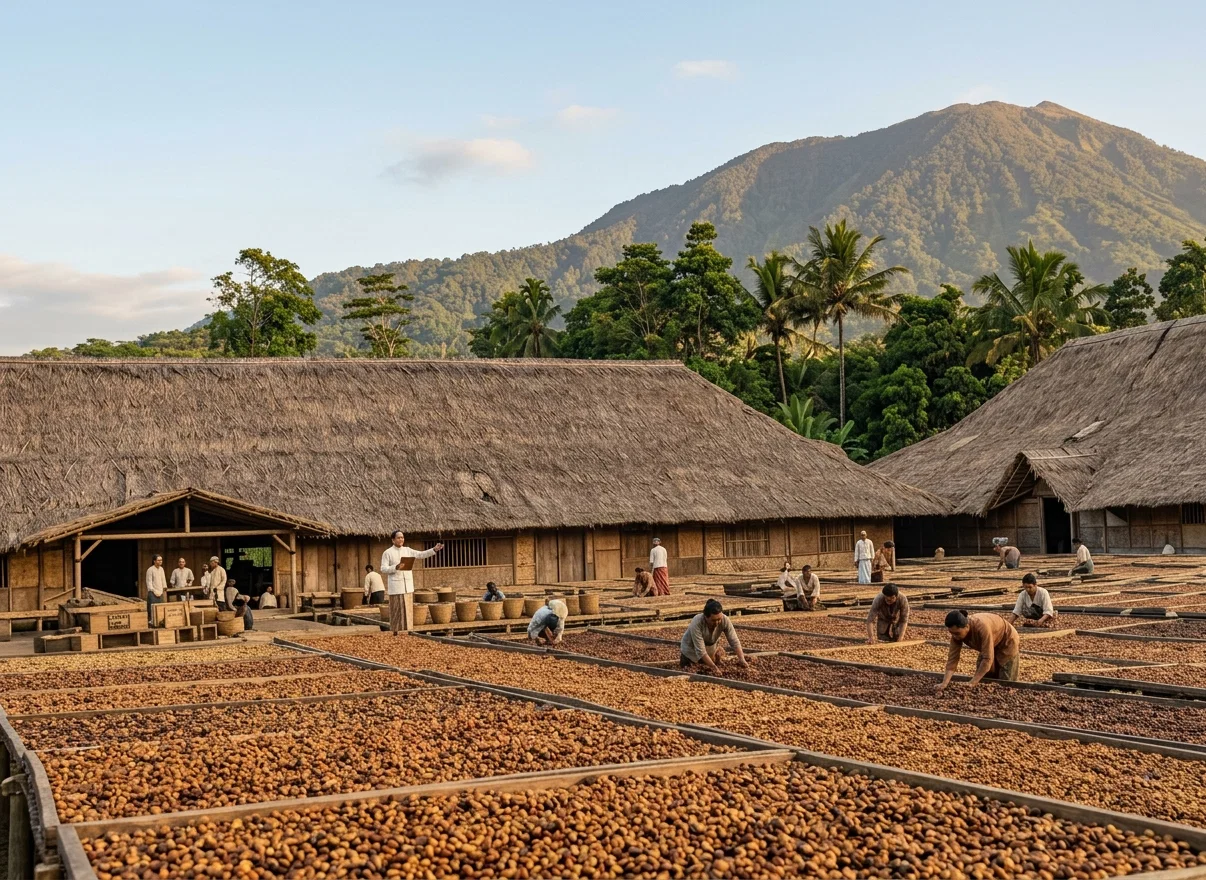
(COFFEE DRYING, JAVA
Here in Padang the rainfall is very heavy, taking the whole year together. Because of this heavy rainfall the climate is the coolest and most enjoyable of any seacoast town in the Indies. A wide plain, composed, particularly along the sea, of sand, forms a great filter bed from which we get the finest water in the world. It is as clear as crystal and absolutely tasteless, as good water always is. Malaria is rarely met with, the nights are cool, and the air pure and fresh, coming, as it does, from either the mountains or the sea. For those who require a cooler atmosphere a few hours' ride on the railway will bring them to Fort de Kock, which is three thousand feet above the sea-level. The mean temperature of Padang approximates eighty degrees Fahrenheit. In some places it is a little higher, but I think nowhere will it exceed eighty-two or eighty-three. The days are warm, and the nights cool. Here in Padang we always sleep under a woolen blanket the greater part of the night. During the rainy months, we have to dress and sleep much as we would in America in the cold season.
The dwellings are all built for the heat, having wide verandas, extending eaves, large windows and doors, and plenty of shade. In this part of the country the houses are built of planks, and have palm-leaf thatch, although many have corrugated iron roofs. The bath is a most important and essential feature of the daily routine, and a most delightful one it is. The bath room is a separate building, near the well as a rule, and supplied with a cement floor, and a large tank that will hold from one hundred to five hundred gallons. This tank is kept filled by a servant, one of whose duties it is to either pump or bail the tank full every day. Here the bather stands and pours the water over his body with a large bath cup, and by the application of soap and water, or water alone, as need requires, he is able to obtain both pleasure and profit at slight expense of either time or money. I have tried many ways of bathing, but none of them compare with that in vogue here in the tropics.
Of course in such a climate, fires are required only for cooking the food. This work is done in a separate building upon a raised platform of bricks and mortar, with openings in the ledge for pots and kettles, supported upon iron cross-bars. The smoke finds its way out of the top of the ventilators made in the roof for the purpose of letting out the smoke and the odors from the cooking food.
The races of the archipelago are all Malayan, but each possesses a type of its own. The Malays proper inhabit the Malay peninsula, the greater part of Sumatra, the northern coast of Java, and the western and northern coasts of Borneo. In north Sumatra are found the Battaks; in the island of Nias the race which gives its name to the island; in Java the Javanese; in Borneo the Dyaks; in the Celebes the Bougis (pronounced Bougeez); in the lesser islands to the west varying types resembling in general, the Malay. The Filipino differs in no important particular from the prevailing type. In New Guinea the Papuan races begin to show themselves, and they present a marked contrast to the Malay character.
The Malay is short and stocky, with straight hair, flat features, and broad, flat nose. The Papuan is tall and rather lank, with long crinkly hair that stands straight out from the scalp, forming a head which, in its full outline, is entirely out of proportion with the rest of the body, suggesting to the mind the ball of thistle-down, which is so familiar to Western eyes.
Just as they are in complete contrast to each other in physique, so are they in natures. The Malay is reticent, undemonstrative, and self-contained, while the Papuan manifests the effervescence of character that is peculiar to negro races. What would call forth no manifestation of emotion from the Malay would throw the Papuan into the most violent expression of merriment or grief. The Malayan uses his powers of speech to hide his real thoughts, while the Papuan tells all he knows.
Although these two types, found in the same latitude and within the same region, differ so widely in many ways, yet they are strikingly alike in one respect. They are both sinners; they are both selfish, as sinners always are; and they are both sadly in need of the gospel of Jesus Christ. The tokens of Satan’s power over them are abundantly evident. They are both alike susceptible to kindness, and are capable of loving those who love them. Both alike are within the range of the gospel, and both have yielded to the power of the truth. Christ died for both, and his command, “Go ye into all the world, and preach the gospel to every creature,” includes both these races; therefore I trust that all who read these words will remember that they too have a responsibility to discharge to these unfortunate people in this highly favored land.
Although the Malay is quiet, he becomes, under certain circumstances, a perfect fiend incarnate, and then he “runs amuck,” killing indiscriminately all who come in his way. It is a form of madness apparently, in which despair is usually the operating cause.
Besides the Malays and Papuans, there are many negritos in the archipelago. They are unlike the Papuans, and their origin is a mystery. They number twenty-five thousand, more or less. They are dwarfs in stature, thin, spindle legged, and have a head like a negro’s, with flattish nose, full lips, and thick frizzly black hair. They are a low type of humanity, but are far superior to the dominant races in one important particular, and that is sexual morality. They are monogamists, allow no divorce, and inflict severe penalties for unfaithfulness.
Many Chinese have long found this fertile region a rich pasturage for their energy and frugality. There are two classes of Chinamen,—the babas and the pure-blooded Mongolians. The former are a mixture of Chinese and Malay blood, and they all speak Malay as their mother tongue.
Not a few Tamils, or “Klings,” as they are locally termed, Japanese, Arabs, and even a few Turks and Asiatic Jews must be added to complete the list.
Of course the European is taken for granted; for he is the ruling power here. It is his genius and ability that have developed the trade and industries of the entire region. Whatever his vices, and however bad his influence in the realm of morals, it is due to him that we can preach the gospel in security here. The absence of cannibalism, family and tribal feuds, and savage warfare testify, to some extent at least, to the spiritual character of the missionaries’ labors.
There is much more that might be said, and we hope to give further information concerning this important region at some other time.
Padang, Sumatra.

Growth of the China Inland Mission

THE China Inland Mission had, on Jan. 1, 1904, in 199 stations in China, 743 missionaries, men and women, besides fifteen still engaged in study, and twenty-five engaged in home work, or not yet assigned to stations. Four hundred and sixty-five of its missionaries are women. The receipts of the society for 1903 were $225,458.30. It reports the number of conversions in its stations in China in 1903 at 1,700. Ten years ago the annual number of conversions was about 700. Comparison of the two figures suggests that the powers of evil prepared the way of the kingdom when they sought to barricade it by that terrible outburst of 1900.

An Appeal for the Seamen

J. CHRISTIANSEN
Whether we acknowledge it or not, the advancement of science during the past century is only an echo from the bell of liberty and progress that started to ring in the United States a century and a quarter ago. In the United States prophecy was fulfilled. But just as we have the United States to thank for the religious and civil liberty that now blesses the world, so we have that country to thank for the third angel’s message. From there it is to go to all the nations, kindreds, tongues, and peoples. Does not this also include the millions of seamen, carrying the world’s commerce on the mighty deep? A long time ago I read from Sister White’s pen that we have paid too little attention to the sea-faring people.
THE BOAT "HEROLD".
THE BOAT "HEROLD".
I am an interested and careful reader of the REVIEW AND HERALD, and notice especially how the several conferences are planning for the advancement of the cause in the different parts of the earth. I see with gladness the great plans and willing responses of our American brethren. I read how Elder Daniells and others stirred the camps in various places, and how the brethren in several of the States responded to the Macedonian call. But why is it that the sea-faring men are never considered?
Our workers sometimes speak of their experiences by sea—the high waves, the stormy weather, and the thankfulness with which they again set foot on terra firma. Perhaps they may have seen or heard the captain; but did they think of those who kept the ship in motion? Do they ever see those coming up from below, all covered with coal dust, or the others busily at work here and there in different parts of the ship? In passing a sailing vessel, do they think of the seamen there?—It would seem not. I am tempted to think of Mark 7:27 in this connection. But some would say, “This neglect is not intentional; it is only thoughtlessness.” Has the Lord forgotten?—O, no! And neither has Satan. He takes great interest in the sailors, and his agents are wide-awake in their calling.
I know from experience that sailors never lack opportunities tending toward destruction. But our people are as silent as if such a class of human beings had no existence, and did not belong to those who have a part in the plan of salvation. If one here and there accepts the truth, he turns his back on his former associates; for he could hardly do otherwise if he desired to.
So far as I know, the boat “Herold” is the only one of its kind in Europe, and how long it will be running is a question. Oresund, between Denmark and Sweden, is the most important place in the world for a mission boat, and for seven years I have been laboring to get one for that place, but thus far it has been of no avail. It is interesting to stand on the shore and see a large fleet of ships get under way, but who asks if these ships have any of our literature aboard? My heart bleeds to think of this. Are we to be silent forever about this? Then why do we read in Rev. 14:6, “to every nation, and kindred, and tongue, and people”? Where do we find them more frequently than on the ships that traverse the sea? Why do we read in Rev. 14:9, “If any man worship the beast,” and in Rev. 17:2, “and the inhabitants of the earth have been made drunk”? Does this not include sailors? In Rev. 12:12 I read, “Woe to the inhabitants of the earth and of the sea! for the devil is come down unto you.” We certainly have much to do on land. But remember that among the seamen are those as dear to our Saviour as any on land. These are included among those he came to save. Through the missionary boats we gain access to these. Our literature is always welcome. A boat in Oresund would be a great help. Donations for this boat can be sent to the treasurer of the General Conference, 222 North Capitol St., Washington, D. C.
Hamburg, Germany.

Christianity’s Growth in Uganda

Less than thirty years ago (1875) Stanley gave King Mtesa, of Uganda, his first lesson in Christian doctrine. At that time there was not a Christian in all Central Africa. This year the London Times, in the regular course of its news, publishes an account of the consecration of the great Christian cathedral, built by the Uganda church, at Mengo, which was formerly King Mtesa's capital. Ten thousand native Christian Ugandans attended the consecration services.

Indiana

HARTFORD CITY.—I came to this place November 25, and began meetings the same evening. The Spirit of the Lord has been present, and his blessing has attended the work. Differences have been put away, and brotherly love has come in instead. Twenty persons have been added to the church, and several others are interested. People of other denominations have come in to worship with us, and a good influence has gone out from our meetings, prejudice being to a great extent removed. The church has been strengthened, and the brethren are all rejoicing in a new life and power. Pray for the success of the work at this place. U. S. ANDERSON.

Mississippi

WE do enjoy the visits of the REVIEW every week. It brings letters of encouragement from all parts of the field, and shows that the third angel's message is going to all the world, and soon the work will be done, Jesus will come, and we shall be gathered home. How careful we ought to be of our words, thoughts, and deeds!
The work in this great and needy State is onward. Three have begun to keep the Sabbath at Moselle. I expect to visit them during the week between Christmas and New-year's.
During the week of prayer I visited the little companies at Hattiesburg, Ellisville, and Laurel, and found them all of good courage. The Lord came near at each place, and we enjoyed the many blessings that he gave. At our last meeting with the few at Ellisville, we took up the annual offering. We are but few and poor, yet we gave with the earnest desire to see the truth go to every nation, kindred, tongue, and people, and thus hasten the glad day when Jesus will come. After the offering was taken, we all bowed down and consecrated the offering, ourselves, our children, and all that we have and are to the Lord's service. The Lord came very near, and we felt strengthened to press forward and work harder than ever before.
Our church-school is progressing well, and it does our hearts good to see the children take such an interest in the things of God. We are sure that the church-school was ordained of God, and that it will be the means of doing much good. We are thankful for the way the parents have co-operated with the teacher. God's hand is leading in this great and important branch of his cause. One little boy has been in the habit of blowing the bellows in the blacksmith shop for his father on the Sabbath; but since he began going to our school, he tells his father that he can not blow the bellows for him on that day because it is his Sabbath. He and his little sister come to Sabbath-school and prayer-meeting regularly. 'Except ye be converted, and become as little children, ye shall not enter into the kingdom of heaven.' God will use the children in these last days to proclaim his message. May the Lord's richest blessings be granted to parents and church-school teachers, for great responsibility rests upon them in training the lambs of the fold. Pray for the work and workers in this needy field. We are of good courage.
JAMES AND CARRIE BELLENGER.
Continue reading: The Work in Northeastern Jamaica