I AM now aboard the Italian steamer “Bulgaria,” on the Gulf of Corinth, returning home from a nine-days’ absence, in response to a Macedonian call across the border-line of Greece into Albania, within a short distance of Macedonia itself. The wind is furious, the waves are rolling high, the decks are drenched with spray, and our good ship is listing leeward as she plows on, undaunted by the stress of weather, toward the Corinthian Canal, Salamis Bay, and Piraeus, the port of Athens. I imagine that if I were Paul, and on the boat in which he sailed on the waters of the Mediterranean, I might have to assist in relieving the ship of part of its cargo. But this last message to the world is to go with speed, and to the uttermost parts of the earth. To facilitate its proclamation, the Lord has provided us with speedy and safe means of travel, for which we who have a share in proclaiming the message thank him every time we make a journey.
The place to which I went, however, being one of the more remote parts of Turkish territory, does not seem to have progressed beyond the days of Paul in the matter of travel, lodging, and roads. After reaching the Ionian coast by boat, I had to travel two days by horse to cover forty miles into the mountains of the interior, over some of the worst road that man or beast ever set foot upon, lodging in Turkish khans by the way, about as primitive and unkept in every feature of equipment and service as one’s imagination can picture.
Yet what one may suffer from these inconveniences and from poor food and exposure in midwinter on such a trip, seems nothing compared with the privilege of teaching the truth to hungry souls, and of seeing them receive it with joy. Several months ago a letter came to Athens addressed, in Greek, “To the Sabbath-keeping Missionary in Greece.” It first fell into the hands of a Millennial Dawn worker, who, through inquiry of the pastor of the Greek Protestant Church, whom I had met, was directed to me. It proved to be from the brother whom I have just visited, making request for some literature in Greek (the only language he knows) on the kingdom of Christ. Not having any literature yet ready in Greek, I set to work to prepare him some Bible readings on the second coming of Christ and the signs of the times, which I sent him, together with a letter of some length, explaining the leading points as well as I could with such command of the Greek as I had at that time. I did not hear from him for a long time, caused by sickness in his family, as I subsequently learned. Then came a letter, and afterward two cards, urging me to visit them, as he and his wife wished to learn more truth and to be baptized. Although I was very busy preparing manuscript for our first tracts in Greek, and although the season was very unfavorable for travel in a country where I had to ford six streams (the largest about ten rods in width) in going forty miles, yet it seemed to be a genuine Macedonian call, and might afford a foothold among the Greeks of Albania. So I went; and the results certainly justify the effort.
I found the brother and his wife already keeping the Sabbath, although they had never seen a Sabbath-keeper (except the Jews), and did not know that the Seventh-day Adventist denomination existed. They gained their knowledge of the Sabbath through the little tract, “Bible Facts on the Sabbath Question,” which a colporteur of the British and Foreign Bible Society had received from some of our people while in Constantinople. The colporteur did not care for the tract, but the Sabbath being mentioned in conversation with our brother one day, he spoke of having a Sabbath tract in his possession. By request he gave it to our brother, who made a careful study of it, resulting in his conviction that the seventh day is the only Scriptural Sabbath. He was then a member of a small Protestant company in Joannina, in southern Albania, where he formerly lived. The observance of the seventh day imposes so many social and business difficulties that he did not begin to keep the Sabbath for two years. But while on his way to work one Sabbath, he was so deeply impressed on the subject that he halted to consider, with the result that he returned home to observe his first Sabbath. His wife, also a Protestant, was strongly opposed, and for four years sought every means—by correspondence with every preacher or Bible student she could learn of, by her own study, and otherwise—to prove to her husband, and particularly to herself, that the seventh-day Sabbath is not binding. The more she tried, the more she became convinced that her case was hopeless, and finally submitted, having now kept the Sabbath for three years with her companion. She says that she did more than any one else to make it hard for her husband to follow his convictions.
But that he was not without other serious opposition is evident from the fact that he was publicly excommunicated from the Greek Catholic Church—not because he had become a Protestant several years before, but because he observed the Sabbath. The Catholic bishop called his flock together,—which usually means every Greek in the community, as there is no such thing in this country as a man without a religion,—and summoned our brother to appear before him. After urging him to renounce the Sabbath and return to the observance of Sunday, and after our brother’s refusal to do so, the bishop read the decree of excommunication.
The next step was to exclude our brother’s children from the Greek schools. With no school privileges at home, and no means to send his children away, what should he do? Later he learned of an Albanian school just across the border in Macedonia, founded by American missionaries, in which Albanian, Greek, and English are taught, and he investigated. His two oldest children (girls) were received with a very slight outlay on his part, and as the school is not in session on the Sabbath, he has kept them there for two years.
As I was approaching the village on my arrival, I was overtaken by a Turkish bey on horseback, who inquired in Greek whom I wished to see. On my giving our brother’s name, he said, “O, yes, the evangelist! I know him.” On walking with the brother on the streets of the village, I observed that any one wishing to call his attention, would say, “Hey! Sabbatarian, I want to speak to you.” His children are mocked at by other children on account of their religion, and on church festival days the people who pass by jeer at the family because they do not go to the church, buy candles, cross themselves, and kiss pictures, as the rest do.
None of these things shook the faith and courage of our brother and sister in the stand they had taken regarding the Sabbath. They learned the truth on the immortality of the soul and the state of the dead from the Millennial Dawn literature they had read, rejecting, however, the doctrine of a second probation, the end of the world in 1914, etc., which that literature teaches, as not being supported by the Scriptures, by which they carefully tested every doctrine that came to them. They learned baptism by immersion from the Protestant pastor (Presbyterian), who regards it as a Scriptural, but not the only acceptable, form of baptism. But by their own study they concluded that it is the only Scriptural, and therefore the only acceptable, mode.
On other points of truth they had only slight glimmerings. I found them so full of questions accumulated from their experience, and so eager to learn more truth, that the first night I was there we slept only four hours, the last only five. The days between were as full of Bible study and conversation on the truth as time and spiritual digestion would permit. The truth presented on the meaning of baptism, the proper observance of the Sabbath, the coming of Christ and signs of the times, the prophecies, the millennium, the judgment, the sanctuary, the saints’ inheritance, health reform, etc., were gratefully received and believed. They wished to be baptized at once, despite the fact that the ground was covered12with snow and ice all the time I was there.
Though very poor, they insisted on paying part of my expenses, and urged me to return to them at my earliest opportunity.
While there, our brother and I planned to make an itinerary, probably on foot, with a horse, mule, or donkey to carry our outfit, through the towns and villages of Albania, with literature, next summer, as we can work with less expense in warm weather. Meanwhile I shall push some tracts through the press, that we may have some good material to work with.
I now have ready for the press the four following tracts: “The Way to Christ,” “What Do These Things Mean?” “The Benefits of Bible Study,” and “Is Sunday the Sabbath?” I have also the first draft of manuscript ready on “The Second Coming of Christ,” “The Signs of the Times,” and “The Sure Word of Prophecy.” In addition to these I have translated the first few pages of “Steps to Christ,” and shall not rest in spirit until that heaven-sent treasure is printed in the Greek language. There is nothing better, outside of the Bible itself, to counteract the effect, upon the heart and life, of a religion that consists in lifeless forms and the payment of Peter’s pence.
Albania is beyond the boundary of geographical Greece, but our mission is to the Greeks wherever found, and this Macedonian call was so clear that I could not but respond. There are many Greeks in Albania (Epirus), and practically all the other races there—Albanians, Mussulmans, and Jews,—speak Greek as readily as their own tongue. Since in Greece proper the translation and distribution of the New Testament in modern Greek is forbidden, and proselyting prohibited by law, it may be a part of the Lord’s plan to start the more open work with literature, among the Greeks in humbler, more remote parts where there is not so much pride, skepticism, and worldliness as in and around the capital. It has been imperative that the preliminary work of studying the language, the views of the more enlightened, and the general conditions of government, society, and the church, be done in Athens, the center of learning. One need not go far from the capital to find the language much mixed with Turkish, Albanian, and Italian words, and the Greek element itself corrupted. There is no point on which intelligent Greeks are more sensitive than that of their language. Any printing not up to the standard is considered worthy of nothing but annihilation. We wish our work to command the respect of the people as far as lies in our power. Whatever the Lord’s plan may be, we feel clear in following the leadings of his providence as he opens the way.
The ways of the Lord are marvelous in our eyes. While the attention of our people was being directed toward Greece eight or nine years ago, when they made a seemingly futile effort to enter that country, the conscience of this Greek brother up in the mountains of Albania was being stirred on the Sabbath question. Now in our second effort to establish a work here, just as we are going to press with our first tracts in Greek, a worker is found ready to help distribute them.
I see no reason why our brother should not make a good worker. He and his wife are both Greeks, and natives of Albania. They know the ins and outs of the customs, religions, and general conditions prevailing there. He is a clear thinker, with no apparent tendencies to fanaticism—a not unusual trait among Orientals. He has stood a very thorough test of loyalty to conviction by keeping the Sabbath for four years alone, and together with his wife for three years more, before it was their privilege to see the face of a Seventh-day Adventist. He is on good terms with his neighbors, despite their ridicule, and has not been inactive in disseminating seeds of truth among them. We see in his case also that the truth has worked the same changes in the daily life as in so many others, in his discontinuing the use of tobacco, liquor, and card-playing.
Before closing, I ought to say that while at this brother’s, we made some visits in the village, and the last evening I was there, I had the privilege of giving a general talk in Greek to four Greek-speaking Jews. They manifested a deep interest as it was made clear that the time of Christ’s first coming is fixed in prophecy, and that the work and death of the Christ they have rejected fulfilled that prophecy to the letter. A further brief presentation of Christ’s present work in the heavenly sanctuary, the events attendant upon his second coming, the work of the one thousand years, and the final setting up of his everlasting kingdom in the earth made new, led them to urge me to stay longer and teach them more, but I could not at this time. The next morning a Greek neighbor who had been absent came in, and from the prophetic chart, which I had used in my talk to the Jews the evening before, I presented the truth to him until my guide called for me at the door. This neighbor accompanied me an hour on the way, while we continued our talk. Our brother accompanied me three hours on foot before he could turn back.
Thus from the very border-line of geographical Macedonia there comes the spiritual Macedonian cry for help. Even Macedonia, whence issued, in fulfilment of prophecy, the third world-conqueror in the series of four universal kingdoms,—Macedonia, out of whose depths the cry for help caught the ears of the great apostle to the Gentiles,—Macedonia, the scene of Ellen Stone’s heroic toils and deliverance from the hands of brigands,—Macedonia, one of the storm-centers of Balkan politics the past few years,—even Macedonia, already nourishing within her borders two Sabbath-keeping girls, must receive the light of this closing message. And may we not hope that before another twelve-month shall pass, the battle for truth may be pressed by earnest workers beyond the Albanian frontier into that historic Greek land?
I return home spiritually refreshed, with courage increased, and still more convinced that also among the Greeks, even in the fastnesses of the snow-capped mountains of Albania and of far-famed but agonizing Macedonia, there are some who will receive the truth with gladness. Pray for the work among the Greeks, and remember that our funds for producing literature in Greek are exceedingly small, and that the Lord expects you who have long lived in the blazing light of the gospel and in a country far surpassing in resources this poor, unfruitful land, to act a generous part in supporting the efforts made for these needy people.
Athens, Greece.
German East Africa
By Ludwig Richard Conradi
L. R. CONRADI
On the twenty-ninth of September, Brethren W. C. Ising, Awada Abd-Elshabeed, and George Keough, and the writer left Beirut, Syria, after our good general meeting at that place. Our steamer of the French Messenger line was so overcrowded with emigrants for North and South America that the only place left was on the deck. Most of these emigrants came from the Lebanon Mountains, whence hard times had driven them out to seek new homes. Our steamer being a direct one, we reached Port Said the next day; but we had to lie there in quarantine for four hours, till the physicians had examined the many hundreds of passengers. After hunting for some time, we were able to find the two sisters who were en route to Abyssinia, who had arrived on the German Lloyd steamer the day previous. We were very sorry indeed that Brother P. Lindegren had to be left behind sick, in Beirut. At that time we hoped that he would be well enough to come ere the steamer would leave on the tenth of October; but to provide for all contingencies, we arranged with Brother Ising to return from Cairo in time to see the sisters off. As Brother Lindegren was ill for months, the arrangement was providential. We are happy to report that the two sisters reached Massawa in safety, and that they were met by Brother Julius Persson.
October 2 the steamer “Admiral,” of the German East African line, came in sight, with our four missionaries on board. During our twelve days’ trip, we had daily Bible studies, and did some missionary work among the passengers. We also met the doctor of the International Sanitary Commission, who is stationed in Arabia. All the Mohammedans coming from the south have to pass the quarantine station there. Among the many interesting details given us, he informed us that no believer in Mohammedanism in all the East Indies was considered a true Mohammedan until he and his family had made a pilgrimage to Mecca. Many of the people will virtually sell themselves to their landlords for eight to ten years’ service, in order13to secure sufficient advances to make the pilgrimage. Not only will they face slavery, but very often these pilgrims are robbed, and they are in danger of losing their lives on the journey. We surely can be thankful to God that the time has come when we need to go neither to Jerusalem nor to Mecca to worship.
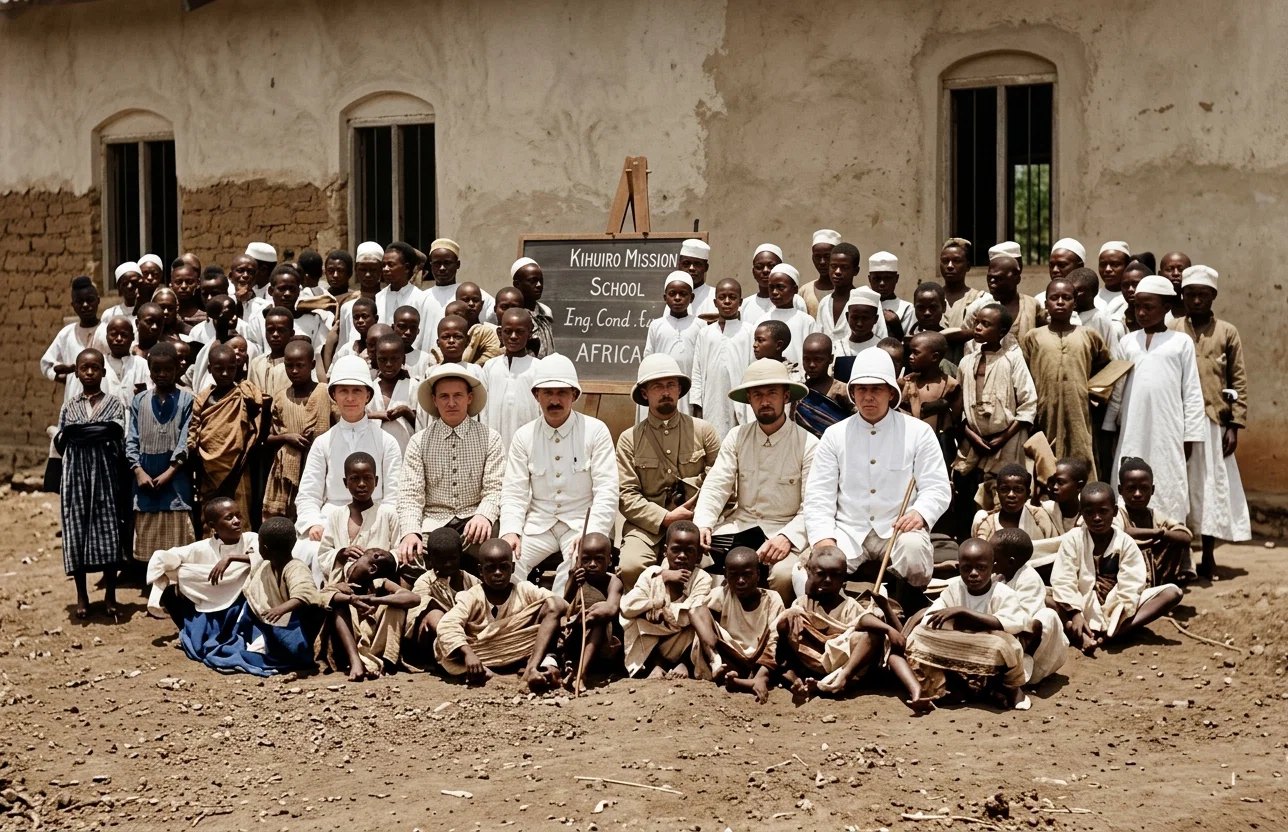
SCHOOLHOUSE AT THE KIHUIRO MISSION, GERMAN EAST AFRICA
On reaching Mombasa, on the fourteenth of October, I found a letter from Brother A. A. Carscallen, in which he stated that he was awaiting me, in case I should then come to his field. After securing a time-table of the steamers around Victoria Nyanza, I found it preferable to proceed with the workers to Tanga, German East Africa, first. Our steamer being somewhat late, we did not reach Tanga till late Thursday night, where Brother A. C. Enns met us. Early Friday we got our goods through the customs in time to take the nine o’clock train. It took us six hours and a half to make the eighty-five miles on the railway. On reaching the terminus at Momba, we found a small donkey team for our goods, but as we wished to be with the church in Kihuiro on Sabbath if possible, a few of us decided to push on that very night, which meant a thirty-five mile journey, nearly all on foot. We completely surprised our people at the station, and found them preparing for our reception on Sunday; but we felt richly repaid, and forgot our weariness occasioned by the night’s travel.
Five years ago we had arrived in Kihuiro about one o’clock at night. There was nothing but a miserable hut in which the two sisters who had accompanied us could rest, and I sat outside with the black boys by a small campfire, trying to fight off the swarms of mosquitoes. As the sun arose, some of the subchiefs met us, and we could talk to one another, mostly through signs. One of these offered us a sheep as a present. At that time most of the people had scarcely any clothing. There was no stopping-place, and there were no stores in the town. What a change the God had wrought during the intervening five years! A nice road led up to the mission station, a mile from town. On one side we saw a beautiful ten-acre cotton-field, and some good maize belonging to the mission station. At the station itself, we found a good dwelling-house and a number of good out-buildings.
MISSION SCHOOL AT KIHUIRO, GERMAN EAST AFRICA
We were very kindly received by the missionaries. And as we returned to the village, we found a commodious school building, which also serves as a chapel. This building will accommodate three hundred persons. It was packed full. The head chief of the town, and a number of his subchiefs, met us, clad in official attire. As we entered the house, we found one hundred fifty young people there, who are in regular attendance at our school. Brother E. Kotz announced one of our familiar hymns to be sung in the native language. Hundreds of voices joined in the praise to God. One of the converts offered prayer. It was then my privilege to talk through a ready interpreter to the natives, upon the love of God for fallen man. Most of the people were clothed. There seemed to be a change even in the town. Some stores had been opened, and the beneficial influence of the mission was apparent everywhere. But that which touched our hearts most was the fact that six of these young people had given their hearts fully to God, and had been baptized, while some others were under instruction for baptism, and over one hundred were daily studying the Word of God.
Mission work is slow work. It requires many sacrifices. It costs the lives of workers whom we dearly love. It costs money, and much patient labor. But the greater the sacrifice, the greater the final results. To see people who could neither read nor write, and whose language was not even committed to writing, who were bound in the darkness of thralldom, freed from all this thralldom, and enlightened by the gospel, praising God and worshiping him, is not only a sight to make the angels of heaven rejoice, but it is a sight that stirs our own hearts. The feelings caused by such an hour as this are the key to the explanation of the mystery why the missionary is so willing to leave home and all that is dear, to enter upon this glorious work, constrained as he is by genuine love for souls. Enjoying a sight like this would be sufficient to inspire our people throughout the world to put forth still greater effort to bring the glorious truth committed to us for this time to the dark corners of the earth.
Hamburg, Germany.
Hope
“Hope puts a song into the heart,
Hope makes a light when the night is dark,
Hope gives strength when the flesh is weak,
Hope is an anchor to those who seek,
Hope chases all our fears away,
Hope brightens up the darkest day,
Hope dries the mourner’s flowing tears,
Hope endures through all the years.”
South Carolina
By H. B. GALLION
We are glad to report progress in the book work for South Carolina. Our recent institute for canvassers held in Aiken was a marked success, and the laborers went forth with renewed courage and consecration to push the work in unentered counties. One of the thoughts which seemed uppermost in the minds of all, was that the work in this State must be done — that some one must meet the difficulties, endure the hardships and privations, come up to the help of the Lord against the mighty, and conquer in the name of the Lord; and each felt that he himself was that some one, and that he ought to enter the work for life. It is no time now to draw back. God expects every one who names his name to do his duty. The bright prospects for 1909 cause us to rejoice in the Lord.
“For that the leaders took the lead in Israel, for that the people offered themselves willingly, bless ye Jehovah.” Judges 5:2, A. R. V.
For territory and information, address the writer at Anderson, S. C.
H. B. GALLION, State Agent.
The Australasian Field
By O. A. Olsen
We have just returned to Sydney from a tour to the west and the south. In company with Elder J. N. Loughborough, Brother J. M. Johanson, and Sister Lizzie Gregg, we attended the missionary convention for West Australia, Nov. 5-15, 1908. The meeting was located on our Heidelberg school farm, and the congregation was housed in the forty tents, including the meeting-tent.
On our arrival we were very happily surprised to find so large a gathering of our people. While West Australia is the youngest of our conferences, we here met the largest gathering for a missionary convention that we have had as yet, and we had an interesting and profitable time.
About two years ago one of the brethren in West Australia, feeling the need of a school in that colony, deeded to the conference his farm of one hundred acres (held to be worth one thousand pounds), for the consideration of one hundred pounds. The location is a favorable one for the school, being about thirty miles from Perth, in an easterly direction, and in a range of hills that has an elevation of from eight hundred to one thousand feet above sea-level. The climate is fine. The farm also has a good stream of water, rising from springs on the place, which itself is a great boon.
The school began in a small way, but has made steady progress. This last year it had an enrolment of twenty-four, but the outlook for the year now soon to begin is that the attendance will double that of last year.
The time of the convention was well improved. Seven exercises were conducted each day. The brethren and sisters present entered heartily into the studies, and much was accomplished. Instruction was given on the plans to be observed in the circulation of papers, tracts, and books, large and small; also in keeping accounts, and in proper methods of conducting the business.
Another line of instruction was that of church organization and the duties of church officers. Brother Loughborough gave each day a talk on the early experiences in the message and its growth and development to the present time. These talks were greatly appreciated by all present.
The convention has given a fresh impetus to the work in the conference, and already we hear good reports as the result. The growth of the school called for more room. Brother Martin, who is in charge, felt rather timid in calling for three hundred pounds for building purposes, but to this call the brethren present gave in cash, pledges, and work four hundred sixty-four pounds, and in loans without interest four hundred forty pounds more, so they have ample funds for their needs.
From West Australia we returned to attend the camp-meeting in Tasmania, Nov. 26 to Dec. 6, 1908. This meeting was located at Moonah, a suburb of Hobart, and right at the end of the tram-line, thus being convenient and easy of access. This is the first camp-meeting for some time in this conference, and we had only twenty-five tents, but those who could not be accommodated in tents found rooms in the houses near by. From the first, the weather was most favorable, and this was a great blessing. The laborers present were Elder W. A. Hennig, Elder J. N. Loughborough, Brother J. H. Paap from the Avondale school, Brethren J. M. Johanson and A. Lemke, and the writer.
The attendance of our own people was good. Tasmania is our smallest conference, and numbers only a few more than two hundred. On the two Sabbaths and First-days of the meetings, we had nearly that number present; during the week not quite so many. The instruction given was of a practical nature, and was well received. The attendance from the surrounding community at the evening discourses, and on First-day, was very good, seeming to indicate some interest.
Elder W. L. H. Baker and family, who had just arrived from Victoria, to take charge of the work of the conference, in the place of Elder L. V. Finster and wife, who have accepted the call to the Philippines, were well received, and he was unanimously elected conference president.
One cheering aspect of the work in Tasmania at present is the many calls for labor. It was evident that in order to fill all these at once, the services of all the ministers in Australia would be required. But the same is the case in other conferences.
Recently the Tasmanian Parliament has passed a Sunday observance measure, similar to the one in Canada. During the camp-meeting, Brother Hennig had some profitable interviews with a number of the members of parliament, and with the governor. The matter came up so suddenly that we were not able to give it all the attention its importance deserved. All these movements are sure indications that we are rapidly hastening to the end.
The two Sabbaths of the camp-meeting were occasions of rich blessings. On the last Sabbath all the unconverted in the tent at the time, and others who were not free in the Lord, responded to the call to seek God, and all experienced a great blessing. On First-day, at 6:30 A. M., we gathered at the water's edge near by, and witnessed the baptism of sixteen souls by Brother Baker. It was an inspiring occasion. Thus closed the best camp-meeting we have had in Tasmania. The work is onward. To the Lord be the praise.
O. A. OLSEN.
The East Michigan Conference
By E. I. Beebe
This meeting was held at Lansing, Mich., Jan. 25-31, 1909. There were present nearly one hundred delegates, representing sixty-five churches and companies. The report of the treasurer showed that $52,607.45 of funds had passed through his office during 1908. Of this amount, $20,603.43 was tithe, and $1,679.01 Sabbath-school offerings to missions. Many of the schools doubled and trebled their offerings of 1907. The missionary department showed a net gain for the year of nearly $800.
The following officers were chosen for the coming year: Conference president, E. K. Slade; secretary-treasurer, E. I. Beebe; tract society secretary and treasurer, Frank Hiner; field missionary secretary, A. R. Sandborn; field missionary agent, J. H. McEachern; religious liberty secretary, C. N. Sanders; educational secretary, H. A. Boylan; Sabbath-school secretary, Tillie E. Barr; medical secretary, L. G. Wagner.
Conference executive committee: E. K. Slade, E. I. Beebe, E. N. Hatt, D. P. Wood, A. R. Sandborn. Auditing committee: Daniel Hale, Wm. Brace, W. R. Fellows, C. H. Gurney, Daniel Wood, Dr. G. G. Brown. Nominees for academy board: E. K. Slade, E. I. Beebe, E. N. Hatt, D. P. Wood, A. R. Sandborn, R. B. Thurber.
The following were given recognition as conference laborers: ministerial credentials being given to E. K. Slade, E. I. Beebe, J. L. Edgar, L. G. Moore, Wm. Ostrander, A. R. Sandborn, B. F. Stureman, C. N. Sanders, E. R. Lauda, D. P. Wood, M. Shepard; ministerial licenses to H. A. Boylan, Fred Hoxie, Claude White, J. H. McEachern, R. B. Thurber, L. G. Wagner, Dr. G. G. Brown, H. S. Guilford; and missionary licenses to Nora B. Ammon, Anna L. Boehm, Tillie E. Barr, H. L. Cohoon, Catherine Dunham, Frank Hiner, Marie Harriman, Beatrice Harter, Clara Kiep, Mina Pierce, F. O. Rathbun, Mabel L. Reavis, Lucy F. Tyte, H. A. Weaver, Katherine Weaver.
Among the resolutions adopted by the conference were the following of general interest:—
“1. Resolved, That we acknowledge with grateful hearts the prospering and protecting hand of God over all our conference work during the annual period, in giving us fruit for our labors, and in keeping death and serious disease or accidents from our laborers.15
“2. We recommend, That our people make a careful study of the important subject of adolescence, and that, in harmony with the action of the Mount Vernon convention, our training-school offer in its curriculum a course in this subject.
“3. We recommend, That every Seventh-day Adventist family take the Instructor, and that fathers and mothers unite with their children in the Missionary Volunteer Reading Course.
“4. We recommend, To all our young people, as well as our older members, the Morning Watch Calendar as an aid to systematic Bible study and prayer.
“5. We recommend, The holding of as many conventions and institutes as may seem practical, and that we do more definite work in encouraging our young people to attend our schools to get a preparation for the Lord’s work.
“6. We recommend, The plan suggested by the General Conference Young People’s Convention at Mount Vernon, Ohio, of the co-operation of the conferences in giving certain students who have received some preparation for young people’s work some experience in this work during vacation.
“7. We recommend, That the plan of organization of local Missionary Volunteer societies harmonize with the general plan of organization as recommended by the Missionary Volunteer Department of the General Conference.
“8. Resolved, That we approve of the Washington Foreign Mission Seminary Endowed Scholarship Fund, and that we do all we can, consistent with other funds, to raise the amount suggested for this conference.
“9. Resolved, That we encourage our brethren in the making of wills to the cause to make the conference a beneficiary, and that the East Michigan Conference Association of the Seventh-day Adventists be made the executors, and that the conference share twenty-five per cent of these legacies with the union conference.
“10. Resolved, That the Medical Missionary Department be strengthened, and that the secretary be encouraged to carry on a vigorous campaign on the principles of health and temperance, and that as conference laborers and church officers we pledge our hearty co-operation.
“11. Resolved, That, in view of the urgent calls that continue to come from the General Conference for needy fields, we again express to the General Conference our willingness to share our laborers and means with these needy fields.
“Whereas, There are many expenses necessary for the founding of the work in the union and local conferences, for which the tithe can not be used, therefore,—
“12. Resolved, That we encourage all our members to pay one per cent of their income into the conference fund, one half of the same to be forwarded by the local conference to the union conference.
“13. Resolved, That it is the mind of this conference that a church-school be established wherever there is a sufficient number of children, and that we urge our church officers to make a vigorous effort to do this; and further, that the conference committee investigate the cases of weak companies, and render such help from the general fund as seems consistent with other needs.”