We have just returned from a trip in the country, and as we had many interesting experiences by the way, we thought they might be of interest to others.
We left our station the evening after the Sabbath, taking our little Wallace with us. Many missionaries in China think it is impossible to take their children with them on these itinerating trips, but the experience of one good missionary woman proved to us that the children could be taken, and be a great blessing in the work. Our little one was dedicated to the Lord at his birth, and we have always felt confident that he would be a blessing to us in our active missionary work. So he went too, and the results more than proved that he helped to open hearts and homes to the truth.
The first seventy li of our trip was taken on a small covered boat. There was not room inside to stand upright, but we made up our bed on the floor, and had a refreshing night’s rest. The boatmen poled away all night, and early next morning we found ourselves at the end of the first stage of the trip. The boatmen had poled for eleven hours, and for this they asked two thousand cash, equaling one dollar. There was a family of five adults on the boat, who were wholly dependent on their boat, which was their only home, for support.
We found our Chinese evangelist awaiting us with a cart, and we were soon ready for a seventy-li ride to the first company of Sabbath-keepers, where we arrived at dusk. The villagers soon gathered to give us a hearty welcome. As we have no chapel in this place, we held our meetings in the home of one of the Christians. The farm animals—two oxen and a donkey—were in one end of our meeting-room, while in one corner was a pile of sweet potatoes, which had just been brought in from the field. But although our surroundings were not the most inviting, the people were warm-hearted, and we had a good time studying together about the Lord’s second coming. After meeting we talked individually with those present, and found a good interest in the message in this village.
That night we were given the best accommodation they had,—a good clean bed, clean for a Chinese bed in these villages. There was also a rather ancient table, and the rest of the room was nearly filled with bins, each five or six feet high, and three or four feet in diameter. There were five of these in all, filled with beans, wheat, and sesame seed. We would have been comfortable, however, if it had not been for the rats, which took advantage of the darkness to scamper in and out of the bins, and then across our bed and up the wall.
Next morning at daybreak the villagers began to assemble for meetings, and all day we were busy talking personally with those who came, and holding meetings for all. When asked if they could help in the erection of a chapel in their village, they gladly promised to do all they could to get one built as soon as possible. There are eight Sabbath-keepers bearing witness for the truth in this place, and we were greatly encouraged to see their zeal. These have all been brought into the truth through the faithful efforts of one Chinese canvasser, Brother Lin. Formerly his father was angry with him because he was anxious to study the truth, and was not willing for him to come to our meetings. But as he has seen his son’s faithful example, he has become more and more interested, and now he is just as earnest as his son in the message. Brother Lin’s wife, his younger brother with his wife, and his father and mother are all keeping the Sabbath. Some of them have not yet learned the truth fully, but they are faithful in living up to the light as it comes to them, and are anxious to learn more. There is also another family of four who are interested in the truth as the result of this canvasser’s work. The mother is blind, but she memorizes texts and hymns, and is eager to learn. The father is studying the truth, and obeying as he understands. The son and daughter are very bright, and with proper training should make good workers. The girl has read the Old and New Testaments, and has unbound her feet, in spite of opposition from her mother-in-law’s family. She was married some six months ago, and is now bearing witness for the truth in her mother-in-law’s family. Our cook, who is an honest Christian, also comes from this village. He was formerly severely beaten several times by his father for listening to the gospel, but now his father is much interested in the truth, and is anxious to send his younger boy here to school after New-year’s. Others interested also wish to send their boys to school here as soon as the school work is started, which we expect will be on our return from the general meeting in January. The Lord has used Brother Lin to break down prejudice in this village, and to awaken an interest in the gospel; and the responsibility now rests with us to follow up this interest, and lead those inquirers into the full truth.
After spending two days with this company, we went to the next village, where there were Sabbath-keepers. Here there are six keeping the commandments of God, and several nominal Sabbath-keepers who have been keeping the Sabbath as they previously kept Sunday. They say they have to make a greater sacrifice when they keep the Sabbath than when they kept Sunday; for then they could go to meeting, and afterward work as usual. But they find it a little more difficult to keep the Sabbath properly. We endeavored to show them that there is a great blessing in Sabbath-keeping, that the Sabbath is the mark of God, and that the Lord requires us to keep his commandments. Most of our time here was spent in personal work, strengthening the believers in the faith, and encouraging them to press forward. Here there is quite a neat little room which has been set aside for a meeting-house by one of the Christian families.
After spending a day in this village, we pressed on to the next place, Siang Cheng. Here we received a most hearty welcome from a company of sisters. When we left Siang Cheng some six months ago, we did not know of any results of the work in that place, with the exception of the girls’ school-teacher. But this teacher is very zealous in the truth, and she gets the little company together, and is teaching them to read the Bible and hymns, and is helping them all she can in their Christian experience.16We found that some of them had not yet learned to pray, but they have given up worshiping their idols, and are seeking God. One woman is from a family in which Sister Selmon had an obstetrical case, and another is a midwife who became interested through Sister Selmon’s obstetrical work. One is the mother of one of the girls who attend the girls’ school. After spending two days with these sisters, instructing them in the first principles of the gospel, we started on our way home. On the way back we visited two other places where there is an interest in the truth. In one of these places there are two Sabbath-keepers, and they tell of quite a number who come together to hear the gospel.
We stayed at a Chinese inn overnight on our way home, and here we had the most unpleasant experience of our trip. The place was largely made up of Mohammedans, and they crowded us so that our evangelist, who had been planning to leave us here and visit his home, said he did not dare to leave until the morning. The room we had for the night had no window or means of ventilation, except the cracks. We closed our door and locked it, but we did not have a very refreshing night’s rest. Next morning we left before daybreak for home, and as the frost was on the ground, and a bitter north wind blowing, we were glad to reach home a little after noon.
The Lord is surely opening up the work in Honan; for we find interests springing up here and there all over this province. It is rather early yet to speak of some of these places, but we expect to report a little later some more of our encouraging experiences. At present there are twenty-four Sabbath-keepers in this district, and a number of these are interested in this truth. It takes much time to visit among these companies, for they are so scattered, but we realize that the Lord’s blessing is with this work. We are anxious to start a girls’ school and a boys’ school, right after New-year’s, for the children of Chinese believers and inquirers. These, with our Bible schools which are held twice a year, keep us busy between our itinerating trips. We trust you will remember the work here in Honan in your prayers; for we need grace and strength to be ready to meet every call that comes to us for the truth at this time.
F. A. ALLUM,
EVA ALLUM.
The Burma Meeting
By J. L. Shaw
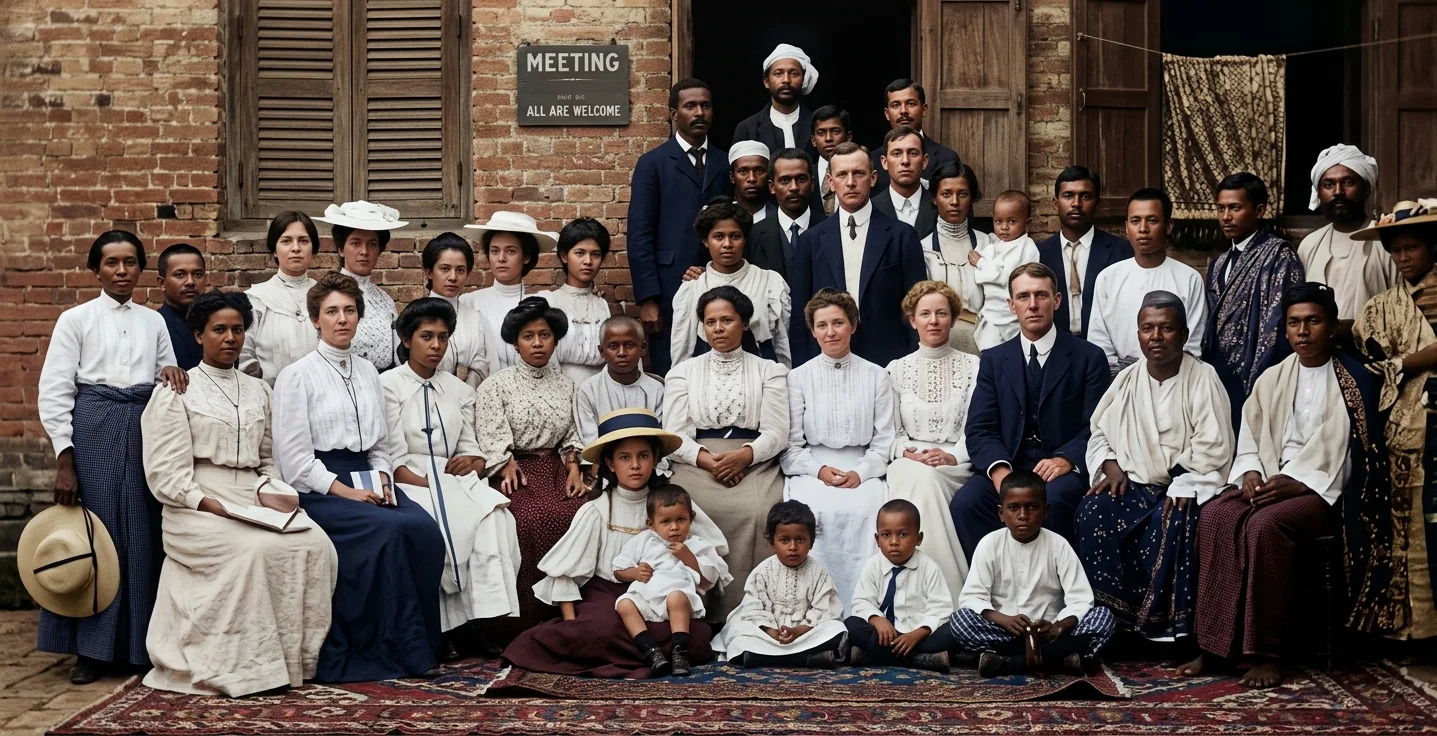
This meeting was held at Rangoon, Oct. 9-19, 1908. Nearly all of our little band of Sabbath-keepers in Burma were present. From Meiktila Brother and Sister Stevens and family and Brother and Sister Carapiet and Sister Lemon were in attendance. Brother Bertie came down from Mandalay, and the Burmese brethren and sisters came over from Moulmein, bringing with them a young Buddhist priest with whom Dr. Ollie Oberholtzer and Brother Hpo Hla had been studying the Bible. He had laid off his Hpoongia robes, and asked for baptism while in Rangoon.
Two meetings a day were held in English, and one in Burmese. The service at 8:30 A. M. took the nature of a Bible and Testimony study. Two lessons were given on the Holy Spirit. These were followed with studies on the spirit of prophecy. Those present took a real interest in the subject of the spirit of prophecy, and in the Testimonies which have come to us through this medium. Two or three complete sets of the “Testimonies for the Church” were ordered. Meetings were held daily with the Burmese brethren. They also manifested an interest in the subject of the spirit of prophecy. Sister Anna Orr conducted two studies with them on this subject.
A preaching service was held each day at 6 P. M. These services were well attended from the outside. Inasmuch as quite a number of those attending had been halting between two opinions, the importance of obedience and surrender to God was made prominent. God gave freedom to his servants in presenting his Word, and souls found freedom. Some who had been wavering for a year or more took a definite stand.
GROUP OF WORKERS AND BELIEVERS AT THE GENERAL MEETING IN BURMA
Sisters Caroline Votaw and Lucy B. Cook led out in the singing. They sang a number of soul-stirring songs. The sweet Spirit of God was continually present throughout the meeting. Brethren H. H. Votaw and R. R. Cook and others labored earnestly for souls, and their efforts were not without results. Chains were broken, and captives were set free. We feel confident that this gathering of our people was for good.
The last service was a social meeting. The fervent testimonies borne gave evidence of help received. Two sisters were baptized in one of the beautiful Rangoon lakes. Several others were formed into a class for further instruction and preparation for this solemn ordinance. A general meeting will, no doubt, be held each year, if possible, in Burma.
Sister Votaw left for America at the close of the meetings. In a letter just at hand from her from Colombo, she says she almost decided to return. Her better judgment, however, prevailed, and she went on on her journey to the States. A year in America will restore her exhausted energies for further work in Burma.
J. L. SHAW.
Greater New York
By K. C. Russell
SABBATH and Sunday, Feb. 6 and 7, 1909, I spent in Greater New York. Sabbath morning I spoke in Church No. 1 in New York City. There was a good attendance, and a deep interest was manifested while the subject of religious liberty was discussed. A liberal offering was taken for the religious liberty work.
In the afternoon a union meeting was held in our Tabernacle in Brooklyn, where two nationalities of our people—English and Scandinavian—meet for worship. I was pleased to meet at this service Elder Claude McMoody, who had just arrived from England on the steamer “Majestic” the night before, and joined me in the services. It being our annual religious liberty day, the services in Brooklyn consisted of a discussion of the theme of religious liberty. Elder McMoody gave a stirring and interesting talk on conditions in Turkey as the result of the declaration of liberty in that country. An offering for the religious liberty work was also taken at the close of the service. We believe that this meeting proved a great blessing to those in attendance.
Sunday morning I held a meeting with the gospel workers of Greater New York. A good spirit pervaded the service. In the afternoon the Greater New York Conference committee held a meeting. One listening to the recital of the urgent needs for means and workers in Greater New York, could not fail to be impressed with what the spirit of prophecy has told us over and over again concerning the importance of working our large cities. It seems to me that our people throughout the country should be aroused to the importance of the work in this great metropolis, with its five million inhabitants. It is evident that now is our time to work these great centers of population, lest the visitations of God's wrath shall sweep them out of existence, as other cities have recently been visited, before they had heard the third angel's message.
K. C. RUSSELL.
The Hearing on the Johnston Sunday Bill
By W. W. P.
A PARTIAL report of this hearing appeared last week, including a summary of the arguments presented by the editor of the Review, and W. A. Colcord, secretary of the Religious Liberty Bureau.
Mr. H. C. Kirk, president of the Secular League of Washington, spoke in opposition to the bill, his chief reasons for his attitude being these:—
“We are opposed to this legislation, first, on the ground that where any social difficulty can be remedied without the passage of a law, it is better to accomplish17it in that way than to enact legislation.”
“The character of this bill, as tending to create new crimes and criminals, is self-condemnatory.”
“There is more than that, however. The question of whether a man is a criminal or not is made to turn upon such fine distinctions.”
“Now, there are multitudinous reasons that could be urged against the passage of this bill. Can anybody doubt that it is really—while ostensibly an economic measure and presented as such—in the nature of Sunday legislation, and as such is contrary to the spirit and letter of the Constitution of the United States?”
John N. Quinn, of Takoma Park, who had been delegated by the employees of the Review and Herald Office to represent them before the committee, gave the following reasons for his opposition to the bill:—
“1. The working man can secure a weekly day of rest without legislation by civil government.
“2. Working men are not agreed either as to the method of securing a weekly rest day or as to the day itself.
“3. The proposed legislation is an acknowledgment of a lack of conscientious conviction.
“4. The working man will not be permitted to exercise his right to decide how he shall observe the day.
“5. It is religious as well as class legislation, and takes issue in a religious controversy.”
“6. It places a ‘big stick’ in the hands of bigots.
“7. The spirit behind the movement is one of intolerance and persecution.
“8. To secure the weekly rest day by civil enactment is to do so illegitimately.
“9. The ultimate of Sunday enforcement will be disaster to religion, the state, and the working man.”
The next fifteen minutes were occupied by A. T. Jones, of Michigan, in an earnest argument against the proposed legislation. He first gave a sketch of Sunday legislation from the time of Constantine to the present, showing that all Sunday legislation in the United States could be traced through the laws of the colonies and through the laws of England, to their original source in the Roman laws at the time when there was the closest union between church and state. In discussing the exemption clause in the bill, he declared:—
“By the Constitution of the United States and by the divine religion, which is Christianity, every individual has a divine right, and also a constitutional right, to be religious without belonging to any combination or society in any way whatever.”
“This bill, then, plainly requires of all people that they must either observe Sunday as dictated by the state, from the church, or else by edict of the state he must be a ‘member of a religious society.’”
“Gentlemen of the Committee: The conclusion of the whole matter, the sum of all that can be said, is that this legislation would doubly revolutionize this whole nation. First, in that, being essentially religious, it commits the nation to the old order of things,—governmental domination of religion and in religion. Secondly, in that it sweeps away absolutely and forevermore all right of individuality in religion. And in this double revolutionizing of things here, it is doubly unconstitutional and doubly antichristian.”
The next speaker was G. B. Thompson, who said, in part:—
“We are told that the reason we are here opposing this bill, Mr. Chairman, is because we keep another day than Sunday. Now, I want to say that we would be opposed to any law that would require anybody to keep the seventh day. We oppose this thing from principle; because the government of this nation has no right to legislate concerning Sunday, the true Sabbath, or any other day. It is not proper for the state to legislate upon this question.
“Many of the promoters of this bill claim that they do not want religious legislation; that all they want is a civil observance of the day. Now, gentlemen, any law that will keep a man civil on Saturday or on Tuesday will keep him civil on Sunday. We have laws in the District of Columbia that require every man to be civil seven days in the week. Isn’t that all that is necessary to make a man civil on Sunday?”
At this juncture petitions against the passage of the bill were presented by W. A. Colcord, secretary of the Religious Liberty Bureau, as follows:—
Two hundred fifty-three petitions from the various States, containing 10,062 signatures.
Eighty-six petitions from the District of Columbia, containing 1,321 signatures.
Three memorials signed by sixty merchants of the District.
Independent Citizens’ Union of Maryland, 10,000 members.
Camp Six of Patriotic Order of Sons of America, 346 members.
One petition from California, addressed to Hon. J. C. Needham, containing 108 signatures.
Total, 345 petitions; 22,797 signatures.
There was also presented the following resolution, adopted the previous day:—
“Resolved, That the District of Columbia Conference of Seventh-day Adventists enters its most earnest protest against the passage of the Johnston Sunday bill now before the District Committee of the House of Representatives.”
Mr. W. H. Rapley, manager of the New National Theater, and associate manager of the Academy of Music, opposed the bill on the ground that there was already sufficient legislation to meet all requirements.
K. C. Russell, chairman of the Religious Liberty Bureau, presented the next argument against the bill, giving a variety of reasons for his opposition:—
“1. Because should Congress pass this bill and it become a law, the national government would then be departing from the exalted position it has so long maintained on the principle of a total separation between the church and the state.”
“2. Because it makes religion a test for a certain class of citizens, in order to be exempt from the penalties of the law; for the bill plainly states that the citizens who are exempted must be members of a religious society.”
“3. Because, should the bill become law, it would necessitate that the judge of the police court of the District of Columbia should assume the position of a bishop or moderator in an ecclesiastical tribunal.”
“4. Because it is a species of class legislation, based upon a selfish principle.”
“5. This bill compels a man to rest on Sunday whether he wishes to or not.”
“6. I am opposed to this measure because it would be allowing the majority to control the minority in matters of a religious character.”
As illustrating the practical workings of Sunday laws, the following facts were stated:—
“From 1885 to 1896, as the result of the enforcement of Sunday laws, over one hundred Seventh-day Adventists in the United States were prosecuted for quiet work performed on the first day of the week, resulting in fines and costs amounting to $2,269.69, and imprisonment totaling 1,438 days, and 455 days served in chain-gangs.”
By the courtesy of the opponents of the bill, time was granted to some of those present who desired to speak in favor of the measure. Mr. E. Hilton Jackson, an attorney, claimed that the Supreme Court of the United States had recognized the constitutionality of State laws relating to the observance of Sunday, on the ground that they were a legitimate exercise of the police power of the State. He read an extract from a court decision which he claimed sustained his contention.
In reply to his challenge calling for a decision of the federal court in favor of the position taken by those who opposed the bill, A. T. Jones stated that inasmuch as there was no federal Sunday law, there could be no federal decision upon the question, and for that reason it was impossible to produce one. He declared that Congress was prohibited from establishing religion, by the First Amendment; but at the very time when this amendment was adopted, every State, except one, already had an establishment of religion. So far as the United States Constitution is concerned, it would be possible for any State to establish religion by law, and to inflict the most severe punishment upon heretics.
Mr. Charles F. Diggs appeared as the attorney of one of the clerks’ associations of Washington, and urged the passage of the bill in the interests of his clients. He claimed that there was nothing religious in the bill, and seemed to resent the fact that it should be opposed on religious grounds. In his replies, however, to some questions propounded to him, he inadvertently made very clear the real nature of the bill, and his own ideas concerning compulsory observance of Sunday. When asked, “What would you do with a man who does not observe any day?” he said, “I would make him observe the day which the law says.” One member of the committee having stated that “the only object of this law is to make a man keep one day in the week, and it makes him do that by law instead of by love,”18Mr. Diggs acknowledged that this was the case with all Sunday laws, by saying, “That is the same thing that every statute throughout the country does.” Being asked if the association which he represented could not protect their members, by adopting certain regulations, Mr. Diggs replied: “So far as the members of our association are concerned, I suppose our members could; but you can bind them much better if you have an act.” To this a member of the committee added, “You can create an abuse much better, too.”
Mr. King, the president of the Georgetown Citizens’ Association, urged the passage of the bill in behalf of some of the residents of Georgetown, but introduced no argument of any weight. His chief plea was that unless all stores were closed on Sunday, those who did close would suffer the loss of their trade, which would be likely to be transferred to the stores which kept open. Being asked whether he knew of any city in the country where Sunday was better observed than in Washington, and being pressed to a definite reply, Mr. King was obliged to say, “No, I do not know that I do,” and the member of the committee who asked the question then declared: “I would rather have a love and a respect for the Sabbath day implanted in a man’s heart than all the laws you could put on the statute-books.” When pleading for Sunday laws to prevent the importation of the Continental Sunday into America, and citing the laxness with which Sunday was observed in London as an example of what should be avoided, Mr. King was considerably nonplussed to be told that there were twenty-seven Sunday laws in force in London.
Mr. F. P. B. Sands, representing the Master Butchers’ Association of the District of Columbia and its employees, was the next speaker who undertook to urge the passage of the bill. Mr. Sands was very sarcastic in his reference to the opponents of the measure, saying: “We have listened to a great many essays upon religious views of individuals representing different religious bodies.” He gave a brief outline of his hitherto unsuccessful efforts to secure the passage of the law for the benefit of his clients; and declared: “This is no religious question. I drafted the bill, and I never consulted or asked or talked with any priest of minister of any denomination.” He argued that it was “an affront to the intelligence of the committee” for the opponents of the measure to criticize the exemption clause, which, he stated, “is intended to give them all the protection they ask for under the bill.” It did not seem to dawn upon the mind of Mr. Sands that it was possible for any one to oppose this legislation because of the wrong principles involved, or that any one could have any other purpose than a selfish one, merely to avoid arrest and prosecution, in appearing against the bill.
Mr. Henry I. Meader spoke in behalf of the retail grocers, stating: “We want a law here to protect those business men who do keep open, in closing on Sunday, so that they may close any day they see fit.” “We appeal to you [the committee] that you give us the proper kind of day, that we may have a day of rest.” “The Jews, and Seventh-day Adventists, and various other denominations can have their day of rest just the same as we are asking for here.” If Mr. Meader, and those whom he represented, were willing to follow the example of Seventh-day Adventists,—decide upon a day which they would observe as the Sabbath, and then observe it, without asking for a law compelling every one else to observe the same day,—there would be no occasion for further legislation, and congressional committees would not be compelled to devote any of their time to hearings upon proposed Sunday laws.
Those who listened to all the arguments presented at this hearing, while convinced that a deep impression was made upon the minds of the committee by the clear and strong arguments presented against the bill, were yet of the opinion that those who appeared before the committee to urge the legislation really did as much or more to defeat it than any others. W. W. P.
Sunday-Law Agitation in Oregon
By W. F. Martin
WHEN the Oregon Legislature convened, the Sunday-law advocates were on hand with their stereotyped bill, which two years before had been passed in Idaho, and which they had tried to put through in California. The conference decided to take active steps against it, so special petitions were prepared, and sent throughout the State for our people to circulate. Our people were also asked to write letters to their senators and representatives. The writer was asked to go to Salem to do everything possible in disseminating the principles of religious liberty. I had the privilege of interviewing a number of senators and representatives, and of placing on their desks copies of Liberty and other literature. It was evident from the first that a strong fight was on. The bill was referred to the judiciary committee, and a hearing was set for Monday, January 8, at 4 P. M. About thirty-five ministers went up from Portland to work for the bill. Among them were the strongest men of the city. Elder D. Nettleton and myself went on the same car. Soon after arriving in Salem, they organized not only to support the bill, but to fight the arguments we might make. One of their number was specially delegated to answer my arguments, as he said, in anticipation. He also said it might be embarrassing to him, as he might not strike the main point. He then launched out in a line of argument against the Sabbath.
The ministers seemed to think if they could prove that we were wrong on the Sabbath question, the committee would make a favorable report on the bill. They used the old arguments of round world, lost time, etc. Some very bitter attacks were made on us. Nearly three hours was devoted to the hearing, the friends of the bill leading out.
First on the opposition was one of the leading attorneys of the State. He handled the assembled ministers in a severe way, which they resented by groans and hisses, till the chairman of the committee called them severely to order. About forty-five minutes was given to the writer. The Lord helped in the presentation of the truth. Before going into the meeting, Brother Nettleton and myself had an earnest season of prayer, our souls reaching out after God. He heard us pray, and gave freedom before that packed room.
Lawyers, newspaper men, and members of the Senate and House sat or stood and intently listened to the message. A score or more came to me after the hearing and commended the stand we had taken, and expressed themselves as highly pleased with the arguments made.
It is manifest that no one knows the principles of religious liberty so well as Seventh-day Adventists. The attorney held in his hand two copies of Liberty, and recommended all to read the magazine.
On Tuesday the bill came up for action in the Senate, with an adverse report. Petitions against the bill, with over three thousand names, were presented, and placed on file. After quite a lengthy debate, in which Seventh-day Adventists came in for their share for opposing the bill, it was indefinitely postponed.
We feel to thank the Lord for what we consider another victory for the truth.
It afforded an opportunity to get the truth before men who would not otherwise have heard it.
The ministers from Portland who went to Salem to urge the passage of the bill, were terribly chagrined at their failure.
It is said they are already laying plans for the legislature of 1911.
We look upon all this agitation as a sign of the near coming of our Saviour, and it behooves us to be doing all in our power to spread the light of truth, that men and women may know where to stand.
W. F. MARTIN.
Field Notes
THREE persons were baptized at Erie, Pa., on Sabbath, January 23.
THREE young men were baptized on a recent Sabbath at the Emmanuel Missionary College, Berrien Springs, Mich.
BROTHER CLAUDE WHITE reports that seven have already taken their stand for the truth where meetings are being held near Shepherd, Mich.
ELDER F. STEBBEDS conducted an effort in the church at Blue River, Wis., which resulted in the addition of nine members, and many others became interested.
As a result of efforts put forth at Moon, Wis., the past few weeks, twenty-six have already promised to obey all the commandments of God, and others are greatly interested.
At Glenwood, Iowa, on Sabbath, February 6, four persons united with the church. Others have expressed a desire to be baptized and unite with the church in the near future.
SUNDAY, February 7, two persons were baptized at Noble, Ill.; later a lady who had been studying the truth for some time took her stand, and is now awaiting baptism.
In Kenosha, Wis., where Elder E. Edwardson and wife have been working, five Danish and six English members have recently been added to the company. A church will be organized there this spring.
SABBATH, January 9, Elder B. F. Kneeland baptized eleven persons at Paterson, N. J. Most of these were brought into the faith through the labors of Brother J. H. Carroll during the tent-meeting at Little Falls last summer.
Canvassers’ Summary for January, 1909
Canadian Union Conference
AGENTS
HOURS
ORDERS
VALUE
1908
Maritime
1
18
9
$17.60
...
Quebec
2
103
28
62.60
...
Ontario
4
260
63
189.75
...
Totals
7
381
100
269.95
$245.75
Atlantic Union Conference
AGENTS
HOURS
ORDERS
VALUE
1908
Central New England
9
567
187
976.05
...
Southern New England
10
240
76
423.75
...
Greater New York
11
620
175
640.00
...
New York
4
170
68
315.75
155.95
Western New York
8
480
147
575.10
470.45
Vermont
2
102
20
42.25
183.50
Maine
2
70
15
30.25
...
Totals
46
2249
688
3,003.15
809.90
Columbia Union Conference
AGENTS
HOURS
ORDERS
VALUE
1908
Ohio
10
1090
687
1,199.30
348.70
West Pennsylvania
12
604
213
725.28
91.25
Chesapeake
12
1007
448
678.00
306.05
New Jersey
11
483
292
566.20
133.00
West Virginia
7
322
129
446.55
171.35
Eastern Pennsylvania
9
345
168
270.25
370.85
Virginia
7
326
84
166.35
281.25
Totals
68
4177
2021
4,051.93
1,702.45
Lake Union Conference
AGENTS
HOURS
ORDERS
VALUE
1908
Southern Illinois
9
856
242
706.45
...
East Michigan
9
563
234
342.95
...
North Michigan
6
447
102
270.95
110.00
Northern Illinois
2
203
22
88.35
53.50
Indiana
2
121
12
43.75
268.35
West Michigan
...
...
...
...
...
Wisconsin
...
...
...
...
...
Totals
28
2190
612
1,452.45
431.85
Southern Union Conference
AGENTS
HOURS
ORDERS
VALUE
1908
Louisiana
7
343
181
257.83
246.45
Mississippi
8
390
265
512.65
...
Alabama
16
723
254
582.50
18.00
Kentucky
5
425
206
220.50
...
Tennessee River
8
510
237
426.85
509.20
Totals
44
2391
1093
2,000.33
773.65
Southeastern Union Conference
AGENTS
HOURS
ORDERS
VALUE
1908
Cumberland
11
927
370
588.15
185.70
Georgia
6
689
152
638.35
470.05
North Carolina
10
904
337
838.10
62.40
South Carolina
8
510
397
449.20
435.50
Florida
4
231
90
169.50
3.00
Totals
39
3261
1346
2,683.30
1,156.65
Southwestern Union Conference
AGENTS
HOURS
ORDERS
VALUE
1908
Arkansas
9
189
63
167.15
72.25
Texas
6
124
48
181.50
115.20
New Mexico
4
274
211
238.50
...
West Texas
1
129
...
11.50
...
Oklahoma
...
...
...
...
389.82
Totals
20
716
322
598.65
577.27
Central Union Conference
AGENTS
HOURS
ORDERS
VALUE
1908
North Missouri
7
420
119
391.00
...
Southern Missouri
3
107
36
208.45
...
Kansas
4
116
38
160.70
308.50
Western Colorado
...
...
...
175.50
...
Eastern Colorado
...
...
...
...
375.05
Nebraska
...
...
...
...
444.57
Wyoming
...
...
...
...
197.50
Totals
14
643
187
935.65
1,307.62
Northern Union Conference
AGENTS
HOURS
ORDERS
VALUE
1908
Iowa
3
143
47
181.50
136.65
Minnesota
...
...
...
...
...
North Dakota
...
...
...
...
...
South Dakota
...
...
...
...
257.10
Totals
3
143
47
181.50
493.75
Western Canadian Union Conference
AGENTS
HOURS
ORDERS
VALUE
1908
Manitoba
3
161
20
120.45
...
Alberta
...
...
...
...
...
Saskatchewan
...
...
...
...
...
British Columbia
...
...
...
...
...
Totals
3
161
20
120.45
...
Pacific Union Conference
AGENTS
HOURS
ORDERS
VALUE
1908
Arizona
1
...
...
181.10
...
California-Nevada
..
...
...
...
581.50
Southern California
8
287
140
400.00
...
Utah
..
...
...
...
...
Totals
9
287
140
581.10
581.50
North Pacific Union Conference
AGENTS
HOURS
ORDERS
VALUE
1908
Montana
..
...
...
...
50.00
Southern Idaho
..
...
...
...
...
Upper Columbia
..
...
...
...
186.00
Western Oregon
..
...
...
...
...
Western Washington
..
...
...
...
...
Totals
..
...
...
...
236.00
AGENTS
HOURS
ORDERS
VALUE
1908
German Union Conference
256
...
...
$7,205.98
$7,315.17
Russian Union Conference
13
...
...
206.21
...
Latin Union Conference
9
1282
2810
158.65
...
Mexican Mission
5
399
467
357.32
...
British Union Conference
76
3618
1398
5,636.34
1,448.75
Scandinavian Union Conference
57
4929
2637
1,755.96
...
Australasian Union Conference
77
6129
2488
9,478.13
8,528.00
1908
Total, North American union conferences
$15,878.46
Total, foreign union conferences and mission fields