There was a little girl in my school who could not, or would not, learn to read. I was teaching her by the thought method, or supposed I was. But she would falter along for a word or two, stand and stare a moment, and then slide her glance away to the window.
“That’s good, Florence,” I would say. “What was it Adam did?” A shake of the head.
“Let me see, my dear. Why, yes, you’ve seen that word before.”
“Whe-e-ere is it?”
“There! Don’t you remember it?”
“Unh-unh!”
But by dint of persistence she got along,—came to read excellently,—as well as I could,—the first lesson or two, until one day I discovered that she was reading while looking out of the window. “I know that all by heart,” she explained.
With the next lesson she was not so familiar, of course; she couldn’t read. Still she was anxious to get along; and she heralded each failure with the combined response and interrogation, “Can’t. What’s the next lesson?”
Finally I found out that she hadn’t learned her A B C’s; couldn’t tell one letter from another. Then, I suppose, I backslid; I set her to learn the alphabet.
“Can’t,” she said, her square little face set determinedly, “unh-unh!”
But with the aid of “The Word Builder,” and by the persuasion of lost recesses and stayings-after-school, she did manage at last to master her A B C’s, and now, I am told, she can read, if not so well as some, yet well.
Somehow, I think I’m much like that little girl. I started long ago to go to a Teacher for special training. I wished to become a teacher, and I went at my primer with diligence. I must learn to read men, women, boys, and girls, in order to be the master that is the teacher. I gathered books, I attended lectures, I dashed bravely into sciences and philosophies, I crammed my head with theories; and oftentimes my elders bore witness that I had a zeal, fervent if not25temperate.
I could recite my first-page authors without looking; I could read better than my teachers.
But when, beyond the first-page authors, I came to life experiences, and in the schoolroom met seared hearts, soured dispositions, warped natures, I stood silent. “Go on,” said my Teacher, encouragingly. I shook my head.
“You need to learn the A B C’s,” said my Teacher. “Study in agricultural lines should be the A, B, and C of the education given in our schools.”
But I was anxious to go on. “Can’t,” I said. “What’s the next lesson?”
“It reveals cowardice,” was the reply, “to move so slowly and uncertainly in the labor line—that line which will give the very best kind of education.”
“But,” I objected, “I haven’t time now to go back and learn that. I have already started on my life-work. I want to go on.”
“Are you progressing?” asked my Teacher.
I looked at the page,—the open page of my pupils’ lives,—and before my eyes the characters were blurred. Again I shook my head.
“Talent is too much idolized,” he said, “and station too much coveted. There are too many who will do nothing unless they are recognized as leaders; too many who must receive praise, or they have no interest to labor.”
“But I can not see that this alphabet will help me. How, by digging in the earth, can I come to know souls better?”
“Teachers must understand what lessons to impart, or they can not prepare students to be transferred to the higher grade. They must study Christ’s lessons and the character of his teaching. In the training of his disciples the Saviour followed the system of education established at the beginning. The twelve first chosen, with a few others who through ministry to their needs were from time to time connected with them, formed the family of Jesus. They were with him in the house, at the table, in the closet, in the field. There is wisdom for him who holds the plow and plants and sows the seed. ‘For his God doth instruct him to discretion, and doth teach him.’”
So I turned, with enlightened eyes, to the A B C’s. O, but it was hard! for I loved my books.
Again my Teacher came to me. “You are spending too much time indoors,” he said. “Go out into the field, and work with your students.” For other matters had pressed, and I must study.
“I can’t,” I answered. “I must read this large book on ‘The Psychology of Adolescence.’”
“Your adolescents are out there hoeing in the strawberry patch,” he said, “and their minds are with them. Study there.”
“They can work better than I can,” I objected. “But I must study science in order to know the workings of their minds, and how to meet them. What can I learn of pedagogy while hoeing?”
“In the cultivation of the soil the thoughtful worker will find that treasures little dreamed of are opening up before him. No one can succeed in agriculture or gardening without attention to the laws involved. The special needs of every variety of plant must be studied. Different varieties require different soil and culture, and compliance with the laws governing each is the condition of success. The attention required in transplanting, that not even a root fiber shall be crowded or misplaced, the care of the young plants, the pruning and watering, the shielding from frost at night and sun by day, keeping out weeds, disease, and insect pests, the training and arranging, not only teach important lessons concerning the development of character, but the work itself is a means of development. In cultivating carefulness, patience, attention to detail, obedience to law, it imparts a most essential training. The constant contact with the mystery of life and the loveliness of nature, as well as the tenderness called forth in ministering to these beautiful objects of God’s creation, tends to quicken the mind and refine and elevate the character; and the lessons taught prepare the worker to deal more successfully with other minds.”
“O, I believe in it!” I said, “but my time is so limited. I will uphold the principle with my voice and pen, but I—I can not come down.”
And the answer came plainly: “There is a spirit of opposition to the plain Word of God and to the Testimonies of his Spirit. There is a spirit of idolatrous exaltation of mere human reason above the revealed wisdom of God. There are men among us in responsible positions who hold that the opinions of a few conceited philosophers, so-called, are more to be trusted than the truth of the Bible or the testimonies of the Holy Spirit. These men are Hazaels, to prove a scourge to our people. They are wise above that which is written.”
Then I yielded, and to some degree I have learned the A B C’s. And the promise has been verified in proportion to the faith exercised; for though I can not read so well as some, still I can read somewhat. I wonder, naturally, how many have had my experience in learning the A B C’s. A. W. SPAULDING.
True to the Light We Have
I AM not bound to win, but I am bound to be true; I am not bound to succeed, but I am bound to live up to what light I have.—Abraham Lincoln.
Live in the Active Voice
By William DeWitt Hyde
LIVE in the active voice, intent on what you can do, rather than on what happens to you; in the indicative mood, concerned with facts as they are, rather than as they might be; in the present tense, concentrated on the duty in hand, without regret for the past or worry about the future; in the first person, from criticizing yourself, rather than condemning others; in the singular number, seeking the approval of your own conscience, rather than popularity with the many.—William DeWitt Hyde.
Work
By Henry Vandyke
LET me but do my work from day to day,
In field or forest, at the desk or loom,
In roaring market-place or tranquil room;
Let me but find it in my heart to say,
When vagrant wishes beckon me astray,
“This is my work, my blessing, not my doom;
Of all who live, I am the one by whom
This work can best be done in the right way.”
Then shall I see it not too great, nor small,
To suit my spirit and to prove my powers;
Then shall I cheerful greet the laboring hours,
And cheerful turn, when the long shadows fall
At eventide, to play and love and rest,
Because I know for me my work is best.
— Henry Vandyke.
The Province of Mathematics in Christian Education
(Concluded)
THE culture value of the study of arithmetic seems equally important and practical with that which we ordinarily term “practical.” Geometry has long been recognized as the branch of mathematics whose study best develops the reasoning faculties; but these faculties would not be found so undeveloped when geometry is taken up, had the possibilities of arithmetic along this line been recognized and made use of in our teaching. If there were less memorizing of rules and formulas, less mechanical and more thought work,—more time taken to develop a subject, more encouragement offered to original solutions, more questions as to the “why” as well as the “how” of the operation involved,—we should see our pupils gain in mental strength more rapidly. “Could we banish half the definitions, most of the rules, and all the answers from our books, much would be gained.”
A clear and concise explanation of every concrete problem solved, with due recognition of original and varied solutions, makes the class hour much more interesting and educative than a recitation of definitions and rules, with the excuse for an explanation, “You add, and then divide, . . . and then you get the answer.” Too often the “answer” was all we wished, and all we got, its connection with the data of the problem, its causes and effects, being wholly lost.
Let us remember, too, that the idea should come first, the definition afterward. When the subject has been developed, and the idea grasped, the mind readily acquires and retains an expression of the same in the fewest words, which may be the author’s definition, the teacher’s definition, or perhaps the pupil’s own. The last is sometimes best, and trains in the concise and accurate use of words. Thus the recitation in arithmetic may also be made a drill in oral language, and in no subject is accuracy of expression more needful.
Attention has often been called to the fact that the moral effect of the study of arithmetic is very good, but much is lost in the accomplishment of this end because of carelessness in teaching. Absolute truthfulness of statement should be insisted upon, not only in oral work, but also in all written work. On this point, one writer has said: “To let a child say that 2 + 3 × 2 is 10 (instead of 8) is to sow tares which will grow up and choke the good wheat. To let him see such forms as, 2 ft. × 3 ft. = 6 sq. ft.; 45° ÷ 15 = 3 hrs.; or to let him hear the expressions, ‘As many times as 2 is contained in $10,’ etc., is to take away a large part of the value that mathematics should possess.”
“Figures will not lie,” is an old adage; and the recognition of the unchanging laws of number and quantity, must be of great value to the pupil at the age when he is apt to be perplexed by the changing, doubtful character of many things about him. Here is something really true, upon which he may depend. Will this not lead him, if properly taught, to recognize the divine origin of the laws of mathematics?—a part of God’s thought, and like him, unchanging!
As problems drawn from God’s works are studied, introducing such subjects of elementary science as are adapted to the pupil’s age and to the work in hand, he will see how the Creator recognizes the laws of number in his works,—that they are but another expression of his character; and the fact that the Lord is a “God of order” will be evident.
Will not the mental development, or culture, obtained from the solution of problems which give us a knowledge of the works of God be greater than that obtained from many problems which still find a place in our text-books? These problems can not be said to be practical. Of what educative value are the problems in which we find the length of the fish from known relations between the lengths of different parts of his anatomy? What matters it, how soon “the hound will catch the fox,” or “the minute-hand overtake the hour-hand” between two consecutive hours? Of what value, save as a mental gymnastic, is the solution of such problems? Shall we not concentrate our energies upon the learning of truth, and upon a preparation for usefulness?
Our text-books in arithmetic may not teach error, but should they not speak positively of him whose thoughts are written in earth, sea, and sky? Should not our teaching of arithmetic positively declare, “Behold the Lamb of God, which taketh away the sin of the world”?
Manual Training for Our Primary Grades—No. 6: Sewing
By Mrs. E. M. Long
Manual Training for Our Primary Grades—No. 6
Sewing
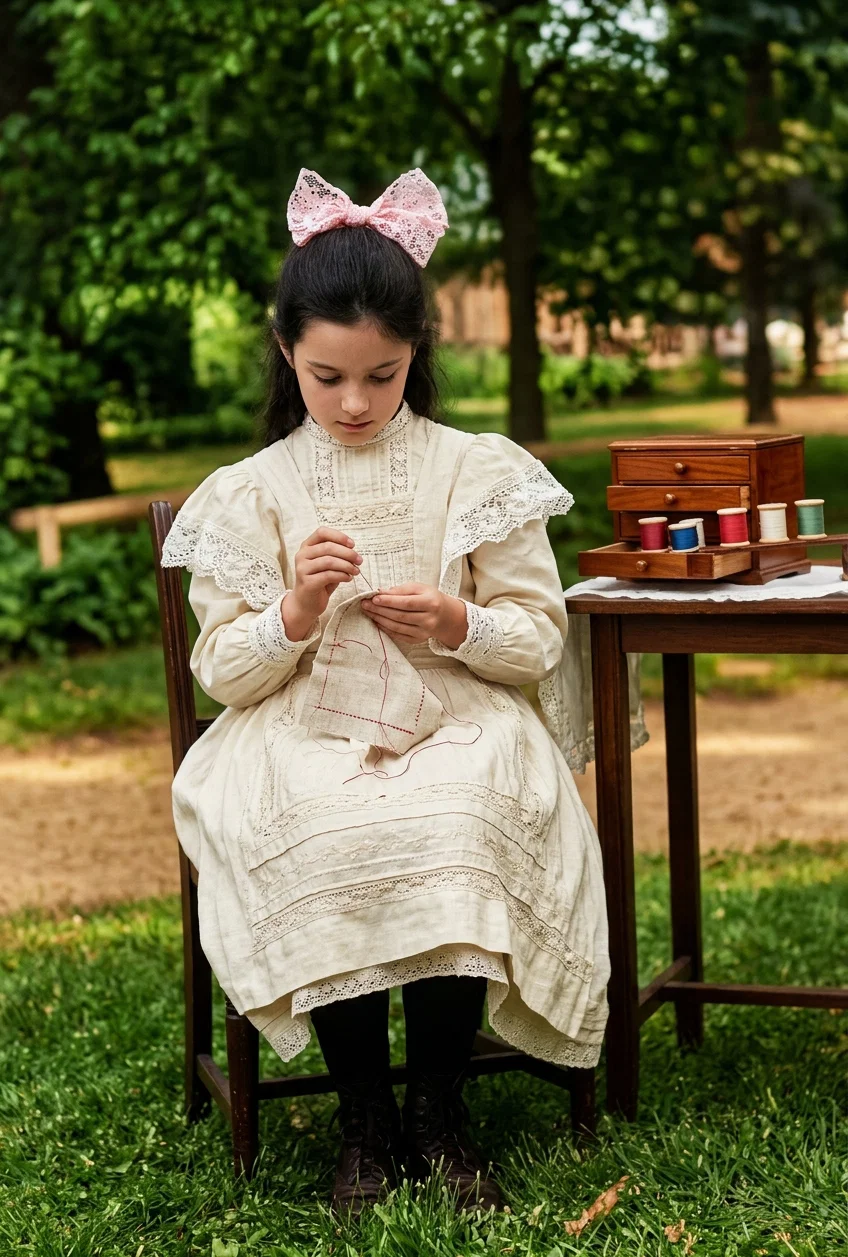
WITH a good system, and a teacher who is desirous of carrying it out to its fullest extent, learning to sew may be as delightfully interesting and as educational as any other branch of learning. As a matter of fact, however, much more depends upon the teacher than upon the system or the particular set of models used; for an earnest, interested teacher will have a good degree of success with any system, while an uninterested, indifferent teacher will fail with the best system, and under the best conditions that can be provided.
CORRECT POSITION IN SEWING
It seems needless to say that a teacher should herself do the work, and become thoroughly familiar with it, before attempting to teach it; but there have been teachers who have not recognized that this was necessary.
The object of the course which will be given here is to teach the principles of plain sewing in a simple but practical way. Doubtless there are other methods and models which would accomplish the same purpose equally well; but this one has been tested personally, and has proved satisfactory. The material is inexpensive, and can be obtained almost anywhere. The work can profitably be given to children seven years of age. Beginning at that age, the average child will complete it in about three years, allowing for two forty-five-minute lessons weekly. The expense will average about twenty-five cents a year for each child. It may be given to boys and girls alike as far as the fourth grade.
In arranging the course, an effort has been made to avoid that which is mechanical, and to make the work easily and naturally progressive. It is of vital importance that every teacher should grasp the fact that while this is a sewing course, sewing is not the most important thing that is to be taught in giving it. Good judgment, self-reliance, a trained eye, and correct habits of working are more valuable than even technical skill; and the teacher who fails to recognize this defeats the most important aim of the work. If you can not teach more than the models, do not teach the models.
To the superficial teacher the precision of detail which will be required may seem unnecessary; but let me ask, Can real excellence be achieved without precision of detail? And further, little by little, hour by hour, and moment by moment, all unconsciously to them, and often to us, the children who are given into our hands for a little time to train, are forming characters not only for this life, but for eternity. Can we, then, afford to neglect any opportunity of bending them in the right direction,—of making deep the impress of right principles? And is the principle of thoroughness and exactness one that is to be regarded lightly?
We read of our Saviour that “in his earth-life, he was an example to all the human family. . . . He learned the carpenter’s trade, and worked with his own hands in the little shop at Nazareth. . . . He did not use his physical powers recklessly, but gave them such exercise as would keep them in health, that he might do the best work in every line. He was not willing to be defective, even in the handling of tools. He was perfect as a workman, as he was perfect in character.”—“Special Testimonies on Education,” pages 38, 39.
It is as true of this course of sewing as of everything else, that the importance of forming correct habits in the beginning can not be overestimated.
The first thing to be impressed upon the minds of the children is that their hands must be perfectly clean before beginning to sew, and this is a point that should be carefully looked after each time the class is called. Next, see that each child is so seated that, when sitting well back in the chair, the feet may rest squarely on the floor. Low chairs are greatly to be preferred, but the ordinary school seats may be used if necessary. If chairs are used, arrange them in a semicircle. The teacher should be seated during the class period, and in such a position that she can readily observe the movements of each child. A well-lighted room is, of course, essential.
The correct position is erect, with the lower part of the body against the back of the chair, the feet near each other, and resting easily on the floor. In this position the lungs are not cramped, and the arms have freedom of movement. The position may be maintained indefinitely without fatigue, as there is no strain or cramping of any part of the body.
The work should be held sufficiently high in the hands to prevent the need of lowering the head. It is seldom necessary to rest the work on the lap while sewing. The teacher’s own position should illustrate what she is attempting to teach, and her vigilance over herself and her pupils should never relax. Sewing in itself is not an unhealthful occupation. It is the bad position, and the wrong conditions under which it is done, that bring the evil results so often seen.
It would be preferable, of course, to have everything needed within reach of each child; but as that is scarcely possible for many of our schools, the supplies should be on a desk or table, to which each may go as he has need. It is possible to allow this and still maintain order and quiet.
A good spool-stand, which will accommodate a dozen spools of thread, may be made from a piece of board twelve inches long, five inches wide, and one inch thick. It should be planed, the corners cut off, and the edges beveled. Wire finishing nails of suitable size to receive the spools, should be driven into the upper surface at equal distances apart.
A thimble-stand may be made from a circular piece of wood of the same thickness, and six inches in diameter. The edges of this should also be beveled, and the desired number of five-eighths-inch holes bored to the depth of one-half inch. The holes may be arranged in some symmetrical design, as a star. A piece of wood of this size will accommodate two dozen thimbles. Bits of jewelers’ cotton may be put into the holes, and the thimbles put in, tops downward. This arrangement makes it easy for the children to fit themselves, and for the teacher to keep track of the thimbles.
Aluminum thimbles are quite satisfactory for school use, as they are inexpensive and do not tarnish. Teach the children that to fit properly, the thimble should allow the finger to touch the top, and yet not be loose enough to fall off if lightly shaken.
The materials for the first model are double-thread penelope or railroad canvas, and dark-red saxony yarn. Long-eyed, round-pointed tapestry needles, No. 21, should be used. The canvas is twenty-five cents a yard. One yard will make three dozen or more models. This material was chosen because it does not tax the unaccustomed eyes of the children, and there is no difficulty in securing a uniform length of stitches, as these are governed by the squares of the canvas. By the time this model is completed, the children should naturally assume and maintain the correct position. They should properly manipulate needles, thread, and thimbles, and should know the names and uses of the various stitches used in the model, and be quick to recognize any irregularities or imperfections in the work. This may sound large, but27constantly repeated experience has demonstrated that it is not expecting too much of either pupils or teacher.
CORRECT POSITION OF THE HAND
There are many grades of the canvas, but that having about twelve double threads to the inch should be chosen. Every tenth thread is dark, thus making a stripe. The piece for each model should be eleven full stripes wide, and nearly an inch longer than wide.
The yarn should be wound into a soft ball. The first step is to teach the children to measure off the proper length of yarn, and to thread their needles. The ball, to prevent rolling, should be placed in a small box or basket, and for the first lesson may be passed around the class, letting each in turn help himself. To determine the length, let the child take the end of the yarn between the thumb and forefinger of the right hand, and with the basket containing the ball resting on the lap, take the ball lightly between the thumb and forefinger of the left hand; then place this hand on the chest directly below the chin, and stretch the other out its full length to the right, letting the yarn pass freely through the left hand; then drop the end from the right hand, and break the yarn at the point which the left hand marks. This gives each child a length in proportion to his own arm.
Thread the needle by placing one end of the yarn over the side of the needle; hold both between the thumb and forefinger of the left hand, slip the needle out, pulling upward, and pressing tightly between the thumb and finger in order to make a sharp, wedge-shaped fold in the yarn. This will slip readily through the long eye of the needle. See that each pupil thoroughly masters this step before proceeding further.
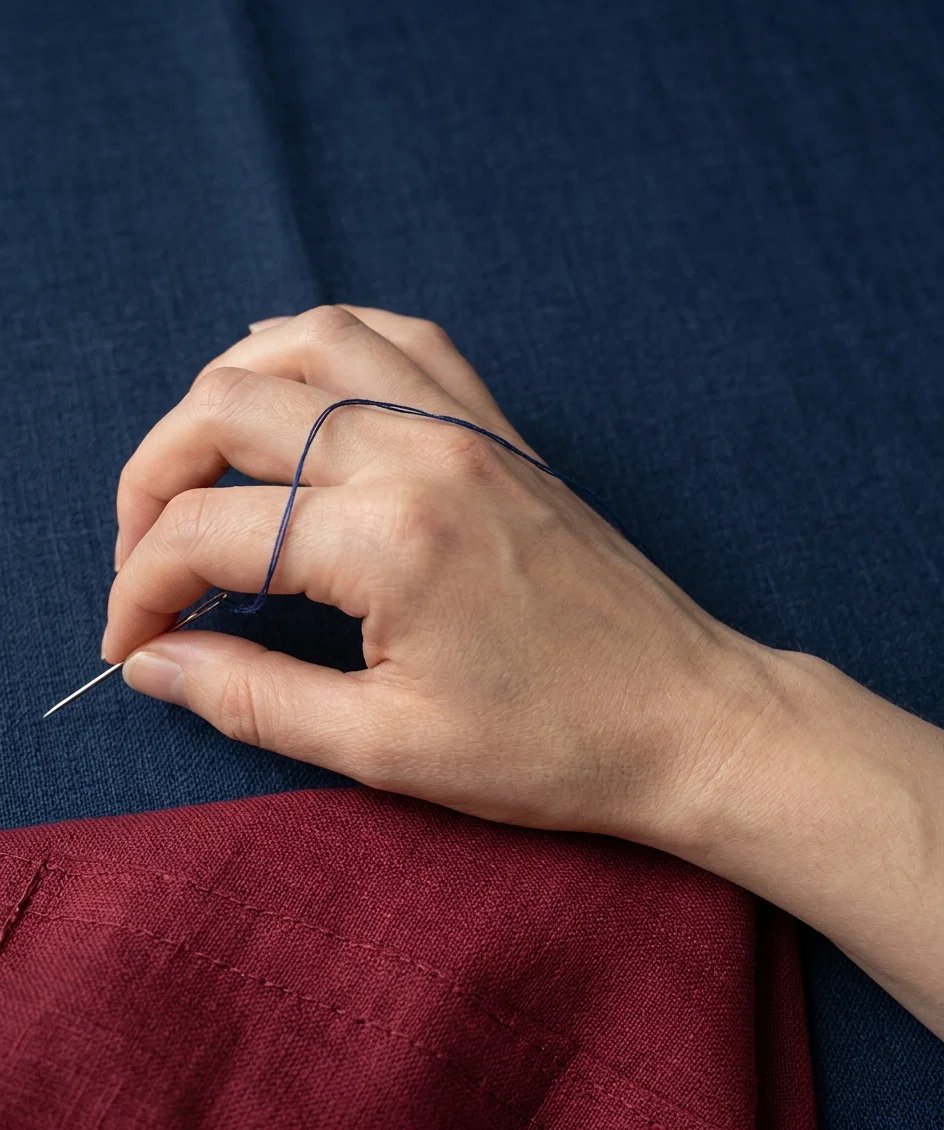
To prevent the canvas from being crumpled by inexperienced hands, it is well to spend a little time in learning to take the stitches in paper. See that the thimble is on the right finger, and properly used. In pulling the thread through, it should fall between the middle fingers. Do not neglect this seemingly small matter. It marks the difference between a clumsy, awkward movement, and a correct, graceful one.
Acquiring the correct position, the correct way of threading the needle and taking the stitches is sufficient for the first lesson, unless more time is allowed than the usual class period.
Mrs. E. M. LONG.
Living Geometry
“THINGS which are equal to the same thing are equal to each other.” That is a familiar statement in school-book geometry, and so simple that any one can at once see the truth and reason of it. Yet it is not merely a truth for school; it applies to real life.
So it impressed one young student, who, in studying his geometry, came upon this axiom, and was struck with a new meaning he had never seen in it before. He had, like most boys, a hero, and for some time had been wishing he were like a certain young man who seemed to him the type of all that was good and manly. He had even tried to imitate him, but not, it must be said, with very great success.
But here was a suggestion. “Things which are equal to the same thing are equal to each other.” Why not work that out? It must be true of persons as well as of things. He finally reasoned it like this: His hero friend was good because he seemed in many ways to be like Christ; then if he himself could be more like Christ, it would follow that he would be more like his friend. He had been looking at the wrong ideal first; and he saw now that if he looked first to Christ, and took him as his ideal and hero, he would become more like his friend, because he would have the same standard of character, the same pattern to follow. It would be easier and better to take the original example first; then the two copies would be more like each other.
There is very good reasoning in that; don’t you think so? It is a practical way of making your geometry live.—The Wellspring.
The Care of Books
By Vera Mueller
HAVING had opportunity during the past few months to learn something of the care of books, it occurred to me that what I had learned might prove beneficial to others, especially to the church-school teacher. So much depends upon the manner in which a book is used, that it would seem advisable for even small children to know something of the care of these, our precious friends.
When first opening a new book, the pages should be carefully separated, never turning the covers back, as this injures the binding. Books are so cheap nowadays that not even the higher-priced ones are well-bound. Children's books will wear much better and soil less easily if covered with one or two coats of shellac. Unless very fortunate in mixing the shellac, it is better to buy that already prepared. Do you wish to have the books labeled? With a clean cloth apply ammonia to a place just the size of the label, and allow it to dry. This removes the dressing, and helps the label to stick. Now paste on the label, and rub until dry. Then write the book number with India ink, and cover with shellac. Thus treated, the label will endure considerable wear. Unless a book is strengthened (and I believe most school-books are), paste a strip of cloth, an inch wide and as long as the book, at both the front and the back of the book, letting it lap an equal distance on both cover and fly-leaf.
When pages come out, they may be tipped in. On one side of the inner edge of the loose page put a little paste. Take a strip of gummed paper, fold lengthwise, and paste against the loose page and the page opposite. Frequently we see a book with the covers off, or nearly off. If they are only hanging on, tear them off. Now hold the book without the covers firmly in one hand, and paste a piece of white cambric over the back, which it should exactly fit. Cut a much wider piece, and paste the edge on the back of the book over onto the fly-leaf, then across and back on the cover, which must be held tightly against the book. After doing this at the front and the back, you have a book with a good cover. Torn pages may be mended with oiled or invisible paper. The paper should be cut according to the shape and size of the tear. A piece on either side makes it less liable to further tearing.
Children soil their books in a short time unless the books have an extra cloth or paper cover. I suppose none of us like to handle these sticky germ-breeders. To clean the covers, rub with a cloth saturated with ammonia; to clean the pages, rub them with finest powdered pumice. Some may very effectually be cleaned with a paste solution, but this is tedious and slow work. It can not be done on all kinds of paper.
It might be well to add that, when using paste, a small quantity should be put into a saucer, and stirred until thin. This makes it smooth, and easy to work with. VERA MUELLER.
The Cause of Christian Education at Walla Walla College
By M. E. Cady
The first semester of the school year has passed, and we are now well started in the work of the second. As we review the work of the first half of the year, we see multiplied evidences of the blessing and presence of God upon and with us in our efforts to carry out the principles of Christian education in this institution.
The large attendance at the school has been a great encouragement to the faculty. Already the enrolment has reached three hundred sixty-five, which considerably exceeds the enrolment of last year. Of this number, one hundred seven are students of the normal training department.
Even though there are eight intermediate schools in the North Pacific Union Conference, with an enrolment of about four hundred students, still the enrolment of the college has more than doubled during the last four years. Surely the Lord is calling our youth to hasten the work of preparation necessary to qualify them to act their part in the closing message, and more and more clearly do we see the great work that lies before our schools, from the primary school, where the children are taught, to the training-school, where young men and women are trained for active service in the great world-wide field.
The normal training department is a demonstrated necessity in connection with our college work. This work has been changed from a poorly lighted room in the basement of the college to quarters of its own, consisting of a well-lighted, properly heated, two-story building, with necessary facilities for carrying on the work. The enrolment has increased from thirty to one hundred seven; and four thoroughly trained, consecrated teachers constitute the normal faculty. There are twelve students in the normal teachers' class, but there ought to be twice that number.
The college has an excellent, earnest class of students, who are doing thorough work in their studies, thus showing an appreciation of their opportunities.
But the success of the school does not depend upon large numbers, nor upon strong courses and elaborate equipments, but upon the degree of moral power pervading the school. We are glad to report good interest in the religious and missionary phases of our work. The week of prayer was a precious season. The Lord came near to the school last year during this time, but this year the28blessing and presence of the Spirit of God was still more manifest. The enemy of souls was present to resist the workings of the Spirit, but he was vanquished, and many captives were set free. I have never seen the powers of darkness so determined to resist the powers of light, but truly, “where sin abounded, grace did much more abound.” On two occasions, the Spirit of God was present with such convicting power that all studies were laid aside, and the Heavenly Guest was our instructor; and he taught lessons of far greater import than those assigned for the day. There was confession of sins, and an earnest seeking of God for complete victory in the life. The Sabbath following the week of prayer twenty-seven souls were buried with Christ in baptism. Others have since decided to take this step at the first opportunity.
Every Tuesday, at 5:45 P. M., the Missionary Volunteer Society meets for a general program, or the various working bands of the society meet to lay plans for aggressive work. A good work has been accomplished, and temperance and missionary rallies, held from time to time, have emphasized the importance of a thorough preparation to do efficient service for the Master.
An important feature of the missionary work of the school is the Foreign Missionary Band, which meets each week, the evening after the Sabbath. It has now a membership of sixty, and all hold themselves in readiness to respond to the calls that come from the fields afar. The members of this band are earnest workers in the Missionary Volunteer Society, and believe that home missionary work and experience is a necessary step in the preparation needed to qualify them for the work in foreign lands.
The Lord has blessed in the temporal and material things necessary for the progress of the work, and this has been a source of great encouragement to the students and faculty. Through the efforts and sacrifices of the students, teachers, friends, and patrons of the school, we have been enabled to improve our chemical and biological laboratories, and now, through a five-hundred-dollar contribution from Dr. Mary Johnston, of Boise, Idaho, we are installing a physical laboratory. Last year we were enabled to secure a four-and-one-half inch achromatic telescope, provided with an equatorial mount. This instrument greatly multiplies the interest in the study of the starry heavens, which declare the glory of God.
We are looking forward with great interest to two memorial days. The first of these will be Sunday, February 7, 1909, at which time the normal school building will be dedicated, free from debt. For this building, so comfortable and convenient for carrying on the work of normal training, we are indebted to Elder and Mrs. H. W. Decker, now living in Portland, Ore. These faithful pioneers have always had an interest in the proper training and education of the children and youth, and have always freely contributed of their means to this end; and their recent gift of three thousand dollars for the erection of a normal school building, where children may be properly taught, and teachers thoroughly trained to teach in our church-schools throughout this union conference, and elsewhere, is certainly a wonderful uplift to the cause of Christian education. May God richly reward these servants of his for their love and sacrifice in behalf of the struggling cause of Christian education.
We hope soon to have the second memorial (memorable) day, when we shall dedicate the Walla Walla College to God, free from debt. A little over three years ago a plan was laid for lifting a debt of twenty-five thousand dollars from the college. Already a little over twenty thousand dollars of this debt has been paid, and we hope, before the present school year closes, to sing the song of jubilee of freedom from debt, and evermore to remain free from it. The past three years the Walla Walla College has been operated without running behind. It has not only met its running expenses and kept up the repairs, but it has also paid the interest on the debt, and last year it had a net gain of two thousand dollars.
The sanitarium building, erected two years ago, has proved inadequate for the increasing patronage; so another story is being added to the building. The sanitarium is a real blessing to the school, and we trust that the general educational advantages offered by the college will prove a real help by giving the nurses an opportunity for laying a good foundation for their special work.
Thank God that the work is onward all along the line. Pray that the work at Walla Walla College may not come behind, but may move steadily forward in its heaven-appointed work.
M. E. CADY, President.
Alberta Industrial Academy
By J. L. Stansbury
We have forty-nine students enrolled, and three more have sent word that they are coming. I am glad to report that we have a very earnest and consecrated company of young people. I am well pleased with the good degree of spirituality in the school. It is the expressed purpose of nearly every one to be a worker in some part of the cause of truth. Several have paid their expenses by earning scholarships; others are planning to join in this work next summer.
A large per cent of our students are mature young men, who have a very definite purpose in view, and if they adhere to this purpose, in a short time this school can be called upon to furnish recruits for mission fields. They manifest an active interest in Sabbath-school work and young people’s work, and they are having the benefit of the experience of conducting Sabbath-school and young people’s meetings.
The weather has been very severe. For several nights the thermometer registered 50° to 60° below zero, and we are not very well protected from cold. Some of the coldest nights it registered as low as 20° below zero in our sleeping-rooms. Two families are living in tents on the school farm, that they may have the advantages of the school. In spite of all this exposure and the bitter cold, we are all enjoying good health. Nothing more serious has resulted than a few frosted ears, noses, fingers, and toes.
We are confident that students who cheerfully endure these disagreeable features, and do not allow our meager and inadequate accommodations to hinder or certainly discourage them in their educational work, are gaining an experience that will be a very essential qualification for missionary work in foreign countries, where there are so many obstacles to be overcome.
We have been pleased to note a marked progress in the various classes. Our hearts are filled with praise and thanksgiving to our Heavenly Father for the many evidences of his Spirit among us.