TO SAY that there is an issue in society to-day, is only to state a fact of which all are abundantly aware. And in saying that this social question is world-wide we merely say what is already well known. When Major Howe, from his little island home within the borders of California, declared a few days since that the corruption and fraud in this country had become so repugnant to him that he could no longer remain a citizen of the nation, he stated the feelings that many others seem on the verge of expressing. This social question is discussed in all the papers and magazines, whether secular or religious. On the rostrum and in the pulpit it is the theme for consideration.
“What is to be done with the tramp?” “How shall we take care of the growing pauper class?” “How can we suppress the robbery,murder,vice,and crime that are so prevalent?” “And how can we harmonize capital and labor?” All these and other like questions are being earnestly asked about the social status of things to-day.
Some of these social questions have been up for discussion more or less all through the ages. But the remarkable thing to-day is that so many issues and social perplexities should arise together, and that they should be discussed with such heated earnestness. And it must be apparent to any thoughtful person that an agitation like this can not continue without a serious crisis being reached.
He who reads the causes that led on to the French Revolution must be impressed with the similarity—it might be said the identity—between the issues in France there and what is before all the world now in this social question. “The nobility secular” and “the nobility spiritual” owned nearly everything there was in the kingdom, just before the Revolution burst forth. The “third estate,” as the common people were called, was bowed down with poverty, and the sight of the luxurious pleasures of the nobles filled their minds with grievances. The difficulties were discussed pro and con, and Louis XVI., as mild and generous a king as France ever had, did all in his power to get the wealthy nobles to satisfy the just grievances of the “third estate.” Their complaints were ignored, and in due time the Revolution, with its Reign of Terror, came on.
The horrible barbarities committed by the frenzied people in that time can never be justified. But they all might have been avoided if the selfishness of the nobility had yielded to the reasonable reforms that the age then demanded. And so the “Revolution” and “Reign of Terror” that now threatens, not France only, but all the world, could be turned aside if the selfish heart of man would yield to the ways of righteousness. But we have not the slightest ray of hope that the self-centered age in which we live will heed this great object lesson in history.
There is one thing, however, of which we may be sure; that is, that we have entered the time when, as in the days just previous to the deluge, “the earth also was corrupt before God, and the earth was filled with violence.” Gen. 6:11. And the Lord has forewarned us that “as it was in the days of Noe, so shall it be also in the days of the Son of man.” Luke 17:26. We may not hope to close up the fountains that are even now “filling the earth” with “violence.” But we can point all to the promises of the soon coming of the Saviour, and tell them of this “Lamb of God that taketh away the sin of the world.” And He is the Refuge for every one who can be led to receive Him. T.
THE SIGNIFICANCE OF THE MONEY QUESTION.
By T.
THAT there is a money question, no one can deny. The presidential campaign in this country two years ago had no other issue that could gain the attention of the people. Some political speakers and writers tried to have the “tariff” and other questions discussed, but no one cared to talk of anything but the “money question.” And, altho nearly two whole years lie between us and that heated campaign, the “money question” is still the political issue.
President McKinley in his speech in New York a few days since said that it is an obligation “to the people to insist upon the settlement of this great question now, or else to face the alternative that it must be again submitted for arbitration at the polls.”
The President sees, then, that this “great question”—this money issue—is still alive, and that unless something is speedily done, his party will have to meet it at the “polls” again in two years hence. And discussions in Congress, yes, in fact, all over the country, show that there is a money issue.
But why all this talk about money? Is it because there is so little wealth in the land? Is it because destitution is so gaunt and haggard that it is so necessary to be all the time talking about money so as to provide a way to relieve the distress? Let some great enterprise be launched that insures good dividends and security and there is no lack of the millions that come rolling out to be invested. Great fortunes, almost fabulous in their colossal magnitude, are being amassed. And there may be seen much reveling in luxurious and costly pleasure that is wanton and wasteful in its extravagance. And still there is a money question. This money question, too, has been agitating the public very strongly for four or five years, and the agitation bids fair to continue. And all this notwithstanding the fact that the country is fairly surfeited with wealth.
Then, after all, is it truly a “money question”? When the bare facts are revealed, does not the real question consist in the concentration of practically all of this wealth in the hands of a few men, while thousands of others are destitute? And will it be possible to ever devise a monetary system that will give each one all he wants, especially since a few seem to be willing to grasp all that can be produced?
The true inwardness of this “money question” is very clearly set forth in the first part of the fifth chapter of James. And when we see these evidences of the soon coming of the Master, so overwhelmingly abundant all about us, we should be comforted by the admonition, “Be patient therefore, brethren, unto the coming of the Lord.” The Lord is surely coming, and the day is near. At that time every question will be settled, and the settlement will be eternal as well as right. T.
THE CHINESE EMPIRE.
In the fate of the Chinese Empire the political and social destiny of more than one-fourth of the human race is directly involved. The time may come when the events of the last few weeks and the next few months will be looked upon as among the most important events in the history of mankind.—New York World.
CRIME UNDER POLICE PROTECTION.
By T.
About four years ago the well-known Lexow committee was doing its work in New York. Upon sworn testimony, it was shown by that investigation that the police in New York City not only protected gambling, prostitution, and other forms of vice and crime, but they were actually in partnership with the criminals, and came in for their share of the proceeds. The police claimed these dividends as a reward for keeping their official eyes closed, and of course would do all in their power to assist criminals to escape arrest. The startling revelations made by that official investigation, together with the comments upon it through the press, have been before the country for quite half a decade. And, notwithstanding the opportunity thus afforded, no one has yet arisen to show that the charges were false or overdrawn. There is something very dark in the picture, when crime can run riot in our land, and instead of the officers of the law suppressing it, they protect it for the sake of sharing in the proceeds of plunder and vice.
And now the reports are coming of an investigation of the Chicago police by a committee from the State Legislature. In this examination it has been ascertained that these “guardians of peace and good order” in Chicago have also been in partnership with crime. Indeed, the despatches say that the chief of police was pressed so closely that “he apologized for the thugs and toughs who had been appointed as members of the police force since he was made chief.” And, further, when the investigation showed that some of the police had participated in the holding up of citizens, the chief characterized it as “an indiscretion,” and thought it an injustice that these officers should not “have another chance.”
Coincident with this investigation in Chicago a large committee of clergymen in Philadelphia have been looking into the criminal condition of that place. The despatch states that one of the ministers forming the committee said “they had counted 400 disorderly houses, and that they saw more vice in two nights than Parkhurst saw in his whole trip around New York. In nearly all of the places liquor was illegally sold, and plenty of evidence was obtained that the houses were protected by the police.”
In the time of Noah “God saw that the wickedness of man was great in the earth, and that every imagination of the thoughts of his heart was only evil continually.” “The earth also was corrupt before God, and the earth was filled with violence.” Gen. 6:5, 11. When “every imagination of the thoughts of his heart” is “only evil,” and when man becomes so corrupt that “the earth” is “filled with violence,” he has reached the very lowest depths of crime and degradation. Such was the condition of things in the times of Noah. And the Master says, “As it was in the days of Noe, so shall it be also in the days of the Son of man.” Luke 17:26.
Reader, as you view the situation to-day, and seriously ask the question, What does all this crime and violence in the land mean? how clearly the answer comes from the Word of God! Surely we are in that time when we can be earnestly looking for the coming of the Son of man. And how it brightens up the gloomy aspect to know that Jesus is soon to appear to put an end to all this vice, crime, and violence! T.
AN ANGEL UNAWARES.
The happiness brought by pure unselfishness is illustrated in a story told recently by a writer in the American Messenger:—
“I don’t see how we can manage it,” said old John Weston.
“Neither do I,” said his good wife Esther; “and yet—”
“Yet you’d like to send for the lass? you’d like to have her here, wouldn’t you?”
“Yes, I would. I’d like nothing better. When you come to think of it, John, there’s no joy one can ever hope to experience this side of heaven like the joy of helping and comforting others who are in need or in trouble.”
From a photograph of an orange tree six years old. This particular tree grows at Livermore, not far from this city. Seen in its natural color, the golden oranges intermingled with the green leaves form a beautiful picture.
“You’re right, you’re right. I’ve often thought as the Saviour must have felt a wonderful peace and joy in His pure heart as He went about doing good, raising the dead, giving sight to the blind, and healing the sick. Aye, and He left us an example that we should follow in His steps.”
There was silence for a moment, then the old man spoke again.
“You say the poor lass is suffering from consumption?” he asked.
“A tendency to consumption,” replied his wife, referring to the letter she held in her hand. “She’s been sitting too close at needlework, and she’s got into a low, weak state; and the doctor who has attended her says that country air and country living for a few weeks would do her more good than all his medicine. The lady who has written about her says she would pay five shillings a week for her. Of course, when we advertised in the city paper saying we had two rooms to let, we were thinking of getting some one who could afford to pay for them; then we meant to lay that money by towards paying off the interest on the mortgage. It seems strange, doesn’t it, that this is the only answer we have had? We thought—”
“Aye, aye, we thought this, that, and the other, good wife, but the Lord’s ways are not like our ways, nor His thoughts like our thoughts. Who knows but He means us to take this poor lass in and do our best for her? If the Saviour came knocking at the door, wearied and worn, we’d take Him in, wouldn’t we?”
“Readily, gladly,” was the reply.
“Then let us take one of His poor, suffering children in; for the letter says the girl is a good Christian. We’ll pinch and save a bit somehow or other to make up for what expense we may be put to; you’re willing, I know.”
“Willing? Yes, John, I’m more than willing. In such straitened circumstances as we are just now, we seem to have so little money to give, but I can give time and help and care; I can try to nurse this poor girl back to health and strength again. I’ll answer this lady’s letter to-day, and tell her that this Phyllis Price she has written about may come as soon as she likes.”
Three days later, Phyllis Price, a sweet-faced, delicate-looking girl, arrived at the little farm where old John Weston and his wife had lived ever since their wedding day, and received from the good couple the heartiest of welcomes.
She soon felt quite at home with them, and told Mrs. Weston all her story of struggle and sorrow—how her father had died suddenly, leaving her and her mother unprovided for; how her mother had obtained a situation in a large store in the city, and how she had taught her child to do the fine needlework required there.
“Then a year ago,” said Phyllis, “mother died; and since then—O, I can not tell you what my life has been! The people at the store were very good to me; they have kept me supplied with work; but in the winter I had a severe illness, and if it had not been for the kindness of Mrs. Barnes, the minister’s wife, who answered your advertisement, I do not know what I should have done. I have been ailing ever since the winter, but now that the beautiful spring has come, a few weeks’ rest here in your dear little home will set me up and make me quite strong again. You have no children, you say?”
“Our three children are dead,” replied Mrs. Weston. Then, motherlike, she told her willing listener story after story of her loved ones. Of her past sorrows she spoke freely, but of her own and her good husband’s present monetary difficulty she said not a word.
Only Phyllis, lying awake one night long after her kind friends believed her to be asleep, could not help hearing them talking to one another about the interest that had to be paid on the mortgage on their farm. It came as a revelation to the girl how, owing to bad harvests, loss of cattle, and scanty crops, the good old people, who had cared for her as lovingly as if she were their own child, were bearing a heavy burden day by day. For the first time she realized that they were fully conscious that, unless the interest on the mortgage could be kept paid up, the home in which they had lived and worked together for so many years, would have to be sold.
Phyllis cried herself to sleep that night as she thought of the coming trial she had no power to avert. In the morning she received a letter from Mrs. Barnes, asking her to return to town for a day in order to see a lady who called to inquire about her.
“She knew your mother in her girlhood,” wrote Mrs. Barnes, “and deeply regrets having lost sight of her for so many years. Her husband is a merchant in a western city, and is here with his wife making large purchases. They spent a large sum at the store you work for, and, inquiring for some one to do some particular kind of work, heard of you. Mrs. Enfield (that is the lady’s name) came to me for your address, and I told her your story. She is able and willing to help you, my dear girl. Pray come at once.”
Phyllis went, but when she met Mrs. Enfield she had not a word to say about her own difficulties; she could only tell the story of the Westons’ troubles.
“I am young and regaining my strength,” she said, “thanks to the nursing and devoted care of two old people who took me, a complete stranger to them, into their home. The pitiful sum they have received weekly for my board can never pay for all they have done for me. If only you would assist them by a temporary loan to tide them over—”
“Hush!” exclaimed Mrs. Enfield; “we have enough and to spare. We regard ourselves as stewards of the wealth God has given us. I will speak to my husband.”
She kept her promise, and to such good purpose that very soon John Weston’s difficulties vanished, and there was no longer any fear of his having to leave his dearly-loved home in his old age.
At her own request Phyllis took up her abode with him and his good wife. “My10friends at the store will send down plenty of work to me,” she said, “and this lovely air is so much better for me than the city; and, if you will have me, I will stay and try to be like a daughter to you all.”
If they would have her! Ah! there was no need to ask the question; the good people were only too glad to keep her with them.
“You came to us a stranger, dear,” said Mrs. Weston; “but John and I are agreed that in opening the door of our home to you, we were preparing, little as we thought it, to entertain an angel unawares.”
A TALE OF A BONNET.
By Susan E. Gammons
A TRAGEDY IN THREE PARTS.
Part I. The Bonnet.
A bit of foundation as big as your hand;
Bows of ribbon and lace;
Wire sufficient to make them stand;
A handful of roses, a velvet band—
It lacks but one crowning grace.
Part 2. The Bird.
A chirp, a twitter, a flash of wings,
Four wide-open mouths in a nest;
From morning till night she brings and brings,
For growing birds, they are hungry things—
Ay! hungry things at the best.
The crack of a rifle, a shot well sped;
A crimson stain on the grass;
Four hungry birds in a nest unfed—
Ah! well, we will leave the rest unsaid;
Some things it were better to pass.
Part 3. The Weaver.
The lady has surely a beautiful face,
She has surely a queenly air;
The bonnet had flowers and ribbon and lace;
But the bird has added the crowning grace—
It is really a charming affair.
Is the love of a bonnet supreme over all,
In a lady so faultlessly fair?
The Father takes heed when the sparrows fall,
He hears when the starving nestlings call—
Can a tender woman not care?
—Susan E. Gammons.
Student Convention.
The Greatest College Gathering in the History of the Church.
In Cleveland, Ohio, meeting February 23d through the 27th, there will be assembled the convention of the Student Volunteer Movement for Foreign Missions, and will call together representatives from
The Colleges of North America.
Representative students and professors from the denominational colleges, the independent and state universities, the theological seminaries and medical colleges of the United States and Canada, will be present. The larger part of the delegate body will be made up of students and professors in these institutions, many of whom have pledged their lives to further Christ’s kingdom throughout the world.
It is a fact that over fifty of the great missionary boards will be officially represented by missionaries, editors of religious journals, clergymen, professors, and board secretaries. Such young people’s movements as the Christian Endeavor Society, the Brotherhood of St. Andrew, and the Epworth League, will send official representatives.
Nations of the Orient.
A reliable statement is made that in addition to the delegate body from the United States and Canada, representatives will be present from the following countries: Great Britain and Ireland, India and Ceylon, Burma, Laos, Malaysia, China, Korea, Japan, Persia, Syria, Turkey, Papal Europe, Central Africa, North Africa, South Africa, West Africa, the United States of Colombia, Brazil, Chile, and the mission fields in the Pacific islands.
What Is the Volunteer Movement?
The Student Volunteer Movement is widely known as an interdenominational missionary agency, having more than 800 institutions of higher learning in the United States and Canada as its field. It does not independently commission or support missionaries, but works in co-operation with the regular mission boards, and through its efforts hundreds of missionaries have been furnished the boards, and are now laboring in the Orient, Africa, and South America.
Among its objects are:—
1. To enlist the students in the colleges and theological seminaries in prayer and labor for the proclamation of the Gospel throughout the world in our generation.
2. To enroll among the students of the continent volunteers who may be sent by the boards to the different fields for lay or clerical service.
3. To inform, through its extensive system of educational classes, the Christian students of North America in regard to the progress and needs of modern missions. In over 300 colleges there are such classes following the movement’s courses.
4. To arouse students and other Christians to the obligation of immediate financial co-operation with the different boards of missions.
HOLIDAY CUSTOMS OF THE JAPANESE.
By W. C. Grainger
Of the many holidays observed by the Japanese, New Year’s day is the most important. Until a few years ago the Japanese reckoned time by the Chinese calendar, but, to be in harmony with western nations, they now begin the year with January 1. From about the middle of December, apparently the all-absorbing thought is the approaching holiday. The first step in preparing for the event is house-cleaning, a universal custom that had its origin a long, long time ago, no man knows when. What little furniture the house may contain is removed, the floor mats are carried out and beaten, the walls, screens, and closets are carefully dusted, and the floors, pillars, and other woodwork polished bright with a scrubbing cloth. Among the nobility and the wealthy, house-cleaning is said to be conducted with considerable ceremony.
After the house-cleaning comes the decorating, which is a matter of tradition also. The outside kazari (decorations) consist of a heavy rope made of rice straw, stretched above the front door or gate, to which is appended a fringe of the same material. To this rope are attached an orange, a lobster (or crayfish), some leaves of fern, a few leaves of an indigenous evergreen called yuzuriha, a strip of edible seaweed named kombu, a string of dried persimmons, and above all some strips of white paper. On each side of the entrance are placed a young pine tree and a bamboo. The two pines must be, according to the rules governing such things, of about equal proportions, the one (the male), somewhat rough and prickly, and the other (the female), smoother and more graceful. The former is placed on the left side of the entrance and the other on the right. These are said to be emblematical of constancy and endurance. The inside kazari is made up in a way similar to that outside, with the addition of potted plum trees, anemones, etc., according to the taste of the family. These are all supposed to greet the visitor in his own peculiar dialect. The language of the orange is, “May your family be prosperous from generation to generation,” and that of the crayfish, “May you live so long that your back becomes bent like mine, and that your whiskers grow so long as mine.”
For two or three weeks previous, at certain privileged places fairs are held for the sale of decorating material. Booths are erected in the streets where these and many other things are sold, especially such as are supposed to invite prosperity or to keep off evil spirits.
Rich or poor, every family must have mochi11for New Year’s day. What is mochi? It is boiled rice pounded into a stiff dough, and a more unpalatable mess I have never tasted. It is heavy, insipid, and indigestible. In olden times each family prepared their own mochi, but of recent years nearly all obtain it from the confectioners. It must be custom that impels people to eat it, for to my mind nothing but a perverted taste could relish it. The origin of this custom is unknown, and I have so far been unable to ascertain its significance.
The evening of the last day of each month, and especially the evening of the last day of the year, it is the custom for each family to gather around the family board and partake of soba, a kind of macaroni made from buckwheat flour, and put up in bunches that resemble skeins of thread or bunches of shoestrings. It is rather more agreeable to the taste than mochi, but is an article that an American can do without very well. The origin and significance of this custom are uncertain, but were probably at some time and in some way connected with the religious superstitions of the country, for those of the Shinto religion still, at times, offer soba to their tutelar deities.
While speaking of the customs connected with New Year’s eve, it is well to mention that of squaring accounts between creditor and debtor. It is considered a disgrace for a man to pass into the new year with debts hanging over his head, consequently the last day of the year is a very busy one to the merchant; but all are expected to settle before 10 o’clock P.M. that he may have opportunity to eat soba with his family.
JAPANESE NEW YEAR DECORATIONS. The upper one at the right is the most common; the lower frequently seen; the upper at the left rarely seen; and the lower not numerous.
The custom of making presents prevails among all classes, but, unlike Americans, as far as I have observed, the utilitarian idea governs in the bestowal of gifts. Among the middle and upper classes, boxes of eggs, baskets of fruit, salted salmon, boxes of cake, and papers of sugar are the most common articles used. The value of the present rarely exceeds fifty cents, and is always put up in a certain way,—baskets, boxes, and papers of certain designs, and always tied with a bunch of paper twine, one half red and the other white. There is also attached to the package a bit of red and white paper folded in a way similar to a school-boy’s thumb paper. The strings and paper are accessories of all presents. If they have any significance other than to indicate that the package is intended for a present, I have not been able to find it out. Packages for presents are always kept on hand by dealers, for the Japanese are much given to bestowing gifts at all seasons of the year. All of our visitors brought presents with them the first time they called to see us. When a man moves into a new neighborhood, he is expected to make presents to his new neighbors if he desires to cultivate their acquaintance. A mess of soba must be sent to each family, with his compliments, otherwise they will always remain strangers to him. The giving of presents is carried to such an extreme that the faculty of the Imperial University a few years ago declared against it, and have since used their influence to break up the custom; but so far they have met with little if any success.
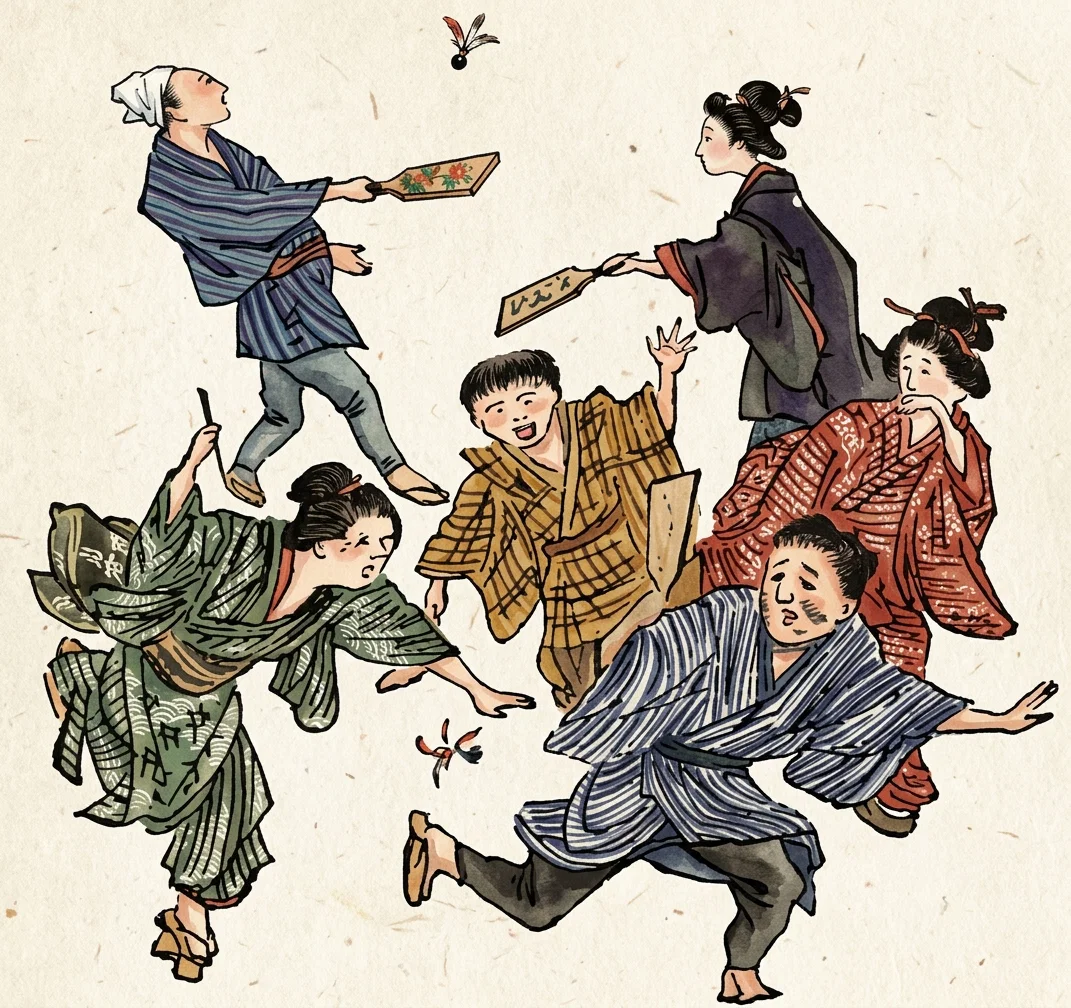
Japanese Children Playing Shuttlecock.
Children are not neglected in the distribution of presents at the beginning of the new year. The boys usually receive kites, and the girls handballs, or shuttlecocks and battledores. New Year’s day the streets were full of boys and girls, the former flying kites and the latter playing shuttlecock. The Japanese kite is in its way a thing of beauty, and to see the sky filled with them is a very pretty sight. In playing shuttlecock whoever fails to catch the shuttlecock with his battledore must have a spot of ink daubed on his face. The game is a very exciting one, and is sometimes played by both sexes. These two games, when the weather is fair, will be all the rage for the next three months. To all appearances the new year brings joy and happiness to everybody.
W. C. GRAINGER.
Tokyo, Japan.
HOW LINOLEUM IS MADE.
At first sight cork and linseed oil seem most unlikely materials for making carpets, yet no less than twelve million yards of linoleum, consisting almost entirely of these substances, are produced every year in Great Britain. Linseed oil is specially prepared and mixed with resin found in kauri gum, a curious fossil resin found in New Zealand. Cork is pulverized by a machine known as a cork-breaker, which consists of a number of very strong circular saws, rotating close to steel bars the ends of which are toothed in an opposite direction to the saws. The ground cork leaves the breaker in fine powder and is very dangerous to handle. The material is so light that it easily becomes suspended in the air, producing a highly explosive mixture.
It would be safer to take a naked light into a powder magazine than into the building where the cork is ground. All lights are carefully guarded. But in spite of every precaution, explosions are sometimes started by sparks from the machinery. The powdered cork is then mixed with the oil and resin cement. After a preliminary rough mixing, the compound is passed into a gigantic sausage machine, where the materials are incorporated thoroughly. The raw linoleum as it issues from the spout bears a close resemblance to German sausages. The lumps of linoleum are passed through rollers, which convert the material into sheets. These are scraped off the rollers, and the substance is then rolled into a backing of jute canvas or wire gauze, thus making plain linoleum.—Selected.
The Wheel.
There are tens of thousands of men and women who five years ago were in the habit of attending church on Sunday who now spend the day riding in the country. As a result of it all, the church is confronted with the gravest situation she has faced since the Reformation.—Rev. S. D. McConnell, Episcopalian, Brooklyn, N. Y.
Character
CHARACTER.—Man decides the question of character. If God had made it impossible to sin, there could have been no character. Man at his best would have been a machine. Neither virtue nor heroism would have been possible.—Dr. J. R. Westwood, Methodist, Philadelphia, Pa.
Cleanliness and Reverence for God
“CLEANNESS of body was ever esteemed to proceed from a true reverence of God.”
OUR FAULTS.
At our birth, the satirical elves
Two sacks from our shoulders suspend:
The one holds the faults of ourselves,
The other the faults of our friends.
The first we wear under our clothes,
Out of sight, out of mind, at the back;
The last is so under our nose
We know every scrap in the sack.
—Household Words.
DOES HE CALL YOU?
JESUS calls me, I am going,
Where He opens up my way,
To the toiling of His vineyard,
Shrinking not a single day.
Friends may shun me, toil await me,
Crucifixion be my lot;
But I’ve chosen Christ my Saviour,
I am going, call me not.
Jesus calls me, I am going
To the life He wills for me;
This poor world can’t fill the aching
Of my heart, or set it free.
O, what anxious, bitter sorrow
Does the world give with its strife;
But with Jesus,—O, what glory!
Ending in eternal life.
Jesus calls me; I am going;
O, that all would test with me,
All the power of Christ’s salvation,
For the fountain’s full and free.
Test the grace so freely offered,
Know the worth of Christ within;
Rise and share the bliss transcendent—
Freedom from the power of sin.
—Selected.
OUR HELPING HAND MISSION.
By S. N. Curtiss
Considerable interest is already being manifested by the people of San Francisco in the work which it is proposed to do there for the Lord’s poor. The Mission has been located on the very camping-ground of the enemy of all righteousness, a place where within a stone’s throw more than eighty saloons are doing their worst to ruin men, body and soul. Think you that there will be lack of opportunity for work in such a place? Nay, verily. The appeals for help began to come in, even before the Mission doors were opened to the public, and already the beneficent work has begun. Food and lodging are being furnished to some of the homeless men who were only too glad to work hard every day for their food and a place to sleep.
In the great cities of San Francisco and Oakland will be found a sufficiently large field for all the workers which the Mission can command, and its accommodations are sure to be taxed to the utmost in caring for the poor, the destitute, and the fallen of these cities alone.
By the time this paper reaches most of its subscribers, actual work will have been begun in earnest for the Lord in the Helping Hand Mission. Every evening of the year, Gospel meetings will be held, and is it too much to ask that those who have an interest in this work, and those who have helped so nobly with their means, remember in their daily prayers the work and workers here?
The question has been raised as to whether the Mission would support the indolent poor. This is not intended, nor is it intended that any one person shall long be retained and assisted; but men will be helped onto their feet, and a temporary home furnished them until they can get out and secure employment, or get a new start in life, and then they must make room for others. Thus our sphere of usefulness can be made as wide as possible, and the largest number benefited.
There is the best of evidence that the Lord has put His hand to this work, and we are sure that if it is carried on as He would have it, as He directs, a rich harvest of souls will be the result.
This article is headed “Our Helping Hand Mission.” You can make this a truth so far as you individually are concerned, dear reader, by taking some interest in it. Do you want it to be our Mission? If so, there is still need of liberal contributions of money, clothing, and provisions. A good start has been made, but only a start, and let us all put our shoulders to the wheel now and give a lift all together. We can assure all that every dollar donated and every contribution of clothing or food will be conscientiously and wisely used for the Master. Hundreds of dollars might have been spent already in the work which has been done, but so far it has been almost entirely volunteer service. And12thus in every way we shall plan to make the means intrusted to us go as far as possible.
What a transformation has taken place within the walls of those two buildings! The dingy old rooms have been scraped, calcimined, painted, scrubbed, and cleansed until no one would know them. How inviting they will appear to the tired, homeless, friendless man who, after his delightful bath, views them for the first time! Perhaps it may be the first time he has had the privilege of sleeping in a good, clean bed, free from vermin, for weeks or months. Can such a man fail to feel that there must be some reality in the Gospel which such a people preach, and in the religion which leads them to search out the destitute in the highways and byways?
Texts of Scripture have been put on the walls of every room, so that, go where you will, some helpful portion of that Word which is “spirit and life,” greets the eye.
The board of management has set February 27 as the day for the dedication, and the services will take place at 3 P.M. It is hoped and expected that the officials and many of the prominent citizens of both San Francisco and Oakland will be present at that time. The Mission having been in operation for some time previous to this, visitors will at this time see everything in running order, and can judge for themselves what must be the results of such work.
Some very liberal contributions have been received since the report in last week’s paper. Among these was a donation of $50 from a brother in this State, and one of $120 from “a friend” in Washington, D. C.
The large expenses incident to the furnishing of the rooms must soon be met, and we hope many others will esteem it a privilege to assist in this work.
The following is the report of cash received up to February 9:—
Reported last week . . . . . . $474 90
Cash received this week . . . . . . 279 95
Total . . . . . . $745 85