From the Christian Educator we cull the following items:—
“At the district conference held at Graysville, Tenn., in November, the educational work in the South received special consideration. It was unanimously voted to place Graysville Academy on a substantial industrial basis, and that the name of the institution be changed to ‘Southern Industrial School.’”
“The Oakwood Industrial School, located at Huntsville, Ala., has one of the most beautiful farms in all the South. The old plantation building, now about seventy years old, is still in a fine state of preservation. What is needed now in order to make the work a success is a commodious school building. This is our leading school for the education and training of colored youth, and its mission is an important one. The laws and customs of the different States in the South require that the white and colored children be kept in separate schools. It makes no difference whether the school be public or private. Thus an ordinary school district must have two schoolhouses and two teachers, in order to do what is accomplished in the North by one building and one teacher.”
“The enrolment in Battle Creek College thus far during the year is 650 students; present attendance, about six hundred. The industrial department has recently been increased by the addition of a shoe shop. Three hundred dollars worth of machinery will also soon be put in for the manufacture of rugs. Opportunity is thus given to students to learn these trades, and help pay their school expenses. This college has sent out this year fifteen missionary teachers, some into foreign lands, and some to take charge of church schools in different States. Others are soon to go into the South to enter the same line of work. Among the latest to other lands are Mr. and Mrs. W. A. Gosmer, to teach on the island of Bonacca, and Mr. and Mrs. W. A. Ruble and Miss Ellen Burrill, to South Africa. Later: A cablegram announces the sad death of Mrs. Gosmer and a number of other missionaries, from yellow fever.”
21 “Now after these things were ended, Paul purposed in the spirit, when he had passed through Macedonia and Achaia, to go to Jerusalem, saying, After I have been there, I must also see Rome. And having sent into Macedonia two of them that ministered unto him, Timothy and Erastus, he himself stayed in Asia for a while. 23 “And about that time there arose no small stir concerning the Way. For a certain man named Demetrius, a silversmith, which made silver shrines of Diana, brought no little business unto the craftsmen; whom he gathered together, with the workmen of like occupation, and said, Sirs, ye know that by this business we have our wealth. And ye see and hear, that not alone at Ephesus, but almost throughout all Asia, this Paul hath persuaded and turned away much people, saying that they be no gods, which are made with hands; and not only is there danger that this our trade come into disrepute; but also that the temple of the great goddess Diana be made of no account, and that she should even be deposed from her magnificence, whom all Asia and the world worshipeth. 28 And when they heard this, they were filled with wrath, and cried out, saying, Great is Diana of the Ephesians. And the city was filled with confusion; and they rushed with one accord into the theater, having seized Gaius and Aristarchus, men of Macedonia, Paul’s companions in travel. 30 And when Paul was minded to enter in unto the people, the disciples suffered him not. And certain of the chief officers of Asia, being his friends, sent unto him, and besought him not to adventure himself into the theater. 32 Some therefore cried one thing, and some another: for the assembly was in confusion; and the more part knew not wherefore they were come together. And they brought Alexander out of the multitude, the Jews putting him forward. And Alexander beckoned with the hand, and would have made a defense unto the people. But when they perceived that he was a Jew, all with one voice about the space of two hours cried out, Great is Diana of the Ephesians. 35 And when the town clerk had quieted the multitude, he said, Ye men of Ephesus, what man is there who knoweth not how that the city of the Ephesians is a temple keeper of the great Diana and of the image which fell down from Jupiter? Seeing then that these things cannot be gainsaid, ye ought to be quiet, and to do nothing rash. For ye have brought hither these men, which are neither robbers of temples nor blasphemers of our goddess. If therefore Demetrius, and the craftsmen that are with him, have a matter against any man, the courts are open, and there are proconsuls: let them accuse one another. 39 But if ye seek anything about other matters, it shall be settled in the regular assembly. For indeed we are in danger to be accused concerning this day’s riot, there being no cause for it; and as touching it we shall not be able to give account of this concourse. 41 And when he had thus spoken, he dismissed the assembly.
QUESTIONS.
1. How long did Paul labor at Ephesus?
2. Tell the striking results of his ministry there.
3. After these things, what did he purpose to do? Where did he intend to go before visiting Jerusalem? What place did he then purpose to visit? Verse 21.
4. Whom did he send on before he started? Where did he himself remain? Verse 22.
5. What took place at that time? Verse 23.
6. Who was the instigator of the trouble? What was the source of the silverworkers’ profit? Verse 24.
7. Whom did this man assemble? How did he address them? Verse 25.
8. What did he say as to the influence of Paul’s preaching? Verse 26.
9. What did he say was in danger? What as to the temple and worship of Diana? Verse 27.
10. What effect had these words upon the craftsmen? How did they show their religious zeal? Verse 28.
11. How extensively did the agitation spread? Whom did the people seize? And what did they do? Verse 29.
12. What did Paul seek to do? Verse 30.
13. What shows the esteem in which Paul was held by the better people? Verse 31.
14. What was the condition of the assembled mob? Verse 32.
15. Whom did the Jews put forward as their spokesman? Verse 33.
16. How was he received? What sort of an uproar ensued? Verse 34.
17. Who quieted the crowd? To what did he refer as an established fact? Verse 35.
18. If, as they believed, the worship of Diana was from heaven, what ought they to do? Verse 36.
19. What testimony did he give concerning the peaceable character of Paul and his companions? Verse 37.
20. What did he say was the proper means of settling any real grievance? Verses 38, 39.13
21. In what danger did they stand? Verse 40.
22. What did the town clerk then do? Verse 41.
NOTES AND QUESTIONS.
1. The town clerk was undoubtedly a heathen; yet see how he had grasped the principle that truth can defend itself. Compare the words of Joash, the father of Gideon. Judges 6:28-31.
2. Note that this great tumult, which, but for the prudent management of the town clerk, might have resulted in a wholesale persecution and massacre of the Christians, was wholly a business matter. The silversmiths’ devotion to the goddess Diana was wholly a question of profit: from the worship of Diana they got their living. Their opposition to Paul was solely on account of the fact that the spread of Christianity interfered with their business. Even so in the days of Trajan, the persecution that was raised against the Christians, concerning which Pliny wrote to the emperor, was due to the fact that those who sold cattle for the heathen sacrifices, found their business diminishing.
OUR WORK AND WORKERS.
The new church building at Libertyville, Iowa, was dedicated on the 23d ult., Brother C. Santee officiating.
The Reporter says “the brethren and sisters of the Madison (Wis.) church have begun a systematic work with the SIGNS in the capital city.”
At the Keene (Texas) Academy, forty-five of the students are preparing especially for labor in some department of the work. Of this number twenty-nine are men and sixteen young women. On the 8th ult., three students were baptized.
The citizens of the “highways and hedges” of Columbus, Ohio, were recently invited to attend the Seventh-day Adventist Church, and, to the surprise of all, the church was filled at the hour for prayer-meeting. A hall has now been secured where meetings will be held and where supplies of food and clothing will be given out to the needy. Here as elsewhere there is a hearty response from the business men of the city.
Rescue mission work has been fairly started in Lincoln, Neb. A three-story building has been leased, and prepared for the rescue of unfortunates, both men and women. Prominent citizens are taking an active part in meetings which have been started. The police matron is also lending a helping hand. Meetings are held four evenings in the week, and several have professed conversion, while many have asked for prayers.
In a letter to the Kansas Worker, Brother C. A. Hall, a missionary to Jamaica, gives some of his experience as follows: “Here we go alone with our tent, do our cooking, wash dishes, sleep, eat, pull teeth, dress sores, do up cuts and bruises, visit and read with callers, read, write, and study, all in our one large tent. As I now am, the dust is thick; my chair, a bench; my bed, an old door laid across a couple of benches, with my bedding laid on it; my food, such as the natives bring in or I cook myself; my congregation, from one to two hundred nightly, and preaching every night; and am in better health than when I left Kansas; and, best of all, am enjoying the presence of God as I never did in more prosperous days and more pleasant surroundings. I wish I had one of our young brethren from Kansas here to develop in this field. It would be a fine experience for him, and would last him till the end.”
The Michigan Conference Committee have decided to establish a mission in Detroit. The committee has also adopted the following resolution: “Resolved, That we recommend a number of our laborers to make a specialty of the canvassing work, and that the profits on their canvassing work go to the conference fund; that they retain their credentials and licenses, and that their accounts be audited by the auditing committee, the same as the other laborers.”
The Avondale School Board (Cooranbong, N. S. W.) are erecting a building for the accommodation of young men and boys, to be named Herman Hall, which will accommodate forty-two persons. The board is also planning to make a special effort to have taught such studies as lie at the foundation of a thorough training in nursing. To this end they have invited Dr. Kate Lindsay, of Battle Creek, Mich., to visit the school on her way from South Africa to the United States.
The following press despatch, dated the 4th inst., has been going the rounds to tell of a good work in Kansas City: “An experimental mission, where the poor are to be served meals at a penny a dish, and a bed for five cents, with a bath thrown in, has been started here under the direction of the church of the Seventh-day Adventists. One hundred and fifty cots have been placed in a large room in a building on the second floor. In the basement, bath-tubs have been provided, together with a room for fumigating clothes and a laundry in which a man may wash his own clothes. The meal consists entirely of vegetables, meat being barred because of its expense and the work of cooking it, and because the management are believers in vegetarianism.”
PERIODICALS WANTED.
Clean copies of the SIGNS, Review, and Our Little Friend will be used in the jails and other missionary work if sent post-paid to W. H. Stanley, 4460 Seventeenth Street, San Francisco, Cal.; or if left at the church, 914 Laguna Street.
Mrs. C. B. Webb, Box 63, Holliday, Mo., desires old copies of the SIGNS, Sentinel, Instructor, and Our Little Friend, for reading racks.
OUR GENERAL AGENTS.
General Eastern Agency.—Pacific Press Pub. Co., 39 Bond St., N. Y. City, N. Y.
General Central Agency.—Pacific Press Pub. Co., 14-18 W. 5th St., Kansas City, Mo.
Argentine—Señor N. Z. Town, Casilla del Correa, 481 Buenos Ayres, Argentine Republic, S. A.
Arkansas Tract Society—Fayetteville, Ark.
Atlantic Tract Society—39 Bond St., New York City, N. Y.
Australia—Echo Publishing House, North Fitzroy, Victoria.
Australian Tract Society—251 St. George’s Road, North Fitzroy, Australia.
California Tract Society—1059 Castro St., Oakland, Cal.
Texas Tract Society—626 and 628 Elm St., Dallas, Tex.
Upper Columbia Tract Society—College Place, Wash.
Utah Tract Society—Box 185, Salt Lake City, Utah.
Vancouver Island—B. Robb, 231 Pandora St., Victoria, B. C.
Vermont Tract Society—190 N. Winooski Ave. Burlington, Vt.
Virginia Tract Society—2504 E. Clay St., Richmond, Va.
West Virginia Tract Society—Newburg, W. Va.
Wisconsin Tract Society—Milton Junction, Wis.
Your Life Work
Is it of Men or of God? A new tract in the Apples of Gold Library. Order A. G. L. No. 20. Price, 50 cents per 100 or one cent each in small quantities. Address, PACIFIC PRESS PUBLISHING CO., Oakland, Cal.; Kansas City, Mo.; or New York City, N. Y.
THE TALENTS.
By M. C. Wilcox
By M. C. Wilcox. A brief essay on “The Parable of the Talents,” showing that the talents represent the various gifts of the Spirit which God bestows as he will upon those who are consecrated to him, with the duties and blessed privileges involved therein. Bible Students’ Library. No. 77; 16 pp., price 2 cents.
Notes on New Tracts
“THE ALARM OF WAR”
Contains 17 engravings. A copy should be placed in the hands of every military man in the United States at once. Price, 2 cents.
THE ENGRAVING found on the cover page of “Christian” Demand for War is an object lesson in itself.
THE PSYCHOLOGY OF SUGGESTION is the title of a new book now being published in New York City. According to the publishers, “the sub-conscious nature of man’s psychic life is closely examined, and a theory . . . is worked out. “TRY THE SPIRITS” presents no “theory” of man, but introduces the wonderful truths of God on this subject. Price, ½ cent.
LESSON X.—SUNDAY, MARCH 6, 1898
JESUS AND THE SABBATH.
NOTE.—The observance of the Sabbath is one of the most important duties of the followers of Christ. Man shows his homage and loyalty to his Creator by yielding obedience to this divine command. The Sabbath command is placed in the very bosom of the law of God, that man could not tamper with it without doing violence to the ten great Words—rending them asunder. The Sabbath command is the seal of God’s law, for it is the only portion of that law which tells by whom it was given, the reason for its establishment, and the authority of the Giver. It is God’s own appointed memorial of completed creation. Being such, its only true observance is on the particular day upon which God Himself appointed it. Any change of the day which God ordained for that memorial would be as unreasonable as to celebrate the signing of the Declaration of Independence upon the 22d of February. Man has said, “All that the commandment expressly requires is to observe a day of sacred rest after six days of labor.” But let the student read carefully the fourth commandment (Ex. 20:8–11), and Gen. 2:2, 3; also Isa. 58:13, 14; Ex. 16:4, 5, 19–30. Had any of the Israelites attempted while in the wilderness (Exodus 16) to use the cunning sophistries of men and begin the numbering of their days so as to bring their rest day on some other than the seventh day appointed by the Lord, the miracle of the manna would have brought them very quickly to their senses. Let not the teacher or student accept such illogical reasoning as shown in the sentence quoted above, in order to avoid one of God’s most emphatic commands. If any should be tempted to do so and to teach others so to do, let them save their own souls by heeding the Saviour’s warning in Matt. 5:19. The lesson section includes the lesson scripture and the parallels given in Mark 2:23–28; 3:1–5; and Luke 6:1–10.
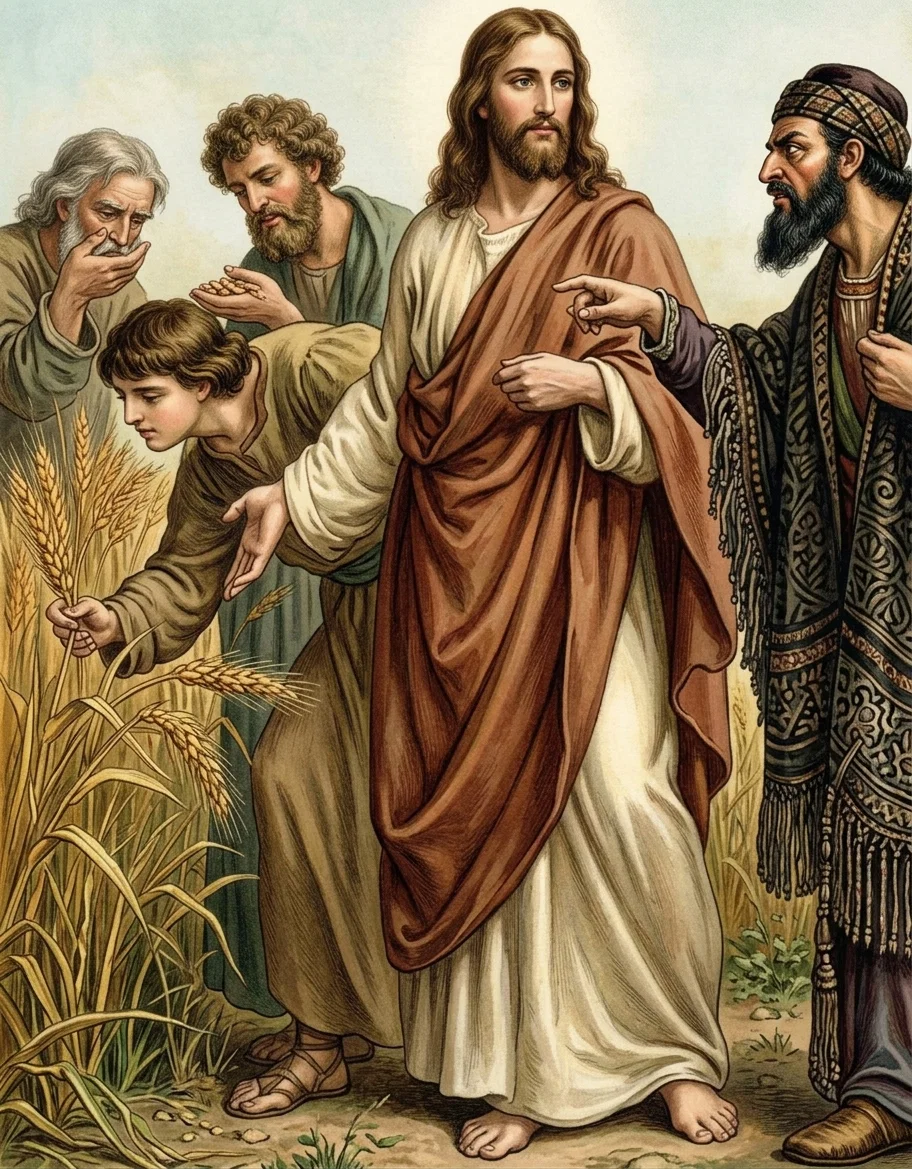
1 “At that season Jesus went on the Sabbath day through the corn fields; and His disciples were an hungred, and began to 2 pluck ears of corn, and to eat. But the Pharisees, when they saw it, said unto Him, Behold, Thy disciples do that which is 3 not lawful to do upon the Sabbath. But He said unto them, 4 Have ye not read what David did, when he was an hungred, and they that were with him; how he entered into the house of God, and did eat the showbread, which it was not lawful for him 5 to eat, neither for them that were with him, but only for the priests? Or have ye not read in the law, how that on the Sabbath day the priests in the temple profane the Sabbath, and are guiltless? 6 But I say unto you, that One greater than the temple is here. 7 But if ye had known what this meaneth, I desire mercy, and not sacrifice, ye would not have condemned the guiltless. 8 For the Son of man is Lord of the Sabbath. 9 “And He departed thence, and went into their synagogue; and 10 behold, a man having a withered hand. And they asked Him, saying, Is it lawful to heal on the Sabbath day? that they might accuse Him. 11 And He said unto them, What man shall there be of you, that shall have one sheep, and if this fall into a pit on the Sabbath day, will he not lay hold on it, and lift it out? 12 How much then is a man of more value than a sheep! Wherefore it is lawful to do good on the Sabbath day. 13 Then saith He to the man, Stretch forth thy hand. And he stretched it forth; and it was restored whole, as the other.
Golden Text: “The Son of man is Lord even of the Sabbath day.” Matt. 12:8.
SUGGESTIVE QUESTIONS.
(1) On what day did the incident of to-day’s lesson occur? Verse 1. (2) Where were Jesus and His disciples at the time? Same verse. (3) What did the disciples do? Same verse. Note 1. (4) What complaint was made to Jesus on account of this? Verse 2. Note 2. (5) What pointed question did Jesus ask the Pharisees? Verse 3. (6) What particular thing had David done which was contrary to law? Verse 4. Note 3. (7) Who only were allowed to eat the showbread? Same verse. (8) What other fact did He call to their mind which was also familiar to them? Verse 5. Note 4. (9) What did Christ say of the relative greatness of Himself and the temple? Verse 6. Note 5. (10) In condemning the disciples, what had the Pharisees done? Verse 7, last part. (11) What knowledge would have saved them from such a blunder? Same verse. (12) What relation does Christ sustain to the Sabbath? Verse 8. Note 6. (13) After leaving the corn field, where did Jesus go? Verse 9. (14) Whom did He see there that needed His healing power? Verse 10. (15) What question did the Jews ask the Saviour? Same verse. (16) What was their reason in asking this? Same verse. (17) What pointed question did Christ ask them in reply? Verse 11. (18) What was their evident custom in a matter of this kind? (19) What would they have to concede in regard to the worth of a man and a sheep? Verse 12. (20) Reasoning, then, from their own custom, what would be the conclusion? Same verse. (21) What did Christ say to the man with the withered hand? Verse 13. (22) What was the result? Same verse.
NOTES.
1. Plucked the ears of corn.—Evidently the heads of wheat or barley, for we see by Luke 1:6 that the kernels of grain were rubbed out in their hands. “The word ‘corn,’ as used in our translation of the Bible, has no reference to maize, or Indian corn, as it has with us. Indian corn was unknown till the discovery of America. . . . The word was applied, as it is still in England, to wheat, rye, oats, and barley.”—Barnes.
2. Not lawful to do on the Sabbath day.—There was nothing unlawful in the act itself, for it was sanctioned by the custom of the country, and is practised till this day. It was also permitted by the Mosaic law. See Deut. 23:25. But the Jewish leaders had woven about the Sabbath law a network of frivolous prohibitions, and claimed that the disregarding of these hair-splitting interpretations and prohibitions of their own was an infraction of the law of God. It was a part of Christ’s mission to sweep away these cobwebs and let the law shine forth in its purity, as it came from the mouth of God, but not to alter it in the slightest detail. Matt. 5:17–19; Luke 16:17.
3. The showbread.—A symbol of Christ, the Bread of life. Its continual presence in the temple would seem to indicate the continual presence of Christ himself in the spiritual temple of the soul that is dedicated to Him. 1 Cor. 6:19. The showbread was renewed every Sabbath day, a striking illustration of the blessing which the Sabbath is designed to bring. Each weekly cycle should work an upward step in the divine life.
4. Profane the Sabbath.—On the Sabbath the priests were engaged in killing beasts for sacrifice, in preparing fires for burning the offerings, and in other work connected with the temple service. It was work, bodily labor, which, if done for any other purpose, or by other persons on that day, would have been sin. But they were blameless, and the law regarded them so. Christ was showing them the inconsistencies of their own requirements, and establishing the fact that “it is lawful to do well on the Sabbath days.”
5. One greater than the temple.—Christ was greater than the temple, for it existed only because of Him and His work. The services of the temple all pointed to Christ.
6. The Son of man is Lord of the Sabbath.—He made it. John 1:1–3; Gen. 2:2, 3. He Himself had designated the manner in which it should be observed, and was the One best able to interpret the Sabbath law, of which He was the Author. This He did by precept and example. To change it was farthest from His purpose, as is shown by Matt. 5:17–19. Had He designed “to ennoble it by merging it” into some other day, He would have left us His own example in that regard by observing that other day Himself as He did in instituting the ordinances. John 13:15. His example and His custom in regard to Sabbath observance are recorded in Luke 4:16. The duty, in this respect, of the one who would follow Christ is plainly shown in 1 John 2:6. To say we can not tell which day is the seventh, will not release us from obedience to the Sabbath law. We have only to go back to the time of Christ for a starting-point from which to reckon; for none can deny that Christ during His earthly ministry kept the Sabbath which He had given, on the day which He had set apart for its observance; and the Jews in every quarter of the globe have kept that same recurring Sabbath from then till now. In addition to this, we have the witness of the historical fact that through the Dark Ages the Sabbath of the Lord, the seventh day, the only day the Bible recognizes as the Lord’s day (Rev. 10:1; Ex. 20:8–11; Matt. 12:8), was being observed by the Waldenses, Albigenses, the Petrobruyans, the Cathari, the Passaginians, the Armenians of the East Indies, and the Church of Abyssinia, which kept, and does still keep, both Saturday and Sunday, as it was taught to do by missionaries who visited Abyssinia in the fifth century.
GOING THROUGH THE CORN FIELDS.
Typewriters Cheap
Until recently we have had the Pacific Coast Agency for the “World’s Greatest” Densmore Typewriter. The magnitude of our publishing work has compelled us to relinquish this agency, and we are closing out our old model machines VERY CHEAP. Write for particulars.