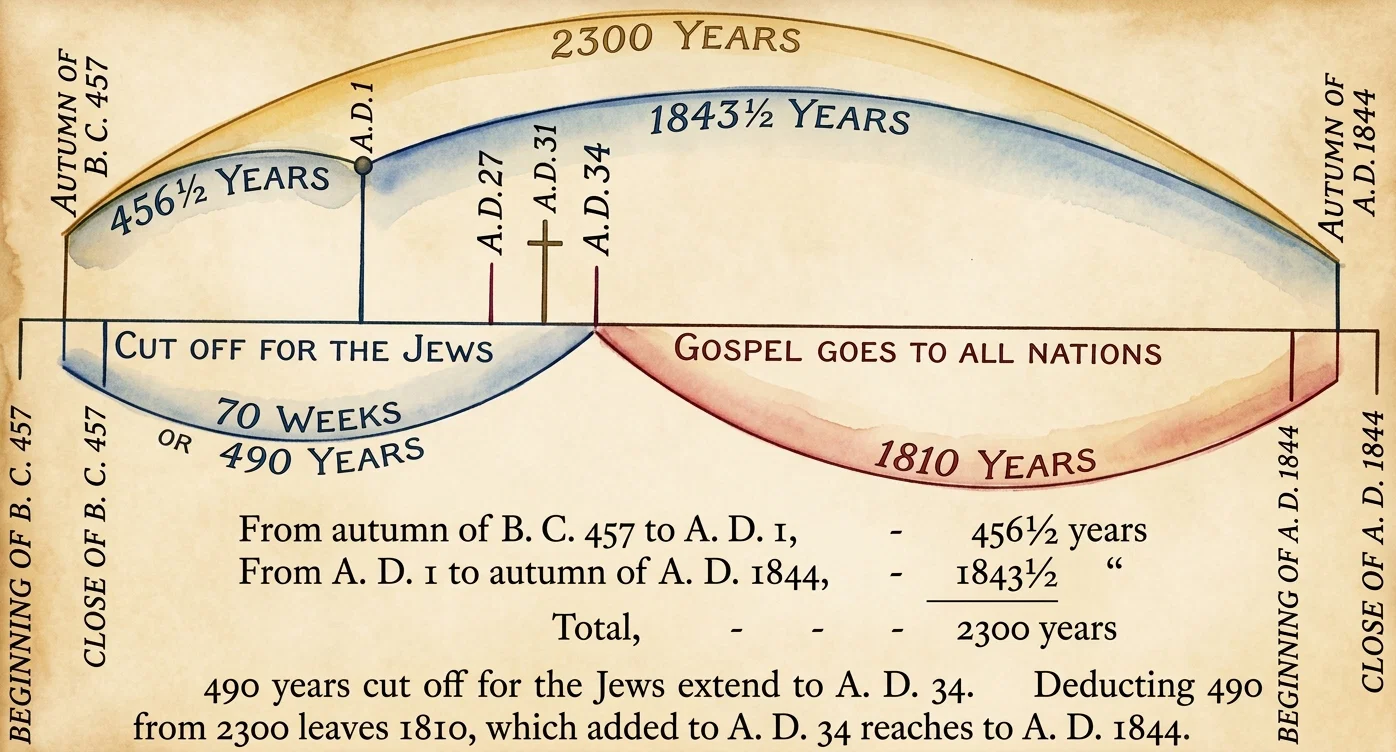
There is one more symbol in this chapter, which was not considered last week, namely, “two thousand and three hundred days.” The vision closes with verses 13, 14:—
“Then I heard one saint speaking, and another saint said unto that certain saint which spake, How long shall be the vision concerning the daily sacrifice, and the transgression of desolation, to give both the sanctuary and the host to be trodden underfoot? And he said unto me, Unto two thousand and three hundred days; then shall the sanctuary be cleansed.”
These two “saints,” or holy beings, are in some way connected with the giving of the vision to Daniel, for the question is concerning the length of time covered by it. The question is evidently asked for Daniel’s information, for the answer is directed to him instead of to the one who made the inquiry. The parallel is in verse 16: “And I heard a man’s voice between the banks of Ulai, which called, and said, Gabriel, make this man to understand the vision.”
On verse 14 two questions arise: (1) What is meant by the cleansing of the sanctuary? (2) What time is included in the “two thousand and three hundred days”? In the religious services of the Jewish Church, the day of atonement was observed once every year, on the tenth day of the seventh month. See Lev. 23:26–32. For the atonement service in detail see Leviticus 16. It is here shown that the high priest made an atonement for himself, for the people, and for the sanctuary; that all the sins that had been confessed during the year before the mercy-seat, were ceremonially or typically carried out and laid on the head of the scapegoat, and the goat was then taken away into the wilderness and abandoned. This was the closing of the yearly round of service; thus every year the Gospel plan was carried out in type, ending with the final act of atonement, the taking away of the sins of the penitent, and the condemnation of the wicked. In this way the sanctuary was cleansed typically, by the blood of the sacrificial goat, the type of Christ, the sinner’s substitute. That all this was typical of the final judgment work, is shown by Lev. 23:29: “For whatsoever soul it be that shall not be afflicted in that same day, he shall be cut off from among his people.”
But it could not have been the cleansing of the earthly sanctuary to which the angel called Daniel’s attention, for that typical day of atonement can not in any way be made to fit the prophecy. It has been shown in former articles that a prophetic day stands for an ordinary year, which carries the fulfilment of the prophecy away beyond that typical dispensation. Moreover, we are dealing with a prophetic vision which was “for many days” (verse 26), or for a long time.
Then what sanctuary could have been contemplated in the vision?—It could have been no other than the sanctuary in heaven, of which the earthly structure was a type. Christ is our “High Priest, who is set on the right hand of the throne of the Majesty in the heavens; a minister of the sanctuary, and of the true tabernacle, which the Lord pitched, and not man.” Heb. 8:1, 2. “For if He were on earth, He should not be a priest, seeing that there are priests that offer gifts according to the law; who serve unto the example and shadow of heavenly things, as Moses was admonished of God when5he was about to make the tabernacle; for, See, saith He, that thou make all things according to the pattern showed to thee in the mount.” Heb. 8:4, 5. Jesus could not be a priest on earth for the reason that he was not of the tribe of Levi, but of Judah. See Heb. 7:11–17. As the tabernacle on earth was typical of that in heaven, so also were the services, and there must come a time for the day of atonement, or cleansing of the sanctuary, in the heavenly tabernacle, according to the type in the earthly. Clearly this antitypical work, the judgment, is the point to which the prophetic period of “two thousand and three hundred days” reaches.
This fact will be further elicited as we consider the time symbol. It must be noted that while the angel was explaining the vision to Daniel, the prophet “fainted, and was sick certain days.” Dan. 8:27. Of course the explanation had to cease for the time being, but the Lord’s messenger came again to finish his mission. In the ninth chapter we have the record of Gabriel’s return. The prophet was studying and praying about the matter of his people’s return to Jerusalem, the time of the captivity foretold by Jeremiah (seventy years) having almost expired. Of the return of Gabriel Daniel says:—
“And whiles I was speaking, and praying, and confessing my sin and the sin of my people Israel, and presenting my supplication before the Lord my God for the holy mountain of my God; yea, whiles I was speaking in prayer, even the man Gabriel, whom I had seen in the vision at the beginning, being caused to fly swiftly, touched me about the time of the evening oblation. And he informed me, and talked with me, and said, O Daniel, I am now come forth to give thee skill and understanding. At the beginning of thy supplications the commandment came forth, and I am come to show thee; for thou art greatly beloved; therefore understand the matter, and consider the vision.” Dan. 9:20–23.
No. 4. DIAGRAM OF THE 2300 DAYS. (Symbolic Time.)
Thus the explanation of the vision was resumed just where it had been interrupted by the prophet’s fainting. Referring again to the time, the “two thousand and three hundred days,” the angel said:—
“Seventy weeks are determined upon thy people and upon thy holy city, to finish the transgression, and to make an end of sins, and to make reconciliation for iniquity, and to bring in everlasting righteousness, and to seal up the vision and prophecy, and to anoint the Most Holy. Know therefore and understand, that from the going forth of the commandment to restore and to build Jerusalem unto the Messiah the Prince shall be seven weeks, and threescore and two weeks; the street shall be built again, and the wall, even in troublous times. And after threescore and two weeks shall Messiah be cut off, but not for Himself; and the people of the prince that shall come shall destroy the city and the sanctuary; and the end thereof shall be with a flood, and unto the end of the war desolations are determined. And He shall confirm the covenant with many for one week; and in the midst of the week He shall cause the sacrifice and the oblation to cease, and for the overspreading of abominations He shall make it desolate, even until the consummation, and that determined shall be poured upon the desolate.” Verses 24–27.
We are here informed that seventy weeks—490 days, or years—were allotted especially to the Jewish people, which would include the time that the Gospel was preached particularly to them by Christ and His apostles. We are also given the point from which the time was to be reckoned,—“from the going forth of the commandment to restore and to build Jerusalem.” There were three decrees concerning this work,—one by Cyrus (Ezra 1), one by Darius (chapter 6), and one by Artaxerxes (chapter 7). The latter being final, its date (B.C. 457) would constitute the conclusion of the commandment. Furthermore, the first two decrees pertained especially to the temple, while the last one included the secular government of the country, thus becoming an essential element in the restoration.
Therefore the “two thousand and three hundred days” began in the year B.C. 457, and the details as given by the angel to Daniel further confirm its correctness. From the going forth of this commandment to the time of Messiah the Prince was “seven weeks and threescore and two weeks,” or sixty-nine weeks—483 days, or years. The “seven weeks,” forty-nine years, was occupied in building the temple, the city, and the wall, “even in troublous times.” This brings us to B.C. 408. Then the sixty-two weeks, 434 years, carries us into A.D. 27, remembering that part of the first year had expired when the commandment went forth. In this year we find Messiah the Prince baptized and anointed by the Holy Spirit. “He shall confirm the covenant with many for one week; and in the midst of the week He shall cause the sacrifice and the oblation to cease.” Jesus preached three years and a half, just half of a prophetic week, and then, at His crucifixion, the typical services were annulled. The sacrifice to which they pointed was made on the cross, and the real mediatorial service of which they were a shadow, was begun when our High Priest ascended to heaven. During the other half of this “week,” the work was continued by the apostles while they preached the Gospel to the Jews only.
Thus the “seventy weeks” of the prophecy are made sure, and marked by well-authenticated events at the beginning and at the end. Therefore the question of the remainder of the time is only a matter of simple addition. The “seventy weeks,” or 490 years, reaches to A.D. 34. Then there are 1,810 of the 2,300 days, or years, to be added to that, which brings us to 1844. What was to take place then?—“Then shall the sanctuary be cleansed.” In other words, as has been shown by comparison of antitype with type, the final judgment work began at that time. Since then we have been in the solemn “day of atonement.” When our High Priest shall have ended that work, He will lay aside His priestly robes, be crowned a King, and come to execute, or carry out, the decrees of the judgment.
We are nearing the time, and when “the great day of His wrath is come,” “who shall be able to stand?” Rev. 6:17. “Who shall ascend into the hill of the Lord? or who shall stand in His holy place? He that hath clean hands, and a pure heart.” Ps. 24:3, 4.
W. N. G.
HIS BANNER OVER US.
By Viola E. Smith
Earth hath a thousand voices which proclaim
The love of God,—the breezes whisper it;
The slumb’ring forests tell it in their sleep;
The glad flowers smile it to the bending sky;
The stars sing of it in their courses vast;
All nature joins in swelling the sweet song,
And gladly rolls it to the throne of God,—
“His banner over us is love.”
Adown the long, dim vista of the past,
I see that royal banner floating free;
Beneath its folds night shineth as the day,
And wildernesses blossom as the rose.
That banner still is o’er us as of old;
Then let us follow, singing, where it leads,
And if the smoke of battle sometimes hides
It from our view, or lowering storm-clouds come
Between us and its blessed sheltering folds,
Let us sing on, sure that it still is there;
And let us follow up the shining heights,
Until, earth’s storms and conflicts far below,
We reach the glorious golden gates of God,
Whereto that banner leads.
VIOLA E. SMITH.
Sergeant Bluff, Iowa.
THE “PEACE-AND-SAFETY” CRY.
By X. Y. Z.
A Sign of the End.
1. THE true servant of God will warn the wicked of danger, and shun not to speak the whole counsel of God.
Witness: “If thou dost not speak to warn the wicked from his way, that wicked man shall die in his iniquity; but his blood will I require at thine hand.” See Eze. 33:1–11, also 2 Tim. 4:1–5; Acts 20:20, 27.
2. The cry of the false prophet has ever been one of peace and assurance in the time of danger.
Witness: “They have healed also the hurt of the daughter of My people slightly, saying, Peace, peace; when there is no peace.” Jer. 6:14. See also Jeremiah 23 and Ezekiel 13 and 22, and many other places.
3. A marked feature of the message which God will give to the world in the last days is that of warning and alarm.
Witness: “Blow ye the trumpet in Zion, and sound an alarm in My holy city; let all the inhabitants of the land tremble; for the day of the Lord cometh, for it is nigh at hand.” Joel 2:1. See also Rev. 14:6, 7.
4. God will place evidence of this message, not only in the Word, but He will write it in visible signs everywhere.
Witness: “And there shall be signs [1] in the sun, [2] and in the moon, [3] and in the stars; [4] and upon the earth distress of nations, [5] with perplexity; [6] the sea and the waves roaring; [7] men’s hearts failing them for fear, [8] and for looking after those things which are coming on the earth; for the powers of heaven shall be shaken. And then shall they see the Son of man coming in a cloud with power and great glory.” Luke 21:25–27. Here are eight signs, some of which are indicative of the wildest commotions, and there are many others, such as war preparations, heaping up of riches, etc.
5. The great day of the Lord, in the beginning of which Christ will return, will come upon the world as a thief.
Witness: “But the day of the Lord will come as a thief in the night.” 2 Peter 3:10.
6. Yet, notwithstanding all the signs and warnings, the peace-and-safety cry will be heard.
Witness: “They shall say, Peace and safety.” 1 Thess. 5:3.
7. But this cry will be but a precursor of the end.
Witness: “For when they shall say, Peace and safety; then sudden destruction cometh upon them.” 1 Thess. 5:3.
There will be another class who will heed the warning message, who will be watching, and who will not be overtaken as a thief.
Witness: “But ye, brethren, are not in darkness, that that day should overtake you as a thief.” See 1 Thess. 5:1–6.
NOTE.—Is it not plain that those who wish to escape the terrors of the day of the Lord must heed the warning message which God gives? And is it not also plain that the cry of “Peace and safety” which is raised, is Satan’s effort to soothe men to slumber in the midst of danger? Happy is he who knows God’s warnings to be “a more sure word of prophecy; whereunto ye do well that ye take heed, as unto a light that shineth in a dark place, until the day dawn.” 2 Peter 1:19. X. Y. Z.
HE “PARDONETH INIQUITY.”
SO DECLARES the Spirit of God by Micah, the Morasthite. “Who is a God like unto Thee, that pardoneth iniquity?” Micah 7:18.
The gods worshiped by the heathen were noted for their vindictiveness, hatred, revenge. That has been the natural man’s conception of God. He clothes God with the attributes of his own perverted nature, or invests Him with a character taught by a perverted theology.
Not so is Jehovah, the God of the Bible, the Father of our Lord Jesus Christ. Tho infinite in purity, tho hating sin with perfect and irreconcilable hatred, yet He loves and pardons the sinner.
This is the meaning of his name: “Jehovah, a God merciful and gracious, long-suffering, and abundant in goodness and truth, keeping mercy for thousands [of generations], forgiving iniquity and transgression and sin.” Ex. 34:6, 7.
What is iniquity?—It is lawlessness, that which is contrary to God’s law. What is sin?—“Sin is the transgression of the law.” “All unrighteousness is sin.” What is it to pardon, or forgive? “Blessed is he whose transgression is forgiven, whose sin is covered. Blessed is the man unto whom the Lord imputeth not iniquity, and in whose spirit there is no guile.” Ps. 32:1, 2.
What then is it for God to forgive?—It is to cover the sins, so that even He will not see them. It is to take them all away, so that not one will be reckoned against us. It is to count the sinner as tho he had not sinned. This is the way that God forgives.
Whom does He thus forgive? Every soul that needs and wants forgiveness in God’s way. He forgives him who is a sinner, who is laden with iniquity. He came “into the world to save sinners.”
“What must we do, when shall we come, in order that we may receive a pardon in which the eye even of God can see no sin in us?” Here is what the Lord says: “Let the wicked forsake his way, and the unrighteous man his thoughts; and let him return unto the Lord, and He will have mercy upon him; and to our God, for He will abundantly pardon.” Isa. 55:7. “If we confess our sins, He is faithful and just to forgive us our sins, and to cleanse us from all unrighteousness.” 1 John 1:9.
That is all, sinner. You can not lift yourself up. You can not cleanse away the sin. You can not make yourself better. But it makes no difference how great a sinner you are, if you desire to forever break with sin, just tell the Lord all about it. Give Him all the sins; He bought you with them; He will take them all away, and He will cleanse you. Do you not want to be a clean man or clean woman? Christ will receive and cleanse you, now, at once, if you will receive His Word. He “pardoneth iniquity.” Have you yielded yours?
“WHEN THEY SHALL SAY, PEACE AND SAFETY.”
By T.
THERE is to be a time when nearly to a man the people will be saying, “Peace and safety.” And the most remarkable thing connected with the situation is that they speak of this “peace and safety” right in the obvious presence of the most destructive dangers that the world has ever known. The evidence for the foregoing statements is based upon Scripture testimony. The Word says:—
“But of the times and the seasons, brethren, ye have no need that I write unto you. For yourselves know perfectly that the day of the Lord so cometh as a thief in the night. For when they shall say, Peace and safety; then sudden destruction cometh upon them; . . . and they shall not escape. But ye, brethren, are not in darkness, that that day should overtake you as a thief.” 1 Thess. 5: 1–4.
The statements of the foregoing scripture need not be misunderstood. The “day of the Lord” is the theme under consideration. The apostle tells us that that great day “cometh as a thief in the night.” But why does “the day of the Lord” thus come as a thief in the night? The same scripture answers this question unequivocally. Read the text over again, and see how plainly it says that the reason why “the day of the Lord” overtakes them “as a thief in the night” is “for” (or because) they are saying, “Peace and safety,” regardless of the clearest evidence that “sudden destruction” is upon them. When our heavenly Father tells us of “the day of the Lord” that is sure to come, and when He gives evidence by which we may know that the time is approaching, and we scoff at that evidence, how can it be otherwise than that the great day should suddenly overtake us “as a thief in the night”?
It should not be overlooked, however, that there are those whom Paul in this text calls “brethren,” and of them he says they “are not in darkness, that that day should overtake” them as a thief. Then how clearly the Word of God shows that those who are overtaken “as a thief” by “the day of the Lord” are in darkness! And refusing to come to the Light of the world, that He may dispel their darkness, they are unable to see the signs of “the day of the Lord”—the tokens of the coming Saviour. In that time of all others when they should be awake, and pointing every one to the Refuge from the impending destruction, we hear them instead repeating, in dreamy and stupefying accents, the words, “Peace and safety,” “Peace and safety.” Hence their own disregard of the plain and positive warnings from God leaves them where their doom is “sudden destruction.”
It is worthy of our thought that “peace and safety” would not be talked of at the time when “the day of the Lord” is imminent, were it not for the fact that God has filled the world with signs which clearly show that the time is near. And men who are drowning themselves in worldly pleasures, unreasonably great business enterprises, or sensual gratifications of any kind, do not like to be convinced that “the day of the Lord” is at hand. Failing to allow the great truth to enter their minds that if they are prepared for “the day of the Lord” then may the highest hopes of infinite joy be realized, they prefer to cling to the unreal and unsatisfying joys of sin. And to drown the promptings aroused in their consciences by the evidence that the coming of the Lord is at hand, they make light of it, and are soothed for the time by repeating to themselves, “Peace and safety,” “Peace and safety.”
What a fatal delusion! And with what awful pangs of remorse will come that “sudden destruction”! Of all the deceptions that Satan has prepared for these last days, none are more cunningly devised than this one. The Lord fairly overwhelms us with the evidence of the coming of our Master. He tells in His Word of what takes place in “the day of the Lord,” and yet men scoff at the efforts of Infinite Love, and refuse the gracious invitation to the marriage supper of the Lamb of God.
Not only do those who are thus saying, “Peace and safety,” ruin themselves in the “sudden destruction” that is coming, but they also turn the feet of others from the path of truth that their awakening conscience is leading them to enter. Says the prophet, “They have healed also the hurt of the daughter of my people slightly, saying, Peace, peace; when there is no peace.” Jer. 6: 14.
Unprecedented storms, earthquakes, and general disturbances in nature are causing men to earnestly ask, “What does it mean?” The rising clamors of the coming revolution occasioned by the conflict between capital and labor are drawing out the question, “What great strife must the immediate future have in store for us?” Increasing crime, and the deepening and broadening stream of general social corruption and vice, are drawing from the hearts of men, as well as from their lips, the desponding query, “How long can our property, our lives, and the morals of our sons and daughters, be held secure?” In a word, the whole situation to-day, both in nature and in society, is intense in its forebodings of the coming crash. And the gathering storm-clouds of universal war, seeming to hang in momentary readiness to burst in fury over the whole world, by no means add brightness to the picture.
And in full view of these conditions is it any wonder, as the Bible foretells would be the case, that there would be seen “men’s hearts failing them for fear, and for looking after those things which are coming on the earth.” Luke 21: 26.
But how cruel is the delusion of Satan by means of which he leads men to say, “Peace and safety,” in the awful presence of the “sudden destruction” that is even now hanging over our heads! And be it known to all the world that our kind Father in heaven, has foretold this evil that the great deceiver has prepared for this time. Hence there is no excuse for any one being taken by his Satanic snares. And not only has our God warned us of the “sudden destruction” into which the world is plunging, but He earnestly invites us to escape it all by taking refuge beneath His all-powerful protection. And when, in the very midst of these dangers, our Master Himself appears on the great white cloud, with what exultant and inexpressible joy will the redeemed say, “Lo, this is our God; we have waited for Him, and He will save us; this is the Lord; we have waited for Him, we will be glad and rejoice in His salvation.” Isa. 25: 9. T.
A DEVILISH BUSINESS.
In the liquor business, we believe, are many as good unconverted men as may be found in other lines of business. They are sober, honest in deal, neighborly, generous. These are in the business, licensed by law, to get a living, with but little thought or realization of the evil. And yet, measured by the result, there is no more evil, legitimately evil, business in the world. It is not only evil in its results, but in its operation. It hardens the hearts of those who engage in it. The following from the address of the presiding officer of the Ohio Liquor League, at its annual meeting, quoted by John G. Woolley in his speech at the recent Neal Dow banquet in Boston, is horrible, and yet literally true; but how could a man who loves or cares for humanity, utter such sentiments?
The success of our business is dependent largely upon the creation of appetite for drink.
Men who drink liquor, like others, will die, and if there is no new appetite created, our counters will be empty, as will be our coffers. Our children will go hungry, or we must change our business to some other more remunerative.
The open field for the creation of this appetite is among the boys. After men have grown and their habits are formed, they rarely ever change in this regard. It will be needful, therefore, that missionary work be done among the boys, and I make the suggestion, gentlemen, that nickels expended in treats to the boys now will return in dollars to your tills after the appetite has been formed.
Above all things, create appetite.
Such sentiments should make every lover of humanity in the world a prohibitionist.
FOR CHRIST’S SAKE.
What Are Your Object and Motive?
A BROTHER in the East sends us the following communication. We print it here, hoping that both it and its setting may be helpful:—
Cold-blooded reasoner as I am, I could not suppress the tears as I read the article in No. 1 of the SIGNS entitled “Just around the Corner.” It brought to my mind the scene of a few months ago, when kind neighbors contributed a profusion of flowers on the occasion of the death of a little one in our own household. The fact that we were Seventh-day Adventists was for the time forgotten. We were one family in a community of neighbors. The thought occurred to me, Would it not be well for us all to forget for the time that we are engaged in a theological war, and cease our efforts to make proselytes, and in our attempts to raise the fallen or comfort the afflicted, do so for humanity’s sake, because they are human beings like ourselves? No one need to compromise a particle of his faith.
The above note suggests three questions: (1) What should be our highest motive in labor? (2) What should be our object as Christians and church-members? (3) What is the object of our faith?
1. The highest motive. The higher is often an enemy to the highest, because we become content with the higher. God desires we should know and work from the highest motive, and the Christian should ever keep it in mind. It is good for humanity that they are helped for “humanity’s sake;” but it is better that they should be helped for Christ’s sake. He who labors alone for humanity’s sake will find in his labors those who are seemingly less than human. They have fallen so low that even the semblance of humanity scarce remains. And yet these poor victims of sin, in whom almost the only trace of humanity is flesh and blood and human form, are among those for whom Christ died.
The heathen world had in the days of the apostle Paul sunk into the lowest depths of degradation, as he describes in the first chapter of Romans; yet he counted himself for Christ’s sake a “debtor both to the Greeks, and to the Barbarians; both to the wise, and to the unwise.” Verse 14. In all his labors it was “the love of Christ” which constrained him. 2 Cor. 5:14. In love Christ died for sinners. As Paul was the purchase of Christ’s blood, he counted himself a debtor to all others for whom Christ died. He who labors for Christ’s sake will therefore see the purchase of Christ’s blood in every soul; and believing in Christ’s power to “save to the uttermost,” he will put forth his hand to help every one whom he can. He will not stop to inquire his nation, his race, his creed, or color. “Does he need help?”—“Yes.” “Then for Christ’s sake I will help him.”
2. His object in doing it will not be to win a name or fame for himself; it will not be to build up a denomination, or obtain converts to a sect. His object will be to save the man for Christ’s sake. He will be burdened for the man’s soul, not to carry a theological argument. He will desire to advance Christ’s kingdom, not to get converts to a sect, or denomination, or creed. His message will not be a belligerent one, but a message of peace to all sinners. He will preach the truth; he will compromise none of it; for the only means of saving men from error is to save them to the truth.
3. The object of our faith is to do God’s will, to witness for Him by teaching and living His truth. The teaching of the truth is not for the purpose of making proselytes; it should be taught for the one sole purpose of saving men. The Sabbath truth, for instance, is to be given to the world, not to get men to keep a different day, not to build up a seventh-day body of people, but to save men by bringing them back to the truth as taught and practised by Jesus Christ, that they may know Him, His power to save, and the sweetness of His rest. This is the message God has given us to give to the world. It is His means of saving men from delusive errors of Church and State union, from man-worship, from sin, and from death, and to prepare them for the mansions of light. If it separates them from the world, from former associates in the church, and unites them with the bearer of the message, that is incidental not objective to him. For this the messenger of truth is not responsible. If the message leads men to break away from hoary traditions and man-made institutions, the message, not the bearer of the message, is responsible. God gave the seventh-day Sabbath, and it should be preached not as a proselyting dogma, but as an eternal, helpful, saving truth. Any man who is laboring from lower motives and objects is not truly witnessing for Christ.
Every true, loyal child of God will labor to save men, and leave results with God. If he makes only proselytes, he has no cause of rejoicing. If Christ through him separates men from sin, whether that sin be in the world or in a church, even to separation from the church, the truth is responsible, not the messenger. It is the messenger’s duty to be loyal to God, and loyalty to God will neither compromise faith, nor refuse the sympathy and help which every soul needs. To compromise faith is treason to God, and to refuse to help the needy of every class when in our power, is to deny our Lord.
Is the law of Gal. 3:19 the same law that is spoken of in Eze. 20:25. If it [the law of Gal. 3:19] is the law of Ten Commandments, to what was it “added,” seeing it is perfect and coexistent with God Himself? How could it be said to be ordained by angels in the hand of a mediator? L. H.
No; the law of Gal. 3:19 is not the law of Eze. 20:25. The word “added” refers to the law in its written form. It was added that sin might be seen to be exceeding sinful. Compare with Rom. 5:20: “Moreover the law entered, that the offense might abound.” “By the law is the knowledge of sin.” God added the law in its written form that man might be left without excuse. It is the great sin detector, and will be till the Lord shall come to inherit the kingdom. It was given in connection with all the myriads of holy ones who came with the Lord to Sinai, and made of themselves a pavilion over the mount. See Deut. 33:2; Ps. 68:17; Acts 7:53.
Will you please explain Lev. 11:22? Reader of Signs.
What explanation is needed? The scripture mentions “four kinds of locusts permitted as food; but these are not certainly known,” as stated in the margin of R. V. There are many in eastern countries who eat locusts still.
717. Who May Preach.
Is it wrong for one who has never been regularly licensed or set apart by the church to the work of the ministry, to preach or give Bible-readings occasionally, provided always that he teaches the truth? T. Z. A.
God has called out His people to “show forth the praises of Him who hath called you out of darkness into His marvelous light.” 1 Peter 2:9. It is the duty of every child of God to teach and instruct and enlighten others according to his talent and ability. We know of no wrong in doing the Lord’s will. If the Lord wants the person to do it, let him do it. Do not run, however, without a message. If God gives you a message, bear it in His grace.
718. The Second Resurrection.
To E. M.—The necessary inference is, it seems to us, from Rev. 20:6; Luke 20:35; Phil. 3:11, and other passages, that only those in the first resurrection, who are blessed and holy, who are “accounted worthy to obtain” “the resurrection out from among the dead,” will be saved. This is the resurrection of “the just,” the other that of “the unjust.” Acts 24:15. There is nothing in Zech. 12:10 which would apply as you seem to apply it. Compare Eze. 39:17, 18 with Rev. 19:17, 18. Eze. 39:25–29 refers to the gathering of the true Israel of God from all nations of the earth. See Matt. 24:31 and Eph. 3:3–5.
Peter, James, and John. See the next verses. The transfiguration was a miniature representation of Christ’s second coming, as king. Compare with 2 Peter 1:16–18.
CRIMINALITY
THERE is no day in the year in which the papers do not come laden with their revolting and appalling list of crimes. In one column the head-lines tell of a horrifying murder. A page is devoted to the details of daring robberies, and annoying petty thieveries. The libertine who by his infernal arts has alienated husband and wife and wrecked a once happy home is photographed, and his worse than beastly sins described. The defaulter, the embezzler, in a word, the criminal of every grade and conception, furnishes a large proportion of what the public calls “news.”
And the records do not confine these crimes to men, neither to persons of maturer years. But boys of what used to be called “a tender age,” banded together as outlaws, boldly invade the alleys, lanes, and sometimes the most public streets of our cities. And even the tenderer natures of women are broken down by this tidal wave of crime, and wives, mothers, yes, and young girls, become bold-faced and daring participants in the evils of this age.
What does it all mean? In the past ages some localities would become notorious for such vices and crimes. But since the days of Sodom and the Flood, when has it been so universal?
In some of the prophecies of the last days may be found words like the following: “For I have heard a voice as of a woman in travail, and the anguish as of her that bringeth forth her first child, the voice of the daughter of Zion, that bewaileth herself, that spreadeth her hands, saying, Wo is me now!for my soul is wearied because of murderers.” Jer. 4:31. And again the Word says: “Hear the Word of the Lord, ye children of Israel; for the Lord hath a controversy with the inhabitants of the land, because there is no truth, nor mercy, nor knowledge of God in the land. By swearing, and lying, and killing, and stealing, and committing adultery, they break out, and blood toucheth blood.” Hosea 4:1, 2.
How graphically do the Scriptures describe the times in which we live! And there is an all-pervading and ever-present sense of the thought that the crimes and social and political difficulties rising in such alarming proportions everywhere portend awful calamities and dangers for the immediate future. Calamities and dangers there will surely be, but he who rightly reads the indications of the present may know full well what it all means, and knowing he may have the shelter of Omnipotence from the approaching storm.