WITH every effort put forth in these islands to spread the truth for these last days, one is confronted with a great barrier in the faasamoa (Samoan custom); but it would be very hard to explain in a few words all that this means.
One of the degrading things in this faasamoa is the aitagi. The Samoan dictionary defines this as follows: “To eat weeping, a funeral feast. A recently adapted term.” But the Samoans themselves give the true meaning of the word as follows: “The word ‘aitagi’ comes from the word ‘ai,’ to eat, and tagata, man;” so the original meaning of the term ‘aitagi’ was to eat a man.”
In the days of heathenism, it was the custom when a person died, to call together all his aigas (relatives). Each one would bring something to make up the feast. Those who had pigs would bring pigs; others would bring fine mats and siapo (native cloth). A great feast would be made, and there would be an exchange of mats and siapo. But the feast was the most important part of the ceremony to the Samoan; and while it seems hard to believe it, the dead body formed part of the food given to the guests'; and this, with the pig and other foods, the exchange of mats and siapo, the drinking of much kava, and the smoking of native tobacco, formed the aitagi.
One might ask, After all these years of missionary effort, how does that custom stand today? The sad answer is, Just the same as it did in those days, with one exception, that is, the eating of the human body. This the missionaries have succeeded in eliminating from the aitagi, but all the rest stands as it did in those days; and when the news reaches a Samoan that one of his aigas has died, he prepares for the aitagi. Often he is there before death has taken place, for the thing that concerns him most is the feast.
One other very vile practice is tattooing. In many groups of islands the tattooing is confined to the face and arms, but with the Samoans every child has his name tattooed on his arm, and what is worse, those parts of the body that should be kept sacred from the public gaze are decorated in various designs. Tattooing is a very painful operation and causes much suffering. While it is being done, the aigas of the victim sit around on the floor of the house and sing to him, sometimes telling him that Jesus will help him to bear the pain. The operator, and his wife, who frequently assists him, sit on the floor with the victim in front of them. The operator’s tools are made of a number of needles tied together on a short stick. They are made according to the size of the figure in the design to be tattooed in the flesh. The instrument is dipped in a liquid made of candlenut and coconut oil, and is then struck with another stick. This pierces the skin through to about the depth of an eighth of an inch, making the blood flow freely. The woman then wipes off the blood with a dirty rag. Sometimes, on account of the weakness of the victim, it takes a few days to finish the operation. When it is completed, it may take days before even the lavalava can be borne against it, and sometimes the wound will fester and be sore for a long time.
This act is the Samoan recognition of manhood. The chief abettors of this cruel work are the women, for very few women have the courage to endure the ridicule of her people if she takes a man who is not tattooed. He is called a tama (boy) until the operation is performed.
From the foregoing it will be seen that there is much that enters into a Samoan’s life; and the higher his position, the more binding are these shackles of Satan. If a man is chosen chief (and the Samoan has no higher ambition), he is bound from head to foot with Samoan customs. These come first in everything, even before the Word of God. The Samoan professes to have very great respect for the Bible. He has family worship night and morning. At the same time the household may all be living in adultery.
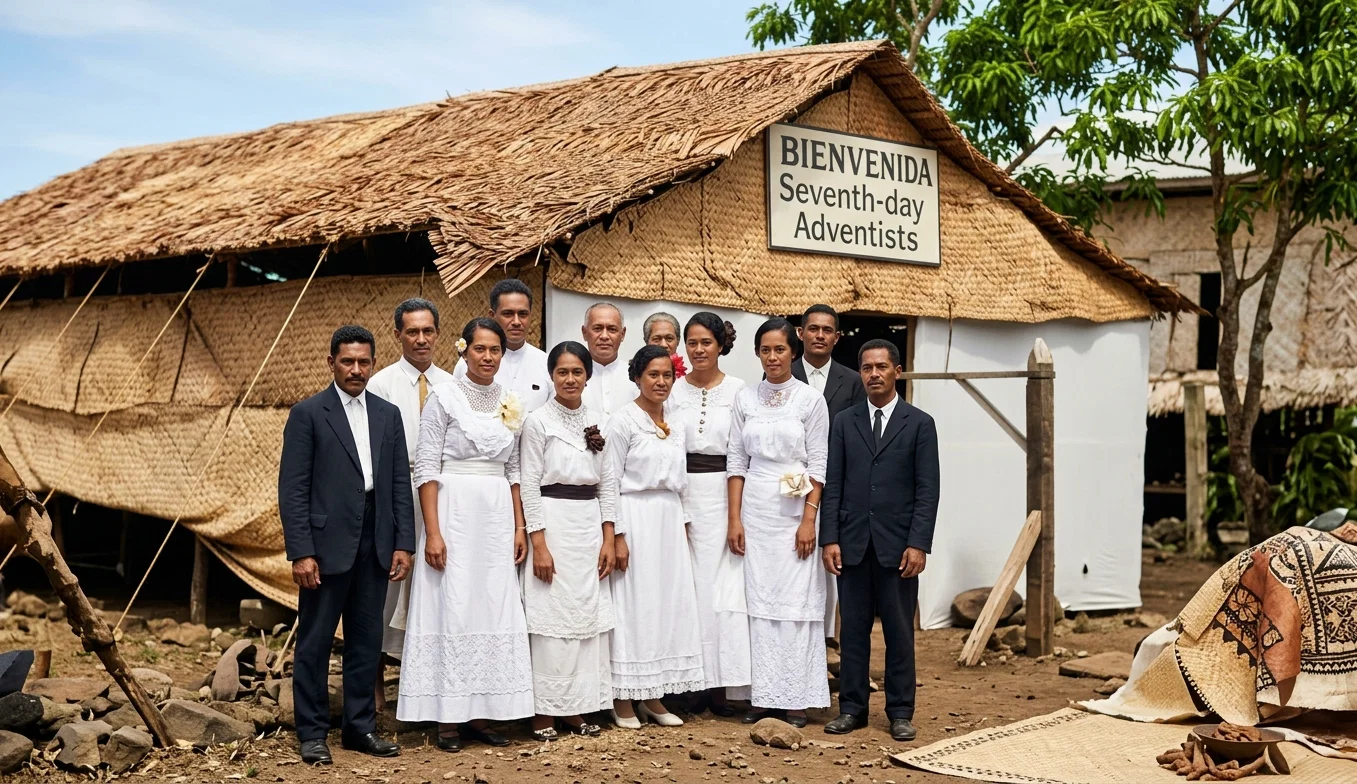
A NATIVE SEVENTH-DAY ADVENTIST CHURCH BUILDING IN APIA, SAMOAN ISLANDS, AND THE CHURCH MEMBERS
Marriage is very little known among them. This is also faasamoa, and is the only excuse presented for breaking the seventh commandment. And this excuse takes precedence of everything else.
Thus it will be seen that this faasamoa stands in the way of God’s work, and makes it very hard for those of older years to break away from its binding claims to walk in the light now shining from the courts of glory. It may be that this is the reason why the servant of the Lord has spoken so much about schools in these island fields, so that the young people may be reached. If the young men can be brought under the influence of this message by training in our schools, there is hope that the leaven will extend, and that more fruit will be gathered.
At present there is quite a strong desire on the part of some of the young men to come to us for training, but we have to turn them away, as we have no school. Our great need is a school.
We have already seen the wonderful power of this message working on hearts bound by these satanic customs. We have also seen the struggles of the evil one in trying to win back those who have been taken from his grasp.
A Visit to Our Mission on Lake Titicaca
By O. Montgomery
(Concluded)
O. MONTGOMERY
MOUNTING our horses Monday morning, we rode away to visit the believers at Whatta, on the peninsula, about eighteen miles from the home station. Juan Huanka, one of the Indian workers, with another young man as assistant, is conducting a school of about ninety pupils and holding Sabbath services at this place. These young men received their training at the Plateria Mission under Brother Stahl and his coworkers, and are now doing acceptable service.
As we came within sight of the place, we could see a large company coming out to meet us with banners, and soon we could hear the strains of their native music. The musical instruments are made of pieces of reed or bamboo of different lengths and sizes, tied together, on which they blow; and with the addition of a large drum and a small one, the band is complete. Before we reached the people, they halted and formed two lines; then as we drew nearer, two young women, with their outer skirts filled with flowers gathered from the mountains, came forward and showered us with the blossoms. Then with music and flying banners we were taken to the chief’s house, where we each made a short speech, to which the chief and the teacher replied. The chief then took us into the house, and himself served us with a real Indian dinner which the women had prepared. It was really a good meal, and after our long ride we ate with a relish.
Dinner over, we went outside and watched Brother Stahl treat the sick. This was an intensely interesting sight. He pulled teeth, gave stomach washes, opened abscesses, dressed wounds, and12dealt out medicine, with remarkable skill. He treated between forty and fifty persons in about an hour, and with the most meager facilities,—only a low table or bench on which to lay his instruments, medicines, bandages, etc. With the Indians crowding around, he was scarcely able to keep his footing while at work. The Lord has wonderfully blessed his labors among these Indians, and there have been some most remarkable results.
On our way home we were escorted by the entire company of nearly two hundred as far as the summit of the mountain range. Here, at an old stone altar that had been used in their heathen worship and around which they had held their dances, we bade them farewell, and with music and banners they returned to their homes. We reached Plateria just before night, greatly pleased with the day’s trip.
Thursday we rode twelve miles south to Esquenas, where Brother Martin Velasques, a faithful native, is at work. Here the Indians have built a nice schoolhouse and furnished the teacher with a house to live in, without expense to the mission. At this place the experiences of the day before were repeated almost exactly, so I will not describe them again.
WORKERS GATHERED AT A GENERAL MEETING AT COIMBATORE, SOUTH INDIA
Three languages are represented here — the three main tongues in south India.
Wednesday was an important day. First, the weekly prayer meeting was held in the church at about seven o’clock. The workers of the mission and about three hundred Indians were present, some having come several miles to attend at this early hour. Professor Prescott gave a short Bible study, and then between forty and fifty of the Indians took part in the prayer service. In the praise service there was much liberty, and a large number spoke. These prayers and testimonies were interpreted into English for our benefit, and we were much impressed with their clearness and depth of meaning. They had the right ring, and it did our hearts good to hear these people praise the Lord for the “true way,” as they expressed it.
About ten o’clock the school from the peninsula came, and a little later the school from Esquenas arrived. Then the Plateria school was dismissed, and the three schools marched in military order up the hill, with waving banners and much music, to the yard in front of Brother Stahl’s home, where they formed in double line, making three sides of a hollow square. Each school in turn went through different exercises, and then one school sang one verse of “Jesus Loves Me,” in English. Following these exercises some of the young men played Indian games for our benefit. These were very amusing.
Among those present were several who had come long distances as special representatives of their tribes, to ask that teachers be sent them. Each was received in turn by the committee. The requests were about the same; all wanted teachers, that they might be taught the “right way.” The earnest pleas touched our hearts. Some of them had been waiting for months, but they had to be told that they must wait still longer until more help could come. One young man who had come two days by horse from the high mountain region, when told by Brother Stahl that there was no teacher to send and that he would have to go back and wait a little longer, replied that he would not go back with out a teacher. He had been there four times, and he could not face his people again to disappoint them. He would wait there until one could be sent with him. It was finally decided to send Ascensio Sosa, the assistant teacher at the peninsula, to answer this urgent call. An advanced student from the Plateria school was put in his place.
During the day thirty or forty were treated at the dispensary. The school in session was visited, and when toward evening the Indians took their leave, we felt that the day had been well spent. One is impressed with the striking contrast between those who have accepted the gospel and those who have not.
The truth has wrought a wonderful change in these Indians. The habit of chewing cocoa leaves, from which cocaine is made, is common among all the Indians, as well as among the white people of these regions, and is very demoralizing. The use of tobacco, drinking, stealing, and many other wicked habits are some of the things from which these natives have been saved, and their faces are alight with joy and hope.
At the time of our visit, there were three hundred and thirty-five baptized believers, besides about as many others who believed the truth. A large number are living earnest Christian lives and waiting for baptism. Brother Stahl has since reported the baptism of fifty at a distance from Plateria.
The workers are all enjoying good health, and are of the best of courage. They are working hard to keep up with the rapidly advancing work, but are utterly unable to respond to the many calls that are coming. It was decided by the committee to ask for seven new workers, to enable the mission to answer the most urgent of these calls. It was also decided to build an addition to the church, and two new rooms to the house now occupied by Brethren Achenbach and Howell, also a three-room cottage for additional workers. The mission was organized with Brother Stahl as superintendent, and Brother Howell as secretary and treasurer.
Thursday morning we were to take our departure. Very early the Indian brethren began to come from every direction until about three hundred had gathered. Accompanied by Brethren Stahl, Achenbach, and Howell, and all the Indians, we mounted our horses and rode out of the yard and off for Puno. When we reached the hill where we were met by the Indians on the day of our arrival, a halt was called. Professor Prescott and Brother Town each made a brief farewell speech, after which I offered a short prayer; then we rode away. When we came to the top of the next hill, we stopped a moment for a last wave of the hand in response to their waving banners. With the soft, sweet strains of their music still sounding in our ears, we passed out of sight, our hearts lifted in grateful praise to our loving heavenly Father “for his goodness, and for his wonderful works to the children of men.”
South India
By G. G. Lowry
G. G. LOWRY
THE first half of the year has been a very busy one for me. The school and general missionary work, together with language study, have taken most of my time. Then, too, Mrs. Lowry has been away in the hills for nearly four months. That, of course, means double work for the one left. She plans to come home this month. She is feeling much better, and I think with proper care she will be able to remain in India a long time.
I have just finished my language work, and have taken the third year's examination. I am told that the grades are the highest yet given any one who has appeared for the examination. Anyhow, I have the consolation of knowing that the task is finished, and the satisfaction of being able to work with and for the people in their own tongue. I can now put in a good deal more time in active mission work.
Our school is a little larger this year than last. All the students are working hard to prepare for some place of13usefulness in the work. About one fourth of them are unconverted, but we have been doing some personal work for them, and eight are planning to be baptized. One of our teachers and his wife will also be baptized soon. Altogether, our work here is in an encouraging condition, and we thank the Lord for the privilege of being allowed to work in India.
A church of twenty members was organized here last month. This is the third church in south India. We are all well and of good courage in the Lord.
Coimbatore.
Be Ye Thankful
By Mrs. I. H. E.
GRATITUDE is an attribute of the heart, not an incident of the life. It is not dependent upon nor affected by circumstances and conditions. The virtue of gratitude may be, and often is, seen in its fullest flower in crushed and broken hearts, in lives that know the depths of toil and poverty and affliction; while very many who, enjoying health and ease and surrounded with material comforts and advantages, are discontented and ungrateful.
“Some murmur when the sky is clear,
And wholly bright to view,
If but one speck of dark appear
In their broad heaven of blue;
And some with thankful love are filled
If but one streak of light,
One ray of God’s good mercy, gild
The darkness of their night.”
I like the spirit of that blind girl of Drumtochty of whom Ian Maclaren tells: “If I dinna see,”—and she spoke as if this was a matter of doubt, and she were making a concession for argument’s sake,—“there’s nae body in the Glen can hear like me. There’s no a footstep of a Drumtochty man comes to the door but I ken his name, and there’s no voice out on the road that I canna tell. The birds sing sweeter to me than to anybody else, and I can hear them cheeping to one another in the bushes before they go to sleep. And the flowers smell sweeter to me,—the roses and the carnations and the bonny moss rose,—and I judge that the oat cake and milk taste the richer because I dinna see them. Na, na, ye’re no to think that I’ve been ill-treated by my God; for if he didna give me ae thing, he gave me mony things instead. And mind ye, it’s no as if I’d seen once and lost my sight; that micht ha’ been a trial, and my faith micht have failed. I’ve lost nathing; my life has been all getting.”
The Blight of Ingratitude
Ingratitude chills the soul. It is sharper than a serpent’s tooth in the heart of a devoted father. How he longs for one word of appreciation and affection, one syllable revealing gratitude and love! Freely he has given his life for his son, counting no service too hard, no self-denial too great; and he asks so little now. No wonder he is grieved by neglect and unthankfulness.
And we are children,—children of our heavenly Father, dependent upon his favor for life itself and the means of sustaining it, for the invigorating sunshine and restoring showers, for sight and hearing and taste and smell. All these daily benefits that we have come to call “common” only because we know them so well, and because we have not learned their preciousness by being deprived of them, are his gift. So, too, is our hope of heaven, bought at so great a price.
Not One Came Back
The editor of the Woman’s Home Companion for November tells a remarkable story of self-sacrifice and ingratitude:—
“The ‘Lady Elgin’ was sinking.
“Some of you can think back fifty-six years and remember that disaster. The song ‘Lost on the Lady Elgin’ was often sung in your youth.
“It was a chilly evening in early September. The ‘Lady Elgin,’ brilliantly lighted, and full-loaded with happy excursionists returning to their homes, stopped suddenly, shuddered like a stricken thing, and began slowly to go down.
“There was no wireless in those days, but none was needed. The ‘Lady Elgin’ had almost reached Chicago; she lay only a few hundred yards off the shore, at Evanston. A thousand pairs of eyes were fastened on her from the shore; a thousand voices raised their cry of terror and alarm.
“Only a few hundred yards, yet it might as well have been miles! The14ship’s small boats could not possibly live in such a sea. The ‘Lady Elgin’ was sinking, sinking fast. Before help could put out from Chicago, she would be gone. And the crowds upon the shore watched her, powerless to help.
“But not all of them were helpless. Two brothers, students in the theological seminary at Evanston, plunged through the crowd, a rope in their arms.
“Nat, the elder, a powerful man and a trained swimmer, fastened the rope about his waist and leaped into the waves. Inch by inch he fought his way through until at last he reached the ship and climbed aboard. A moment later he plunged back again with a woman in his arms. The crowd hauled him in, choking, cold, but still strong.
“Again he plunged in, and again, and again. Seventeen women and children he brought to shore, one after the other. At last flesh and blood could stand no more. He sank to the ground exhausted.
“Yet still the cries rang in his ears. After a bit he raised himself, and again plunged in. Again they pulled him back to shore with another human life.
“Twenty-three human lives Nat Spencer saved before his strength entirely left him. Then they carried him away to his bed, exhausted, sick, and almost out of his mind.
“It was many weeks before he left that bed. Most of the time he was delirious. The twenty-three whom he had saved had scattered to their homes. The bodies of the three hundred who were lost had been tossed up by the sea; the nation had begun to forget the tragedy.
“But the twenty-three whom he had saved, surely they did not forget. Surely they were grateful.
“This is the simple, solemn truth about those twenty-three: Not one of them ever came back to thank Nat Spencer for what he had done. Not one of them even wrote him a letter.
“Nat Spencer went out into life an invalid, having given the strength of his youth for twenty-three human beings who did not so much as say ‘Thank you.’”
We are amazed and horrified at the story; yet are we not in danger of the same carelessness, the same ingratitude, toward God? Daily we ask his blessings, hourly and moment by moment we receive from his hand; yet how often we neglect to give thanks! and when we do, is it not frequently a matter of the lips, and not of the heart?
“It is a good thing to give thanks”—good for us, and good for those who hear. It is a wonderful thought that God takes note of his child’s gratitude and the expression of it; that he is pleased to hear our feeble note of praise and thanksgiving in all the wonderful chorus that rises to his throne. We should remember, too, that our failure to express gratitude, to speak of God’s goodness and acknowledge his benefits, while it may grieve his heart of love and may influence others to coldness and indifference, harms ourselves most of all. Without the exercise of this grace “our souls will shrivel, and we shall become craven, even beastly.”
Things to be Thankful For
The first Thanksgiving Day wears a wonderfully romantic halo in the distant years; but the fact is that the Pilgrim fathers and mothers were thankful for very ordinary things. They had passed through such sorrows and hardships as few of us can know. Now they gave thanks, in a public way, for the prospect of plain food during the long, cold winter ahead, for shelter for their families, and, as has been well said, “for the privilege of giving thanks when and how they wished.”
“We should, first of all, be thankful ‘that there is Somebody to thank.’” An impersonal world, even impersonal bounties, would be a chilling thing. Dr. Alexander Whyte says that when he was a child he received a lesson that he never forgot. At a flower show held in his native town, a noted man had been chosen to make the opening speech. As he was closing, he pointed to the beautiful display, and said, “The best of it all is this, that our heavenly Father made them all.” The gifts without the Giver would mean little; far more to be desired than all “material gifts, bountiful and wonderful as they are, is the Giver himself.”
We should be thankful for love,—the Love that upholds the universe, and the dear human love that is set as a light in countless homes, illuminating the shadowy places, and cheering and blessing all who come under its influence.
We should be thankful for work and the power to accomplish our task. For work is one of the blessings brought out of Eden, and only when it is perverted or used to crush others does it become a curse.
We should be thankful for our membership in God’s great family on earth, and our high calling to be laborers with him in extending his kingdom. Remembering that his love reaches out to all, we should love one another, help one another, and pray for one another. Thus will our thanks-giving become “thanks-living.”
“In everything give thanks,” says the apostle. The editor of the Sunday School Times relates this incident: “It was unusual to hear a Christian woman in prayer recently thanking God that we have the privilege of greeting one another by the cordial handshake. She had been a missionary to lepers. Some of her friends have no hands. Others dare not touch the hands of one that is free from leprosy. Missionaries to the lepers have a keen sense of things to be thankful for.” And so shall we, if we take a little time to think about our daily blessings, and to observe how even those things that seemed ill and hard to bear have worked out to our good under God’s blessing.
“In everything give thanks”—
“For grief unsuffered, tears unshed;
For clouds that scattered overhead;
For pestilence that came not nigh;
For dangers great that passed us by;
For sharp suspicion soothed, allayed;
For doubt dispelled that made afraid;
For fierce temptation well withstood;
For evil plot which brought forth good:
For weakened links in friendship’s chain
That, sorely tested, stood the strain;
For harmless blows with malice dealt;
For base ingratitude unfelt;
For hatred’s keen, unuttered word;
For bitter jest unknown, unheard;
For every evil turned away,
Unmeasured thanks we give today.”
It is a good thing to have a special day for the giving of thanks, and to consider the real purpose of the day. It is still better to remember that gratitude is an everyday grace, and to endeavor to keep it bright and fresh and glowing by constant use.
MRS. I. H. E.
Mission Notes
BROTHER L. V. FINSTER, writing September 22, states that in about one month they hope to have their new school building ready for occupancy. Professor and Mrs. Steinel and Brother Sevrens have reached Manila, and will open school as soon as the building is ready. Mrs. Sevrens remained in Shanghai over one boat to assist the Division brethren in stenographic work. Only a short term can be held this year, as their school year in the Philippines closes in March. They call it a “short special course” for this year. Brother Finster expresses sincere thankfulness for the help sent them for their educational work, and closes his letter by saying: “We are leaving this forenoon for San Pablo, to hold quarterly meeting and have another baptism. I am taking Brother and Sister Steinel with me, that they may get acquainted with our young people there before the school opens.”
DURING the last two years the reading public has been surfeited with descriptions of modern warfare and its horrors. The world’s most eminent writers have used ink abundantly in depicting war’s frightfulness. But it has been left to a mere babe to give the most graphic picture of war’s brutality,—a neutral view, moreover, for this baby knows nothing of nationalities and their narrow patriotisms.
The baby is Ankeen, a tiny, laughing, black-eyed, four-year-old Armenian girl, brought to this country from Erzerum by Robert Stapleton and his wife, missionaries. The Stapletons and their charge spent the summer in Chicago, and though no attempt is made to get the child to talk on the war as she saw it, there are times when her experiences crop out.
For instance, the party was crossing a river on the cars. Ankeen looked out and saw the moving stream. She was filled with childish terror and screamed, “Oh, don’t throw me in there, will you? Please! Please! You won’t, ’cause they threw my baby sister in the river.” And the little face was hidden in the small hands.
At another time she saw some soldiers on the march, and once more she shrieked in terror, “Oh, they’ll shoot us! They shot my mamma and papa! I saw them!”
It is a view of war through a baby’s eyes—unbiased, uncensored, unprejudiced.
Conducted by Mrs. I. H. Evans, Takoma Park, Washington, D. C
By Mrs. I. H. Evans; Miss Lora E. Clement
Assisted by Miss Lora E. Clement
Through the columns of this department, hints will be given on all matters pertaining to the home life. Short articles and letters are solicited from home makers, telling of their everyday experiences,—their joys and sorrows, their failures and successes.
The Things I Miss
By Thomas Wentworth Higginson
An easy thing, O Power divine,
To thank thee for these gifts of thine,
For summer's sunshine, winter's snow,
The hearts that burn, the thoughts that glow;
But when shall I attain to this,
To thank thee for the things I miss?
For all young fancy's early gleams,
The dreamed-of joys, that still are dreams,
Hopes unfulfilled, and pleasures known
Through others' fortunes, not my own,
And blessings seen that are not given,
And never will be, this side heaven.
Had I, too, shared the joys I see,
Would there have been a heaven for me?
Should I have felt thy being near,
Had I possessed what I hold dear?
My deepest knowledge, highest bliss,
Have come perchance from things I miss.
Today has brought an hour of calm;
Grief turns to blessing, pain to balm;
I feel a power above my will
That draws me, draws me onward still.
And now my heart attains to this,
To thank thee for the things I miss.
—Thomas Wentworth Higginson.
Concerning Preferences
A LITTLE girl was showing me her best hat one day not long ago. The hat never was trimmed with pink ribbon.
“Pink is my favorite color,” said the little girl.
“It is a very good color to have for a favorite,” I said.
The little girl looked down at her coat, which was blue. “Blue is my favorite color, too,” she remarked.
At that moment a girl friend in a red dress came along.
“Red is my favorite color, too,” the little girl added.
“You have a great many favorite colors,” I suggested.
“Yes,” she agreed, “I have; any bright color is my favorite color.”
She is an eager, happy, merry child. “She gets a lot of fun out of life,” her mother says. She does; and I am inclined to think it is because “any bright color is her favorite color.” There are a number of bright colors; so many that one, at least, is almost certain always to be within her range of vision. If she liked only pink, or blue, or red, or any one bright color, she would miss a great deal of innocent satisfaction.
I have a friend who has a garden in which a great variety of flowers grow; from April to October that garden is full of blossoms. “You seem to like to grow all kinds of flowers,” I heard some one say to her recently, “while I enjoy cultivating only my favorites.”
“Favorite flowers!” exclaimed my friend; “but I assure you I do raise my favorite flowers.”
“Why, you have no favorite flowers,” said the neighbor in surprise.
“Oh, yes, I have,” my friend returned. “Every flower is my favorite flower.”
She has a beautiful garden, that friend. Long before, and long after, and often in between times, when her neighbor’s garden has no flowers in it at all, or only a few blossoms, my friend’s garden is a riot of color and fragrance. It is easy to see why—every flower is her favorite flower.
Does not something similar happen in connection with preferences touching more important matters? Does not the man whose favorite author is any good author read more books than the man whose favorite author is some one particular person? Does not the woman whose favorite child-friend is every child-friend have a happier and fuller experience of childhood than the woman15whose favorite child is some one particular little boy or girl? And in the realm of manners and morals, does not the person whose favorite virtue or favorite courtesy is every virtue and every courtesy, both give more and receive more than the person whose favorite virtue or favorite courtesy is only one particular thing? In short, does not the person who likes and enjoys all good things get more fun out of life than the person whose preferences are more limited?—Home Progress.
A Few Hints on Wall Paper
By L. A. HANSEN
L. A. HANSEN
It is better not to use wall paper if your walls will permit the use of paint. If the surface is smooth, and there are no cracks that cannot be properly hidden, it will be more satisfactory to paint. Health considerations, hygiene, and cleanliness are in favor of paint. The cost may be made as low as that of wall paper, or lower, especially at the present time.
A recent experience of my own prompts me to give a few suggestions on papering, hoping they may be helpful to others similarly situated. I could have saved time and labor had I known before I began the work, what I knew when I was through.
It is generally advisable to remove the old paper on the wall before putting on fresh. Disease germs and other objectionable matter are thus better gotten rid of. If the old paper is loose in places, it must be removed. The new paper is likely to loosen the old in other places. If for any reason you must do the work yourself, you need not regard it as overly difficult.
To remove old wall paper, wet it with boiling water, using a whitewash brush or broad paint brush. Apply to as much space as you can work while the paper is soft. If there are a number of thicknesses of paper, several applications of water will be necessary. The more water used, the easier is the work of scraping. For scraping use a broad putty knife, a large case knife, or a four-inch scraper such as may be bought at a ten-cent store. A small hoe with an even edge and the blade straightened, would be splendid. If the scrapings are allowed to harden on the floor, they will be difficult to remove.
After the wall is scraped, wash or wipe smooth of small particles. Apply a size made by dissolving eight ounces of glue in two gallons of water, and boiling over a slow fire. Glue burns readily.
Cracks and holes may be repaired with plaster of Paris. First cut away the edges with a sharp knife, slanting the edges in. For large spaces mix fine sand or sifted lime or both with the plaster. Small breaks may be easily repaired with the plaster alone. Mix a small quantity at a time, as it hardens fast. Adding flour paste or mixing with vinegar, will prevent rapid hardening. Paper pulp, mixed with thin glue, may be used for repairing cracks.
For living-rooms the plain papers are best, giving a quiet air, and serving to bring out in full relief the pictures on the walls. Next in preference are the two-toned papers. Large or striking figures should be avoided.
For the bedroom select a simple design, avoiding set patterns of unreasonable figures. Have thought for the possible invalid who might have to occupy the room, and who should not have occasion to let the mind chase through a labyrinth of confusing designs, constructing in his feverish mind various grotesque forms that distract and annoy. Vertical stripes make a room seem higher than it is. Large figures and dark colors make it seem smaller. Solid colors give the effect of enlarging the room. For a low room use a striped paper, running to the ceiling, placing the picture molding close to the ceiling. For a narrow room, or one with high ceiling, lower the picture molding twelve or eighteen inches, and let the ceiling paper run down to the molding.
Save some of the left-over pieces for patching. Do not cut paper when patching; tear it. A cut edge will show. To patch a broken place, expose a piece of the paper to the sun until it is faded to the same shade as the old paper. Lay the patch face down, apply paste, and when moist, scrape the edges to a thin bevel. Paste again, and apply the patch.
Pleasure in Little Things
By Alice Elizabeth Cate
How can children best be taught to take pleasure in little things?
If children are fortunate enough to be born poor, with an ingenious mother, the chances are that they will be brought up on a joyous medley of clothespins, Ivory soap (with nails and hammer to go with it), a dozen feet of clothesline, and some blocks. Joy in these things can be cultivated even in wealth if the mother is wise and self-disciplined, and gives some time to studying the longings of little children for simple toys and simple joys.
I know a very small boy who didn’t seem to get much pleasure out of his surroundings. His mother made up her mind that he must be made to take pleasure in little things. She used to say, again and again when they were driving or having a frolic: “Aren’t we having a lovely time?” “Isn’t it the loveliest day you ever saw?” And before long the small boy was saying the same things, and noticing when the sun shone and that the ride was lovely. One day, while sitting with him in the hammock, his mother cuddled him up to her as she said,—
“You and I together, Love,
Never mind the weather, Love.”
For months afterward, whenever they were alone together, he would lisp,—
“You and I to-geller, Love,
Never mind the welter, Love.”
The secret, of course, is that the mother herself must see how infinitely interesting little nothings are, and be able to pass on her enthusiasm, eye kindling eye.—Alice Elizabeth Cate, in Home Progress.
Her Record
By Edward Bok
A WOMAN who is known for the excellence of her home in every department, whose placid relations with her servants and their service with her for fifteen and twenty years are the amazement of her neighbors, whose husband is devoted to his home and family, and each of whose three sons is a successful man, was recently asked by a friend, “Why is it that you are not in any way identified with outside interests?”
“Well, you see,” quietly answered the woman, “I haven’t had time: I have been so busy at home! I know I haven’t much to show for it—except what you see and my three sons.” And there was a quiet twinkle in her eyes as she spoke that left very little more to be said on the subject. As a matter of fact, there is never much to say to a woman who, by her works, realizes that the home can be made and is as much the world as the office or the forum, and who translates that realization into results.—Edward Bok.
Life’s Music
“LIFE’s music is never in the white keys or black, but in the soul that sweeps them with skilled fingers. Rail not at the keys, but gird your soul to the divine mastery.”
Transgressing Against Convictions
WHAT man in his right mind would conspire his own hurt? Men are beside themselves when they transgress against their convictions.—William Penn.