The Youth’s Instructor, Vol. 66, No. 8.

Short-Term Ambition

The Youth’s Instructor

Feb 19, 1918

Review and Herald Publishing Assn. · Takoma Park Station, Washington, D. C. · Feb 19, 1918

Short-Term Ambition

ONE of the reasons why so many girls and women fail to attain real success in business,” said a successful business woman the other day, “is short-term ambition. I have girls in my business who have worked splendidly for three, four, or five years, making themselves steadily more valuable. Then upon reaching some particular position, they’ve stopped short. I have several who are not worth a bit more than they were five years ago. On the contrary, they are worth less, for in business quite as markedly as anywhere else in life, decay sets in when growth stops. Sooner or later those girls, although they are doing their work without blunders or noticeable failure, will be compelled to give way to girls who have life ambitions—girls who are eager and interested, alert to make both themselves and the business in which they are engaged continually more valuable.”
If girls would only understand that! We see it so clearly in all departments of life. The minister who is not constantly gaining new visions of truth and making new applications of truth to life soon wearies his congregation. The physician who does not keep up with new discoveries and methods finds his patients turning to other and more progressive doctors. The business man who is not constantly on the alert to study every new suggestion soon finds himself outdistanced by competitors.
There is a sadder failure still. The mother who does not make it the great purpose of her life to keep in touch with her children as their interests broaden comes sooner or later to the heartbreaking hour when she discovers that she has lost their confidence—that she is left behind.
Failures all, pitiful, tragic failures, because they had short-term ambitions, because the goals to which they looked forward were so far short of—eternity!— Selected.

A Bad Temper

Do you think he is a Christian?” a native of India asked a missionary, concerning an American whose outburst of anger he had just witnessed.
“Certainly,” replied the missionary, “but he has a bad temper.”
The missionary did not fail to notice a look of incredulity on the face of the questioner, and it set him thinking. It was evident that to say, “This man is a Christian, but he has a bad temper,” was as illogical to this native’s mind as to have said, “He is a perjurer, or a blasphemer, but a Christian.”
John Wesley would have agreed with the native. He said, “I would as lief swear as scold.” In truth there is much blasphemy in scolding. The apostle James condemns the inconsistency of him who blesses God and speaks unkindly to men who are made in God’s image.
Persons who have evil tempers often excuse themselves by saying with a kind of pride:
“You know I have such a bad temper.”
Sometimes a quick temper goes with a warm and generous nature, but it also goes with narrowness of vision. The person who acknowledges a bad temper should say:
“I have a mind too narrowed either by nature or by habit to permit of my seeing both sides of a subject at once, and so lacking in control that I fly into a fury when I see only one side.”
The Christian religion, unlike Oriental faiths, does not place emphasis upon mere submissiveness; it seeks to make men strong and courageous rather than negatively submissive. But it also teaches self-control, and should establish it in the lives of all who profess to believe in Christ. Greater than he that taketh a city is he who ruleth his own spirit.—Youth’s Companion.

Literary, Military, and Agricultural Notes from the Periodical

The immortal poem Gray’s “Elegy” cost the author, Thomas Gray, seven long years of patient toil to produce.
Great Britain has transported more than 4,000,000 men across the English Channel from Dover since the war began and has not lost a single man.
By planning next summer’s garden now and ordering your seeds early, you will not only help the seed houses, but also the railroads and the postal authorities.
John E. Andrus, of Yonkers, New York, has just founded an orphan asylum at Yonkers in memory of his deceased wife, the value of the grounds and the endowment amounting to $2,000,000.
The American Red Cross reported, on January 10, that its membership had been increased, since May 10, from 486,394 to 22,000,000. The total of subscriptions to the Red Cross war fund was $103,525,955.64.
Last year army engineers spent nearly $25,000 to keep the navigable streams of the Southern part of our country free from the troublesome, yet pretty, water hyacinth. At one time the plants were sprayed with powerful acids to kill them; but this was discontinued by an act of Congress, for it wrought ill to cows whose favorite pastime was feeding upon this succulent plant.
Since the war began, over 5,000,000 horses, or one twentieth of the world’s supply, have been killed in battle or died in Europe from disease or other causes. Of this immense total, the United States has contributed 1,000,000 horses, and in addition, about 300,000 mules, having an aggregate value of some $260,000,000. About 5 per cent of the horse population of the United States have been fed to the war god and nearly 7 per cent of the mules.
Sapphires are found in Montana; rubies and emeralds in North Carolina; and diamonds in California and Alabama. The most characteristic American precious stone, however, is the turquoise. It is the stone that the Indians have always prized above all others. Near Los Cerrillos, New Mexico, great quantities of turquoise have been mined since prehistoric ages by the Aztecs, the Spaniards, and the Indians. Recently the works were reopened.

Tried as Silver. Ps. 66:10

MRS. J. W. PURVIS
I MUST be tried as silver, yet I know Why, in his wisdom, God has made it so. Crushed, that the dross and ore may fall apart, And show the precious metal of my heart; Else would it ever like a rock have been, None could have seen the silver hid within.
Tried, too, by fire; life’s trials and its pain Do scorch my heart like fire, yet to my gain, For fire alone can burn the dross away And separate the precious from the clay. O cleansing fire! make ashes of my pride, And yield to God the silver long denied.
I must be melted, that this will of mine Make no resistance to the One divine. Just be impassive while he fashions me, Not asking that the pattern I may see. So will he teach my wayward heart to trust, And not to yield to him because I must.
I must be molded by his gracious will To fit a place no other soul can fill. But whether he will fashion me to shine Or not, I do not know. His will be mine. If humbly placed, to know the Master’s hand Has put me there will seem supremely grand.
I must be polished till God’s image shine Restored, reflected, in this soul of mine, That by my brightness others’ eyes may see The pathway where the Lord is leading me,— A path with his own glory made resplendent, With love’s sweet guiding star as mine attendant.

Personal Work for Souls

G. B. THOMPSON
A WELL-KNOWN evangelist and soul-winner says: “There is but one business that is worth while. To undertake it the throne of heaven was emptied that the mansions of heaven might be filled. It challenged the Son of God, and consumed him with its passion, and there is nothing so godlike among men. No rewards are so great as those which it offers, and they will shine with unabating brilliancy when suns and systems are no more. ‘He that winneth souls is wise.’”
There is no work greater than this. Winning the lost was truly the business of the Master. For this great work he sacrificed all, even life itself. The zeal of this great mission consumed him.
The most successful element in the work of soul-winning is personal contact. More can be accomplished by visiting in homes, offices, and making a direct appeal, than in any other way. A word of cheer to one who is discouraged, a recognition of some poor person, or some cold, ragged boy, kneeling and praying with the bereaved, weaves a cord of love around the heart.
This was the custom of Jesus. We see him in the night season with a single auditor—Nicodemus. One of the most famous conversations of the Saviour which has been preserved to us was delivered to the woman at Sychar’s well; and it bore abundant fruit. He spoke wonderful words of truth to the Samaritan woman, and to the rich ruler who came to inquire concerning eternal life.
“Those early Christians understood their personal responsibility and the power of personal effort. Peter goes right after Cornelius; Philip talks directly to Queen Candace’s royal treasurer; Paul answers the Philippian jailer’s questions face to face, and Aquila and Priscilla have a great Bible class in the person of the eloquent Apollos.”
The success of John Vassar in winning souls was in his personal work. The following incident illustrates how faithful he was in seeking for those who were unconverted:
“A young man was noticed to come night after night to revival meetings, but would slip away before one could grasp his hand. Mr. Vassar felt he must see this person, and walked five miles to the farm where he lived, arriving as the family was about to eat an early dinner, of which he was urged to partake. After being seated, the face of the young man not appearing in the family group, Mr. Vassar excused himself from the table, and hunted through all the farm buildings where a man might possibly be in hiding. At last, when about to confess himself defeated, he walked to the farther end of the corncrib, and there, in an old hogshead, he found the fellow lying low. The man afterward confessed that he had taken satisfaction in looking through the bunghole of the hogshead, in believing Uncle John would not find him there. But this ‘winner of souls,’ knowing his opportunity, leaped over by the side of the runaway, and then and there turned, as Charles Spurgeon has said, ‘the hogshead into a Bethel,’ and won a soul for heaven.”
We have been instructed that we are to work for those who seem as hopeless as if dead and in their graves. The Holy Spirit may be moving their hearts far more than appears.
“J. Hudson Taylor, of the China Inland Mission, tells that when he was a college student, he had charge of a man with a gangrenous foot. It was his duty to dress the man’s foot every day. He soon learned that his patient was not a Christian, and had not been in a church for forty years. Such was his hatred of religion that he refused to go inside the church at his wife’s funeral. Young Taylor made up his mind to speak to this man about his soul every time he visited him. The man cursed him, and refused to allow him to pray. The student persisted in presenting Christ, until one day he said to himself, ‘It’s no use,’ and was leaving the room. When he reached the door, he turned around and saw the man looking after him as if saying, ‘Why, you are going away today without speaking to me about Christ!’ Then the young man burst into tears, and returning to the bedside, said: ‘Whether you wish me to or not, I must deliver my soul. Will you let me pray with you?’ The man assented, began to weep, and was converted. Mr. Taylor says, ‘God broke my heart, that through me he might break this wicked man’s heart.’”
Great earnestness should be manifested in doing personal work for souls by those who believe that probation’s hour is closing. The curtain is soon to be drawn on earthly things. The drama of a world is about finished. The last act is being staged. The shadows are lengthening, and the doom of eternal night for the lost is almost here. Today we can appeal to those outside the ark to enter through its open door; soon it will be too late. The Saviour still pleads in the most holy place; in a little while from this he will lay down the priestly censer, and put on a vesture dipped in blood. The muttering thunders and deepening gloom tell us that a storm of relentless fury is about to break. We have no time to lose, for many are without hope. Why should we not be consumed with burning zeal for those who have no hope, and labor personally, with prayer and supplication, for their salvation?

What Will You Do with Jesus?

JESUS is the attraction of all the worlds. The unfallen beings adore him, and in astonishment consider his great love for fallen, sinful man revealed in his death on the cross. Angels still love to look into that deep, mysterious plan of salvation that called for the life of the Son of God. How much more should it interest us whom it most concerns, for whom it was planned to uplift from the depths of hereditary, acquired, and developed sin. As the great High Priest, Jesus is the special attraction of the righteous of this age. In the sanctuary above he is our Mediator between our sinful self and a most righteous heavenly Father. Because we are drawing so near to the close of this great antitypical day of atonement, Jesus should attract our attention more than ever, and we ought to inquire how we stand before God. It would be well if we were concerned to know whether we have done our part so that the “Advocate with the Father” might with power present our cases before the “Judge of all the earth,” and his infinite sacrifice and righteous blood avail in our behalf.
JESUS, THE GOOD SHEPHERD
Jesus is the pivot of the universe, the axle upon which he has turned the hopes of millions of souls during six thousand years, the point of greatest importance to mortal beings. He is “the image of the invisible God, the first-born of every creature,” “in whom we have redemption through his blood, even the forgiveness of sins.” He is not only the One by whom “all things consist,” but he is also the upholder and preserver of all his creation and especially so of the crowning work of his creation—man. He is the One in whom we have redemption and the only one who is able to grant us eternal life. Like the pivot upon which the strain comes,—if it breaks, the machinery is useless,—so Jesus is the One upon whom all our hopes of heaven depend. Thank God he has no flaws. He never failed, and he is able to save to the uttermost those who come unto God by him.
Jesus is the anchor of our souls both sure and steadfast; he is the master Pilot on life’s sea. Through raging sea and boisterous wind he keeps the life in its proper course. He is acquainted with his bark, no one needs to volunteer him information, for he knows what is in man, because he made man. In fearful typhoon, or in dead calm his knowledge is sufficient. Whether near land or far out at sea, in narrow, shallow channel of the harbor or on the boundless deep, the vessel is safe with him at the helm. Rocks, shoals, reefs, and the like are not to be feared when one recalls that he is the Pilot. Power over the storms is in his hands, for if he commands, “Peace be still,” even inanimate nature will obey. With this infinite knowledge and power, can we not safely and confidently trust him and put all in his care?
He is our Creator and Redeemer, our King, our Saviour, and our Friend, and it is all summed up in the word proclaimed to his parents at his birth, “Thou shalt call his name Jesus: for he shall save his people from their sins.”
“Jesus, the name that charms our fears, That bids our sorrows cease, ’Tis music in the sinner’s ears, ’Tis life and health and peace.”
The closest earthly associates of Jesus, who were with him in all experiences and knew him well, in conviction exclaimed, “Thou art the Christ.” Those who lived upon the earth in ages past considered whether they would accept him as the Christ, as their personal Saviour; and individuals of today are also concerned with this the most important question.
How do you answer it?
You believe that there was such a person who lived and died in Palestine, but —
“Though Christ a thousand times in Bethlehem be born, If he be not born in thee, thy life is forlorn.”
You may make a confession as true and as well-sounding as the devils whom the Master cast out, “Jesus, thou son of the most high God,” but if your life is not consciously, permanently affected by the life and death of Jesus, then you are no better than the devils who said it, for the scripture tells us even they “believe, and tremble.”
Let us, with Thomas, say, “My Lord and my God,” and then, as the disciples of old, leave all and follow him, settling once and settling right the question, “What shall I do with Jesus?”
M. G. CONGER.

Prayer and Love the Secret of Soul-Winning
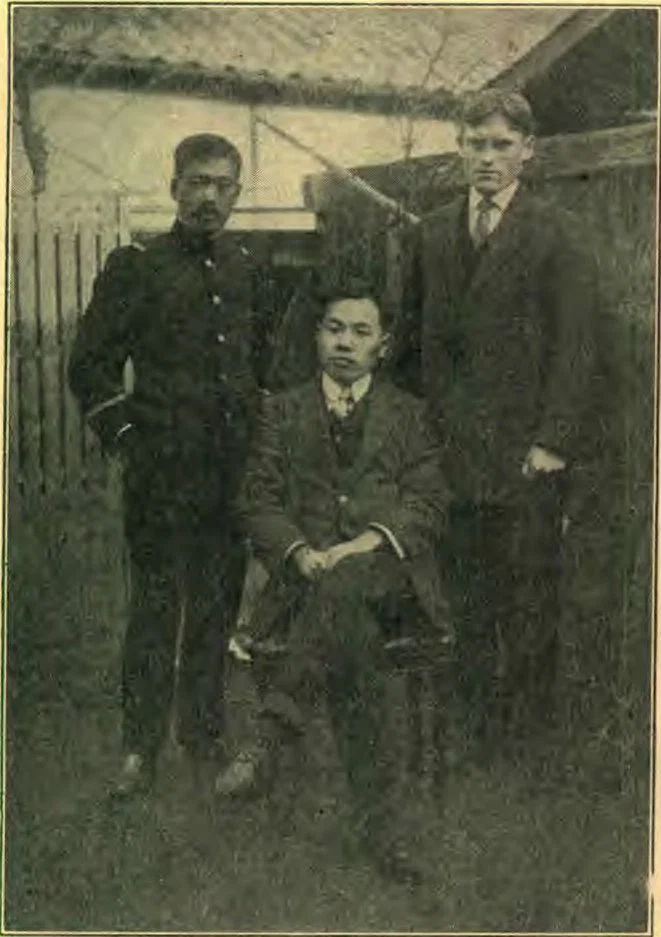
ONE fine September afternoon in 1913 a young Japanese clerk was sitting at the inquiry window of the post office in Seoul, Chosen, pondering on the attainment association which he planned with a few friends, in order to promote their knowledge of English. Mr. Frank Mills, the secretary and treasurer of the Korean Mission, came in and stood at the window to remit some money. He smiled and bowed politely to the clerk. After the business was transacted, the clerk asked:
“Do you know of a foreigner who teaches English?”
“No,” Mr. Mills answered; “but I will teach you if you will study the Bible.”
“Yes, we will.”
They made an arrangement to have an English Bible class once a week at the house of one of the clerk’s friends. The first Bible class was held on the next Saturday evening. Mr. Mills did his best to teach about the creation, but their knowledge of English was not sufficient to enable them to understand it well; but the class was held regularly. Mr. Mills lived about two miles away, and often he missed the last car and was obliged to walk home. Day and night he prayed, and endeavored to drive deep into their minds the love of God by teaching and by a godly life.
MR. MILLS AND HIS TWO BIBLE READERS
Mr. Nagatori is in the center.
MR. MILLS AND HIS TWO BIBLE READERS Mr. Nagatori is in the center.
By and by his influence began to tell, and the young man gave up the use of tobacco and liquor. One evening the study was on the first chapter of James. “For he that wavereth is like a wave of the sea driven with the wind and tossed.” This text impressed the young man deeply. That night after he went to bed, the Spirit of God came to him and made him meditate upon his sinful condition. He slept, but the Lord worked wonderfully for him. He arose next morning as usual, but he was not the same man. His first prayer was offered that morning. The earnest prayers of the devout missionary were answered.
After this, Mr. Mills helped this man spiritually and physically. At last he not only accepted the message of mercy for this generation, but connected with the work at Soonan as instructor in the Japanese language. Now he is working in Kobe, Japan, ministering the Word to others.
Mr. Mills worked so hard that his health was broken, and he was obliged to go back to America, but his efforts were not in vain. The seed sown with tears sprang up. It will continue to bear fruit, and the sower will rejoice when he sees the fruit of his labor at the glorious appearing of Christ and his kingdom.
That Japanese young man is the writer of this article. SANAS NAGATORI.

The Two Voices

In the spring of 1904, with my two sisters and brother, I left our home for college. My sisters really wanted to go to school, while we boys went just to please our parents, and, when once there, stayed only to please our sisters.
We were led to a large, open room comprising the whole of the second floor of one building, where about fifteen boys had curtained off little rooms to live in, and were informed that we also could make our home there.
“This doesn’t look like our cozy little room at home,” brother blurted out.
“I should say not.”
“H’m, we won’t be here long.”
Some of the fellows must have overheard our remarks, for soon they introduced themselves thus:
“We are certainly glad to see you, boys.”
“Why so?” we asked in surprise.
“We saw you carrying a guitar and a mandolin in with you,” said one.
“We just have great times here,” declared another; while the third spoke for the whole crowd. “We’ll help you get settled, boys.”
Needless to say our mental attitude was greatly changed, and our little room soon took on quite a homelike appearance from the contents of our trunks.
Of course we didn’t plan to violate any of the regulations, still we hoped that in some honorable way we should be asked to sever our connection with the school. An opportunity soon presented itself whereby we thought to succeed in quietly leaving the college and carrying out our plans to go to Chicago and travel with a musical company.
Being accused of wilfully violating one of the rules, we were invited to a private conference with the president of the college on a Sabbath, immediately after dinner. Perhaps his summoning us so soon after a good meal had not a little to do with what followed. As I just remarked, we had planned to leave, while our good sisters rendered steady and faithful help to the school, which reacted upon us much more than either they or we then realized.
We met the professor, as requested, at his home. When he entered the room where we were, his face wore an expression we were not expecting to see.
“What seems to be the trouble, boys?” he asked, pleasantly.
“Don’t know,” said my brother; “I guess we’re not wanted here any longer.”
“I guess you may do as you please about that matter.”
“That’s just what we’ve been hoping for,” brother replied curtly.
“Well,” returned the professor, rather sympathetically, “I think it can be arranged in about an hour.”
This reply was somewhat unexpected. We felt that he loved bad boys, and we promptly responded, “We’ve got all over wanting to go now.” We then chatted about many things. He talked so kindly to us that we just wanted to stay and do right. We knew he was our friend. We remained during the summer, and when school opened in the fall we were again enrolled.
The routine of college work continued as usual, but I was not happy. I hardly knew why, for I was obeying all the rules.
The annual week of prayer drew on, when the richest experience of my whole life occurred, when I found “the Christian’s secret of a happy life.” I had dreaded the week, for I surmised, on the one hand, what an embarrassment it would be to one who was unwilling to yield his long-cherished plans, and on the other, what it would mean to turn “right-about-face.”
Being a member of the college orchestra, which played regularly for chapel at that time, I was in my usual place for the morning service. I had listened for six days to the readings, talks, and earnest appeals, apparently unmoved, but I was thinking. I had not given up my plans for a good time traveling, though I had promised myself to be loyal to the school as long as I chose to remain.
Finally the last Friday morning came, and chapel was called as usual. The reading for the day seemed to have been prepared especially for me. As I sat there, two conflicting voices talked to me.
“Your probation may soon close,” said the one.
“No hurry; no one is sure about it,” said the other.
“As the close of probation finds us, so we shall forever remain.”
“Plenty of time when you get back.”
“Are you ready to meet Jesus? He loves you too much to see you lost.”
“You wouldn’t change your plans now! Your trip will be innocent and educational.”
Just then I was aroused by an invitation to stand for special prayer that God would make me “willing” to yield all to him. It was a moment of awful suspense to me, while the voices continued:
“Don’t stand up here.”
“You may never again hear that sweet Spirit calling you.”
“Just be quiet; don’t be sissy.”
“If you want to be made ‘willing,’ stand up quickly.”
I would do that much, and I did. I felt the help of a good angel lifting me to my feet.
I felt freer. The enemy of our souls had deceived me, but Jesus came to my rescue.
This was but the first step. I hastened to my room, got my Bible, went up to the attic, and locked myself in a little room, where I fell upon my knees and prayed, and wept, and read my Bible, by turns for several hours. No human being suspected where I was. I was “alone with God”—we communed together.
I arose with a light heart. My sins were confessed and forgiven, and I promised God to become reconciled to all whom I had injured. From that day to this I have not doubted his promises, nor questioned his dealings with me. Though I make mistakes, it is a pleasure to hasten for pardon. He loved me dearly when I cared but little for him, and will he leave me now when I am his child, and trying to please him?—No, indeed! I long to see him “face to face.”
My greatest joy is laboring for lost souls, pointing them to the One who alone gives real happiness.
“God’s peace has a home in my soul, And I’ll praise him wherever I go, For cleansing and making me whole.”
R. D. JAMES.

L. MYRTLE SOURS

Coming

O THE bright spring days are coming, Coming, coming! O the bright spring days are coming, Coming by and by!
When the bees will all be humming, Humming, humming; When the bees will all be humming, Humming by and by.
And the birds will all be singing, Singing, singing; And the birds will all be singing, Singing by and by.
And the flowers will all be blooming, Blooming, blooming; And the flowers will all be blooming, Blooming by and by.
Butterflies in clover hover, Hover, hover; Butterflies in clover hover, Hover by and by.

L. MYRTLE SOURS

Continue reading: Enemies of the Submarine