KEPT as the Sabbath by thousands of good Christians in the past. Kept by thousands of good Christians in the present. It is worthy of your consideration.
The Bible Christian says, "Prove all things [by the Word]; hold fast that which is good." Jesus said: "Every plant which My heavenly Father planted not, shall be rooted up." Matt. 15:13.
Every Mention of the "First Day of the Week."
What then do the Scriptures say in regard to a first-day sabbath?—Well, here is every text in the New Testament which speaks of the first day of the week:
1. "In the end of the Sabbath, as it began to dawn toward the first day of the week, came Mary Magdalene and the other Mary to see the sepulcher." Matt. 28:1.
2. "And when the Sabbath was passed, Mary Magdalene, and Mary the mother of James, and Salome, bought spices that they might come and anoint Him. And very early on the first day of the week, they come to the tomb when the sun was risen." Mark 16:1, 2.
3. "Now when He was risen early on the first day of the week, He appeared first to Mary Magdalene, from whom He had cast out seven demons." Mark 16:9.
4. "And on the Sabbath they rested according to the commandment. But on the first day of the week, at early dawn, they came unto the tomb, bringing the spices which they had prepared." Luke 23:56; 24:1.
5. "And behold, two of them were going that very day to a village named Emmaus, which was threescore furlongs from Jerusalem." Luke 24:13.
6. "Now on the first day of the week cometh Mary Magdalene early, while it was yet dark, unto the tomb." John 20:1.
7. "When therefore it was evening, on that day, the first day of the week, and when the doors were shut where the disciples were, for fear of the Jews, Jesus came and stood in the midst, and saith unto them, Peace be unto you." John 20:19.
8. "And upon the first day of the week, when we were gathered together to break bread, Paul discoursed with them, intending to depart on the morrow, and prolonged his speech until midnight." Acts 20:7.
9. "Upon the first day of the week let each one of you lay by him, in store, as he may prosper, that no collections be made when I come." 1 Cor. 16:2.
There they are, reader, every one of them. Read them over and over till every word is familiar. Take your Bible and read the context till you are familiar with the record. Know as you read that you have before you every instance in all God’s Word where the "first day of the week" is mentioned.
What Do They Mean?
The first seven of these passages, including Luke 24:13, refer to one and the self-same first day of the week, the day on which Jesus arose from the dead. They record this rising, and the events of that day. In that record there is not an intimation that the day was sacred or to be made sacred. When Christ the Creator founded the Sabbath in the beginning He did it by three specific steps; namely, resting upon that day, blessing it, setting it apart. But no such record is given of the first day. His resurrection upon that day was as it were in a moment, occurring before the day dawned, and some contend on the Sabbath day previous. The very uncertainty as regards the exact time shows clearly that the resurrection was not to be commemorated by a Christian day, but by a Christian life.
The day was one of uncertain suspense to the disciples. They disbelieved, they doubted, they hoped, they feared. The very meeting held at the close of the day, was in their own common abode (Acts 1:13), not to celebrate the day or the fact of the resurrection; for when Jesus appeared He upbraided them for their unbelief (Mark 16:10, 12, 14; Luke 24:38). Most certainly the fear and unbelief are not consonant with the claim that they met together to honor that day. The simple fact is that Jesus met with them as soon as they were all together, at the very close of the day.
The eighth passage merely records a night meeting at Troas by the apostle Paul on his way to Jerusalem, on what is our Saturday night (the Bible day began at sunset), and the apostle spent the light part of that day in journeying on foot to Assos. The great event of the meeting was the restoration of life to Eutychus. The day was one of activity both to Paul and his companions.
The ninth passage, quoted above, is simply an order from the apostle, to each member of the church to set apart as God prospered a certain amount on the first day of the week. The labors of the previous week were in the past, and the members could better calculate their store. Note also that this money was not to be taken to the church or placed in a contribution box, but was to be laid up "by him in store," in his own house, or home. The whole thing speaks of business, not a holy day.
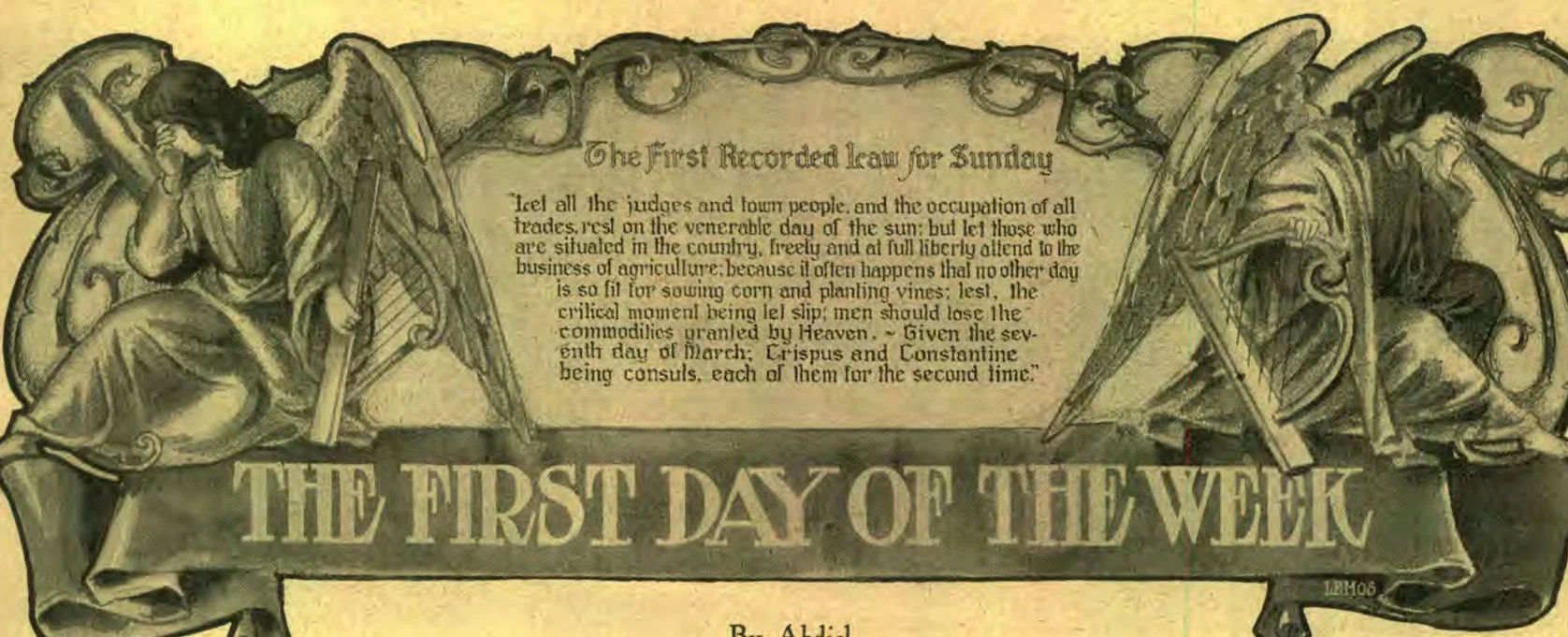
The First Commandment for First-day Observance
There is a first-day observance commandment, the very first on record; but unfortunately not as old as the Bible, nor given by a holy man.
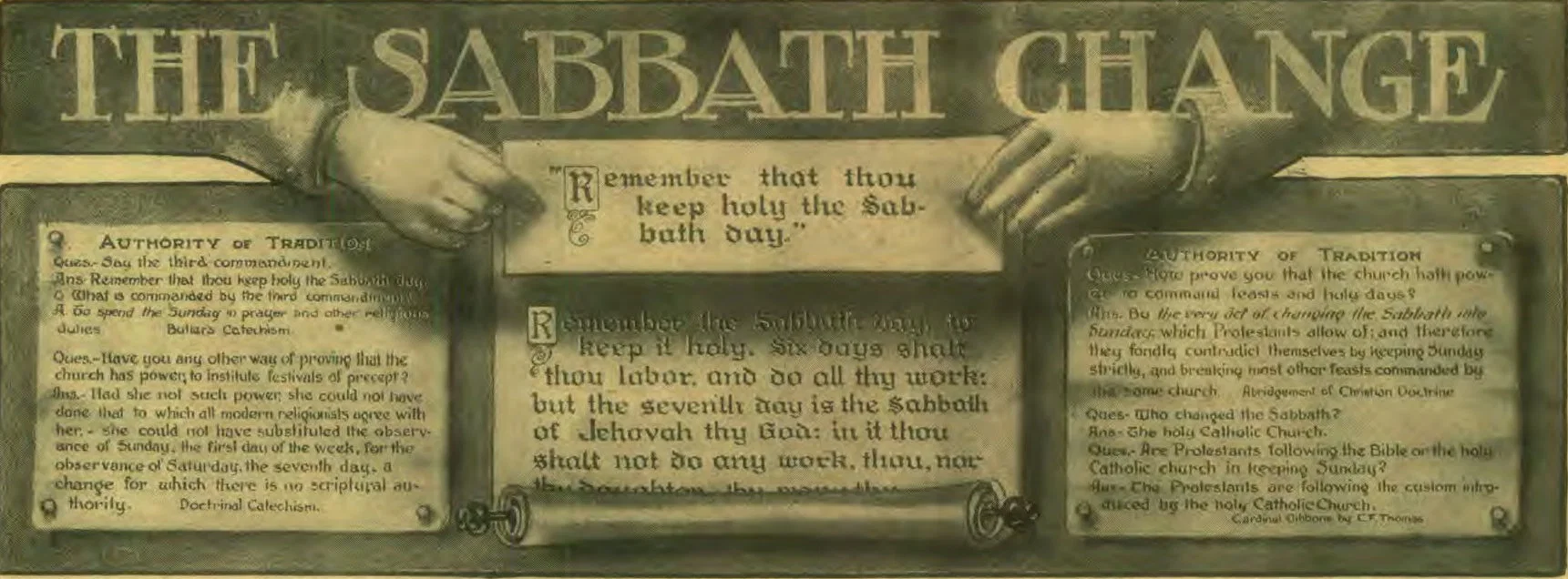
It is given on this page. Its author was the heathen emperor Constantine, a sun- and self-worshiper. All the Sunday observance of the early centuries crept into the church through half-converted heathen philosophers and teachers who corrupted the faith. Choose between these commandments in the headings of this and the previous page.
We are not, dear reader, condemning the good of past generations or of to-day. The old counterfeit of God’s Sabbath is well worn. Many have accepted it as genuine even as honest men accept counterfeit bills as genuine. But no honest man would continue to pass a counterfeit bill, knowing it to be such. He would pocket his loss if he could not collect from the man who passed it to him.
God’s plan is infinitely better. When He reveals by His great Detector, the Scriptures, the counterfeit, He gives us the eternal genuine.
"Every plant, which My heavenly Father hath not planted," says Jesus, "shall be rooted up." Will you take planting of error in the soon-to-perish tradition, or the plant of truth forever to grow and bloom and fruit in the evergreen garden of God?
CREATION VERSUS REDEMPTION
AMONG the claims for first-day sacredness frequently put forward is that redemption was finished on the first day of the week, that it is greater than creation, and therefore the day on which redemption is finished should be observed instead of the Sabbath, which is a memorial of creation. This is a large conclusion from very questionable premises; for (1) what authority have we that redemption is greater than creation? That is pure assumption on the part of poor, finite mortals, who know absolutely nothing of either; only the infinite God can create, only the infinite God can redeem. More than that, He tells us that redemption, regeneration in order to redemption, is creation; for "if any man be in Christ, he is a new creature," or as in the margin, "there is a new creation." 2 Cor. 5:17, A.R.V. "For we are His workmanship, created in Christ Jesus for good works." Eph. 2:10. Therefore the memorial of creation, the Sabbath, ought to be a day of double worth and joy to the recreated man. "Moreover also, I gave them My Sabbaths, to be a sign between Me and them, that they might know that I, Jehovah, do sanctify them." Eze. 20:12, margin, A.R.V.
2. It is not a wonderful thing that God should call from the dead His own righteous Son. It is a wonderful thing that He should die for a race of sinners, and it was on the cross that He said, "It is finished." Surely, if any day should be kept as a memorial of our redemption (for we are redeemed by His blood), it ought to be6the day on which He died, and not the day on which He arose.
3. While Christ paid the price of redemption on the cross for His children, that work of redemption is not completed until He shall come again; and so when that coming draws nigh, we are bidden to "look up, and lift up your heads; because your redemption draweth nigh." Luke 21:28.
4. It was a fitting thing to commemorate the work of creation by a day because God rested on that entire day and delighted Himself in the contemplation of His work; but the resurrection of Christ took place in a moment of time while the shades of night were yet tarrying, and the day following, the first day, passed without any divine acts which would in any way indicate that it was sacred.
5. God has given two things by which the believer shows forth to the world the power of Christ's redemption; one is the Lord's Supper, "an occasional emblem of a continual feast," the other is baptism, the beginning of a new life in Christ Jesus. And so the great memorial of Christ's resurrection is not a day, but a life. The newness of life to be manifested in the believer, the power over sin, is the greatest evidence to the world of a risen Saviour. The Lord's Supper and true baptism, or immersion, the failure to appreciate what these have meant by a church lost in the wilderness of tradition, led them to transgress the law of God, and put in the place of His memorial an institution for which there is no authority in the Scriptures. Truly has the Lord said of the wickedness that there is at the present time, "They have transgressed the laws, violated the statutes, broken the everlasting covenant." Isa. 24:5.
The Broken Hedge
By J. O. Corliss
How the Change of the Sabbath Took Place
THE common understanding of the word "hedge" is a thicket of bushes surrounding a field for its protection. All sacred writers have used the word in the same sense. For example, God spoke through the prophet and His Son concerning His people, likening them to a vineyard, which He fenced in, that its fruit might be preserved to His acceptance. But when He looked for the expected, well-developed grapes, He found nothing but common, wild fruit. So disappointed was He at this result, that He felt justified in taking away the "hedge," that the whole vineyard might be freely entered, and its growth be either "eaten up" or entirely "trodden down." Isa. 5:1-6. Matt. 21:33.
In both of these instances God's people are represented as being hedged about for their protection. The only possible harm which could come to the people of God, is that which follows the failure to keep in mind Him who is both Creator and Benefactor of the race. 1 Peter 4:19. So long as the "hedge" of protection against this remains unbroken, God's people are safe from every outward foe.
God's Hedge to His People
It is just as necessary now to preserve a knowledge of God as Creator and Benefactor, in order to be kept from evil, as it was in the time of our first parents. God's law was given to "hedge" men "round about," that within its enclosure and influence, they might know only that which emanates from its Author. That law is so "exceeding broad" (Ps. 119:96) that he who fully imbibes its unadulterated sentiment receives the mind of Him who spoke its unalterable decrees.
The Author of the Law
It is the rule of every state or nation, in making its laws, to append to these the authority by which they may be put in operation. Otherwise they are absolutely inoperative, for the reason that he whose life is to be regulated thereby can not possibly know to whom he is amenable, because he does not know the extent of the law's authority. It must be the same regarding God's law. Somewhere in connection with it must be revealed its Author, or else it can not enlighten men concerning the scope of its jurisdiction, and the power of its sovereign Defender.
This point is clearly stated in the Word. Recalling what He had done for that people who had forgotten their heavenly Benefactor, God says: "I gave them My Sabbaths, to be a sign between Me and them, that they might know that I am the Lord that sanctify them." Eze. 20:12. Thus we find the Sabbath commandment occupying the place of honor in God's law, in that it is the only one of the ten which absolutely identifies God, and accords Him the honor of being Creator of the heavens and earth, and hence He who has authority to command obedience from all in heaven above, and in the earth beneath.
True knowledge of the great God is therefore gained only by recognition of the Sabbath of the Ten Commandments. When this command is heeded, the entire law becomes a "delight" and comfort, because it settles forever the duty of him who would honor God. In this way the law of Ten Commandments becomes a "hedge" round about men to preserve them from the evil of the world.
The Hedge Broken
This hedge has, however, been broken. The law of God has been made void. Ps. 119:126. This was not done by faith in Christ, tho some have maintained that this is the result of faith. But true faith in Christ fully establishes the law. Rom. 3:31. Referring to the time just prior to the great battle of the day of the Lord, the prophet looks forward to that time and says of Israel: "Ye have not gone up into the gaps, neither made up the hedge for the house of Israel to stand in the battle in the day of the Lord." Eze. 13:5. On the other hand, the prophet charges the Israel of that time with seeing vanity and lying divination, saying the Lord saith, when the Lord has not sent them.
This appears a grievous charge, so grievous indeed, that God says that those who are guilty shall not be counted among His people nor have any part with them. Verse 9. Speaking of this matter at length in chapters 20 to 22, the prophet says the difficulty is that the people hide their eyes from His Sabbaths, and so He is profaned, or irreverently regarded, among them. Chapter 22:26. The Lord then goes on to say that He sought for a man among them to make up the hedge and stand in the gap thus made, showing that the disregarded Sabbath—the breach made in God's law—is the "broken hedge" which, before being broken, was intended for the protection of God's people.
The Beginning of Departure
Just how the Sabbath of God's law came to be ignored by professed Christendom is plainly written on the page of history. The "day of the sun," or Sunday, was observed by ancient heathen as a pagan festival. Rome, at the zenith of its power in the days of Christ, observed this pagan day, and to be consistent with its laws, which forbade any one having a religion of his own, under penalty of death or banishment, that government persecuted those who did not pay due regard to their solar holiday.
Under this stress, Mosheim says that when the second century dawned, it found the Christian church so far yielded to the mysteries of Paganism as to imitate its forms, even to turning the face toward the sun in worship.—"Ecclesiastical History," Century 2, part 2, ch. 4, pars. 5 and 7.
Constantine and Sunday
This pago-Christianity soon became the dominating influence in the church, and the Emperor Constantine (still a heathen in fact) "assumed to himself" the "external administration of the church." (Ibid., Century 4, part 2, ch. 2, par. 4.) Under these circumstances the emperor was prepared to dictate the policy to be pursued by the church, when differences arose as to the duty of men regarding a day of worship. The controversy over the question became so acute that he felt obliged to interfere, and in March of the year 321, issued the following edict: "Let all the judges and town people, and the occupation of all trades, rest on the venerable day of the sun; but let those who are situated in the country, freely and at full liberty, attend to the business of agriculture, because it often happens that no other day is so fit for sowing corn and planting vines; lest, the critical moment being let slip, men should lose the commodities granted by Heaven."
Two years later, Constantine professed conversion to Christianity. But his pagan proclivities led him to refuse to surrender the day so long dedicated to the worship of the sun, and he therefore brought that heathen holiday forward as a fitting day of rest under Christian worship. Nicephorus declared that the emperor "directed that the day which the Jews considered the first day of the week, and which the Greeks dedicated to the sun, should be called the Lord's day."—Quoted in Elliott's "Horae Apocalypticae," fifth edition, vol. 4, p. 603.
The Church of Rome and the Sabbath
Sylvester, the bishop of Rome, endorsed the name "Lord's day," as thus applied, and so conferred that title upon the first day of the week, in behalf of the church.—"Historica Ecclesiastica, per Ludovicum Lucium," Century 4, ch. 10, pp. 739, 740.
This, however, provoked a protest from many, in consequence of which the Council of Laodicea was convened in 364, from whence the following edict issued: "Because Christians ought not to Judaize, and to rest on the Sabbath, but to work in that day, which many did refuse at that time to do. But preferring to honor the Lord's day, there being a great controversy among Christians which of the two days . . . should have precedency. If they desired to rest, they should do this as Christians. Therefore if they shall be found to Judaize, let them be accursed from Christ."—"Dissertations of William Prynne," pages 33, 34.
When the Reformation called Protestantism into existence, it failed to reform the people on the point of the Sabbath day, and so the churches of to-day are observing the first day as an heirloom of Paganism, filtered through the Papacy. It originated with a people who knew not God, and came into prominence as the mark of apostasy from God. Without understanding it, the churches of to-day are assisting to maintain this breach in God's law, made by the heathen world, and so refuse to take part in repairing the "broken hedge," that it may be a protection to God's people in the battle of the day of the Lord. There are those, however, who are not satisfied with their present standing, whom it is hoped may be induced to heed the call of God for this time, to make up the hedge for that fast-approaching day.
Obey God Rather Than Men
"WE ought to obey God rather than men." Acts 5:29.
"WHETHER it be right in the sight of God to harken unto you more than unto God, judge ye." Acts 4:19.
BABYLON ITS CHARACTER
By C. M. Snow
By C. M. Snow
The Nature of Her Apostasy
FROM remotest times Babylon was the seat of nature worship, manifesting itself in most repulsive rituals and ceremonies. Contrary to the inspired record of creation, Babylon taught that all existence was an emanation of Deity; that all life, animal and vegetable, partook of the divine substance. She confounded the creature with the Creator, and her teachings transformed the Deity into a kind of god-world, whose manifestations were to be found in all the phenomena of nature.
With that belief and those teachings she fabricated a host of idols, and served them, and taught their service to the nations of the world. To such an extent did Babylon carry this iniquitous practice that the prophet of Jehovah declared of that land, "It is a land of graven images, and they are mad over idols." Jer. 50:38. Again the prophet says of her:
"Behold, the days come, saith Jehovah, that I will execute judgment upon her graven images; and through all her land the wounded shall groan. Tho Babylon should mount up to heaven, and tho she should fortify the height of her strength, yet from Me shall destroyers come unto her, saith Jehovah." Jer. 51:52, 53.
To what does the Lord refer in the words, "Tho Babylon should mount up to heaven"? The instigator of the whole Babylonian system once had his seat in heaven. Satan it was who first brought confusion into the universe of God. He sought to overthrow the government of God, to usurp God's place and prerogatives. This is what the Word of God says of this "king of Babylon:"
"How art thou fallen from heaven, O daystar [Lucifer], son of the morning! How art thou cut down to the ground, that didst lay low the nations! And thou saidst in thy heart, I will ascend into heaven, I will exalt my throne above the stars of God; and I will sit upon the mount of congregation, in the uttermost parts of the north; I will ascend above the heights of the clouds; I will make myself like the Most High." Isa. 14:12-14.
Self-Exaltation
In this boast of Lucifer there is no thought or intimation of loyalty to God or dependence upon the Creator. The whole idea is an insurrectionary one—rebellion against the existing order, a purpose to set up a throne and government of his own in the place of the government of God, self-salvation. The dissemination of these ideas and the consequent disaffection of a host of the angels broke, for the first time, the order and harmony of heaven. That marked the origin of Babylon, confusion.
It is reasonable to suppose that Satan's mission among men would be identical with his mission among the angels. The history of nations and the record of God's Word proves this to have been the case. Satan's first work in Eden was to induce men to attempt to be like God; and thus he instituted confusion there.
A "Gate of God"
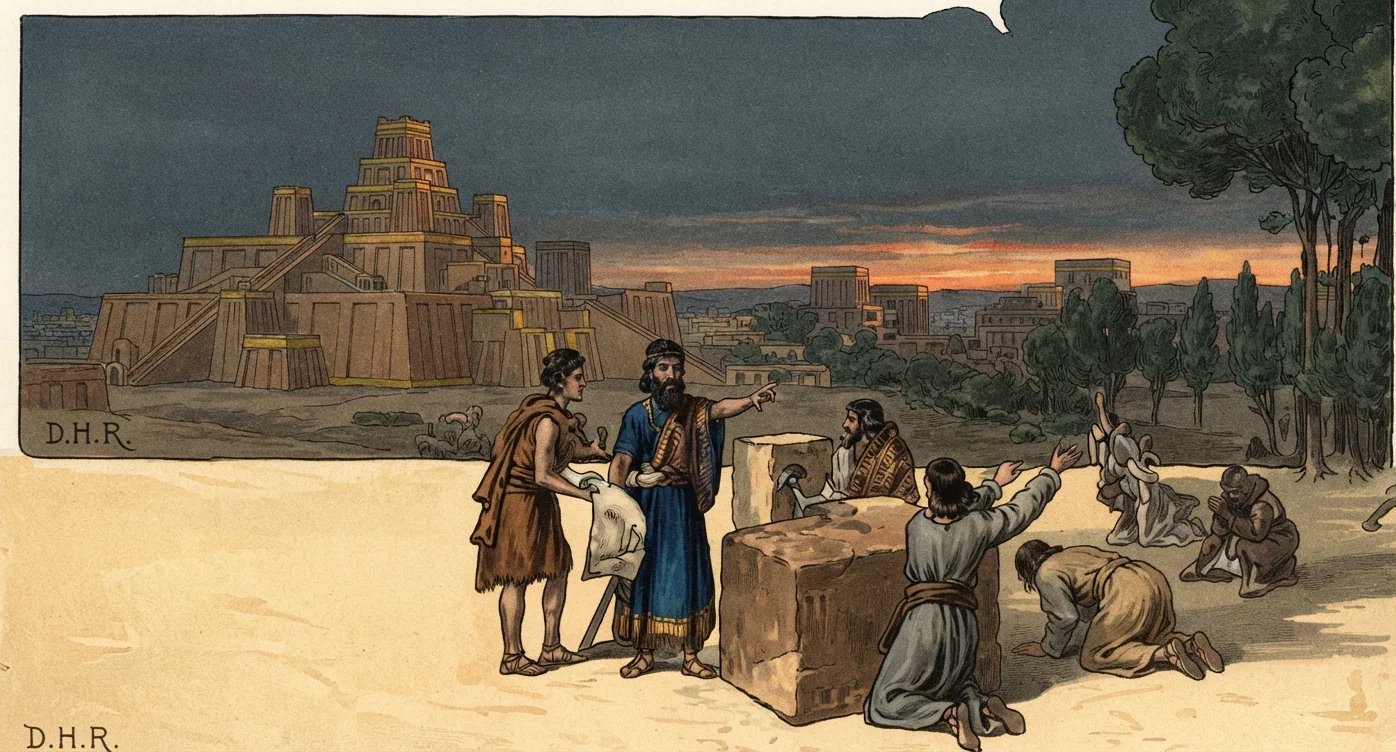
In the faithless posterity of sensual Ham, Satan found fertile soil for the propagation of his Heaven-defying purpose. These sons of Ham and of Nimrod decided to undertake a work that would insure their own salvation. They would build a mighty tower that would save them from the destructive power of any flood that Jehovah might bring upon them. They would build a tower that would reach to heaven, and then they would become the gate-keepers to heaven for all the rest of the world.
That is what the name they gave their tower signified. All the world would then flow to their city, the very key to the heavens, and they would be exalted above all the world. (Babylon of to-day claims to be the gate-keeper of heaven, carrying the keys.)
They began the tower, and they named it Bab-ili, the gate of God. But the completion of their presumptuous work God did not permit. They had been one people, and so one in purpose. They spoke the same language. God said, "Let us go down, and there confound their language, that they may not understand one another's speech. So Jehovah scattered them abroad from thence upon the face of all the earth, and they left off building the city." Gen. 11:7, 8. What they named Bab-ili, God named Babel, confusion. There was more in it than the mere confusion of speech. Babylon's dogma of self-salvation was in itself confusion. It was opposed to God and His truth; it was another system designed to supplant the true worship of Jehovah; it was a system of rebellion against God, for it was propagated in image worship, which was contrary to the law of God. Confusion it was, and wherever it went it carried confusion and disobedience with it, and men began to look to their own deeds for salvation, and to attribute to the Creator the attributes of their own carnal hearts.
Babylon's Teaching
The confounded speech was the secret of their scattering; and yet they did not all leave Babylon. Later that city became the great commercial emporium of the East. Babylon occupied the position of a great spider, sitting in the center of a mighty web of highways which led to all parts of Asia, and to Africa and India. She manufactured cloths of richest colors in fine linen, wool, and silk; she dealt in spices and ointments, gold, silver, and precious stones, wines, and fine flour. Her wares were hawked to the ends of the earth, and princes came to her storehouses to purchase for themselves and their retinues.
Sitting thus in the mart of the nations, great Babylon taught them the religion of self-salvation; taught them to look to idols for the help which no one but God could give; taught them to trust in their own works to appease the wrath of the offended gods. The building of the tower of Babel was the outgrowth of the character of the men who built it. That self-righteous characteristic, that assumption of the power of self-salvation, has worked itself out along different lines in different countries; but the principle is the same in all its manifestations. Buddha learned it, sitting in austere contemplation of himself under the Bo tree; monks and nuns have practised it in the seclusion of the cloisters; men have followed those teachings on bleeding knees, scourging their backs with withes and cruel knouts, or have sought to drive sin out of their mortal bodies by sleeping on beds of spikes or standing between fires. All of this was germinant in the teachings of Babylon of old and of spiritual Babylon of to-day; and all is alike contrary to the law of God and the Gospel of Jesus Christ.
Perpetuation of Babylonian Error
Babylon of old fell under the direct judgment of God; but, before she fell, the call went forth to God's people, "Flee out of the midst of Babylon, and save every man his life; be not cut off in her iniquity; for it is the time of Jehovah's vengeance; He will render unto her a recompense." Jer. 51:6. Babylon went down; but the principles of Babylon's religion persisted in the nations she had taught—even in the nations that overthrew her. Every false religion of earth has been founded upon that Babel principle—self-righteousness and self-salvation.
Spiritual Babylon to-day sits upon her throne in the seven-hilled city, and teaches a religion of penances to purge away sin, and traffics in the souls of men (Rev. 18:11-13). Babylon of old sought to make herself mistress of the very gates of heaven; spiritual Babylon claims possession of the keys to the gates of heaven—claims power to open and shut heaven. Babylon of old reveled in a host of idols; spiritual Babylon fills her sanctuaries with them. Her worshipers bow down to images and pictures of saints, and perform painful or arduous tasks to cleanse their souls from sin, while her priests take to themselves authority belonging only to God, the authority to grant forgiveness for sin. The cities of ancient Babylonia had their patron saints; the cities of those countries dominated by spiritual Babylon have theirs. Ancient Babylon mocked Heaven with her infractions of the law of God; spiritual Babylon claims the right and authority to change that law itself, and of the wrong to make right. The Word declares of the head of that system that he should oppose and exalt himself "against all that is called God or that is worshiped; so that he sitteth in the temple of God, setting himself forth as God." 2 Thess. 2:4. Ancient Babylon oppressed the people of God, even to the death; spiritual Babylon, God declares, is "drunken with the blood of the saints, and with the blood of the martyrs of Jesus." Rev. 17:6.
This is the character of Babylon, persistent, unchanging; and all her history has been spelling out her name, Confusion. As Babylon of old fell, so will spiritual Babylon fall. "Fallen, fallen is Babylon the great, and is become a habitation of demons, and a hold of every unclean spirit." Rev. 18:2. As God called His people out of ancient Babylon (Jer. 51:6), so does He now call them out of spiritual Babylon. "I heard another voice from heaven, saying, Come forth, My people, out of her, that ye have no fellowship with her sins, and that ye receive not of her plagues." Rev. 18:4. God said of ancient Babylon: "The heavens and the earth, and all that is therein, shall sing for joy over Babylon; for the destroyers shall come unto her." Jer. 51:48. And so He says concerning the end of spiritual Babylon: "Rejoice over her, thou heaven, and ye saints, and ye apostles, and ye prophets; for God hath judged your judgment on her." Rev. 18:20.
The end of Babylon's history is the end of the history of all sin and all confusion in the universe of God. No wonder the heavens and the earth are called upon to celebrate that grand consummation.
The Tower of Babel.
MARANATHA
By John R. Macduff
Christ is coming; let Creation
Bid her groans and travail cease;
Let the glorious proclamation
Hope restore and faith increase.
Maranatha!
Come, thou blessed Prince of Peace.
Earth can now but tell the story
Of Thy bitter cross and pain;
She shall yet behold Thy glory,
When Thou comest back to reign.
Maranatha!
Let each heart repeat the strain.
Long the exiles have been pining,
Far from rest, and home, and Thee;
But, in heavenly vesture shining,
Soon they shall Thy glory see.
Maranatha!
Haste the joyous jubilee.
With that "blessed hope" before us,
Let no harp remain unstrung;
Let the mighty advent chorus
Onward roll from tongue to tongue.
Maranatha!
Come, Lord Jesus, quickly come.
—J. R. Macduff.