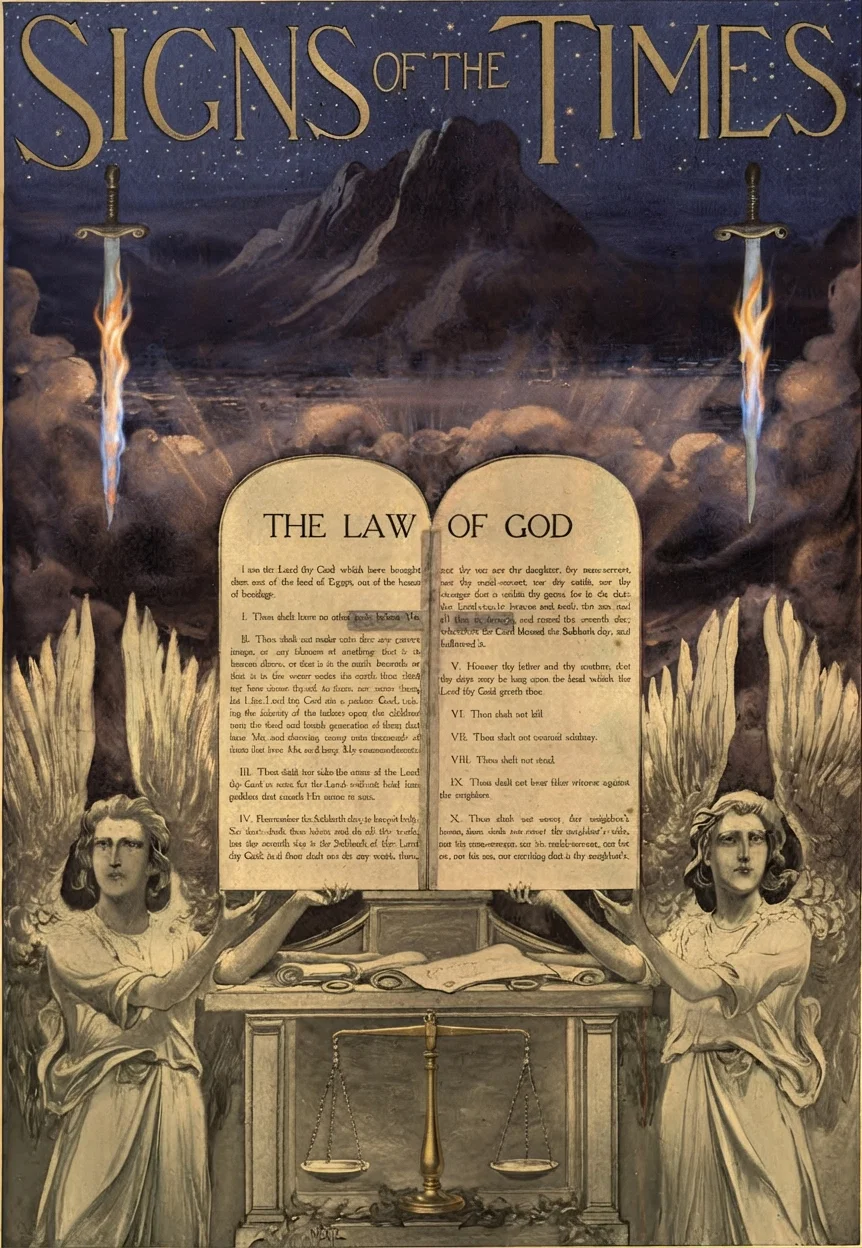
Signs of the Times, Vol. 31, No. 45.

Holiday Suggestions

Earlier text: Encroachments on Freedom

EDUCATION IN THE HOME. NO. 24

(Continued from "Signs" of October 25.)
"SURE enough," admitted Walter, "it would be quite absurd to expect one to 'seek' for immortality if he already possessed it."
"But this is only one text containing the word immortality," said Mr. Wilber, "please let us hear the others—this study is growing intensely interesting, to me, at least."
"The Bible is a deeply interesting book as well as an instructive one," was the reply, "and the only wonder is, that it is studied so little. But, Mrs. Gray, if you will turn to 1 Cor. 15: 53, 54, you will find another instance of the use of this rare word."
"'For this corruptible must put on incorruption, and this mortal must put on immortality. So when this corruptible shall have put on incorruption, and this mortal shall have put on immortality, then shall be brought to pass the saying that is written, Death is swallowed up in victory.'"
"The word is used twice in this instance, but as it is in the same verse and used in the same connection, we count it but once; but is there anything, Mrs. Gray, do you think, in this scripture, to indicate that the soul or spirit of man is now immortal?"
"O, no, indeed; there is everything to indicate exactly the opposite."
"Certainly," chimed in Mr. Gray. "Man is called mortal twice in this scripture."
"Mr. Wilber, I will ask you to read the next instance in which the word is found, and let us watch closely to see if we can not find some mention of an immortal soul or spirit in man," smiled Brother Hartman, "I think Elsie can give you the reference."
"I must ask if you look these texts up beforehand, Mr. Hartman. I have often been surprised at the readiness with which your family find the texts," queried Mr. Wilber, as Elsie paused a moment before giving him the reference.
"I think," she replied, "that you will find the word immortality in 1 Tim. 6: 15, 16 also; and—well, yes, Mr. Wilber, we certainly do study our lesson. We think it worth our while. Don't you think so?"
"It seems to pay you, really, it does," interrupted Mrs. Gray.
"Yes, yes, Miss Elsie, it pays you well; in fact, I suppose an earnest study of God's Word is a pretty paying business. But I will read the text: 'Which in His times He shall show, who is the blessed and only Potentate, the King of Kings, and Lord of Lords; who only hath immortality, dwelling in the light which no man can approach unto.'"
"Well," said Billy Black, with a twinkle in his eye, "I'm sure that's plain enough; it says that nobody but just God is immortal."
"Yes, Billy," assented Walter Gray, "yes, but what about the angels? I didn't suppose any of them ever could die."
Billy looked a little put out at this turn in the argument, and turned appealingly to John, while he wondered if his friend could help him out of the tangle.
"I think Billy wants me to answer your question, Walter, but I will refer it to father," said John modestly.
Mrs. Wilber turned her dark eyes questioningly upon Brother Hartman, and Mrs. Jones interrupted eagerly: "I think this is leading us into pretty deep water, isn't it, Mr. Hartman?"
"Perhaps; but there is not a single subject in the Word of God but that is as deep as the deepest depth, and high as the measureless heaven. Mrs. Wilber, will you kindly read Jude 6?"
"'And the angels which kept not their first estate, but left their own habitation, He hath reserved in everlasting chains under darkness unto the judgment of the great day.'"
"But that doesn't say that even bad angels are not immortal, does it, now,—honestly, Mr. Hartman?" queried Walter.
"Wait a moment, Walter. Will you read John 3: 16?"
"With pleasure. Indeed, I believe I can repeat that text from memory. 'For God so loved the world that He gave His only begotten Son, that who-soever believeth in Him should not perish, but have everlasting life.'"
"Now, Walter, don't you think this is equivalent to saying that all who do not believe in Christ shall perish? and surely if we must believe in Christ or perish, evil angels who, with Satan as their leader, are constantly fighting against Christ, must perish. But now, I would like Mrs. Gray to read Eze. 28: 18, 19."
While Mrs. Gray turned to the text, Sister Hartman remarked: "This entire chapter refers unmistakably to Satan, for verse 16 calls him 'the covering cherub.'"
"'Thou hast defiled thy sanctuaries by the multitude of thine iniquities; . . . therefore will I bring forth a fire from the midst of thee, it shall devour thee, and I will bring thee to ashes upon the earth. . . . Thou shalt be a terror, and never shalt thou be any more!'"
"Thus we see," continued Brother Hartman, "that not only evil angels, but Satan as well, will finally be destroyed,—which, of course, they could not be if they were immortal. Is this plain to you, Walter?"
"Much plainer than before, Mr. Hartman, but I think it would be a good plan to have an entire reading just upon that subject."
"I am sure it would be of great interest," interrupted Mrs. Jones and Mrs. Wilber together.
"Very well; we will try to do so; for it is a subject which will bear much study. But there is just one more text which contains the word immortality. It is found in 2 Tim. 1: 10. Will Mr. Gray please read?"
"'But is now made manifest by the appearing of our Saviour Jesus Christ, who hath abolished death, and hath brought life and immortality to light through the Gospel.'"
"Ah! through the Gospel!" repeated grandma. "Immortality is only possible through Christ our Lord."
"Is this the last text, father?" asked Mattie.
"Yes, and yet we have found that in not a single instance does the word 'immortality' refer to the soul or spirit of man."
"Isn't it most time we told our stories about dead men, papa?" asked little Beth anxiously; at which every one smiled, while Brother Hartman added by way of explanation:
"The children were each to have told a Bible story to-night, of some person who had died and been raised to life again by the power of God, so that we might see if anything is said in that connection, about their being conscious after death. But we must wait until the next reading for this, as it is now rather late. Let us sing to close: "Only in Christ we have life immortal!" And as the beautiful strains rang out, more than one in that little company at Brother Hartman's felt a deeper desire for true holiness, without which eternal life is impossible."
(Continued in two weeks.)

A SISTER'S INFLUENCE

"If I only had a sister, Cousin Helen, but I am so lonely. You know that since mama died, I have no one but papa and Hugh."
The speaker was a young girl only eighteen years of age, but her earnest face was expressive of strong character.
"Why not let Hugh take a sister's place?" suggested Cousin Helen.
"How?" and Margie's eyes really sparkled.
"Talk with him about the many things that interest you, great and small. Our brothers like to feel that their sisters can trust them."
"Margie," continued Cousin Helen, with a troubled look in her eyes, "there has recently been opened down town an elegant saloon, which is called the 'Gilded Palace,' and last evening I overheard a conversation between Hugh and his friend, Chester Winthrop, concerning it. Hugh evidently thought it an improper place for moral young men to frequent, but Chester tried to overcome his scruples by informing him that there are rooms connected with the main saloon, where moral men can assemble without coming into contact with anything objectionable, and that many of the best young men in town spend their evenings there. Pardon me, dear, but have you made home attractive to Hugh of late?"
"I am afraid not, Cousin Helen, for I have fallen into the selfish habit of spending much time in my own room. Thank you for your suggestion."
That evening, as Hugh Nelson was passing through the hall, hat in hand, he was surprised to hear his sister call out from the parlor:
"Are you going out, Hugh?"
"Ye-es," he answered, with hesitancy, for a glance into the pretty parlor, with its glowing fire-grate and open piano, made him almost wish that he were going to spend the evening at home.
"Come in a little while, please, and help me select my new suit," pleaded Margie.
"Your new suit!" echoed Hugh, with astonishment. "What do I know about girls' suits?"
"I believe you can help me," urged Margie, "for you have good taste in selecting your own clothes. You know, Hugh, I have not been used to choose for myself, and I miss mama so much."
There was a quiver in the voice that Hugh could not resist, and after hanging his hat on the rack, he walked into the parlor, and was soon as deeply interested in the examination of dress samples and fashion-plates as his little sister could wish.
From that time Margie followed her cousin's suggestions to the very letter. She laid her plans before Hugh as she would have done before an older sister, always asking his opinion concerning them, thereby making him feel that she needed his companionship and counsel. By this means there was gradually formed between this brother and sister a bond of love which was truly beautiful.
Years passed, and one evening, while Hugh and Margie Nelson were enjoying the quiet of their cozy parlor, Margie was startled by an exclamation of horror from her brother, and, on turning toward him, she saw that he had dropped the evening paper, and had buried his face in his hands. Catching up the paper, she anxiously glanced down the column until she came to this item:
"A young man named Chester Winthrop was fatally wounded last evening at the 'Gilded Palace Saloon,' with a pistol-shot fired by David Holmes. Doubtless, both of the young men were under the influence of liquor."
"Was Chester Winthrop once your friend?" asked Margie.
"Yes," answered Hugh, as he raised a pale face from his hands, "and but for the influence of my precious little sister, I might be as he is to-night."
Margie looked incredulous, for Hugh had so many years been an earnest Christian that she could not imagine him as having sunk to such depths of degradation.
"After mother died," resumed Hugh with emotion, "I was sad and lonely. Father was absorbed in business, you spent much time by yourself, and I longed for some attractive place in which to spend my evenings. Chester asked me to go to the 'Gilded Palace Saloon,' which, he said, had every attraction heart could wish. After much urging, I consented; but, on the appointed evening, you wished me to help you select your new suit. As I looked into the parlor, which you had made bright and pretty, I thought some other night would do for my visit to the 'Gilded Palace,' so I yielded to your persuasions, and spent the evening at home. But after that, I found every evening the same, for you always had some pleasant entertainment in store for me, and I finally came to the conclusion that our parlor was good enough for me, and that it would be difficult to find more attractive company than that of my own sweet sister."
"Margie," he continued, while a soft light came into his eyes, "altho I was not a Christian, you talked so freely with me about your religious experiences, that I could not fail to see the deep satisfaction you found in the religion of Jesus Christ. I soon came to yearn for the peace and rest that you evidently enjoyed, and so I was led to yield my heart to the Saviour. Ah, little Margie, if all sisters were as good and wise as mine has been, the saloon keepers would find few victims among our young men!"
While Margie Nelson listened to this candid confession, her heart was raised to God in gratitude for the blessed assurance of having been the instrument through which He saved her brother.—Christian Intelligencer.

A FAMILY TRAGEDY

[The following is a true tale of a recent happening in an American city. It is a good story to relate to patients and legislators in the campaign against nostrums and against adulterated foods and drugs.]
A RESPECTED clergyman fell ill, and the family physician was called. After examining the patient carefully, the doctor asked for a private interview with the patient's adult son.
"Harry," said the doctor, "do you know what is the matter with your father?"
"No. We sent for you to tell us that."
"Well," the physician said, "I am sorry to tell you that your father undoubtedly is suffering from chronic alcoholism."
"Chronic alcoholism! Why, that's ridiculous! Father never drank a drop of liquor in his life, and we know all there is to know about his habits."
"Well, my boy, it's chronic alcoholism, nevertheless, and at this present moment your father is drunk. How has his health been recently? Has he been taking any medicine?"
"Why, for some time, six months I should say, father has often complained of feeling unusually tired. A few months ago a friend of his recommended to him [mentioning a much-advertised remedy], assuring him that it would build him up. Since then he has taken many bottles of it, and I am quite sure that he has taken nothing else."
In this connection it might be added that a very prominent anti-saloon worker, a clergyman, lately said that in shame he was compelled to admit that he had run across indubitable proof that there are ministers of the gospel who receive pecuniary commissions from the makers of alcoholic nostrums whose wares they recommend! Than this there can be no worse form of graft. The time is here for the organized profession to join hands with all other workers and organizations, whether anti-saloon leagues, temperance unions, or courageous anti-nostrum publications, to set a definite limit to the progress of respectable and innocent intemperance.
—Journal of American Medical Association.

Marriage and Moral Conduct

I HAVE never seen a man who takes a light view of marriage who has not, in one way or another, fallen.

THE HOME OF THE REDEEMED

1. In the beginning man was given dominion over all the earth, and all that was in it. Gen. 1:26. But by disobeying God he forfeited his life (Gen. 3:19), and consequently lost his dominion, which passed into the hand of his conqueror, Satan becoming “the prince of this world.” John 12:31; 14:30; 16:11; Acts 26:18; 2 Cor. 4:3, 4.
2. But the Son of God espoused the cause of the lost race, and will restore the former condition. So the prophet says, “And Thou, O Tower of the flock, the Stronghold of the daughter of Zion, unto Thee shall it come, even the first dominion.” Micah 4:8.
3. The promise to Abraham was that he should be “heir of the world” (Rom. 4:13). “And if ye be Christ’s, then are ye Abraham’s seed, and heirs according to the promise.” Gal. 3:29. But Abraham died without receiving the promise (Heb. 11:8-10, 13, 14); therefore it must yet be given him, for the Lord’s promises are sure. 2 Cor. 1:19, 20; 1 Peter 1:24, 25.
4. The further promise of Christ is, first through David (Ps. 37:9-11, 22), and then by His own mouth (Matt. 5:5), that “the meek shall inherit the earth.”
5. The present sin-cursed earth will be destroyed, and a new, or renewed, earth will take its place, and be the home of the redeemed. As the antediluvian world was destroyed by water, so the world that now is will be purified by fire. 2 Peter 3:5-14.
6. The New Jerusalem, coming down from heaven, will be the capital of the new earth, and of the universe. Rev. 21:1-3.
7. “Therefore the redeemed of the Lord shall return, and come with singing unto Zion; and everlasting joy shall be upon their head; they shall obtain gladness and joy; and sorrow and mourning shall flee away.” Isa. 51:11.

THE STAR OF TRUTH

BY ELIZA H. MORTON
The Christ-Child saw a star and said, It is a light An angel holds within his hand. It is so bright I can not see his shining face, But he is there, And he shall be my guide, henceforth And everywhere.
The years passed on, the Child, a Man, Still saw the star— The word of truth in all its power— Shining afar. He said, I would the wandering sheep Might it behold And from the wilderness come forth To find the fold.
And there beneath that star He knelt Wrestling with wrong, And angels came and ministered A holy throng. He touched their wings and clasped their hands And from God's throne Obtained a strength and living power To be His own.
And when at length above the cross The sun grew dim, The Christ-Child still beheld that star Shining for Him. And still for us the star shines on— The truth divine— And in our hearts as in His heart That truth may shine.
North Deering, Me.

TEN DOLLARS A WEEK.

SOME agents are making as high as $10 a week selling E-Z Washing Tablets. Why not you? Sample bar sufficient for a month's washing for 10 cents post-paid. TERMS FREE.
Address, Alfred Mallett, Elkridge Sta., Baltimore, Md.

Millennial Text-Book

MILLENNIAL TEXT-BOOK.—Every known reference, over 500 arranged according to events, adapted for instant reference or profound Bible study; result of 12 years search. Mailed for 10 one-cent stamps or a dime. Eugene A. Brown, Phœnix, Ariz.

Modern Science and Christianity

OUTLINES OF MODERN SCIENCE AND MODERN CHRISTIANITY.—A logical presentation of the true principles of Christianity and science, in contrast with modern ideas of Christianity and science. It is written to arrest the downward drift of theology, and place within the minds and hearts of its readers the soul-stirring, life-giving, character-regenerating doctrines of the Bible. Cloth bound; 272 pages, net... 75c.
Address PUBLISHERS OF THIS PAPER.

BOY PUZZLE, THE.

By Rev. Joseph Flint. It commends itself to parents and teachers alike, and shows how they may win love and obedience without frequent punishment. The author is master of his subject. The book is full of faithful warnings and helpful suggestions, and is illustrated by sketches representing, in an original and unique manner, the various stages of human development. Cloth, net ..... 75c. Address PUBLISHERS OF THIS PAPER.

OUR SPECIAL NO. 4

Is the last of the series. We are glad for the good words which have come to us from all over the field for our first number. We are writing this before there is time to receive word from the second number. But allowing us to judge,—and we have lived with these Specials for weeks,—we believe that the last number is the best of all. Let us name to our readers some of the excellent articles which that number will contain:
1. A Spirit-filled Church. It is not a long article, but it is a splendid one, clear, scintillating, powerful, by W. A. Spicer, one who, as he looks out over the great mission field, feels the need of a spirit-filled church, and his article echoes his soul's cry.
2. The Requisite Conditions of a Spirit-filled Church. What is necessary on the church's part if she is to receive the Spirit-filling; and the truth in this is also shown by one who feels a great burden for the world's need, a great longing that the baptism of the Spirit shall come upon the children of God in these last days. It is written by the President of the General Conference, Pastor A. G. Daniells.
3. Spiritual Gifts, by J. N. Loughborough. We know that there are those who will deny the gifts; we know that Mormonism has set up its counterfeit, we know that Satan is trying to discredit the blessed gifts of the Spirit in a dozen different ways, just as He did of old. Nevertheless it is still true that Christ gave gifts to His church to remain even to the end. You certainly will be interested in this short paper by one who has given more than two-score years study to the question.
4. The Great Apostasy, and Spiritual Gifts, by Prof. W. W. Prescott, editor of the Review and Herald. This article shows the reasons why spiritual gifts are not now manifested in the church as they were in the beginning. The great apostasy, the mystery of iniquity, came in, took away the very longing for the truth; and that is set forth in this article. We are sure you will miss much if you miss what is said on this phase of the subject.
5. This is the climatic article of the subject of the sanctuary treated in past numbers. It is entitled, The Ark of God the Great Center of the Sanctuary Service, written by John Orr Corliss.
6. The Seal of God, by Roderick S. Owen, the closing article on the great Sabbath question, carried from the third number over into this. It is natural for every human being who has possessions to think that they are genuine and that they are his by the stamp of authority. Of how much more importance is it to be among those who are sealed with the seal of the living God, for His kingdom is for all eternity. This is also an important article; it explains the prophecies of Rev. 7:1-3 and Ezekiel 9.
7. God's Last Great Protest, by A. O. Tait. Surely one understanding the conditions of the world at the present time and the efforts that men are making to nullify God's law, ought to be grateful to know that God has given one vital, tremendous protest in His Word against every effort of this kind, and this article sets forth that protest.
8. Our Preparation for the End, by Mrs. E. G. White, showing the work that is necessary on our part if we would stand before the Son of Man when He comes.
9. The Church Restored and Triumphant, the climax of all the ages of earth's travail and sorrow, the one thing for which the children of God have longed and hoped through all the sorrow, sin, and suffering of the past.
Besides, we have our Home department, bright, hopeful, instructive; a poem on Isa. 26:20, how God will keep His children when "There gathers o'er the world the stormcloud's wrath," by Frances E. Bolton; and another beautiful poem by Mrs. Stuttle, "The Church Triumphant." It seems to us that the last number is worth the price of all the four, and the editor wishes that it could have a circulation of ten million in the United States alone. You want them and you want your friends to have them. Help us to circulate them.

CONTAINED IN THIS NUMBER.

Poetry.

The Morning Cometh, MRS. L. D. AVERY-STUTTLE . . . 3
Maranatha . . . . . . . . . . . . . . . . . . . . . . 7
The Book of Remembrance, L. D. SANTEE . . . . . . . . 9
The Star of Truth, ELIZA H. MORTON . . . . . . . . . 15

General.

The Eternal Law, the Everlasting Gospel, W. A. SPICER . 3
What Men Have Said . . . . . . . . . . . . . . . . . 3
The Bible Sabbath, A. T. ROBINSON . . . . . . . . . . 4
The First Day of the Week, ABDIEL . . . . . . . . . 5
Creation versus Redemption . . . . . . . . . . . . . . 5
The Sabbath Change, J. O. CORLISS . . . . . . . . . . 6
Babylon—Its Character, C. M. SNOW . . . . . . . . . . 7
Principles of Babylon in Succeeding Ages, R. C. PORTER . 8
The Investigative Judgment, MRS. E. G. WHITE . . . . . 9
The Reformation and America, J. A. L. DERBY . . . . . 10
Encroachments on Freedom, K. C. RUSSELL . . . . . . . 11
Signs in the Earth, A. J. SAXBY BOURDEAU . . . . . . 12
The Great Field of Prophecy . . . . . . . . . . . . 13

The Home.—Education in the Home, MRS. L. D. AVERY-STUTTLE . . . . . . . . . . . . . . . . . . . 14

A Family Tragedy . . . . . . . . . . . . . . . . . . 14
A Sister's Influence . . . . . . . . . . . . . . . . 14
The Home of the Redeemed . . . . . . . . . . . . . . 15

Publishers. . . . . . . . . . . . . . . . . . . . 2

The Potency of the Cross

Our cover page speaks for itself: in words, by the eternal law of the Most High God; in illustration, of the justice, the mercy, the love, of God. The angels of the mercy-seat uphold the law of God.
We ask our readers to study, as dealing not only with one of the great questions of eternity, but as one of the great world questions, the articles on the Sabbath in this and the number following. It is worth while.
We regret that this issue would not admit all the good things written for it. Most of our contributors exceeded their limitations; for which we do not blame them, but we were obliged to abbreviate in some instances contrary to our desire. Some short articles written expressly for this issue are held over for future numbers.
The Potency of the Cross.—There is a beautiful, suggestive thought in the shadow of the arms of the cross upon our cover page. On the one side it blots out other "gods before" the Lord, and on the other side it includes "all that in them is." This is an undesigned coincidence, but it is characteristic of the cross of Christ. He who knows and bears the cross of Christ will value all false gods at their true worth—vanity. And if he knows the full meaning of the cross, he will gladly rejoice, and the language of his soul shall be, "Far be it from me to glory, save in the cross of our Lord Jesus Christ, through which the world hath been crucified unto me, and I unto the world." It is the only thing which makes possible the keeping of God's law.

By the Truth.

Those who live in the last days have all the evidences which have ever been given before in all the centuries of the past. The Word of God shines out upon the moral darkness of a sinful world as never before. The people of God will not win their greatest triumph through mighty works, but through the simple truth of God treasured in hearts made pure by the blood of Christ. Not the theory of the truth, not the love of the theory of the truth, but the love of the truth in all its purifying power, will preserve men from "all the deceivableness of unrighteousness" by which the great adversary will destroy unwary souls. 2 Thess. 2: 10-12. Such a faith in the Word of God, such a love of the truth, will unite them to God, the Author of the truth, and will enable them, tho all around them fail, to stand alone with God.

Forewarned

Forewarned.—There is no movement likely to affect the world's destiny, there is no nation or government having a moulding power upon the world, there is no principle threatening the destruction of good government, causing extensive suffering in the world, or likely to corrupt the church of Christ, but that God has clearly foretold it in His Word, has faithfully forewarned against its dangers, and has presented a sure antidote for its evil. "Surely the Lord God will do nothing, but He revealeth His secret unto His servants the prophets." Amos 3:7.

THE LOVE OF GOD

Wonderful love that would move the heart of God to give even His only-begotten Son! Wonderful love that would lead that Son, He who was in the bosom of the Father from the beginning, who created all the shining worlds, and the thrones, dominions, principalities, and powers of the universe, to whom the shining myriads of heaven delighted to pay homage,—wonderful love which would lead Him to come to earth, to be made lower than the angels which He created, to clothe His divinity in sinful flesh, to be made sin for man! He could have blotted men and the earth from existence in justice, and put in their place an earth unmarred by sin, a race higher than man. But this would not have manifested His love to dying man.
Follow Jesus of Nazareth in all His earth-life from the temptation in the wilderness to the cross of Calvary, and it speaks with ever-increasing volume and melody the one word, Love. Christ was the manifestation of God, and in every unselfish act of His earth-life (and all were unselfish) we see the manifestation of the love of the Godhead. It was Divine Love which withheld not His Son to die; it was love divine which breathed through the prayer, "Father, forgive them, they know not what they do." And that same love still reigns. Jesus lives to plead the blood shed for sin in behalf of those who trust Him; and He pleads to the sinner, "Come;" to the backslider, "Return." With love more tender than that of a mother for her little nursling, He reproves and chastens, that we may come near to Him and thus be made like Him.
But where can we pause? Time, eternity, would fail to tell God's love to fallen man. He says that He loves us; His deeds are more than His words. Would you know His love, dear reader? Then yield to Him your heart. "Taste and see that the Lord is good."

You have reached the end of this edition.

Signs of the Times · Nov 8, 1905