THE term Babylon means "confusion," and is applied to the ancient Babylonian head of the seven-headed beast of Revelation, chapters 12, 13, and 17. Babylon refers to confused views of religious truth emanating from the ancient city of Babylon, and from that place heralded to all the earth. This is too well authenticated to leave reasonable room for doubt.
It is equally plain that Satan, termed in Isaiah 14:4, king of Babylon, and in Revelation 12:1-17, the dragon, set forth as in deadly conflict with Michael, determined to destroy the Manchild (Jesus) as soon as He was born, is the Head of this Babylonian system.
The Center of Controversy
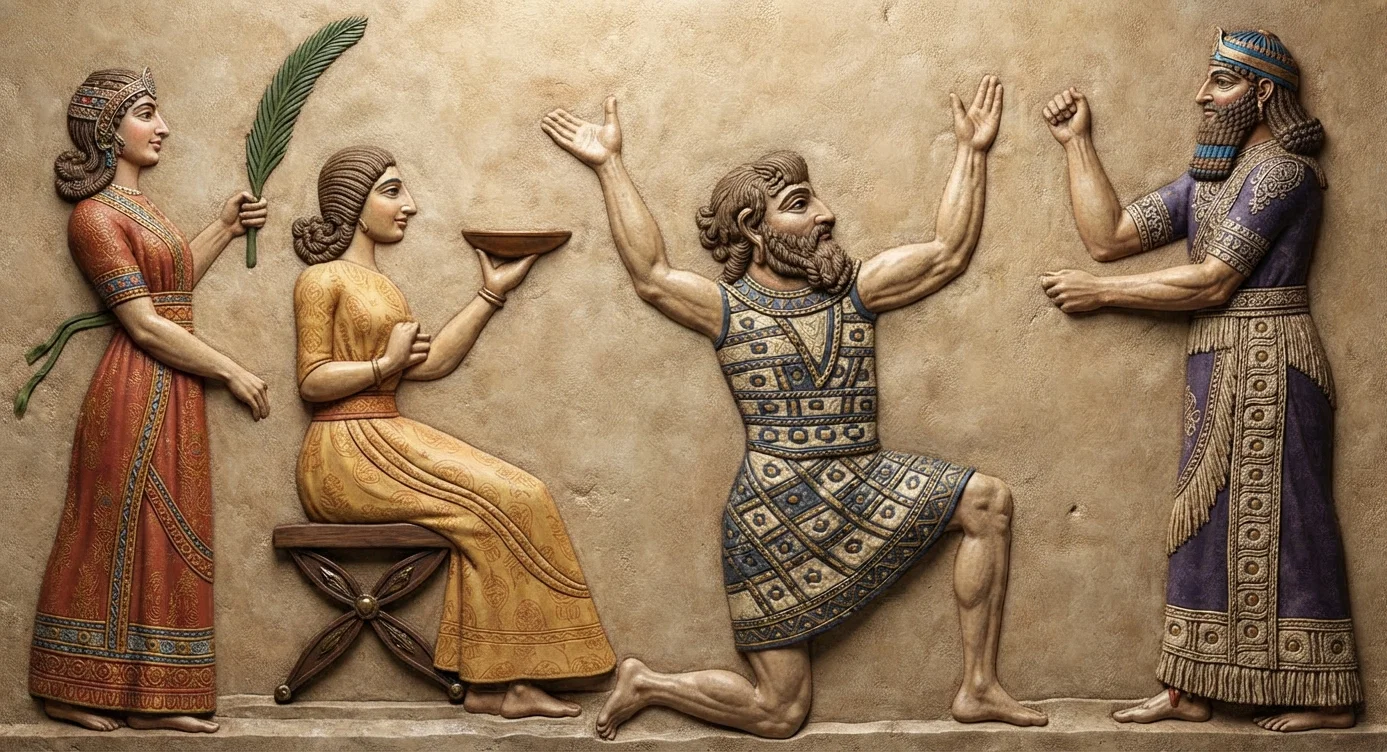
The warfare now waged upon earth began in heaven, when Michael and His angels fought against the dragon and his angels. Rev. 12:7. The conflict then was over the commandments of God and loyalty to the King omnipotent. The conflict upon earth has ever been over the commandments of God and the testimony of Jesus Christ. Gen. 3:1-5; 1 Kings 18:17-21. This will be the occasion of continual controversy between Christ and Satan, between Christianity and the Babylonian system, to the close of time. Rev. 12:17. In ancient Babylon the state was made to serve as a means of propagating a false system of religion. This abuse of the purpose of the state was carried to the extent of religious persecution. In Daniel the third chapter is recorded the order of the king, that all those who would not worship according to the demands of the Babylonian system should be cast into the fiery furnace. As a rebuke to the state for the misuse of its authority, and in demonstration of the superior power by which Christ conducts His work, the decree of the king was reversed by the presence of Christ in the fiery furnace with His faithful followers. The fire did not harm them, altho the furnace, by order of the king, had been heated sevenfold hotter than on ordinary occasions.
God's Attitude toward Babylon
There is no mistaking God's attitude toward this Babylonian system of religion. It is in open and irreconcilable hostility to the religion of Christ; and but for the judgments of God upon the nations from time to time, the states, influenced by the Babylonian system of religion, would have crushed out the last follower of Christ and allowed him no religious rights.
In the last part of Jeremiah 50, and chapter 51, the character of Babylon is set forth, and God's defense of His people. In verse eleven the kings of the Medes are called upon to "make bright" their arrows and gather their shields to destroy Babylon, "because it is the vengeance of the Lord, the vengeance of His temple." After all this testimony of God's disfavor to the system emanating from Babylon which caused the overthrow of that city and that nation, the same system is perpetuated, and the power of the state turned to its support in succeeding kingdoms. The second head of the beast of Revelation 13 evidently refers to the kingdom following Babylon. In this, the kingdom of the Medes and Persians, before the conclusion of the reign of the first king, we see Daniel in the lions' den by order of the state, for no cause but that he observed the law of his God. Here again Christ rebukes the Babylonian system of religion, and the state for allowing itself to become its agent in intolerance, by delivering Daniel from the power of the lions.
In Revelation 17, the apostate woman, who with her daughters, is used as a symbol to represent the Babylonian system in the Christian dispensation, is seated upon the seven-headed beast. And verse 18 says, "And the woman which thou sawest is that great city, which reigneth over the kings of the earth." This explains the meaning of the symbol of the woman seated upon the beast. The symbol is a fallen woman, representing an apostate church. Seated upon the beast is the same as reigning over the kings of the earth. Verse 2 states that with her the kings of the earth have committed fornication. An unholy alliance with kings for the accomplishment of her designs, and filling the world by this means with her false doctrines, is here revealed. This use of kings is seen throughout the seven heads, as we have seen it during the first two already examined.
A Threefold Manifestation—The First
In Rev. 16:19 this Babylonian system is said to be divided into three parts. The great pagan system of religion has in the previous article been shown to be the first division of this threefold Babylonian system. The influence of Paganism dominated Babylon, Medo-Persia, Grecia, and Pagan Rome. Persecution to the death was continued against those who were devoted to Christ in the days of Rome. Even Christ, pure and sinless, was condemned and executed upon Calvary through Rome's being controlled by the system of Babylon's religion. In this act the climax of the conflict between the religion of Love, of which Christ is the Author, and a religion of force, championed by Satan, was reached. In this act also the controversy was settled in heaven where it first began, and of the disloyal angels it was thenceforth said, "And prevailed not; neither was their place found any more in heaven. . . . He was cast out into the earth, and his angels were cast out with him." Rev. 12:8, 9.
PRINCIPLES OF BABYLON IN SUCCEEDING AGES
This stupendous challenge of the Babylonian system of religion, demanding the death of the Son of God to make way for its onward march, swaying into service the cringing, cowardly kings of earth, stands unparalleled for audacity.
The Second Manifestation.
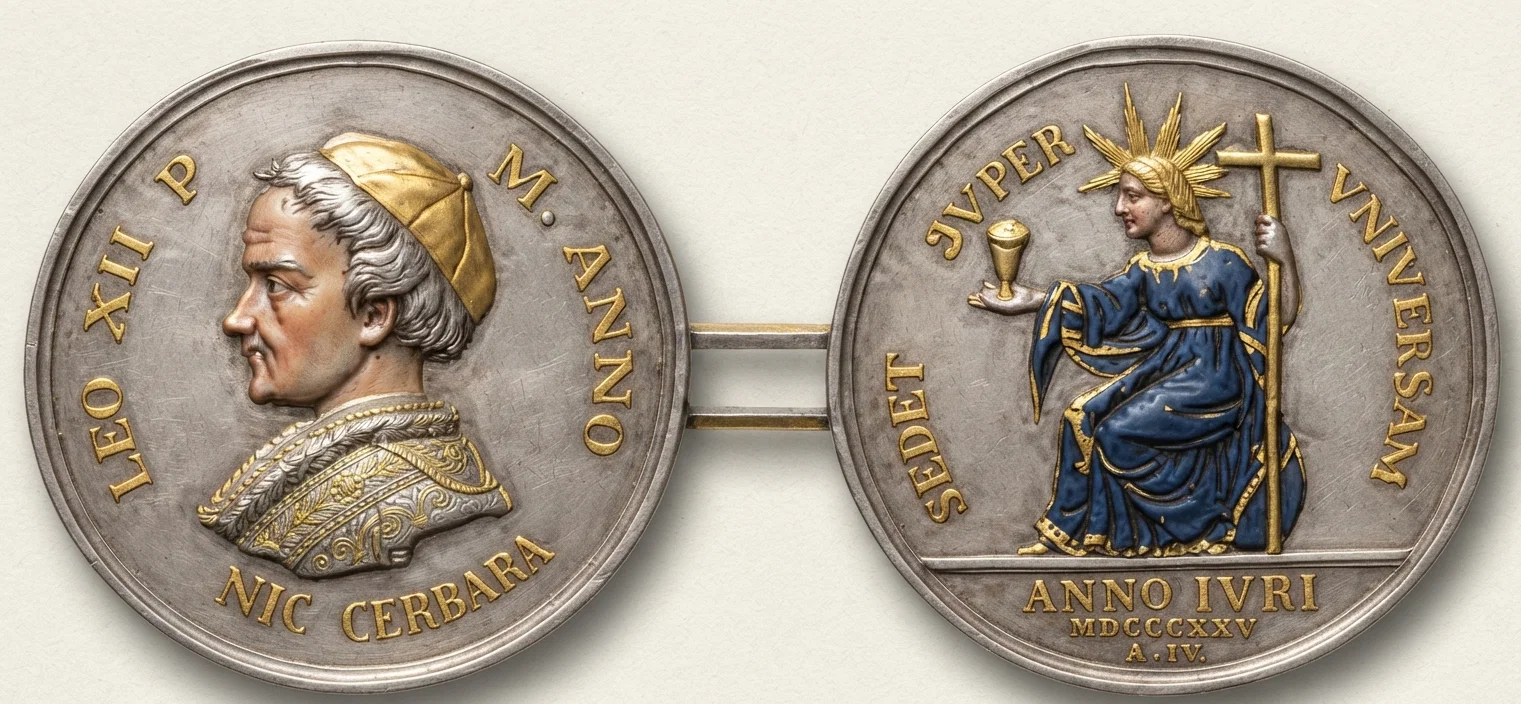
The exalted character of the religion of Love, represented by Christ—who so meekly met this insult from one dependent upon His love for life and power to perform this awful deed, who bowed His head in death before the storm of oppression, the tempest of wrath of Babylon's creed against the loveliest, purest Son of Man that had ever trod the earth—proved stronger than the creed of Babylon; yes, stronger than death itself. Soon old earth, appalled at such a scene, with a terrific quaking gave up this Son of Man as conqueror over death, and sealed the fate of His impenitent oppressors. Soon after, in deadliest wrath, knowing that his time is short, Satan, the head of this defeated scheme to hold in death the Son of God, develops through apostasy the second great division of Babylon. By this apostasy the Papacy is developed, "Mystery, Babylon the great, the mother of harlots." By this creed we see the worship of an image of a triune God, and the same is true in Babylon.
A Parallel
In this second edition of Babylon's great religious system, the Papacy, all can be shown to be radically Babylonian. The college of cardinals with the pope at its head, "is just the counterpart of the pagan college of pontiffs with its Pontifex Maximus, or sovereign pontiff, which had existed in Rome from the earliest times, and which is known to have been framed on the model of the grand original council of pontiffs at Babylon." ("Two Babylons," page 206.) "The sovereign pontiff of the Babylonian system was believed to be incapable of error." (Wilkinson's "Egyptians," lib. ch. 7, p. 57.) "So also the pope claims infallibility. The pagan system had her priests, monks, and nuns. The Papacy has the same. Paganism had her madonna and child. The Papacy has her Virgin Mary and Child. Paganism had her sign of the cross, infant sprinkling, relic worship, purgatory, and prayers for the dead, sacrifice of the mass, extreme unction, Christmas and lady-day, Easter, image-worship, and a host of holy days. The Papacy has the same. ("Two Babylons," pages 128-224.) Paganism had its Sunday holiday as a rival of the Sabbath of the Lord, decreed by civil enactment by Constantine in A.D. 321." ("Encyclopedia Britannica," art. "Sunday.") The Papacy claims to have enforced Sunday upon the Christian world in the place of Sabbath. (See Catholic Catechisms).
A Third Manifestation of Babylon
The warfare waged by the Papacy against the followers of Christ was so fierce and relentless that inspiration describes it in Rev. 17:6 with these dreadful words, "And I saw the woman drunken with the blood of the saints, and with the blood of the martyrs of Jesus." In Rev. 13:1-10 we have the history of the Papacy as forecasted in prophecy. The last verse of the above reference give the overthrow of the Papacy when it went into captivity under the sword of France in 1798. In verse eleven "another beast" is seen "coming up" controlled by the influence of the lamb-like principles of the Protestant Reformation, through which the Papacy received its first death-stroke which led to its overthrow. These Protestant principles do not last. The beast later speaks as a dragon. It also proceeds to make an image to the beast (the Papacy) which preceded it, and, drifting into the old dragon-like spirit of Paganism, enforces the worship of the beast (the Papacy) and the reception of his mark under the pains and penalties of the boycott and death.
This is, in brief, the history of Protestantism and prophecy of her apostasy. Protestantism in her apostasy joins the Papacy as the third division of the old Babylonian system of apostasy, and completes the picture of Babylon in three divisions before she drinks the fierceness of the wrath of God. Rev. 16:19.
The characteristic feature of the Babylonian system is religion by force. When Protestantism enters upon a campaign of enforced Sunday observance, she will have taken the step taken by both Paganism and the Papacy, which identifies her as a part of the Babylonian system, and it will be but a short time until she will influence the Protestant nations to make an image to the Papacy. Supported by this influence the Papacy will rise again, and all the world will pay her homage. In Rev. 14:8 the sad statement then applies—9
Principles of Babylon
(Continued from page 8.)
"Babylon Is Fallen, Is Fallen,
that great city, because she made all nations drink of the wine of the wrath of her fornication." Also Revelation 18: "Babylon the great is fallen, is fallen, and is become the habitation of devils, and the hold of every foul spirit, and the cage of every unclean and hateful bird." "Come out of her, My people, that ye be not partakers of her sins, and that ye receive not of her plagues." Called out of fallen Babylon, the safe platform of true reform is presented in Rev. 14:12: "Here is the patience of the saints, here are they that keep the commandments of God, and the faith of Jesus." The enforcement of religious observance is the test in all the ages since the creed of Babylon was given to the world from that fallen city. That creed has permeated the nations and peoples of earth from that day to this. Her final doom is fast hastening. The call "Come out of her, My people," is as emphatic as in the days of Lot. "Escape for thy life," was his only hope. So now, "Blessed are they that do His commandments, that they may have right to the tree of life, and may enter in through the gates into the city."
THE INVESTIGATIVE JUDGMENT
By Ellen G. White
By Mrs. E. G. White
IT is while men are still dwelling upon the earth that the work of investigative judgment takes place in the courts of heaven. The lives of all His professed followers pass in review before God. All are examined according to the record of the books of heaven, and according to his deeds the destiny of each is forever fixed.
At the time appointed for the judgment, the close of the 2,300 days, in 1844, began the work of investigation and blotting out of sins. All who have ever taken upon themselves the name of Christ must pass its searching scrutiny. Both the living and the dead are to be judged "out of those things which were written in the books, according to their works."
Sins that have not been repented of and forsaken will not be pardoned, and blotted out of the books of record, but will stand to witness against the sinner in the day of God. He may have committed his evil deeds in the light of day or in the darkness of night; but they were open and manifest before Him with whom we have to do. Angels of God witnessed each sin, and registered it in the unerring records. Sin may be concealed, denied, covered up from father, mother, wife, children, and associates. No one but the guilty actors may cherish the least suspicion of the wrong; but it is laid bare before the intelligences of heaven. The darkness of the darkest night, the secrecy of all deceptive arts, is not sufficient to veil one thought from the knowledge of the Eternal. God makes no mistakes in His estimation of character. He pierces all disguises, and reads the inner life.
Character Photographed in Heaven
As the features of the countenance are reproduced with unerring accuracy upon the sensitive plate of the artist, so the character is faithfully delineated in the books above. Yet how little solicitude is felt concerning that record which is to meet the gaze of heavenly beings. Could the veil which separates the visible from the invisible world be swept back, and the children of men behold an angel recording every word and deed which they must meet again in the judgment, how many words that are daily uttered would remain unspoken; how many deeds would remain undone.
We are now living in the great Day of Atonement. In the typical service, while the priest was making the atonement for Israel, all were required to afflict their souls by repentance of sin, by humiliation before the Lord, lest they be cut off from among the people. In like manner, all who would have their names retained in the book of life, should now, in the few remaining days of their probation, afflict their souls before God by sorrow for sin, and true repentance. There must be deep, faithful searching of heart. The light, frivolous spirit indulged by so many professed Christians must be put away. There is earnest warfare before all who would subdue the evil tendencies that strive for the mastery. The work of preparation is an individual work. We are not saved in groups. The purity and devotion of one will not offset the want of those qualities in another. Tho all nations are to pass in judgment before God, yet He will examine the case of each individual with as close a scrutiny as if there were not another being upon the earth. Every one must be tested, and found without spot or wrinkle or any such thing.
The Close of Probation
When the work of the investigative judgment closes, the destiny of all will have been decided for life or death. Probation is ended a short time before the appearing of the Lord in the clouds of heaven. Christ in the Revelation, looking forward to that time, declares: "He that is unjust, let him be unjust still; and he which is filthy, let him be filthy still; and he that is righteous, let him be righteous still; and he that is holy, let him be holy still. And, behold, I come quickly; and My reward is with Me, to give every man according as his work shall be."
The righteous and the wicked will still be living upon the earth in their mortal state—men will be planting and building, eating and drinking, all unconscious that the final, irrevocable decision has been pronounced in the sanctuary above. Before the Flood, after Noah entered the ark, God shut him in, and shut the ungodly out; but for seven days, the people, knowing not that their doom was fixed, continued their careless, pleasure-loving life, and mocked the warnings of impending doom. "So," says the Saviour, "shall also the coming of the Son of Man be." Silently, unnoticed as the midnight thief, will come the decisive hour which marks the fixing of every man's destiny, the final withdrawal of mercy's offer to guilty men.
"Watch ye therefore; . . . lest coming suddenly, He find you sleeping." Perilous is the condition of those who, growing weary of their watch, turn to the attractions of the world. While the man of business is absorbed in the pursuit of sin, while the pleasure-lover is seeking indulgence, while the daughter of fashion is arranging her adornments,—it may be in that hour the Judge of all the earth will pronounce the sentence, "Thou art weighed in the balances, and art found wanting."
THE BOOK OF REMEMBRANCE
By L. D. Santee
BY L. D. SANTEE
Up in the heavens is the book that is kept for us,
Having the record of deeds, good or bad,
Sins we've committed when angels have wept for us,
Virtues that made all the universe glad.
Solemn with awe is my heart as I think of it;
Wrongs unforgiven will end in despair;
Those who have sinned, of the dregs they must drink of it.
Mercy will leave you, O sinner, beware.
Morning by morning they're turning the leaves of it,
Writing the record of each passing day;
Oft I forget it, and so do not grieve for it,
While years of probation pass swiftly away.
At the last day we shall pale when beholding it,
Weeping in anguish, unless we're forgiven;
But if the white robe of Christ is enfolding it,
We, through His merits, are taken to heaven.
If we're rejected, 'twill be as the night to us,
Night dark and hopeless, with never a day;
But if accepted, the future is bright to us,
Glory eternal, and gladness for aye.
Chicago, Ill.
THE REFORMATION AND AMERICA
By Prof. J. A. L. Derby
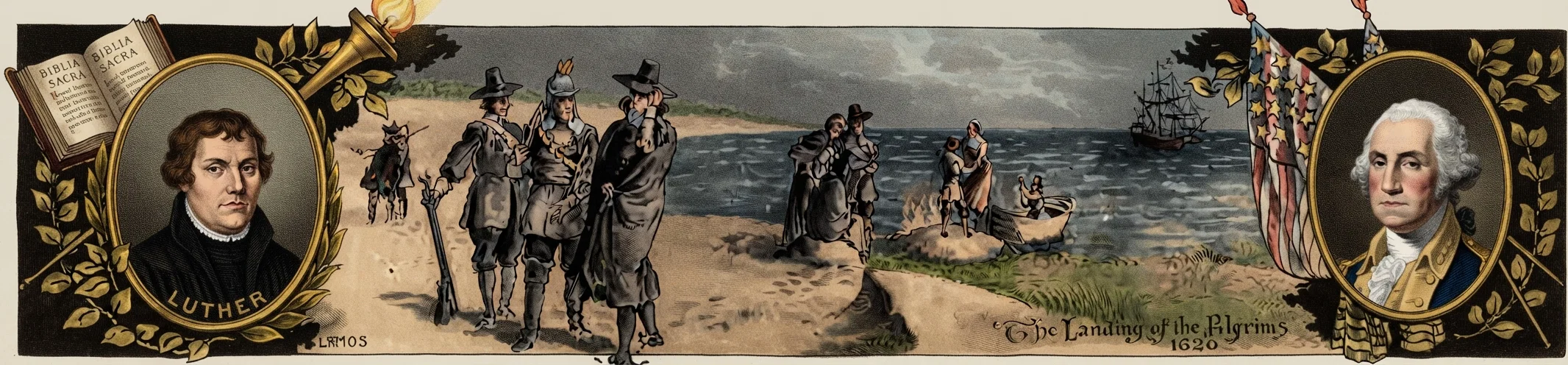
The Landing of the Pilgrims 1620
Two Great World Movements
FOR well-nigh nineteen hundred years no name except that of Jesus Christ has contained such significance as that of Rome. Rome! that resistless embodiment of force which rose and dominated the world. Rome! whose mission it was to give to mankind law, as Greece gave beauty in literature and art. Rome! whose mind-and-soul-en-slaving religion has even yet loosed its last shackle from but a small part of Christendom. But the wondering gaze of men is shifting; or we might say, is beginning to pierce the glory that so long has dazzled human vision, and to see far behind it the flashes of an earlier and brighter glory, of which Rome is but a dim reflection.
The Mother of Much in Modern Education
When in the middle of the last century the shovel of the archeologist first turned sod over the ruins of Babylon, the light burst forth. From more than one hundred sixty thousand tablets—books of ancient ages—we now read the records of a kingdom the genius of whose institutions and principles is identified to-day as one of the chief elements in the underlying forces of twentieth century civilization. Not Egypt, Greece, or Rome has set in motion influences so perennial. Especially is this true in religion and certain theories concerning the sphere of civil government. Says the author of "Religious Systems of the World:" "The time will come—is rapidly drawing near—when no student of the science of religion will feel his work complete without careful study of the ancient tomes which for centuries have lain hidden in the treasure-houses of antiquity. From them we learn that not only was Babylon the motherland of culture and civilization, of arts, science, and letters, but also that in her temple-schools were taught the first principles of many of the great doctrines of religion which we hear at the present day set forth from our pulpits." This opinion is not alone.
The Survival of the Unfittest
But in nothing is this more evident than in the survival of her religion and her church-and-state doctrine. It is simply the statement of a fact patent to every student of ancient Babylon to say that every essential feature of her degrading religious system exists to-day, sometimes, indeed, disguised, but none the less identical. None familiar with the ancient system, with its elaborate rites, its hierarchy from priest-king and pontifex maximus down to tonsured monks, and "unmarried maidens" (nuns) consecrated to the service of the "sacred harlot" Istar, the mother of the gods, and its whole doctrine from the three-in-one trinity, its priestly power to forgive sins, purgatory, and what not,—no one that has studied that system can fail to recognize its successor and counterpart during this Gospel dispensation. John, the seer, beheld it in vision, saw and marveled, and branded it as "Mystery, Babylon the Great, the Mother of Harlots and Abominations of the Earth." Mysterious indeed has been the working of this stealthy principle. Paul calls it the "Mystery of Iniquity." A better characterization could not be devised.
The Fruitage of Babylon
Strange and marvelous was the eclipse of "the grandeur that was Greece and the glory that was Rome," the eclipse of those mighty civilizations, and the plunge into the intellectual and spiritual night of the Dark Ages. But the pendulum of the centuries, moved by the hand of God, swung back again. The hour struck. Infinite wisdom had permitted spiritual Babylon to demonstrate to the satisfaction of the universe the fathomless, destructive, insatiable iniquity of her principles. Degradation of mind, slavery of soul and body, murderous persecution of the saints of the Most High—in one word, Antichrist,—this was the fruitage of her doctrines. First among the forces which Providence prepared to assault this fortress of wickedness was that mighty awakening of the long-dormant human mind—the Renaissance.
When in May, 1453 A.D., Mohammed II, battered down the ancient walls of Constantinople, the last stronghold of the Cæsars and of political Rome, the event was in a sense typical of the outcome of the assault which the re-awakened mind of Europe was to make against the venerable fastnesses of ignorance. The Greek scholars, fleeing from the impending doom of the Eastern capital to Italy, with their ancient manuscripts, rekindled the flame of classic culture. As men saw from what they had fallen intellectually, so they naturally began to question other things.
The restless human spirit aroused by the revival of learning invaded the realm of religious beliefs. Babylon entrenched in church and state was to totter to its foundations and lose its grasp on a large part of Christendom.
The crusades had prepared the way for the Renaissance, voyages and discoveries assisted in arousing curiosity, stimulating to inquiry, and in forming broader conceptions. Men more than suspected that if the dominant church was mistaken about the earth's being flat, it might be mistaken on other things.
As a natural result of all this, says Professor Fisher, "there existed a great amount of outspoken and latent discontent. First, complaints were loud against administration in church affairs. There were extortions and other abuses that excited disaffection. Secondly, the authority exercised by the pope was charged with being inconsistent with rights of civil rulers and national churches. Thirdly, disputes sprang up both in regard to various practises deemed objectionable, like prayers for the dead and invocation of saints, and also concerning important doctrines, like the doctrine of the mass, or the Lord's Supper, and the part that belongs to faith in the Christian method of salvation. Out of this ferment arose . . . the Protestant Reformation." Better, "Into this mass God sent the life of the Gospel."
Principles of Babylon Remain
Dissent from Rome became possible, and also triumphantly actual; but, strange to say—and yet not strange to the student of the Bible—the Babylonish principle of conformity still survived. The tyrant was dead, the tyranny still lived. Many states broke from the Papacy, but the papal principle of the union of church and state remained the ruling theory concerning the relation between government and religion. This was the doctrine of ancient Babylon. "The king often was by birth, and always by right of office, a khattesi, or high priest, and, as such, head of the church and state." ("Religious Systems of the World," page 19.) "The earliest form of government in the Euphrates Valley is theocratic." ("Religion of Babylon and Assyria," page 656.) "From the outset the Babylonian monarchy was essentially theocratic. The king was simply the high priest in a new form. But [later on] the king himself became a god. The vicegerent had taken to himself the attributes of deity, the adopted son succeeded to the rights and powers of the divine father." (Sayce.) Here we find that infallibility is not peculiar to the successors of Peter in the primacy of Rome. We also see where modern Babylon got her doctrine. One more quotation from the last-mentioned source: "At the head came the potesi, or high priest, who in the early days of Babylonian history performed the functions of a king. But the potesi was essentially the vicegerent of the god. The god delegated his powers to him and allowed him to exercise them on earth. It was the doctrine of priestly mediation carried to its logical conclusion. Only through the priest could the deity be approached, and in the absence of the deity the high priest took his place." It is evident that the genius of Babylon still flourished at the time of the Reformation.
But the Reformation Opened the Bible
Thus was unchained the mighty adversary of the "mystery of iniquity." "Every plant which My heavenly Father planted not, shall be rooted up," said Jesus. Matt. 15:13. This the Word of God must accomplish. The work begun by Huss, Wyclif, and others, has never stopped. The years that have intervened have witnessed a gradual purification of faith and doctrine in the true church. From the hierarchy of Rome to congregational church government is a far call. But it came. One by one the errors and superstitions of Romanism have withered beneath the blaze of Biblical truth. We shall briefly illustrate the process by the history of the development of the Christian principle of the separation of church and state.11
As noted above, the Reformation gave only the right to dissent from Rome. No European nation from that day to this has entirely succeeded in disentangling itself from the Babylonian notion of a necessary connection between civil government and religion. It remained for America only to found a state on the Scriptural principle, "Render to Cæsar the things that are Cæsar's, and to God the things that are God's." Ireland (the most Catholic of Catholic countries) has absolute religious liberty in practice. In law, however, that nation is subject to England, which could, if she pleased, re-establish in Ireland the Church of England. Of course religious freedom in Ireland is simply a concession from her Protestant mistress. This is toleration, not liberty. Of all European nations, Switzerland by her constitution approaches nearest to the true principle. The constitution of 1874 grants liberty of worship to all except Jesuits. These are forbidden to enter the country. The same instrument forbids the establishment of convents and religious orders. "Every canton," however, "has its own established church controlled by civil magistrate."
This and the following quotations are from "Rise of Religious Liberty," by Cobb:
Few of the reformers got far enough away from Rome to be clear regarding this great principle. Truly all nations have been made drunk by the wine of Babylon. Luther himself was not consistent on this point. Notice his contradictory statements: "Whenever the temporal power presumes to legislate for the soul, it encroaches." Compare this with, "Since it is not good that in one parish the people should be exposed to contradictory preaching, he (the magistrate) should order to be silent whatever side does not consist with the Scripture."
That he saw the true position there is evidence; but it is equally certain that he did not stand unequivocally for it. The explanation—or excuse—may possibly be found in the impression made upon him by the generally rude state of the German people, the Peasant War, and the fanatical disturbances of the Anabaptists. These last held the principle in its theoretical purity, but brought it into disrepute by their turbulent actions.
It was probably due to Luther's influence that the Augsburg Confession, in 1530, contained the correct doctrine: "The administration of civil affairs has to deal with other matters than the Gospel deals with. . . . The ecclesiastical and civil powers are not to be confounded." But the Peace of Augsburg, twenty-five years later, shows a great retrogression. Here the principle, "Cujus regio, ejus religio"—"Whose the rule, his the religion," in other words, that the people must follow the prince in religious matters—is stated in so many words. Emigration was the only relief.
Every one knows what Calvin did for Geneva and to Michael Servetus. Zwingli was scarcely behind Calvin in his belief on this question. If John Knox and Scotland did not burn heretics it was due to public sentiment rather than to the authorities.
Vindication of the Principle
But not by might nor by power has the true principle come to prevail. Of the forces working for it, space would fail us to speak of the Anabaptists, Quakers, Sir Harry Vane, Roger Williams, Jonathan Edwards, Madison, Jefferson, and others. Madison believed persecution to be a "diabolical, hell-conceived principle." Jefferson taught, "It is error alone that needs the support of the government. Truth can stand by itself." Roger Williams stood for absolute religious equality under circumstances similar to those where Luther failed. God has vindicated the principle on American soil. Every American citizen knows (as, indeed, does all the world know) the position of our organic law on this matter. Babylon is judged. Would God she were as far removed from the hearts of the people as from the fundamental law of our nation.