A Mere Holiday Rest Not Enough—Church Attendance What Is Desired—Would Have Laws to Reclaim Erring
WHEN the advocates of Sunday laws seek legislation to compel the observance of that day, they usually deny that they want to enforce anything of a religious character, but claim they are seeking to obtain a day of rest for man's general physical and civil needs, without any religious significance.
The following extracts from speeches and papers by men prominent in the movement to obtain world-wide Sunday laws, as presented at the International Lord's Day Congress in Oakland, California, July 27 to August 1, show clearly, notwithstanding the oft repeated denial, that the real object of Sunday laws is to build up and strengthen the religious character of Sunday rest.
WHAT THE DAY STANDS FOR
"Of course the Lord's day stands for worship and rest, the religious idealism of worship."—Right Rev. William F. Nichols, D. D.
"The very crime of the sabbath breaker is that he takes that day and uses it against the One who gave that gift. Sabbath breakers are, unconsciously to themselves, ingrates. When they break the sabbath, they may well stop and inquire if they do not also break the infinite heart. . . . We have need of your presence, in order that in due season, upon the statute books of California, and inscribed upon the hearts of its citizens, you may help us to write that great principle of God almighty, 'Remember the Sabbath day, to keep it holy.'"—Right Rev. Edwin H. Hughes, D. D., bishop of the Methodist Episcopal Church.
SUNDAY FOR WORSHIP
"There is somewhere between these two extremes of a Puritan and a continental Sunday observer, to be found a Sunday which recognizes God by attending divine worship, and makes it a point to do it at least once on that day."—Judge Alton B. Parker, permanent chairman of the congress.
"It finds its necessity in the longing of man for religion. It is this culture of the religious, the spiritual, the inner life of man that is the highest benefit and efficacy of the sabbath. Nothing so expands the soul, and strengthens us for the supreme crisis, . . . as the setting apart of this day of worship."—J. B. Remensnyder, D. D., LL. D., ex-president of the Synod of the Lutheran Church in the United States.
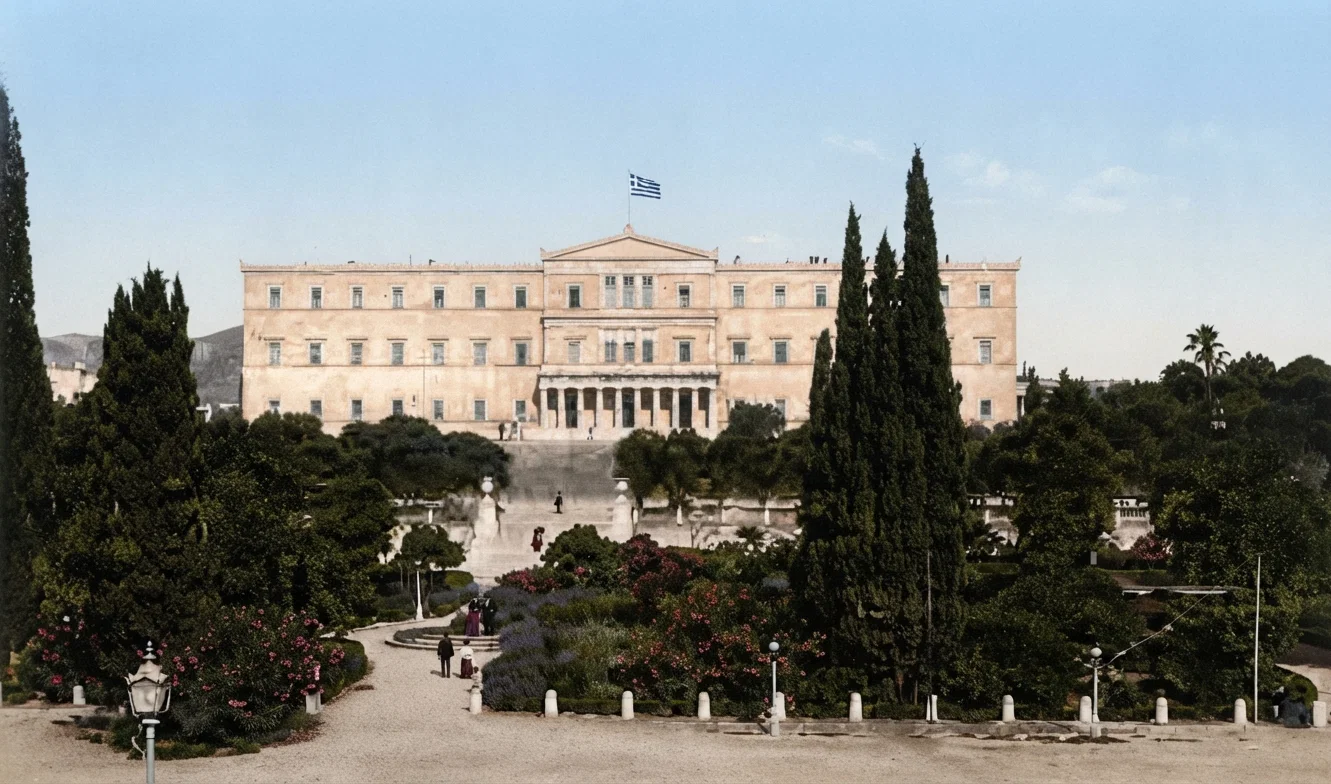
THE ROYAL PALACE IN ATHENS, GREECE
LAWS TO RECALL THE ERRING
"The deepest need of man's nature is his need of God. Unless he have the time to worship his Creator, life is not sustained and soothed by the unfaltering trust. . . . When the almighty God placed the obligation of labor upon us, He also commanded us that we observe one day in every seven for worship and rest. . . . Legislation on the part of the church did not begin until laxity and indifference showed themselves among Christians. It was then found necessary to make laws which would recall the erring ones to their duty. It was enforced by the councils and bulls of the pope. All through the Middle Ages, these were the civil laws of the land. . . . The historic church of Christendom makes the observance of Sunday the day of all importance to her members."—John J. Burke, C. S. P., S. T. D., S. T. L., editor of the Catholic World.
It is well to note, from this last quoted high authority, that there never was any demand for Sunday laws because of man's physical needs. They were only found necessary when "laxity and indifference showed themselves among Christians." The laws were made to "recall the erring ones to their duty." Those same civil laws which are admitted to have been "legislation on the part of the church," and "enforced by the councils and bulls of the pope," tormented and tortured to death millions of as conscientious, liberty-loving men and women as this world ever knew, who believed their salvation was found in obeying the word of God, and not in following the "bulls of the pope." To establish again legislation to enable the church to "recall the erring ones to their duty," is to destroy liberty, and renew the persecution of the Dark Ages.
ALL SHOULD GO TO CHURCH
"All the children on the Lord's day should go to the church or Sunday school, absolutely. . . . Don't listen to those who viciously say there is no God. . . . He who destroys the Lord's day destroys the temple of God; and whosoever defiles the temple of God, him will God destroy."—The Rev. V. V. Alexandroff, Greek Catholic of San Francisco, California.
"There is no religion without worship, and there is no worship without the sabbath."—The Rev. Mr. Griffith.
NOT TO BLACK BOOTS ON SUNDAY
"The organization I represent drafted, presented, and secured the passage of the Sunday law which is a national law. . . . The function of Sunday laws is admirably represented by that statute. I know of two laborers, living one thousand miles from each other, who on that memorable Sunday evening appeared in church, the first one for the first time in seven years, and the other one for the first time in three years. . . . Regarding bootblacks, and these other people, in Quebec the law is not yet being rigidly enforced. . . . Now people should get their boots blacked on Saturday. . . . Suppose those bootblack stands were closed on Sunday. How many boys would get their liberty? — One thousand. The churches would go into ecstasy over the gathering in of those boys."—The Rev. William M. Rochester, secretary of the Lord's Day Alliance of Canada.
Observe that "the function of Sunday laws is admirably represented" when it gathers men into the church. The object of closing the bootblack stands in Quebec is that the church may have a chance to gather in the boys. What if, in the course of time, it shall be found that many men do not go to church, and the bootblacks take to the swimming pool and the fishpond, and thus "the function of Sunday laws" is not met? Then695will it be found necessary to make another law to "recall the erring ones," and compel their attendance on "divine" worship?
BETTER TO HAVE PURITAN SABBATH
"The Christian sabbath cannot be divorced from Christianity. They stand or fall together. . . . California has a weak form of one-day-rest-in-seven law, which doubtless could be strengthened. One day's rest in seven does not and cannot take the place of Sunday laws. . . . Children must be taught the sanctity of the sabbath. . . . It would be better for us to have the Puritan sabbath to-day for the home, the church, the state, the country, and God, than the spineless, lame-backed Sunday we have in most of our states. We need to go on and defend it through our congress and cooperating bodies.
"Judge Parker raised the question in executive committee yesterday, and said, 'What shall we do after this congress is over?' I urge that we do this: ask and appeal to our Christian churches and every Christian citizen and every good citizen of the country to back, reenforce, and move with all our splendid Lord's day and sabbath organizations, to the end that one day we shall write upon the federal statutes a law similar to that of Idaho. When every state shall have her strong Sunday law, and one-day-rest-in-seven law to supplement it, then we shall not only be a Christian nation in name but in fact."—The Rev. H. L. Bowlby, secretary Lord's Day Alliance of the United States.
"Remember that thou keep holy the Lord's day. Is it not possible to refrain from work on Sunday, and still do nothing to make the day holy? Therefore it is evident that something positive must be done to fulfill this command. . . . A man must do something on that day which has a direct reference to God."—The Rev. Edward F. Brophy, chaplain United States army, Fort Baker, California.
THE GREAT QUESTION IS A RELIGIOUS DAY
"We are facing the great question in this congress only as we see it as a religious day. Primarily and essentially it is a religious day. All those social benefits are incidental."—Henry Collin Minton, D. D., LL. D., president of the National Reform Association.
"I do not fear the continental Sunday if it has that religious spirit through it all."—William H. Van Allen, S. T. D., Roman Catholic priest, Boston, Massachusetts.
WOULD MAKE THE GOVERNMENT RELIGIOUS
"What we need to-day is the exaltation of the Lord Jesus Christ in the civil sphere, and in that we find the foundation for everything in the way of reform that we seek to bring to the nation. . . . I would say the sabbath shall be sanctified by rest on that day from all labor or pleasure, such as is engaged in on other days of the week, a holy day, given to the worship of almighty God. So I would be in favor of putting into our literature and our platform addresses, whenever we speak of this day, the sabbath of God, and let the world have it for its day of worship. All opposition to the sabbath law that I have met, and I am sure that you have met, is based upon the secular theory of government, upon the idea that the state has nothing to do with religion, or religion with the state. . . . The only hope of meeting them is for the friends of the sabbath to stand by the Christian idea of government."—The Rev. Dr. James S. McGraw, Los Angeles, California.
When Dr. McGraw emphatically declared that the only hope for the success of Sunday laws was in making the government religious and not secular, his words were greeted with loud applause from the delegates.
OPPOSED TO THE SUNDAY PAPER
"Thousands of fathers who otherwise would go to church, get so under the influence of the Sunday newspaper that they do not attend. If they do go to church, they have filled their minds with the paper instead of filling their hearts with the thoughts of prayer, and the sermon does them very little good. The country needs to be delivered from the secular press on the Lord's day."—The Rev. J. B. Davison.
These words open up the true character and spirit of this movement, and point a few steps farther along the way to the Inquisition. They demand that the Sunday newspaper be suppressed, not because the workmen need rest—of course not. Any one knows that workmen do not need a law for rest on Sunday any more than they need one for rest on Monday, or any other day. But the Sunday paper keeps people away from church; and if they do attend after reading the paper, their hearts are not filled with "thoughts of prayer."
Religion is of the heart. Therefore, when the church and the state take the contract to legislate people into heaven, it devolves upon them to see that the heart is right. When it becomes evident, through listless attention to the sermon, or by other acts, that one's heart is not right, the cause must be removed, and something must be done to lead the "erring one" to repentance. In the days of the Inquisition, such persons were hanged up by the thumbs, their finger nails pulled out, and they were otherwise tortured, to compel confession of their sinful hearts. Will these modern censors of salvation, self appointed to control other men's thoughts, be able to improve upon those old inquisitorial methods?
THEY CALL FOR A STATE RELIGION
"Where there is a state religion, that day will be recognized by law on religious grounds. Where there is no state religion, the reason for Sunday laws must be based on economic grounds."—Judge Ralph E. Prime, Yonkers, New York, in a paper read by the Rev. Alexander Jackson.
This shows the deceptive character of the movement. It proposes to get the law on religious grounds when that can be done; and when that cannot be accomplished, then obtain it on "economic grounds," denying its religious significance.
A GO-TO-CHURCH SUNDAY
"Let us have a go-to-church Sunday, not once a year, but once a week. . . . The civil sabbath would not have been instituted if there had not been a religious sabbath."—The Rev. George B. Werner, ex-president of the Lutheran Synod of New York and New Jersey.
VIEW OF SALONIKI, GREECE'S PORT ON THE AEGEAN SEA
This admits the fact that the Sabbath has no other basis than that of religion; and all human laws for its enforcement must be in support of a religious institution.
The Length of Creation Days
By Eugene Leland
Were They Ordinary Days of Twenty-Four Hours Each?
Or Were They Millions of Years in Duration?
By EUGENE LELAND
IT is quite popular, for various reasons, to consider the seven days of creation week as long, indefinite periods, perhaps millions of years in duration, instead of literal days of twenty-four hours each. This opinion is said to be the scientific one,—the one that is published in some of our public school text books for the school children to learn. It is the opinion held by many modern theologians also, and taught by them to the "children of larger growth." It would not do for a minister of the gospel to risk his reputation as a scholar and a scientist in these days of "evolution," "new thought," and a few other things, by teaching so "unscientific" a truth as that the word "day" of the first chapter of Genesis signifies a period of twenty-four hours.
THE MANIFEST MEANING
To be sure, that is so manifestly the meaning of the word in that chapter, that no one but a "scientist" would ever think of giving it any other meaning; and as scientists have accomplished some wonderful transformations, theologians have decided that they were able to transform the meaning of the word "day" from that of a period of twenty-four hours, as everybody hitherto has understood its meaning to be, to that of a period of a million years, more or less, according to the fancy of the scientist.
We have no desire nor disposition to ridicule this opinion, though the argument upon which the opinion is founded, does not appear to have much weight. There are several simple facts, besides some statements of Scripture, which stand in the way of our subscribing to this opinion. Let us notice a few.
The period of time which the first chapter of Genesis calls a "day" is said to be made up of two parts of about equal average length,—696a light part, also called "day," and a dark part, called "night." This division of time into day and night was made by the Creator Himself during the first three days of time. Verses 4, 5. But after the fourth day, this division of time was effected by the sun, which was created on that day. Verses 14-19.
WAS ADAM’S FIRST NIGHT A MILLION YEARS?
Now, as Adam was created on the sixth day, he must have lived all through the night following; and that being about equal in length to the day, which, we are told, was millions of years in duration, he must have longed — earnestly longed — for the morning of his first full day to dawn. Though he retired to rest on the evening of the sixth day in the full strength of youthful vigor, like Rip Van Winkle, he arose on the morning of the seventh day, a gray-haired, toothless old man, bent with the weight of a million years.
And that is science! But the Bible says that "all the days that Adam lived were nine hundred and thirty years: and he died." Gen. 5: 5. Or are we to understand that these "days" which Adam lived are also long, indefinite periods of duration, like the "days" of creation week? We can see no "scientific" reason why they should be considered differently.
We are told that the seven days of creation week were not literal twenty-four-hour days, because the sun was not created until the fourth day. "How," it is asked, "could the days have been divided before the sun was created?"
TIME DIVIDED WITHOUT THE SUN
Sure enough! That is a most serious objection to the mind of a "scientist." But we who are not "scientists," wonder if the Creator would have found any more difficulty in dividing the time, before the creation of the sun, into periods of twenty-four hours each, than He would have found in dividing it into periods of millions of years.
And then, again, we wonder how it was that the grass, the herbs, and the trees, which were created on the third day, could exist through all those millions of years without sunlight, any more than time could be divided into periods of twenty-four hours each without the sun. And how did vegetation survive all through the darkness of the millions of years of night that lay between the third and the fourth day of creation week?
The answer to the first question comes quickly: "Light was created before the sun; and by means of this light, vegetation was kept alive until the sun was created."
Very true; but is it not equally true that the division of time into day and night was made before the sun was created? Read the passage: "And God divided the light from the darkness. And God called the light day, and the darkness He called night. And the evening and the morning were the first day." Gen. 1: 4, 5.
Now, in all candor, what sense or significance is there in speaking of dividing a million-year period into night and day, evening and morning? Was it one long night succeeded by one long day, that constituted the first and each succeeding day of creation week? If so, what is meant by the word "night"? Or was time measured, during all those million-year periods, by literally recurring periods of twenty-four hours each? If not, when did the twenty-four-hour division of time begin?
It is better to take the simple, straightforward statement of the record, and believe it. In taking this position in the past, the writer has been publicly dubbed an ignoramus. But in reply to this argument , we may say that neither skill, courage, education, nor refinement is required to call one an ignoramus.
A WORD TO OUR READERS
By Editor
We send no papers from this office to individuals without pay in advance. When persons receive copies without ordering them, they are sent by other parties, and we can give no information in regard to them. Persons thus receiving copies of the SIGNS are not indebted to the office, and will not be called upon to pay for them. Please read the papers you may receive, and hand them to your friends to read.
DATE OF EXPIRATION
The SIGNS wrapper bears date of last issue due on your subscription. Unless renewed in advance, paper stops with expiration date.
If herewith is an order blank, you will know you have overlooked sending renewal. You will not wish to miss a single issue. Back numbers often cannot be furnished.
SCRIPTURE QUOTATIONS
Our authority for the doctrines we teach is the Bible. Quotations are usually from the King James Version or the American Standard Revised.
CHRISTIAN SCIENCE TESTED
By R. C. P.
The Mother and the Baby Both Knew There Was Pain — The Bible Speaks Clearly Enough on the Subject
LINCOLN once said, "You can fool all the people some of the time, and some of the people all the time; but you can't fool all the people all the time." One is forcibly reminded of this terse and truthful statement when confronted by the bald and groundless claims of the unscientific cult known as Christian Science.
THE ILLUSION OF PAIN
During a recent visit to Manila, a well informed hospital nurse related to me the following interesting statement of her experience while attending an obstetrical case in a Christian Science family. The case proved to be very serious, the use of instruments being required by the physician in charge.
The patient was also attended by a Christian Scientist, who sought to conduct her through her ordeal upon strictly Christian Science principles. She constantly reminded the patient that there was no pain, that what seemed to be pain was only a mental illusion. The dutiful patient made no response, except that she cried out now and then in the same way that others do under severe pain.
Some months later, the babe was suffering of a severe attack of colic; and while the nurse was busy with the case, the mother began to soothe the youthful patient by administering the usual Christian Science instruction. She said: "My little darling, there is no such thing as pain. It is only a mental illusion. But you can bet your life that your mother had pain all right at the time of your birth."
THE BABE TOO INNOCENT, THE MOTHER TOO HONEST FOR SUCH A SCIENCE
That babe with colic was too innocent, and that mother was too honest, to suppress the truth in support of a fraudulent theory. She could no longer be fooled upon the question of the Christian Science doctrine, "There is no such thing as pain."
And that doctrine is diametrically opposed to the plain teaching of the Bible, which says: "Like as a woman with child, that draweth near the time of her delivery, is in pain, and crieth out in her pangs; so have we been in Thy sight, O Lord." Isa. 26: 17. "We have been in pain." Verse 18.
WHEN PAIN WILL BE GONE FOREVER
Not until our feet are securely planted within the pearly gates of the gold-paved city, the New Jerusalem, does the Bible warrant the assertion that there is no pain. Its statement is:
"And I saw a new heaven and a new earth: for the first heaven and the first earth were passed away. . . . And I John saw the holy city, New Jerusalem, coming down from God out of heaven. . . . And there shall be no more death, neither sorrow, nor crying, neither shall there be any more pain: for the former things are passed away." Rev. 21: 1-4.
WHEN GOD WILL AGAIN WALK AND TALK WITH MEN
It is not until the former things have passed away, and the Paradise from which man was removed at the time of the entrance of sin is restored, and God again walks and talks with man as in Eden of old, that there will be no more pain. From that time, no more heartaches will be felt, no tears will flow, and there shall be no more death.
Until then, how stupid in the eyes of God must appear the teacher of His holy word, who teaches that there is no such thing as pain!
Christianity has lived to see the dismantling of many frauds, which have been announced to the world in the name of Christ; and the antichristian and unscientific teaching of Christian Science should soon share their fate. R. C. P.
A TYRANNICAL DECEIVER
By George B. Thompson
SIN is a tyrant, an awful deceiver. It haunts us on every side. We are born in sin, and "shapen in iniquity." It is like a siren that clings to us, and then plunges with us into the lake of destruction. Unless delivered from its awful power, we will be destroyed by it at last.
Judas is an example. He was once an innocent babe in his mother's arms. He played in the streets like other boys. Life had as bright a rainbow of promise for him as for others. But sin ruined him. He hugged it to his bosom, and refused to break with it. Though under the instruction of the great Teacher Himself, he kept the wicked thing in his heart. He wore a mask, and became the traitor, the betrayer of the Son of God.
But there has been a Deliverer raised up. There is a fountain opened in the house of David in which we may wash and be clean. There is One who can bind the enemy, and deliver us from his deceptions. By faith we are victors, and become righteous in Him. G. B. T.
TORPIDITY
By J. E. F.
THE patent medicine vender has little difficulty in convincing many people that they have torpid livers, and that his liver medicine is a specific sure to cure. Many thousands do suffer of torpidity of the liver, and from this condition many ills result.
The Bible speaks of torpid senses—dull eyes and ears. We are living in an age of torpidity. Wrong methods of eating and drinking and living have brought on our physical torpidity. And the body has its relation to the soul. Wrong spiritual habits have resulted in torpidity of the senses—dull, lethargic hearts. Many have "eyes, but they see not; ears, and they hear not."
We see and appreciate too much the glittering tinsel of this world, but fail to esteem "the things of the kingdom," which "come not by observation." Our ears are open to the din and music of this world, and its thunder of applause, but are often untrained to hear "the still small voice."
J. E. F.
Protecting Minority Rights
The majority may have the power to oppress and override the minority, but it has no right to exercise such despotism. Strong governments that are also just are careful to protect the minority. When the lone individual is not protected in his rights, the government is on the road to the tyranny that begets decay.
Going Beyond Pardon
By A. S. Booth
Steps by Which the Unpardonable Sin Is Committed
Special Cases as Illustrations
"KEEP back Thy servant also from presumptuous sins; let them not have dominion over me: then shall I be upright, and I shall be innocent from the great transgression." Ps. 19: 13.
The foregoing text is remarkable from the standpoint that it has to do with the perfect life, the presumptuous sins, and the great transgression, or unpardonable sin.
God has set before the human family the perfect life. The law of God is a perfect standard, and Jesus is a perfect example of commandment keeping. We are admonished to keep the commandments of the Lord, and follow in the footsteps of the Master. In order that we may live the perfect life, all power in heaven and earth is pledged to us. It is as easy for the Lord to give power to gain victory over all sins, as over one. The same faith that brings the assurance that our sins are forgiven, should grasp the power of God to overcome sin.
PROVISIONS OF MERCY
The Lord has also made provision that, if we fail to live the perfect life, mercy will be extended to us. "My little children, these things write I unto you, that ye sin not. And if any man sin, we have an Advocate with the Father, Jesus Christ the righteous." 1 John 2: 1. The great mistake is made when we take this provision, which the Lord has so graciously offered to us, as a license to sin. Known sin is the sin that prevents our prayers from being heard. When we willfully disobey the commandments of the Lord, and refuse to walk in His ways, we are doing very presumptuously. The presumptuous sin is a step toward the unpardonable act.
The Christian should be so educated that just as soon as he sees he is doing wrong, committing sin, he will confess at once, and turn from the evil thing. We should not permit the sun to go down on our sins. In other words, the going down of the sun closes the day, and we should not let a day pass into eternity without being right with the Lord.
MAY GO NEVER TO RETURN
The Holy Spirit will not always plead with the hearts of men. There is such a thing as resisting the Spirit to such a degree that it will be driven away, and not return. Those who do so, have committed the great transgression, or the unpardonable sin. If we are careful relative to the presumptuous sins, we need not worry about the unpardonable sin; for the presumptuous sins are those that grieve the good Spirit of God, and cause us eventually to go too far. Then the Lord will withdraw His Spirit entirely from us.
As David prayed, "Keep back Thy servant also from presumptuous sins: . . . then shall I be upright, and I shall be innocent from the great transgression," so ought we to pray. Make thorough work of the confession of sin. To do otherwise is presumptuous.
SAUL TOOK THE FATAL STEP
Saul committed the unpardonable sin. His mistake especially was in being partial in the keeping of the commandments of the Lord. God told him to destroy his enemies, the Amalekites, utterly. Saul performed some of the commandment, but spared the best of the sheep and cattle, and also Agag, the king.
That which he refused to do, robbed him of all the blessing. He was willing to do some of the commandments of God, but not all. We are told in the Bible, that if we break one of the commandments, we are guilty of all. James 2: 10. It is much easier to keep all of God's law, by His help and the blessing of heaven, than to attempt to keep part in our own strength. And what incentive is there to go part of the way, and stop short enough to lose the blessing, as did poor Saul?
CAIN'S SIN WAS UNPARDONABLE
Cain, too, committed the unpardonable sin. He brought a substitute offering. There was no blood in his offering. He brought a perverted ordinance, of the fruit of the ground. Without the shedding of blood, there is no remission of sin. Cain went so far in his rebellion and presumptuousness, that the Lord pronounced the curse upon him, and there was no remedy for him. We should be careful to observe the ordinances of the Lord. The ordinance of humility, the Lord's Supper, and baptism should be faithfully carried out by the church of God, lest we be found to pervert that which is holy in God's sight.
JUDAS YIELDED TO MONEY
Judas also committed the great transgression of going beyond the forbearance of God. The love of money caused him to make the great mistake of selling his Lord. The Master knew the weakness of Judas, and labored many times for him. The critical time came at the last supper. Said the Lord, "That thou doest, do quickly," or, in other words: "Judas, if you are going to yield your heart to the Lord, do so quickly. The Holy Spirit is pleading with you for the last time. It is your last chance. Repent before it is too late." Judas passed the opportunity by, and lost all.
The name of Judas comes to us branded with infamy. When he sold his Lord for a few pieces of silver, he sold his soul, and all hope of eternal life. The sin of selling the Lord for the pleasures and riches of the world is the mistake of all mistakes.
The special sins that led Saul, Cain, and Judas to commit the unpardonable sin were, being partial in the keeping of the commandments of God, bringing a substitute offering, and the love of money. May God keep us from these mistakes.