Signs of the Times, Vol. 42, No. 44.

THE GREAT SEALING MESSAGE
Earlier text: Religious Sunday Laws Sought

191—THE SEVENTH-DAY SABBATH

Can you explain why Seventh-day Adventists take Saturday for the Sabbath, instead of Sunday? What proof have you that the day Seventh-day Adventists take for their Sabbath is the same specified day designed by the Lord in Exodus 20? H. M.
First, Seventh-day Adventists do not take Saturday for the Sabbath, because Saturday and Sabbath are not identical. Saturday begins at midnight, and closes at midnight. The Sabbath begins at sunset of Friday, and closes with sunset of Saturday. Seventh-day Adventists do not take any day for their Sabbath, but for the Lord's Sabbath; and they take the seventh day because the Lord specifically commanded it. They know that to be the seventh day, for these reasons:
(a) It is not reasonable to believe that the Lord would set apart a Sabbath, and then hide from His people the knowledge of the day. In other words, He is not so unjust as to ask them to observe a day, and then leave them without the means of knowing whether they are observing the right day or not. Consequently, He set apart the day in Eden. From that to Exodus, according to the original Bible chronology, is about twenty-five hundred years.
The Sabbath may have been lost to God's people during this time, although we do not believe that it was. But we will admit that it may have been. God's people may have become confused concerning the day. But when the Lord called them out of Egypt, He did not leave that day to their own guesswork or conjecture. He revealed to them that day by the threefold weekly miracle of the fall of the manna for forty years. See the sixteenth chapter of Exodus. The manna fell six days in the week. A double portion fell on the sixth day, and none fell on the seventh day. That which fell on the sixth day would keep over the Sabbath. That which fell on another day would not keep over until the next day, but bred worms, and became corrupt. Thus God wrought this threefold miracle every week. If any went out to gather manna on the Sabbath, they found none. If they tried to keep it over from one day to another, it spoiled. If they kept it over, according to God's commandment, from the sixth day to the seventh day, it was fresh. For forty years, God marked the seventh day. Man could not at that time make any mistake concerning it.
(b) From that time to our Lord's first advent is a period of about fifteen hundred years. When Jesus came, He kept the Sabbath. He found the people keeping the Sabbath; and it is said of His own disciples that when Jesus died, they kept "the Sabbath day according to the commandment." See Luke 23: 56.
The commandment teaches the seventh day. It declares the seventh day to be "the Sabbath of the Lord thy God." If the disciples in the time of Jesus kept the Sabbath "according to the commandment," they kept the day according to the threefold miracle of the manna for forty years. So whether man knew the correct day or not, Jesus, the Lord of the Sabbath, did know. He observed the day, and He left His disciples observing it.
(c) From that time on to this, there has been no question among scholars of various nations regarding the day of the week. The Jews, who have been scattered in all parts of the world, are agreed as touching the seventh day.
Apostasy came into the church very early, and some began to keep the heathen day of the sun, the first day of the week. That day came just after the seventh day. There has been no question in reference to this day. We have records of eclipses as far back as five hundred years B. C. Those records, compared with present astronomical records, agree there has been no loss of time, no upsetting of the days of the week. The months have been changed, the days of the month have been changed, but the week has not been changed. For instance, Russia reckons by old style, and there is about fifteen days' difference in Russia's months and our months in the date, but there is no difference so far as the day of the week is concerned. Everything indicates that we have the same reckoning.
If you wish to see this amplified, send for the tract No. 114, Bible Students' Library, "The Identical Seventh Day," three cents; or the fuller representation of the Sabbath question, No. 134, "The Lord's Day the Test of the Ages," ten cents.

192—THE DAY OF PENTECOST

Is it not a fact that the day of Pentecost came on Sunday? Acts 2: 1; Lev. 23: 15, 16, 21. If so, Paul, it seems, observed the day of Pentecost. Acts 20: 16; 1 Cor. 16: 8. Why do not Christians observe the day at the present time? C. E. G.
In the first place, the Pentecost of Acts 2: 1 is a disputed point. Some scholars contend that it fell on Sunday, others that it fell on Sabbath, while others seem to think it may have fallen on Monday. It depends on the time from which one begins to count the fifty days, and there is disagreement over this. The day of the week was not the point emphasized by Inspiration. If it had been, the day of the week would have been given. Pentecost was named simply because it was the fulfillment of the type in our Lord Jesus Christ. The fact that Paul met with the disciples on the first day of the week, does not indicate that he observed the day. 1 Cor. 16: 8 has no reference to the observation of the day of Pentecost.
Paul seems to have expected to go to Jerusalem and be there at Pentecost, because at that time great companies of the Jewish people would be gathered together. He did not observe Pentecost as a holy day; and the Pentecost to which he refers, in all probability fell on some other day than Sunday. The chances are about one to seven of its falling on Sunday. It fell sometimes on one day of the week, and sometimes on another day. There is absolutely nothing in the New Testament which would indicate that either the Pentecost or the first day of the week should be observed.
The words of Jesus are, "Why call ye Me, Lord, Lord, and do not the things which I say?" On the other hand, when Israel multiplied fasts and feasts themselves, and neglected the commandments of God, His word to them was, "Who hath required this at your hand?"

193—DIAL OF 'AHAZ

Please explain, through the Question Corner, the dial of Ahaz in Isa. 38: 8. What is the dial of Ahaz, and how much is ten degrees? C. F. C.
The dial is the first time-measuring instrument we have in the Scriptures. It may have marked off the hours. At least the day was divided into different periods, and the dial itself marked them. It seems to have come from Assyria or Babylon. We cannot tell just what shape the dial was in the days of Ahaz; but dials have been found in other places, as for instance in Hindustan, or India, the construction of which would meet the circumstances of the dial of Ahaz, so the "Popular and Critical Bible Encyclopedia" tells us.
It was a building erected in triangular form, of some elevation at its greatest height, and with a gradual slope to the ground. At the top of this was a gnomon, or pillar, the shadow of which was cast on a circular coping, which was graduated to mark, by the shadow of the pillar above, the sun's progress both before and after noon. This was also indicated seemingly on certain steps, translated "degrees" in our Common Version — literally "steps" — in the account of the dial of Ahaz. The shadow falling one way would go down the steps of the coping; and the other way, would seemingly ascend them. The exact construction of that we do not know. The one thing we do know,—it was an instrument for measuring time.
The phenomenon which then took place was doubtless miraculous, as the work above referred to says: "The phenomenon on the dial of Ahaz, however, was doubtless of a miraculous nature, even should such a medium of the miracle be admitted. Nothing less than a divine communication could have enabled Isaiah to predict its occurrence at that time and place. Besides, he gave the king his own choice whether the shadow should advance or retire ten degrees. There seems, however, to be no necessity for seeking any medium for this miracle, and certainly no necessity for supposing any actual interference with the revolution of the earth or the position of the sun." In 2 Kings 20: 11 we read that the Lord, at the prayer of Isaiah, brought the shadow ten degrees backward.
To quote again: "The miracle, from all the accounts of it, might consist only of the retrogression of the shadow ten degrees by a simple act of almighty power, without any medium, or, at most, by that of refracting those rays only which fell upon the dial. It is not said that any time was lost to the inhabitants of the world at large. It was not even observed by the astronomers of Babylon, for the deputation came to inquire concerning the wonder that was done in the land. [That is, the land of Judea.] It was temporary, local, and confined to the observation of Hezekiah and his court, being designed chiefly for the satisfaction of that monarch."
Just how much ten degrees are we do not know. As before remarked, it is ten degrees on that dial.

194—BAPTISM

Is there any statement in the Bible denying baptism to any confessing their sins, and repenting, and acknowledging Jesus the Son of God, who died and rose again for our salvation, and who is coming at His second advent to take His waiting people home? W. J. B.
We know of no statement that demands more than this. "Repentance toward God, and faith toward our Lord Jesus Christ," are the conditions laid down in God's word again and again. Acts 20: 21; Mark 1: 15. If we meet those conditions, we meet all God asks of us. Repentance means sorrow for sin, and turning from sin, as set forth in 2 Cor. 7: 10, 11; and the acceptance of Jesus Christ means the acceptance of all that He stands for — Christ the way, the truth, and the life. John 14: 6. His word is our guide, our companion. His Spirit is our power. His life is our life. More than this cannot be asked of any one. See the little tract on "Bible Baptism."

195—AMBASSADORS TO THE VATICAN

Has Germany an envoy to the Vatican? If so, what is his name?
Germany did have an ambassador to the Vatican before the war broke out. We believe, however, that he left after that, not that diplomatic relations are broken with the Vatican, but on account of safety. His name we do not recall. Germany doubtless has some one there yet who looks after her affairs. We believe that at the present time, all European countries have ambassadors or representatives at the Vatican, unless it is France. While she has no regular ambassador there, she has some one there who is looking after her interests.

196—MARK OF THE BEAST

How is the mark of the beast to be received in the hand, as mentioned in Rev. 14: 9? L. A. V. N.
To be received in the forehead would evidently indicate the assent of the mind. One who would yield to the mark of the beast would be agreed in mind to it. He would accept it because he was in harmony with it. Receiving it in the hand, however, might indicate that the assent of the mind was not given, but the service was.

The God of Elijah Among the Heathen

Rain in Answer to Devout Prayer in a Pagan Village

Thank Offerings to Express Their Gratitude

By MYRTIE B. COTTRELL
IN charge of one of our outstations at Chang Djang Fu, Hupe, is a Chinese brother seventy-one years of age, who is known by all our brethren and sisters, as well as by the townspeople, as "old Mr. Djang,"—the term being one of great respect, as age is everywhere venerated and honored in China.
According to the old Chinese schools, this man has a very good education, having received a classical literary degree for his attainments. This, together with his age, commands attention when he speaks, and we believe he is exerting a good influence for the truth in the town where he is located.

A THREATENED DROUGHT

Last spring, after the Chinese farmers had planted their rice, unfortunately there was no rain for about two months. The farmers were greatly perplexed. They depend largely on the rice crop for their food, and rice does not mature unless the fields are submerged with water until the grain is nearly ripe; so this to them was a real calamity.
"What shall we do?" they asked, as they talked the matter over in the village where our outstation is located. They resorted to an old heathen idea, which is usually employed on such occasions. A dog was sported through the streets in front of the idol, the idea being that, according to a Chinese proverb, "A laughing dog brings response from heaven."

MEETING TO PRAY TO ELIJAH'S GOD

They used every heathen method they had of pleading for rain, for weeks; but the sky remained cloudless. Finally, old Brother Djang called a meeting in our chapel, and extended an invitation to all the townspeople to attend. He first read from the Bible Elijah's experience in praying for rain, and expounded it to them; then he invited all who had faith in God, to manifest it by praying for rain. After the meeting had closed, the people returned as usual to their homes, but watched the sky closely for any sign of rain.

A COPIOUS RAIN

As evening drew on, the believers discovered a small cloud arising, and at once they recognized this as a sign that God had heard and would answer their prayers. They closed all the doors and windows of their houses, and waited for rain. God did not disappoint them. During the night, the rain fell in torrents, and the crisis was averted.

A THANKSGIVING SERVICE

The following day was the thirteenth Sabbath, and the time for the special Sabbath school offering. When the people saw how the Lord had answered prayer, you can readily imagine Brother Djang had a large attendance at Sabbath school; and he took advantage of the opportunity to tell them that that day had been set apart by our denomination for a special missionary offering, and asked all who appreciated the special blessing of rain in answer to their prayers, to give liberally to God.
The people quickly responded, several of the heathen saying that they too wanted to have a part in donating to a God who answers prayer in that manner. The offering from this one outstation on that day was 30,000 cash, or about $10 gold.

DISCARD IDOLS AND COME TO GOD

Nor was this all. Many of the heathen were convinced that we pray to a prayer-hearing God; and a number of them, from that time forth, became earnest inquirers. It was our privilege to meet one of these at our late Hupe general meeting. We found that she has put away her idols, given up the use of pork, is keeping the Sabbath, and is walking in the light as far as she knows. This woman will probably be baptized soon.
Thus again we are reminded that "the God who lived in Elijah's time, is just the same to-day," and the faith of those who have so lately forsaken their idols, moves the God of heaven.
Rain in Anstey
Rain in Anstey

Urgent Call for Harvesters

By ELLA MAE ABBOTT
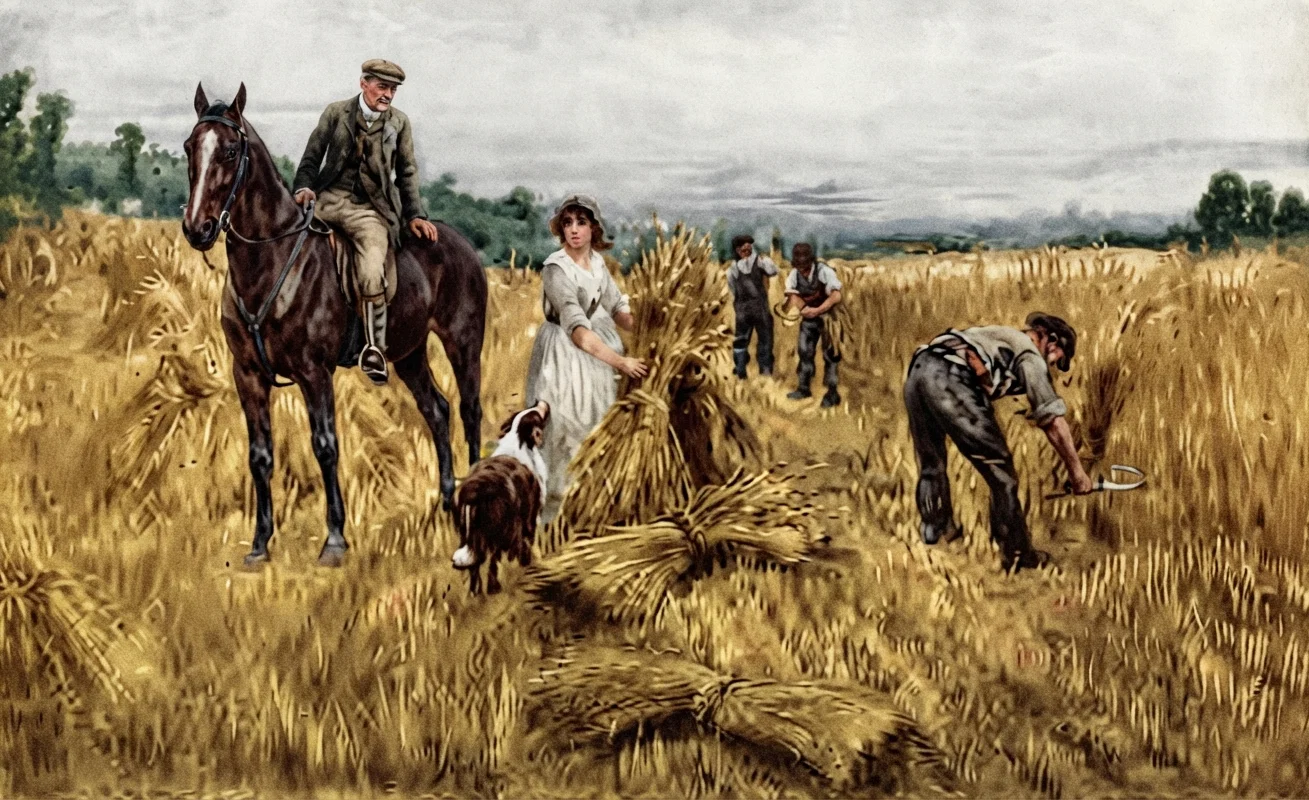
HARK ye! Listen! From the distance Comes the sound of busy reapers, Gathering in the golden harvest, That the plowman and the sower May rejoice with them together. They have worked both late and early, Bringing in the sheaves that have ripened, Gathering in the precious clusters; But there still remains the gleaning, And the ending of the harvest.
Listen to the voice that's calling: "Come and work ye in My vineyard. Just one hour is all that's needed, If I find some faithful workers Who will toil till all are gathered. I have waited, Oh, so patient, Waited for the precious clusters, Till the latter rain had fallen, And the golden grain had ripened White and ready for the harvest."
Go ye forth and labor for Him. You will come back with rejoicing, Laden with the sheaves you've gathered, And with joyful heart will lay them At the feet of Him, thy Master, Saying: "Lord, I used the talents That Thou trustedst in my keeping. Lo, Thou hast Thine own with usage, For they ever kept increasing, Take now what is Thine, and welcome."
He will say: "Well done, My servant. You have worked by faith most earnest. You have given bread and clothing To the humblest of My children. Come, and we will reign together. Come ye to the feast I'm spreading, To the supper of the Bridegroom. I will surely rise and serve you. Come, thou blessed of My Father, Enter to thy home most welcome."

They Stand Under Trial

Coming to Christ from Heathen Darkness—Suffer Persecution Rather than Yield

By O. A. HALL
"A MAN'S foes shall be they of his own household." The truthfulness of this text is demonstrated many times in the experiences of the young people of China. This gospel has set many a youth "at variance against his father." But when the truth takes root in the heart, and the individual knows that God has said, "He that loveth father or mother more than Me is not worthy of Me," he is willing to forsake all in order to become His disciple.

CHOSE CHRIST ABOVE POSITION

Three cases of this kind have just come to our notice. One, a young man nineteen years of age, a few months ago accepted Christ, and began the observance of the Sabbath. This resulted in his separation from the denominational school he was attending. His brothers were connected with government service; and his father, not being a Christian, insisted on his taking up the same work. The son replied that he could not and be a Christian. The firm stand he has taken is worthy of commendation, and will, if maintained, change the entire course of his life.

LEFT HOME RATHER THAN YIELD

The second, a young man twenty-three years of age, has for a number of years been a student in the government schools. About four months ago, he began the study of the Bible truth. His acceptance of the Sabbath demanded his separation from the school, as their sessions were held on the Sabbath, and he could not attend. For three months, he did not inform his parents of his decision. His father holds a responsible position on the Pukow-Tientsin Railway, and three times has urged him to accept a position with good salary, as his younger brother has already done.
A short time ago, he told his father of the decision he had made to observe the Sabbath, and that for this reason he could not accept any position that would interfere with his observance of all the commandments of God.
This immediately set him at variance with his father. Three days were given the young man in which to accept his father's demands or withdraw from his home. His testimony was, "I love my father and mother, but my heavenly Father more," and he consequently has withdrawn from his home for the sake of the gospel.

EXPELLED FROM SCHOOL FOR CHRIST

The third is also a young man, a student in the government school for a number of years, at one of our inland stations. During the New Year's season, while school was not in session, he attended the services at the chapel, accepted Christ, and began the observance of the Sabbath.
When the school again opened, he asked to be excused on the Sabbath to attend the Sabbath services. When the privilege was refused, he told the faculty that he could not continue his regular school work upon the Sabbath. They insisted that he must continue as usual or be expelled from the school, fined fifty dollars, and have his case fully set forth, in Chinese fashion, on a placard posted on the school door.
He decided that whatever the penalty, he could not continue as usual upon the Sabbath. He was advised to have a private interview with a member of the faculty who was acquainted with the message of Christ's coming, and friendly to our people. This he did, and the friend made an appeal for him before the faculty. He was expelled from the school, but no further penalty was inflicted.
Such cases deserve our earnest prayers.

A Text from a Motor Cycle

How the commonest incidents, and those connected with modern prosaic things, as well as the kind Christ drew from the familiar life of His time, will furnish illustrations to the alert messenger of the gospel, is shown again by the following story from a worker who was traveling in Africa on a motor cycle:
“On my return journey, I was able to speak to a company of Kafirs who gathered around me at a wayside hotel to observe how I was filling my gasoline tank—‘feeding my horse,’ as they put it.
“An intelligent looking native remarked that the white man is very wonderful to make a horse of iron which can run without legs; and I answered, ‘Yes; but if man is wonderful, how much more wonderful is God, who made man, and all things.’
“For nearly half an hour, I spoke to them of the creative power of God, of His love for fallen humanity, and of the coming Saviour. The Spirit of the Lord was with us, and these souls seemed to drink in what I told them.
“They were loath to let me go, and made me promise that the next time I passed that way, I would tell them more. I assured them that if they would pray to the great God, He would, to use their own expression, ‘open to them the way.’”

The Inside Climate

A WELL-KNOWN physician has said, "The climate that we create for ourselves on the inside has far more to do with our health and happiness than the climate that surrounds us."
This is very true. Wherever one goes, he finds people complaining, and thinking that they might enjoy better health if they were only in a more congenial climate. Many are moving here and there, hoping to find a climate particularly adapted to health and longevity. But we usually take our old habits along with us when we go; and if they are the cause of our ill health, as is usually the case, we cannot be materially benefited by any climate. Perhaps if we remain right where we are, and correct our habits of eating and drinking, living in accordance with the light that has been given us on these points, we may soon find ourselves greatly improved in health and spirits.
MRS. IVA F. CADY.

The Christian Grows

THE Christian life is one of growth and development. We are first "babes," then "little children," and last of all "perfect men."
We may not remain babes, neither may we suddenly become men. Babes may really try to wear their father's boots, but the effort only provokes the smiles of those older in years.
Let us adhere to the divine plan. As young converts, let us to-day take "the sincere milk of the Word," that we may grow, contenting ourselves with the blessed truth that ere-long we shall reach maturity, stability, and responsibility in the cause of God,— we shall be men and be known as men.
C. L. TAYLOR.

WANTED for MISSIONARY PURPOSES

Vincent D. O'Connor, 56 S. Royal Street, Mobile, Alabama: a continuous supply of SIGNS OF THE TIMES, also Jewish papers, to be used in missionary work.
Mrs. H. T. Moor, Formosa, Florida: a continuous supply of tracts and all denominational literature for free distribution.

For Sale.

160 acres of good farm land in North Dakota. Land in the vicinity sells for $20 to $30 an acre. On account of sickness and inability to work it, will take $18 an acre. For full information, address Paul Iverson, 427 7th Avenue W., Kalispell, Montana.

Banish Envy and Hatred

"BANISH envy from my thought and hatred from my lips."

Malay People Call for the Gospel

Gratifying Activities in Parts of the East Indies,

By F. A. DETAMORE
OUR work here is going forward nicely. Ten were baptized recently, and seven or eight others will go forward in this rite soon. The interest is growing, and many others are keeping the Sabbath besides these already baptized. Every worker is loaded with all that he can do, and still we are unable to fill the calls. I am receiving letters from all parts of the field, some places where we do not have workers, asking for help to understand our message.
A native over in the Celebes, who has never seen a Seventh-day Adventist, has been selling our literature for over a year, and sending the money as he received it. He has also sent some books and tracts to friends in New Guinea and other places, for them to sell. He has learned about the Sabbath, and now he is trying to keep it, and is holding Bible studies in his house every Sabbath.
We also have Sabbath keepers at Pontianak, Dutch Borneo, where our literature has gone. In Sarawak, a British protectorate of Borneo, some natives have begun to keep the Sabbath, and want us to come and teach them the whole truth. Up the east coast of the peninsula are some people who want to unite with us. A Eurasian lady has begun to keep the Sabbath, and her son wants to become a worker. He may attend our training school. At this place are others who have read our literature, and are writing for something about the war and Turkey. These people are Christians and Hindus.
Two years ago, when I first came to the field, we had a membership of some 114. It was felt that our field was not producing the results that it should, so we have gone about to see what could be done; and our membership has increased to 206—a gain of almost one hundred—and we will add others before the end of the year. This shows that people can be brought into the truth here.
Every worker is loyal and true, working shoulder to shoulder, and of good courage in God for the finishing of His work in the East Indies.

40c From Every Dollar Is Yours

It is the commission earned when you sell the justly popular HOME WORKERS' BOOKS, for children and young people. And it amounts to something, too, when you sell two or three in a single home, or eight or ten a day, as some do.
One agent's average sales for an entire month were $1.20 an hour. A feeble woman, advanced in years, sold $12.50 worth in just a few hours.
Good demand for these clean, attractive books, especially in November and December, when people expect to spend money for gifts. Thousands of these books sold every year.
One of the 16
One of the 16
Enlist in the ranks of workers without delay. Former preparation not necessary. You will be supplied with all needed help.
A letter to our representative in your district (see list on page 15) is all that is necessary. He will help you get started.

Pacific Press Publishing Association

Mountain View, California
Kansas City, Mo. Portland, Ore. College View, Neb. Calgary, Alberta, Canada

ALWAYS IN A HURRY

True Greatness Is Free from Strenuous Rush — Great Characters Who Have Done Great Things Calmly

By MARY ALICE HARE LOPER, M. S.
MANY persons on the path of life are conspicuous because they never use a muffler when trying to speed up. One who has studied the selfish human "speeder," doubtless has noticed his excitability, irritability, and lack of consideration for his own or others' best good, while painfully conscious that he has at his disposal only twenty-four hours in a day — just the same as the laziest man on earth.
The poet used to sing of the "noiseless tenor" of one's way, indicating an agreeable quietude, and a continuity of action which perpetuated peace and contentment. Those were blessed days before the spirit of selfish competition in both social and business relations had robbed life of its sweetest harmonies — before people had become too frantically busy to plant roses and forget-me-nots in the garden of life, and to enjoy the fruitage of their labors.

SILKEN THREAD OF MODERATION

"Moderation is the silken thread that runs through the pearl chain of all virtues." The man or the woman who does a half day's work before breakfast in the morning, just for the sake of doing something extraordinary, is using up physical force that ought to be spent in a better cause. Some persons always work under pressure, as the uncultured expression of the small boy suggests: "Bridget's peelin' 'taters like you'd think she went by steam."
The individual who is habitually in a hurry, not only uses up his nerve force, but puts forth misguided efforts, and often experiences the truthfulness of the old adage, "The more haste, the less speed."
No one can make real progress along profitable lines, no one can make a success of life, without taking time to read the Bible and to pray. But it is so easy to allow the "care of this world, and the deceitfulness of riches," to crowd both out of the daily routine of affairs.
Some become too much rushed at times to practice even the common courtesies of life, much less to pay to the world what they owe it in the way of personal touch and kindly ministration. A man uses his time just as he uses his money. If he uses his money selfishly, he uses his time in the same way. Both are devoted either to the cause of humanity or to the cause of self. With the former practice comes the cheerful contentment that is a "continual feast"; with the latter, a restless experience that is "like the troubled sea."

RATIONALLY BUSY OR FRANTICALLY RUSHED?

There is a great difference between being rationally busy and being frantically rushed. The man who makes the most out of life is deliberate. He spends his God-given time to the best advantage. He accomplishes more for the world, because he conserves his nerve energy, and labors faithfully toward a definite and laudable end. It is a great mistake to form the detrimental habit of being a sort of "rush order" through life. Jesus says, "Come ye yourselves apart, . . . and rest a while." Let the storm of life subside; for "in quietness and in confidence shall be your strength." Everything is accomplished by being rationally busy, but everything is lost by being selfishly so.
Truly great minds do not assume the air of always being in a hurry. One of the greatest men of the recent past, whose life work was marvelous in its achievements as a minister of the gospel, an editor, an author, an inventive genius, a language critic, had time to treat every one with due courtesy. His work was intricate and vast; yet he so faithfully practiced the habit of always being agreeable upon interruption, that his callers received a pleasing impression, no matter how great the inconvenience to himself. One of the most blessed memories of his life is found in that remarkable legacy which he left to the world — even members of his own household cannot recall ever having heard him utter one cross word! He was truly a great man. For "he that is slow to anger is better than the mighty; and he that ruleth his spirit than he that taketh a city." He exemplified the character of the greatest Man this world has ever known.

NOT A NOISY BUSTLE

The life of Christ was not one of noise and bustle and loud pretensions. We never read of His being in a breathless hurry about anything, but He was very busy — usefully employed. He went about quietly from place to place, "doing good," His influence being such that the people in great multitudes flocked to hear Him. If a person's work is of importance, people will find it out without his sounding a trumpet to call attention to himself. Christ's work was the most tremendous ever undertaken in this world. But no matter how much He was pressed for time, He never neglected an opportunity to do good to humanity. He always found time to encourage a Zacchaeus, to caution a Peter, to comfort a sorrowing Mary or Martha. Amid the noisy scenes of roaring waves and heaving billows, there was His quiet "Peace, be still." In His arduous efforts to bring the good news of salvation to a lost world, He had time to restore to a blind Bartimaeus his eyesight, and to rehearse the sweet story of the gospel to an inquiring Nicodemus or a lone woman of Samaria. Even the little children learned to love Him, because He had time to be loved. Little children to-day love that person who takes time to devote to their happiness.

TOOK TIME FOR SOCIABILITY

The Saviour of the world had time to practice true sociability. He was the personification of good form, and of all that combines to constitute Christian ethics. When invited to dine in some humble home, He did not search for an excuse for nonacceptance because the people were not of His "social set." On the contrary, it was His pleasure to be present, and to add to the happiness of all about Him. All men were His brethren. He came to die for Judas the same as for the beloved disciple. He knew no exclusiveness in His associations with men, for His love reached the lowest depths of degradation and poverty. He sought to raise the fallen, to encourage the despondent, to lighten the weary burdens of oppressed humanity.

GREAT THINGS WITH LITTLE NOISE

It is a great thing to acquire the art of using one's time as the Redeemer of the world used His — just as a soul here and there conscientiously tries to use his. There is no companionship like that of busy people who accomplish very great things with very little noise. Such lives are an inspiration to others to attempt great things. They are an encouragement to those who really wish to render to the world the best service of which humanity is capable — Christian service. Such persons exemplify the divine admonition, "Whatsoever thy hand findeth to do, do it with thy might" — not with thy mouth. Such lives reveal the workings of that blessed principle, "Let your moderation [not desperation] be known unto all men."
The person who has no time to devote to making others happy, is robbing himself of the greatest happiness this world affords. One who impresses a caller that he is an intruder, is not strengthening the bonds of brotherly love that should bind humanity together; is not making for himself an enviable reputation. If the Redeemer of the world had time for sociability, so have we. But how many there are who keep up such a selfish perpetual motion that they never even take time to encourage a disheartened fellow traveler on the pathway of life! Such individuals are little else than revolving fossils — dead relics so far as benefiting the world is concerned. If one wishes to imitate the Master in going about doing good, he will find that it will take him entirely away from a selfish sphere of action. The sun, not the comet, can be depended upon for constant illumination. A comet may attract a great deal of attention for the time being, but it soon disappears, while the sun remains constant, a life preserver to all upon this darkened orb. "Ye are the light of the world." Followers of the Master have the enlightenment of His Spirit, are luminous — suns in the terrestrial heavens, whose light penetrates the darkened corners of the earth. Constant illumination is what humanity needs just now. There are many human comets, but very few suns, whose quiet rays are serving as life preservers to sinking humanity on the sea of time.
"Take time to be holy. The world rushes on. Spend much time in secret With Jesus alone. By looking to Jesus, Like Him thou shalt be; Thy friends in thy conduct His likeness shall see."

THE UNDERTONE OF PAIN

By CLARA EDNA ROSENCRANS
Ah, the undertone of pain — how it throbs through earth's sweet music! How its pathos and its sorrow fill each measure rich and deep! Love and pain and prayer commingled, give the heart its richest treasure, And the heart is not like Jesus that has never learned to weep. Love is godlike that has suffered patiently, with strong endurance, And has felt, in all self-giving, cleansing of the soul from sin. Holy meekness comes with waiting God's own time, in calm assurance, As His voice in angel whispers speaks unto the soul within. Thus, as sorrow, pain, and anguish purify and cleanse and sweeten, We can look in holy trust to Him to make the work complete, Smiling when the pain is sorest, singing cheerily through the heartbreak, Till we lay it all in rapture at the loving Saviour's feet. Just a little more of sorrow, just a little while for weeping, And the deep, rich chords of heaven fill our hearts with deepest peace. Robes of purity and whiteness, starry, golden crowns, are given, And, most precious of all giving, love and home and pain's release. Then the Saviour's loving smile, and the dear ones reunited, And the blessedness and rapture earth's low dwellers never knew. Then to golden harps' soft music, all our hearts will join in singing That the sorrow all is over and God's promises are true.
Continue reading: Dr. Lyman Abbott