1. What are we admonished to do instead of following the past life of sin?
“Be ye therefore imitators of God, as beloved children.” Verse 1. Note 1.
2. How are we to walk?
“And walk in love, even as Christ also loved you, and gave Himself up for us, an offering and a sacrifice to God for an odor of a sweet smell.” Verse 2. Note 2.
3. What should not be named among us?
“But fornication, and all uncleanness, or covetousness, let it not even be named among you, as becometh saints; nor filthiness, nor foolish talking, or jesting, which are not befitting: but rather giving of thanks.” Verses 3, 4. Note 3.
4. What is the sure end of those who indulge in such things?
“For this ye know of a surety, that no fornicator, nor unclean person, nor covetous man, who is an idolater, hath any inheritance in the kingdom of Christ and God.” Verse 5. Note 4.
5. Of what should we specially take heed?
“Let no man deceive you with empty words: for because of these things cometh the wrath of God upon the sons of disobedience. Be not ye therefore partakers with them.” Verses 6, 7. Note 5.
6. Why should we not be partakers with them?
“For ye were once darkness, but are now light in the Lord: walk as children of light, . . . proving what is well-pleasing unto the Lord.” Verses 8, 10. Note 6.
7. What is the fruit of the light?
“For the fruit of the light is in all goodness and righteousness and truth.” Verse 9. Note 7.
8. With what should we not have fellowship?
“And have no fellowship with the unfruitful works of darkness, but rather even reprove them; for the things which are done by them in secret it is a shame even to speak of.” Verses 11, 12. Note 8.
Note and Comment
1. “Be ye therefore imitators.”—Our Common Version has “followers.” It does not mean a surface imitation, an outward pattern of the Master. In the first place, that would not touch the real heart and life; and in the second place, it would last only a little while before the hypocrisy would be apparent; for hypocrisy is simply the putting on of a mask, and an endeavor to imitate God while the heart was not in harmony with His will would simply be hypocrisy. Elsewhere the apostle has told us how this must be done,—“And be not fashioned according to this world: but be ye transformed by the renewing of your mind, that ye may prove what is the good and acceptable and perfect will of God.” Rom. 12:2. And in Eph. 4:23 we have the same thought,—“and that ye be renewed in the spirit of your mind.” The heart must first be made right, for it is out of the abundance of the heart that the character is molded. Let the instructions given in the previous chapters of Ephesians be carried out, and it is not difficult to become imitators of God, just as the child who loves his father will follow the father; therefore “be ye . . . imitators of God, as beloved children.”
2. “Walk in love.”—Cherish it, develop it by exercising it. Live in its atmosphere by living in Christ. Keep ever before you this one example: “as Christ also loved you, and gave Himself up for us, an offering and a sacrifice to God for an odor of a sweet smell,” instead of the stench of sin from us. So live for Him that He through you may show forth the same blessed grace and sweetness to the world.
3. Not even named.—This injunction is further emphasis laid upon what the apostle said in verse 29 of the previous chapter. Don’t talk of the things of wickedness, do not talk of the fornications and of the uncleanness and of the covetousness that is going on in the world. Christians do too much of it. “Let it not be named among you.” The heart becomes transformed by that on which it feeds, the mind by that upon which it thinks. It is not becoming to saints, to holy ones of God, to talk of those things that are evil and only evil. Let the filthiness stay where it belongs. There is no need of spotting by it the garments which Christ has made white. Leave the foolish talking and the low jesting, the “lewd turns,” as some render. They ought not to be “convenient,” as expressed in our Common Version,—better the text which we are using, they “are not befitting.” They do not become Christians, they are not an appropriate dress to wear before those outside. They are made by the wrong outfitter. There is one thing that is much more becoming—cherish that—the giving of thanks. Do not grumble. Look upon the bright side. In this way will you commend the religion of the Master.
4. “For this ye know.”—At least we ought to know it, and every one instructed in the word of God ought to know it, and every one who has had long observation in this and old world ought to know it,—that no fornicator, nor unclean person—men that give their lives up to such things—have any inheritance in the kingdom of Christ and God. They do not have a decent living generally in this world. If they give themselves freely to such indulgences, they become marked, outcasts, even in good, decent worldly society. The wicked themselves feel that such do not belong in the kingdom of God. They would have no taste to be there anyway; and cherishing those things, they can never hope to get there. A covetous man, we are told, is an idolater. One worships that which he covets. It is possible to covet some things properly. We can earnestly desire the things which God would have us be and possess, but we are not doing that for selfish purposes. The man who covets money, or covets pleasure, or covets lust, however, so that that becomes the molding thought or power of his life, is as truly an idolater as he who bowed before the image of Baal or Ashtoreth.
5. “Let no man deceive.”—There has been, and there is growing now, a liberalism in religion which condones all kinds of sin, just as though God were a great, good-natured king that would pay no attention to the sins, however gross they were. Men are taught that while they are doing these things they are still children of God; all that they need to do is to recognize that fact, straighten up, and in their own strength be somebody; that the germ of life and the relationship with God is there, consequently God will not destroy such, nor allow sin to do it. “Let no man deceive you with empty words.” Those who are in sin, in the words of the apostle, are “separate from Christ, alienated from the commonwealth of Israel, and strangers from the covenants of the promise, having no hope and without God in the world.” Eph. 2:12. They are the “sons of disobedience,” and are “by nature children of wrath.” Verses 2, 3. Note where the apostle uses the same earnest exhortation in Gal. 5:21, in which we are told that “they who practise such things shall not inherit the kingdom of God.” Also 1 Cor. 6:9, 10. There is hope for such, however, if they will but turn to God, for such were some of the early saints. The apostle, after naming fornicators and idolaters and adulterers and effeminate and thieves and drunkards and extortioners and revilers, declares, “And such were some of you: but ye were washed, but ye were sanctified, but ye were justified in the name of the Lord Jesus Christ, and in the Spirit of our God.” But having been washed and justified, we must not return to the old path. Remember that it is to the disobedient that these things come. But God is able to make the most disobedient those who love obedience. Therefore because of His love, do not be partakers in such things.
6. “Ye were . . . but are now.”—It is well to be reminded of what we once were. Sometimes our hearts get lifted up in foolish pride, and we do not remember the pit whence we were digged, nor the place from which God calls us, and where we all are by nature—unregenerate. “Ye were once darkness, but are now light in the Lord: walk as children of light,” and in walking as children of light, prove in your own heart and in your own life what is well-pleasing to the Lord. God gives the light in His word. He will write it again in the life, that there may be the twofold witness in His child. Read verses 8 and 10 together, omitting the parenthetical expression of verse 9, which is explanatory of the worth of light.
7. “Fruit of the light.”—Verse 9 is a further explanation of the worth of the life which walks in the light; for the fruit of the light is not death, is not corruption, is not ultimate sorrow and pain, it is in all goodness and righteousness and truth. Walking in the light would bring us to the fulness of those blessed characteristics.
8. “And have no fellowship.”—A fellow is an equal. Fellowship is equally partaking with the fellows—with other fellows or equals. It is sympathy and comradeship. We are not to understand, by the text, that God would have us utterly cast off those who do not know Him, or turn away from the sinner. That is not the thought of the scripture. Neither would He have us link with the wicked in fellowship. That is an utterly impossible thing, for we have no sympathy with them in the sin. Our lives should be such that the wicked themselves would know that. But in this darkness of wickedness there are those who are longing for the light of righteousness. There are those who are longing for freedom from sin and bondage. And if they find those who have no fellowship with such things as that, such a life will be a help and inspiration and encouragement to them rather than discouragement. We do not win the soul by walking in the wickedness and darkness of that soul. God has lifted His children on a higher plane than that; but He has given them power and length of arm, by His grace, to stoop down and reach the uplifted hands crying for help in the slough of sin and despond, and He has given power to lift them above the low plane and pit of sin onto the glorious highway of righteousness. Utterly disfellowship the unfruitful works of darkness. Yea, rather even reprove them, if necessary by words, always by life. Sometimes silence is more of a reproof than outspoken speech. Let those with whom you fall into association know that when their conversation or acts are contrary to that which is true, you can not and do not approve of them.
“Hurting Business”
By T.
ONE of the greatest obstacles in the road of moral progress is the fear of “hurting business.” It goes through the whole range of trade, from the small dealer in the little village to the largest dealers in the great cities. If certain reforms are proposed that will require the united efforts of a large part of the truly well-meaning element of a community, we are at once met with the excuse of first this individual, and then that one, that he is afraid to do11anything, for “it will hurt my business.” You talk to the business men, and they will agree with you that certain base characters in society are doing things that are demoralizing and that are degrading to the community. They will agree to all of these things readily, but they say: “My hands are tied. I can do nothing about it, because if I did, this one and that one and the other one are customers of mine, and they are in some way situated so that if I would join in these reforms I should jeopardize my trade with these individuals.” And so men allow the evils to progress. They ought to see that by doing this, while they may be saving a little business to-day, they are preparing general disaster for their community in the days to come.
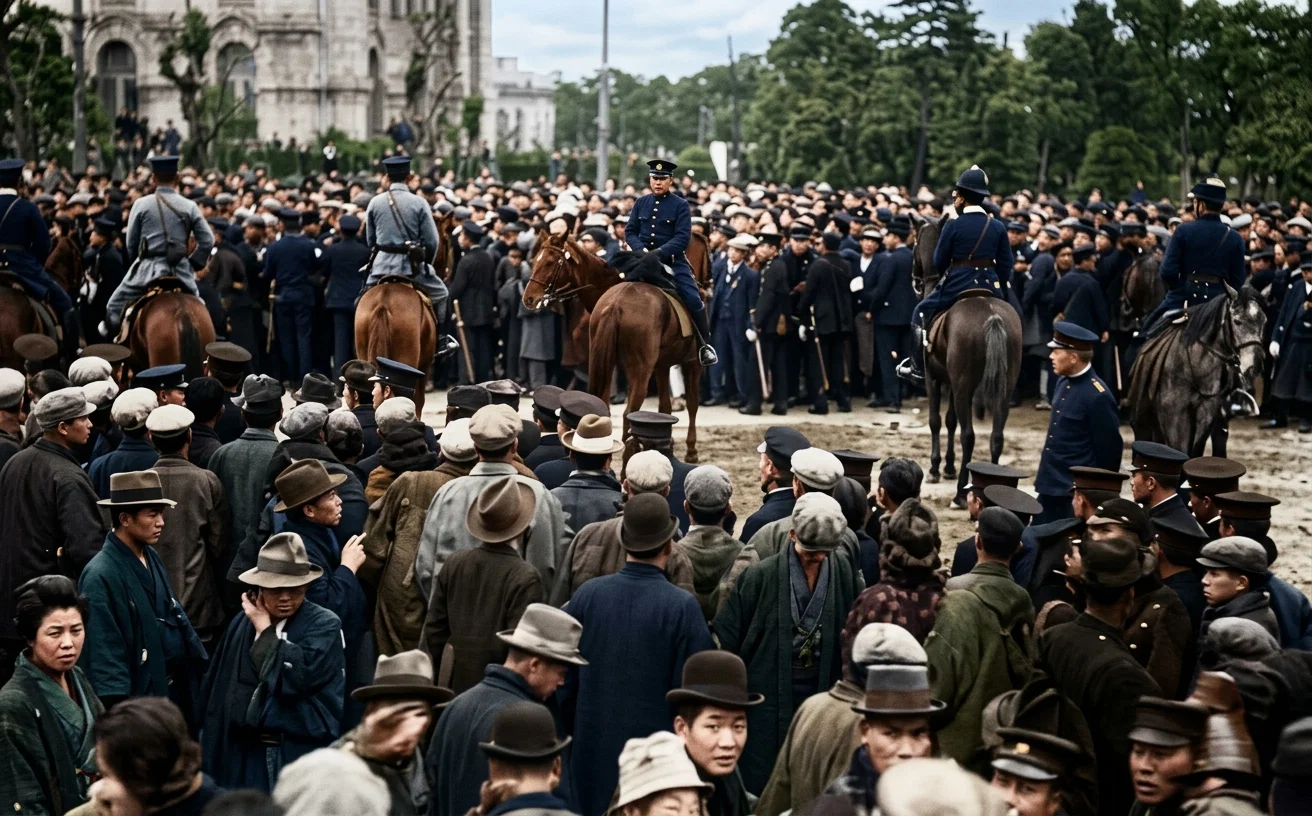
Photo by Paul Thompson, N. Y. The discontented and inflamed populace in Japan. The illustration shows mounted police seeking to keep order near parliament.
A class of Chinese who are studying the gospel under the direction of the missionaries. The missionary will hail with delight the acknowledgment, by this country, of the new Chinese republic.
When Mr. Langford, Mr. Heney, and Detective Burns were doing their heroic work in San Francisco a few years ago, undertaking to send to the penitentiary the grafters and traffickers in all sorts of crimes and vices, the cry was raised by business men all through the city, that they were “hurting business,” that they were retarding commercial interests by the course they were pursuing. This cry became so strong that finally the prosecutions were hushed up and broken off, and only a very few of the guilty men were sent to the penitentiary.
That half-way measure produced the results that should have been expected. San Francisco is again going through a general harvesting of criminals that have been doing in a lesser way the very kind of crooked work that was going on in San Francisco a few years ago. If the work in that time had been thoro, these evil-doers would have been so terrified by the strict justice meted out that they would not have dared to attempt what they have attempted and that is causing these prosecutions in San Francisco at the present time.
The half-way measures of dispensing justice, and the care for the dollar, together with the use of the dollar in bribery, etc., are rapidly placing our great cities in the hands of the most lawless element. The only thing that could correct this would be for men to stand strictly for justice and right, regardless of present pecuniary advantages, leaving the matter of dollars to take care of itself, until we would have clean communities and right-minded men in places of responsibility and power. The only thing that is saving the country at all from general ruin through this sort of thing is the fact that we have some strong men in leading positions in city, state, and nation, who absolutely refuse to be corrupted, and who are standing for truth and righteousness. Everything goes to show that Mayor Ralph of San Francisco is a man of that class. It is to be hoped that the leading men of that great city will not raise the cry that “it is hurting business,” and thus tie his hands in the good work that he is doing at the present time in attempting to rid the city of these criminals, a number of whom have been on the police force and in other responsible positions.
It will not be disputed, by any intelligent person, that the foregoing statements concerning the influence of the cold dollar give facts as we know them to exist throughout the country; and in view of these facts, how appropriate and applicable is the following verse of Scripture:
“But this know, that in the last days grievous times shall come. For men shall be lovers of self, lovers of money.”
Notice that the apostle calls us to “know”—not surmise, but to “KNOW”—that grievous times will come in the last days because of the fact that men will be both lovers of self and lovers of money. Men have always been lovers of self and lovers of money throughout the career of this world in sin; but here is a period brought to view when this love of self and love of money will become so wide-spread and so deep-rooted that it will make the times “grievous.”
Having reached the place that we put business ahead of morality, and dollars in front of righteousness, and our trade and commerce where it will block the progress of justice that is seeking to rid the world of such vices and crimes as the white slave traffic, drunkenness, gambling, robbery, and oppression, it is time to ask the question, Are we not amid those grievous conditions that are to mark the last days? This one statement of Scripture would not be enough to decide such a great question as that; but when we consider that this scripture is in harmony with the great voice of prophecy throughout the Bible, we ought to know that we are nearing the end of this world. In the past, nations have gone down whenever they have become fully corrupted. This has been the universal voice of history; and when the entire world becomes corrupted as it is becoming at the present time, and when every section is mad with the craze for money and the corrupting vices that grow out of luxury, we ought to know that it must all go down. There should be but one conclusion in regard to where we are standing in this time.
T.
What Is Protestantism?
By Editor
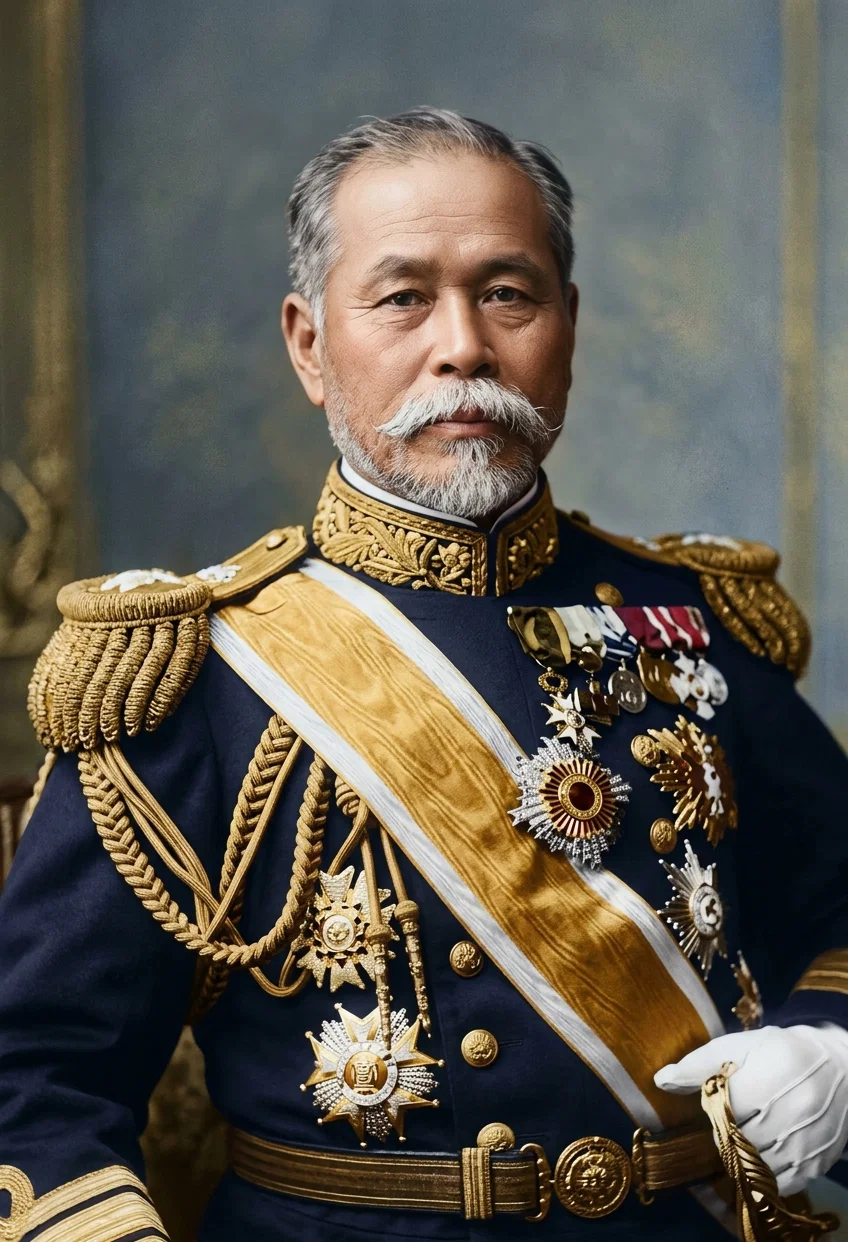
The prime minister of Japan, Admiral Yamamoto
Photograph by Underwood & Underwood, N. Y.
ONE of the new books, and one listed as “the book of the month” by the “Biblical World,” is “What Is Protestantism?” There never ought to be need of such a question. If Protestantism had held to its own, had held to the principles which gave it birth,—namely, a protest against all that is contrary to the gospel of the Lord Jesus Christ, and the positive doctrines of that gospel, the justification by faith in Christ, and the all-sufficiency of His word,—there would be no need of asking the question. Protestantism would be the same virile religion that it was in the days of Martin Luther, only cleaner, stronger, truer, better. Dr. Gerald B. Smith, professor of Christian theology in the University of Chicago, in his review of the book in the “Biblical World” for March, 1913, says, “To-day, under the scrutiny of historians, even, that seemingly simple division between Catholicism and Protestantism which forms the staple of popular polemic, is discovered to be less absolute than was once supposed.” He quotes from the author of the book, Ernst Troeltsch:
“The genuine early Protestantism of Lutheranism and Calvinism is as an organic whole, in spite of its anti-Catholic doctrine of salvation, entirely a church civilization like that of the Middle Ages.”
But it seems to us that the church civilization of which the author speaks is that which lingered from the old régime. Virile Protestantism had not yet formed its civilization. The best sample of what it would form was found in America. It could not be, in the nature of the case, formed in the Old World. There was too much of the old leaven in both individual and government.
Another statement which is made, as enumerated by Professor Smith, is that—
“Our modern doctrines of freedom of conscience, and the consequent recognition of the fact that a church must be organized by the free consent of the members, is due to the radical Baptists and Spiritualists, whom original Protestantism repudiated.”
But original Protestantism previous to Calvinism did not in principle repudiate this. It lifted the word of God above all creed, and if it had followed the principle, it would have grown out of creeds entirely. The sad thing of Protestantism was when it harked back to the creed principle. Just as soon as Protestantism departed from its primal principles of the word of God and the Word alone, as the rule of faith, the Bible above the creed, Christ above the church, it began to go backward. That is why God demands a revolution and a reformation at the present time. The author of this book thinks that—
“The issue between Catholicism and Protestantism is likely in the near future to assume a new form and a new intensity. Catholicism has unmistakably asserted its intention to hold to the medieval ideal of a church-controlled civilization. It intends, so far as possible, to direct the education, the politics, and the social organization of men. It has a powerful ecclesiastical organization with which to work for its ends. Modern Protestantism, on the other hand, has come to terms of modern culture. . . . But the religious ideals of early Protestantism were nearly all related to the medieval conception of a church-controlled civilization. Its theology, therefore, is lacking in those fundamentals which are essential to a religious interpretation of the modern world. Protestantism thus faces a real crisis. Shall it strive to perpetuate a theology which must be constantly at war with modern science, modern social ideals, modern ethical issues, and modern religious aspirations? If so, it will inevitably see the modern world drifting away from its ideals, while those who really wish a church-controlled civilization will find Catholicism far more efficient than Protestantism in promoting this end.” (Bold face ours.)
And right there the whole question lies. Protestantism has not enough of the real vigor and life of the Word to stand against that element in the world which demands a church-controlled civilization. Many of the strong men in the Protestant church are working for that to-day. That is one of the objects of the Federation of Churches in America. Nor could Protestantism ever hope to hold the world against that, with the Babylon of theology which she holds at the present time. It lacks conviction. It lacks virility. It lacks power to grip the hearts of men, and lift them above all the tradition of the past that is not based on the Word, and all the fear of great masses, and the power of an organized ecclesiasticism. What, then, may we look for but just what is suggested by Professor Smith,—that those who really wish a church-controlled civilization will find Catholicism far more efficient than Protestantism? Mere modern culture will never change the morals of the world. Protestantism HAS reached a crisis. Its hope, however, does not lie in endeavoring to mold its principles after the modern culture, or the deductions of modern science. Its hope now lies, as its hope did in the beginning, in cleaving to God’s word and the life of that Word above all things else. That must be dominant. For that Protestantism the “Signs of the Times” stands. If true Protestantism is not maintained, its power and influence over the world will be swept away by the strength and better organization of Roman Catholicism.
Japan and the United States
THERE can be no doubt, if we give credence to the newspaper discussion that is going on, that the situation between this country and Japan is very delicate; but we trust, and believe, that the reporters are getting things very much exaggerated. There is no reason whatever why we who are dwelling in such times of intelligence and professed good will, should immediately begin examining our guns and battle-ships as soon as we reach the place where it is necessary for us to have an argument with some other nation over some problem. If we were really in the time of such peace and good will as we are frequently told we are, the sentiments of the country would be so strongly against such Jingo talk that it would be frowned down everywhere.
The facts in the case are that the spirit of war is even stronger in the world now than it ever was before. This is made manifest by the actual facts, notwithstanding much of the talk upon the subject. It is well for us to learn how to weigh things as they actually are, regardless of the prevailing style of talk. We have styles in talk that outrage the facts just as much as styles of dress at times outrage decency and good sense, and men and women are just as much enslaved to the prevailing style in talking as they are to the prevailing style in dressing. Men will follow current and popular sentiment regardless of its fact or good sense.
That is what the majority of people are doing when they are discussing this question of war. They tell us that we are in times of unquestioned peace, and that no great wars can ever come; and yet there is nothing to indicate it. One of our leading newspapers on this coast poses as a great advocate of peace, and at the same time it is one of the loudest in its clamors that this state shall go ahead and enact certain laws regardless of the effect it may have upon Japan, and of the possibilities of our being thrown into war with that courageous little nation.
That same paper, while it follows the prevailing style of talking peace, at the same time is urging that we should have a big navy, and be armed to the limit for war. It is true that the paper referred to claims that this is the best way of insuring peace; but if we have to insure ourselves at such awful cost against war, are not the sentiments of war the spirit of this age, rather than the sentiments of peace? There is but one conclusion to be drawn.
Record Shooting at Golden Gate
In the target practise in the forts surrounding the Golden Gate, some record shooting has been done. One battery scored 100 per cent of hits; others have scored six out of a possible seven.
A missionary to China, and his class of students, who are studying the gospel message with him. It is because of classes of this kind that the missionaries in the Orient are so anxious to keep the spirit of friendship among the nations, and to quench the war spirit that is so rampant.