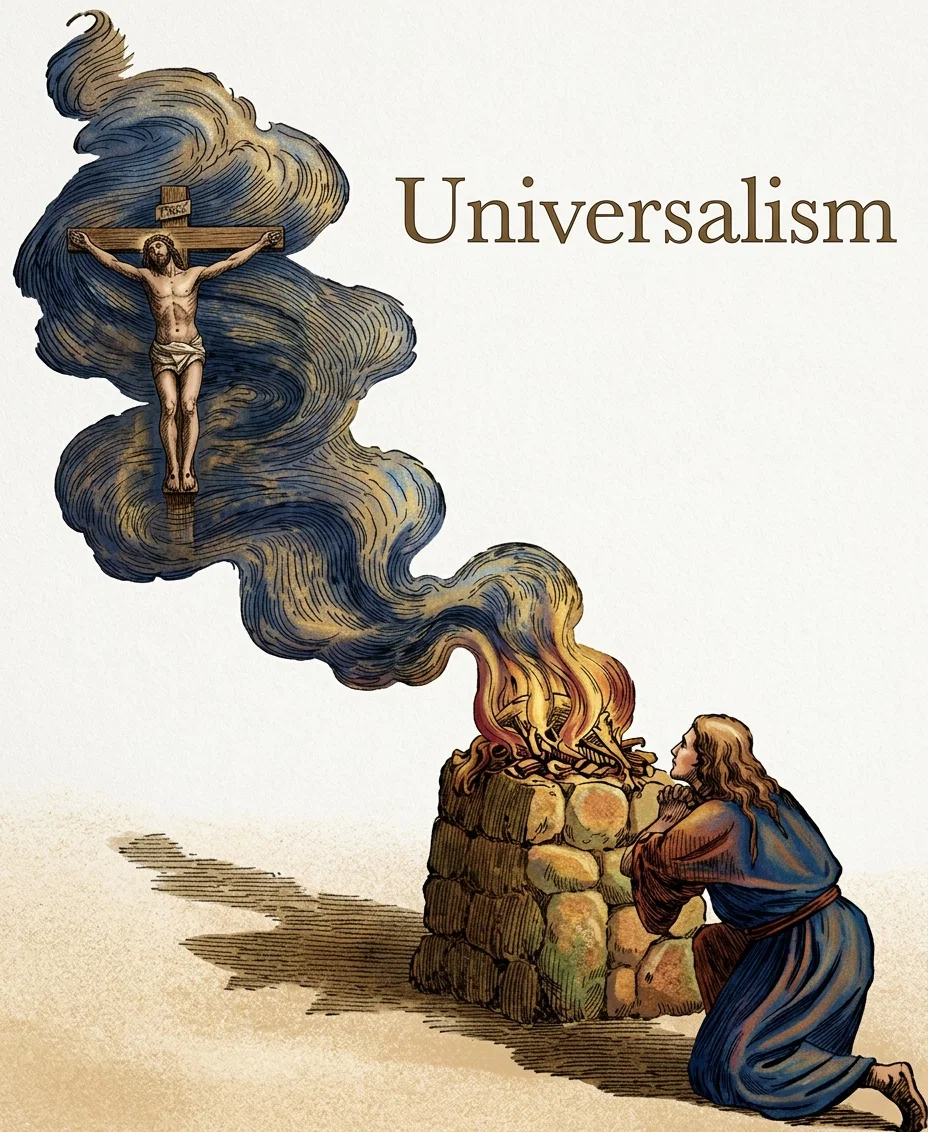
Some even in Paul's day thought that because Christ had died for their sins, they were no longer to regard the law of God. They considered being under the throne of grace as equivalent to making void the law of God. They preached that the love and mercy of Jesus had set aside the law of His Father. Well might Paul exclaim, “God forbid.” Rom. 3:31; 6:15. Yet these ideas are widely preached to-day when the claims of the law of God are urged upon the conscience; and many minds are darkened and confused thereby.
But that we cannot be true subjects of the throne of grace and be disobedient to God's law is very evident. The psalmist says of this throne, “Justice and judgment are the habitation of Thy throne; mercy and truth shall go before Thy face.” Ps. 89:14.
It is at the throne of grace that we find mercy. Heb. 4:16. But its foundation or habitation is justice and judgment, which cannot be if there is no law. In the typical sanctuary, the law of God graven on the immutable stone was just beneath the mercy seat, which was the cover of the ark, and with “the cherubims of glory,” represented the throne of grace, the glorious high throne that from the beginning has been the place of our sanctuary. In Ps. 85:10, we read, “Mercy and truth are met together; righteousness and peace have kissed each other.”
Truth and Righteousness
And again the psalmist says, “Thy law is the truth,” and “all Thy commandments are righteousness.” Ps. 119:142, 172. It is thus clear that the law, which is “the truth” and “righteousness” of God, is the very foundation of the throne of grace. And the law contained in the ark on earth was and is an exact copy of the law in the ark of the testament in the sanctuary in heaven. Rev. 11:19.
But as this law has accepted for the punishment of its transgression a Substitute in the place of the actual sinner, it has gone outside the boundary of its jurisdiction. The law is not made for a righteous man, but for the lawless; and of its own power, it can hold only those for whom it is made. Hence when it takes a righteous man in place of the sinner, it must meet the voluntary substitute on equal terms with itself. So mercy and truth meet together at the throne of grace; righteousness and peace, the peace that comes through justification by faith, have kissed each other.
But One Could Be Found
This is why, in all the universe, there was but one who could, in behalf of man, satisfy the claims of the law. He must be one equal with the law. No angel's life, whether Gabriel's or Lucifer's, can meet the penalty of the law for sinful humanity, or any portion thereof. Therefore Christ trod the wine press alone, while of people or of angels there was none with Him. And He did it “that the righteousness of the law might be fulfilled in us, who walk not after the flesh, but after the Spirit” (Rom. 8:4), and that He might be able “to declare His righteousness for the remission of sins that are past” (Rom. 3:25).
Again there are those who teach that this wonderful sacrifice of Christ is insufficient to atone for and dispose of the sins of mankind or even of the righteous, and another sacrifice is put in to meet the demands of the law for those who shall finally be saved.
Let us see. The sins of the whole world were made to meet on Christ. Isa. 53:6. If His death was not a complete satisfaction for the sins imputed to Him, what authority or right had He to come forth from the grave? Would not sin have held Him there? Or if we suppose He has risen with sin still imputed to Him, must He not then die again?
Took His Life
God forbid! The imputing of sin to Christ was not a mere theory. It was so terribly real that it took His life away. But when He had thus laid down His life, He was freed, or justified from the imputed sin of humanity; and according to the commandment He had received from His Father, He had the power to take up His life again. John 10:18.
Again, it is taught that the death of Christ atoned automatically for the sins of the world of all ages; that the whole human family was freed from sin to the fullest possible extent, so that no one of them, regardless of the way he treats his Saviour, will ever have to suffer for any of the sins for which Christ died. It is taught that when Christ died, the whole world died with Him the death that frees from sin.
Such teaching would spread this blessing over all the dives of infamy and all the palaces of sin in the world. But the word of God shows clearly that this is an error. The imputing of sins to Christ is not the removal of sins from mankind; for in the thirty-second psalm, God says: “Blessed is he whose transgression is forgiven, whose sin is covered. Blessed is the man unto whom the Lord imputeth not iniquity.” Paul, in Rom. 4:6, says that David, in the verses quoted, is describing “the blessedness of the man, unto whom God imputeth righteousness without works.”
But to whom does God impute righteousness without works? Verse 5 says that to him who “believeth on Him that justifieth the ungodly, his faith is counted for righteousness.” Then sin is imputed to every man—that is, the sins he commits right along every day—until Christ's righteousness is imputed; and this righteousness is imputed only to those who exercise faith, who “believe on Him that raised up Jesus our Lord from the dead.” Rom. 4:24. It is then plain that the death of Christ, except through the repentance of the sinner, did not take away the sin of the world. The human race as a whole was not thereby freed or justified from sin.
It is true that so far as the plan and purpose of God are concerned, all died in Christ when He died. For though it was Christ, and He alone, who died, the death He died was vast and broad enough, in the sight of God,
to answer for the death of all mankind; and all might, if they would, die into that death. “Know ye not, that so many of us as were baptized into Jesus Christ were baptized into His death?” Rom. 6:3. Thus it was Christ who died. Rom. 8:34. “He that is dead is freed [or justified] from sin.” In that Christ died, “He died unto sin once.” “Being raised from the dead,” freed from imputed sin, Christ “dieth no more; death hath no more dominion over Him.” Rom. 6:7, 10, 9. He is now our Advocate in the courts above. “If any man sin, we have an Advocate with the Father, Jesus Christ the righteous.” 1 John 2:1.
Authority to Give Righteousness
As our Advocate, Christ has the infinite merits of His sinless life and spotless sacrifice to present before the Father in our behalf. He “did no sin, neither was guile found in His mouth.” Hence for every sin sent up to Him by sincere confession, He can show the payment of the penalty by the wounds that our sins have made, paid by One who did not deserve to be treated thus, that the ones who did deserve it might, by the mercy and forbearance of God, go free.
To Christ, the Father has given the authority “to declare His righteousness,” through faith in His blood, “for the remission of sins that are past.” Rom. 3:25. From the throne of grace, all things that pertain to life and godliness are ministered by Christ to His people, to those who confess and repent of their sins, and believe on “Him that justifieth the ungodly.”
Freedom from sin is one of these blessings. But as in the type, it is a blessing obtained and retained on conditions. Those who confess and forsake their sins, and believe on Christ, can individually say by faith: I am “dead indeed unto sin, but alive unto God.” “I am crucified with Christ: nevertheless I live.” For “if Christ be in you, the body is dead because of sin.” Rom. 8:10. “And they that are Christ's,” that is, truly believe on Him, “have crucified the flesh with the affections and lusts.” Gal. 5:24. Then they are free from sin, and have peace with God through their Lord Jesus Christ. Yet in one sense, they are not entirely free from their sins; for as we shall see, sins, though forgiven, were not blotted out till the day of atonement, and were held again against those who proved untrue to their profession.
“Christ glorified not Himself to be made an high priest.” Heb. 5:5. He was called of God. To this call, He responded, “Lo, I come . . . to do Thy will, O God.” He became flesh. He learned obedience by the things that He suffered. “In all things it behooved Him to be made like unto His brethren, that He might be a merciful and faithful high priest,” able to succor the tempted. “And being made perfect, He became the author of eternal salvation unto all them that obey Him; called of God an high priest after the order of Melchisedec.” Heb. 5:9, 10.
His Offering the Antitype
Thus Christ entered upon His work as priest in the sanctuary above. And as the work in the type began with the daily service, so in the antitype; for those priests served “unto the example and shadow of heavenly things.” Heb. 8:5. Of Christ, Paul says: “Who needeth not daily, as those high priests, to offer up sacrifice: . . . for this He did6once, when He offered up Himself.” Heb. 7:27. This is a plain statement that Christ's one offering is the antitype of all the daily offerings of the Levitical priesthood, as well as the annual. Hence it is clear that Christ, at His ascension, began His work in the first apartment of the sanctuary on high.
(Continued from page 5)
This is the more evident from the fact that previous to the first advent of Christ, there was in the heavens no priest nor sacrifice, without which there could be no antitype of the service in the holy place of the earthly sanctuary; and the work there was not a shadow of that which then was, but it was a figure, or example, of that which was to be, of “good things to come.” Heb. 10:1. The whole sanctuary service in type pointed men to the future, to “behold the Lamb of God, which taketh away the sin of the world.”
In the holy place of the heavenly sanctuary, Christ ministered as our Forerunner and Advocate. For guilty men, He pleaded His divine sacrifice. All were invited to come boldly to the throne of grace. The gospel was preached in its fullness. Christ's disciples were filled with great joy; for by faith, they saw Christ, the propitiation full and complete for all their sins, sitting at the right hand of God, and declaring His righteousness for the remission of sins that are past, to every one who believed.
This was to continue, as in the earthly example and shadow, till the day of atonement, when a short, solemn, and decisive work should close up the plan of salvation, and the mystery of God be finished. What is the nature of this work? Have we reached the time? Has Christ begun His closing work as our Advocate? These are solemn questions, on which no one can afford to remain in ignorance.
Sumatra, the Land with a Future
By F. A. Detamore
By F. A. DETAMORE
NATIVE HOUSES IN BATTAK-LAND
Not counting Australia and Greenland, Sumatra ranks fourth in size of all the islands in the world, and contains 167,480 square miles, which is more than thirteen times the size of Holland, and is next to Java in importance among the Dutch possessions in the East Indies. It is twice as large as the state of Minnesota, and about the size of the states of Washington and Oregon together. Although four times the size of Java, it has less than one tenth the population, or 4,029,505 (1905).
A Great Future
It is claimed that Sumatra, “whose soil and subsoil hold their own easily with those of Java in the matter of mineral and agricultural wealth, is only now beginning to attract the attention of the Dutch,” and “might easily contain and support some seventy-five million human beings;” but while “Java is a country of magnificent realization, Sumatra has only a great future.”
Ludovico Di Varthema is said to have been the first European to discover the coast of Sumatra (1505), though it had been known to the Hindus and the Arabs, who brought their beliefs and civilizations there long before. The Portuguese followed in 1509, and the Dutch landed on the coast of Achin in 1599. “Here Cornelius Houtman, one of those who ‘discovered’ for Holland the route to the Indies, was killed by the Achinese (1599), who began, over the body of the representative of the power of Holland in the East, their interminable struggle against that power.” Having expelled the Portuguese, the Dutch struggled throughout the eighteenth century against the rivalry of England. In 1824, by the treaty of London, England abandoned all claims to Billiton and the whole of Sumatra, in return for all the remaining Dutch possessions in the Indian coast and the Malay peninsula, with the island of Singapore.
Volcanoes and Timbers
Ninety volcanoes, a few of which are still active, have been discovered in Sumatra, though it has not yet been fully explored. These are scattered amidst a series of mountainous groups which run the whole length of the island. While on a recent tour through Sumatra, the writer visited a number of hot springs, which were formerly worshiped by the natives. Much of the interior is a high table-land, or series of table-lands, two thousand to four thousand feet above sea level. In these parts, the climate is cool and pleasant the whole year round.
Sumatra has a larger variety of timbers than any other of the East India group, and produces gums and resins of great commercial value. Tobacco is the chief export.
NATIVE HOUSES IN BATTAK-LAND
Other products are gold, silver, petroleum, etc. Among the wild animals there are elephants, rhinoceroses, tigers, panthers, tapirs, and a few orang-utans.
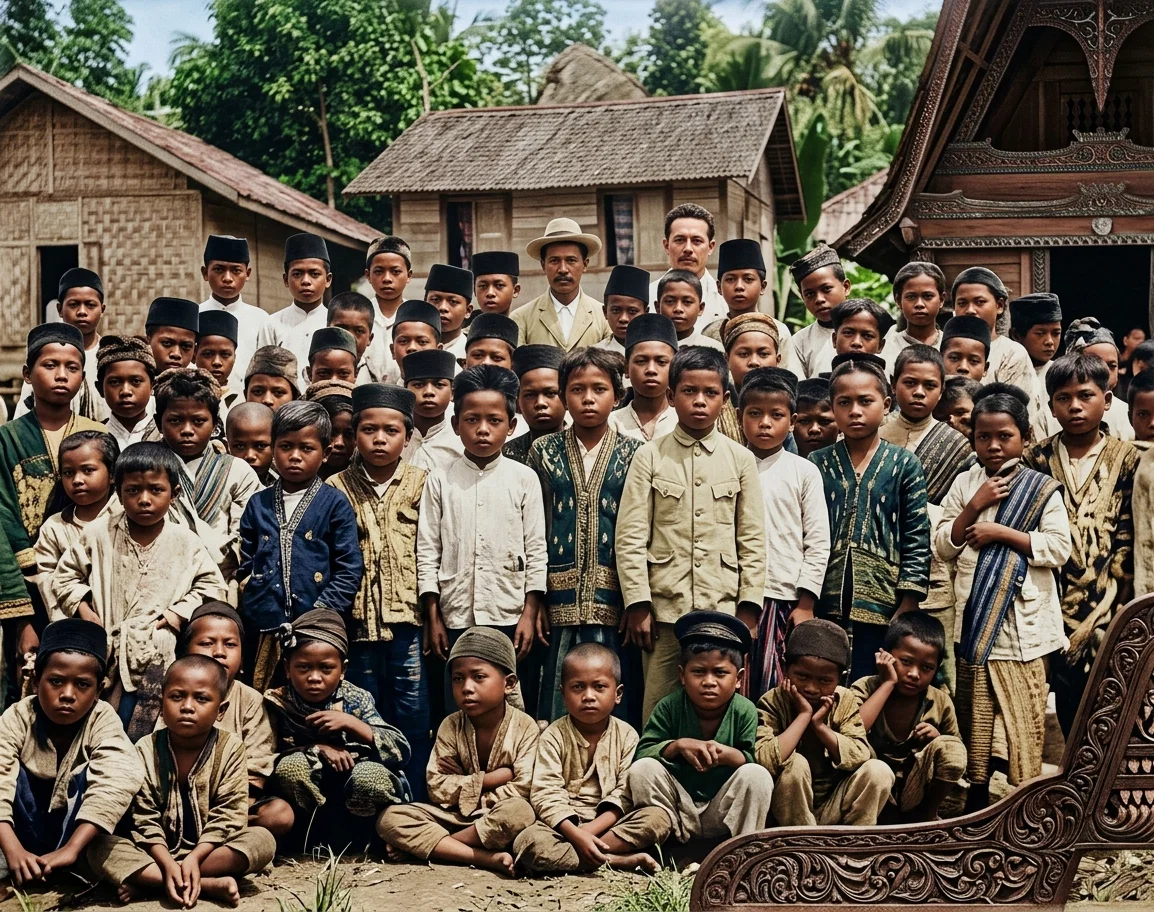
The inhabitants are principally Malays, Battaks, and Achinese. In the coast towns may be found many Chinese, Tamils, Bengalis, Arabs, and mixed races. They are more open to education and civilization than are the natives of the interior, whose condition is still extremely rudimentary.
The Battaks inhabit the residency of Tapanoeli, and are divided into a number of classes, some of whom are Mohammedans, while others have embraced the Christian religion. Our knowledge of the Battaks dates from 1867-1883.
Eat Their Ancestors
MALAY VILLAGE IN SUMATRA
They have a terrible reputation for cannibalism. It is claimed that they ate their aged relatives, in order to give them a pious sepulcher in their stomachs. At the season when the lemons were ripe, the aged one would climb a tree, and the family would gather and dance below, singing, “Where the fruit is ripe, it falls from the tree.” The victim would then let himself drop from the tree, when he was knocked in the head and killed and eaten. It is said that those savages would have objected to any other form of death; for they hoped to obtain immortality by becoming a very part of those who consumed them. “Consumption by the family . . . might well be accompanied by a conception of immortality. The old, helpless man, with the joys of life failing him, would find a certain attraction in the idea that his body would become part of the strong brown bodies around him. He might even have a dim conception that he would be partly conscious in each of his sepultures.”
Thus the archdeceiver would lead these poor souls far from the Bible teaching that “the dead know not anything.” Eccl. 9: 5. He would hide from their minds the lovely Jesus, who “hath brought life and immortality to light through the gospel.” 2 Tim. 1: 10.
The work of educating and Christianizing these poor people has been going on now for some fifty years, and many of them are intelligently responding to the influence of the gospel.
Our work in Sumatra was started in 1899, at Padang. We now have a church organized there, and a good school in operation. A home has recently been erected for our missionary, together with a comfortable little schoolhouse. Some have become tired of waiting for us to enter their land with the message of Christ’s soon return, and have sold their possessions, and come to Singapore to attend our school.
Multitudes of needy souls surrounded us as we passed through the land, and begged us to come and teach them the Bible and the common branches of education. But for lack of men and means, we are still unable to answer the majority of these earnest pleas for help.
Peter and the Keys
Christ gave no more power or authority to Peter than to the other apostles. The Saviour’s words, “I will give unto thee the keys of the kingdom of heaven,” were not addressed to Peter any more than to the church militant. The keys are the word of God. They are given to the church to be used as directed by Christ. The directions are recorded in the eighteenth chapter of Matthew. If a brother trespasses against his brother, and after being properly approached, refuses to be reconciled, the case is to come before the entire church. “If he neglect to hear the church, let him be unto thee as an heathen man and a publican.”
In other words, let him be expelled from the church. Such a course will be sanctioned in heaven; for we read, “Whatsoever ye [the church] shall bind on earth shall be bound in heaven: and whatsoever ye shall loose on earth shall be loosed in heaven.” Matt. 18: 15-19; 16: 19. If the offender never becomes reconciled, this divine rule, if properly followed, excludes him from heaven.
When the question of circumcision was under consideration in Jerusalem, Peter gave his experience, the same as Barnabas and Paul gave theirs; but the apostle James rendered the decision. He said: “Wherefore my sentence is, that we trouble not them, which from among the gentiles are turned to God: but that we write unto them, that they abstain from pollutions of idols, and from fornication, and from things strangled, and from blood.” See Acts 15: 12-20. According to this record, Peter held a subordinate position, and he held no keys except the Holy Scriptures, which have been in the hands of the church of God for ages.
If Christ had given Peter the keys of the kingdom, and appointed him gatekeeper, that would have settled matters, and their disputation over position would have ceased. But Christ never appointed Peter to any such position. E. HILLIARD.
BATTAK MISSION SCHOOL
DID HE COME IN SECRET?
By Rufus A. Underwood
Who Could Call This the Millennium?
By RUFUS A. UNDERWOOD
“Behold, I have told you before. Wherefore if they shall say unto you, Behold, He is in the desert; go not forth: behold, He is in the secret chambers; believe it not. For as the lightning cometh out of the east, and shineth even unto the west; so shall also the coming of the Son of man be.” Matt. 24: 25-27.
This text exposes one of Satan’s plans, against which Christ has given warning. A publication supposed to have been written by the late Mr. Russell, and “scattered like the leaves of autumn,” has been saying, “Behold the Bridegroom,—not, Behold, the Bridegroom cometh, but, Behold, He has come, and we are now living in the presence of the Son of man.” These statements will be found in a bound volume entitled “Thy Kingdom Come,” series 3, page 93.
Again, in the same volume, I read: “The second advent of our Lord in the end or harvest of the gospel age, occurring in the fall of 1874, proves to be a point of time exactly parallel to the time of His first advent, in the end of the Jewish age. . . . The parallelism continues to the full end of the harvest in this dispensation—until the overthrow of the professedly Christian kingdoms, really the kingdoms of this world, and the full establishment of the kingdoms of God in the earth at A. D. 1914, the terminus of the times of the gentiles.” (Series 3, pages 125, 126.)
In the book “The Time Is at Hand,” series 2, page 104, we read: “The first work of Christ at the second advent must be the gathering of His elect church. . . . As will be shown, it is a period of forty years, which both ends the gospel age and introduces the millennial age.” According to this reasoning, the second advent, which Mr. Russell declared to have occurred in the autumn of 1874 A. D., would bring us to the date of 1914 A. D. for the opening of the millennium.
Was It Thus in Secret?
A still further, more definite statement in the same volume, page 170: “In the preceding chapter, we presented evidence showing that the time of the gentiles, or their lease of dominion, will run fully out with the year A. D. 1914, and that at that time, they will all be overturned, and Christ’s kingdom fully established. That the Lord must be present, and set up His kingdom, and exercise His great power, so as to dash the nations to pieces as a potter’s vessel, is then clearly fixed; for it is in the days of these kings, before their overthrow—that is, before A. D. 1914—that the God of heaven shall set up His kingdom, and it shall break in pieces and consume all these. Dan. 2: 44.”
This is sufficient to show that the late Mr. Russell, and those who are sending out his writings, teach very positively that Christ’s second coming has already taken place, and that the millennium began in 1914, which is designated as the antitypical jubilee of the world. Under the heading “Earth’s Great Jubilee,” on page 181 of series 2, it is said: “But instead of being a year, as in the type, it will be longer. It will be the beginning of the great thousand year jubilee,—the millennium.”
If Christ has already come, and has been here for forty-two years, and the millennial reign has been in progress for two years, or since the autumn of 1914, it is surely time that the world should know that this is a fact. However, we feel that these publications present a false view of Christ’s coming, and also of Christ’s gathering a select few called the bride to Himself in the antitypical jubilee which also is claimed to have opened the millennium in 1914, during which time also a second probation is offered to all that have neglected God’s grace in the past. This teaching is a delusion, a perversion of the manner of Christ’s coming to this world the second time.
But Have We Had Peace?
We are told that the Prince of peace in person has been on earth the second time since October, 1874 A. D., and that His kingdom was to be fully set up on this earth in October, 1914. If this is true, we are led to ask, Have we seen peace and love ruling in the place of vice and hatred? Has the malaria of sin had less effect upon the world since October, 1874, or even since 1914? Do we not still see virtue and justice trodden underfoot? Has honest toil been requited? Is not wealth accumulated by means of fraud, with vice, intemperance, and oppression still exalted above virtue? Is not two thirds or more of the earth’s surface involved in the most cruel war the world has ever seen? Do not the sorrowful children and widows, and the blood of millions of the best men of Europe, protest against the selfish greed of those who lead them to the slaughter?
Yet, in the face of increasing selfishness, crime, bloodshed, and almost universal mourning, we are told that Christ, the Prince of peace, would fully establish His kingdom on earth before 1914. If the present condition of the world is an indication of what the kingdom of Christ is to bring to this sorrow-smitten world in the future, we surely have been deceived and mocked as we have contemplated Christ’s coming, and prayed, “Thy kingdom come.” We have hoped that in that kingdom, injustice would be terminated, innocence vindicated, death abolished, righteousness exalted, every wrong righted, and peace and joy, with life uninterrupted, given to the inhabitants of Christ’s kingdom forever and ever.
Fanciful and Unwarranted
Such fanciful and unwarranted interpretations of the Scriptures as are set forth by the “millennial dawn” advocates are not only deceptive, but they destroy the simplicity, beauty, and hope of the Christian religion. If the millennium has been in progress for the last two years, a united prayer should ascend from the millions of the blood-stained nations of Europe for the Almighty to shorten this period of jubilee. A misconception of the events that will occur at Christ’s coming is apparent from the statements made that Christ’s kingdom was to be fully set up in 1914, as already quoted from the publications cited.
It is a great mistake to think that Christ’s coming is in secret; and further, all attempts to fix the date of Christ’s coming will come to naught, and bring disgrace upon those who teach the definite time of that event. “Wherefore if they shall say unto you, Behold, He is in the desert; go not forth: behold, He is in the secret chambers; believe it not. For as the lightning cometh out of the east, and shineth even unto the west; so shall also the coming of the Son of man be.” Matt. 24: 26, 27. “But of that day and hour knoweth no man [maketh known no man], no, not the angels of heaven, but My Father only.” Verse 36.
Two Unprecedented Events
I will notice in this article two unprecedented events that will occur in connection with the coming of Christ. First, the resurrection of all the righteous dead of past ages, and the translation of all the righteous living, takes place at the appearing of Jesus Christ the second time. “For the Lord Himself shall descend from heaven with a shout, with the voice of the Archangel, and with the trump of God: and the dead in Christ shall rise first: then we which are alive and remain shall be caught up together with them in the clouds, to meet the Lord in the air: and so shall we ever be with the Lord.” 1 Thess. 4: 16, 17. “Behold, I show you a mystery; We shall not all sleep, but we shall all be changed, in a moment, in the twinkling of an eye, at the last trump: for the trumpet shall sound, and the dead shall be raised incorruptible, and we shall be changed.” 1 Cor. 15: 51, 52.
“Marvel not at this: for the hour is coming, in the which all that are in the graves shall hear His voice, and shall come forth; they that have done good, unto the resurrection of life; and they that have done evil, unto the resurrection of damnation.” John 5: 28, 29. “Thy dead men shall live, together with my dead body shall they arise. Awake and sing, ye that dwell in dust: for thy dew is as the dew of herbs, and the earth shall cast out the dead. . . . For, behold, the Lord cometh out of His place to punish the inhabitants of the earth for their iniquity: the earth also shall disclose her blood, and shall no more cover her slain.” Isa. 26: 19, 21. “I will ransom them from the power of the grave; I will redeem them from death: O death, I will be thy plagues; O grave, I will be thy destruction.” Hosea 13: 14.
Second, Christ comes to reward both the righteous and the wicked. “And, behold, I come quickly; and My reward is with Me, to give every man according as his work shall be.” Rev. 22: 12. “When thou makest a760feast, call the poor, the maimed, the lame, the blind: and thou shalt be blessed; for they cannot recompense thee: for thou shalt be recompensed at the resurrection of the just.” Luke 14: 13, 14. “I have fought a good fight, I have finished my course, I have kept the faith: henceforth there is laid up for me a crown of righteousness, which the Lord, the righteous Judge, shall give me at that day: and not to me only, but unto all them also that love His appearing.” 2 Tim. 4: 7, 8. “And to you who are troubled rest with us, when the Lord Jesus shall be revealed from heaven with His mighty angels, in flaming fire taking vengeance on them that know not God, and that obey not the gospel of our Lord Jesus Christ: who shall be punished with everlasting destruction from the presence of the Lord, and from the glory of His power; when He shall come to be glorified in His saints, and to be admired in all them that believe (because our testimony among you was believed) in that day.” 2 Thess. 1: 7-10.
The Greatest Want of the World
By Ellen G. White
“The greatest want of the world is the want of men,—men who will not be bought or sold; men who in their inmost souls are true and honest; men who do not fear to call sin by its right name; men whose conscience is as true to duty as the needle is to the pole; men who will stand for the right though the heavens fall.”— White.