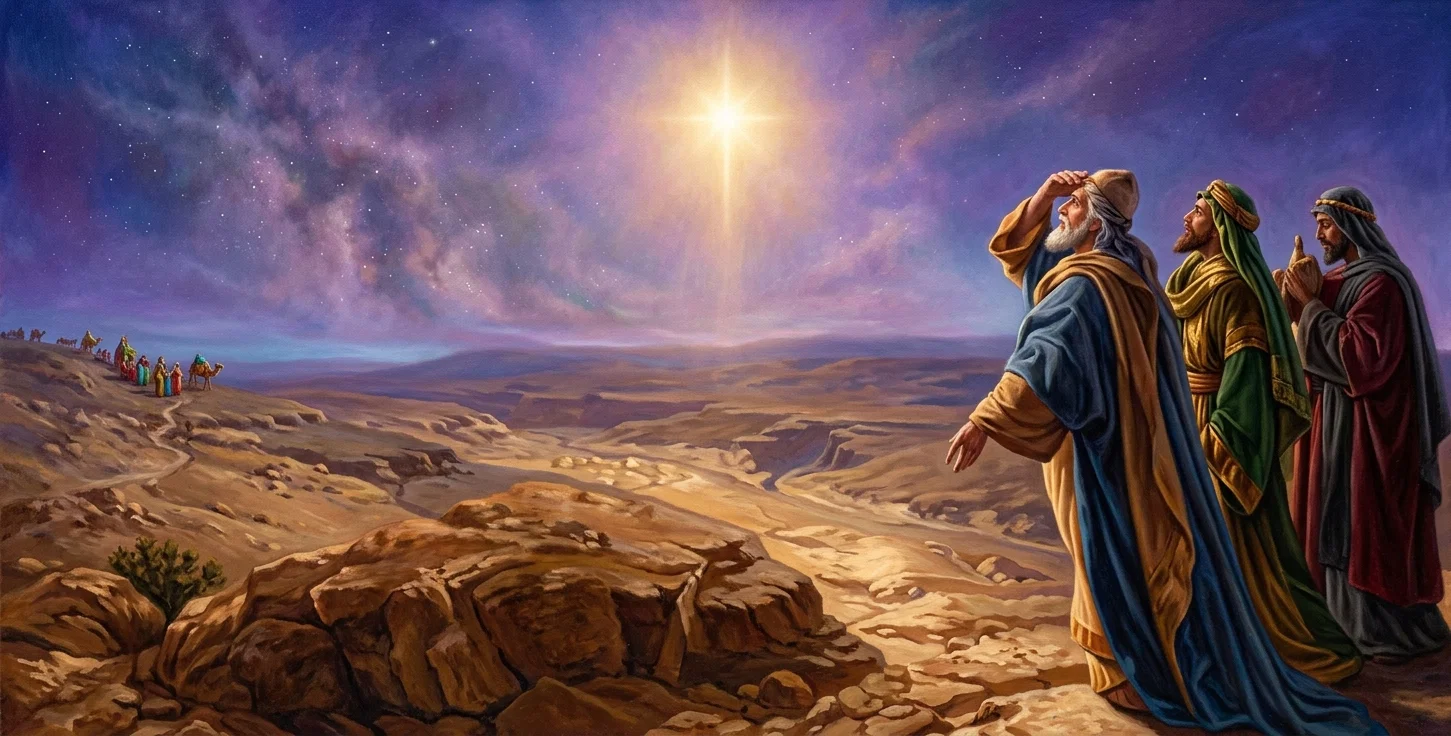
“Now when Jesus was born in Bethlehem of Judea in the days of Herod the king, behold, there came wise men from the east to Jerusalem, saying, Where is He that is born King of the Jews? for we have seen His star in the east, and are come to worship Him.”
The wise men from the east were philosophers. They belonged to a large and influential class, that included men of noble birth, and comprised much of the wealth and learning of their nation. Among these were many who imposed on the credulity of the people. Others were upright men, who studied the indications of providence in nature, and who were honored for their integrity and wisdom. Of this character were the wise men who came to Jesus.
Beheld His Glory
The light of God is ever shining amid the darkness of heathenism. As these magi studied the starry heavens, and sought to fathom the mystery hidden in their bright paths, they beheld the glory of the Creator. Seeking clearer knowledge, they turned to the Hebrew Scriptures. In their own land were treasured prophetic writings that predicted the coming of a divine teacher. Balaam belonged to the magicians, though at one time a prophet of God. By the Holy Spirit, he had foretold the prosperity of Israel and the appearing of the Messiah; and his prophecies had been handed down by tradition from century to century. But in the Old Testament, the Saviour’s advent was more clearly revealed. The magi learned with joy that His coming was near, and that the whole world was to be filled with a knowledge of the glory of the Lord.
The wise men had seen a mysterious light in the heavens upon that night when the glory of God flooded the hills of Bethlehem. As the light faded, a luminous star appeared, and lingered in the sky. It was not a fixed star nor a planet, and the phenomenon excited the keenest interest. That star was a distant company of shining angels, but of this the wise men were ignorant. Yet they were impressed that the star was of special import to them. They consulted priests and philosophers, and searched the scrolls of the ancient records. The prophecy of Balaam had declared, “There shall come a star out of Jacob, and a scepter shall rise out of Israel.” Num. 24: 17. Could this strange star have been sent as a harbinger of the Promised One? The magi had welcomed the light of Heaven-sent truth; now it was shed upon them in brighter rays. Through dreams, they were instructed to go in search of the newborn Prince.
The Prophecies, the Star, and the Spirit
As by faith Abraham went forth at the call of God, “not knowing whither he went;” as by faith Israel followed the pillar of cloud to the promised land,—so did these gentiles go forth to find the promised Saviour. The Eastern country abounded in precious things, and the magi did not set out empty-handed. It was the custom to offer presents as an act of homage to princes or other personages of rank, and the richest gifts the land afforded were borne as an offering to Him in whom all the families of the earth were to be blessed. It was necessary to journey by night in order to keep the star in view, but the travelers beguiled the hours by repeating traditional sayings and prophetic utterances concerning the One they sought. At every pause for rest, they searched the prophecies; and the conviction deepened that they were divinely guided. While they had the star before them as an outward sign, they had also the inward evidence of the Holy Spirit, which was impressing their hearts, and inspiring them with hope. The journey, though long, was a happy one to them.
They have reached the land of Israel, and are descending the Mount of Olives, with Jerusalem in sight, when, lo, the star that has guided them all the weary way rests above the temple, and after a season, fades from their view. With eager steps, they press onward, confidently expecting the Messiah’s birth to be the joyful burden of every tongue. But their inquiries are in vain. Entering the holy city, they repair to the temple. To their amazement, they find none who seem to have a knowledge of the newborn King. Their questions call forth no expressions of joy, but rather of surprise and fear, not unmixed with contempt.
Rehearsing Traditions
The priests are rehearsing traditions. They extol their religion and their own piety, while they denounce the Greeks and Romans as heathen, and sinners above others. The wise men are not idolaters, and in the sight of God they stand far higher than do these, His professed worshippers; yet they are looked upon by the Jews as heathen. Even among the appointed guardians of the Holy Oracles, their eager questionings touch no chord of sympathy.
The arrival of the magi was quickly noised throughout Jerusalem. Their strange errand created an excitement among the people, which penetrated to the palace of King Herod. The wily Edomite was aroused at the intimation of a possible rival. Countless murders had stained his pathway to the throne. Being of alien blood, he was hated by the people over whom he ruled. His only security was the favor of Rome. But this new Prince had a higher claim. He was born to the kingdom.
Herod suspected the priests of plotting with the strangers to excite a popular tumult and unseat him from the throne. He concealed his mistrust, however, determined to thwart their schemes by superior cunning. Summoning the chief priests and the scribes, he questioned them as to the teaching of their sacred books in regard to the place of the Messiah’s birth.
This inquiry from the usurper of the throne, and made at the request of strangers, stung the pride of the Jewish teachers. The indifference with which they turned to the rolls of prophecy enraged the jealous tyrant. He thought them trying to conceal their knowledge of the matter. With an authority they dared not disregard, he commanded them to make close search, and to declare the birthplace of their expected King. “And they said unto him, In Bethlehem of Judea; for thus it is written by the prophet,—
“And thou Bethlehem, land of Judah,
Art in no wise least among the princes of Judah;
For out of thee shall come forth a governor,
Which shall be shepherd of My people Israel.”
Herod now invited the magi to a private interview. A tempest of wrath and fear was raging in his heart, but he preserved a calm exterior, and received the strangers courteously. He inquired at what time the star had appeared, and professed to hail with joy the intimation of the birth of Christ. He bade his visitors, “Search diligently for the young child; and when ye have found Him, bring me word again, that I may come and worship Him also.” So saying, he dismissed them to go on their way to Bethlehem.
The priests and elders of Jerusalem were not as ignorant concerning the birth of Christ as they pretended. The report of the9angels’ visit to the shepherds had been brought to Jerusalem, but the rabbis had treated it as unworthy of their notice. They themselves might have found Jesus, and might have been ready to lead the magi to His birthplace; but instead of this, the wise men came to call their attention to the birth of the Messiah. “Where is He that is born King of the Jews?” they said; “for we have seen His star in the east, and are come to worship Him.”
Now pride and envy closed the door against the light. If the reports brought by the shepherds and the wise men were credited, they would place the priests and rabbis in a most unenviable position, disproving their claim to be the exponents of the truth of God. These learned teachers would not stoop to be instructed by those whom they termed heathen. It could not be, they said, that God had passed them by, to communicate with ignorant shepherds or uncircumcised gentiles. They determined to show their contempt for the reports that were exciting King Herod and all Jerusalem. They would not even go to Bethlehem to see whether these things were so. And they led the people to regard the interest in Jesus as a fanatical excitement. Here began the rejection of Christ by the priests and rabbis. From this point, their pride and stubbornness grew into a settled hatred of the Saviour. While God was opening the door to the gentiles, the Jewish leaders were closing the door to themselves.
Find the Star Again
The wise men departed alone from Jerusalem. The shadows of night were falling as they left the gates; but to their great joy, they again saw the star, and were directed to Bethlehem. They had received no such intimation of the lowly estate of Jesus as was given to the shepherds. After the long journey, they had been disappointed by the indifference of the Jewish leaders, and had left Jerusalem less confident than when they entered the city. At Bethlehem, they found no royal guard stationed to protect the newborn King. None of the world’s honored men were in attendance. Jesus was cradled in a manger. His parents, uneducated peasants, were His only guardians. Could this be He of whom it was written that He should “raise up the tribes of Jacob,” and “restore the preserved of Israel”; that He should be “a light to the gentiles,” and for “salvation unto the end of the earth”?
“When they were come into the house, they saw the young child with Mary His mother, and fell down, and worshiped Him.” Beneath the lowly guise of Jesus, they recognized the presence of divinity. They gave their hearts to Him as their Saviour, and then poured out their gifts,—“gold, and frankincense, and myrrh.” What a faith was theirs!
The Broken Barrier
By Lucas A. Reed
What Opened the Way for Evolution
By LUCAS A. REED
In these last days, the record of the life of Christ has been winnowed, by many, of all references to the miraculous or the supernatural, with a result that we have only a human Christ, with only human powers, or such powers as any man possesses, if he will but exercise them.
This rejection of the miraculous and the supernatural from the life of Christ and from all His teachings leaves man without any power to give him a spiritual birth, a redemption from sin. It leaves him with only natural forces, ordinary powers,—forces of nature, so to speak,—with which to combat malignant evil.
This rejection of the miraculous and the supernatural from modern religion is a result of the assaults of evolution, which began its attacks upon the record of creation. Having cleared the board so far as Genesis was concerned, it went on until it has destroyed, in the minds of thousands, any belief whatsoever in anything supernatural or miraculous, wherever it may appear.
Evolution in the Pulpit
This evolution is taught in the schools and the colleges, has even entered the theological schools, and has gone into the pulpits to preach to the audiences in the churches. It may be fairly said to-day to be ascendant, to have control.
The passive attitude of the world, and especially of the clergy, has been due to the fact that the great principle of God's working was not understood, because the Sabbath, God's memorial, had been cast down, and another institution had been exalted in its place. In a previous article, it has been shown that the Sabbath truth is in reality the fundamental truth of God's workings; that if it be rejected, everything is rejected, because all God's work, in principle, is thereby discountenanced.
How came it, then, that the Sabbath had been lost? For an answer to this question, we may appeal to two sources: to prophecy—that is, God's foreknowledge; and to history—that is, the fulfillment.
What Was Predicted
First, as to prophecy: Hundreds of years before there was any sign of the apostasy, to the prophet Daniel was revealed the fact that there would come a time when an apostate power would cast down the truth to the ground, and would practice and prosper (Dan. 8: 12)—one that would “speak words against the Most High,” and would “wear out the saints of the Most High,” and “think to change the times and the law” of God (Dan. 7: 25). In this wearing out of the people of the Most High, it was foretold that the saints would “fall by the sword and by flame, by captivity and by spoil, many days.” Dan. 11: 33.
To John, it was specified that this power would open “his mouth for blasphemies against God, to blaspheme His name, and His tabernacle, even them that dwell in the heaven,” and that he would “make war with the saints, and . . . overcome them: and there was given to him authority over every tribe and people and tongue and nation. And all that dwell on the earth shall worship him, every one whose name hath not been written in the book of life of the Lamb that hath been slain from the foundation of the world.” Rev. 13: 6-8, margin. According to the prophecy, this apostate power was to make a change in the times and in the law of God. Those who have made that change, say themselves that they have made no real change in the law save in the fourth commandment; but this commandment they acknowledge they have changed.
What Catholics Assert
The Catholic Church claims that it is consistent in changing the Sabbath from the seventh to the first day of the week. It claims to have authority to do this. For example, we quote:
“410. Whence does the church get the right to give commandments?”
“From Jesus Christ Himself, who charged His church to guide and govern the faithful in His name.”
“411. Can the church do more than give commandments?”
“She also has the right to see that these commandments are obeyed, and to punish those who disobey them.”
“412. Which are the commandments of the church?”
“These six: First, to rest from servile work and to hear mass on all Sundays and holy days of obligation. Second, to fast,” etc.—“A Catechism of the Catholic Religion,” by the Rev. Joseph Deharbe, title, S. J.; translated from German; edited by the Rt. Rev. P. N. Lynch, bishop of Charleston.
You will note that this Catholic teaching is that since Christ authorized the church to guide and govern the faithful in His name, it has a right to put forth commandments in violation of the commandments of God as contained in the Bible; and you see that in this, the Catholic Church has gone outside of any authority given the church by Christ. It has taught the obligation to rest from secular work on Sundays instead of the Sabbath, and thus has caused men to work upon the Sabbath day in violation of God's commandment, “The seventh day is the Sabbath of the Lord thy God: in it thou shalt not do any work.” To such lengths do men go in their assumption of power over human souls. But the prophecy predicted that an attempt would be made to change the law. Thus is the prophecy fulfilled.
That the papacy acknowledges that it has changed the Sabbath may be further discovered from the following:
“Question.—How prove you that the church hath power to command feasts and holy days?”
“Answer.—By the very act of changing the Sabbath into Sunday, which Protestants allow of; and therefore they fondly contradict themselves by keeping Sunday strictly, and breaking most other feast days commanded by the same church,”—“Abridgment of Christian Doctrine,” by the Rev. Henry Tuberville, of Douay College, France (1649), page 58.
“Ques.—Have you any other way of proving that the church has power to institute festivals of precept?”
“Ans.—Had she not such power, she could not have done that in which all modern religionists agree with her,—she could not have substituted the observance of Sunday, the first day of the week, for the observance of Saturday, the seventh day, a change for which there is no Scriptural authority.”—“A Doctrinal Catechism,” by the Rev. Stephen Keenan, page 174.
“The Catholic Church of its own infallible authority created Sunday a holy day to take the place of the Sabbath of the old law.”—Kansas City Catholic, February 9, 1893.
“The Catholic Church, . . . by virtue of her divine mission, changed the day from Saturday to Sunday.”—Catholic Mirror, official organ of Cardinal Gibbons, September 23, 1893.
“Ques.—Which is the Sabbath day?”
“Ans.—Saturday is the Sabbath day.
“Ques.—Why do we observe Sunday instead of Saturday?”
“Ans.—We observe Sunday instead of Saturday because the Catholic Church, in the Council of Laodicea (A. D. 336), transferred the solemnity from Saturday to Sunday.”—“The Convert's Catechism of Catholic Doctrine,” by the Rev. Peter Geiermann, C. SS. R., page 50, third edition, 1913, a work which received the “apostolic blessing” of Pope Pius X, January 25, 1910.
“You may read the Bible from Genesis to Revelation, and you will not find a single line authorizing the sanctification of Sunday. The Scriptures enforce the religious observance of Saturday, a day which we never sanctify.”—Cardinal Gibbons, in “The Faith of Our Fathers,” edition 1892, page 111.
“Sunday is a Catholic institution, and its claims to observance can be defended only on Catholic principles. . . . From beginning to end of Scripture there is not a single passage that warrants the transfer of weekly public worship from the last day of the week to the first.”—Catholic Press (Sydney, Australia), August 25, 1900.
Protestant writers also acknowledge that there is no Scriptural authority for the change of the Sabbath. Note the following:
“Is there no express commandment for observing the first day of the week as Sabbath, instead of the seventh day?—None whatever. Neither Christ, nor His apostles, nor the first Christians celebrated the first day of the week instead of the seventh as the Sabbath.”—New York Weekly Tribune, May 24, 1900.
“The Scriptures nowhere call the first day of the week the Sabbath. . . . There is no Scriptural authority for so doing, nor of course any Scriptural obligation.”—The Watchman (Baptist).
“The observance of the first instead of the seventh day rests on the testimony of the church, and the church alone.”—Hobart Church News (Episcopalian), July 2, 1894.
This is only a fragment of the testimony that might be brought to bear upon the subject. In addition, we might quote from many10
The Broken Barrier
(Continued from page 9)
church histories and Protestant authorities to show the same fact,—that it is the Catholic Church that has made the change in Sabbath observance.
And since it is the loss of the Sabbath that caused hundreds of Christians to be passive under the assaults of evolution against the creation record in Genesis, the Catholic Church is responsible for this spiritual anaesthetic delivered to the Protestant as well as the Catholic world.
We may even now see that the prophecy recorded in Daniel is in process of fulfillment. The truth is cast down to the ground, while apostasy, skepticism, infidelity, and atheism practice and prosper.
Prophecy and History
“We may appeal to two sources: to prophecy—that is, God’s foreknowledge; and to history—that is, the fulfillment.”
WE may appeal to two sources: to prophecy—that is, God’s foreknowledge; and to history—that is, the fulfillment.
“EARTHQUAKES IN DIVERS PLACES”
The Saviour said, almost nineteen hundred years ago, “Great earthquakes shall be in divers places, and famines, and pestilences; and fearful sights and great signs shall there be from heaven.” Luke 21:11. Matthew, in chapter 24:7, and Mark, in chapter 13:8, report the same prediction of the Master, in substantially the same words. They tell of the great earthquakes that will visit divers places.
Previous to the time of Christ, there are records of but very few earthquakes. Amos speaks of an earthquake that occurred during the reign of Uzziah, king of Judah, and while Jeroboam was king in Israel. See Amos 1:1. This quake must have occurred about 800 B. C. Zechariah, who prophesied several centuries later than Amos, also speaks of this earthquake. See Zech. 14:5. It would seem, from these statements of Amos and Zechariah, that earthquakes were so unusual in the days before Christ, as to be commented on for centuries after their occurrence.
But the Master makes the bold announcement that “there shall be earthquakes in divers places.” And not only will there be earthquakes, but there will be “great” earthquakes.
On another page in this issue, the reader will find a tabulated list of the “destructive” earthquakes that have occurred during the centuries of the Christian era. It must be borne in mind that this list does not include all the tremblings of the earth, but refers only to those quakes which have produced destruction of sufficient dimensions to be worthy of special note. We would call attention to the fact, also, that these figures are furnished by an organization that stands without a peer from the standpoint of reliability. There is no higher scientific authority recognized to-day than the British Association for the Advancement of Science.
The Master does not specifically say that the earth quakes will increase as the centuries go by. His statement is that there will be “great earthquakes,” and that they will be “in divers places.”
It is interesting to note, however, that in the first ten years of the nineteenth century, there were eighty destructive earthquakes, though it took almost all of the first six centuries to give us that number. And if we take the seventh and the ninth decade of the nineteenth century, we will find that we had more destructive earthquakes in each of those periods than occurred in the first eleven centuries of the Christian era.
When we come to the figures for the first ten years of the twentieth century, it will be observed that they are on a different basis from the others. The eighty-six earthquakes of that particular decade were felt through as much territory as all of Europe and Asia, or else through the entire world.
Earthquake Instruments
Let it be granted that modern instruments will detect earthquakes which otherwise men would not recognize. Let it also be granted that modern facilities will record and report earthquakes that previously might not have been taken into account. The question of their frequency is not emphasized. It is not even mentioned in the prediction of the Master. He said that there would be “great earthquakes,” and that they would be “in divers places.” Let us emphasize the actual statements made in the prediction, and then let us closely observe the facts.
Standing in a time when earthquakes had been but few, the Master says that they shall be “in divers places,” indicating that they would be all over the world. Examine the list as it appears on the accompanying page. You will see that earthquakes have visited the various portions of every continent of the globe. They have visited the islands of the sea. They have even shaken the sea itself. They have indeed been “in divers places.”
They Stand as Signs
As is shown in the context, the Master’s predictions concerning the “great earthquakes” that should be “in divers places” came as a part of His reply to the important question asked by His disciples, “What shall be the sign of Thy coming, and of the end of the world?” Matt. 24:3. It should go without question, that since these rockings of our planet are designed by the Creator as a “sign,” we may be sure that along with the disturbances of earth there will come the conviction upon the heart of each individual, that supernatural forces are working.
This conviction is pressed upon the heart by the Spirit of the living God. Says the prophet: “When Thy judgments are in the earth, the inhabitants of the world will learn righteousness. Let favor be showed to the wicked, yet will he not learn righteousness: in the land of uprightness will he deal unjustly, and will not behold the majesty of the Lord.” Isa. 26: 9, 10.
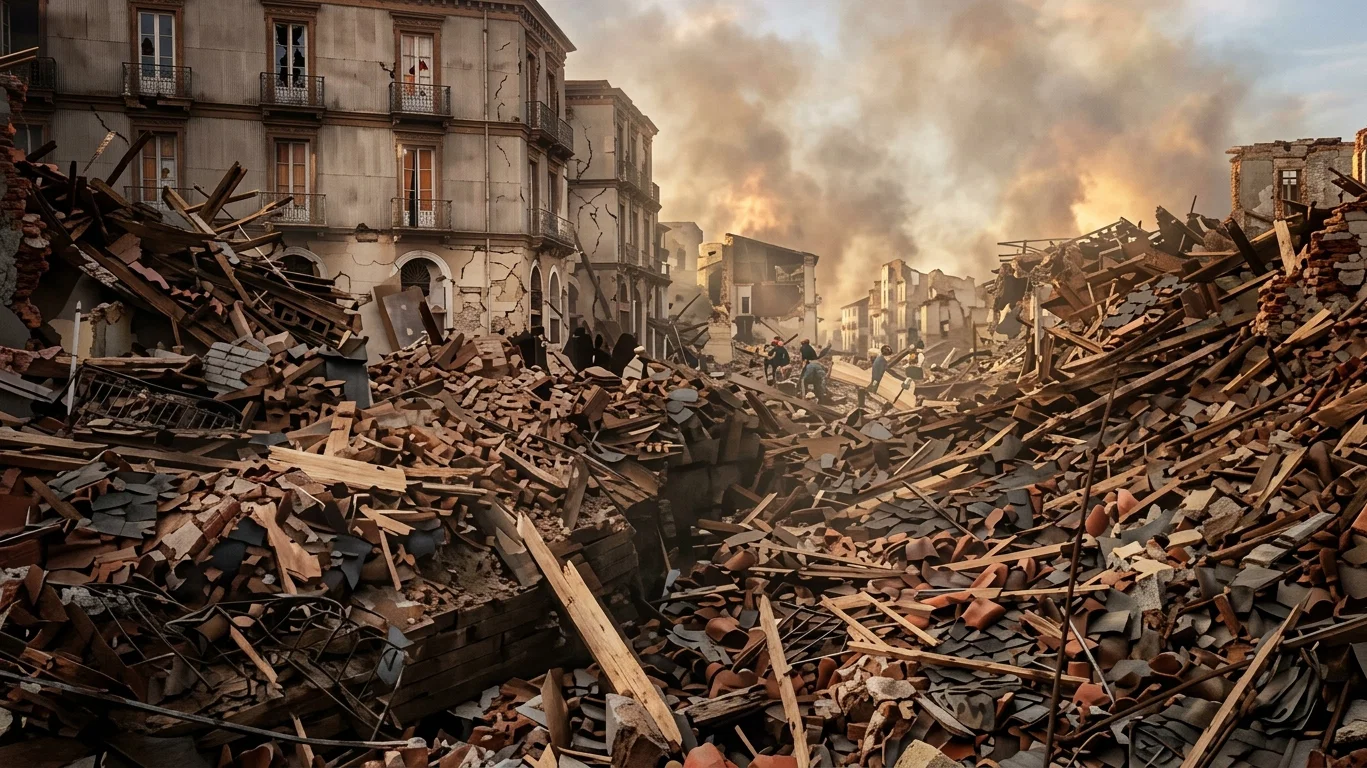
STREET SCENE, VALPARAISO EARTHQUAKE
Men become so absorbed in wickedness, that nothing can arouse them but the judgments of God. And one of the peculiar things in connection with earthquakes, whether they occur in civilized lands or among the most ignorant and superstitious people, is that there is always a sense of awe, a feeling of the infinite, that grips the soul, and causes the individual to recognize that a great les son is being forced upon him by the trembling of the earth underneath his feet.
Men may controvert this. They may seek to laugh it off. After the danger is past, they may even jeer at death. But nevertheless, there stands the conviction impressed upon the soul by the manifest workings of almighty power.
When men are left to themselves, the tendency is, in the majority of instances, for them to plunge deeper and deeper into the riotous pleasures that degenerate and degrade the soul. God could not be true to Himself and the principles of righteousness, unless He did continually wage a strong controversy against evil and wickedness, even, if necessary, by terrible judgments.
“The Lord Hath a Controversy”
“A noise shall come even to the ends of the earth; for the Lord hath a controversy with the nations, He will plead with all flesh; He will give them that are wicked to the sword, saith the Lord. Thus saith the Lord of hosts, Behold, evil shall go forth from nation to nation, and a great whirlwind shall be raised up from the coasts of the earth. And the slain of the Lord shall be at that day from one end of the earth even unto the other end of the earth: they shall not be lamented, neither gathered, nor buried; they shall be dung upon the ground.” Jer. 25: 31-33.
The prophet Hosea calls to us: “Hear the word of the Lord, ye children of Israel: for the Lord hath a controversy with the inhabitants of the land, because there is no truth, nor mercy, nor763knowledge of God in the land. By swearing, and lying, and killing, and stealing, and committing adultery, they break out, and blood toucheth blood.” Hosea 4: 1, 2.
“The Lord hath a controversy with the inhabitants of the land,” because of their wickedness. Many who are aroused to a realization of their true condition through the mighty judgments of God, will reform, and learn the ways of righteousness and of salvation. God, to be true to Himself, must seek for these, even, if need be, through the mighty judgments that He visits upon the earth to show that He is still God, and that His power is able to do terrible things. Rather than allow a single soul to become stupefied through sin, and fail of everlasting life, He will cause the pillars of heaven to tremble, and remove the earth out of its place.
The Last Great Earthquake
In the sublime apocalyptic visions that John had on Patmos, there are at least four references to the earthquakes that will come in connection with the closing scenes of time. One of the most striking and one of the last of these references is in the following words:
“The seventh angel poured out his vial into the air; and there came a great voice out of the temple of heaven, from the throne, saying, It is done. And there were voices, and thunders, and lightnings; and there was a great earthquake, such as was not since men were upon the earth, so mighty an earthquake, and so great. And the great city was divided into three parts, and the cities of the nations fell: and great Babylon came into remembrance before God, to give unto her the cup of the wine of the fierceness of His wrath. And every island fled away, and the mountains were not found. And there fell upon men a great hail out of heaven, every stone about the weight of a talent: and men blasphemed God because of the plague of the hail; for the plague thereof was exceeding great.” Rev. 16: 17-21.
When the Lord finally stands up, in the majesty of Omnipotence, to make His mighty protest against the sins and oppressions of the world, through declaring His righteousness from the heavens, we read these words: “The Lord reigneth; let the earth rejoice; let the multitude of isles be glad thereof. Clouds and darkdarkness are round about Him: righteousness and judgment are the habitation of His throne. A fire goeth before Him, and burneth up His enemies round about. His lightnings enlightened the world: the earth saw, and trembled. The hills melted like wax at the presence of the Lord, at the presence of the Lord of the whole earth. The heavens declare His righteousness, and all the people see His glory.” Ps. 97: 1-6.
There are various theories as to the cause of earthquakes; but these theories should not be allowed to cover up in our minds the great truth of the Saviour’s prediction, and of the predictions of the inspired prophets. We should place these predictions side by side with the facts, and recognize that God has a controversy with the wicked inhabitants of the earth; recognize the fact that the Master said there would be “great earthquakes” “in divers places.” They will be given as “signs” of the power of God, and as “signs” of the end of all earthly things, which is so rapidly approaching.
No Need of Fear
The climax is almost reached. The second coming of Christ is almost here. The prophecies are abundant which show it; and this concerning earthquakes is only one of many voices that proclaim from the prophetic Word that the end of all things earthly and sinful is at hand, that the great day of the final triumph of righteousness is almost here, that the Lord’s coming is a near event in the program of this world’s history.
If the predictions that may be found in the sacred volume, concerning earthquakes and other calamities, fill us with terror, it is because we have not become acquainted with the Christ of the Bible, and have not learned to trust in His mighty promises. If we have learned to trust in Him, we stand among those who are saying: “God is our refuge and strength, a very present help in trouble. Therefore will not we fear, though the earth be removed, and though the mountains be carried into the midst of the sea; though the waters thereof roar and be troubled, though the mountains shake with the swelling thereof. There is a river, the streams whereof shall make glad the city of God, the holy place of the tabernacles of the Most High. God is in the midst of her; she shall not be moved: God shall help her, and that right early.” Ps. 46: 1-5.
To Our Readers
By Editor
All reasonable effort will be made to preserve accuracy of statement, and to verify all authorities quoted.
Scripture quotations, when not from the Authorized Version, are taken from the American Standard Revised, unless otherwise stated.
Persons receiving copies of this paper without ordering them are not indebted to this office. Such papers are paid for by others.
Manuscripts should be addressed to the editor. Address all business and make all money orders, etc., payable to the SIGNS OF THE TIMES, Mountain View, California.
Subscription Rates
By JAMES COCHRAN
Three months ............................ $0.50
Six months .............................. .90
One year (50 numbers) .................. 1.75
With "Questions and Answers" ........... 2.00
Two or more copies to one person, six months, each $0.60.
Two or more copies to separate addresses, six months, each $0.65.
Expiration: The wrapper bears date of last issue due on your subscription. Unless renewed in advance, paper stops with expiration date.
Change of address: Kindly give both old and new address.
JAMES COCHRAN, Circulation Manager.
Religious Icebergs
By G. B. T.
We have entered upon uncommon times. Wolves are masquerading in sheep’s clothing; new and old controversies commingle; dangerous heresies, dressed in the livery of heaven, seek admission into the church. A power from beneath is exerting a strange, bewitching power everywhere. There are many “advanced thinkers,” “progressive theologians,” men who are known as “profound scholars,” who exalt reason, and bow low at her shrine. The Ten Commandments, the Sermon on the Mount, and, in fact, the whole Bible are regarded as a little too exacting, and are discounted before the people.
The chill of skepticism and unbelief is perceptibly felt. Some enlightening, illuminating power is surely needed. The church is traveling over enchanted ground. Many of the elect of God, who truly believe the Word, have been peering through the fog of unbelief about them for several decades, looking for the return of the Bridegroom from the wedding. Some have become drowsy, and some are fast asleep. The cares of the world, the love of money and pleasure, are choking the Word in the hearts of some, and no fruit is brought to perfection. A few are awake; but these are in danger of being thought “peculiar,” “extreme,” “good men and women, but unpractical.” G. B. T.