The Youth’s Instructor, Vol. 64, No. 49.

Miscellaneous News Items from Recent Press Reports

The Youth’s Instructor

Dec 5, 1916

Review and Herald Publishing Assn. · Takoma Park Station, Washington, D. C. · Dec 5, 1916

Miscellaneous News Items from Recent Press Reports

A New York barber claims to have received $300,000 in tips.
To set apart Palestine at the close of the war as an International Peace Park has been suggested.
A new moving picture screen has been invented that permits the displaying of pictures in lighted halls or in the open daylight.
In the month of May, Oklahoma oil wells produced a daily average of 301,500 barrels, netting each day more than $400,000 to the prosperity of the State.
Thirty thousand dollars was recently subscribed at a luncheon in Chicago to start a national organization to induce Congress to pass legislation making military training and service universal among the youth of our land.
Among the passengers on a steamer that arrived at Seattle the other day from Alaska were twenty-four dogs, traveling each on a regular passenger ticket. It was the first stage of the long journey to France, where the dogs will be impressed into military service.
Last year ten hundred and eighty-six persons riding in automobiles lost their lives at grade crossings in the United States. To impress on all drivers the lesson of “Safety First,” “Stop, Look, and Listen,” and “Take No Chances at All,” the Denver and Rio Grande Railroad has posted warnings in public and private garages, repair shops, and other places along its line, in the hope that they will be more effective than the signs at the railway crossings.
A pushball is said to be the biggest plaything in the world of sport. The game of pushball originated in Newton, Massachusetts, but is now played in England and on the Continent, as well as in various parts of our own country. It would be more widely played were it not for the cost of the gigantic ball required by the game. The ordinary pushball is six feet in diameter and costs $300. The inner part, or bladder, lasts only two or three years, and a new one costs $150.
A frog can hold his breath under water longer than any other air-breathing creature. We human beings can go without air for hardly a minute. Even the whales, air breathers like ourselves, though they look like fishes, can keep their heads under water for only half an hour. But the common frog, it has lately been discovered, if kept in clear, running water, is able to stay down a week; while some especially long-winded individuals have stuck it out for nearly a month.
Real ruby glass is most expensive, since it must be prepared with gold. It owes its color to the presence throughout its mass of particles of gold too small to be seen with the microscope. Only the ultramicroscope, which renders visible objects perceptible by means of their diffusion of light, is able to show the existence of these minute particles. With the ordinary microscope the glass appears as a uniform transparent mass, but the ultramicroscope shows that it is filled with points of light resembling stars on a black background. These points indicate the presence of the particles of gold to which the color of the glass is due.
The Chinese in the neighborhood of Amoy have a curious way of hatching hens’ and ducks’ eggs. The breeder roasts a quantity of unhusked rice, and when it is lukewarm spreads a three-inch layer of it in a wooden tub, and places about one hundred eggs thereon; then he spreads another layer of rice over the eggs. Each tub has six layers of rice and five layers of eggs, so that there are five hundred eggs in each tub. Once every twenty-four hours the eggs are taken out and the rice reheated. When the eggs are again put into the rice, those that formed the bottom layer are placed on top. The chicks and ducklings hatch in from twenty to thirty days.
Day after day, long lines of men and women carrying bundles, packages, and pieces of metal ware of all descriptions, stand in the government offices of Poland, awaiting their turn. They are surrendering their domestic utensils—bathroom fixtures, kitchen ware, pots, pans, kettles, doorknobs, lamp hangers, anything having the slightest bit of metal about it. The Austrian-Hungarian government has posted notices throughout war-ridden Poland, requisitioning all household metals for military purposes. Nothing escapes. No one is exempt.

A Negro Colony

A COMMITTEE representing 800 Negroes of New York, Philadelphia, Chicago, St. Louis, Cincinnati, Washington, and some Southern cities who have organized the People's Civil League, is negotiating with the Santa Fe Railroad for the purchase of 20,000 acres in western Kansas, on which to establish a farming colony, which is to be exclusively Negro. Only Negroes now farming or those in cities who wish to farm will be admitted to the colony. The deeds to the land will prevent, in perpetuity, its resale to a white man, and the charter of the colony will provide that only Negroes shall hold office. Negro teachers will direct the aim of the young idea in the colony. Churches will be given ten acres apiece as sites, but only one church of any denomination is to be admitted. Kansas now has a similar colony established twenty years ago—Nicodemus, in Graham County. It is a prosperous, law-abiding community.—The Christian Herald.

The Law of Compensation

A MATURE and splendid Christian worker who has suffered many disappointments in life says frequently to his friends: “When God takes anything away from me, I always say, ‘Well, Lord, what have you for me now? I know that you took this joy away from me in order that you might give me greater joy.’”—The Christian Herald.

Peter’s Educational Advice

MRS. M. A. LOPER
SANCTIFY the Lord God in your hearts: and be ready always to give an answer to every man that asketh you a reason of the hope that is in you with meekness and fear.”
Peter was only a poor fisherman when he decided to follow Christ, and he knew little of what people should know who are to bear the light of the gospel to others: this he keenly realized after his conversion.
It was his blessed privilege to be under the tutorship of the Great Teacher for three years and a half, during which time he learned the valuable lesson of human frailty, and knew by experience that without Christ, life is a failure.
As the result of Peter’s training, the impulsive, self-loving, falsifying nature became transformed into the meek, earnest, sincere Christian character which shines forth in this bit of educational advice which he has left as a precious legacy to all who would be followers of the Great Teacher.
In these days when education is coming into its own, it is the privilege of every young person to become fitted for service—so thoroughly fitted that he will be able to answer intelligently those who may inquire the reason of his hope.
No one in these days should settle down contentedly with the knowledge that he has not improved this privilege. He should not consider himself capable of achieving success in whatever his life work may be, until he is educated sufficiently to do that work in the best manner of which he is capable.
All the education necessary is not found in school curriculums. The Young People’s Missionary Volunteer Society opens up avenues of information, and affords opportunities for practical efforts, which should be improved by every young person who would keep pace with his possibilities.
Many do not realize how much they need the training which the Young People’s Missionary Volunteer Society affords. It is difficult to persuade them that they really are capable of doing greater things than they have yet dreamed.
Peter became an enthusiastic advocate of educational training. He believed in the Standard of Attainment—in storing the mind with truth to such an extent that one could answer intelligently any reasonable question in regard to any point of the Christian religion, or the history of the Christian church.
Therefore Peter was a strong believer in the idea of becoming successful in extemporaneous efforts. And here is a grand ideal for every young person to cherish.
It is not in God’s plan for every young person to become a public speaker; but it is his plan for every one to become so thoroughly conversant with truth, and so void of self-consciousness, as to be an extemporaneous speaker of worth wherever it is his duty to spread the gospel light.
It requires time to reach any ideal of worth; and no ideal surpasses this.
The young person who disciplines himself to do whatever he is asked to do on the young people’s program, and do it the very best of which he is capable, is the one who grows both mentally and spiritually.
Physical strength is increased by activity; mental and spiritual strength become greater by the same method.
The reading and study of the Bible are necessary to salvation. We cannot afford to neglect the daily study of the Bible if we would grow spiritually.
Every one needs the knowledge gained through preparation for the Standard of Attainment test. To be able to refer readily to texts of Scripture upon any point of truth, and to present chief points in our denominational history, constitute a fitness for service that is worth while, the influence of which is of inestimable benefit.
The location of the books of the Bible should be as familiar as that of the A B C’s. One thereby escapes the embarrassment of having to spend precious time during a Bible reading, in searching for that which should be found almost instantaneously.
Every one should learn the chief points of our denominational history, which is increasing with such great rapidity that those who procrastinate will find the task becoming more and more difficult to accomplish.
Some of our older members can readily recall the time when we had not a single foreign missionary. The present year has already witnessed the sending out of one hundred and forty-two to various foreign fields. So the matter of learning the extent of our work in other lands, where now we have over three thousand missionaries, is quite a stupendous task. And wherever a center of work is established, we see schools, publishing houses, and sanitariums springing up.
But the Standard of Attainment requires only the principal points.
Let our young people not be afraid to discipline themselves to speak extemporaneously, and “be ready always to give an answer to every man that asketh you a reason of the hope that is in you with meekness and fear.”
Our Reading Course books contain excellent instruction and information for every one. Our entire church membership would catch a higher vision of life if young and old would devote more time to these books, and less time to the perusal of that which is injurious or useless.
One little book like “A Retrospect,” read and mentally digested, affords more spiritual nourishment than scores of books which might be considered harmless, but are of no special benefit in these times.
Read that which will better fit you for your life work, including the Reading Course books.

Faith Comes by Hearing the Word

DWIGHT L. MOODY wrote: “I prayed for faith, and thought that some day faith would come down and strike me like lightning. But faith did not seem to come. One day I read in the tenth chapter of Romans, ‘So then faith cometh by hearing, and hearing by the word of God.’ I had closed my Bible and prayed for faith. I now opened my Bible and began to study, and faith has been growing ever since.”

ORVA LEE ICE

Calmness

ORVA LEE ICE

THE great army, the greatest the world had ever seen, moved northward toward the sea. Forty-six different nations were represented by its million men. The great king and commander seated on an ivory throne, watching the grand review, burst into tears at the thought that in a few years not one of these brave men would be alive. With sounding brass and tinkling cymbal the array of steel and shield passed, halting only upon its arrival at the sea, where awaited it the swift, daring fleet of the Phenicians which was to land the army safely over into the land of the Grecians. The world’s greatest engineers were brought forward, and two magnificent pontoon bridges were built across the Hellespont, preparatory to transporting the army.
Suddenly a storm came up, lashing the sea into foam and destroying the bridge. The great king of the Persians, who but a moment before had everything under his calm control, flew into a seething rage, and ordering the brave men to lay down their arms, supplied them with whips and commanded them to lash the waters of the sea. This done, the builders of the bridge were executed and their bodies cast into the water. Fetters and chains were cast into the sea to show that the king was its master. The vast army was seven days in crossing. That which could have been done calmly in a few hours was tragically delayed for seven days. Xerxes was full well master of his large army, but a slave to his passion.
A few months later the greatest army of previous history was defeated, and Xerxes himself fled to Asia. For want of calmness the commander was lost; for want of a commander the victory was lost; for want of victory the nation was lost; and all for the want of calmness and quiet self-possession. Even more, Persia was ruler of the world, and so her power and prestige was lost. Thus we see that—
Not to the strong is the battle, Not to the swift is the race; But to the calm and the faithful, Victory follows through grace.
Self is the great engine that has untold power when governed rightly. Without its governor it rides roughshod over friend and foe, until the ground grows soft beneath it and it sinks, swallowed up by its own undoings. The governor of this steam roller is calmness. Without this regulation, although it has unlimited action, its power is wasted on the desert air. Action without direction is wasted energy, and calmness is the true director. A goldfish swims a hundred miles every day, and never gets a foot away from its starting point. It is the runaway that tears up the buggy, not the calm and peaceful family horse. Calmness is the prime factor; without it we are fractions, not integers. It casts up the highway before me, and leaves a boulevard for those “who follow after.”
The greatest antidote for imprudence is calmness. It is the panacea for chronic misjudgment and unwise calculation. Calmness looks before it leaps, does not behave itself unseemly, and is not easily provoked; considers all things; investigates all things. Calmness never faileth. Wisdom is the principal thing, therefore get wisdom; but remember that calmness has led the vanguard in every victory prudence has ever won.
Again, the kingdom of self-mastery is likened unto a strong horse to run a race, its bridle being calmness. How many accidents happen every day because when excitement came in the door, calmness fled out the window! How many killed, when calm self-possession would have been the lifeboat! Why so many “safety first” signs, and warnings of danger, when a little grain of calmness would leaven the whole lump? One may be wiser than Solomon, stronger than Samson, swifter than the flying chariot of Jehu, but without calmness it would profit him nothing.
Prudence comes to him who waits; excitement breeds folly. Excitement is the dread disease of humanity. Put the two horns of excitement and impatience on a lamb, and it will speak like a dragon. Follow the old rule of thinking twice before speaking once, and how many feelings would be hurt? It is the words spoken in whims of excitement or impatience that cut to the quick and sever the golden cords of friendship. Excitement is the swift-flowing stream that rushes to the falls, over which plunges to the end the fortunes of legion; but calmness is the river of depth that moves its passengers serenely and surely to oceans of success.
You point me to Luther, the man who moved Europe and who hurled the ink bottle at the devil, and I remind you of Melanchthon, his coworker, who on account of his timid reserve does not get the place given to Luther, but who was the leaven of the Reformation. You recall Nehemiah, who built the walls of Jerusalem, and who in his excitement plucked off men’s beards and chased men from him, and I mention Ezra who was his counterpart and placed the work upon an enduring foundation.
Excitement is the sword of the feeble that cuts its way through, heedless of the injuries it inflicts, stamping the residue with its feet. Calmness is the good Samaritan that binds up these wounds, and, like the tortoise, slowly yet surely wins out in the end. In excitement there is much flame but little heat, loud thundering but no lightning, while up above and higher than it all is the calm, serene blue sky. So every engine of success has its governor. Remove it, and although there is still much powerful energy, the wheels will only beat the air.
Calmness does not exclude energy; it includes it. It sometimes takes more strength, more self-mastery, to keep still and be calm than to move a mountain. Note the results of the armies that have waited until they saw the whites of the enemy’s eyes before acting, that realized the danger and calmly faced it. Compare that army with the one that fights in excitement. They generally go out one way and flee seven. Calmness does not exclude energy. Calmness without energy is void, for where no horse is, there is no need of reins. Calmness is the timekeeper for deliberation, for without calmness there can be no deliberation, and without deliberation there can be no discretion, and the greatest of these is calmness. Two armies face each other. Calmness is the commander of one and impulse of the other. Which is your leader? Seek calmness and pursue it. It is the trade-mark of self-mastery; no other brand will do. It is the universal element of success, the first aid to an injured career.
“Be still, and know that I am God.” Would you know God? Be calm. People who are converted under exciting influences soon relapse. It is the quiet wooing of the Holy Spirit that will yield fruit in harvest time. Experience a quiet calm in your own secret chamber and find God. He is not in the loud demonstrations, not in the winds that rend the mountains, nor in the earthquake, nor in the fire: but listen, be calm; the still, small voice that speaks to you, that is God.
In his excitement Peter cut off the ear of the high priest’s servant, and was rebuked by the Master. Spit upon, mocked, lashed, and scourged by men, Jesus was brought as a lamb to the slaughter; and as a sheep before her shearers is dumb, so he opened not his mouth. What an example of calm self-possession! The enemy of souls tried to excite the Saviour to have him act from impulse, thinking in this manner to cause him to use divine power in his defense. But Jesus while here never contended for his own rights,—just for the right. Satan rejoices to see us act from impulse; but calmness is the shield and buckler. Defend yourself from any exciting influence. Calmness, then, is a virtue that adorns the soul like a diamond the tiara of a queen. Look before you leap.

Preparedness: Making Ready for the Future

Preparedness

Much is said these days about preparedness, or the state of being prepared. We hear of it in politics, in business, and in nearly all walks of life. Day after day the student prepares his lessons for the next day; the housewife prepares for tomorrow’s breakfast; and the farmer prepares for next year’s crops. And so, all through life, preparedness is essential. I have a most unpleasant remembrance of a bright fellow student, whose usual answer to his teacher was, “Unprepared.” The habit followed him throughout his short life.
Solomon’s slothful man was not necessarily weak or lacking in intelligence; he simply did not prepare for future needs. One great difference between the savage and the civilized man is this very thing.
But it is not only man who makes preparation; God himself prepares for the future. Before creating man, he prepared this earth and all the beautiful things in it, to be a suitable home for him. He even went so far as to prepare a way of escape should man fall under temptation. And he is still preparing. Some of the most precious promises in the Bible tell of the home he is preparing for his children. John 14: 1-3; I Cor. 2: 9; Rev. 21: 1, 2.
The Lord also prepares for individuals. While Paul was praying, the Lord prepared Ananias to give him encouragement. When Elijah was in great need, in time of drought, the Lord had in readiness a godly woman who provided him with food and shelter. And we ourselves have seen how a long train of circumstances has been arranged to meet some crisis in our lives. Before great national and religious crises, it is evident that God prepared such men as Elijah, Luther, and Lincoln to meet the issue.
But the subject of preparedness more intimately affects us in our preparation for life, both now and to come. No one can overestimate the importance of a thorough preparation for life. John the Baptist, the greatest of prophets, was thirty years preparing for only a few months of active service. The same was true of the Lord himself, and surely no one who knows his teachings, can say it was not time well spent.
David Brainerd and Henry Martyn are examples in modern times, of men who, although they died at about thirty years of age, had made such thorough preparation and worked so energetically, that they accomplished more than many others who lived their full threescore and ten years.
A well-rounded education is one of the best preparations for a life of usefulness. Moses and Paul stand out as two of the best-educated men of the Bible, and although they lived so long ago, probably modern civilization owes to these two men as much as to many others.
Much that is called genius is careful preparation. In a public address, one of our great statesmen referred, with a blaze of oratory, to the Stars and Stripes. Afterward a personal friend congratulated him on such a fine impromptu speech, but was told by the orator that the address had been carefully thought out some years before and committed to memory.
Times of crises in our lives really show us what we are, what our life training has been. Those who are prepared to meet the test, we call great.
Nor should we regard life as composed of two periods, one of preparation and the other of service. Service is a part of preparation; it shows us our need and fits us for better service. And our service begun here will be continued hereafter, for “His servants shall serve him.”
After all, the greatest preparation is heart preparation. 1 Sam. 7: 3. Without this all other preparation is of no final value. Heart preparation is as much more valuable than any other preparation as the life to come is of greater importance than the present.
R. W. BROWN

A. W. HERR, M. D

Disappointment

A. W. HERR, M. D

He did not do as he was told, And now the work has all been marred He promised faithfulness, and failed,— For this I'd labored long and hard.
A bankrupt and a ruined man, I know that I have been disgraced. I'm hopelessly and quite perplexed.— If only frankly me he'd faced?
Completed nearly was the task, My hope ran high, fame nearly won Then left to him the work to do, That part that I had left undone.
I am aweary, weary now, I could but wish that I were dead. This chaos is too much for me, My heart is sore and heavy as lead.
Behind me then a voice spoke low, “O soul of man, get thee good cheer: I saw thy work, I saw thy woe; I marred thy work, to thee so dear.
“I have for thee a better plan, Wrought out by me in perfect form. A plan more simple and more grand, A work that will stand any storm.”
Unfolded there in perfect form, Without one flaw, drawn up for me, Outlined in gold by unseen hand, My whole life's span could plainly see.
I've learned that now when things are marred, When the way's dark and life's a blank. That disappointment is a part Of His appointment,— and him thank

Gleanings from Norwegian History — No. 2

DURING the latter part of Harold Harfagr’s reign, Christianity had made great headway in Norway. The old king had welcomed the missionaries of the new faith, encouraging them to found schools, that his subjects might attain, culturally, to the status of the near-by nations. So here the propagandists found an easy field, and, at Harfagr’s death, the Christians were to be numbered by thousands.
At the death of Harold Harfagr, his eldest son, a pagan, assumed the royal prerogatives, with the title of Eric I. He proved to be of a vacillating character. Taking advantage of the general discontent manifested under the rule of this weak-sceptered sovereign, the church party, by what they must have considered a brilliant coup d’état, placed Eric’s Christian brother on the throne as Hakon I, who had been converted during a sojourn in England. With a Christian king, it was now easy to make converts. The work of proselyting went on apace. But at the same time, the old belief was by no means dead. Old ideas do not pass in a day, nor do people always change their religion at the bidding of kings. Thousands were faithful to the faith of their fathers, and thousands more professing Christ were not entirely sure in their hearts but that the old religion was true.
Though Hakon I ruled with great moderation, his reign was an era of great unrest. Many of the jarls forsook their native land, and became citizens of other countries. Others, after the manner of their forefathers, became corsairs, plundering on every known sea. But the pirate’s profession was falling into disrepute, and they no longer found open welcome in Norway.
One outlawed jarl, Eric the Red, sought refuge for a time in Iceland; then restlessly cruising to the westward, came upon the shores of Greenland. Here he founded a settlement, and about the year 985, Biarni Herjulfson, sailing thitherward from Iceland, being driven out of his course, came upon a land far to the west, which was undoubtedly America. However, Herjulfson was not seeking new lands, but was intent upon reaching Greenland. Therefore, being convinced that it was not the land he sought, he changed his course, and in due time arrived at Eric’s settlement, on the bleak Greenland coast.
Some years after this, Eric the Red fitted out an expedition to explore the strange western land. Eric at first intended commanding the expedition, but as he was on his way to the vessel, the horse upon which he was mounted, stumbled. This Eric interpreted as an ill omen, and decided to remain in Greenland, intrusting the leadership to his son Leif. After sailing many days in a southwesterly direction, land was sighted, and a party went ashore. The country was well-wooded, and Leif called it Markland. Going farther south along the coast, they came to a fair country where grapes abounded. This Leif called Vinland (Vine-land). Thus it appears that Europeans first touched American soil about 1000 A. D.
Later, a Norse settlement was established, and matters were prosperous until trouble arose with the skraellings, as the Norse called the natives. As Leif was now in Greenland, having been recalled by the death of his father, the settlers had no leader, so they abandoned Vinland. In time, the very existence of the country was forgotten. It was only during the last century that authentic proofs of Leif’s voyages were obtained. Now we know that the fair-haired Norseman, Leif Ericson (Eric’s son), was the real discoverer of America.
During all this time, great changes had taken place in Norway. At the time of Leif’s first voyage, Hakon the Christian had long been dead, and a great-grandson of Harold Harfagr’s had ascended the throne. This king was Olaf Trygvesson. He was a Christian, but not intolerant toward those professing paganism.
Olaf Trygvesson and Leif Ericson were friends, and it is not beyond the reach of probability that, had Trygvesson’s reign been a longer one, Norway might have begun the colonization of the New World in the twelfth century. This king, however, came to an untimely end in the year 1001, in a fight at sea with the Swedes and Danes, off the German coast. In this battle, Trygvesson commanded a ship called “Long Serpent,” and when he saw his enemies boarding this vessel, he gave up hope, and after making a desperate struggle, sprang, in full armor, into the Baltic, and was immediately swallowed up by the waves. His followers believed him to be more than mortal, and asserted that he swam beneath the waves out of harm’s way, and confidently expected his return to Norway. Needless to say, in this expectation they were disappointed.
J. FRED SANTEE.

How Can We Cultivate It?

Enthusiasm

ENTHUSIASM means literally to be “filled with the god.” It is taken from two Greek words, en — in, and theos — god. Lifted into its highest meaning for Christians, enthusiasm is the overflowing life of God in us, stirring us to thoughts and deeds that break out in joyous service for him, beyond the boundaries of our own narrow abilities, and in spite of all opposition or discouragements. When we have enthusiasm, we have the same glad note in our lives that Isaiah had and that Paul had, a note that even the most glowing words could not wholly express.
Life is inert and insipid without enthusiasm. It has such value as salt had in the small girl’s definition: “Salt is what potatoes taste so bad without.” Life without enthusiasm is little more than mere existence. Unless we can be roused by calls to service so that we dare and do things far beyond the measure of our calculating estimates of what we usually can do, we never serve to the utmost. The value of enthusiasm is in its drive, and stir, and assurance, its lack of self-consciousness, and its rousing of the whole nature to the best use of every faculty.

How Can We Cultivate It?

We can cultivate it by giving God a chance. We think too much about ourselves. We don’t know what God could do with us, because we so seldom let him use us to the utmost.
We can cultivate it by tackling jobs that are too big for us. Our lives usually run in a fairly easy rut, where, even if we have a spark of enthusiasm in us, it doesn’t get a chance to break out very often. What we need is to swing out of the rut and make a new track.
We can cultivate it by getting a vision of others’ needs, instead of a vision of our own ailments and failures. When the life-saver lets go, pushes out, and takes an oar in the lifeboat, he forgets about the sore thumb and the headache. The stranded vessel looms in the mist, and he sees the men in the rigging. Enthusiasm? Why, one could break an oar in such circumstances. God has work just like that for you. Will you sit snug by the hearth? — Wellspring.
RAMSHARON DEE OF INDIA

A Faithful Observer

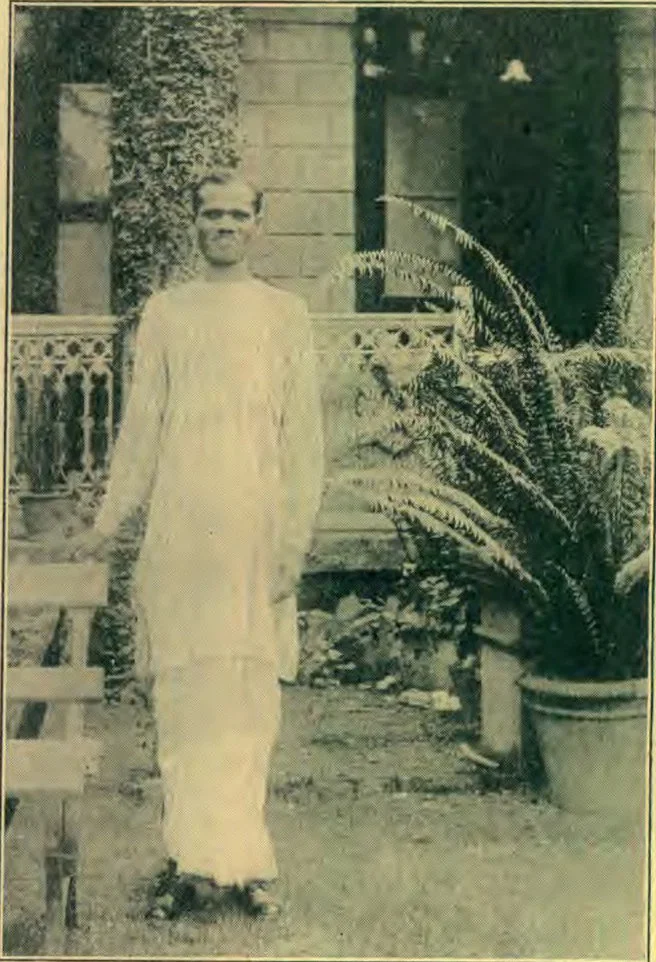
I SHOULD like all of our young people to know how the truth is taking hold on the hearts of some of the youth here in India. The case of the young man whose picture appears with this article, is a striking example of the value of an early training in the fundamentals of our truth.
This boy, whose name is Ramsharon Dee, came to our mission when but a child, along with several others who suddenly found themselves orphans as the result of an epidemic of cholera which was raging at that time.
He was cared for by our missionaries, and was placed in our school, where he received in addition to the subjects usually taught, instruction in the principles of our faith.
As he became older and the time came for him to leave school, he received employment in our mission institutions. Having a natural liking for mechanics, he was given work in the press at Lucknow for a time, and later when a motor launch was purchased for use in eastern Bengal, it was thought best to have him go over and drive the engine.
Recently it was decided to sell the launch. As the purchaser was very anxious to have the boy accompany the launch, Ramsharon Dee decided to go if arrangements could be made for him to keep the Sabbath. The purchaser, a Hindu, is local magistrate of the district where he resides. When request was made for consideration of this boy's religious principles, it was readily granted, and he was accordingly employed.
One Friday afternoon as the magistrate was out on tour, they were many miles from his home when it was noticed that the sun was setting. Our brother at once stopped the launch which happened to be in midstream. The gentleman inquired the reason for this, and was told that Seventh-day Adventists strictly observe the Sabbath from the going down of the sun on Friday until that time on Saturday. The magistrate argued that it would not be convenient to stay there, and wanted to know what Mr. Kellar used to do under similar circumstances. When told that we always dropped anchor wherever we chanced to be and remained over the Sabbath, he became convinced that the boy's profession was genuine, and consented to remain where they were over the Sabbath.
Should not this native boy's integrity be an example to us all?
Let us pray that many more young people in India may be witnesses for the truth among their people.
C. C. KELLAR.

Trying is Better than Saying “I Can’t”

I HAVE been greatly interested in following the recitation papers of one of our correspondence students in academic rhetoric. She lives on a ranch in a distant State, and before she got beyond the studies of her local school she had a long way to go to school. During the last two years she has been studying rhetoric and algebra by correspondence, while performing duties that would appall some of our dainty maidens accustomed to city life. I remember that one of the subjects assigned her for theme writing was, “Why I was Late to School.” The story ran somewhat as follows: Up before sunrise to milk, and found the cows gone. Mounting a horse, she scurried over the plain, rounded up the herd, and drove them to the corral. Milking over, she got breakfast for — I have forgotten how many persons; and finally, after sundry incidents and accidents interspersed with her regular duties, she reached the schoolhouse fifteen minutes late!
Not long ago she finished her rhetoric lessons, and this is the enthusiastic and thankful way in which she received her certificate: —
“I thank you very much for the certificate I received. I never was so proud of a grade as I am of this one [and she had good reason, for her standing was excellent]. I need hardly tell you that I have enjoyed studying in the Fireside Correspondence School, although sometimes I became discouraged when a lesson seemed hard to get. Still, rather than not finish what I had begun, I would try; for I have always found that trying is far better than to say ‘I can’t.’”
“I have indeed received the benefit I expected, and more too. I have not forgotten about the algebra course, and I hope soon to have another lesson to send in [she has now finished twenty-six lessons]; but we are quite busy with fall work just now.
“Before long I expect to take up general history to study this winter; for I find that studying by correspondence is satisfactory, though not so interesting, perhaps, as being in a large class.”
Such courage and perseverance are bound to be rewarded. I shall expect sometime to hear of this young woman in one of our schools, experiencing the joy of “being in a large class.” And later she will make her mark as a worker in some department of the Master’s cause.
I shall be glad to correspond with others temporarily deprived of school privileges, and to explain to them how they may carry forward their education until the way opens for them to attend school.
C. C. LEWIS,
Principal Fireside Correspondence School, Takoma Park, D. C.
Continue reading: A Stargazer