COME in, William. You are to play a solo at the next court concert, and you must practice.”
“O father, please let me stay outdoors a little longer! I want to look at the stars.”
The father smiled to himself at the boy’s interest, but he came back to his side and stood for quite fifteen minutes longer, pointing out to him Orion with the splendid star Sirius always below; Taurus the Bull, with the red star Aldebaran in his forehead, and other constellations shining brightly in the clear, frosty air. Then he said firmly:—
“Now, my son, you must come in and practice your music, for it is necessary. The concert comes next Wednesday, and you must play well for the credit of the family.”
The young musician sighed as he turned to go in. “I wish I could stay out and watch the stars all night,” he said; “I want to see how they move across the sky.”
But he went in dutifully, and practiced hard and played his solo at the concert very well. Young William Herschel always went into everything earnestly, whether it was practicing on oboe, piano, or violin, studying lessons, learning the stars, or making the little moving toys and musical instruments which was his recreation.
A little girl sat on the farther side of the room, patiently knitting a stocking so long that when she stood up it touched the floor. Not a word that William said or a motion that he made escaped her notice. She was his little sister Caroline, or Lena, as they called her in the German home. She thought her brother William the cleverest, the best, and the dearest boy in all Hanover. Her heart was very sore, when at nineteen years of age he went to England to earn his living by giving music lessons and playing in concerts. But later she was made very happy, for this favorite brother asked her to come to England and live with him and help him.
“How can Lena help William?” asked Dietrich, the youngest boy of the family, incredulously. He did not want Caroline to go away, for she was very useful to have around.
“William thinks that she can be a help to him in his church music and his concerts by her singing,” answered the mother. “And, anyway, she will keep the house for him. She will see that his meals are cooked and that his clothes are mended and that his house is comfortable. That is what women are made for.”
It was the ideal of the time as a standard of women’s work. Caroline Herschel came up to it. She did all these things for her brother William faithfully and well. But she did much more besides.
She found that he was making his living by his music in accordance with his father’s training, but all his heart was set upon something else. It was stargazing again. And the thing he wanted above everything else was a telescope.
But he could not afford to pay as much as one would cost, neither could he buy one as perfect as he wanted. So this William Herschel, who had made his own toys when he was a little boy, proceeded to make his own telescope.
He had just begun it when his sister Caroline came. Because he cared so much about it, and she cared so much about him, she set about learning to help him with this with all her sisterly soul. She studied hard, dry books of mathematics to help him make his calculations. She learned how to grind lenses and polish reflecting mirrors. She saw with comical dismay every room in the house turned into a workshop, but she made no complaint. Instead, she devoted every second of her time to waiting on her brother. She wrote down his observations, ran his astronomical clocks, fetched and carried his instruments, measured and calculated, and did a hundred things that no one else could or would have done, besides attending to his meals and clothes, marketing and housekeeping.
The glasses of his telescope had to be ground and polished by hand, for there was no machinery that could do it accurately enough. Once Herschel spent sixteen hours without taking his hands off his polishing, and Caroline fed him by putting bits of food into his mouth, since he would not stop for meals.
It was not long before he dismissed his pupils, that he might have more time for work on telescopes and observations. He used to rush out between pieces when he was leading the orchestra, to snatch a glimpse of the heavens. When he had no concerts he was happy.
“I wish I could stay up all night and watch the stars,” he had said when he was a boy. Now he did, and his sister stayed beside him to help him always. For years the two never went to bed on a clear night, summer or winter, while a star was to be seen. Often he perched himself up on a narrow crossbeam, fifteen feet or more above the floor, to take observations. One windy night he had hardly touched ground, descending, before the whole apparatus was blown down. But he did not mind that, since, fortunately, the glasses of his telescope remained uninjured. When the thermometer was twenty below zero he still worked on, his sister standing beside him and writing down his observations, though the ink froze in the bottle at her hand.
They made great discoveries. It was William Herschel who first mapped the heavens with modern accuracy, and discovered Uranus, the seventh planet,—called the greatest achievement ever made in the line of astronomy. He found out wonderful things about the misty, cloudlike appearances called nebulae, which no man had ever understood before. He measured the distance of the stars. He discovered that the fixed stars were not really fixed, but every one in motion along with our solar system, and that every star was a sun. His eye looked farther into space than ever man’s had looked before. And the telescopes, that he had constructed in large part with his own hands because no workman was skilful enough, were at that time the best in the world.
The plain little German boy who begged to stay out and look at the stars is known as Sir William Herschel, one of the most eminent of the world’s men of science. In all his scientific work his sister stood beside him and helped him. She herself discovered no less than eight comets. It is a fine story of a great success won by perseverance and hard work, an enthusiastic spirit, and a sister’s help.—Youth’s World.
A Temptation Overcome Is a Battle Ground
“A TEMPTATION overcome is a battle ground.”
Sleeping-Porch Bed
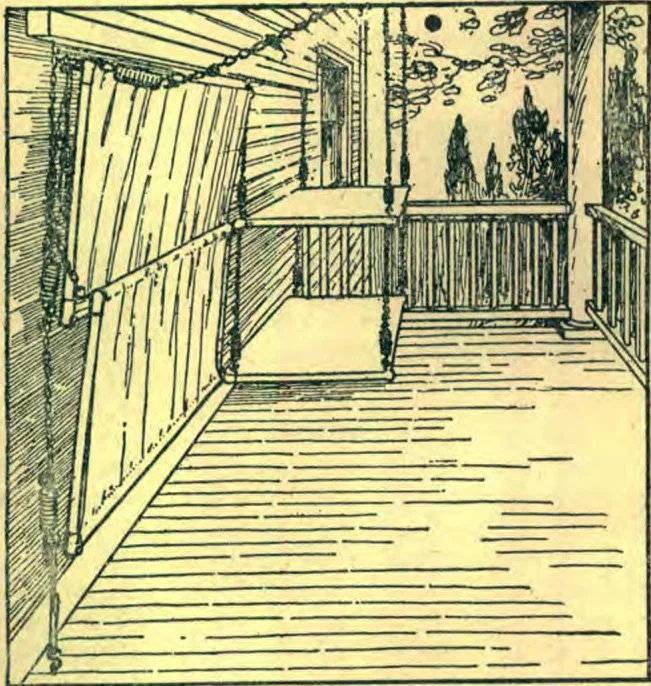
HERE is a bed that can be folded against the wall when not in use, allowing its space to be utilized for other purposes. It is sanitary, comfortable, and durable, and is adapted for camp cars, hospital cars, lodging houses, sleeping porches; in fact, all places where sanitary couches are used. No mattress or springs are needed.
It is made of a canvas sheet stretched on a frame of metal tubing and suspended by four springs from as many chains attached to the ceiling and to the floor. A small spring and lever keeps the chains taut. Where two beds are hung from the same chains, the springs on each bed act independently of the other, allowing one bed to move up or down on its own springs without affecting the other. The tubing, springs, and other metal parts are galvanized to protect them against the attacks of moisture, cold, and heat, in cases where the couch is used outdoors.— Popular Science Monthly.
Rhyming Definitions
By Mary H. Moore
My mother, brother, and I have whiled away many hours of unattractive household tasks, such as shelling peas, stringing beans, cracking nuts, or even the hated dishwashing, by playing “rhyming definitions.” This old-fashioned game, brought from my mother’s girlhood, deserves recognition and a place in every home where there are growing young people who often cry, like my little neighbor, “Muvver, what tan I do now?”
One player chooses a word, preferably of one syllable, and states to the company some word with which it rhymes. Each then guesses a word rhyming with the one given and defines it. The chooser must then name the word defined, and tell whether it is the word he had in mind. The one who first guesses and rightly defines the chosen word takes his turn in giving a word to the others. Example:—
“I think of a word that rhymes with shoot.” “Is it something a man wears on his foot?” “It is not boot.” “Is it silent?” “It is not mute.” “Is it a Congressman from Utah?” “It is not Smoot.” “Is it to ridicule?” “It is not hoot.” “Is it a musical instrument?” “It is flute.”
This game’s beauty is its unlimited possibilities. It requires no apparatus; it can be suited to any company, from grammar school children to the wisest, most epigrammatic scholars. It is a fair game, for it makes both the “it” and the rest of the players share the guessing. Try it; you will be amazed at the interesting variety found in our common three- and four-letter words.
MARY H. MOORE.
The Negroes' Mistake
“FOR your lives!” cried the Portuguese captain of an African slave ship to a band of naked Negroes, as he pointed to an English ship which had been in hot chase of him for some hours. “Fight for your lives!” he cried out, as he gave each man a weapon. And the deluded and terrified Negroes did as they were told, and in so doing they wounded and killed their best friends, who had come to deliver them. So Jesus came to set the captives of sin free; but the Pharisees rose against Jesus, and the very men he loved and came to free they urged on to kill him.—The Christian Herald
Play the Game
There would be nothing but well-deserved hisses from the bleachers and grand stand for that player who drops from the game and sulks when he is put out on second. No baseball man does that. He gets back into the game, and tries to win. He will not be put out.
The world scorns the boy who walks away and sulks when he is knocked out in business or school life. Its admiration is for the one who gets back in the game, and proves that he can succeed.— Youth’s World.
For the Finding-Out Club
How and from what do we get rubber?
When a ship passes through the Panama Canal from the Atlantic Ocean to the Pacific Ocean, what general direction does it take?
For what purpose does it seem that a zebra has a striped back?
What causes an eclipse of the moon?
Does the compass always point straight north?
How did Louisiana get its name?
What useful purpose have the spikes on the heads of horned toads?
What is a sponge?
What is chocolate?
Was St. Patrick born in Ireland?
What country produces the most coal?
Who knew about the power of steam before Watt patented his steam engine, and how many years before his patent did the first experiments with steam power take place?
Did the United States gain more of its territory, (a) from England by the Revolutionary War? (b) from France by the Louisiana Purchase; or (c) from Mexico by the Mexican War and the annexation of Texas?
What is the chief article of food of the Japanese?
In what country and battle were cannon first used in the open field?
How many acres are there in Central Park, New York, and when was it first laid out?
Which city is farther north, Paris or Boston?
How Freddy Found a Hen’s Nest
A True Story
“FREDDY,” said his mother one day, “the speckled hen is laying away somewhere; I wish you would try to find her nest for me.”
Freddy was fond of his mother, and was always ready to do her bidding. He was also fond of eggs, and thought hunting for them was great fun.
Specky was a knowing hen, and Freddy soon found that it was no use trying to follow her to her nest. When she saw that she was being watched, she just walked up and down, picking in the grass. When Freddy got tired and turned his back, away she would slip, and a few minutes later he would hear her cackling in the scrub. Off would rush Freddy, only to meet Specky coming out of the scrub looking much pleased with herself.
Not to be beaten, he went all through the scrub patch, and looked in and out of every bush and tussock, but it seemed all to no purpose.
Often when he was scrambling, and scratching himself, and feeling quite out of patience with everything, and with Specky in particular, he would hear her cackle quite close to him. When he got where she was, she would still be cackling, but a search around left Freddy more puzzled than ever.
One day after another passed in this way, and the boy was beginning to think that the hen would beat him after all. He went out again for “just one more try,” as he said, but soon got tired out, and sat on the ground to rest and think. He said to himself: “Well, if I don’t know where this nest is, I am sure that God does. He knows how much I want to find it, so I will ask him to show me where it is. He says we have only to ask and we shall receive, and a lot more that I don’t remember, so I will ask him.” He knelt down and asked God to show him where Specky was laying, for he had looked for her nest all he could, and now he wanted God to help him find it.
Freddy had scarcely finished when something happened which gave him quite a start; and what do you think it was? Close beside him he heard a loud cackle-cackle, cackle-cackle, and turning his head, there was old Specky, making all the noise she could, and walking slowly away.
“Now that is puzzling,” he thought; “wherever has she come from?” There were no bushes near where she could have been hiding, yet she must have come from somewhere; of that he was sure. Still staring about him, he at last saw a hole going into the ground, which he had not noticed before. It was but a small hole at the top, not quite the size of the crown of his hat, and went slantwise into the ground. It looked dark inside, but he thought he could see something white at the end. Reaching in his arm, Freddy gave a shout of joy when he felt, not something to bite him, as he half feared, but eggs, a whole nestful of them.
Freddy was so full of joy and thankfulness for having had an answer to his prayer so soon, that he just shut his eyes and lay still.
We can be sure that God was listening to what was in his heart, and that Freddy had learned his first lesson in faith. The Bible says that according to our faith so shall it be unto us.
Freddy is grown up now, and has learned to love and trust the God whom he never doubts heard and answered his first prayer of faith when he was a boy of nine years.—The Watchman.
Saripah: A Javanese Woman Finds Friendship and Faith
By Petra Tunheim
Saripah
SARIPAH was a Javanese woman who came out from Mohammedanism, and who learned to love our dear Saviour and his precious truth. She was one of the women from a colony of poor and sick people that we had charge of for a few years. She was far from being good-looking, and she had the queerest and most disagreeable disposition of any human being I have ever seen; consequently no one liked poor Saripah. But one could read on her countenance that she had a real longing for friendship and sympathy.
At night when I would sit quietly in my little bamboo hut, studying hard at that difficult language, Saripah would creep in and squat down in the doorway on the ground floor. After a few nights she came still nearer and sat beside me, and finally bent her head over into my lap. Often she would look into my face with a pleasant smile, saying in her own language, “I love you.” I could not in return express to her in words how that Jesus had placed his love in my heart for her, but I would show it by stroking her black, hard hair, that was shining from the daily smearing on of rancid coconut oil.
This poor unfortunate soul, who had been friendless and so unhappy in this world, began to be brighter and happier. Her former gloomy life was changed little by little, and she learned to love the One who through infinite love had given his life for her. It was not long before she gave up her filthy betel nut habit and so many, many other bad habits that she had.
She was with us for more than nine years. The last two years we isolated her up near our mountain home, because the bronchial cough she had for years finally developed into consumption.
A year and a half ago when I visited her she was very happy to see me. She was weak and could walk only a short distance with great effort, but she would come daily struggling along, and offer to help sew for me. Even now when I look at the neat buttonholes, and all the fine stitches of love that she made with her poor shaky hands, tears come to my eyes. A great change had come into her life, so quiet and gentle had she become.
When I was ready to leave, she came again and again to me saying: “Koelo adjeng nderek ndoro [I11want to follow mistress]. I want to follow you until I die.” I said, “No, Saripah, you cannot follow me now; we have to go through the bitterness of parting here below, in this land of death. You must plead earnestly to be covered with the pure and perfect garment of Christ’s righteousness and become like him, then very soon we shall meet in that glorious home where we shall have the joy of being together forevermore. There you will have a strong and perfect body, reflecting the beauty of our Holy Redeemer. He will place a glorious crown on your head more brilliant than the beaming sun.”
The long years of Saripah’s suffering, which she patiently bore, are now ended. She sleeps in Jesus, awaiting the glorious resurrection morning that is soon to take place, when the King of kings shall appear in his beauty with all his holy angels. Then shall also Saripah’s grave be opened, and she will be called forth clothed with immortality. Then I hope to clasp her hand in mine; and there together, without once hearing the sad word “good-by,” we shall sing praises to him who has redeemed us, throughout the ceaseless ages of eternity.
PETRA TUNHEIM.
The Little Hero of Haarlem
LONG, long ago there lived in Haarlem, one of the cities of the Netherlands, a brave little boy named Peter. His father was a “sluicer,” that is, a man whose business it is to open and close the sluice gates that are put across the canals to keep back the water. When more water is wanted, the sluicer raises the gates and lets the water in; and then at night the gates are carefully closed, for the Netherlands are lower than the sea level and the waters are kept from flooding the land by means of strong dikes.
One autumn day Peter’s mother said to him: “Take these cakes, which I have just baked, to the poor old blind man who lives across the dike; and make haste, for you will have just time to go and return before the sun has set.”
Peter whistled a merry tune as he trudged along, his wooden shoes clicking on the stones as he clattered down the road. The old man was glad to have a visit from his little friend, and he thanked Peter for the cakes. Then Peter said good-by and hurried toward home. As he walked along he saw near the edge of the dike some blue flowers which he picked for his mother. Then, looking up, he noticed that the sun was setting. “I must hurry home, for my mother will be worried,” he said. So he walked faster and faster, when suddenly he stopped as he heard a little trickling sound: “Trickle, trickle, trickle.” He looked up and then grew pale with terror, for there, pushing its way through a tiny hole, was a stream of water.
“A leak in the dike!” he shouted and, dropping his flowers, climbed quickly up the steep bank. “Come, help! A leak in the dike!” But there was no one near to hear him. Peter understood the danger at a glance. Soon that small hole would become a larger one as the water broke through it, and the small stream would become a mighty flood destroying all the land.
Quick as a flash the boy threw himself on the ground and placed his finger in the tiny hole. The water was forced back and Peter said in delight: “The angry waters shall not flood Haarlem if I can help it.”
Now this was all well for a time, but the dark night soon settled down upon Peter and he suffered with cold and fear. His hand and arm grew numb, and then his whole body was filled with pain; but he bravely held on. “Come, help! Come!” he shouted again and again, but no one came. The tears rolled down his cheeks, but still the brave little lad held on. “Will no one come? Mother! Mother!” he cried; and he thought of his mother and father and his brothers and sisters, snug and safe, asleep in their beds at home. “What would happen to them, and to all in Haarlem, if I should give up?” he said. “No, no, I must stay here and hold back that angry sea.” And so he endured the pricking pain of the numbness all through the cold dark night.
In the early morning a workman heard groans coming from beyond the dike and saw a small boy lying on the ground, crying out with the pain. “Boy,” he shouted, “what are you doing there?”
“I am keeping the water back,” answered Peter. “Oh, tell them to come and help me!”
The workman called to some friends and they came running up the embankment and lifted the brave little boy in their arms. Then they carefully mended the hole and carried the little lad to his home.
All this time Peter’s mother had been anxious about him. At tea time she stood in the doorway and watched the road for some minutes. “I never knew him to stay away without my leave,” she said. And later, when they all made ready for bed, she looked out again into the darkness. “It is not like my Peter; I always trust him, but tonight he must have stayed with his old blind friend. I must speak to him about it in the morning.”
In the early morning, when she opened the shutters and stepped to the house door, she again thought of Peter. “I wonder why he did not come home last night,” she said. And then, against the rising sun, she saw a black shadow coming toward her, and a limp little form which was carried between two strong men. She was so frightened she cried out, and the father, hearing her cry, came running to the door and looked at the silent procession coming down the road.
When the men saw the anxious parents, they said: “Your brave little lad has saved our land. Give thanks to the good God who has spared his life!”
Then Peter was carried into the house, and when he was rested he told them the whole story of the leak in the dike. And, though they tell tales of many valiant heroes who fought and died for the Netherlands, there is no story which the children enjoy hearing so much as this one of the little hero of Haarlem.
— Ladies’ Home Journal.
Old-Fashioned Folks
By Clara M. Kahle
All grown-up folks have greatly changed
In almost every way;
They do not seem to do the things
They did in Grandma's day,
When quilting bees and singing schools
Were quite the style, she says;
But all those things she tells about
Sound very strange these days.
But children never change a bit;
They're just the same, you know,
As little children used to be
A hundred years ago;
They like to play the same old games—
Like ball and blindman's buff;
Of dolls and hoops and jumping ropes
They've never had enough.
They love to play at keeping house;
And if you watch, you'll see
That ring-around-a-rosy is
As new as new can be.
And so, while other folks have changed
In almost every way,
They're the only real old-fashioned folks
In all the world today.
— Clara M. Kahle
Missionary Volunteer Work Summary, North American Division, Quarter Ending June
By M. E. Kern
Summary of Missionary Volunteer Work in the North American Division Conference for Quarter Ending June 30, 1916
CONFERENCES
No. Societies Reporting
Present Membership
Conf. Society Members
Missionary Letters Written
Missionary Letters Received
Missionary Visits
Bible Readings
Cottage Meetings
Subscriptions
Papers Sold
Papers Lent or Given Away
Books Sold
Books Lent or Given Away
Tracts Sold
Tracts Lent or Given Away
Hours of Christian Help Work
Clothing and Meals Given
Bouquets Given
Scripture Cards Given
Treatments Given
Signers to Temperance Pledge
Offerings for Foreign Missions
Offerings for Home Missions
Conventions
ATLANTIC UNION
E. New York
6
106
17
85
34
139
43
28
136
1246
91
26
70
1032
308
86
15
2
3
3
$39.27
$30.55
2
Greater New York
12
355
—
501
169
1930
377
19
2798
4157
302
303
75
3474
1049
692
—
—
—
—
252.26
74.88
—
Maine
7
127
—
54
21
282
63
—
880
1498
106
57
—
907
159
32
22
51
—
100
55.49
8.89
—
Massachusetts
15
281
7
515
95
503
252
4
1291
2503
178
185
657
2613
442
201
20
12
27
19
88.28
70.34
22
N. New England
5
38
4
50
16
22
15
385
2185
—
20
—
191
42
25
—
—
58
10
—
22.80
—
—
S. New England
8
62
6
27
17
108
8
—
272
629
—
21
3
161
67
21
—
—
—
24
44.12
1.47
—
W. New York
10
61
—
210
53
303
23
15
551
1272
230
49
22
3833
124
149
50
149
19
59
127.78
310.65
—
Bermuda
1
18
—
4
1
2
3
—
2
—
60
1
—
—
—
1
1
—
—
—
21.04
—
2
CENTRAL UNION
Colorado
11
220
3
114
56
552
47
57
79
1459
26
40
—
2515
318
177
62
30
37
87
45.58
—
—
Kansas
10
225
—
155
128
111
94
36
222
774
261
54
11
737
375
218
—
62
14
—
20.39
—
3
Missouri
5
146
—
119
46
156
10
6
175
864
9
26
287
—
228
65
138
—
13
—
—
.75
17
Nebraska
8
223
5
172
36
425
65
7
255
2305
66
46
—
1682
512
136
28
3
45
1
60.44
6.32
2
Wyoming
3
36
16
142
53
50
30
24
—
50
40
42
—
110
211
44
3
2
—
—
40.18
150.00
6
COLUMBIA UNION
Chesapeake
9
210
—
210
44
318
190
37
240
2008
67
88
72
922
1089
320
34
13
34
21
47.27
.79
13
District of Columbia
3
70
—
188
32
422
28
7
167
1458
5
28
—
305
201
41
18
58
9
—
25.54
9.62
8
E. Pennsylvania
12
164
5
123
77
157
21
1
316
1824
12
79
24
1695
414
261
31
111
71
6
40.69
36.44
6
New Jersey
20
260
—
196
152
711
151
2
434
2629
148
40
306
2025
800
91
20
25
10
—
52.82
20.01
18
Ohio
16
369
—
293
196
418
304
46
636
2733
187
213
693
2166
2213
416
69
3
127
1
188.91
56.83
6
Virginia
2
59
—
4
1
7
—
—
—
3
8
4
—
500
2
15
1
—
—
—
33.45
—
—
W. Pennsylvania
3
73
—
419
131
376
220
54
1128
7223
757
488
61
1243
217
341
31
7
35
—
58.68
49.74
5
West Virginia
2
33
—
68
18
128
59
61
809
1291
72
27
43
535
135
24
—
—
—
—
2.20
11.47
—
LAKE UNION
E. Michigan
21
334
—
111
43
332
23
1
364
3188
160
74
44
2584
320
194
119
174
3
54
91.45
52.31
7
Indiana
25
385
—
149
43
314
103
—
324
2983
148
95
140
1706
167
325
25
118
—
—
161.68
23.93
3
N. Illinois
29
501
—
393
219
2201
469
36
2865
2421
124
593
334
2673
845
527
69
175
36
4
112.36
57.39
4
N. Michigan
6
100
—
76
49
59
35
1
21
659
48
9
3
141
118
59
29
17
—
—
221.32
2.02
2
S. Illinois
9
158
8
208
48
172
24
8
161
1765
115
84
19
302
199
82
28
—
7
—
.39
49.73
1
W. Michigan
27
553
4
264
129
591
159
16
176
4660
546
186
244
1361
1113
628
145
62
72
63
151.42
27.54
20
Wisconsin
21
304
3
500
236
523
360
94
1900
2127
365
119
912
1279
1494
438
140
177
109
18
514.31
72.44
37
NORTHERN UNION
Iowa
14
284
—
126
113
336
69
20
862
2944
651
145
942
2146
507
365
30
200
60
14
91.05
96.06
13
Minnesota
16
338
73
334
103
229
80
—
182
3481
43
74
30
2097
981
157
74
63
47
1
32.34
67.08
30
North Dakota
3
38
2
225
81
45
8
4
5
31
—
1
—
—
6
9
—
—
—
—
11.45
—
4
South Dakota
4
43
—
343
193
82
8
1
156
209
6
14
12
89
117
178
48
12
—
—
2.25
7.26
3
NORTH PACIFIC UNION
Montana
—
—
—
—
—
—
—
—
—
—
—
—
—
—
—
—
—
—
—
—
—
—
—
S. Idaho
8
150
—
51
14
179
15
9
41
850
29
32
22
269
42
26
50
—
—
—
75.75
2.60
—
S. Oregon
6
101
4
86
38
241
53
3
8
517
2
45
1
106
148
125
77
—
3
1
10.63
7.66
2
Upper Columbia
8
183
5
75
14
116
8
—
29
1349
126
40
103
542
127
100
68
10
11
6
57.55
13.15
30
W. Oregon
9
214
4
164
20
128
13
3
—
5738
18
61
—
876
183
104
35
289
—
1
43.11
22.62
29
W. Washington
8
115
—
47
4
52
13
12
133
1339
4
19
—
257
58
24
—
—
—
—
22.81
.65
10
PACIFIC UNION
Arizona
—
—
—
—
—
—
—
—
—
—
—
—
—
—
—
—
—
—
—
—
—
—
—
California
8
250
—
330
123
621
121
44
987
4215
49
195
523
2837
417
924
143
198
139
3
111.60
86.89
4
Cen. California
11
288
—
131
25
401
121
25
80
2843
142
155
10
4155
619
108
37
—
24
17
88.50
—
21
Inter-Mountain
5
76
8
492
195
370
46
—
8
351
8
25
—
282
200
176
35
—
3
—
—
8.37
—
Nevada Mission
2
—
—
48
22
2894
41
3
21
3207
101
29
5
315
55
28
—
40
3
—
29.00
1.25
—
N. California
11
225
—
70
35
72
35
—
224
1512
3
56
—
154
103
108
76
34
8
—
43.93
36.70
—
N. W. California
14
215
—
154
63
563
105
12
489
2992
71
77
19
1223
288
425
362
398
26
13
62.63
38.83
4
S. California
—
—
—
—
—
—
—
—
—
—
—
—
—
—
—
—
—
—
—
—
—
—
—
S. E. California
—
—
—
—
—
—
—
—
—
—
—
—
—
—
—
—
—
—
—
—
—
—
—
SOUTHEASTERN UNION
Cumberland
4
93
—
85
42
229
35
4
854
441
14
28
109
68
322
105
34
4
74
3
31.42
1.00
—
Florida
13
199
—
125
50
236
257
20
484
6934
45
29
1
8
472
112
143
—
29
—
47.09
11.67
—
Georgia
3
59
—
75
36
561
36
30
100
556
12
33
32
826
367
450
15
145
21
3
147.48
2.48
—
North Carolina
7
138
—
26
24
161
28
9
196
323
18
24
1
150
47
116
19
—
12
—
16.29
—
—
South Carolina
2
47
—
34
22
195
19
—
4
201
25
21
10
342
30
26
5
—
—
—
1.26
—
2
SOUTHERN UNION
Alabama
6
80
—
293
213
543
113
95
583
2518
150
82
61
493
1012
318
—
1
148
—
14.57
12.64
19
Kentucky
6
134
31
199
80
225
80
7
372
1917
8
39
—
282
568
141
81
16
40
1
10.68
8.31
14
Louisiana
3
73
2
46
13
100
32
38
331
63
10
3
—
236
57
74
—
—
11
—
8.67
11.44
2
Mississippi
3
29
1
40
9
376
7
—
55
205
47
3
—
302
159
17
3
—
3
—
1.70
—
—
Tennessee River
3
32
—
34
11
91
7
—
34
327
1
23
9
94
273
188
111
2
12
—
6.92
2.63
6
SOUTHWESTERN UNION
Arkansas
7
108
9
35
23
16
5
—
—
290
20
22
8
36
97
82
20
11
12
—
14.94
5.65
14
New Mexico
5
64
9
341
138
114
24
5
192
5021
—
26
18
141
103
81
17
—
2
42
16.39
21.24
6
N. Texas
7
246
—
155
39
213
47
4
161
1512
33
54
18
310
331
33
26
28
9
—
38.40
9.59
—
Oklahoma
10
198
—
65
34
119
24
6
11
1372
12
36
—
1192
81
78
2
22
2
3
15.16
18.53
4
S. Texas
3
45
—
36
17
100
25
—
141
391
18
45
—
40
59
11
2
1
11
—
1.40
—
2
W. Texas
2
42
—
13
6
39
9
—
21
290
24
82
—
97
97
5
—
—
6
—
.50
.25
4
EASTERN CANADIAN UNION
Maritime
—
—
—
—
—
—
—
—
—
—
—
—
—
—
—
—
—
—
—
—
—
—
—
Ontario
5
59
—
50
14
143
73
3
599
436
172
17
138
1505
27
16
1
—
—
—
16.38
5.68
6
Quebec
3
45
10
79
44
101
14
—
—
422
6
36
—
157
255
204
17
6
8
—
6.50
13.83
—
WESTERN CANADIAN UNION
Alberta
4
80
5
34
12
214
26
—
83
328
13
4
—
1335
42
7
2
11
7
—
17.60
12.70
—
British Columbia
10
92
5
10
5
50
3
—
334
933
21
14
—
447
88
57
132
2
2
—
18.15
21.14
—
Manitoba
2
33
11
20
14
20
6
1
107
565
—
11
—
337
7
7
—
—
—
—
2.00
—
4
Saskatchewan
2
23
—
—
—
—
—
—
4
—
—
—
195
—
—
64
—
—
—
—
8.25
—
10
Totals
543
9890
257
9821
4032
21537
4782
1303
26238
109849
6048
4577
6473
60289
21490
10633
2763
2802
1414
566
$3644.47
$1671.91
487
Totals for Quarter ending June 30, 1915
525
9683
269
9727
3697
22080
5490
956
33555
126731
10563
4990
12178
70260
45496
11185
2155
1805
2508
495
$3525.75
$1838.57
556
M. E. Kern, Secretary M. V. Dept. of N. A. D. Conf.