The Youth’s Instructor, Vol. 64, No. 49.

Miscellaneous News Items from Recent Press Reports
Earlier text: A Stargazer

Our Refuge

  • (Texts for December 10 to 16)*
ONE of the through passenger trains was just turning into the horseshoe curve in Pennsylvania when the engineer caught sight of two small children playing on the track. It seemed too late to save them. Another moment the train would be upon them. But no—the instant the shrill shriek of the whistle caught the little girl’s ear she thrust her baby brother into a niche in the rocky wall by the track. As the train went thundering by, many of the passengers, who with tears in their eyes were witnessing the narrow escape, heard the clear voice of the little girl ring out: “Cling close to the rock, Johnny! Cling close to the rock!”
To cling close to the rock was the only thing that could save the little boy from being crushed under the swiftly moving train. There was only one refuge for the little lad. There is only one sure refuge from the merciless powers of evil that are sweeping over the entire world, and that refuge is Jesus Christ, the Rock of Ages. There is a cleft in that Rock for you. In it you may hide from all evil. You will be safe, perfectly safe, if you “cling close to the Rock.”
Late one afternoon, Charles Wesley sat by an open window. He was thinking of the work he had tried to do that day, and was feeling discouraged over the apparent failure of his efforts to lift his fellow men, when a little bird pursued by a hawk, sought refuge near the sympathetic man. To Mr. Wesley the incident typified the refuge all may find in Christ from sorrows, from heartaches, from all things that oppress; and it led him to write the beautiful hymn, “Jesus, Lover of My Soul,” whose strong magnetic power has ever since been drawing men, women, and children in all the world into the only never-failing refuge.
When the daughter of one of the French Revolutionists was incarcerated in Newgate prison, she realized that even in the prison cell God was an ever-present help and a sure refuge from trouble; and she passed on her experience to others in the immortal hymn, “Nearer, My God, to Thee.” It was the sweet strains of this song with which the heroic band on the ill-fated “Titanic” comforted the doomed passengers. There was only one refuge for those who went down with the ship. They must look to God for a refuge that was stronger than death; and this song pointed them to it, for even death cannot separate the Christian “from the love of God, which is in Christ Jesus.”
It is now many years since the unfortunate “London” went down, while her drowning passengers, amid their sobs, sang:—
“Rock of Ages, cleft for me! Let me hide myself in thee.”
But the song has not lost its power over hearts, for the Rock of Ages has not changed. It still affords a hiding place from every trouble life or death can bring.
This refuge will not fail God’s faithful children in the time of trouble just before us. If you do not feel confident that this is true, let the following words from the Spirit of prophecy, cast every trace of fear out of your heart:— “Fearful tests and trials await the people of God. The spirit of war is stirring the nations from one end of the earth to the other. But in the midst of the time of trouble that is coming,—a time of trouble such as has not been since there was a nation,—God’s chosen people will stand unmoved. Satan and his host cannot destroy them; for angels that excel in strength will protect them.”
MEDITATION.—I do thank God for the never-failing refuge he has provided for his children. I want to hide in it today, that I may be safe from the temptations that come. I want to abide there, for it is the only place where God can protect me in the time of trouble. Sin means wandering away from this hiding place. I do pray that not even one known sin shall ever get between me and the Rock to which I must cling for safety.
SPECIAL PRAYER.—Last week our special prayer was for complete victory in Christ. If we have gained the victory and made a complete surrender, it is right for us to ask now for the outpouring of the Holy Spirit, without which we cannot do effectual soul-winning service for the Master. Let us pray that this outpouring may come to God’s consecrated servants everywhere, that a rich harvest of souls may be the result.
M. E.

The Morning Watch

“THE camel kneels at break of day To have his guide replace his load; Then rises up anew to take The desert road.”
“So thou shouldst kneel at morning’s dawn, That God may give thee daily care, Assured that he no load too great Will make thee bear.”
“The morning prayer fits us for the duties of the day. Then we tell our Father of our plans for the day, of the duties which devolve upon us, and of the contingencies which may arise in matters concerning which we have some doubt. In that subtle, spiritual way so well known to the children of God, our Father suggests to us the way in which we should go, and we rise from our knees with hearts flooded with the assurance that we are girt about with his love, and that wherever we are or whatever we do, his thought and love will follow us.”—R. J. Burdett.
“Here are one or two hints that may help us to make the best use of the Morning Watch. Use the same Bible; your own Bible; the Bible which is deeply associated with your saddest and happiest days. I like to handle my beautiful Bible. The oranges of gold ought to lie in a basket of silver filigree work. At the same time your Bible must not be so beautiful that you fear to mark it or subject it to hard usage. For when its superficial beauty has passed, the marked passages, the penciled dates in the margin, the verses blotted with tears, communicate a fragrance and preciousness which no gilt or leather or printer’s ink could give.”—Sunday School Times.
“Every day let us renew the consecration to God’s service; every day let us, in his strength, pledge ourselves afresh to do his will, even in the veriest trifle, and to turn aside from anything that may displease him. He does not bid us bear the burdens of tomorrow, next week, or next year. Every day we are to come to him in simple obedience and faith, asking help to keep us, and aid us through that day’s work; and tomorrow, and tomorrow, and tomorrow, through years of long tomorrows, it will be but the same thing to do; leaving the future always in God’s hands, sure that he can care for it better than we. Blessed trust! that can thus confidently say, ‘This hour is mine with its present duty: the next is God’s, and when it comes, his presence will come with it.’”—W. R. Huntington.
“The real significance of the Morning Watch seems plainly to be this: At the close of his night of loving vigil over us the Lord requests us to rise and spend the last minutes of his morning watch with him. It is as if he might say in our human language: ‘I have been watching over you all the night while you slept, and now I wish you would give me the refreshment of a quiet bit of talk and fellowship with you before day begins.’ Notice Isa. 50:4, revision: ‘The Lord God hath given me the tongue of them that are taught, that I should know how to sustain with words him that is weary: he wakeneth morning by morning, he wakeneth mine ear to hear as they that are taught.’ Here is a morning appointment with God. It is at his special request, for ‘he wakeneth.’ It is the first appointment of the morning, and it is early morning; for one is wakened for it. It is daily; for ‘he wakeneth morning by morning.’ And the results are remarkable. First, a trained ear, then a trained tongue (what rarities!), and then a life of helpfulness.”—S. D. Gordon.
“Where the Battle Center Is.—One of the first conditions of obtaining the maximum of benefit from the Morning Watch is the fixed purpose to maintain it. We must build a ring fence round that portion of the day which we devote to the recharging of our soul with divine energy. The foes that threaten it are as numerous and insidious as white ants, which are the despair of the tropics. It is as though the order had gone forth, ‘Fight neither with small nor great, but only with the maintenance of the Morning Watch.’ It is not on the first or second or third morning that we begin to slacken, but on the fourth or fifth. In fact, for some of us, who are late in going to bed, our habits in that respect must be modified if we are to hold to our resolve. It is next to impossible to rise early for our Morning Watch if we have sat into the small hours reading an exciting novel or talking gossip. We must retire to bed in reasonable hours, and our last thought should be a fixed resolution of keeping our tryst.
“Hudson Taylor once told me that during his long journeys in the interior of China, when he was obliged for months to sleep in the guest chambers of Chinese inns, sharing the surface of the brick fire-stove with a dozen and more Chinese, his only opportunity of keeping the Morning Watch was between 3 and 4 A. M., when his companions were snoring around him. So habituated did he become to this habit that for years, when there was no need to maintain the practice, he was accustomed to awake at the same hour.”—Sunday School Times.

Are You Represented?

THE little rills make the brook, and many brooks make the river. The little that you do may not seem large, but when all the little rills of service from all parts of the United States and Canada flow together, the aggregate is large. Our 9,821 reporting members during the second quarter of 1916 made 21,537 missionary visits, held 4,782 Bible readings and cottage meetings, distributed nearly 67,000 tracts, spent over 21,000 hours in Christian help work (nearly 8½ years), and gave over $5,000 to home and foreign missions. And the report shows that 437 young people were converted during this time.
There is one thing, however, about the report which is somewhat discouraging: many items are smaller than for the corresponding quarter last year. What is the matter? Have our young people slackened their efforts? Are we less zealous in the Lord’s service than last year? Have some become stupefied by the miasma of the world and ceased their efforts to warn the people of Jesus’ coming, no longer endeavoring to lead souls to Jesus? Or have some of us forgotten the help and courage that comes to our Adventist youth to see what the Missionary Volunteers in all parts of the field are doing, and neglected to report?
I should like to bring to our North American young people the example of some of our African boys and girls who have been reclaimed from heathenism. Missionary Volunteer Societies have recently been organized on several of the mission stations in Africa, and these dark-skinned brothers and sisters of ours show a zeal in the Lord’s work which is commendable. One of our missionaries on the old Solusi Mission writes:—
“I am glad to say that every one is a working member. It would do the young people at home much good to step into one of our meetings some Sabbath-afternoon and hear these black boys and girls give their reports. They would not hear any of that argument of not letting the right hand know what the left hand is doing. And if I did not confine them strictly to giving only the barest facts of their report, we should have a three hours’ meeting every time. I encourage them to report everything, from the preaching of a sermon to the helping of a sick donkey onto his feet. Of course, the secretary cannot write all of it down, but I tell the boys and girls that if they help a sick or injured animal and do it with the spirit of Jesus in their hearts, it is missionary work. So it is very interesting to hear them give their reports.”
They are also zealous to reach the Standard of Attainment. The missionary says:—
“If you have anywhere in the homeland a Volunteer Society of sixty-six members, with a Standard of Attainment class of seventy-five, give me its address. I should like to correspond with it.”
If our North American young people were as anxious to report as are these young people, do you suppose our summary would be what it is? Are you, dear reader, represented in this report? or did you forget or neglect to report what you did for your Master? And how is it with you and your society this quarter?
M. E. KERN.

In the Silent Midnight Watches

In the silent midnight watches, When the darkness shroudeth all, Then it is that we remember Actions far beyond recall. And we sigh for words we uttered, Long to take them back again; But, alas! they're gone forever, And our wishes are in vain.
O that we might be more careful, Follow where our Saviour leads! Then we would not be so saddened By our words and by our deeds. Help us, Father, ever guiding All we do and all we say, Help us that to thine own glory We may testify each day.
ELOISE CASE.

Life's Inheritance: The Struggle Renewed

“To struggle again and again, to renew the conflict, this is life's inheritance.”

The Bible Year

Assignment for December 10 to 16

December 10: Titus.
December 11: 2 Timothy.
December 12: Jude; 1 John 1, 2.
December 13: 1 John 3 to 5.
December 14: 2 John; 3 John.
December 15: Revelation 1, 2.
December 16: Revelation 3 to 5.
For helps and suggestions on this assignment, see the Review for December 7.

Missionary Volunteer Society Programs for Week Ending December 16

THE programs for the Missionary Volunteer Societies, Senior and Junior, for this date, with notes, illustrations, and other helpful material, will be found in the Church Officers’ Gazette for December.

XI — The Gospel Rejected in Pisidia; Preaching at Iconium

(December 16)
LESSON SCRIPTURE: Acts 13:44 to 14:7.
MEMORY VERSE: “He that heareth my word, and believeth on him that sent me, hath everlasting life.” John 5:24.

Questions

  1. Who came to hear the word of God the next Sabbath after Paul first preached in Perga? Acts 13:44. Note 1.
  2. How did the Jews feel when they saw the multitude? What did this feeling lead them to do? Verse 45. Note 2.
  3. What did this cause Paul and Barnabas to say? Verse 46. Note 3.
  4. What was their authority for speaking such words? Verse 47.
  5. How did the Gentiles show their joy? Verse 48.
  6. Where was the truth published? Verse 49.
  7. What caused Paul and Barnabas to be persecuted? What was done to these missionaries? Verse 50.
  8. Why did the apostles shake the dust from their feet as they left? Verse 51; Matt. 10:14.
  9. With what were they filled? Why were they joyful? Verse 52; Matt. 5:11, 12.
  10. To what city did Paul and Barnabas then go? Where did they preach? What was the result? Acts 14:1. Note 4.
  11. Who opposed them there? Why? Verse 2.
  12. Was their stay long or short in Iconium? How did they speak? In what way did the Lord work with them? Verse 3.
  13. How were the people of the city divided? Verse 4.
  14. Who assaulted the apostles? What did the people intend to do with them? Verse 5.
  15. What did this situation cause them to do? To what cities did they go? Verse 6. Note 5.
  16. What did they do there? Verse 7.

Questions for Diligent Students

  1. Trace the journey of the apostles on the map from Antioch in Syria to Derbe.
  2. Did the missionaries do right when they fled from persecution in Iconium? Give a Scriptural reason.

Notes

1. “The intervening week between this Sabbath and the next had not only its days of meeting in the synagogue, but would give many opportunities for exhortation and instruction in private houses; the doctrine would be noised abroad, and through the proselytes would come to the hearing of the Gentiles. So that, ‘on the following Sabbath almost the whole city came together to hear the word of God.’ The synagogue was crowded. Multitudes of Gentiles were there in addition to the proselytes. This was more than the Jews could bear. Their spiritual pride and exclusive bigotry were immediately aroused. They could not endure the notion of others being freely admitted to the same privileges with themselves. This was always the sin of the Jewish people.”—“Life and Epistles of the Apostle Paul,” Conybeare and Howson.
2. “Instead of realizing their position in the world as the prophetic nation for the good of the whole earth, they indulged the self-exalting opinion that God’s highest blessings were only for themselves. . . . Thus, in the Pisidian Antioch they who on one Sabbath had listened with breathless interest to the teachers who spoke to them of the promised Messiah, were on the next Sabbath filled with the most excited indignation when they found that this Messiah was ‘a light to lighten the Gentiles,’ as well as ‘the glory of his people Israel.’ They made an uproar, and opposed the words of Paul with all manner of calumnious expressions, ‘contradicting and blaspheming.’”—Ib.
3. “Paul and Barnabas were not cowards. When men opposed, they grew more bold, and gave reproof fitted to the occasion.”
The Jews of Antioch were not the only ones who put the word of God from them, and judge themselves unworthy of everlasting life. Their course stands as a warning to all. If we make the same choice as they, the voice of God to us will be heard no longer, and others will receive the invitation and the reward meant for us.
4. “The apostles came to Iconium from Antioch of Pisidia, having been driven out of the latter place by the infuriated Jews and their sympathizers. Persecution was Satan’s powerful weapon, but the Lord made use of it to enlarge his own kingdom. They preached in the synagogue in Iconium, and many of the Jews and Gentiles believed the gospel. The unbelieving Jews made it their business to stir up opposition against the apostles. After remaining for some length of time to establish the church, they left for Lystra and Derbe; but the reason for their going was that the Jews and pagans who were arrayed against them made an assault upon them. They preached the gospel in the places where they went to save their lives.”—Practical Commentary.
5. “Lystra was eighteen miles southwest of Iconium in a wild region. From the violence of a mob, excited by the Jews, they fled into a wilder region where there were few or no Jews, and the cities were enumerated in the order in which they visited, while some to which they went are unnamed, but included in the general term, ‘the region round about.’”—Id.

Helping Hands

“I CAN never see you,” said a well-known Christian worker to an aged believer, “without longing for a word from you, and wanting to shake hands with you. You know what a debt I owe you, do you not?”
He had made his way through a crowd to the side of the old gentleman, who shook his head, having come in contact with so many during the course of his long life that circumstances could not always stand out clearly in his memory. He knew the speaker now as an energetic gospel standard bearer, but more than this he could not recall.
“Years ago,” said the other, “I came up to London to seek a place in a business house, bearing a letter of introduction to you. I was friendless, timid, strange. You were very busy when I entered the warehouse, but you read the letter, and spoke to me a few words as to the worth of good character. You said you would do your best for me, and promised to see me again. Then you asked me whom I knew in London, and I said, ‘Only yourself!’ ‘In that case,’ you said, ‘you must spend tomorrow with me; your first Sunday in London must not be a lonely one.’ You welcomed me home on the morrow; you took me to worship, and to the Sunday school with you; that Sunday decided me for the service of the Master.”
Who knows what eternal issues may hang on a kind word, a helping hand held out to a young life at a crisis like this?—Young People's Weekly.

Lehigh Sophomores and Freshmen Replace Hazing with Baseball

In place of the annual “tie-up” and “banner rush,” the sophomores and freshmen of Lehigh University this year played a game of baseball. By vote of the student body hazing has been abolished.

There is a Difference

To talk is easy. But talk, to count, must be born of knowledge. And knowledge comes from experience. The following incident, related in the Youth’s Companion, illustrates the difference between mere opinion and a living experience:—
“As for me, I think one religion is about as good as another. It’s mostly a matter of climate and race and tradition.”
“That’s so,” said the other man. “Christianity is sentimentally attractive. But what has it ever really done? It has broken down under the war. It’s no better than any other religion.”
“The world is small, and travelers in America may expect the unusual. The two men were on a transcontinental train. A man seated across the aisle, who had the air of a foreigner, suddenly leaned forward and said very politely:—
“Pardon. But your remarks, which I could not help hearing, deeply interest me. May I say why?”
“Surely. Go ahead,” the first speaker replied, looking curiously at the foreigner.
“Thank you, sir. I am an Armenian. I was born in Bitlis. Bitlis has about forty thousand people. Have you a town of that size you can think of in America?”
“Just the size of my own town,” said the second man.
“Take your town, then, and call it Bitlis; and say of your town these things: no hospital, no doctor, no dentist, no church except the mission and the Armenian, no press, no telephone, no sanitation, no water system, no library, no transportation, no nurse, no public school. And that is your town, here in America. That is, you understand, my town of Bitlis in Turkey.”
“The one bright spot in my town is the Christian mission, which supports a dispensary and a school and the hope of life. During the recent uprising against the Armenians, in which over three hundred thousand of them were massacred, the missionaries in Bitlis, aided by those in Van, at the risk of their lives saved me from torture and death. All my relatives were murdered and our property was utterly destroyed. My wife and children were tortured and burned alive in my house.”
“Do you wonder that I cannot agree with you that one religion is as good as another? Gentlemen, it is Christianity that has stretched out its healing hand to the tortured people of Europe; and after the war it will be the spirit of the Master that will build up life on the ghastly ruins. I am a witness of it.”
“The men who had flippantly dismissed Christianity in two sentences spent the next hour learning some wholesome truths about Christian missions and the heroes of the cross. The Armenian was helping the Bitlis missionaries raise money for a hospital in his city. The two travelers pulled out their pocketbooks to make a contribution.
“Send it to the headquarters in Boston,” said the defender of Christianity. And they did, to the agreeable surprise of the treasurer.”

Caught One Soul

DURING vacation the students of the Indian Christian Training School have been out in active service. They have had good experiences and also success. Last Friday evening in the prayer meeting one who had been out during the summer, testified thus: “I am glad to be back in school again. God has blessed me much in my work, and with his help I caught one soul.”
He had been canvassing for papers and tracts, and had been on the lookout for some one to help. God gave the opportunity and he had grasped it with the result that one soul was brought to the truth, and got a glimpse of the power of God in salvation.
Young people, are you on the watch that you may catch souls for Christ? If you are awake to the times in which we live, God will surely give you the opportunity. If a young man that has been a Christian only a short time, and has been reared in a heathen home and amid heathen surroundings can “catch” men, there surely is no excuse for those who have been reared under Christian influences and in Christian homes and who have been shown the light of the last gospel message.
I. F. BLUE.

Answering the Call

No lesson is perhaps more insistently yet indirectly brought to us in our study of the book of Acts than the one that God’s servants obeyed, “straightway,” “immediately,” “without gainsaying;” “Philip ran thither to him.” This prompt obedience surely was the secret of the marvelous success of the early Christian workers. After Pentecost, delay seems to be a word unknown.
A traveler tells of once hearing in the mountains of India what is known as the twilight call. “I heard a call,” he says, “from the ridge below. Away through the stillness it came, and from the ridge above me floated down the response. And then I heard in a moment more a faint call from a far ridge, away up and beyond, sounding almost like a distant echo. What did it mean? It meant that the man close above me was passing the word from the man below to the man beyond. The man below could never have reached the other man except for the man who stood on the middle ridge and passed the message on.”
Philip was the man on the middle ridge passing the word of God above on to the eunuch on the ridge below; so did Peter from the middle ridge pass the word of God on to Cornelius. We are each stationed by the Lord on the middle ridge between himself and some other soul. Shall we catch the call from above and pass it on as did Philip, Peter, and Paul? or shall we be so concerned gathering the flowers at our feet, or attending even to the stern duties of life, that we shall not hear God’s voice, and so the one below us will fail to be put in communication with his Saviour? Let us ever keep our ear open to hear God’s voice, and then be quick to respond to his commands. Let us remember the lesson of the twilight call, for there may be some “man down below who will never hear the Man up there, unless we become the one on the middle ridge.”

Prayer and the Measure of Spiritual Power

“No prayer — no power. Little prayer — little power. Much prayer — much power.”

A Captain Saved by a Bible

A captain was wounded by a shell. When he was examined, the doctors found a Bible in his hip pocket. The piece of shell had struck the Bible and gone through the pages. Had it not been for the Bible the officer’s spine would have been shattered. Curiously enough, the missile had stopped at the ninety-first psalm, and the officer’s father, who had given him the Bible, had written a verse from that psalm on the flyleaf.
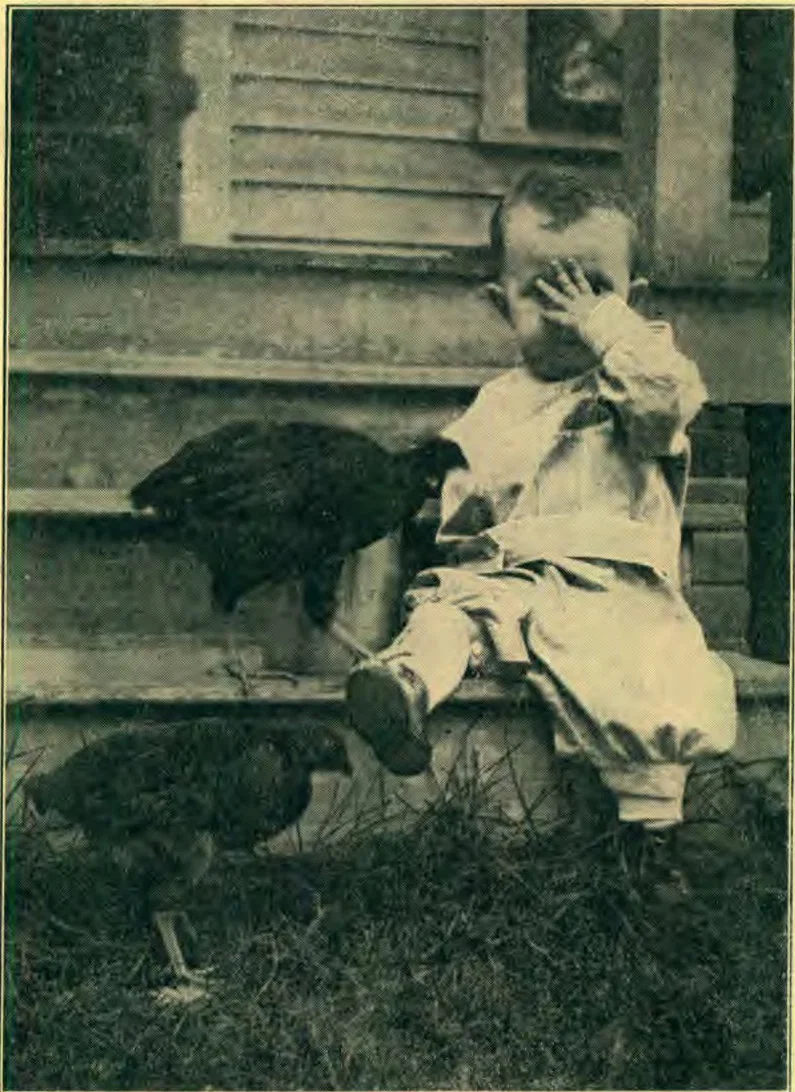
PLAYING PEEKABOO
PLAYING PEEKABOO

You have reached the end of this edition.

The Youth’s Instructor · Dec 5, 1916