NOTE.—We wish those who ask questions to take particular notice: (1) Only such questions will be answered here as we believe to be of general interest and information. (2) We can not undertake to explain from four to a dozen scriptures, as in one sentence we are often requested to do. (3) Do not ask to “explain” a certain text or passage. State clearly the point in question. (4) Give full name and address, not for publication unless desired, but as evidence of good faith, and to give us the privilege of replying by letter if deemed best. (5) Unsigned communications of any kind find the quickest way to the waste-basket. (6) It is always well to inclose stamp. (7) “Foolish and unlearned questions avoid,” also those that minister to mere curiosity. (8) Study the Scriptures yourselves.
No. 623. Tithes and Increase.
If I buy a ranch for $400, live on it and improve it for seven years, and at the end of that time sell it, owing to circumstances, but able to get only $200, is there any increase in it, or tithe for the Lord? P. B.
In general, no; but in particular, it depends. If the $400 originally invested was not tithed, the proceeds, the $200, should be tithed. If the $400 was from money duly tithed, and money had not increased in value more than double during the seven years, there would be no tithe to be paid from the $200. But if the $200 would now buy as much as $500 would then, $100 ought to be tithed. The question can not be clearly answered without knowing all the facts. Take it to the Lord.
WILL you kindly explain Luke 23:31, “If they do these things in a green tree, what shall be done in the dry?” M. F. B.
The green tree is a symbol of our Lord, the ever-flourishing, fruitful Tree, of which the righteous are the branches. The dry tree represents the wicked. Compare Eze. 20:47 with 21:3, 4. If the green tree, Christ, who was suffering on their behalf, should be thus treated, what would be the just judgment upon those who thus filled up their cup of iniquity?
No. 625. Division of the Ten Commandments.
IS THERE any authority to show us which is the true division of the Ten Commandments? Also is not Ex. 20:2 included in the Decalog? G. N. B.
The proper division of the Ten Commandments is indicated by the nature of the commandments. The first four pertain to our duty to God. Catholics hold that the first two commandments cover but one principle, and so unite them, while they divide the tenth. But the first two cover two different principles, the first striking against the worship of many gods, the second against image worship, or the making of an image of Deity. The tenth touches but one principle, that of coveting. The proper place of division is that made by Protestants generally, and by God himself, in the very nature of his law. If Roman Catholics had held to the principle enjoined in the second commandment, they would not have stooped to the adoration of images.
Ex. 20:2 belongs to the Decalog; of this we do not see how there can be any doubt.
No. 626. Keeping the Sabbath.
I HAVE a good job of work, but can not keep it unless I work up to 12 o’clock Friday nights, and commence 12 o’clock Saturday nights. I would like to keep the job. I find all other sects claim it is not wrong to work until 12 o’clock Saturday nights and commence 12 o’clock Sunday nights. F. M.
The “sects” of which you speak begin their Sabbath, Sunday, according to Roman, civil time, at 12 o’clock midnight. The Lord’s Sabbath begins at sunset and closes at sunset. See article on “Beginning of the Day,” page 2 of this paper. The Lord declares that the Sabbath is “My holy day.” He rested in that day, blessed, and sanctified it. Isa. 58:13; Gen. 2:2, 3; Ex. 20:8–11. How much of the day is therefore holy?—Evidently all. Shall we discriminate where God does not? It is better to die than to sin. Sin ends in eternal death. The grave can not hold him who is in Christ. Acts 2:24.
A CONFEDERACY.
By Editor
Dr. Carroll, editor of the New York Independent, suggests that the young people's societies of the different denominations unite. He gives the numbers of the societies as follows: “Christian Endeavor, 40 denominations, 2,162,000; Epworth League, M. E. Church, 1,500,000; Epworth League, M. E. Church South, 150,000; Baptist Young People's Union, 400,000; Young People's Christian Union, United Brethren, 75,000; Lutheran League, 60,000; Young People's Christian Union, United Presbyterian, 35,146; Young People's Christian Union, Associate Reformed, 2,223; Young People's Christian Alliance, Evangelical Association, 30,407; total, 4,414,776. The Westminster League would swell the total to 4,500,000.” The worst thing about all this is that these societies, especially the greater ones, are being turned into political lines. Among their chief topics are “Christian Citizenship,” which means political methods and work, and Sunday laws. These young people are taught that the hope of the country is in making it what it never can be made, politically Christian; that unless the Sunday sabbath is preserved by law, the nation is ruined, and that the hope of this is a great confederacy or federation, by which the religio-political forces of the country may be used to sweep away all opposition to “Christian government;” and thus will the reign of Christ be brought in by politics and the ballot.
But all hope based upon political measures and political unions will prove futile. Thus the Lord speaks to his people of such work: “Say ye not, A confederacy, to all them to whom this people shall say, A confederacy; neither fear ye their fear, nor be afraid.” Well, what is a Christian to do in the face of this rising, engulfing tide of evils?—“Sanctify the Lord of hosts himself [“in your hearts,” 1 Peter 3:15]; and let him be your fear, and let him be your dread. And he shall be for a sanctuary.” Isa. 8:12-14. The only true union is union in the truth as it is in God's Word through Jesus Christ. Such union will not build political bridges of confederation over cold, dead creeds, but leave “traditions” and “vested interests,” and follow Christ. The U. S. Senate in 1829 spake truly: “Extensive religious combinations to effect a political object . . . are always dangerous. . . . All religious despotism commences by combination and influence; and when that influence begins to operate upon the political institutions of a country, the civil power soon bends under it, and the catastrophe of other nations furnishes an awful warning of the consequence.” We repeat, True union is union in the truth as it is in the Word through Christ.
“THE TEMPLE OF GOD.”
By Ida M. Poch
“Let us make man in Our image.” “Male and female created He them.”
In our last paper it was suggested it might be well to study to know something of this wonderful mechanism, which in this paper we will call “woman,” because we will deal particularly with the feminine portion of the human race. In this brief study we may find, not only many interesting facts, but also be able to discover some of the “whys,” which are supposed to be especially dear to the daughters of Eve.
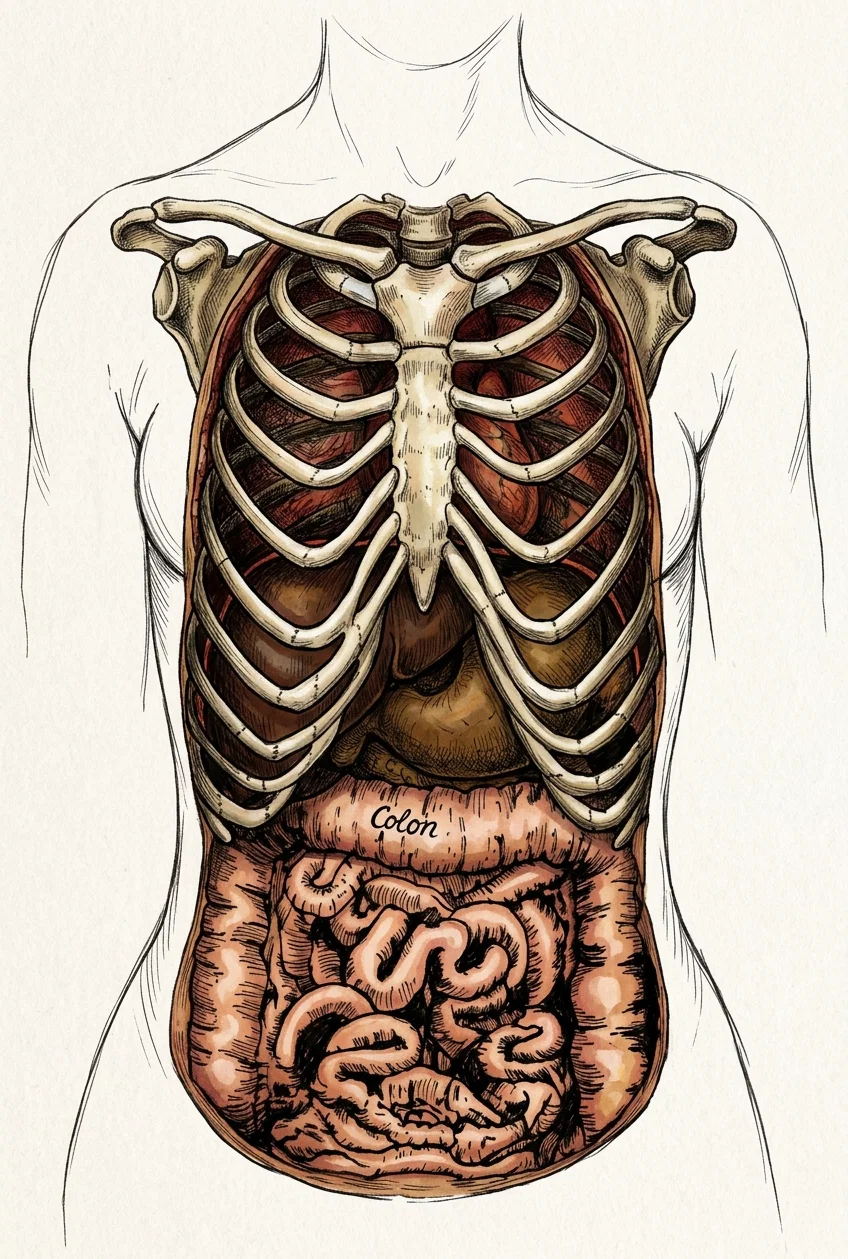
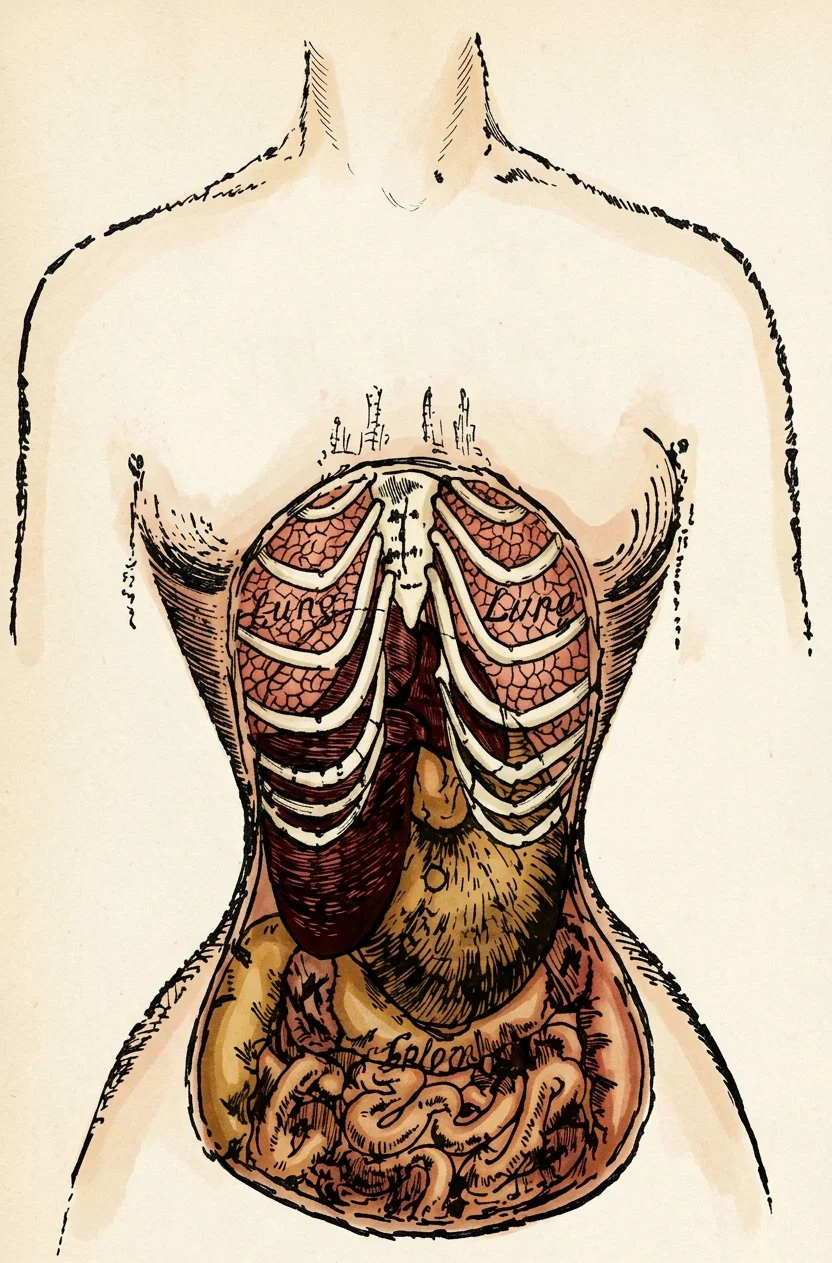
In the physiologies we studied perhaps a long time ago, we learned that the trunk of the body is divided into the chest cavity and the abdomen by a dome-shaped muscle called the “diaphragm.” The chest cavity is a box formed by the spinal column at the back, the sternum in front, and the ribs at the sides, joining these two. In this compartment are found the heart, lungs, and large blood-vessels. Immediately below the diaphragm is the body’s workshop, where are located the stomach, liver, spleen, kidneys, etc.—all the appliances necessary to the manufacture of living tissue from the “raw material”—the food and drink taken—a work of no mean proportions, and certainly not of small importance, when we consider the ultimate results,—the works of men’s hands.
We will stop here a little and consider. The process by which the food we eat becomes incorporated into our living tissue is the mystery of our physical life, and can not be understood any more than is the mystery of our spiritual life. It is one of the things we know by faith. As we look the various parts of the machinery over, we must be forcibly impressed with several thoughts,—the wonderful adaptability of each portion, however small, to its peculiar use. There is no flaw anywhere. “Perfection,” in this particular, expresses it. Then the nicety, the exactness of the whole arrangement; nothing might have been a little longer, or a little smaller; its proportions are exactly adequate to the volume of work it is meant to do. If it were possible for us to look into this wonderful mechanism as it lives and moves, we would find not a particle of extra space; there is just enough, and none to spare. Each organ has its particular position also, and is so exactly fitted into it that it can not be moved in the least without crowding its neighbor.
In fact, the main supports of the abdominal viscera are the abdominal muscles and the juxtaposition of the organs themselves. We quote from “Influence of Dress,” by Dr. Kellogg:—
“How are all these important organs held in place? Altho fitted together with the nicety of an articulation, the viscera are certainly not held together by anything corresponding to the firm ligamentous bands which unite the osseous elements of a joint. . . . The so-called ligaments which hold in place the liver, stomach, spleen, and bowels, can not properly be called ligaments, as very little ligamentous tissue enters into its composition. . . . I think the idea is gaining ground among those who have made a special study of this subject, that the chief factors in the support of the pelvic viscera, as well as other of the organs of the lower trunk cavity, are the tone of the muscular walls of the abdomen and the juxtaposition of the organs themselves.”
We will leave this for the present, and consider the contour of this portion of the “human form divine.” The most noticeable features are the shape of the waist (which is elliptical), and the outline of the front abdominal wall (which describes a convex curved line), the curve being very slight at the top, gradually increasing toward the lower end. We also notice this wall is of soft, yielding tissue, unlike the bony protection placed around the chest cavity. (Let us keep in mind that the spleen, liver, stomach, pancreas, etc., are placed above or at the waist line.) From the foregoing the reason for the contour of the body as described, must be apparent. We must also recognize the fact that the external shape is an index of the internal condition. By this we mean that if the contour of the body is destroyed, there has been a corresponding change in size or position of the various organs, and this must result in impaired action, and consequent loss of power.
Let us clothe the described figure in conventional garb—corset, skirt-bands (unsupported), etc.—and what happens?—The front line of a corset or corset waist is concave, or, at best, straight, and when this is brought10into contact with the yielding abdominal wall, the contour is changed, and the shape of the waist becomes round.
But this can not take place without disarranging God’s plan. The various organs must be pushed downward (they can not go up because of the resistance of the diaphragm and chest walls); the whole mechanism is thrown out of gear. It is under the painful necessity of readjusting itself as best it can. No wonder a strong protest is sent up in the shape of pain, or a nameless misery, which is worse.
But is the uncomfortable feeling all the harm done?—By no means. The laws of our being can not be disregarded without consequences, which, unfortunately, are handed down from generation to generation, perhaps not in any specific disease, only a continually decreasing vitality. Weakened powers of resistance, which are easily overcome by dread diseases, attest to the sure results of transgression. “The wages of sin is death.” What, to compress the waist a sin! Why not? Have you, my dear sister, any right to slowly, but none the less surely, shorten your days? or if not so, to cut off a portion of your usefulness, which, after all, is the true measure of life? In the light of eternity lives are not measured by days or years, but by deeds. If the thought of harm toward your brother constitutes a heinous crime, how shall we escape the conclusion that deliberately destroying the health, so that your own life, and perhaps other’s lives, are to any extent robbed of any usefulness or beauty, is a sin?
We are in the world for a purpose. We have a work to do for ourselves and for the world at large. Mothers, how often do you think miserable feelings have led you to neglect something for which your little ones have suffered? And, O, how often little bodies have smarted as the consequence of mother’s ill feelings! You know and God knows. To be sure, tight, uncomfortable clothing is not responsible for it all, but it adds its share, and would remove much of the irritability.
If we could realize the wondrousness of this form we bear, if we could appreciate the fineness of the workmanship, surely we would not abuse it as we do. We would honor it for itself. And if we realized that in this body dwells the life of God, that he desires his Holy Spirit to dwell there, that this body is its temple, we would not deface what God has been pleased to call his dwelling-place. When he beseeches us to yield our bodies to him a living sacrifice, it is that he may honor us with his presence, and it surely can not but displease him when, at the dictates of fashion, we remodel that which was made after his own likeness. When we consider from whence is this pattern, and who the workman, we do not wonder at Shakespeare’s words: “What a piece of work is man! How noble in reason! How infinite in faculties! In form and moving how express and admirable! In action how like an angel! In comprehension how like a god! The beauty of the world! The paragon of animals!” But these words can hardly apply to the misshapen, distorted, and sometimes almost pitifully grotesque, figures we meet in our daily walk.
IDA M. POCH.
Our “Christian” Country.
There are those among the great movements of to-day who recognize the simple and obvious fact that the world is still “without God.” Miss Patterson, of Chicago, speaking not long since in Oakland, truly said: “The world does not yet know Christ, tho 1,900 years have elapsed since the command, ‘Go ye into all the world, and preach the Gospel,’ was given.” In South America there is but one missionary to every 600,000 people. Africa has one minister to every 250,000. China has a missionary to each 500,000. To many of these lands there are missionaries ready to go, but professed Christians, many of them abounding in wealth and luxury, have nothing to give. This great “Christian” country, as it is so often called, gives a paltry $5,000,000 for missions, but spends a billion dollars for intoxicating and malt liquors, between $400,000,000 to $500,000,000 for tobacco, $22,000,000 for chewing gum, and supports, it is said, a quarter of a million of prostitutes, but pays all told for home higher culture, church and mission work, and foreign missions, $105,000,000. “Evil men and seducers shall wax worse and worse, deceiving and being deceived.” “And My people love to have it so, but what will ye do in the end thereof.” Aye, but there is room for work.
Anti-Saloon League Organizes in California
The Tribune of this city (July 20) contains the following item:—
“The Anti-saloon League of the State held a breakfast in San Francisco yesterday, and afterward transacted some executive work. Rev. R. Whitaker of Fruitvale, Rev. Dr. E. S. Chapman of Oakland, Rev. F. D. Bovard of Alameda, and Dr. Hill of this city, were present, and it was decided to thoroughly organize the work in this State. It was agreed to appoint Mr. Robinson, of Michigan, to field work in this State. It is believed that Dr. Chapman of this city will be selected for the office of State superintendent.”
Liquor Dealers and the Santa Fe Railroad
PRESIDENT EDOFF, of the California Liquor Dealers' Association, the organization which threatened to boycott the Santa Fe Railroad on account of its order prohibiting its employees entering saloons, now states that no such action will be taken, as an arrangement mutually satisfactory has been entered into with the railroad company. If this arrangement means a withdrawing of the Santa Fe's order to its employees, it will show something of the power of the liquor men in attaining their own ends, even tho the lives of the traveling public are placed in jeopardy.
LIVED AND LOVED TOGETHER.
By Anon.
We have lived and loved together
Through many changing years;
We have shared each other's gladness,
And wept each other's tears.
I have never known a sorrow
That was long unshared by thee,
For thy smile can make a summer
Where darkness else would be.
Like leaves that fall around us
In autumn's fading hours
Are the traitor smiles that darken
When the cloud of sorrow lowers,
And tho many such we've known, love,
Too prone, alas! to range,
We both can speak of One, love,
Whom time could never change.
We have lived and loved together
Through many changing years;
We have shared each other's gladness
And wept each other's tears;
And let us hope the future
As the past has been will be;
I will share with thee thy sorrows
And thou thy joys with me.
—Anon.
TO SLEEP OR NOT TO SLEEP; THAT IS THE QUESTION.
By Julia H. Duffie
Why is it that people will swelter and gasp, passing sleepless nights in the most stifling corner of the room, when by a trifling exertion and the exercise of a little good sense they might sleep alongside the open window in close proximity to the best air outside?
It seems as unaccountably ridiculous as for one to perish from thirst within easy reach of a spring of fresh, cool water.
There are usually as many windows in a home as there are beds; then why not have the beds in front of the windows, and if we must have those eight-foot head-boards, do let us turn about at night, at least, and make our beds with the pillows at the low foot-board, thus permitting what air may be stirring to circulate freely about the head of the sleepers. Of course there are invalids and delicate children who could not endure so much exposure at first, but those in ordinary health, as well as many feeble persons, could very soon accustom themselves to these conditions, and be greatly benefited by them.
In all cases a draw curtain of cloth of sufficient thickness should be hung, which could be drawn over the lower half of the window almost without awakening whenever the air became too cool or damp to fall directly on the person, as it usually does before morning. Screens are also quite necessary for this mode of sleeping.
East or north windows are of course preferable, but those on the south or west side are better than none. In that case the sun needs to be shut off the bed during the hottest portion of the day.
A cool sponge bath just before retiring is a great promoter of rest and sleep, also leaving off every article of clothing worn during the day, and donning a fresh, cool sleeping robe. A little attention to these details will help us through the hot season very comfortably. Then—
Open the windows and let in the air;
Of great nature's bounties freely share;
She is kind to those who are true to her;
Then why share the fate of a trespasser?
JULIA H. DUFFIE.
PRESERVATION OF BIRDS.
The Massachusetts Legislature has passed a law prohibiting the wearing, selling, or having in possession, the feathers of song or insectivorous birds. Senator Geo. F. Hoar, who was one of the efficient workers for the law, wrote the following petition for the birds to the legislation, which we take from Our Dumb Animals:—
To the Great and General Court of the Commonwealth of Massachusetts:—
We, the song birds of Massachusetts and their play-fellows, make this our humble petition. We know more about you than you think we do. We know how good you are. We have hopped about the roofs and looked in at the windows of the houses you have built for poor and sick and hungry people and little lame and deaf and blind children. We have built our nests in the trees and sung many a song as we flew about the gardens and parks you have made so beautiful for your own children, especially your poor children, to play in.
Every year we fly a great way over the country, keeping all the time where the sun is bright and warm; and we know that whenever you do anything, other people all over the great land between the seas and the great lakes find it out, and pretty soon will try to do the same thing. We know; we know. We are Americans just as you are. Some of us, like some of you, came from across the great sea, but most of the birds like us have lived here a long while; and birds like us welcomed your fathers when they came here many years ago. Our fathers and mothers have always done their best to please your fathers and mothers.
Now we have a sad story to tell you. Thoughtless or bad people are trying to destroy us. They kill us because our feathers are beautiful. Even pretty and sweet girls, who we should think would be our best friends, kill our brothers and children so that they may wear their plumage on their hats. Sometimes people kill us from mere wantonness. Cruel boys destroy our nests and steal our eggs and our young ones. People with guns and snares lie in wait to kill us, as if the place for a bird were not in the sky, alive, but in a shop window or under a glass case. If this goes on much longer, all your song birds will be gone. Already, we are told, in some other countries that used to be full of birds, they are almost gone. Even the nightingales are being all killed in Italy.
Now we humbly pray that you will stop all this, and will save us from this sad fate. You have already made a law that no one shall kill a harmless song bird or destroy our nests or our eggs. Will you please to make another that no one shall wear our feathers, so that no one will kill us to get them? We want them all ourselves. Your pretty girls are pretty enough without them. We are told that it is as easy for you to do it as for Blackbird to whistle.
If you will, we know how to pay you a hundred times over. We will teach your children to keep themselves clean and neat. We will show them how to live together in peace and love and to agree as we do in our nests. We will build pretty houses which you will like to see. We will play about your gardens and flower-beds,—ourselves like flowers on wings,—without any cost to you. We will destroy the wicked insects and worms that spoil your cherries and currants and plums and apples and roses. We will give you our best songs and make the spring more beautiful and the summer sweeter to you. Every June morning when you go out into the field, Oriole and Blackbird and Bobolink will fly after you and make the day more delightful to you; and when you go home tired at sundown, Vesper Sparrow will tell you how grateful we are. When you sit on your porch after dark, Fife-bird and Hermit Thrush and Wood Thrush will sing to you; and even Whip-poor-will will cheer up a little. We know where we are safe. In a little while all the birds will come to live in Massachusetts again, and everybody who loves music will like to make a summer home with you.
The signers are: Brown Thrasher, Robert o' Lincoln, Hermit Thrush, Vesper Sparrow, Robin Redbreast, Song Sparrow, Scarlet Tanager, Summer Red Bird, Blue Heron, Humming-bird, Yellowbird, Whip-poor-will, Water Wag-tail, Woodpecker, Pigeon Woodpecker, Indigo Bird, Yellowthroat, Wilson's Thrush, Chickadee, King-bird, Swallow, Cedar-bird, Cow-bird, Martin, Veery, Vireo, Oriole, Blackbird, Fife-bird, Wren Linnet, Pee Wee, Phoebe, Yoke-bird, Lark, Sandpiper, Chewink.
WAIT AWHILE.
FATHER GRAHAM was an old-fashioned gentleman beloved by every one, and his influence in the little town was great, so good and active was he.
A young man of the village had been badly insulted, and came to Father Graham full of angry indignation, declaring that he was going at once to demand an apology.
“My dear boy,” Father Graham said, “take a word of advice from an old man who loves peace. An insult is like mud; it will brush off much better when it is dry. Wait a little, till he and you are both cool, and the thing is easily mended. If you go now, it will be only to quarrel.”
It is pleasant to be able to add that the young man took his advice, and before the next day was done the insulting person came to beg forgiveness.—Standard.
PROUD OF A PATCH.
A POOR boy with a large patch on one knee of his trousers was laughed at by a schoolmate who called him “Old Patch.”
“Why don’t you fight him?” cried one of the boys; “I’d give it to him if he called me so.”
“O,” said the boy, “you don’t suppose I’m ashamed of my patch, do you? For my part, I’m thankful for a good mother to keep me out of rags. I’m proud of the patch for her sake.”
A patch is better than a hole, and patched garments which are paid for are more comfortable than new ones which make a man afraid to meet his tailor.—S. S. Advocate.
Love Softens All Things
NOTHING is so fierce but love will soften; nothing so sharp-sighted in other matters but it throws a mist before the eyes on’t.—L’Estrange.
OUR WORK AND WORKERS.
A CAMP-MEETING for the western part of the State of Colorado has been announced for October 5-11, at Montrose.
ELDER D. A. BALL has been holding meetings in a Methodist Church at Sidney Center, N. Y., and reports that seven persons have fully decided to obey the Lord, and others are deeply interested.
“THE work in Boston, under the management of Elder Geo. B. Wheeler, is prospering very encouragingly, there having been several recent additions to the church there.” So says Elder H. W. Cottrell in the Review.
“FIFTEEN have taken a stand for the Sabbath of the Lord, and others are interested,” is the report from a tent effort at Grand Island, Neb., under the labors of Brethren E. L. Stewart, O. E. Jones, and L. V. Finster.
A REPORT to the Review from the Texas camp-meeting, at Fort Worth, during its progress, told of a deep spiritual interest, and a large outside attendance. A like report comes from the meeting at Springfield, Ohio.
THE new schooner Herald, which has been built for use on the Caribbean Sea, made her first start on a missionary trip on July 9, and is said to give good satisfaction. There is a call for experienced canvassers to work in the towns on the Caribbean Coast of Central America.
THE labors of Elder J. D. Pegg at Mayfield, Ky., have borne fruit. He reports that twenty are keeping the Sabbath of the Lord, and that there is an unusual interest on the part of the people to hear. Several hundred people went out to a lake near by to witness a baptismal scene.
A CAMP-MEETING for the special accommodation of the brethren in the southern part of Idaho will be held at Boise, September 23 to October 3. Another meeting for the eastern part of Oregon will be held at Union, October 7-17. Both these meetings will be under the auspices of Upper Columbia Conference.
THAT so-called Protestants are sometimes more intolerant than Roman Catholics was illustrated recently at Deer Park, Wash. Elder W. W. Steward had permission of two of the three trustees to use a certain schoolhouse for meetings, but when the time came, he found the house closed against him. However, the free use of a hall was granted by a merchant who is a Catholic.12
PROF. W. W. PRESCOTT is again in Battle Creek for a short time, assisting in the Sanitarium Summer School. He will shortly return to Europe with his family.
In addition to the laborers at the Los Angeles, Cal., camp-meeting mentioned last week, there were afterward added, Elders N. C. McClure, M. C. Wilcox, and R. S. Owen.
THE annual report from Texas Conference shows an increase of 209 members, not counting those received by letter from other parts. Six new churches were added to the conference during the year.
BROTHER G. R. HAWKINS writes as follows to the Des Moines Bulletin, of the work in Dubuque, Iowa: “The readers of the Signs are anxious to have readings, and are beginning to inquire about the Sabbath question. If there were ten or fifteen Bible workers here, I am sure they could be kept busy.”
THE tent work in Atchison, Kansas, has been attended with good results. New members have been added and backsliders reclaimed. In the forepart of the month a general meeting was held there, in which the Spirit of the Lord was present in a marked degree. Elder G. C. Rupert has had charge of the tent work.
A BROTHER in Waukon, Iowa, over seventy-five years of age, recently secured eight subscribers for the American Sentinel. Our older brethren are prone to deem themselves on the retired list, while there is still work that they can do. Here is an example for them. The Sentinel is always full of that information for the want of which the people of the United States are being unwittingly led into the delusive web of Church and State union.
WORD from Prof. W. E. Howell, who with his wife and Mrs. S. B. Kinner were released from Healdsburg College to inaugurate the new Chinese school in Honolulu, indicates that the work is in a prosperous condition. A number of wealthy Chinese merchants are promoting the enterprise, and it is hoped that their new building will be completed before the fall term begins. A branch school will be established on a neighboring island.—Christian Educator.
ELDER J. M. REES, president of Colorado Conference, reports a good work at Cripple Creek, in the face of very inclement weather. Cripple Creek is a mining region high up in the mountains, and the tent-meetings conducted by Elders Wilson and Curtis have been considerably hindered by storms of rain, hail, and snow. A church of twenty-nine members was recently organized there, and an effort is being made to build a house of worship. Brother Rees says there are more than 40,000 people in the Cripple Creek country, within a radius of fifteen or twenty miles.
CHINESE PERSECUTION.
Mr. GODDARD reports to the Missionary Herald a recent tour through the Ing-Hok District of Foochow Mission. He speaks as follows concerning the persecution of Christians at Gak-liang:—
“The beginning was back in May, and at one time we thought peace was secured, but later influential men took up the matter against the Christians and formed a compact with all the villages about by distributing cakes; two are given to each family, and over 9,000 were distributed. Whoever accepts them binds himself to the compact. In this case it was an agreement to have no fellowship with the Christians. This meant that the Christian storekeepers could do but little business, scholars would not come to Christian schools, and thieves and vagabonds would be free to molest Christians with impunity, and Christians from the outlying villages coming to sell produce would not be able to do so. The enemies, seizing one pretext or another, have led things from bad to worse. The village elders and constables are all against the Christians, and when appeal is made to the magistrate, he sends out runners who take the word of the elders and constables and they report: ‘There is no trouble down there,’ or, ‘The distribution of cakes is a village custom, and has no connection with the Christians,’ or, ‘The pastor is a busybody with a hasty tongue who stirs up strife,’ or, ‘The Christians refuse to pay taxes,’ etc.
“Now if the Christians were always faultless, and would only ‘tell the truth, the whole truth, and nothing but the truth,’ we could get to the bottom of the business; but, alas! they are first of all Chinese, and only recently converted from heathenism. They are sorely tempted, like all Chinese, to make out their side as all right, and I am afraid they have presumed on their growing numbers and connection with the ‘foreigners,’ who are supposed to have unlimited wealth and power, to boast and threaten. The Chinese idea is to look out for number one. All altruistic ideas of self-denial for others, or Christian ideas of humility and loving service, are unknown by inheritance. It is news to them that a loving, holy life conquers all things, that there is power in enduring patiently the devices of evil men. So they feel a little aggrieved because the wealth and power of foreign missionaries are not at once put at their disposal when persecution comes. But we are here to teach them that their only help is in Jesus and his teachings, and that with him to help they will conquer all things.
“They do not realize also that it is part of the Lord’s dealings with his children to test them and discipline them for better things. This is a spiritual teaching, and the Chinese are very materialistic. Is it strange that they should be staggered, at first, by actual persecution? If they give way a little, it is not because they are weak or unconverted, but because spiritual things are new to them. When we explain it to them, they use a very expressive word, ‘mó-huák,’ which means, ‘inevitable, we must endure it,’ and forthwith they patiently wait and suffer long. As they are slow to accept Christianity, they are slow to give it up. Of the 143 church-members at Gak-liang, half of whom joined this year, four months of persecution have only turned back six or seven. Praise the Lord!”
“Let me relate two of many instances of their steadfastness. A church-member from a little isolated village way up in the beautiful mountains came down with a back-load of wood to sell and to buy food. No one would buy of or sell to him because he was a Christian, and they took him by the queue and jostled him about. They so threatened and persecuted three Christian storekeepers that they fled the village and hid, but came back when I came to tell their story. That night a constable with twelve men visited the store of one of them, who a few years ago had came from Diong-loh, where he had learned to be a Christian, and asked to see goods and crowded into his store, and then into his loft, stole his money, and warned him to leave the village. He left that night, not knowing whither to go, and without money, but still a faithful Christian. God bless such and care for them!”