The Youth’s Instructor, Vol. L, No. 37

The Glory Revealed
Earlier text: Battles between Truth and Falsehood

Suggestive Program

1. Song.—No. 208, “Christ in Song.”
2. Prayer.
3. Opening Exercise, by leader and eight children.
Leader: Children, what is this day called?
Answer: Harvest Ingathering.
Leader: How did God’s people anciently celebrate it?
Answer: With sacred songs and thanksgiving.
Leader: How did they prepare for it?
Answer: Everything that could please the eye, and give expression to the universal joy, was brought from the woods.
Leader: How did the city appear?
Answer: The city bore the appearance of a beautiful forest.
Leader: What was the center of attraction?
Answer: The temple was the center of the universal joy.
Leader: What did the people bring in their hands?
Answer: From far and near the people came bringing in their hands a token of rejoicing.
Leader: What else did they bring?
Answer: Old and young, rich and poor, all brought some gift, as a tribute of thanksgiving.
Leader: Why do we observe this service?
Answer: Because the Lord has told us it would be well for the people of God at this time to do so.
4. Song.—No. 201, “Christ in Song.”
5. Class Exercise, by a teacher and a number of members of the school.
Teacher: What are we here for?
First Voice: To joyfully commemorate the blessings of God to us.
Second Voice: To celebrate the ingathering of the harvest of the earth.
Third Voice: To bring some gift as a tribute of thanksgiving to Him who has crowned the year with his goodness.
Fourth Voice: To point forward to the great day of final ingathering, when the Lord of the harvest shall have safely gathered the ransomed of the Lord into the heavenly Canaan.
Teacher: What is promised to the sowers?
Fifth Voice: “He that reapeth receiveth wages, and gathereth fruit unto life eternal: that both he that soweth and he that reapeth may rejoice together.”
Teacher: Is this time near?
Sixth Voice: “Lift up your eyes, and look on the fields; for they are white already to harvest.”
Teacher: Before the harvest, is there to be a time of trouble and trial?
Seventh Voice: “There shall be a time of trouble, such as never was.” We must through much tribulation enter the kingdom.
Teacher: Will the Lord forget his people in this trying hour?
First Voice: Did he forget faithful Noah when judgments were visited upon the antediluvian world?
Second Voice: Did he forget Lot when fire came down from heaven to consume the cities of the plain?
Third Voice: Did he forget Elijah when the oath of Jezebel threatened him with the fate of the prophets of Baal?
Fourth Voice: Did he forget Joseph surrounded by idolaters in Egypt?
Fifth Voice: Did he forget Jeremiah in the dark and dismal pit of his prison-house?
Sixth Voice: Did he forget the three worthies in the fiery furnace, or Daniel in the lions’ den?
In Concert: “Can a woman forget her sucking child? . . . yea, they may forget, yet will not I forget thee.”
Teacher: The people of God will not be left to perish. . . . There is a mighty earthquake, and God’s people are set free. . . . Soon the King of kings descends upon the cloud. He looks upon the graves of the righteous; then raising his hands to heaven, cries: Awake! Awake! Awake, ye that sleep in the dust of the earth, and arise! From the prison-house of death they come. Little children are borne by the angels to their mothers’ arms. Friends long separated by death are united, nevermore to part, and with songs of gladness ascend together to the city of God. . . . Jesus opens wide the pearly gates, and the nations that have kept the truth enter in. As they gather about the great white throne, gladness unspeakable will fill their hearts when they behold those whom they have won for Christ brought into the haven of rest to praise Jesus through the endless ages of eternity.
6. Song.—No. 441, “Christ in Song.”
7. Nature Lessons.
8. Song, appropriate for the lesson given.
9. Exercise for a number of the school.
Leader: What kind of home did God give to man?
Answer: “And the Lord God planted a garden eastward in Eden; and there he put the man whom he had formed.”
Leader: What grew in this garden?
Answer: “And out of the ground made the Lord God to grow every tree that is pleasant to the sight, and good for food; the tree of life also in the midst of the garden, and the tree of knowledge of good and evil.”
(Describe a tree, using Bible texts. As the verses are recited, the leader will note the parts of the tree named, and write them on the blackboard; as, branches, roots, leaves, etc., also the different kinds of trees, fruits, and flowers in the same way. Following are appropriate texts: Matt. 24: 32; Matt. 3: 10; Song of Solomon 2: 3; Ps. 52: 8; Luke 17: 6; Num. 24: 6; Isa. 44: 14; Song of Solomon 6: 11; Num. 13: 23; Isa. 17: 6; Isa. 35: 1; Matt. 6: 28, 29.)
Leader: What has come in among the flowers and fruit because of sin?
Answer: Repeat, in concert, Isa. 34: 13 and Matt. 7: 16.
10. Song.—No. 456, “Christ in Song.”
11. The Leader will repeat Exodus 25: 2 and Proverbs 11: 25.
12. Collection of Offerings.
(Concluded on page 7)
(Continued from page 8)
13. Gospel Farming. This exercise may be given by nine boys, each of whom will repeat, in order, one of the following texts: (1) Hosea 10: 12, beginning with, “Break up,” to the end of the verse; (2) 1 Cor. 9: 10: “He that ploweth should plow in hope;” (3) Ps. 126: 6; (4) Eccl. 11: 6; (5) Eccl. 11: 4; (6) 2 Cor. 9: 6; (7) Zech. 10: 1; (8) James 5: 7, 8; (9) Gal. 6: 9.
14. Song.—No. 447, “Christ in Song.”
15. Announcement of amount of collections and number of fields remembered.
16. Closing Song.—No. 448, “Christ in Song.”

Note to the Superintendent

Distribute your texts so that all will have a part, both old and young. Give twenty or thirty minutes to the nature lessons. Select some one for this work who is especially adapted to interest children.
In the first two exercises the answers are quotations from the writings of Mrs. E. G. White. It will be well to suggest that the donors write upon their envelopes the way their gifts were earned, as well as the field to which they shall go. Ida B. Hibben.

Over 225 Years

Is the total length of time the eight men named below have written shorthand. They are the most widely known, and stand highest in their chosen branches of the profession, of any stenographers in the world; and hence an unusual weight is attached to the unsolicited opinions they have expressed regarding “The Rogers Compendium of the Graham System of Shorthand:” —
“Does away with all useless study.”—Henry L. Dietz, Stenographer and Notary, Chicago, Ill.
“The best condensation of any shorthand system I have ever seen.”—James W. King, Official Stenographer, Three Rivers, Mich.
“More ounces to the pound and pounds to the hundredweight than has hitherto been dreamed possible.”—Thomas I. Daniel, for 32 years Official Stenographer, Jackson, Mich.
“No better text-book could be put into the hands of a pupil.”—James H. Emery, Official Stenographer, Toledo, Ohio.
“A monument of conscientious and intelligent labor.”—David Wolfe Brown (since 1864), Official Reporter of Debates, House of Representatives, Washington, D. C.
“One of the most advanced text-books for the successful teaching of shorthand that I have seen.”—Francis H. Hemperley, editor of “The Stenographer,” Philadelphia, Pa.
“Replete with practical shorthand information, and will fill a long-felt need in the shorthand world.”—Prof. F. B. Cornwall, Shorthand teacher, Columbia Commercial College, Evansville, Ind.
“The best arrangement for the study and acquirement of Graham stenography that I have ever seen.”—Ruel Smith, for twenty years Official Stenographer of the Maine Supreme Judicial Court, Bangor, Me.
Our specially low tuition rates for correspondence instruction based on “The Rogers Compendium” are in effect only until October 15.
FIRESIDE CORRESPONDENCE SCHOOL, Battle Creek, Mich.

SOLID THROUGH TRAINS OF

WIDE VESTIBULE COACHES and PULLMAN SLEEPING CARS BETWEEN Battle Creek and Chicago, Buffalo, New York, Philadelphia, Toronto, Montreal, Boston
For time-tables, descriptive matter, and information, apply to any representative of the company.

XIII — The Third Angel’s Message

(September 27)
MEMORY VERSE: “Here is the patience of the saints: here are they that keep the commandments of God, and the faith of Jesus.” Rev. 14:12.

Synopsis

Our last week’s lesson developed the truth that the forgiveness of sins makes God’s kingdom sure; for he that “hath given himself for us” (Eph. 5:2) has given righteousness for sin; and he that worketh righteousness shall never be moved (Ps. 15:2, 5): he is an everlasting foundation (Prov. 10:25); for he is built upon the Rock—Christ. 1 Cor. 3:11; Isa. 28:16.
This divine transfer of good for evil is seen in all God’s work. We bury in the earth all kinds of vegetables and seeds; they die, but in their place spring forth living things, teeming with life from God. As the blood courses through the body, what does it carry?—Life; all the little red cells are full of God’s fresh air, which they give to the tissues in return for their impurities. A divine exchange! and whenever we see God working, we are to know that he is doing just this kind of work, and is waiting to come into our heart and do the same thing.
The Seed of the universe has died, and has risen again to bring forth much fruit. John 12:24. “When thou shalt make his soul [life] an offering for sin, he shall see his seed, he shall prolong his days. . . . By his knowledge [of which faith is the basis, 2 Peter 1:5] shall my righteous servant justify many; for he shall bear their iniquities.” Isa. 53:10, 11.
All this is embodied in the message which is preparing the world (Rev. 14:6, last part) for the coming of the Seed. Verse 14. This message brings out a people who have patience, who keep God’s commandments, and who keep the faith of Jesus. Rev. 14:12.
Now one can not have patience without faith; for to faith it must be added. 2 Peter 1:5, 6. Neither can one keep the commandments without it; for “without faith it is impossible to please him.” Heb. 11:6. The third angel’s message, then, is to develop faith, and that at a time when it is scarcely found in the earth.
As the prophet Malachi looked into our time, he exclaimed, “Who shall stand when he appeareth?” (Mal. 3:2); when John caught a glimpse of the same scene, he cried, “Who shall be able to stand?” Rev. 6:17. “The ungodly shall not stand in the judgment” (Ps. 1:5), but the “house of the righteous shall stand.” Prov. 12:7. Moreover, the “everlasting gospel,” which is being preached at this time (Rev. 14:6), is God’s provision to make us stand. 1 Cor. 15:1, 2. Shall we not accept it?

Questions

  1. What truth makes God’s kingdom sure?
  2. What evidences do we see in nature that our God returns good for evil?
  3. What return is he waiting to make to us?
  4. Whose death makes this possible?
  5. What offering must we accept in order to become the fruit of the divine Seed?
  6. What will this prolong?
  7. What will his knowledge do for us?
  8. Have you accepted this offering?
  9. What message prepares for the coming of the Seed?
  10. Who is to be prepared?
  11. What are the characteristics of the people whom this message prepares?
  12. What do these characteristics show that the message develops in them?
  13. What does Christ say of the scarcity of faith at this time?
  14. How did the prophet Malachi and the apostle John feel over this present situation?
  15. Who will not stand in the judgment?
  16. Who will?
  17. What provision has God made to help us stand?

Understand the Way

The old proverb, “All’s well that ends well,” is a good motto after the work is finished; but, “Well begun is half done,” is a far better one in the beginning of a work. Solomon bears testimony to this fact when he says: “The wisdom of the prudent is to understand his way.”
As the harvest ingathering service comes more prominently before the people, some queries arise in the minds of those who are most deeply interested in it, that deserve careful consideration at this time, in order that we may understand the way, and may have the work “well begun.” Then the service will prove a blessing to the cause in general, and to the youth and children in particular.
One of these queries is: Could we not increase the interest in the service by having all the gifts turned into one channel, the relief of the schools, for instance, thus giving the children a definite end to work to? The name of the service indicates what it is—simply a gathering in of the harvest. We reap what we sow. He who sows best, and cultivates most carefully, will reap the largest harvest. If the field is left free for all to sow and cultivate, then each has an equal showing; but if the field is devoted to one enterprise alone, then he who has the largest amount of capital (influence) gets control of the field, and monopolizes it. When this is done, the one of small capital (influence) has no chance whatever. It does not lie in the province of the service to say where the offerings shall go; it is simply the time for gathering in the offerings to each and every enterprise for the furtherance of the gospel of the kingdom. Let each church be free to interest its children in that branch of the work most dear to the hearts of its members, and each enterprise be free to sow in the hearts of the people; and He who has promised that while the earth remains, seed-time and harvest shall remain, will bless both the sowing and the reaping.
Another query: Shall we appoint a definite day for the service? We believe that the results will prove more satisfactory by allowing each church to appoint its own harvest day, for this reason: Each one knows the most fitting time to gather in the fruit of its labor. If this is allowed, each church may call to its aid a sister church, and thus in some localities the children may enjoy several ingathering services.
Let me emphasize one thought in closing, and that is that we carefully guard against making a display of the musical or elocutionary ability of the children. May God’s people so be led of him that the coming ingathering may prove a blessing in many ways. Ida B. HIBBEN.

This Number

Of the INSTRUCTOR is largely filled with matter suitable to the season of harvest ingathering. No special date for holding the ingathering service is set, as it will of necessity be held at different times, according to the locality.
The program, on this page, has been carefully prepared, but it is only suggestive, and may be varied to fit the needs of different schools. The article on “True Science Study” will give suggestions for appropriate nature lessons; and the opening poem will make an excellent recitation. Other timely suggestions as to a proper understanding of the object of the ingathering, utility, decorations, etc., etc., will be a help to those who have a part in conducting such a service.
Our thanks are due to those who have worked so faithfully to make this special number a success; and we send it forth with the hope that it will indeed prove a blessing to all our Sabbath-schools as well as to the individual readers.
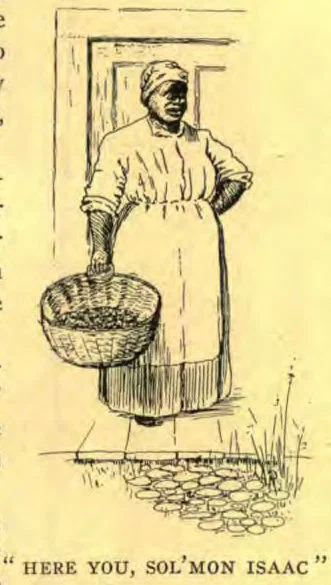
HERE YOU, SOL’MON ISAAC”

You have reached the end of this edition.

The Youth’s Instructor · September 18, 1902