The Youth’s Instructor, Vol. L, No. 37

The Glory Revealed

The Youth’s Instructor

September 18, 1902

Review and Herald Publishing Company · Battle Creek, Michigan · September 18, 1902

The Glory Revealed

“Show me thy glory, I beseech, O God! O let me see thy face, thou sovereign Lord! Then shall all other gods forgotten be, And I in truth shall worship only thee; All alien lords that have usurped thy throne Shall bow in dust before thee, stricken, prone.”

THE MIRROR

While thus, with longing gaze upturned, I prayed, A gentle voice was heard: “Be not afraid; No mortal can approach unto the light In which I dwell, and still survive the sight, And yet my image you may clearly see— Earth is the mirror of divinity.”

BEHOLD HIM!

And then I heard the burning seraphim, Who ceaseless sing the everlasting hymn: “Thrice holy is the Lord of hosts, and all The spacious earth is of his glory full!” And from the sky, the mountains, seas, and sod, The mighty chorus swelled: “Behold your God!”

HIS GLORY

The glorious sun and radiant silver moon Are servants at his gates, reflecting down Upon the waiting earth the faintest gleams Of the transcendent, uncreated beams Of righteousness, that from his being spring, And healing splendor shed on everything.

HIS BEAUTY

When thus the light of his sweet face is shed O’er all the earth, the things that he has made, Beholding and adoring, each must take Something of his fair likeness,—earth to make Like unto paradise, where all things fair The beauty of his holiness declare.

HIS LIFE

The thrill of life in each created thing Is the pulsation from his heart—the spring, The secret center, and the soul of all— From insect mote, to mighty, flaming ball. “All are but parts of one stupendous whole Whose body nature is, and God the soul.”

HIS LAW

One law the boundless universe controls: The lily grows, bird flies, and planet rolls, All governed by the same great law of love— The Spirit of his life that bids them move Guides each to its appointed destiny, Keeps all in everlasting harmony.

HIS LOVE

The love of mother for her offspring dear Is but a spark of the celestial fire, The Light of life that glows in every breast; He rocks each cradle, broods o’er every nest, And, the fierce savage and wild beast among, Yields milk of loving-kindness to their young.

HIS POWER

Girded with strength, he sets the mountains fast; Controls the raging seas; sends forth the blast Out of his treasuries; speaks in the peals Of mighty, rolling thunder; but reveals Not less his power in the growing blade That silently through earth its way has made.
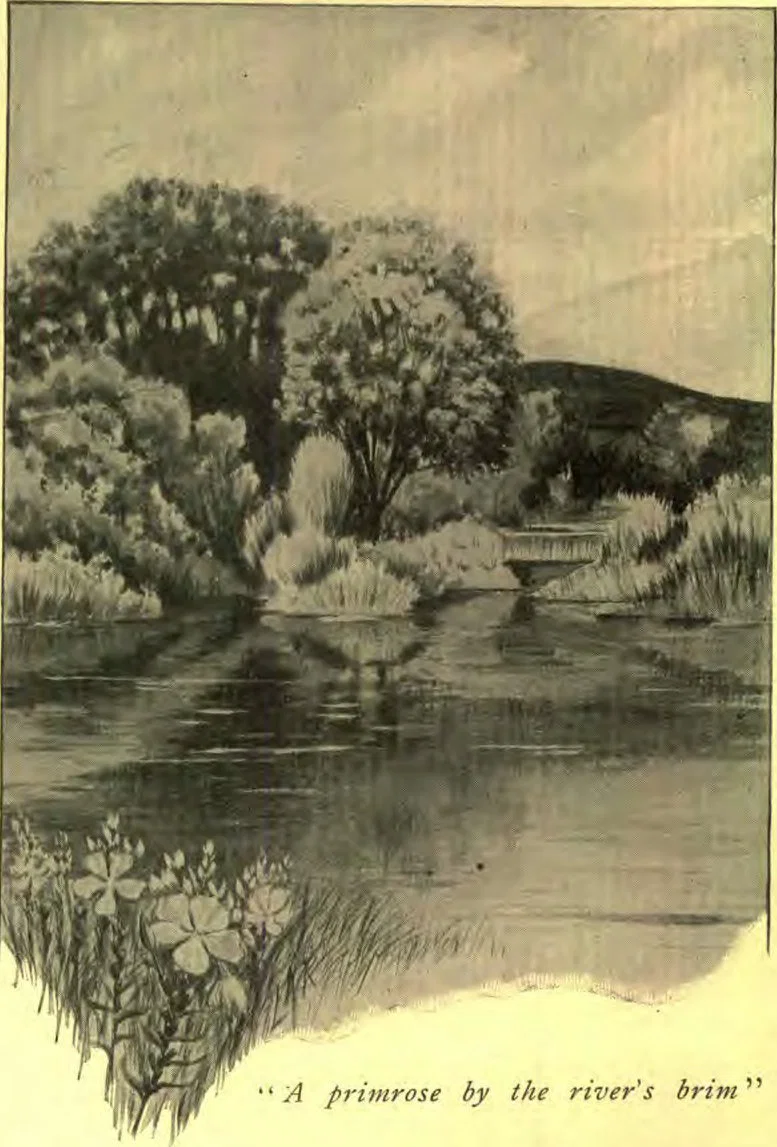
A primrose by the river’s brim

HIS FULLNESS

The fullness dwelling in him he outpours In life’s glad river, that o’erflows, and stores The earth with plenty; clothes the fields with corn; Sends springs into the valleys, rushing on To mighty rivers, that refresh the land, And spread a common feast on every hand.

CONCLUSION

And so thy glory I have seen, O God! Thy face shines forth from all, thou sovereign Lord! Now shall all other gods forgotten be, For I in truth can worship only thee: Like to the rapt, adoring seraphim Who see his glory, and must speak of him.
EDITH E. ADAMS.

True Science Study

NATURE is in truth the word of God; but the one whose studies of nature have been confined to school-book work in zoology, botany, and the like, can not see much of its truth,—not because what he studies is of itself false, but simply because he supposes that his study takes hold of the real essentials of nature, and is therefore likely to be satisfied with less than he might have. The anatomical study of nature is only the road to certain things, not the things themselves; and he who thinks that the facts taught by our common text-books are the great and only things of science to be learned, has stopped too soon on the highway of knowledge.
I would not decry botanical study, if entered upon with the proper purpose and understanding. I would not discourage it, if rightly gone into, any more than I would discourage a child from learning his letters. But if the child should think that learning the forms and names of the letters was the sum and substance, the whole end, of his labors, I should do my best to show him that a great world of art, literature, and letters lay far out beyond the narrow threshold of the alphabet that he was about to learn. I would seek to show him that the A B C was only a door to knowledge; that learning his letters was much like opening this door; and that out beyond this portal of the alphabet lay the real world to which he was to come. Last of all, I would be compelled to say that this alphabetical door had no excuse for existence unless it opened to lead him to this; and that he had simply wasted his time if, having opened it, he did not go forth to the great world that lay beyond.
So I would say that the great facts of nature should be learned, that we should study them as much as we can. But let us insist from the very beginning, and all along up to the very last, that these facts are but the doors through which we go to a higher and better knowledge. If these facts do not lead us to these higher things, they fail of their great purpose; and if we are content to learn only the facts, it is certain, to say the least, that we fail rightly to understand that purpose.
A man can become so wrapped up in the dry facts of botany that—
“A primrose by the river’s brim A diacotyledon is to him, And it is nothing more.”
But in every flower that blooms there flashes forth a message from the great heart of Eternal Truth. A bunch of grapes contains a whole revelation. Every spear of grass, every leaf—in short, all that nature has and is—breathes forth the word of God, and re-echoes all that he has said in law and promise and prophecy.
“IT HAS BROAD LEAVES”
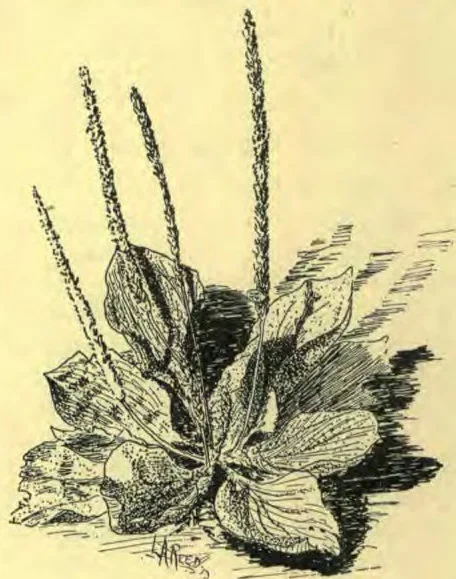
Take, for instance, the lesson of some of our common weeds. They live through droughts and wet seasons, through cold weather and through hot. How are they able to accomplish this?—Let us examine some of them. In almost every dooryard thrives that pest of lawn and garden, the plantain. It adapts itself with ease to various and varied surroundings,—that is one secret of its success, and one of the great lessons that it has to teach. If it grows in the uncut grass and weeds, it puts its leaves high enough to get the sun and rain necessary for life; if it happens to be living on a closely cut lawn, its leaves hug the ground; and if the seed-stalk is repeatedly cut off, the plant puts up successively shorter ones, and sooner or later, if not uprooted, produces seed, so that next summer there may be several plantains where now is but one. Thus it increases.
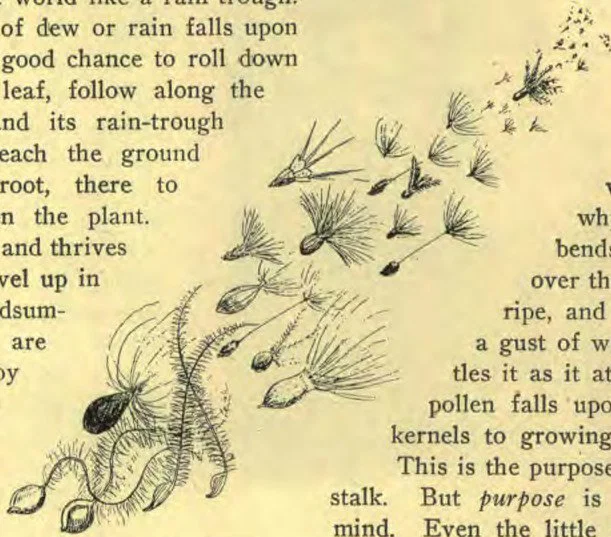
Then, too, it has broad leaves; but broad and crinkled as they sometimes are, their surfaces slope toward the midrib. And the stalk of the leaf is made for all the world like a rain-trough. So, you see, if a drop of dew or rain falls upon the leaves, it stands a good chance to roll down to the middle of the leaf, follow along the hollow of the leaf and its rain-trough of a stem, and so reach the ground quite close to the root, there to freshen and strengthen the plant. Thus the plantain lives and thrives when other plants shrivel up in the dry, hot days of midsummer. Further, there are many devices whereby the various weeds distribute their seeds. Some have little hooks, which stick into whatever touches them; others are tiny balloons, and soar away to some good growing spot. So it is that these plants flourish in the face of every difficulty, and increase in spite of every enemy.
BALLOONING SEEDS
BALLOONING SEEDS
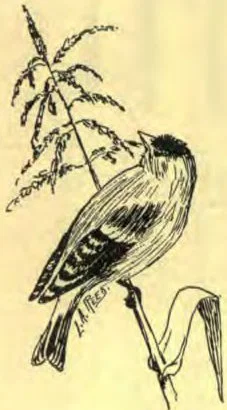
“A BIRD JOSTLES IT”
“A BIRD JOSTLES IT”
As we study this persistency of the weeds, what is it that we are studying?—Why, it is but the persistency of that word which cursed the earth, thus giving to man his portion of sorrow and labor. That word decreed that in the sweat of his brow, man should eat bread. Now if man, by persistent or even herculean labor, could, once and for all, destroy every vestige of weeds upon the earth, he would have gone far toward defeating the purpose of God.
But only momentarily can man gain advantage over the weeds. Like an unconquered enemy, they steadily return for another contest. They are never driven out for long; and as we study even a little into the secrets of their lives, we see that God has made so great provision for their existence that it is impossible ever entirely to conquer them. We acknowledge that God’s will is greater than our will, and in the life of the weeds we see one means by which the divine will succeeds in the carrying out of its all-wise and persistent purpose. Thus this sort of study, though it be but a study of weeds, is, after all, a study of the will of God, and of the means by which that will operates.
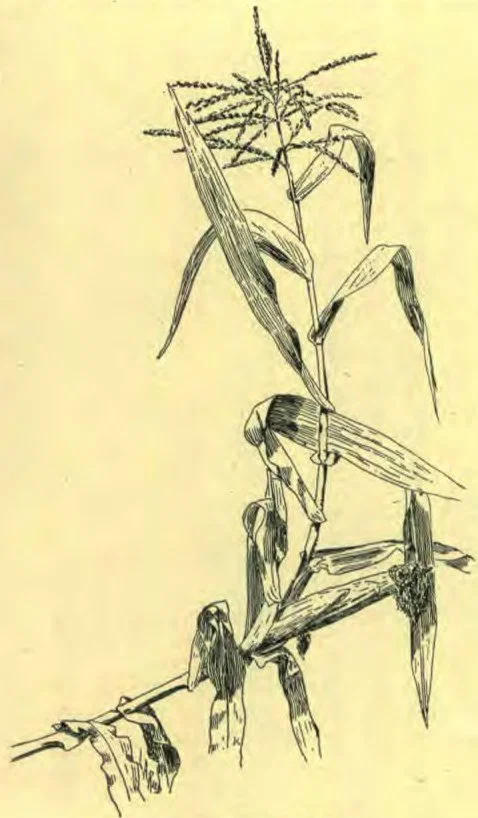
Take another example. Many a time I have seen a corn-stalk tumbled over by the wind and rain, and never thought for an instant that it could in its downfall teach me any special lesson worth mentioning. But it can. In the accompanying picture, I have tried to show one of several stalks that are growing in my garden. When this stalk first fell down, it was straight throughout its course. But very shortly after it fell, the stalk began to bend, and push its tasselled top up into the air. You will notice that the stalk bends almost entirely at that part where the ear is situated; true, the stalk bends to some extent above it, but there is little or no bend below the ear. Now why did the corn curve thus? and why did it bend almost entirely at this one part of the stalk?
In answering this question, let me say, first of all, that out of the end of the ear project very many fine fibers, which we call the “silk.” Each thread of this silk leads back to a kernel—or what is later to be a kernel—of corn. In order that a kernel shall develop, it is necessary that a particle of dust from the tassel, called “pollen,” shall fall upon the silk. This particle of dust follows up through a tube, so to speak, in the silk, until it reaches the spot where the rudiment of the kernel lies, and there begins a growth that ends only with a ripened kernel of corn. And so the work goes on for each kernel.
Now the dust must reach the silk, or the kernels of corn can not develop. A stalk of corn standing among other corn might get pollen from the tassels of its neighbors, but nature provides for each stalk as if no other were near. Thus you see why the stalk of fallen corn bends until the tassel is just over the ear. When the tassel is ripe, and the pollen ready to fall, a gust of wind comes, or a bird jostles it as it attempts to alight, and the pollen falls upon the silk, and sets the kernels to growing within the ear.
This is the purpose of the bend in the corn-stalk. But purpose is always an attribute of mind. Even the little folks know the meaning of doing things “on purpose.” A thing “done on purpose” means that some person has done the thing knowingly; that is, intentionally. But to know, to intend, to have a purpose, proves that it is a mind that thus knows, intends, and does what it does with a purpose.
Here is the corn plant. It has bent the tassel up above the ear intentionally,—yes, “on purpose.” But the corn-stalk has no mind, yet it does what any good mind would have it do. In other words, there is a mind somewhere thinking for the corn, and causing it to do just what it would do if it had a mind of its own. What mind is this?—It is the mind of the Creator. God thinks for the corn, and causes the corn to do just the right thing. The corn has the full benefit of God’s own mind.
But this is mind in nature. Yes; it is God in nature, of which you have heard so much. Here it is all clear and plain—God working in a common corn-stalk! It makes me stand in awe of it; not because the corn is so very much, of itself, but because I see that God is really working in it, though all these years I knew it not. Truly this world is the House of God, and all about us we find Gates to Heaven.
But that is what was said at the first. The facts of nature are but gates,—doors,—which we may open, and go forth to the great, true things of God.
This is true learning. This is true botany. This is true science. This is God in nature. And, acknowledged and confessed and lived out to its fullness, this is God in you, the everlasting gospel, the fullness of the word of God.
L. A. REED.

Rain and Its Lesson

On the second day, God “divided the waters which were under the firmament from the waters which were above the firmament.” Gen. 1:7. Later “there went up a mist from the earth, and watered the whole face of the ground” (Gen. 2:5); “for the Lord God had not caused it to rain upon the earth.” Rain came when “God saw that the wickedness of man was great in the earth” (Gen. 6:5); “and the rain was upon the earth forty days and forty nights.” Gen. 7:12. But we have his “token of a covenant,” that the bow shall be seen in the cloud, and “the waters shall no more become a flood to destroy all flesh.” Gen. 9:13-15.
God said to his children: “If ye shall harken diligently unto my commandments, . . . to love the Lord your God, and to serve him with all your heart, and with all your soul, that I will give you the rain of your land in his due season, the first rain and the latter rain, that thou mayest gather in thy corn, and thy wine, and thine oil.” Deut. 11:13, 14. We could have no harvest ingathering if “the Lord’s wrath be kindled against you, and he shut up the heaven, that there be no rain, and that the land yield not her fruit.” Verse 17. But in his loving-kindness he “sendeth rain on the just and on the unjust” (Matt. 5:45), to teach all to love their enemies. Matt. 5:44.
“Who hath measured the waters in the hollow of his hand? . . . Behold, the nations are as a drop of a bucket.” Isa. 40:12, 15. Yet “he shall come down like rain upon the mown grass: as showers that water the earth.” Ps. 72:6. “For as the rain cometh down, and the snow from heaven, and returneth not thither, but watereth the earth, and maketh it bring forth and bud, that it may give seed to the sower, and bread to the eater: so shall my word be that goeth forth out of my mouth: it shall not return unto me void, but it shall accomplish that which I please, and it shall prosper in the thing whereto I sent it.” Isa. 55:10, 11.
By faith and obedience we are baptized “with water unto repentance.” Matt. 3:11. We learn the lesson of humility by obeying our Master’s command, “Ye also ought to wash one another’s feet.” John 13:14. “And whosoever shall give to drink unto one of these little ones a cup of cold water only in the name of a disciple, verily I say unto you, he shall in no wise lose his reward.” Matt. 10:42.
The second and third angels pouring their vials upon the sea and upon the rivers and fountains of waters (Rev. 16:3, 4) is terrible to contemplate; but in the earth made new what a blessed contrast: “I will make them and the places round about my hill a blessing; and I will cause the shower to come down in his season; there shall be showers of blessing.” Eze. 34:26.
Close with song, “There Shall Be Showers of Blessing.” JEAN PHILLIPS.
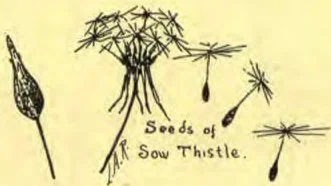
Seeds of A. Sow Thistle.
THE BENT STALK
THE BENT STALK

The Feast of Tabernacles

[Address given at the ingathering service in Oakland, California, Nov. 30, 1901.]
This thanksgiving service is in remembrance of the great Feast of Tabernacles, or ingathering service, celebrated by God’s ancient people. It followed closely after the day of atonement, when the sins of the people had been separated from them. Hence it was very appropriate for them to rejoice. As an expression of this joy, they each brought to Jerusalem a thanksgiving token; therefore it was called an ingathering. The feast lasted seven days, and, in addition to being a harvest thanksgiving, it symbolized the deliverance from Egypt and the sojourn of Israel in the wilderness. The people lived in booths, or huts made of green branches, to bring to their minds more forcibly that journey when all Israel lived in tents.
So much for the custom. But we certainly have reasons vastly greater than any of these to make appropriate such a service as this. Custom belongs to the past, but we belong to the present.
It seems to me that this is a principle upon which we should dwell, and, to make it clear, even to the children, let us illustrate it by giving the experience, as represented by one man, of a class of people who attended one of the last of the great Feasts of Tabernacles. This man was not satisfied with the forms and ceremonies of the Jewish church, even as many of us are not satisfied with our present standing before God. He had faithfully attended the various feasts and services held at Jerusalem, but they did not feed his soul. However, this time he went up with a feeling of joyful expectation, as it had been rumored that the Man of power, the wonderful Teacher, might be there.
He found the usual multitudes in the city; he saw the beautiful decorations everywhere, the armies of priests slaying the flocks of sacrificial victims. At night he saw the two great standards in the temple court, each bearing aloft four powerful lamps. He knew this typified the pillar of fire which led the people of Israel in the wilderness; but he wanted light for his feet now; no past illumination interested him, however brilliant it might have been.
So the time passed. The last day had come, and still no sight of the great Teacher. The man grew weary and sad. He had searched carefully and faithfully for the Man of power, but had not found him. On this last morning he found himself carried along by the vast throngs toward the temple, where the special service commemorating the smiting of the rock in the wilderness would take place. He saw the priest dip up a flagon of water from the neighboring brook, and ascend the steps to the altar. He saw the water poured into a silver basin, with its hole in the bottom, through which the water was carried back to the brook, and lastly to the sea. He was unmoved. He knew it represented the fountain of water which had gushed forth from the rock in the wilderness, bringing life to his forefathers and their famishing flocks. He even heard the song, “Therefore with joy shall ye draw water out of the wells of salvation;” but it was only a song of words. His heart remained as destitute of the true water of life as the silver basin through which the water had just passed.
Again this day he is in the vicinity of the temple. He sees some one in the distance addressing the people. He gets nearer and still nearer, until a single sentence, spoken louder than the rest, greets his ears, “If any man thirst, let him come unto me and drink.” Like a trumpet note that call thrills every fiber of his being. “If any man thirst,” thought he to himself. “Have I not thirsted all these years for power over sin? Of a truth this is the Man of power, the great Teacher. O, that I may hear more!” So closer and closer he edged his way, till he heard every word. Soon was made that other statement, which has lighted so many souls out of the dark maze of sin, “I am the Light of the world.”
His vision began to clear. He saw that the Christ who led in the wilderness was still leading, had led him that day; that the water which gushed forth from the rock was only a figure of the ever-flowing Fountain from which he was invited to drink. He did drink, thank the Lord, and went his way, not only with his thirst slaked, but he himself had become a fountain to which other thirsting souls might “come and drink.”
Brethren and sisters, the Lord is the same yesterday, to-day, and forever. If we have come here to-day with our hearts full of thanksgiving to him for his past blessings, and with our souls longing for power to overcome future temptations; if we have come, not because there will be a special program, but because we want the sweet presence of the Lord Jesus Christ in our lives, we shall not go away unsatisfied.
H. H. HALL.

Harvest Hymn

Now to God we lift our voices, For each thankful heart rejoices That the reaping time has come! Now the church her pæan raises, To the Father singing praises For the joys of harvest-home.
While the wintry winds are blowing, Through the fields we went forth sowing, Doubting what the year would bring; But we tell another story, Now the hills are crowned with glory, And the valleys shout and sing.
All the harvest’s treasures golden Tell us of the promise olden Which our future peace insures; As it was, it will be ever, Seed and harvest-time shall never Cease as long as earth endures;
For the Lord who clothes the meadows Will his flock through grateful shadows And refreshing pastures lead; He who from the highest heavens Stoops to feed the hungry ravens Will supply his children’s need.
Though we sow the seed in sadness, We shall come again with gladness Bringing home the golden sheaves; After nights of toil and sorrow Dawns at last a bright to-morrow, Which all former loss retrieves.
If we sow the seed from heaven, Unto us there shall be given Treasure in the world to come, Where the silver bells are ringing, And the angel reapers singing Joyful songs of harvest-home.
— Ellen Thorneycroft Fowler.

Recitation: Harvest Ingathering Lessons from Nature

Recitation

KIND friends, far and near, we welcome you here Our Harvest Ingathering to share, To join in our song, and our praises prolong For our bountiful Father’s care.
When far from his home our Saviour did come, To rescue from sin and the tomb, Grand lessons he drew, for me and for you, From nature’s decay and her bloom.
The mustard seed small to a spreading tree tall; The caroling birds in the trees; The sower that sowed; the reaper that mowed; The soft, gently whispering breeze;
The stars shining bright; the sun’s glorious light; The seed planted deep in the soil,— By him were all used, impressing grand truths On those whom he met in their toil.
From woodland and dale, from hillside and vale, We’ve gathered bright flowers and leaves, And woven them here in garlands of cheer Where Jesus his sweet Spirit breathes.
Glad praises we bring to Jesus our King, For the beauties of nature we see; To them now we turn a lesson to learn, That more like our King we may be.
Our Father, in love look down from above With smiles on our offering to-day, May thy Spirit’s power be felt here this hour, And follow us each on our way.
MRS. IDA B. HIBBEN.

A Practical Thought

HAVE as many of the members of the Sabbath-school as possible go to the woods, and gather bunches of autumn leaves, vines, berries, grasses, flowers, etc. The children may make long strings of red haws, and wreaths of autumn leaves, to be used as festoons, with a marked prettiness of effect. An arch in the front of the room where the meeting is to be held, covered with nature’s treasures, is a pleasing feature.
A prominent part of the decorations may be fruits and vegetables of the season, which should be distributed to the poor after the service. Do not have this done in a haphazard way; but before the service, let the poor and sick be sought out, and each gift brought intended for some specific purpose. Those who do not raise such products may provide sacks of flour or cans of fruit, or may bring potatoes, corn, etc. It is befitting at this time to remember the poor at home, as well as those we reach by the gifts to missions. Let the children feel that by distributing these things, they are doing missionary work for the Master. Do not make the mistake of having for decorations only that which is pleasing to the eye,—“nothing but leaves.”
Some of the children may have missionary gardens, a portion of which is set apart for this purpose; or they may piece quilts to be sent to the Orphans’ Home. The children of Elgin, Illinois, are working according to the parable of the talents,—to increase a penny given to each.
MINNIE A. PETERSON.

Giving Willingly: God Loves the Cheerful Giver

GIVE willingly. Remember that beyond the gift, God loves the “cheerful giver.”

Is It I?

LABORERS wanted! The ripening grain Waits to welcome the reaper’s cry; The Lord of the harvest calls again; Who among us shall first reply, “Who is wanted, Lord? Is it I?”
The Master calls, but the servants wait; Fields gleam white ’neath a cloudless sky; Will none seize the sickle before too late, Ere the winter’s winds come sweeping by? “Who is delaying, Lord? Is it I?” —Selected.
Continue reading: Battles between Truth and Falsehood