1 Corinthians 10:28
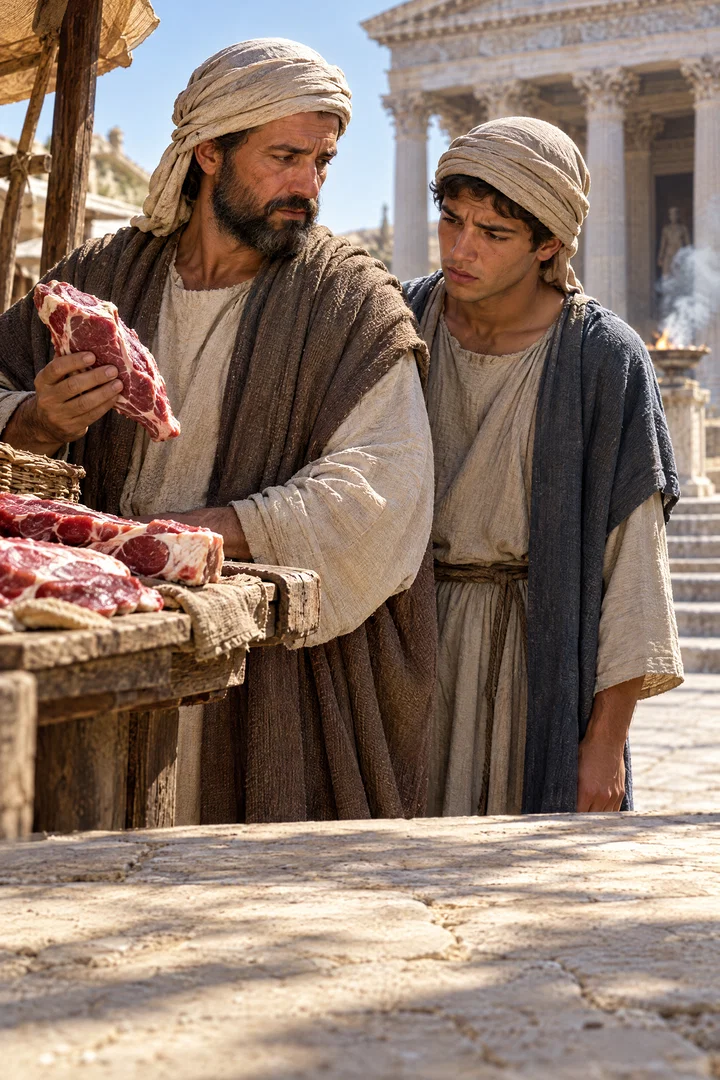
But if any man say unto you, This is offered in sacrifice unto idols, eat not for his sake that shewed it, and for conscience sake: for the earth is the Lord’s, and the fulness thereof:
Translations
But if any man say to you, This is offered in sacrifice to idols, eat not for his sake that showed it, and for conscience sake: for the earth is the Lord’s, and the fullness thereof:
King James Version, KJV Cambridge Paragraph Bible
But if any man say unto you, This is offered in sacrifice unto idols, eat not for his sake that shewed it, and for conscience sake: for the earth is the Lord’s, and the fulness thereof:
But if any man shall say to you, This is offered in sacrifice to idols, eat not for his sake that showed it, and for conscience' sake: for the earth is the Lord's, and its fullness:
But if any man say unto you, This hath been offered in sacrifice, eat not, for his sake that shewed it, and for conscience sake:
But if any man say unto you, This hath been offered in sacrifice, eat not, for his sake that showed it, and for conscience’ sake:
and if any one may say to you, 'This is a thing sacrificed to an idol,' — do not eat, because of that one who shewed [it], and of the conscience, for the Lord's [is] the earth and its fulness:
But if any one say to you, This is offered to holy purposes, do not eat, for his sake that pointed it out, and conscience sake;
But, if anyone should say unto you,—This, is, a holy sacrifice, do not eat, for that man’s sake who disclosed it, and for conscience sake:—
But if someone tells you, “ This food was offered to idols,” then do not eat it, for the sake of the one who told you and for the sake of conscience—
But if someone tells you, “ This food was offered to idols,” then do not eat it, for the sake of the one who told you and for the sake of conscience— for the earth is the Lord’s, and the fullness thereof—
But if anyone says to you, “ This was offered to idols,” don’ t eat it for the sake of the one who told you, and for the sake of conscience. For “ the earth is the Lord’s, with all its fullness.”
But if anyone says to you, This food has been used as an offering, do not take it, on account of him who said it, and on account of his sense of right and wrong:
But if any man say vnto you, This is sacrificed vnto idoles, eate it not, because of him that shewed it, and for the conscience (for the earth is the Lords, and all that therein is)
Douay-Rheims (Challoner revision)
But if any man say: This has been sacrificed to idols, do not eat of it for his sake that told it, and for conscience’ sake.
Pictures
Cross-references
- 1 Corinthians 8:4-13
As concerning therefore the eating of those things that are offered in sacrifice unto idols, we know that an idol is nothing in the world, and that there is none other God but one.
Idols cannot affect the food, but eating it may trouble a weak conscience.
- Psalms 24:1
The earth is the LORD’s, and the fulness thereof; the world, and they that dwell therein.
Both affirm that the earth and all it contains belong to the Lord.
- Romans 14:13-15
Let us not therefore judge one another any more: but judge this rather, that no man put a stumblingblock or an occasion to fall in his brother’s way.
Food liberty must yield to avoid grieving or stumbling another believer.
- 1 Corinthians 8:9-13
But take heed lest by any means this liberty of yours become a stumblingblock to them that are weak.
Personal freedom in eating idol food can wound another believer’s conscience and cause stumbling.
- 1 Timothy 4:4-5
For every creature of God is good, and nothing to be refused, if it be received with thanksgiving:
Both affirm receiving food with thanksgiving, while 1 Corinthians addresses meat associated with idol worship.
- Acts 15:28-29
For it seemed good to the Holy Ghost, and to us, to lay upon you no greater burden than these necessary things;
Directs Gentile Christians to abstain from food sacrificed to idols.
- Exodus 34:15
Lest thou make a covenant with the inhabitants of the land, and they go a whoring after their gods, and do sacrifice unto their gods, and one call thee, and thou eat of his sacrifice;
The command is cited as the basis for Jewish scruples about eating sacrificial meat.
- Psalms 115:16
The heaven, even the heavens, are the LORD’s: but the earth hath he given to the children of men.
Both affirm that the earth belongs to God and is given to humanity.
- Romans 14:21
It is good neither to eat flesh, nor to drink wine, nor any thing whereby thy brother stumbleth, or is offended, or is made weak.
Urges restraint in eating to avoid offending or weakening another.
- Romans 14:3
Let not him that eateth despise him that eateth not; and let not him which eateth not judge him that eateth: for God hath received him.
Both address disputes over eating and respecting another’s conscience.
- 1 Corinthians 10:21
Ye cannot drink the cup of the Lord, and the cup of devils: ye cannot be partakers of the Lord’s table, and of the table of devils.
Christians cannot share both the Lord’s table and the table of demons.
- 1 Corinthians 10:16
The cup of blessing which we bless, is it not the communion of the blood of Christ? The bread which we break, is it not the communion of the body of Christ?
The passage contrasts sharing the Lord’s table with idolatrous participation.
- Luke 10:8
And into whatsoever city ye enter, and they receive you, eat such things as are set before you:
Both instruct followers to eat what is set before them.
Commentary
Each commentary is drawn from primary sources: the writings of Ellen G. White and Adventist pioneers and periodicals. Each commentary is separate. Its own words are not a quotation; follow the references to read the source passages.
Ellen G. White
1 source
In diet reform the verse calls for real common sense that is studied broadly and deeply.MH 319.2 It forbids criticizing others whose practice is not in harmony in all things, because it is impossible to make an unvarying rule to regulate everyone's habits and no one is a criterion for all.MH 319.2 Not all can eat the same things, since foods that are palatable and wholesome to one person may be distasteful and even harmful to another.MH 319.2 Thus some cannot use milk while others thrive on it, some cannot digest peas and beans while others find them wholesome, and coarser grain preparations are good food for some while others cannot use them.MH 319.2
Sources
Pioneers and periodicals
20 sources
An idol is nothing and has no power over food, so offering food to it does not change what the food is or whether it is fit to eat.ST Sep 30, 1886RH Jul 22, 1902ST Dec 11, 1901 A believer is free to buy suitable food in the market or eat at an unbeliever's table without asking about its history, and should not raise the question.ST Jul 15, 1908ST Dec 11, 1901ST Apr 5, 1905 But once someone points out that the food was offered in sacrifice to idols, it must not be eaten, for the sake of the one who pointed it out and for conscience sake, lest a weak conscience be troubled or wounded, another be misled or made to stumble, or eating appear to honor idols and join in their worship.ST Sep 23, 1889ST Jul 15, 1908ST Sep 30, 1886 This freedom is not leave to use everything desired, but applies only to what is lawful and suitable in itself, with self-control, care for the body as bought with a price, and care to give no occasion of stumbling.ST Sep 23, 1889ST Dec 11, 1928ST Aug 25, 1909 For the earth is the Lord's and all its fullness, made by Him and bought back by blood, and all that is done, whether eating or drinking, is to be done to His glory.RH Jul 22, 1902ST Aug 25, 1909RH Aug 1, 1912
Eating Food Offered to Idols
An idol is nothing and has no power over food, so that offering food to it does not change its nature, quality, or fitness to eat.RH Jul 22, 1902ST Dec 11, 1901ST Apr 5, 1905ST Dec 11, 1928ST Dec 5, 1895 The dedication to an idol is therefore not in itself a reason to avoid the food, and refraining when it is identified as such is for conscience sake and not because the offering has altered it.ST Sep 30, 1886RH Jul 22, 1902ST Apr 5, 1905ST Dec 11, 1928ST Dec 5, 1895 The believer is free to buy and eat suitable food from the market or what is set before him at an unbeliever's feast without asking questions about its idolatrous history.ST Jul 15, 1908ST Dec 11, 1901ST Dec 11, 1928ST Dec 5, 1895ST Mar 19, 1894 The question should not be raised, since the scruples of one troubled by the association, especially one formerly an idolater whose conscience would be injured, are not to be needlessly provoked.ST Dec 11, 1901ST Apr 5, 1905ST Dec 11, 1928ST Mar 19, 1894 The inquiry the verse governs concerns only whether the food was offered in sacrifice to idols, not what kind of food it is or whether it is clean or unclean.ST Jul 15, 1908ST Dec 11, 1901ST Apr 5, 1905ST Dec 5, 1895ST Apr 29, 1913 It does not concern pork or other flesh as such, which could be known by sight without asking, nor dietary health in general, but only the food's association with idolatry.ST Sep 30, 1886ST Dec 11, 1901ST Apr 5, 1905ST Dec 5, 1895ST Apr 29, 1913
When any man points out that the food was offered in sacrifice to idols, it is not to be eaten, for his sake that showed it and for conscience sake.ST Jul 15, 1908ST Sep 30, 1886RH Jul 22, 1902ST Dec 11, 1928ST Dec 5, 1895 Abstaining then avoids troubling or injuring a weak conscience, misleading another, and causing a weaker brother to stumble.ST Sep 23, 1889RH Jul 22, 1902ST Dec 11, 1901ST Dec 5, 1895ST Feb 4, 1903 It also avoids appearing to honor idols or to endorse and support idol worship, and avoids joining in idolatrous worship itself.ST Sep 23, 1889ST Jul 15, 1908ST Oct 19, 1888ST Dec 11, 1928 Even what is otherwise lawful is to be given up when its use becomes a stumbling block, calling for self-control and care not to prejudice others against truth while not compromising principle or participating in sin.ST Sep 23, 1889ST Aug 25, 1909ST Feb 4, 1903 This liberty gives no permission to eat and drink everything desired, but applies only to what is lawful, suitable, proper to eat, and not evil in itself, and does not set aside what God has expressly forbidden as filthy, unhealthful, and vile.ST Sep 23, 1889ST Dec 11, 1928ST Mar 19, 1894 Suspected harmful food should still be examined, the body honored as the temple of the Holy Spirit bought with a price, all eating and drinking done to the glory of God, and no occasion of stumbling given to Jews or Greeks or the church of God.ST Sep 23, 1889ST Dec 11, 1928ST Aug 25, 1909ST Mar 19, 1894 For the earth is the Lord's, and the fulness thereof, and everything in it belongs to Him.RH Jul 22, 1902
Ownership, Principle, and Applications
The earth and everything in it belong to the Lord because he made it, and after humanity lost it through sin he purchased it back through his blood, and this ownership entitles Christ to worship.RH Aug 1, 1912 The declaration that the earth is the Lord's and its fullness stands together with Psalm 24:1 as proof of that universal possession.RH Aug 1, 1912
The verse belongs to the lessons and warnings God gave to Israel in the desert in health reform, set forth as examples for later believers to show that proper care of the body has great moral and spiritual value and is not too small a matter for God to care for.RH Apr 29, 1873 In these degenerate days it teaches care for bodies enfeebled by disobedience to physical laws, expecting men to do what they can for themselves, as in laboring for the products of the earth for health, before he gives the finishing touch of immortality by translation without death.RH Apr 29, 1873
Daniel followed the principle of the verse by choosing simple food rather than the king's table, refusing food dedicated to an idol when eating it would express sympathy with idolatry or entrap someone into that expression.RH Jun 11, 1908 Food offered to idols is therefore a matter of conscience, so that if someone identifies it as sacrificial food the Christian refrains from eating it for that person's sake and conscience.RH Feb 20, 1913RH Jun 11, 1908
The same concern for another person's conscience outweighing personal freedom applies beyond food.ST Sep 4, 1879RH Sep 15, 1859 Even if an activity would do no harm personally, taking part may encourage another person who has doubts to think it is right, so the principle requires refusing to attend the theatre rather than lending Christian influence to an activity that could mislead someone else.ST Sep 4, 1879 When it is made clear that a prayer is offered without regard to Christ, the Christian must not join in it or affirm it, because doing so compromises Christian faith.RH Sep 15, 1859
What is lawful without inquiry becomes unlawful once it is expressly named as offered to idols, and then it must be refused for the sake of him who pointed it out and for conscience sake.ST Aug 30, 1883 Resting on any day is in itself no physical or spiritual injury, just as eating food set before one is lawful, but when rest on Sunday is demanded because it is the Christian Sabbath substituted for the seventh day, keeping it for that reason is homage to the power that gave it its Sabbatic character and must be refused.ST Aug 30, 1883 Sunday first received its character as a rest-day from respect paid to Apollo the sun-god, and its professed Christian character from the man of sin, so to recognize it as a religious institution in place of the Sabbath of the Lord God is an insult to God, setting aside his own memorial and exalting a human religious innovation above it.ST Aug 30, 1883 Therefore God's authority must be respected, his commandments kept, and everything coming in conflict with them rejected, even if joined by a multitude.ST Aug 30, 1883
The verse belongs to instruction about eating food offered to idols and how God's children should relate to the customs around them.ST Aug 25, 1909 Questions of that kind that arise are settled by doing all, whether eating or drinking or whatever is done, to the glory of God, and by giving no occasion of stumbling to Jews or Greeks or the church of God, a rule that guides humble teachable believers at all times and under all circumstances.ST Aug 25, 1909
Sources