Romans 14:3
Let not him that eateth despise him that eateth not; and let not him which eateth not judge him that eateth: for God hath received him.
Translations
Let not him that eats despise him that eats not; and let not him which eats not judge him that eats: for God has received him.
King James Version, KJV Cambridge Paragraph Bible
Let not him that eateth despise him that eateth not; and let not him which eateth not judge him that eateth: for God hath received him.
Let not him that eateth, despise him that eateth not; and let not him who eateth not, judge him that eateth: for God hath received him.
Revised Version, American Standard Version
Let not him that eateth set at nought him that eateth not; and let not him that eateth not judge him that eateth: for God hath received him.
let not him who is eating despise him who is not eating: and let not him who is not eating judge him who is eating, for God did receive him.
Let not him that eats make little of him that eats not; and let not him that eats not judge him that eats: for God has received him.
Let not, him that eateth, despise him that eateth not, and let not, him that eateth not, judge him that eateth; for, God, hath received him.
Berean Standard Bible, Majority Standard Bible
The one who eats everything must not belittle the one who does not, and the one who does not eat everything must not judge the one who does, for God has accepted him.
Don’ t let him who eats despise him who doesn’ t eat. Don’ t let him who doesn’ t eat judge him who eats, for God has accepted him.
Let not him who takes food have a low opinion of him who does not: and let not him who does not take food be a judge of him who does; for he has God's approval.
Let not him that eateth, despise him that eateth not: and let not him which eateth not, condemne him that eateth: for God hath receiued him.
Douay-Rheims (Challoner revision)
Let not him that eateth, despise him that eateth not: and he that eateth not, let him not judge him that eateth. For God hath taken him to him.
Pictures
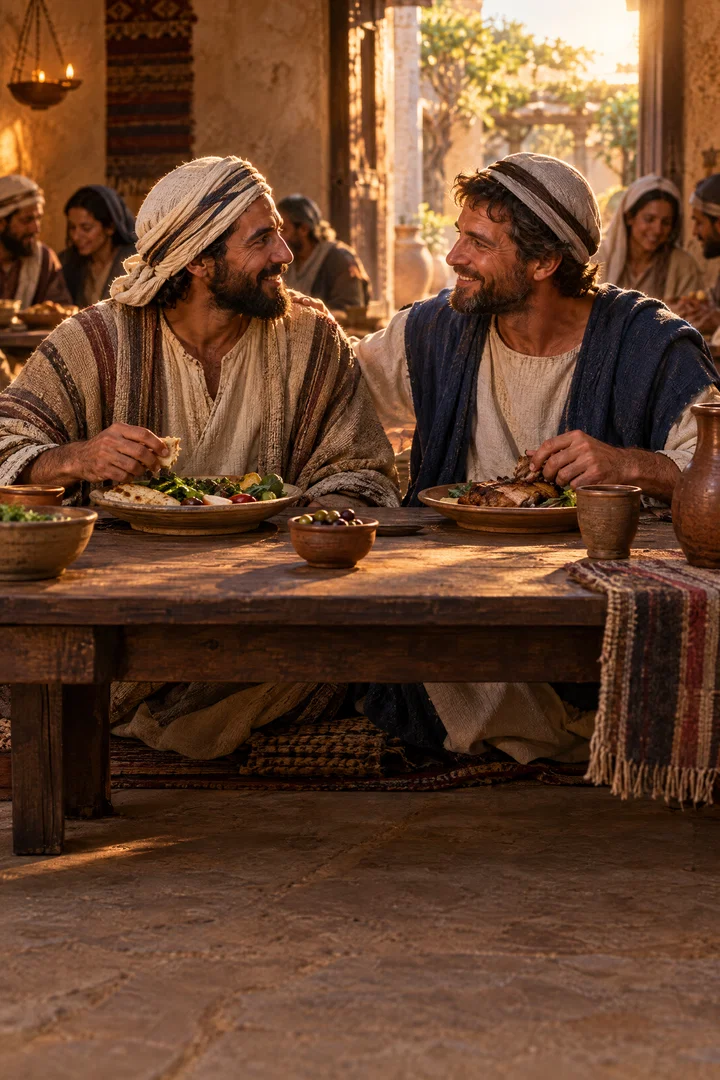
Cross-references 20 of 21
- Colossians 2:16-17
Let no man therefore judge you in meat, or in drink, or in respect of an holyday, or of the new moon, or of the sabbath days:
Both address judgment over food and special days understood as ceremonial observances.
- Romans 14:13
Let us not therefore judge one another any more: but judge this rather, that no man put a stumblingblock or an occasion to fall in his brother’s way.
Calls believers to stop judging and avoid causing another to fall.
- Romans 14:17
For the kingdom of God is not meat and drink; but righteousness, and peace, and joy in the Holy Ghost.
Food and drink are not the kingdom’s defining concerns; righteousness, peace, and joy are.
- Romans 14:10-12
But why dost thou judge thy brother? or why dost thou set at nought thy brother? for we shall all stand before the judgment seat of Christ.
All will stand before God and give account, rather than judge a brother.
- 1 Corinthians 8:8-13
But meat commendeth us not to God: for neither, if we eat, are we the better; neither, if we eat not, are we the worse.
Food does not commend believers to God, and liberty should not harm a weaker believer.
- Romans 14:19
Let us therefore follow after the things which make for peace, and things wherewith one may edify another.
Believers are urged to pursue peace and avoid causing one another to stumble.
- 1 Corinthians 10:25-28
Whatsoever is sold in the shambles, that eat, asking no question for conscience sake:
It gives rules for eating meat offered to idols, with regard for another’s conscience.
- 1 Timothy 4:3-4
Forbidding to marry, and commanding to abstain from meats, which God hath created to be received with thanksgiving of them which believe and know the truth.
God created every food to be received with thanksgiving, supporting liberty to eat or abstain.
- Romans 14:14
I know, and am persuaded by the Lord Jesus, that there is nothing unclean of itself: but to him that esteemeth any thing to be unclean, to him it is unclean.
A person’s conviction about food shapes whether eating it is clean to them.
- Romans 14:21
It is good neither to eat flesh, nor to drink wine, nor any thing whereby thy brother stumbleth, or is offended, or is made weak.
not causing brother to stumble
- Romans 15:1-2
We then that are strong ought to bear the infirmities of the weak, and not to please ourselves.
Urges the strong to bear with the weaknesses of others.
- Romans 14:23
And he that doubteth is damned if he eat, because he eateth not of faith: for whatsoever is not of faith is sin.
Acting while doubting is sin because it is not done in faith.
- Exodus 34:15
Lest thou make a covenant with the inhabitants of the land, and they go a whoring after their gods, and do sacrifice unto their gods, and one call thee, and thou eat of his sacrifice;
Its command is linked to Jewish concern about eating meat sacrificed to idols.
- Romans 14:15
But if thy brother be grieved with thy meat, now walkest thou not charitably. Destroy not him with thy meat, for whom Christ died.
Love forbids causing a brother to stumble through food.
- Matthew 7:1-5
Judge not, that ye be not judged.
Both warn against judging or criticizing others.
- Galatians 2:14
But when I saw that they walked not uprightly according to the truth of the gospel, I said unto Peter before them all, If thou, being a Jew, livest after the manner of Gentiles, and not as do the Jews, why compellest thou the Gentiles to live as do the Jews?
Peter’s conduct over eating with Gentile believers illustrates conflict over Jewish practices.
- Romans 2:1
Therefore thou art inexcusable, O man, whosoever thou art that judgest: for wherein thou judgest another, thou condemnest thyself; for thou that judgest doest the same things.
The one who judges another condemns himself.
- Romans 14:22
Hast thou faith? have it to thyself before God. Happy is he that condemneth not himself in that thing which he alloweth.
faith must be personal before God
- Colossians 2:20-23
Wherefore if ye be dead with Christ from the rudiments of the world, why, as though living in the world, are ye subject to ordinances,
Both reject judgment based on man-made rules about food and observance.
- 1 Timothy 4:4-5
For every creature of God is good, and nothing to be refused, if it be received with thanksgiving:
cited together as food texts to explain
Commentary
Each commentary is drawn from primary sources: the writings of Ellen G. White and Adventist pioneers and periodicals. Each commentary is separate. Its own words are not a quotation; follow the references to read the source passages.
Ellen G. White
3 sources
The verse forbids mutual contempt over food, requiring that the one who eats not despise the one who abstains, and that the one who abstains not judge the one who eats.MH 319.2Lt 331, 1904, par. 11TSSW 117.2 Criticism of another whose practice is not in all things in harmony with one's own is prohibited.MH 319.2 The restraint rests on the fact that God has received the other person.TSSW 117.2
In diet reform this means real common sense studied broadly and deeply, with no one making himself the criterion for all.MH 319.2 No unvarying rule can regulate everyone's habits, because not all can eat the same things.MH 319.2 Food that is palatable and wholesome to one person may be distasteful and even harmful to another.MH 319.2
For example, some cannot use milk while others thrive on it.MH 319.2 Some cannot digest peas and beans while others find them wholesome.MH 319.2 Coarser grain preparations are good food for some while others cannot use them.MH 319.2
Each person may follow conscientious convictions about diet without being pressured to conform.Lt 331, 1904, par. 11 Differences in experience, habits, understanding, and how difficult a particular duty is call for self-control, forbearance, and sympathy rather than judgment.TSSW 117.2 Such differences over food should not cause disturbance or division among brethren.Lt 331, 1904, par. 11
Sources
Pioneers and periodicals
76 sources
The verse addresses divisions in the early church between Jewish converts who still held to ceremonial food rules and feast-day observances and Gentile believers who did not, as the church moved from the ritual system to the gospel.RH Feb 14, 1856RH Apr 21, 1851ST Aug 11, 1909 Its topic is meats and kindred ceremonial distinctions and the days associated with them, not the seventh-day Sabbath, the fourth commandment, or the moral law.RH Feb 14, 1856RH Apr 21, 1851RH Mar 14, 1854 The one who eats must not despise the one who abstains, and the one who abstains must not judge the one who eats, over eating, drinking, and days.ST Apr 21, 1914ST Nov 11, 1930 The reason for this forbearance is that God has received both the one who eats and the one who abstains, and that acceptance is sufficient.RH Feb 14, 1856RH Apr 21, 1851 Each believer stands or falls to his own Master, who is able to uphold him, and is accountable to God rather than to fellow believers, for God alone is Judge.ST Jul 12, 1910ST Aug 11, 1909ST Feb 11, 1913ST May 17, 1910
Historical Dispute Over Food
The division lay between Jewish converts who held to ceremonial food rules and feast-day observances and Gentile believers who did not, as the church passed from the ritual system to the gospel.RH Feb 14, 1856RH Apr 21, 1851ST Aug 11, 1909RH Apr 21, 1851RH May 23, 1854 The weak in faith were to be received without judging their thoughts, and neither eating nor abstaining proved anyone unsound in the faith, since God had received both the one who eats and the one who abstains.RH Feb 14, 1856RH Apr 21, 1851ST Aug 11, 1909ST Aug 20, 1896ST Apr 1, 1889 Jewish believers who continued to keep annual feasts such as Passover or the Day of Atonement were not to be condemned by those who saw those types fulfilled in Christ, provided they did not treat the observances as a means of justification and kept them for the Lord.RH Feb 14, 1856ST Apr 1, 1889 Those Mosaic food rules were not to be imposed on Gentiles as burdens required by the gospel, and the instruction met a division in the apostolic church that no longer exists in the same form.RH Apr 21, 1851RH May 23, 1854
The contrast is between one who believes he may eat all nourishing things and one who is weak in faith and eats only herbs, meaning cultivated plants and vegetables.RH Apr 20, 1876RH Aug 11, 1904ST Aug 20, 1896RH May 9, 1854ST Jan 2, 1907 The abstainers regarded distinctions in food as binding because of earlier training, while other Christians considered wholesome, nourishing foods permissible.RH Apr 20, 1876RH Aug 11, 1904 Both could act with an honest regard for God, and those who have found righteousness, peace, and joy in the Holy Spirit must not judge one another over such minor matters, though those who believe all foods may be eaten are nearer right.RH Apr 20, 1876RH Aug 11, 1904ST Jan 2, 1907 The rule concerns obedient believers differing over nonessential matters, not a license for disobedience, and either person is not necessarily right simply because he is received.ST Nov 24, 1909
Part of the food question concerned meat that had been offered in sacrifice to idols, of which only part was offered and the rest was eaten by the worshiper or sold in the market like other meat.ST Sep 30, 1886ST Oct 19, 1888 Jewish believers scrupled that eating it acknowledged the idol or had fellowship with idolatrous sacrifices forbidden by their law.ST Sep 30, 1886ST Oct 19, 1888 Such meat may be eaten like any other meat, since the food itself is not made unlawful by dedication to an idol, unless it is expressly pointed out as having been offered to idols and eating it would be understood as giving approval to idol worship.ST Sep 30, 1886ST Oct 19, 1888 The dispute therefore concerned scruples about idol meat and matters not expressly forbidden in Scripture, not pork and not permission to eat anything God has forbidden.ST Dec 30, 1913ST Sep 30, 1886 Liberty here must act in love so as not to become a stumbling-block defiling and destroying the weak conscience of a brother lately out of heathendom for whom Christ died, even to abstaining from flesh rather than cause stumbling, because food does not commend anyone to God.ST Feb 22, 1883ST Feb 4, 1903
The related days are the yearly ceremonial feasts and fasts such as Passover eaten with bitter herbs and unleavened bread, the Day of Atonement, and feast-day sabbaths, which some still kept while others counted them like other days.ST Jul 12, 1910RH Aug 28, 1853ST Jul 23, 1896RH May 5, 1851 In the mixed church at Rome some Jewish believers still ate the Passover with bitter herbs and observed the yearly feasts, fasts, and sabbaths, while others saw no obligation in these ceremonial days.ST Jul 12, 1910ST Jul 23, 1896 Those Jewish feast-days on which certain meats were eaten were not essential to salvation, no more than circumcision, and no one was bound to keep them, those who did not observe them having Christ the fulfillment of what the festivals symbolized.RH Aug 28, 1853 The choice about observing such a day was left with the individual and the Lord as a matter of personal conviction, and the toleration taught covers only the ceremonial days placed in man's keeping, the six working days.ST Jul 23, 1896
Both sides could act from honest regard for God and sincere conviction while receiving greater light, with those of greater understanding showing charity toward those with less, since each is to live by the light and evidence available.RH Feb 14, 1856RH Apr 20, 1876RH Apr 20, 1876ST Feb 20, 1907 Observing or not observing those ritual practices of the Jewish ritual system was a matter of indifference when no one sought justification through them or rejected Christ's sacrifice.ST Sep 16, 1875ST Apr 1, 1889 Differences over these nonessential customs and former religious observances must not break Christian fellowship, nor should liberty be used in a way that could prejudice a weaker believer against the gospel.RH Apr 20, 1876RH Apr 20, 1876 The eating dispute included Mosaic distinctions about clean and unclean foods and Jewish notions about eating that troubled Gentile believers, and “him that eateth not” does not mean that some Christians lived without eating.RH Aug 5, 1852RH May 23, 1854RH Nov 25, 1852RH May 2, 1854RH Apr 21, 1851 Those who held that no distinction between clean and unclean meats is now recognized used the verse to place Ezekiel 44:23, 31 with its recognition of clean and unclean meats in the Mosaic dispensation as incapable of future fulfillment.RH May 25, 1876RH Jan 20, 1853
Sabbath Not In View
Romans 14:3 does not refer to the seventh-day Sabbath, the fourth commandment, the moral law, or the Ten Commandments, but to meats and kindred ceremonial distinctions and the days associated with them.RH Feb 14, 1856RH Apr 21, 1851RH Mar 14, 1854ST Dec 8, 1881ST Mar 25, 1875 It forbids the one who eats to despise the one who abstains and the one who abstains to judge the one who eats, because God has received both, and the disagreement concerns Jewish food practices and feast days kept from sincere conviction while receiving greater light about the gospel.RH Feb 14, 1856RH Apr 21, 1851RH Mar 14, 1854 The eating and abstaining concern food connected with feast days and governed by ceremonial rules, limited to matters that are permissible or indifferent, belonging to the Jewish ritual system rather than to the Sabbath.RH Mar 14, 1854ST Dec 8, 1881ST Mar 25, 1875ST Sep 16, 1875 Observing or not observing those ritual practices is a matter of indifference so long as no one seeks justification through them or rejects Christ's sacrifice.ST Sep 16, 1875
The verse does not prove or teach the abolition of the Sabbath or the commandments, and to use it that way is inferential, without plain mention or starting point.ST Mar 25, 1875RH Aug 5, 1852RH Dec 20, 1853RH Aug 13, 1857 There is no explicit statement abrogating God's Sabbath in the chapter, which concerns another subject, and making it do so would contradict Paul's affirmation of the perpetuity of the law in the same epistle.ST Mar 25, 1875 It is therefore not a justification for setting aside God's commandments or the Sabbath, since it rejects the claim that Christ abolished or superseded the Decalogue.RH Aug 5, 1852 It does not mention the Lord's Sabbath and is not plain, direct proof of its abolition.RH Dec 20, 1853RH Aug 13, 1857RH Mar 21, 1854
The days in view are ceremonial feast-day sabbaths and yearly sabbaths that ceased and were nailed to the cross, entirely distinct from the weekly Sabbath.RH Mar 29, 1864RH Aug 19, 1851RH Aug 19, 1851ST May 17, 1910ST Jul 23, 1896 The instruction not to despise or judge over eating applies only to distinctions of meats and drinks belonging to the Jewish ritual with its carnal ordinances and feast days and yearly sabbaths, during the change from that ritual system to spiritual worship of Jesus.RH Mar 29, 1864 Eating all things or eating herbs was a matter of indifference so long as no one sought justification through those observances and thereby rejected the sacrifice of the Saviour.RH Mar 29, 1864 The rule governs intercourse with weak brethren not so well instructed, requiring forbearance between Gentiles and Jews, while leaving the Sabbath by itself on its foundation, since nothing about ceremonial meats and drinks was written in what was spoken by God's own voice and engraved on the tables of stone.RH Mar 29, 1864RH Aug 19, 1851
That weekly Sabbath belongs to an entirely different moral system, spoken by God's voice, engraved on stone, kept as God's creation memorial and type of future rest.RH Mar 29, 1864RH Aug 19, 1851RH Aug 19, 1851RH Mar 24, 1874 What is referred to is the Jewish ritual and Mosaic ritual services finding their antitype in Jesus and the coming glories of the great salvation, with ceremonial holy days and sabbaths done away in Christ while the Sabbath remains.RH Aug 19, 1851RH Aug 19, 1851 The mixed church at Rome included some Jewish believers who still ate the Passover with bitter herbs and observed yearly feasts, fasts, and sabbaths, while others saw no obligation in these ceremonial days and counted them like all other days.ST Jul 23, 1896 The toleration taught covers only the ceremonial days placed in man's keeping, the six working days, and old traditions, with each person's practice directed toward the Lord and no judging of brethren, giving no license to disregard God's law or the Sabbath founded on God's Word.ST May 17, 1910ST Jul 23, 1896 No one is judge of a brother over such doubtful propriety, for such matters are between his soul and God, who alone judges and is able to make him stand.ST May 17, 1910ST Jul 23, 1896RH Mar 24, 1874
The verse does not make keeping the Sabbath or the fourth commandment optional, does not give liberty to break God's law or choose any day for the Sabbath, does not establish Sunday keeping, and gives no ground for charging Sabbath keepers with falling from grace or being weak in faith.ST Dec 30, 1913ST May 17, 1910ST Jan 3, 1878RH Aug 28, 1853RH Jun 24, 1852 Its expressions concern the ceremonial law, not the weekly Sabbath or any commandment of the universal moral law, and therefore do not establish a dispute over which day to observe.ST Jan 3, 1878 Jewish feast-days on which certain meats were eaten with bitter herbs were not essential to salvation, no more than circumcision, so no one was bound to keep them, and if more than those optional observances were meant the words about eating and not eating would equally prove that some people ate nothing at all.RH Aug 28, 1853 To treat the weak in faith as given liberty to keep or break the fourth commandment is condemned, for the commandment remains binding and keeping it does not make a person weak in faith.RH Jun 24, 1852 The food question concerns scruples such as meat that may have been offered to idols, not permission to eat anything God has forbidden, addressing how believers treat one another in matters not expressly forbidden in Scripture without overturning the seventh-day Sabbath command or establishing Sunday keeping as a way to gain heaven.ST Dec 30, 1913ST Jun 22, 1904
It does not deal with doing God's righteous will or permit choosing any day for the Sabbath or keeping no Sabbath, since God's children put away all sin and by the Spirit fulfill the righteousness of the law and keep His Sabbath without question.ST Jun 22, 1904 It deals with personal duty between the soul and God, where each must be fully assured in his own mind before God's judgment seat, while also requiring believers not to put a stumbling block or occasion of falling in a brother's way over food and still wishing to keep former feast days and fast days.ST Jun 22, 1904 The esteeming of every day does not include the Lord's Sabbath, the same expression being used elsewhere where the Sabbath is certainly not included. The chapter does not identify which day was disputed, and grouping the disputed day with questions about meats and herbs does not show that the day was the Sabbath, since the fourth commandment does not stand associated with things of this kind.RH Jan 13, 1852 The days in the discussion are connected with distinctions about food, including whether to keep the Passover, and do not make every day alike or include the Sabbath, leaving the choice about observing such a day to each person's conviction.RH Jan 13, 1852
The chapter bears on regard for days parallel to Galatians 4:10, but it does not teach that Paul regarded Sabbath keeping as dangerous. Reading Galatians 4:10 to condemn Sabbath keeping contradicts the argument drawn from Romans 14. Those who held otherwise taught that the Sabbath is a Jewish institution that Christians may keep or leave aside as they choose, that there is no distinction among days, and that each person may choose to observe or refrain from observing any day.RH Nov 8, 1853RH Feb 3, 1852 In that minority use, Christians are not to despise believers who observe Jewish days, including the seventh day, or judge those who do not, with such observance treated as a weakness to be borne with among converted Jews rather than a reason to reject them, since God has received them.RH Apr 1, 1873
Mutual Forbearance Commanded
The one who eats must not look down on the one who abstains, and the one who abstains must not condemn the one who eats, in matters of eating and drinking and days, because God has received both.ST Apr 21, 1914ST Nov 11, 1930RH Mar 11, 1862RH Oct 19, 1916 Differences of conscience on these scrupulous matters are not grounds for denying one another fellowship, and dietary differences do not make one believer judge over another.ST Nov 11, 1930ST Jul 29, 1897 Their faith is personal before God, and acceptance by Him is sufficient reason for mutual forbearance.ST Apr 21, 1914RH Oct 19, 1916
Differences over these scruples must not break Christian fellowship, and the weak in faith must be received without judging his thoughts.RH Apr 20, 1876RH Apr 20, 1876ST Aug 20, 1896 Both sides may act from honest and serious regard for God, the one holding food distinctions as binding from earlier training and the other counting wholesome nourishing foods permissible, and neither difference proves either side unsound in the faith.RH Apr 20, 1876RH Apr 20, 1876ST Aug 20, 1896 Believers are therefore to accept one another and not despise or condemn fellow Christians, treating one another with love and forbearance as servants of one common Master.ST Nov 11, 1930ST Aug 4, 1909ST Aug 4, 1909
The strong should bear the infirmities of the weak and show charity toward those with less understanding, rather than using liberty in a way that could prejudice a weaker believer against the gospel.RH Apr 20, 1876ST Feb 11, 1913 No stumbling-block or occasion to fall is to be put in a brother's way, and conduct that would cause a fellow believer to stumble is to be avoided, even by abstaining when love requires it.ST Jul 12, 1910ST Feb 11, 1913 This applies especially where a new believer thinks eating food once offered to idols acknowledges the idol or has fellowship with idolatrous sacrifice, while others know the idol has no power and the food itself is not made unlawful; the matter must not become a cause of dispute.ST Jul 12, 1910ST Sep 30, 1886
The instruction concerns nonessential, doubtful, indifferent, or permissible matters and former religious observances such as still keeping Passover, Atonement, and other feasts and holy days, not essentials.RH Apr 20, 1876ST Jul 12, 1910ST Dec 8, 1881RH Sep 24, 1872RH Mar 9, 1869 Disputes over religious circumstances that may be done or left undone must not embitter believers or divide those who follow Christ.RH Apr 20, 1876RH Sep 24, 1872RH Mar 9, 1869 The one great essential is faith in God leading to implicit obedience from the heart, which is worthless unless it comes home to the individual heart.RH Apr 20, 1876ST Jul 12, 1910
The verse is not a rule prescribing what foods people should eat, and it does not tell what a man should do morally but what he should not do, judge his neighbor.ST Aug 11, 1909ST Nov 24, 1909ST May 21, 1902 Its concern is differing practices among fellow church members and obedient believers who differ over nonessential matters, not a license to sin or to break God's commandments.ST Feb 11, 1913ST Nov 24, 1909ST Jun 22, 1904 One who chooses to disobey God's word will reap the wages of sin which is death, and one who feeds on what is unwholesome will reap disease, while choosing in harmony with God's word brings righteousness and peace and joy in the Holy Spirit by which God's word will judge in the last day.ST Feb 11, 1913ST Nov 24, 1909ST May 21, 1902 It does not permit choosing any day for the Sabbath or keeping no Sabbath, since God's children put away all sin and by the Spirit fulfill the righteousness of the law.ST May 21, 1902ST Jun 22, 1904
Those who have found righteousness, peace, and joy in the Holy Spirit must not judge one another over minor matters, though they may teach a better way without condemning.ST Jan 2, 1907RH Apr 22, 1915ST Jul 29, 1913 A believer who thinks another is wrong may speak with that person kindly and directly, and until the matter is discussed the proper response is prayer rather than spreading reports or condemnation, treating the other according to the golden rule.ST Jan 2, 1907RH Apr 22, 1915 Abstaining from particular foods or observing particular days does not save, for salvation is through Christ with obedience following from connection with him, and each must pursue what builds up while leaving the matter with the individual and the Lord to whom each will answer.ST Jan 2, 1907RH Apr 22, 1915ST Jul 29, 1913
God Receives And Judges
The ground of forbearance is that God has received both the one who eats and the one who abstains, and that acceptance is sufficient to forbid despising on the one side and judging on the other.RH Feb 14, 1856RH Apr 21, 1851RH Apr 20, 1876ST Dec 30, 1913 The difference concerns Jewish food practices and feast days, with one believing he may eat all nourishing, wholesome things and another who is weak in faith eating only herbs, and both may act from honest regard for God and sincere conviction while receiving greater light about the gospel.RH Feb 14, 1856RH Apr 21, 1851RH Apr 20, 1876RH Aug 11, 1904 The scruple includes meat that may have been offered to idols, yet the permission in view is only for matters not expressly forbidden in Scripture and does not overturn what God has forbidden or the seventh-day Sabbath command or establish Sunday keeping.RH Apr 21, 1851ST Dec 30, 1913 Dietary differences do not make one believer judge over another or prove either unsound in the faith, and freedom from adverse criticism is the main point, though those who hold that all foods may be eaten are nearer right.RH Apr 20, 1876RH Aug 11, 1904
Each believer stands or falls to his own Master, who is able to uphold him, and is accountable to God rather than to fellow believers.ST Jul 12, 1910ST Aug 11, 1909ST Aug 20, 1896ST Nov 24, 1909 The weak in faith must be received without judging his thoughts, since eating and drinking and days are not essentials and differences between brethren are expected, as when Jewish converts still observed Passover, the Atonement, and other feasts and holy days.ST Jul 12, 1910ST Aug 20, 1896 The strong should bear the weak's infirmities and put no stumbling-block or occasion to fall in a brother's way, looking instead to his own case and conduct so as to stand acquitted before God.ST Jul 12, 1910 This rule concerns obedient believers who differ over nonessential matters and does not mean either person is necessarily right or that disobedience is beyond judgment, for each will answer to God who receives those who honor Him according to conscience.ST Nov 24, 1909ST Mar 19, 1894
No believer is judge of a brother, for God alone is Judge, before whose judgment-seat all must appear and by whose law, including the Sabbath commandment, they will be judged.ST Feb 11, 1913ST May 17, 1910ST May 21, 1902 The chapter's purpose is to show how servants of one common Master are to regard one another in differing practices among fellow church members, directing each person's practice toward the Lord whether it concerns old traditions, ceremonial sabbaths, or Jewish yearly feasts.ST Aug 20, 1896ST May 17, 1910 Its concern is not a license to sin or to break God's commandments or to disregard God's law and Sabbath founded on God's Word, and even one doing what he believes is duty must not set himself up as judge over another person's heart.ST Feb 11, 1913ST May 17, 1910 Every person is left free to choose without compulsion, but the verse tells what he should not do, judge his neighbor, while leaving judgment with God and requiring each to make sure his own course is right.ST May 21, 1902 One who chooses to disobey God's Word will reap the wages of sin which is death, and one who feeds on what is unwholesome will reap disease, while choosing in harmony with God's Word brings righteousness and peace and joy in the Holy Spirit.ST May 21, 1902
Each person must be fully persuaded in his own mind and live by the light and evidence available, following conscience informed by God's word.ST Feb 20, 1907ST May 21, 1902RH Feb 13, 1872ST Jun 22, 1904 In matters where Scripture gives no direct order, such as raising swine to sell, no one may bind another's conscience.RH Feb 13, 1872 One who acts against such conscience is condemned by it, while one who does not know or understand may be justified in acting as he does, since those with greater understanding should show charity toward those with less.ST Feb 20, 1907 The question under discussion is faith, with one man's faith broad enough to eat all things while another differently educated confines his diet to herbs, meaning cultivated plants and vegetables, and neither is to pride himself in his virtue nor condemn his brother.ST Feb 6, 1896 This personal duty between the soul and God does not deal with doing God's righteous will and does not permit choosing any day for the Sabbath or keeping no Sabbath, since God's children put away all sin and by the Spirit fulfill the righteousness of the law and keep His Sabbath without question, while still not putting a stumbling block in a brother's way over food and former feast days and fast days.ST Jun 22, 1904
Mere doing or not doing a particular thing does not save, for salvation is through Christ and belongs to the kingdom of righteousness, peace, and joy in the Holy Spirit, with obedience following from connection with Him.ST Jan 2, 1907ST May 21, 1902ST Jul 29, 1913ST Feb 6, 1896 The contrast between faith to eat all things and weakness eating only herbs belongs to minor matters among those who have accepted Christ and found righteousness, peace, and joy in the Holy Spirit, who may teach a better way but must not condemn.ST Jan 2, 1907 Dietary choices belong to the realm of eating and drinking, not to the basis of righteousness, so a Christian may choose food wisely for health and service to God without making diet an unbearable burden or treating it as making anyone righteous.ST Aug 10, 1915 Abstaining from particular foods or observing particular days must not be made a basis for salvation or judgment of one another, and the true servant of God will still eat and drink to God's glory and will not cause his brother to stumble.ST Jul 29, 1913ST Feb 6, 1896
Practical Applications For Believers
Diet is not a test of religion or a ground of righteousness, and eating and drinking belong to a different realm than the kingdom of righteousness, peace, and joy.RH Sep 15, 1910RH Oct 6, 1904ST Aug 10, 1915 Those who eat must not despise those who abstain, and those who abstain must not judge or condemn those who eat, because God has received both.RH Sep 15, 1910RH Oct 6, 1904ST Apr 11, 1906 Such differences must not become cause for quarrel, criticism, petty persecution, or judging another person's motives and Christianity.RH Sep 15, 1910RH Oct 6, 1904 A Christian may choose food wisely for health and service to God, but must not make diet an unbearable burden or treat it as what makes anyone righteous.ST Aug 10, 1915
Each person is responsible for studying health principles and applying the light received as circumstances permit, with wisdom, examining and applying them to himself rather than imposing a personal standard on another.RH May 7, 1914 Brotherly love and Christian charity must have place even above the practice of health principles, and loving example is more effective than censure in bringing needed reform.RH May 7, 1914 Whether to eat flesh meat or abstain is decided by individual conscience under the rule of glorifying God in eating and drinking. Food needs can differ from person to person, so no single diet rule suits everyone; reformers should avoid extremes, respect others' consciences, and make changes patiently, meeting people where they are, sharing health benefits found in abstaining without urging the practice on others or judging them for eating meat.RH Jan 19, 1905RH Dec 6, 1864
The original human diet and the manna did not include flesh, and much flesh eating corrupts the body, dulls spiritual responsiveness, and craves stimulation, especially as animals grow more diseased, so thousands rightly choose a vegetarian diet that supplies all that is necessary. Yet good people in all ages have eaten flesh, and at times flesh was the very best food to be had, as with Noah after the flood, Elijah fed bread and flesh by ravens in famine, and Jesus eating fish, so no brother in Christ is to be judged for eating or not eating. In matters where Scripture gives no direct order, such as raising swine to sell, no one may bind another person's conscience, but every man must be fully persuaded in his own mind.RH Feb 13, 1872
Applied to Sabbath observance in the home, neither side should despise or judge the other or force outward religious conformity, but both should show consideration, with the aim to win the child to love the truth, since that love should shape conduct.RH Mar 27, 1900 Sunday observance or non-observance is treated as a doubtful question where observers must not despise non-observers and non-observers must not judge observers.RH Jun 7, 1906 The Sabbath of the fourth commandment is distinguished from this as an enduring command, not a doubtful matter, and conscientious seventh-day observers should be respected rather than interfered with.RH Jun 7, 1906 Withdrawing from a brother who walks disorderly has no fixed direction fitting every case, so the verse must be studied together with other Scriptures while seeking wisdom from God to witness for God and win the sinning soul if possible.ST Oct 12, 1904
Sources