1 Kings 12:16
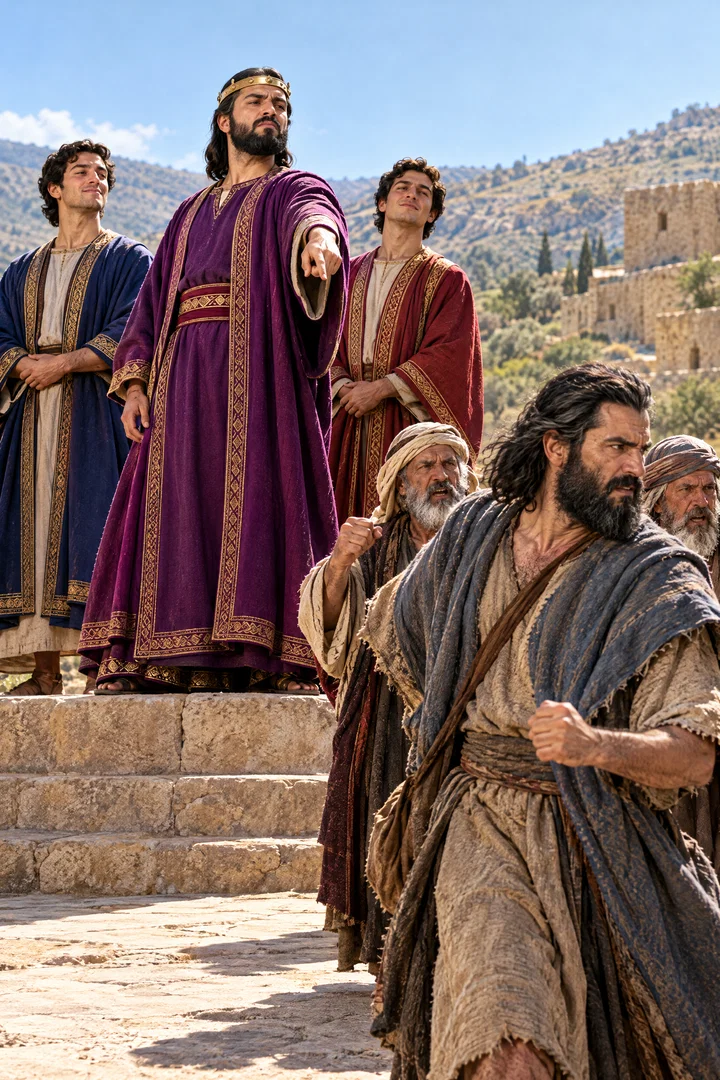
So when all Israel saw that the king hearkened not unto them, the people answered the king, saying, What portion have we in David? neither have we inheritance in the son of Jesse: to your tents, O Israel: now see to thine own house, David. So Israel departed unto their tents.
Translations
So when all Israel saw that the king listened not to them, the people answered the king, saying, What portion have we in David? neither have we inheritance in the son of Jesse: to your tents, O Israel: now see to your own house, David. So Israel departed to their tents.
So when all Israel saw that the king hearkened not unto them, the people answered the king, saying, What portion have we in David? neither have we inheritance in the son of Jesse: to your tents, O Israel: now see to thine own house, David. So Israel departed unto their tents.
So when all Israel saw that the king hearkened not unto them, the people answered the king, saying,
What portion have we in David?
Neither have we inheritance in the son of Jesse:
To your tents, O Israel:
Now see to thine own house, David.So Israel departed unto their tents.So when all Israel saw that the king hearkened not to them, the people answered the king, saying, What portion have we in David? neither have we inheritance in the son of Jesse: to your tents, O Israel: now see to thy own house, David. So Israel departed to their tents.
Revised Version, American Standard Version
And when all Israel saw that the king hearkened not unto them, the people answered the king, saying, What portion have we in David? neither have we inheritance in the son of Jesse: to your tents, O Israel: now see to thine own house, David. So Israel departed unto their tents.
And all Israel see that the king hath not hearkened unto them, and the people send the king back word, saying, 'What portion have we in David? yea, there is no inheritance in the son of Jesse; to thy tents, O Israel; now see thy house, O David!' and Israel goeth to its tents.
And all Israel saw that the king hearkened not to them; and the people answered the king saying, What portion have we in David? And [ we have] no inheritance in the son of Jesse: To your tents, O Israel! Now see to thine own house, David! And Israel went to their tents.
So when all Israel saw that the king hearkened not unto them, the people answered the king, saying—What portion have, we, in, David. Or inheritance in the son of Jesse? To your homes O Israel! Now, see to thine own house, O David! And Israel departed to their homes.
Berean Standard Bible, Majority Standard Bible
When all Israel saw that the king had refused to listen to them, they answered the king:
“ What portion do we have in David,
and what inheritance in the son of Jesse?
To your tents, O Israel!
Look now to your own house, O David!”So the Israelites went home,When all Israel saw that the king didn’t listen to them, the people answered the king, saying, “ What portion have we in David? We don’t have an inheritance in the son of Jesse. To your tents, Israel! Now see to your own house, David.” So Israel departed to their tents.
And when all Israel saw that the king would give no attention to them, the people in answer said to the king, What part have we in David? what is our heritage in the son of Jesse? to your tents, O Israel; now see to your people, David. So Israel went away to their tents.
So when all Israel sawe that the King regarded them not, the people answered the King thus, saying, What portion haue we in Dauid? we haue none inheritance in the sonne of Ishai. To your tents, O Israel: nowe see to thine owne house, Dauid. So Israel departed vnto their tents.
Douay-Rheims (Challoner revision)
Then the people seeing that the king would not hearken to them, answered him, saying: What portion have we in David? or what inheritance in the son of Isai? Go home to thy dwellings, O Israel, now David look to thy own house. So Israel departed to their dwellings.
Pictures
Cross-references
- 1 Kings 11:34-39
Howbeit I will not take the whole kingdom out of his hand: but I will make him prince all the days of his life for David my servant’s sake, whom I chose, because he kept my commandments and my statutes:
Ahijah foretold the kingdom’s division, fulfilled when Israel rejected David’s house.
- 1 Kings 11:13
Howbeit I will not rend away all the kingdom; but will give one tribe to thy son for David my servant’s sake, and for Jerusalem’s sake which I have chosen.
The promised division leaves one tribe to David’s house, while Israel rejects David’s house.
- 1 Kings 12:20
And it came to pass, when all Israel heard that Jeroboam was come again, that they sent and called him unto the congregation, and made him king over all Israel: there was none that followed the house of David, but the tribe of Judah only.
Israel makes Jeroboam king after separating from David’s house.
- 1 Kings 12:28-30
Whereupon the king took counsel, and made two calves of gold, and said unto them, It is too much for you to go up to Jerusalem: behold thy gods, O Israel, which brought thee up out of the land of Egypt.
Jeroboam responds to the divided kingdom by setting up golden calves for worship.
- 2 Samuel 7:12-16
And when thy days be fulfilled, and thou shalt sleep with thy fathers, I will set up thy seed after thee, which shall proceed out of thy bowels, and I will establish his kingdom.
The promise to David’s seed grounds the preserved Davidic line.
- 1 Kings 11:40
Solomon sought therefore to kill Jeroboam. And Jeroboam arose, and fled into Egypt, unto Shishak king of Egypt, and was in Egypt until the death of Solomon.
Jeroboam flees to Egypt before returning to lead the revolt.
- Psalms 132:11
The LORD hath sworn in truth unto David; he will not turn from it; Of the fruit of thy body will I set upon thy throne.
It affirms God’s oath concerning David’s descendants.
- 2 Chronicles 10:16-19
And when all Israel saw that the king would not hearken unto them, the people answered the king, saying, What portion have we in David? and we have none inheritance in the son of Jesse: every man to your tents, O Israel: and now, David, see to thine own house. So all Israel went to their tents.
Records the same rejection of Rehoboam and division of Israel.
- 1 Kings 12:3-5
That they sent and called him. And Jeroboam and all the congregation of Israel came, and spake unto Rehoboam, saying,
gives the plea for a lighter yoke that was rejected
- 1 Kings 11:43
And Solomon slept with his fathers, and was buried in the city of David his father: and Rehoboam his son reigned in his stead.
identifies Rehoboam as Solomon's successor who was rejected
- 1 Kings 11:26-33
And Jeroboam the son of Nebat, an Ephrathite of Zereda, Solomon’s servant, whose mother’s name was Zeruah, a widow woman, even he lifted up his hand against the king.
prophesies ten tribes given to Jeroboam for idolatry
- 1 Kings 12:21-24
And when Rehoboam was come to Jerusalem, he assembled all the house of Judah, with the tribe of Benjamin, an hundred and fourscore thousand chosen men, which were warriors, to fight against the house of Israel, to bring the kingdom again to Rehoboam the son of Solomon.
God forbids Rehoboam to fight the separated tribes.
- 1 Kings 11:1-8
But king Solomon loved many strange women, together with the daughter of Pharaoh, women of the Moabites, Ammonites, Edomites, Zidonians, and Hittites;
Solomon’s idolatry and apostasy provoked the revolt.
- 1 Samuel 8:5
And said unto him, Behold, thou art old, and thy sons walk not in thy ways: now make us a king to judge us like all the nations.
central government demanded then failed to unite tribes
- 1 Kings 14:21
And Rehoboam the son of Solomon reigned in Judah. Rehoboam was forty and one years old when he began to reign, and he reigned seventeen years in Jerusalem, the city which the LORD did choose out of all the tribes of Israel, to put his name there. And his mother’s name was Naamah an Ammonitess.
Rehoboam’s Ammonite parentage is noted alongside his harsh answer to Israel.
- 1 Kings 13:1-2
And, behold, there came a man of God out of Judah by the word of the LORD unto Beth-el: and Jeroboam stood by the altar to burn incense.
A man of God confronts Jeroboam’s idolatry with the LORD’s word.
Commentary
Each commentary is drawn from primary sources: the writings of Ellen G. White and Adventist pioneers and periodicals. Each commentary is separate. Its own words are not a quotation; follow the references to read the source passages.
Ellen G. White
5 sources
The cry recorded here came after the people had asked for reform and relief from the burdens laid on them by Solomon's oppressive policies, which Rehoboam refused to grant.PK 91.2–3RH Jul 10, 1913PK 90.2–91.1 He set aside the counsel of the old men and followed the counsel of the young men, answering the people roughly with no regard for their welfare.RH Jul 3, 1913RH Jul 3, 1913 Instead of lightening their load he threatened a heavier yoke, declaring he would chastise them with scorpions.RH Jul 3, 1913PK 90.2–91.1
When all Israel saw that the king would not listen to them, they answered with a formal renunciation of any portion in David and any inheritance in the son of Jesse.RH Jul 3, 1913PK 91.2–3 By those words they declared they no longer accepted the rule of the house of David and withdrew their allegiance from Rehoboam.PK 91.2–3PK 90.2–91.1 They summoned Israel to their tents, bade David see to his own house, and departed to their tents.RH Jul 3, 1913
That refusal to listen was from the Lord, to perform what He had spoken by Ahijah the Shilonite to Jeroboam the son of Nebat.RH Jul 3, 1913
Their answer marked the division of Israel and the loss of the northern tribes from Rehoboam's rule.PK 91.2–3RH Jul 10, 1913 The breach thus made became irreparable, with Judah and Benjamin forming the southern kingdom of Judah under Rehoboam, while the ten northern tribes formed a separate kingdom under Jeroboam.RH Jul 10, 1913PK 90.2–91.1 Even the children of Israel dwelling in the cities of Judah remained under Rehoboam's reign as part of that southern kingdom.RH Jul 3, 1913
The outcome shows the consequence of Rehoboam's failure to consider the people's welfare, for his poor judgment in refusing their appeal weakened his influence over a large part of the nation and led Israel to reject his rule and separate from the house of David.RH Jul 3, 1913
Sources
Pioneers and periodicals
33 sources
The verse marks the revolt of the ten tribes and the breaking of Israel into two separate kingdoms after Solomon's death.RH May 25, 1916ST Jul 30, 1885 When the people saw Rehoboam would not hear their plea to lighten Solomon's heavy burden of taxes and labor, they renounced all share in David's family and in Judah, told the house of David to care for itself, and went home to their own dwellings while those in the cities of Judah stayed under Rehoboam.RH Jul 3, 1913ST Jun 16, 1898ST Jul 23, 1885 Rehoboam brought this to pass by rejecting the counsel of the elders to grant relief and answering harshly after the counsel of the young men with threats of still heavier chastisement, yet his refusal was from the Lord to fulfill what had been spoken by Ahijah that ten tribes would be torn from Solomon's house and given to Jeroboam while one tribe would be left for David's sake and for Jerusalem's sake.RH Jul 3, 1913RH Apr 7, 1910ST Jun 25, 1885ST Jun 22, 1904ST Sep 7, 1904 Behind that rending lay Solomon's breaking of God's covenant through idolatry and strange wives, for which the Lord declared He would tear the kingdom from him.ST Jun 25, 1885ST Jun 22, 1904 The division thus opened the way for Jeroboam to turn Israel to the worship of golden calves and brought continuing war and strife between the two kingdoms.RH May 13, 1875ST Apr 28, 1909ST May 20, 1913RH Aug 1, 1871ST Apr 17, 1907
The Kingdom Divided
The verse marks the revolt of the ten tribes and the division of Israel into two separate kingdoms after Solomon's death.RH May 25, 1916ST Sep 8, 1898 It records the division under the weak and foolish Rehoboam, when because he stubbornly refused the people's request most of the kingdom was taken from him and Israel and Judah continued as separate kingdoms.ST Jul 30, 1885ST Apr 26, 1910 When Rehoboam refused, Israel rejected the Davidic house and departed, separating the ten tribes from Judah.ST Apr 26, 1910ST Sep 8, 1898
When all Israel saw that Rehoboam would not listen to their plea to lighten Solomon's grievous yoke of taxes and imposed labor, the people disowned any share in David and any inheritance in Jesse's son, summoned Israel to their tents, told David to look after his own house, and went home to their tents.RH Jul 3, 1913ST Jun 22, 1904ST Jul 23, 1885 The break came at Shechem after he forsook the old men's counsel to grant relief and answered roughly after the young men's counsel, threatening a heavier yoke and chastisement with scorpions.RH Jul 3, 1913ST Jun 22, 1904 Those dwelling in the cities of Judah remained under Rehoboam's reign, with Judah alone continuing to follow him.RH Jul 3, 1913ST Jun 16, 1898 His refusal to listen was from the Lord to perform what He had spoken by Ahijah the Shilonite to Jeroboam son of Nebat, that ten tribes would be rent from Solomon's house because Solomon led the people into idolatry and given to Jeroboam.RH Jul 3, 1913ST Jun 22, 1904 Jeroboam was Solomon's servant who fled to Egypt when Solomon sought to kill him and returned after Solomon's death to head the northern delegation demanding relief, while one tribe was left to Solomon's house for David's sake because of the Lord's oath to David concerning his seed, so the kingdom remained intact until Solomon's death and was then taken from his son.ST Jun 22, 1904
The question about a portion in David means what the ten tribes have to do with David's family as represented in Rehoboam, or with Judah, David's tribe.ST Dec 7, 1882ST Jun 22, 1904 It meant that David's descendants would receive no further support from the ten tribes, who believed their rights could not receive just consideration where the royal family and capital were located.ST Jun 16, 1898 The call to their tents signified separation from Judah, return to their homes, and making ready for war.ST Dec 7, 1882ST Jun 22, 1904ST Jun 16, 1898 The Lord preserved one tribe so the promise to David concerning the Messiah could be fulfilled, in keeping with the covenant made with Abraham, Isaac and Jacob and the purpose of Israel's national covenant at Sinai.ST Jun 16, 1898
The departure was rebellion against the house of David unto this day.ST Jun 22, 1904ST Jul 23, 1885 After Rehoboam sent Adoram who was over tribute and task-work, all Israel stoned him to death and Rehoboam fled by chariot to Jerusalem.ST Jun 22, 1904ST Jul 23, 1885 Then when all Israel heard Jeroboam had returned they called him to the congregation and made him king over all Israel, with none following the house of David but Judah only.ST Jun 22, 1904ST Jul 23, 1885
Judah and Benjamin remained under Rehoboam, while the ten northern tribes formed a separate kingdom under Jeroboam.RH Jul 10, 1913 All Israel except Judah and the southern part of Benjamin broke away and chose Jeroboam as king, and the division fulfilled Ahijah's prediction and began the separation of the northern kingdom of Israel from Judah.RH Apr 7, 1910 Those who held that Judah retained more than one tribe taught that Judah with the southern part of Benjamin and two and a half tribes remained, while the other ten formed the northern kingdom.RH Apr 7, 1910 The ten tribes carried their copies of the books of Moses with them when they separated from Judah and Benjamin under Jeroboam after Solomon's death.RH May 1, 1879
The division of Israel is compared with the North and South during the American Civil War.RH Mar 10, 1863 Jeroboam's revolt in rejecting Rehoboam's rule after he refused their appeal, separating from the house of David and forming an independent kingdom, is likened to the Southern secession under Jefferson Davis.RH Mar 10, 1863
Causes and Divine Purpose
The rending of the kingdom was rooted in Solomon's forsaking of his wisdom and breaking of God's covenant and statutes through idolatry.ST Jun 25, 1885ST Jun 22, 1904 He loved many strange women of the Moabites, Ammonites, Edomites, Zidonians and Hittites, went after Ashtoreth the goddess of the Zidonians and Milcom the abomination of the Ammonites, and built high places for Chemosh of Moab and Molech of Ammon and for all the gods of his strange wives.ST Jun 25, 1885 For this the Lord stirred up adversaries against him all his days and declared He would surely rend the kingdom from him and give it to his servant.ST Jun 25, 1885ST Jun 22, 1904 Yet He would not rend away all the kingdom but would leave one tribe to Solomon's house for David His servant's sake and for Jerusalem's sake which He had chosen.ST Jun 25, 1885ST Jun 22, 1904
Solomon's mistake in multiplying wives to himself divided his heart among a thousand women and turned away his heart from God.ST May 20, 1913 His God-given wisdom and public greatness were weakened by luxury and lust. That course left a weak, wavering, foolish and unsteady son, and had he used his wisdom for God throughout his reign the division of Israel would not have occurred.ST May 20, 1913 Though in his last days he repented when he penned Ecclesiastes, the consequence remained.ST May 20, 1913
Rehoboam forsook the old men's counsel to grant relief and answered the people roughly after the counsel of the young men grown up with him.RH Jul 3, 1913ST Jun 25, 1885ST Jun 22, 1904 Treating their reasonable plea for relief from heavy taxes and imposed labor as rebellion, he threatened that his little finger would be thicker than his father's loins and that where his father had chastised with whips he would chastise with scorpions.RH Jul 3, 1913ST Jun 25, 1885 His stubborn refusal and rashness in disregarding wise counsel cost him ten of the twelve tribes.ST Sep 7, 1904ST Dec 1, 1914 That rashness hastened a division from transgression that the Lord had foreseen and foretold in Solomon's day.ST Sep 7, 1904ST Apr 23, 1912
That harshness came from the upbringing of Rehoboam and the young men under Solomon's heathen wives.ST Jun 25, 1885 Rehoboam himself was the son of Naamah an Ammonitess, reared amid incense and sacrifice to Molech, Ashtoreth, Chemosh and Baalim.ST Jun 25, 1885 Their male and female worship was lasciviousness by ritual prostitution and burning offspring in the fire, a training that left them unfit to counsel in a crisis involving one of the greatest kingdoms then in the world.ST Jun 25, 1885
Rehoboam is weak, unsteady and unsettled, foolish, stubborn, pampered and prideful, misusing royal honor to become a cruel tyrant.ST Apr 26, 1910ST Apr 28, 1909ST Apr 23, 1912ST Apr 17, 1907 He failed to consider the people's welfare and to act wisely, and his poor judgment weakened his influence over a large part of the nation.RH Jul 3, 1913ST Apr 17, 1907 His failures belong to a sad history in which the failures of leaders helped lead the people astray.ST Apr 26, 1910 His oppressive policies and cruel treatment drove Israel to resistance, expressing the spirit of a people turned against their government when convinced their rights could not receive just consideration.ST Apr 23, 1912
His refusal to listen was from the Lord to perform what He had spoken by Ahijah the Shilonite to Jeroboam the son of Nebat, that ten tribes would be rent from Solomon's house and given to Jeroboam.RH Jul 3, 1913RH Apr 7, 1910ST Jun 22, 1904 The kingdom remained intact until Solomon's death and was then taken from his son, fulfilling Ahijah's prediction, while the children dwelling in the cities of Judah remained under Rehoboam's reign.RH Jul 3, 1913RH Apr 7, 1910ST Jun 22, 1904 One tribe was left to Solomon's house for David's sake because of the Lord's oath to David concerning his seed and for Jerusalem's sake which He had chosen.ST Jun 25, 1885ST Jun 22, 1904 The Lord preserved that remnant so the promise to David concerning the Messiah could be fulfilled, in keeping with the covenant made with Abraham, Isaac and Jacob and the purpose of Israel's national covenant at Sinai.ST Jun 16, 1898
Consequences and Lessons
The division opened the way for Jeroboam's idolatry over the ten tribes, for the wicked king turned Israel from worshiping God to worshiping golden calves and introducing images for worship.RH May 13, 1875ST Apr 28, 1909RH Aug 1, 1871 After Israel rejected the rule of Solomon's son and separated from the house of David, the northern kingdom began a course of backsliding under Jeroboam, whose calves drew the people from God while prophets appealed but the people gave little heed to God's voice or service.ST Apr 28, 1909RH Aug 1, 1871ST Jun 27, 1911 The weak reign of Rehoboam was unsteady and unsettled, and the division stands as an object-lesson of the fruits of backsliding and sin.ST Apr 28, 1909
From that time on there was war and strife between the two divisions, beginning the stormy and turbulent kingdom of the ten tribes.ST May 20, 1913ST Apr 17, 1907 The revolt was rooted in Solomon's mistake in multiplying wives to a thousand women, which divided his heart and turned it from God, though in his last days he repented when he penned Ecclesiastes, leaving two and a half tribes under his deplorably weak son Rehoboam while ten tribes departed under Jeroboam, the strong young man who induced Israel to revolt.ST May 20, 1913 Rehoboam, the pampered son of Solomon, refused the reasonable demand of the people and did not act wisely, so the ten tribes departed from him and the energetic, ambitious agitator Jeroboam became first king of the turbulent ten tribes, where otherwise he might have been content to fill some important office under Rehoboam.ST May 20, 1913ST Apr 17, 1907 His foolish stubbornness in refusing the people's appeal cost him the ten tribes and much of his wealth, which went to the king of Egypt.
After the division in Rehoboam's time, the northern kingdom had a 215-year period of probation before its final rejection.ST Dec 7, 1904 The verse shows Israel rejecting the king's rule and declaring separation from David's house, illustrating how a people driven to resistance by cruel treatment and oppression may turn against their government.ST Apr 23, 1912ST Jun 16, 1898 The ten tribes rejected Rehoboam because they were convinced their rights could not receive just consideration from Judah, where the royal family and capital were located, meaning David's descendants would receive no further support from them.ST Apr 23, 1912ST Jun 16, 1898 Yet the Lord preserved one tribe so the promise to David concerning the Messiah could be fulfilled, in keeping with the covenant made with Abraham, Isaac, and Jacob and the purpose of Israel's national covenant at Sinai.ST Jun 16, 1898 Rehoboam's failure to consider the people's welfare and his poor judgment in refusing reforms weakened his influence over a large part of the nation, as Israel rejected his rule and separated from the house of David.RH Jul 3, 1913
The cry to their tents supplies a model for churches to act without dependence on worldly money or influence that would compromise faith or give the wealthy control and a stake in their affairs.ST May 28, 1885ST May 28, 1885 They should depend on their own God-helped strength and do modest work with integrity, even preaching in a tent if necessary, leaving to each person the free choice to participate with the church.ST May 28, 1885ST May 28, 1885 Even a tent faithfully supported is preferable to a grand cathedral maintained by worldly support.ST May 28, 1885
Sources