1 Kings 13:1
And, behold, there came a man of God out of Judah by the word of the LORD unto Beth-el: and Jeroboam stood by the altar to burn incense.
Translations
And, behold, there came a man of God out of Judah by the word of the LORD to Bethel: and Jeroboam stood by the altar to burn incense.
And, behold, there came a man of God out of Judah by the word of the LORD unto Beth-el: and Jeroboam stood by the altar to burn incense.
And behold, there came a man of God out of Judah by the word of the Lord unto Beth-el: and Jeroboam stood by the altar to burn incense.
And behold, there came a man of God out of Judah by the word of the LORD to Beth-el: and Jeroboam stood by the altar to burn incense.
And, behold, there came a man of God out of Judah by the word of the LORD unto Beth-el: and Jeroboam was standing by the altar to burn incense.
And, behold, there came a man of God out of Judah by the word of Jehovah unto Beth-el: and Jeroboam was standing by the altar to burn incense.
And lo, a man of God hath come from Judah, by the word of Jehovah, unto Beth-El, and Jeroboam is standing by the altar — to make perfume;
And behold, there came a man of God from Judah, by the word of Jehovah, to Bethel; and Jeroboam stood by the altar to burn incense.
And lo! a man of God, came in out of Judah, by the word of Yahweh, unto Bethel,—as Jeroboam was standing by the altar, to make a perfume.
Berean Standard Bible, Majority Standard Bible
Suddenly, as Jeroboam was standing beside the altar to burn incense, there came a man of God from Judah to Bethel by the word of the LORD.
Behold, a man of God came out of Judah by the LORD’s word to Bethel; and Jeroboam was standing by the altar to burn incense.
Then a man of God came from Judah by the order of the Lord to Beth-el, where Jeroboam was by the altar, burning offerings.
And beholde, there came a man of God out of Iudah (by the commandement of the Lord) vnto Beth-el, and Ieroboam stoode by the altar to offer incense.
Douay-Rheims (Challoner revision)
And behold there came a man of God out of Juda, by the word of the Lord to Bethel, when Jeroboam was standing upon the altar, and burning incense.
Pictures
Cross-references
- 2 Kings 23:15-18
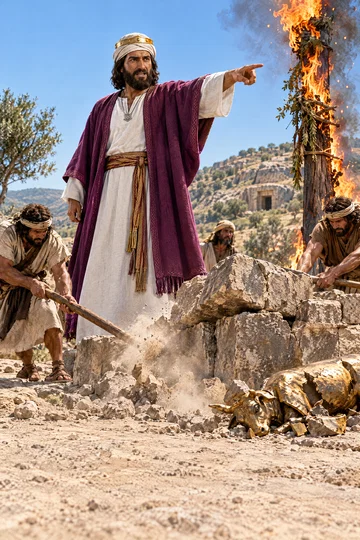
Moreover the altar that was at Beth-el, and the high place which Jeroboam the son of Nebat, who made Israel to sin, had made, both that altar and the high place he brake down, and burned the high place, and stamped it small to powder, and burned the grove.
Josiah destroys Bethel’s altar and fulfills the prophecy concerning it.
- 1 Kings 13:20-26
And it came to pass, as they sat at the table, that the word of the LORD came unto the prophet that brought him back:
Disobedience to the Lord’s command brings the man of God’s death by a lion.
- 1 Kings 12:28-33
Whereupon the king took counsel, and made two calves of gold, and said unto them, It is too much for you to go up to Jerusalem: behold thy gods, O Israel, which brought thee up out of the land of Egypt.
Jeroboam established the Bethel altar and worship that the man of God condemned.
- 1 Kings 13:18
He said unto him, I am a prophet also as thou art; and an angel spake unto me by the word of the LORD, saying, Bring him back with thee into thine house, that he may eat bread and drink water. But he lied unto him.
A false prophetic claim deceives the man of God into disobeying the Lord’s command.
- 1 Kings 12:32-33
And Jeroboam ordained a feast in the eighth month, on the fifteenth day of the month, like unto the feast that is in Judah, and he offered upon the altar. So did he in Beth-el, sacrificing unto the calves that he had made: and he placed in Beth-el the priests of the high places which he had made.
Jeroboam establishes and officiates at the Bethel altar for his self-appointed feast.
- 1 Kings 13:8-10
And the man of God said unto the king, If thou wilt give me half thine house, I will not go in with thee, neither will I eat bread nor drink water in this place:
The man of God refuses the king’s offer and follows the Lord’s instructions.
- 1 Kings 13:5
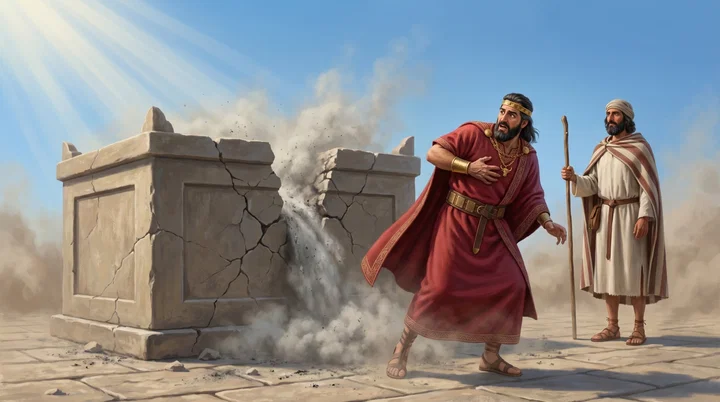
The altar also was rent, and the ashes poured out from the altar, according to the sign which the man of God had given by the word of the LORD.
The altar is split and its ashes spill out, fulfilling the foretold sign of God’s displeasure.
- 1 Kings 11:37
And I will take thee, and thou shalt reign according to all that thy soul desireth, and shalt be king over Israel.
Ahijah foretold Jeroboam’s rise to rule over Israel.
- 1 Kings 13:33-34
After this thing Jeroboam returned not from his evil way, but made again of the lowest of the people priests of the high places: whosoever would, he consecrated him, and he became one of the priests of the high places.
Jeroboam persisted in evil despite the warning, bringing judgment on his house.
- 1 Samuel 2:27
And there came a man of God unto Eli, and said unto him, Thus saith the LORD, Did I plainly appear unto the house of thy father, when they were in Egypt in Pharaoh’s house?
shares title men of God
- 2 Chronicles 13:19
And Abijah pursued after Jeroboam, and took cities from him, Beth-el with the towns thereof, and Jeshanah with the towns thereof, and Ephrain with the towns thereof.
shows Bethel altar left standing after capture
- 1 Samuel 9:6
And he said unto him, Behold now, there is in this city a man of God, and he is an honourable man; all that he saith cometh surely to pass: now let us go thither; peradventure he can shew us our way that we should go.
shares title men of God
- 1 Kings 12:20
And it came to pass, when all Israel heard that Jeroboam was come again, that they sent and called him unto the congregation, and made him king over all Israel: there was none that followed the house of David, but the tribe of Judah only.
Israel makes Jeroboam king after the ten tribes revolt.
- 1 Kings 12:31
And he made an house of high places, and made priests of the lowest of the people, which were not of the sons of Levi.
continues the rival system after the rebuke
- 1 Kings 13:19
So he went back with him, and did eat bread in his house, and drank water.
His return and eating constituted disobedience.
- 1 Kings 14:7-11
Go, tell Jeroboam, Thus saith the LORD God of Israel, Forasmuch as I exalted thee from among the people, and made thee prince over my people Israel,
God rejects Jeroboam and announces the destruction of his house.
- 1 Kings 12:22
But the word of God came unto Shemaiah the man of God, saying,
shares title men of God
Commentary
Each commentary is drawn from primary sources: the writings of Ellen G. White and Adventist pioneers and periodicals. Each commentary is separate. Its own words are not a quotation; follow the references to read the source passages.
Ellen G. White
7 sources
The Lord sent a man of God out of Judah by the word of the Lord unto Bethel, and he arrived while Jeroboam stood by the altar to burn incense, interrupting the idolatrous offering in progress.Ms 153, 1906Ms 1, 1912, par. 9–10Ms 153, 1906, par. 7–9PK 102.3Ms 1, 1912, par. 17 The altar where the king ministered was unauthorized, set up apart from the true worship God had appointed.PK 102.3 The coming was at the Lord's command, with a message for Jeroboam delivered directly against that altar.Ms 153, 1906Ms 1, 1912, par. 9–10Ms 1, 1912, par. 17RH Jul 24, 1913
The word spoken against the altar rebuked idolatrous sacrifices as an abomination to God.Ms 153, 1906, par. 7–9 It set before the king and the ten tribes the evils of disobedience and of turning Israel away from worshiping God.PK 102.3PK 281.1 It was meant to inspire awe and to turn the people to the Lord.Ms 153, 1906, par. 7–9
The message foretold that a descendant of David named Josiah would sacrifice the priests of the high places upon that very altar and burn human bones upon it.Ms 1, 1912, par. 9–10 As a present sign, the altar would split apart and its ashes spill out, making the rebuke public and declaring God's displeasure with the idolatrous worship.Ms 1, 1912, par. 9–10Ms 153, 1906, par. 7–9PK 102.3 That sign was fulfilled exactly as spoken.Ms 1, 1912, par. 9–10
The events that followed confirmed the prophecy spoken over the altar.RH Jul 24, 1913 When Jeroboam stretched out his hand to seize the messenger, his hand became helpless and palsied so he could not draw it back, and when he asked the man of God to pray for him his hand was healed.Ms 153, 1906, par. 7–9 The later death of the disobedient messenger stood as a third evidence to Jeroboam that God's words were true, and together the rent altar, the palsied arm, and the prophet's death demonstrated God's swift displeasure.Ms 1, 1912, par. 17RH Jul 24, 1913
These messages and signs should have led Jeroboam to repent, to abandon his evil ways and his plan to turn Israel away, and to serve the Lord.PK 102.3Ms 1, 1912, par. 17 Instead he hardened his heart and chose his own way, and was warned by these judgments not to persist in wrongdoing.PK 102.3RH Jul 24, 1913 The signs were given to correct existing evils, but the people's hearts remained hardened.Ms 153, 1906, par. 7–9 This reproof and entreaty to turn Israel from disobedience was one of repeated warnings later continued through Elijah and Elisha and through Amos and Hosea, yet Israel sank lower and lower in apostasy.Ms 153, 1906, par. 7–9PK 281.1
Sources
Pioneers and periodicals
35 sources
A man of God from Judah, the seer Iddo, comes by direct divine commission to Bethel while Jeroboam stands officiating as priest at the dedication of his newly built rival altar twelve miles north of Jerusalem.RH Jun 8, 1911RH Apr 6, 1905ST Dec 7, 1882RH Apr 7, 1910 That altar belongs to the calf worship Jeroboam set up at Bethel and Dan as a political measure to keep the people from returning to Jerusalem, with calves patterned after Apis as supposed symbols of Jehovah and served by unfit common priests.ST Dec 7, 1882RH Apr 7, 1910ST Apr 26, 1910 Over the altar he foretells that a future king named Josiah, more than three hundred years later, will defile and overthrow it and burn men's bones upon it.RH Feb 12, 1861ST May 10, 1910ST Jul 26, 1905RH Jun 23, 1903ST Dec 7, 1882 The immediate rending of the altar with its ashes poured out, and the withering and then healing of Jeroboam's outstretched hand, pledge and confirm that distant fulfillment and witness against his apostasy.RH Feb 12, 1861ST Dec 2, 1880RH Dec 14, 1905ST May 10, 1910ST Jun 3, 1913 God's command to His messenger to eat no bread, drink no water, and not return by the same way must be obeyed exactly, and no claim of later inspiration through another prophet can set aside what the Lord has plainly spoken.RH Mar 17, 1904ST Feb 7, 1911ST Mar 31, 1898ST Mar 4, 1880ST Dec 7, 1882 That unchangeableness of God's word condemns Jeroboam's self-chosen worship and all human changing of what God prescribed, as in replacing the seventh-day Sabbath with Sunday, while the messenger's own disobedience unto death proves saints can fall and yet that inspiration rests on the Lord and not on the holiness of the instrument.RH Mar 13, 1879RH May 13, 1875ST Dec 3, 1894ST Oct 1, 1894ST Dec 7, 1882
Setting and Confrontation at Bethel
The verse belongs to the historical record of 1 Kings 3-21, a sad record from the time after David when the moral tendency in Judah and Israel was generally downward with times of reviving.ST Apr 26, 1910 It belongs to the history of the separate kingdoms of Judah and Israel after the ten tribes revolted, during the period ending with Jehoshaphat's death, a history that also includes the ministry of Elijah.RH May 25, 1916
Jeroboam the son of Nebat was made king of Israel upon its separation from Judah immediately following the death of Solomon, and very soon thereafter he is standing at the altar in Bethel to burn incense and offer sacrifice.RH Jun 8, 1911 He himself is officiating as high priest at the dedication of his altar, having set up golden calves in Bethel and Dan for the people to worship instead of returning to the temple at Jerusalem and rejoining Judah and Benjamin, and having appointed low, unfit men as common priests.ST Dec 7, 1882 Bethel was twelve miles north of Jerusalem at the old patriarchal sanctuary, while the sanctuary at Dan, farthest from Jerusalem, was consecrated first, and Jeroboam then attempted the same consecration service for the altar at Bethel with a golden calf set up there.RH Apr 7, 1910
That calf worship at Bethel and Dan was purely a political measure by Jeroboam to hold the people from going up to Jerusalem to worship and to build up his own kingdom rather than restore the true worship of Jehovah.ST Apr 26, 1910ST Sep 8, 1898 The people's idolatry had been encouraged by Solomon's backsliding, and the calves were designed as representatives and symbols of Jehovah in whom Jeroboam still believed, yet regarded as symbols of the true God while patterned after the Egyptian sun-god Apis.ST Apr 26, 1910ST Sep 8, 1898 That worship was unauthorized idolatry and blasphemy that offended God, made Israel to sin, and became a curse to the ten tribes from that time forward, persisting through their descending history notwithstanding God's solemn warnings, though a faithful remnant remained while most of Israel departed from Him.ST Apr 26, 1910ST Sep 8, 1898 Yet Jeroboam was not deterred but maintained the altars at Dan and Bethel even after the altar was rent asunder as a sign of God's displeasure upon its existence.RH Apr 7, 1910
The man who comes is an unnamed, unknown prophet from Judah, identified as Iddo the seer who testified against Jeroboam.RH Jun 8, 1911ST May 20, 1913 His title man of God is the name given to the greater prophets and means he is an interpreter and medium of the divine will, God's mouthpiece who pours forth utterances under divine influence as one in whom the Spirit of Jehovah enters and whom the Spirit clothes.RH May 11, 1911 He comes from Judah to Bethel by the word of the Lord with a special message and definite mission, knowing where to go, and though Jeroboam was standing by the altar to burn incense when he arrived, the king's presence did not prevent him from delivering the Lord's message.ST Dec 24, 1885ST Oct 23, 1884RH Apr 6, 1905
The verse introduces his prediction, warning, and testimony against Jeroboam, his altar, and his idolatry in the account of Jeroboam's idolatry. He cries not so much against the king as against the altar being set apart as a rival to the true sanctuary altar at Jerusalem.RH Apr 7, 1910 His appearance is a witness against the king's rebellion, apostasy, idolatry, and moral darkness and a sign that God had faithful servants who spoke with His power amid Israel's apostasy.ST Jan 17, 1884RH May 9, 1871
While Jeroboam is dedicating the altar and burning incense, the prophet delivers a rebuke from the Lord for introducing unauthorized worship, and the altar's breaking and ashes spilling out immediately confirm that the message is from God.RH Jul 17, 1913 At his word the altar is rent asunder and its ashes scattered as a sign of God's displeasure, preceding the prophecy that the altar would be polluted by Josiah more than 300 years later.RH Feb 12, 1861 When Jeroboam raised his hand to seize or order the seizure of the prophet, his arm and hand were completely withered so he could not draw them back, and it was restored after the prophet prayed at the king's request, humbling the king and hearing the prophet's prayer.ST Dec 2, 1880RH Dec 14, 1905ST Dec 7, 1882
Prophecy of Josiah Fulfilled
Over the altar the man foretells its overthrow and pollution, that Josiah will do a future work against idolatry and destroy the evidence of idol worship in the land by burning men's bones upon it, even the bones of its priests.ST Jul 26, 1905RH Jun 23, 1903ST Dec 7, 1882
That foretold work lies far in the future, more than three hundred years afterward, about three hundred and forty years later in the reign of Josiah, hundreds of years later.RH Feb 12, 1861ST May 10, 1910ST Dec 7, 1882 It comes to pass when Josiah begins that destroying work at age twenty.ST Jul 26, 1905
The immediate rending of the altar and scattering of its ashes pledges that distant fulfillment.RH Feb 12, 1861 The prophecy spoken over the altar is later fulfilled exactly as declared in Josiah's reformation, just as the Lord had declared, as the events that follow confirm.RH Jul 24, 1913RH Feb 12, 1861ST May 10, 1910ST Jun 3, 1913
Obedience Inspiration and Warning
The commission carried an explicit, positive command from God governing the mission itself, that the man was not to lodge or stay with any man, to eat no bread nor drink water in that place, nor to return by the same way he came but to start home by another way.RH Mar 13, 1879RH May 13, 1875ST Feb 7, 1911ST Dec 7, 1882ST Oct 23, 1884 He faithfully pronounced the curse against the altar, refused to eat with the king, and started home another way.ST Feb 7, 1911ST Dec 7, 1882RH Mar 11, 1873 While going home he was persuaded by an old lying, apostate prophet claiming a message from the Lord, even an angelic message, to turn back and eat bread.RH Mar 13, 1879RH May 13, 1875ST Feb 7, 1911ST Dec 7, 1882RH Mar 11, 1873 While they were eating it was declared that because he had eaten and drunk where the Lord had forbidden him his carcass should not come to the sepulcher of his fathers, and he was slain by a lion on his return and died in that sin.RH Mar 17, 1904RH Mar 13, 1879RH May 13, 1875
The chapter shows that God's commands must be obeyed exactly, for God means exactly what He says and requires unquestioning obedience in every age.RH Mar 17, 1904ST Mar 31, 1898 A command given by the Lord must not be set aside because another person claims to speak by inspiration.RH Mar 17, 1904ST Mar 4, 1880 Even a prophet can be deceived into thinking God does not remain steadfast in what He has said.ST Mar 31, 1898 God's Word is above all other words, and no influence or word of any person, even a prophet or former prophet, may turn the child of God from what he knows the Lord has said.ST Feb 7, 1911ST Dec 7, 1882RH Mar 11, 1873ST Dec 7, 1882 He is responsible to obey unless the Lord Himself revokes the command with equal clarity, has no right to shift personal responsibility to another, and comparatively few reject the Lord's prophets because they speak falsely while many reject them when truth they dislike does not contradict God's other words.ST Feb 7, 1911ST Mar 4, 1880ST Dec 7, 1882
The Lord's word is sacred and unchanging: if God would not alter a command given to one individual who believed God had changed it, He would not change a command given to all people.ST Dec 3, 1894 Jeroboam's self-chosen time of worship likewise shows the wrong of changing what God has prescribed.ST Dec 7, 1882 This warns against replacing the seventh-day Sabbath with Sunday, since God's command specifies the time and human authority or convenience cannot change it.ST Dec 7, 1882 Though proved to be in entire acceptance and favor with God by being called a man of God and coming by the word of the Lord, the man was induced to disobey and finally apostatized, proving that saints can apostatize and be lost and that one who was in grace can fall from grace and must die the second death.RH Mar 13, 1879RH May 13, 1875
God's message was delivered by a disobedient prophet, demonstrating that the message came from the Lord and not from the prophet himself and that inspiration does not depend on the moral character or holiness of the human instrument.ST Oct 1, 1894ST Dec 26, 1892 The verse shows that when the people sought God, God worked for them and through them abundantly, and shows the responsibility resting on leaders, since faithful kings and priests greatly mold the people for good while failing leaders cause the people to fail with them.ST Apr 26, 1910 The free passage of men of God between the rival kingdoms served to keep alive a general sentiment of national religion and to preserve a true history of the two kingdoms.RH Jun 8, 1911 The rent altar, Jeroboam's palsied arm, and the prophet's death demonstrate God's swift displeasure and warn not to persist in wrongdoing.RH Jul 24, 1913
Sources