1 Kings 11:1
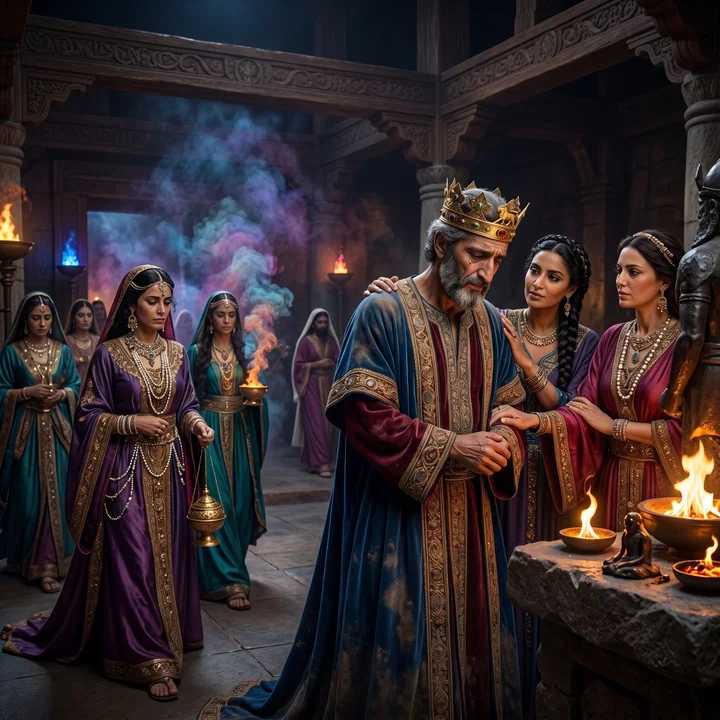
But king Solomon loved many strange women, together with the daughter of Pharaoh, women of the Moabites, Ammonites, Edomites, Zidonians, and Hittites;
Translations
But king Solomon loved many strange women, together with the daughter of Pharaoh, women of the Moabites, Ammonites, Edomites, Zidonians, and Hittites:
King James Version, KJV Cambridge Paragraph Bible
But king Solomon loved many strange women, together with the daughter of Pharaoh, women of the Moabites, Ammonites, Edomites, Zidonians, and Hittites;
But king Solomon loved many foreign women, together with the daughter of Pharaoh, women of the Moabites, Ammonites, Edomites, Zidonians, and Hittites;
Now king Solomon loved many strange women, together with the daughter of Pharaoh, women of the Moabites, Ammonites, Edomites, Zidonians, and Hittites;
Now king Solomon loved many foreign women, together with the daughter of Pharaoh, women of the Moabites, Ammonites, Edomites, Sidonians, and Hittites;
And king Solomon hath loved many strange women, and the daughter of Pharaoh, females of Moab, Ammon, Edom, Zidon, [and] of the Hittites,
But king Solomon loved many foreign women, besides the daughter of Pharaoh: women of the Moabites, Ammonites, Edomites, Zidonians, Hittites;
But, King Solomon, loved many foreign women, together with the daughter of Pharaoh,—women of the Moabites, Ammonites, Edomites, Zidonians, Hittites:
Berean Standard Bible, Majority Standard Bible
King Solomon, however, loved many foreign women along with the daughter of Pharaoh— women of Moab, Ammon, Edom, and Sidon, as well as Hittite women.
Now King Solomon loved many foreign women, together with the daughter of Pharaoh: women of the Moabites, Ammonites, Edomites, Sidonians, and Hittites,
Now a number of strange women were loved by Solomon, women of the Moabites, Ammonites, Edomites, Zidonians, and Hittites:
Bvt King Salomon loued many outlandish women: both the daughter of Pharaoh, and the women of Moab, Ammon, Edom, Zidon and Heth,
Douay-Rheims (Challoner revision)
And king Solomon loved many strange women besides the daughter of Pharao, and women of Moab, and of Ammon, and of Edom, and of Sidon, and of the Hethites:
Pictures
Cross-references 20 of 25
- Deuteronomy 7:3-4
Neither shalt thou make marriages with them; thy daughter thou shalt not give unto his son, nor his daughter shalt thou take unto thy son.
Forbids intermarriage because it would turn Israel away from God.
- Deuteronomy 17:17
Neither shall he multiply wives to himself, that his heart turn not away: neither shall he greatly multiply to himself silver and gold.
The law forbids a king to multiply wives lest his heart turn away.
- 1 Kings 3:1
And Solomon made affinity with Pharaoh king of Egypt, and took Pharaoh’s daughter, and brought her into the city of David, until he had made an end of building his own house, and the house of the LORD, and the wall of Jerusalem round about.
Solomon’s marriage to Pharaoh’s daughter precedes his many foreign marriages.
- Exodus 34:16
And thou take of their daughters unto thy sons, and their daughters go a whoring after their gods, and make thy sons go a whoring after their gods.
Foreign marriages could turn God’s people toward other gods.
- 1 Kings 11:9-13
And the LORD was angry with Solomon, because his heart was turned from the LORD God of Israel, which had appeared unto him twice,
God responds to Solomon’s unfaithfulness by taking the kingdom from him.
- Nehemiah 13:26
Did not Solomon king of Israel sin by these things? yet among many nations was there no king like him, who was beloved of his God, and God made him king over all Israel: nevertheless even him did outlandish women cause to sin.
Solomon’s foreign wives are cited as causing him to sin.
- 2 Kings 23:13
And the high places that were before Jerusalem, which were on the right hand of the mount of corruption, which Solomon the king of Israel had builded for Ashtoreth the abomination of the Zidonians, and for Chemosh the abomination of the Moabites, and for Milcom the abomination of the children of Ammon, did the king defile.
Identifies shrines Solomon built for the gods of his foreign wives.
- 1 Kings 16:31
And it came to pass, as if it had been a light thing for him to walk in the sins of Jeroboam the son of Nebat, that he took to wife Jezebel the daughter of Ethbaal king of the Zidonians, and went and served Baal, and worshipped him.
Ahab’s marriage to a foreign woman is associated with idolatry.
- Joshua 23:12-13
Else if ye do in any wise go back, and cleave unto the remnant of these nations, even these that remain among you, and shall make marriages with them, and go in unto them, and they to you:
Intermarriage with other nations becomes a snare to Israel.
- Genesis 2:24
Therefore shall a man leave his father and his mother, and shall cleave unto his wife: and they shall be one flesh.
Marriage is described as a man cleaving to his wife, not wives.
- Deuteronomy 7:6-8
For thou art an holy people unto the LORD thy God: the LORD thy God hath chosen thee to be a special people unto himself, above all people that are upon the face of the earth.
Israel’s call to be a distinct people contrasts with Solomon’s departure.
- 1 Kings 3:7
And now, O LORD my God, thou hast made thy servant king instead of David my father: and I am but a little child: I know not how to go out or come in.
Solomon’s early humility contrasts with his later moral decline.
- 1 Kings 11:33
Because that they have forsaken me, and have worshipped Ashtoreth the goddess of the Zidonians, Chemosh the god of the Moabites, and Milcom the god of the children of Ammon, and have not walked in my ways, to do that which is right in mine eyes, and to keep my statutes and my judgments, as did David his father.
Solomon’s foreign marriages led him to worship other gods.
- 1 Kings 9:16
For Pharaoh king of Egypt had gone up, and taken Gezer, and burnt it with fire, and slain the Canaanites that dwelt in the city, and given it for a present unto his daughter, Solomon’s wife.
Pharaoh’s gift of Gezer to Solomon’s wife appeared to bless a marriage that encouraged disobedience.
- Ezra 9:1-2
Now when these things were done, the princes came to me, saying, The people of Israel, and the priests, and the Levites, have not separated themselves from the people of the lands, doing according to their abominations, even of the Canaanites, the Hittites, the Perizzites, the Jebusites, the Ammonites, the Moabites, the Egyptians, and the Amorites.
Israel’s leaders repeated forbidden marriages with foreign women, bringing displeasure from Heaven.
- 1 Kings 11:14
And the LORD stirred up an adversary unto Solomon, Hadad the Edomite: he was of the king’s seed in Edom.
God raised an adversary against Solomon after his unfaithfulness.
- 1 Kings 11:34-35
Howbeit I will not take the whole kingdom out of his hand: but I will make him prince all the days of his life for David my servant’s sake, whom I chose, because he kept my commandments and my statutes:
Solomon’s unfaithfulness leads to most of the kingdom being taken from his son.
- Ezra 10:1-2
Now when Ezra had prayed, and when he had confessed, weeping and casting himself down before the house of God, there assembled unto him out of Israel a very great congregation of men and women and children: for the people wept very sore.
The cited marriage passage is part of the scriptural basis for the teaching.
- 1 Kings 9:4
And if thou wilt walk before me, as David thy father walked, in integrity of heart, and in uprightness, to do according to all that I have commanded thee, and wilt keep my statutes and my judgments:
God’s blessing on Solomon depended on his walking in the right way.
- 2 Samuel 12:24-25
And David comforted Bath-sheba his wife, and went in unto her, and lay with her: and she bare a son, and he called his name Solomon: and the LORD loved him.
Records Solomon’s birth and his name Jedidiah, meaning beloved of the Lord.
Commentary
Each commentary is drawn from primary sources: the writings of Ellen G. White and Adventist pioneers and periodicals. Each commentary is separate. Its own words are not a quotation; follow the references to read the source passages.
Ellen G. White
60 sources
Solomon took hundreds of foreign idol-worshiping wives alongside Pharaoh's daughter from Moab, Ammon, Edom, Sidon, the Hittites and many other nations, practicing polygamy contrary to God's law.PK 56.3–47MR 74.1–31SP 395.31SP 396.2ST Nov 26, 1896 He married their princesses to seal political and commercial alliances for power, wealth and greatness, hoping his wisdom and example would turn them to the true God.RH Aug 17, 19057T 217.4–218.2ED 48.3–4PK 53.2–54.1RH Dec 21, 1905 That hope proved vain, for instead of converting them he gradually yielded passion over principle until he joined them in idol worship and corrupted his own character.RH Mar 10, 19107T 217.4–218.2Ms 47, 1898, par. 33–37FE 498.3–4PK 53.2–54.1 His example broke down Israel's separation, spread polygamy, mingled pagan rites and human sacrifice with true worship, and began the downfall that made Israel a prey to those same nations.RH Dec 28, 1905Ms 47, 1898, par. 33–37PK 58.2ED 48.3–47MR 74.1–3 His fall therefore stands as a warning that even the wisest cannot safely depart in the smallest degree, marry unbelievers, or seek worldly alliance to advance God's work, but must remain a distinct people dependent on God to the end.2T 305.3CTBH 128.2CH 628.1FE 500.1ST Nov 26, 1896
Meaning of Strange Women
The strange women were foreign idol-worshipers from Egypt, Phoenicia and Sidon, Edom, Moab, Ammon, the Hittites and many other places.RH Dec 28, 1905PK 56.3–47MR 74.1–3 They were beautiful and attractive women taught to practice cruel and degrading rites, including licentious rites and human sacrifices to idols.RH Dec 28, 1905PK 56.3–47MR 74.1–3 The verse describes loving many such women together with the daughter of Pharaoh, naming Moabites, Ammonites, Edomites, Zidonians and Hittites.PK 56.3–41SP 396.2ST Nov 26, 1896 Their number reached hundreds taken from Egypt, Phoenicia, Edom, Moab and many other places.PK 56.3–41SP 396.2
Taking many wives in this way was polygamy directly opposed to the law of Jehovah.7MR 74.1–3 It was a sinful practice contrary to God's arrangement.7MR 74.1–31SP 395.3 It mingled error with truth and betrayed sacred trust, corrupting religion through paganism countenanced and sustained by groves and idol shrines built for the wives.RH Dec 28, 19057MR 74.1–3
The marriage to Pharaoh's daughter came first, and then the barrier was broken further by taking many other heathen princesses as wives on forbidden ground.FE 498.3–4RH Feb 1, 1906RH Dec 21, 1905 Although the Egyptian wife was converted, her conversion did not justify the forbidden union and did not excuse forming it.FE 498.3–4RH Feb 1, 1906 Solomon could have resisted the harm his choice set in motion.FE 498.3–4
These marriages violated the law forbidding marriage with heathen nations.FE 498.3–4Ms 94, 1899, par. 20ST Jul 1, 1903 They disregarded God's provisions and barrier for keeping Israel separate and distinct from idolatrous nations.FE 498.3–4RH Feb 1, 1906ST Jul 1, 1903 They were part of alliance with heathen nations and a breach of the holy separation God had established for Israel.RH Feb 1, 1906ST Jul 1, 1903
Motives for Foreign Marriages
Political ambition and desire for power and self-aggrandizement drove the forming of unholy political and commercial alliances with nation after nation, and those alliances were often sealed by marrying heathen princesses.RH Aug 17, 19057T 217.4–218.2ED 48.3–4PK 53.2–54.1 Association with idolaters then corrupted faith, one false step led to others, and the protections God had established for Israel were broken down by turning from allegiance to God.RH Aug 17, 19057T 217.4–218.2ED 48.3–4 For a time compassionate mercy overruled the terrible mistake and its evil forces, which a wise course could still have checked in large measure.PK 53.2–54.1
The alliances brought abundant gold and silver, and luxury, self-indulgence and the favor of the world were regarded as greatness, with infatuation even with beauty, but prosperity became ruin.PK 56.3–4FE 501.2CH 294.2RH Feb 1, 1906 The world drew the heart away from God, duties to God and to the kingdom were neglected, and the warning remains that the same corrupting influences still make people vulnerable when worldly partnerships and support are sought even to advance God's work.PK 56.3–4FE 501.2CH 294.2RH Feb 1, 1906
The reasoning was that such alliances would bring the nations to a knowledge of the true God and draw them into close touch with Israel, and that wisdom and the power of example would lead the wives from idolatry to worship of the true God.PK 53.2–54.1RH Dec 21, 1905 There was flattering self-confidence in being strong enough to resist the influence of heathen associates.PK 53.2–54.1RH Dec 21, 1905 That hope was vain and fatal, for disregard of God's law could not lead others to revere and obey its sacred precepts.PK 53.2–54.1RH Dec 21, 1905 Reliance on human alliances and personal plans set God's commands aside for the customs of surrounding peoples in an attempt to carry out the Lord's purpose in an own way, disregarding God's provisions for keeping Israel separate from idolatrous nations.FE 498.3–4PK 53.2–54.1
Yielding to the temptations connected with prosperity and honored position brought forgetfulness of God and of the conditions of success.RH Dec 21, 19051SP 395.3 Sight of the Source of power and glory was lost as inclination gained the ascendancy over reason with growing self-confidence.PK 53.2–54.1 There was failure to trust God and to accept counsel, with corruption through human praise and pride in own wisdom and reliance on self, and the apostasy came so gradually as to wander far almost unawares while conforming more and more to surrounding customs.RH Dec 21, 1905PK 53.2–54.1Ms 81, 1900, par. 28–29 Wisdom, riches and honor had been promised on condition of walking in the ways of the Lord and keeping His statutes and judgments, yet there was departure by going to other nations to secure facilities and workmen for building the temple when it could have been built with what the Lord had provided.Ms 169, 1902, par. 8–919MR 39.3–40.1Ms 169, 1902, par. 61–63 That idolatrous connection with the world greatly displeased God, and departure brought a share in the sorrows that follow such departure.Ms 169, 1902, par. 8–919MR 39.3–40.1Ms 169, 1902, par. 61–63
The wider causes of the apostasy included the spread through the kingdom of covetousness and self-seeking with grasping, selfish principles.PK 64.3SSP 7.2–3 Grasping after high wages fostered covetousness, luxury and extravagance.SSP 7.2–3STB 782.2–3 Corruption spread, the poor were oppressed, and the spirit of self-sacrifice in God's service was nearly lost.PK 64.3SSP 7.2–3STB 782.2–3
Solomon's Personal Downfall
Love for many foreign women became his sin and a snare, for he failed to control lustful passion and his wives led him into idolatry.2T 305.3CH 628.11SP 396.1 Indulgence of appetite and passion enslaved him and brought him under God's displeasure, turning him from God and costing him the firmness and wisdom God had given.ST Jul 1, 1903LC1 136.22RED 32.2 Yielding principle to passion separated him from God the source of his strength, showing the need to resist temptation and depend on God to the very end of life.2T 305.3CH 628.11SP 396.1
He was the one called Jedidiah, Beloved of the Lord, specially favored, honored and entrusted with great responsibility including building the temple and sacred service.RH Dec 21, 1905LC1 47.1–2PP 457.2 Yet indulgence in lustful passion led him away from God and made him corrupt, proving that even the wise and powerful can be overcome by inward corruption and outward temptation despite position, learning and status.2T 306.21SP 396.2Lt 209, 1899, par. 19 So it had been with Noah, Lot, Moses, Abraham and David, and so it was with David and Solomon though especially favored by God.LC1 47.1–2PP 457.2 After many years of walking uprightly with heavenly wisdom to rule with impartiality and mercy through prayer and dependence on God, he turned from God the source of his strength to reliance on self and fell a prey to temptation.RH Dec 21, 1905GC 509.34SP 329.1ST Mar 19, 1885 His world-wide fame for wisdom and uprightness and his wise counsel to others did not keep him faithful when he went forward trusting himself.RH Dec 21, 1905Lt 209, 1899, par. 19
The wisdom and remarkable powers God had given did not protect him when he turned away, but made him a more effective agent of the adversary and instrument of evil.GC 509.3GC88 509.2–34SP 329.1ST Mar 19, 1885 His apostasy was so gradual that almost before he was aware he had wandered far from God.RH Dec 21, 1905 He lost sight of the necessity of implicit obedience to the plain precepts of Scripture and conformed more and more closely to the customs of the surrounding nations, yielding to the temptations connected with prosperity and honored position and forgetting God and the conditions of success.RH Dec 21, 1905 One departure from God's standard weakens moral power and makes further departures easier, and one false step leads to others step by step through political ambition, pride, self-interest and failure to seek God's guidance.RH Aug 17, 19057T 217.4–218.2Lt 21, 1894, par. 6–9
Instead of leading the women to the truth, he allowed pagan beliefs to become part of his religion and no longer treated the Lord as the only true and living God.RH Mar 10, 1910Ms 47, 1898, par. 33–37 Association with idolaters corrupted his faith, his once firm and pure character became morally weak, and he ended as an apostate, dishonoring himself, Israel and God.RH Mar 10, 19107T 217.4–218.2Ms 47, 1898, par. 33–37 In his later years he turned from God's temple to worship idols in groves and places of worship he prepared and built for them, uniting with them in the worship of false gods.PK 56.3–46T 249.4–250.2Ms 169, 1899, par. 25Ms 94, 1899, par. 20Lt 209, 1899, par. 19 Through their strong influence he neglected his duties to God and to his kingdom and disregarded God's instruction given as a barrier against apostasy.PK 56.3–4
Association spoiled his after years, in contrast to the time when he was exalted to be king and humbled himself before God, acknowledging before all the people that he was but a little child in management.Ms 109, 1907, par. 7–8 His departure brought the loss of his kingdom's unity and his rule as universal monarch.1SP 396.2 An Ammonitess among his wives became the mother of Rehoboam and shaped his unstable character, and neglected early training with the evil influences around him contributed to his eventual apostasy, showing the lasting harm the union with idolatrous women brought to son and kingdom.1SP 396.2PK 88.2 He followed a course God had forbidden and refused the counsel God sent him, and to refuse to receive the testimonies sent by God is to stand as Solomon stood, an example of not giving truth the right of way.Ms 168, 1905, par. 33–34Ms 135, 1906, par. 27–30
Corruption of Israel
The marriages bound the king to idolatrous nations and exposed him to their influence, and by marrying idolaters he broke down the protections established to preserve Israel's distinct faith and loyalty to God.Ms 47, 1898, par. 33–37ED 48.3–4 Instead of drawing his wives to the true God, he accommodated their worship and built altars for their idols, mixing idolatry with Israel's religion.Ms 47, 1898, par. 33–37 His desire for political power and self-aggrandizement helped bring about these alliances, and they corrupted his faith and turned him from allegiance to God into the worship of false gods.ED 48.3–4
His example introduced polygamy into Palestine where it became accepted, and joined Israel in marriage to nations that bowed at idolatrous shrines.RH Dec 28, 1905PK 58.2Ms 44, 1894, par. 21–247MR 74.1–3 Through alliance with heathen nations by foreign marriages, many of the children of Israel were led to violate the law of God and become contaminated with heathen principles and practices.RH Dec 28, 1905 Contact and intermarriage with idolaters weakened the people's love for God and their abhorrence of idolatry, and companionship with the world lowered religious principles.PK 58.2Ms 44, 1894, par. 21–24
The pure religious service instituted by God was replaced in some lives by idolatry of the darkest hue, including human sacrifices to idols and licentious heathen rites.RH Dec 28, 1905PK 58.2 This was a mingling of error with truth and a betrayal of sacred trust that corrupted religion through paganism, with licentious and cruel rites greatly dishonoring to God.RH Dec 28, 19057MR 74.1–3 That paganism was countenanced and sustained by groves and idol shrines built for his wives.7MR 74.1–3 Through intermarriage and close association with idolaters, heathen customs and worship spread until Israel's faith became confused.FE 499.1PK 58.2 Love for God and sense of His holiness weakened, idolatrous mothers raised their children in heathen rites, and idolatry became common.FE 499.1PK 58.2
The idol shrines he built for his wives remained visible in Christ's time at the Mount of Offense, whose ruins remained until Shiloh, Christ, came and looked on them.RH Mar 10, 19107MR 74.1–3 This rejection of the ways of God for the ways of men began the downfall of Israel, which continued until the Jewish people became a prey to the very nations whose practices they had chosen to follow.RH Dec 28, 1905 His example helped corrupt Israel, and choices pass an inheritance of good or evil to others, to sorrow and reproach on God's cause.PK 673.1–3Ms 44, 1894, par. 21–24 What happened to ancient Israel in enticement into sin, when Satan broke down the barriers separating them from the world through forbidden association with the heathen, is the pattern by which modern Israel is led astray.ST Mar 19, 1885
Warning to Remain Separate
Solomon's love of many foreign women became the passion that was his sin and a snare, for he failed to control lustful desire and his wives led him into idolatry.2T 305.3CH 628.11SP 396.1 As he yielded principle to passion he turned from God the source of his strength and lost the firmness and wisdom God had given him, illustrating that even great wisdom and strength cannot preserve one who so yields.2T 305.3CTBH 128.2CH 628.11SP 396.1 His downfall shows the need to resist temptation and to seek strength from God with watchfulness and dependence to the very end of life.2T 305.3CTBH 128.2CH 628.11SP 396.1 Even a small departure from strict integrity is unsafe, showing the need for purity, watchfulness, trust in God and obedience to the end.CTBH 128.21SP 396.2
His history stands on record for all the religious world as a warning not to cherish and introduce the errors of the world that deceive and destroy simplicity of faith and mar the precious landmarks of truth.7MR 74.1–3Ms 47, 1898, par. 39–40 It warns that error must not be mingled with truth and that close associations that lead away from right principles must be avoided.7MR 74.1–3RH Mar 10, 1910 The true and explicit narration of sin overcoming one favored of God and entrusted with great responsibility, as with Noah, Lot, Moses, Abraham and David, shows divine wisdom and justice in refusing to gloss over faults or suppress the sins of chief characters.ST May 31, 1910 It gives a faithful record of human frailty, struggle with evil and the sure penalty of disobedience, to teach strict regard for God's commandments and that retributive justice never fails.ST May 31, 1910 The record is for benefit and warning and also for encouragement to desponding hearts, proving that those who strive, waver and fall into error can through God's grace gain fresh vigor, rise above evil nature, take heart again, conquer and renew the conflict.ST May 31, 1910
Joining life to unbelievers in opposition to God in forbidden marriages and other close alliances, in hope of influencing them for good, can instead entrap until faith is yielded, principle sacrificed and separation from God follows.FE 500.1ST Nov 26, 1896RH Feb 1, 1906 One wrong step leads to another and binds as in chains that cannot be broken, hindering service to God and bringing sorrow and reproach on God's cause.FE 500.1ST Nov 26, 1896RH Feb 1, 1906 Companionship with the world and injudicious friends lowers religious principles, and Solomon's choice of heathen wives and friendships with idolatrous nations turned his heart from God and endangered his soul while bringing polygamy and idolatry into Israel.Ms 44, 1894, par. 21–24Ms 81, 1900, par. 28–29RH Mar 10, 1910 Though chosen of God and entrusted with building the temple and sacred service, he became corrupted through human praise, pride in his own wisdom, and failure to trust God or accept counsel, revealing human weakness and turning from doing God's will.Ms 44, 1894, par. 21–24Ms 81, 1900, par. 28–29
Blessing remained while he remained separate from the world, and God's people are likewise blessed while they remain distinct and peculiar, holding the beginning of confidence steadfast to the end and standing true to principle.19MR 53.4–5Ms 169, 1902, par. 61–6319MR 41.3–42.2 God desires to encircle His people with His protecting arm, blessing them above all others and preserving them in purity while closely connected with Him, but departure from Him brings a share in the sorrows of Solomon.Ms 169, 1902, par. 8–919MR 39.3–40.1 Worldly partnerships and support must not be sought even to advance God's work, including binding to follow the wisdom of worldly men to secure help and linking with unbelievers for supposed advantage such as calling sanitariums undenominational.RH Feb 1, 1906Ms 169, 1902, par. 61–6319MR 41.3–42.2 His alliances with unbelievers through his marriages brought abundant gold and silver, but prosperity became his ruin as the world drew him away from God.FE 501.2CH 294.2RH Feb 1, 1906 His downfall warns that people today are just as vulnerable to the same corrupting influences of wealth and worldly alliance and must remain separate from the world and its influence rather than seek worldly support.FE 501.2CH 294.2RH Feb 1, 1906
Sources
Pioneers and periodicals
67 sources
The verse marks Solomon's relapse into idolatry, when the king who had begun in devotion loved many foreign women including Pharaoh's daughter and women of the Moabites, Ammonites, Edomites, Zidonians and Hittites.RH Aug 18, 1868 In doing so he deliberately broke God's commands against intermarrying with surrounding nations and against a king multiplying wives, commands given because such wives would turn the heart away from God.RH Jan 12, 1869RH Jul 2, 1914ST Apr 26, 1910 When he was old his wives did turn his heart toward other gods, so that he favored their worship and built idol temples and altars, including for Chemosh, Molech and Ashtaroth.RH Mar 10, 1910ST Sep 24, 1902RH Mar 31, 1910 His fall proves that great wisdom, ability, prosperity and past obedience cannot by themselves keep a person faithful, and refutes the idea that once in grace a person is always safe.ST Sep 24, 1902RH Jan 12, 1869RH May 13, 1875RH Aug 31, 1869RH Feb 6, 1879 It therefore warns that those who love the Lord must not marry unbelievers but choose companions who share the same truth, lest such unions ensnare faith, sacrifice principle and overthrow servants of God as they overthrew the greatest king Israel ever had.ST Nov 26, 1896RH Aug 3, 1911ST Jul 1, 1908
Words and Historical Context
The verse introduces Solomon's relapse into idolatry, for despite his place as king and his earlier devotion he loved many foreign women. That love sets the context for the account of his turning away from God.ST Jun 25, 1885 It belongs to the wholly historical record of 1 Kings 3-21, a sad record full of important lessons.ST Apr 26, 1910 That record shows the general downward moral tendency in the kingdoms of Judah and Israel from the time of David.ST Apr 26, 1910 It belongs also to 1 Kings 1-11, which gives the history of the undivided kingdom under Solomon and covers the same events as 2 Chronicles 1-9.RH May 11, 1916
The verse names together Pharaoh's daughter and women of the Moabites, Ammonites, Edomites, Zidonians, and Hittites, including women from Moab, Ammon, Edom, Sidon, and the Hittites as well as Pharaoh's daughter.ST Jun 25, 1885 The marriage to Pharaoh's daughter was ill-advised, and the espousing of many strange women was a repetition of that crime and the transgression of another distinct law of Moses.RH Aug 18, 1868 It was the early fruit of forbidden traffic with Egypt for horses and multiplying horses to excess, proving that the forbidden horse trade was the origin of all the mischief and that the beginnings of evil must be resisted.RH Aug 18, 1868 It led first to building idol-temples for his wives' use and then to erecting other temples for his own worship as he followed their gods and built places of worship for them.RH Aug 18, 1868ST Jun 25, 1885 The presence of Hittite women among his wives, as part of the peoples represented in his household and harem, evidences that the Hittites were a real people in Old Testament times.ST Oct 1, 1885
Those marriages to women from surrounding nations began Israel and Judah's later slide into idolatry through alliances with heathen peoples.ST Jul 19, 1905 That beginning of departure from wisdom and faithfulness brought lasting consequences, for the Lord raised adversaries against him and decreed that the kingdom would be torn from his house, though one tribe would remain for David's and Jerusalem's sake.ST Jun 25, 1885
Disobedience That Caused Ruin
Solomon deliberately broke God's commands against marrying women of the surrounding nations and against a king multiplying wives, commands that warned such wives would turn his heart away from God.RH Jan 12, 1869RH Jul 2, 1914RH Feb 6, 1879 In loving many foreign women together with Pharaoh's daughter — Moabites, Ammonites, Edomites, Zidonians and Hittites — he joined himself to idolatrous peoples and multiplied wives to his own harm rather than good.RH Jan 12, 1869RH Jul 2, 1914ST Apr 26, 1910ST May 27, 1908 His later multiplying of adultery and idolatry stands as warning rather than example, proving present wisdom and past obedience do not keep a person safe after turning from God's way.RH Feb 6, 1879ST May 27, 1908
His sin was bound up with multiplying horses to excess through forbidden traffic with Egypt for horses and trade in horses and chariots with Egypt and neighboring kings.RH Aug 18, 1868ST Oct 30, 1884RH Mar 10, 1874 That forbidden horse trade was the early fruit and origin of all the mischief, first repeating his crime in marrying Pharaoh's daughter in many strange women, then leading to building idol-temples for his wives' use and afterward temples for his own worship.RH Aug 18, 1868ST Oct 30, 1884 Obedience to the distinct laws of Moses against multiplying horses and wives would have guarded him, so the beginnings of evil must be resisted.RH Aug 18, 1868ST Oct 30, 1884RH Mar 10, 1874
His course was driven by political ambition and pursuit of greater wealth, power and supposed political advantage through alliance with heathen nations.RH Aug 17, 1905ST Dec 30, 1880ST Jul 1, 1903ST Oct 16, 1884 Inflated with prosperity and courting worldly honor, he crossed the barrier of holy separation God had set between Israel and pagan peoples step by step until association with idolaters corrupted his faith.RH Aug 17, 1905ST Dec 30, 1880ST Jul 1, 1903ST Oct 16, 1884 Compromise tarnished his character, passion enslaved him, and what began as seeking wealth and power led him away from hope, happiness, heaven and God, turning a wise ruler into a despot.ST Dec 30, 1880ST Jul 1, 1903
He wrongly treated the command as necessary for others but not for himself, judging himself strong enough by wisdom, example and strength to resist heathen influence.RH Dec 21, 1905RH Jan 12, 1869 Beginning with Pharaoh's daughter and then breaking the barrier further with many other heathen princesses on forbidden ground, he flattered himself that his wisdom and power of example would draw the surrounding nations and his wives from idolatry to the worship of the true God and bring them into close touch with God's people.RH Feb 1, 1906RH Dec 21, 1905 The hope that his wives would be converted did not excuse the forbidden unions, and that hope was vain and fatal, for his own disregard of God's law could not lead others to revere and obey its sacred precepts but helped draw him from God and bring idolatrous influence into Israel.RH Feb 1, 1906RH Dec 21, 1905RH Jan 12, 1869
His apostasy after many years of walking uprightly with heavenly wisdom to rule with impartiality and mercy was so gradual that almost before he was aware he had wandered far from God.RH Dec 21, 1905RH Aug 17, 1905 Though called Jedidiah, Beloved of the Lord, specially honored with remarkable divine favor, world-wide fame for wisdom and uprightness, and giving wise counsel to others, he lost sight of the necessity of implicit obedience to the plain precepts of Scripture and conformed more and more closely to the customs of surrounding nations.RH Dec 21, 1905 Yielding to temptations connected with prosperity and honored position, he forgot God and the conditions of success, showing that one departure from God's standard weakens moral power and makes further departures easier.RH Dec 21, 1905RH Aug 17, 1905
Having come to the throne at once in full brightness like the sun mounting at once to its meridian, without prior training in poverty, sorrow, affliction and humility, he could not bear his exalted position.RH Jun 9, 1868ST Jul 28, 1881ST Dec 16, 1880ST Dec 8, 1881 His honor, wealth, blessings and prosperity lifted up his heart and overshadowed the promise of his early reign in a disastrous eclipse, nearly costing his soul and nearly costing his kingdom to an usurper.RH Jun 9, 1868RH Aug 12, 1875ST Jul 28, 1881ST Dec 16, 1880ST Dec 8, 1881 No man should seek honor before being prepared by humility, for prosperity intoxicates even favored men and safety is in walking humbly with God, serving Him regardless of circumstances and being rich in faith rather than longing for wealth.RH Jun 9, 1868RH Aug 12, 1875ST Dec 8, 1881
Luxury and lust sapped his God-given wisdom and power, for indulgence of appetite and passion and the seductive influence of wine and the idolatrous women of his court overcame the wisdom for which he was renowned.ST Feb 22, 1883RH Jul 28, 1874ST Dec 5, 1911ST Sep 18, 1901 Though especially favored by God as great statesman, sage, noted author and poet, mighty builder and renowned scientist, he allowed lust to lead him astray and incurred God's displeasure.ST Feb 22, 1883RH Jul 28, 1874 Such evil by one of God's chosen servants was done when men walked morally and intellectually in twilight, and God never approved it but recorded it as a father tells a younger child of an older child's sin and its necessary punishment, that His younger children may be warned.ST Jan 29, 1885
Fall and National Consequences
When he was old his wives turned his heart toward other gods so that it was not wholly faithful to the Lord.ST Sep 24, 1902RH Mar 31, 1910 He favored their worship and built idol-temples for his wives' use and then for his own worship, including shrines and altars for Chemosh, Molech and Ashtaroth with an idol shrine on Olivet.RH Mar 31, 1910ST Dec 10, 1896 Instead of leading the women to the truth he allowed pagan beliefs to become part of his religion and became an apostate, no longer treating the Lord as the only true and living God.RH Mar 10, 1910 The idol shrines he built remained visible in Christ's time at the Mount of Offense.RH Mar 10, 1910
His alliances with heathen nations through foreign marriages introduced polygamy into Palestine and replaced the pure religious service instituted by God with idolatry of the darkest hue.RH Dec 28, 1905 That idolatry included human sacrifices to idols and licentious heathen rites, and through it many of the children of Israel violated the law of God and became contaminated with heathen principles and practices.RH Dec 28, 1905 This rejection of the ways of God for the ways of men began the downfall of Israel, which continued until the Jewish people became a prey to the very nations whose practices they had chosen to follow.RH Dec 28, 1905
His magnificent and glorious reign, in which he built the temple, enriched his kingdom and expanded his dominions, ended in gloom and clouds.RH May 2, 1865ST Apr 23, 1912 His fall tarnished his glory and character, and his case is an example of God marking disapproval of disobedience and punishing when he turned from the path of obedience.ST Jun 29, 1904RH Mar 17, 1904 The reading of his reign closes with the division of the kingdom because of transgression.ST Apr 23, 1912
His sin brought lasting consequences, for the Lord raised adversaries against him on every side and decreed that the kingdom would be torn from his house, though one tribe would remain for David's and Jerusalem's sake.ST Jan 27, 1904ST Jun 25, 1885 Had he used his wonderful God-given wisdom for God throughout his reign, he would not have left a weak and vacillating son to reign over Israel, and the division would not have taken place. His divided affections left little room for God, and his mistakes led to the division of the kingdom into Judah and Israel, followed by war and strife between them.ST May 20, 1913 His ships and wealth did not protect him from ruin, for he trusted in his wealth, wisdom and foreign wives, and God took from his descendants the kingdom that otherwise would have been theirs.ST Oct 8, 1902
He is left in a fallen condition, since his wives turned his heart from serving God to idolatry and his later intent to kill Jeroboam shows that he died with murder in his heart.RH May 13, 1875 Applied to Ezekiel's test of character, his final sin leaves him subject to the second death.RH May 13, 1875 He later repented of his mistakes as shown in Ecclesiastes.ST May 20, 1913 Through the influence of his many wives he did evil and incurred the wrath of God, though its execution was suspended because of his sincere repentance.RH Apr 28, 1868
Doctrinal Lessons Affirmed
Solomon's God-given wisdom did not keep him from falling when his heart was turned in old age and was no longer wholly faithful, and wisdom by itself cannot save a sinner or keep a professed believer from falling, for justification is by faith and the just live by faith.ST Sep 24, 1902RH Jan 12, 1869RH Aug 31, 1869 Even the wisest of men became an idolater and apostate when he forgot sacred history and grew confident in his own strength, showing that great wisdom and prosperity cannot keep anyone from ruin.ST Sep 24, 1902RH Jan 12, 1869RH Aug 31, 1869 Great ability, knowledge, strength of character, and experience of grace can foster pride and leave a person exposed to sin for a time, and prosperity and blessing can lead to forgetting their source, as when Solomon turned to idols.RH Jan 12, 1869RH Aug 31, 1869RH Aug 12, 1875 When he turned from the Source of his strength and went forward relying on himself he fell prey to temptation, and his marvelous wisdom and power only made him a more efficient agent of the adversary.ST Mar 19, 1885ST Sep 24, 1902RH Aug 31, 1869
His later history, in which multiplied forbidden unions led to idolatry, proves that present wisdom and past obedience do not keep a person safe after turning from God's way, and it stands as warning rather than example.RH Jan 12, 1869RH May 13, 1875RH Feb 6, 1879 His wives turned his heart from serving God to idolatry and left him in a fallen condition, and by the test of character in Ezekiel his final sin, shown in intent to kill Jeroboam with murder in his heart, leaves him subject to the second death.RH May 13, 1875RH Feb 6, 1879
Polygamy was contrary to God's original plan of one husband and one wife shown in making them male and female and in a man leaving father and mother, cleaving to his wife, and becoming one flesh with her.ST Feb 25, 1913RH Apr 28, 1868ST Jul 21, 1898 It came from human blindness and wilfulness, from lust and following universal custom, then the general rule especially after war left many women, and it was against God's command, especially for kings who were warned not to multiply wives.ST Feb 25, 1913RH Apr 28, 1868ST Jul 21, 1898 God suffered it while knowing the heart and lack of understanding, and mightily used Solomon because with heart and motives right toward God he was the best instrument at hand, subduing the heart by His word rather than removing a general public evil by one stroke of power.ST Feb 25, 1913RH Apr 28, 1868 Transgression of this kind always brought its own trouble, and in Solomon's case jealousies and troubles that broke up his kingdom, with his wives leading him astray into evil that incurred God's wrath whose execution was suspended because of sincere repentance.ST Feb 25, 1913RH Apr 28, 1868ST Jul 21, 1898 Multiplied legitimate wives is better than unbridled licentiousness, but there is no excuse for sin at any time and such conduct was never in harmony with God's plan, so recording it does not sanction it.ST Feb 25, 1913RH Apr 28, 1868
The Bible faithfully and impartially records even the sins and faltering weakness of the wise, noble, and best without glossing over, concealing, or hiding faults, as in the awful mistakes of the wisest king of Israel.ST May 1, 1907ST The account of loving many strange women is fully inspired and therefore correct as a record, but inspiration does not mean God moved him to do it or approved it, because it contradicts the fundamental principles of righteousness.RH Jul 9, 1908ST Apr 7, 1881ST Jan 29, 1885 God never approved such evil done by His chosen servant in moral and intellectual twilight, and He recorded it as a father tells a younger child of an older child's sin and its necessary punishment, so younger children may be warned by the sins of former servants and consequent punishment.STRH Jul 9, 1908ST Jan 29, 1885 The sacred record is impartial, and the sin left a stain upon character that is a reproach to the truth, showing how professed friends of the cause who imbibe immoral principles while professing great love for it become its worst enemies and give opposers something to feast upon, yet such failure ruins the sinner himself and not the Christian religion, for God's cause in its native purity exists still.RH Jul 9, 1908ST Apr 7, 1881ST Jan 29, 1885 The record is given for warning, to teach strict regard for God's commandments and that retributive justice never fails, and for encouragement that those who strive, waver, and fall can through grace rise, conquer, and renew the conflict.RH Jul 9, 1908ST Apr 7, 1881ST Jan 29, 1885
The account of many foreign wives gave rise to the mistaken idea that the Song of Solomon was a love poem written from infatuation with women.RH Oct 30, 1860ST Nov 1, 1910 His strange character stands among the saints not to show how good he was, though guilty of evil deserving prison and hell, but to show how God's grace brings salvation to the very worst of men and makes saints out of the vilest sinners.RH Oct 30, 1860ST Nov 1, 1910
His practice of taking many women, including foreign women, is the vice of a good man, not permission for others to imitate his sin, and no one can use his conduct as warrant to indulge lust or claim that having the virtues of godly people makes sins allowable.ST Feb 25, 1913RH Aug 17, 1869RH Feb 6, 1879
Warnings for God's People
The verse stands as a special warning against intermarrying with the surrounding nations, because such marriages prove a snare that seduces from allegiance to God.RH Jan 22, 1867 To marry an idolater who leads toward false worship is no better than to marry an infidel who professes no faith at all, and the same rule holds now.RH Jan 22, 1867 One who has no God and no Sabbath opposes God and His Sabbath no less than one who has a false god and a false Sabbath, for false religion is ever the most violent opponent of the true.RH Jan 22, 1867
Anyone who loves the Lord must not join in the close union of marriage with an unbeliever, but must choose a companion who shares the same truth.RH Aug 3, 1911ST Jul 1, 1908 There can be no harmony between one who follows God and one who loves the sinful pleasures of the world.RH Aug 3, 1911 Such unions can bring sorrow and reproach upon God's cause, ensnare believers to yield their faith and sacrifice principle, and separate them from God.ST Nov 26, 1896RH Feb 1, 1906 They led to the overthrow of servants of God, overthrowing even the greatest king Israel ever had.ST Jul 1, 1908ST Jul 24, 1884
Love for many strange women was intermarriage with the people of the world, an evil among God's people through all the ages.ST Jul 1, 1908 It had the same effect in every age of the history of the children of Israel and before the Flood, and still has in the Christian church, to the destruction and impoverishment of souls.ST Jul 1, 1908 It is compared with the sons of God taking wives from among the daughters of men, which led to corruption and could turn the heart away from God.ST Jul 1, 1908ST Aug 27, 1912
His alliances with unbelievers brought him abundant gold and silver but proved his ruin, as the world drew him away from God.RH Feb 1, 1906 They were unwarranted alliances made for supposed political advantage, showing the tendency when inflated with prosperity to court worldly honor and political power.ST Oct 16, 1884 His fall warns that people today are just as vulnerable to those influences and must not seek worldly partnerships and political power, even to advance God's work.RH Feb 1, 1906ST Oct 16, 1884
The record belongs to a sad history showing the general downward moral tendency in Judah and Israel from the time of David.ST Apr 26, 1910 It shows the responsibility resting upon the leaders of God's people, that whenever king and priest are faithful to God and strong for Him they mold the people immensely, but whenever the leaders fail to lead in right ways the people fail with them.ST Apr 26, 1910 Satan overcomes the people of God by breaking down the barriers that separate them from the world through forbidden association with the heathen.ST Mar 19, 1885 What happened to ancient Israel in this enticement into sin is the pattern by which modern Israel is led astray, warning against close associations that lead away from right principles and against mingling error with truth.ST Mar 19, 1885RH Mar 10, 1910 When he turned from the Source of his strength and went forward relying upon himself he fell a prey to temptation, and his great powers only made him a more efficient agent of the adversary of souls.ST Mar 19, 1885
His talents, wisdom, knowledge, strength of character, and experience of God's grace were gifts from God bringing responsibility to be used faithfully in His service, not for selfish gratification and ambition.RH Aug 31, 1869RH Aug 31, 1869 Great ability and spiritual experience do not by themselves protect from sin, but can foster pride leading to sin and to escape from its consequences for a time.RH Aug 31, 1869 His heart was lifted up by wealth and honor, and despite all his wisdom his great prosperity tended to cause his fall and ruin, nearly costing his soul and his kingdom, proving that prosperity intoxicates even favored men.RH Jun 9, 1868 From the loftiest faith and most exalted communion with God he fell into the most abominable idolatry through pride, glorious apparel, ivory, gold and pearls, warning that others may fall before similar temptations.RH Jan 21, 1909 Safety is in walking humbly with God, serving Him regardless of circumstances and being rich in faith rather than longing for wealth, sensing fallen condition and great need of Christ and dependence on Him, and clothing oneself with humility, simplicity and sobriety rather than pride and glorious display.RH Jun 9, 1868RH Jan 21, 1909
Sources