1 Kings 16:32
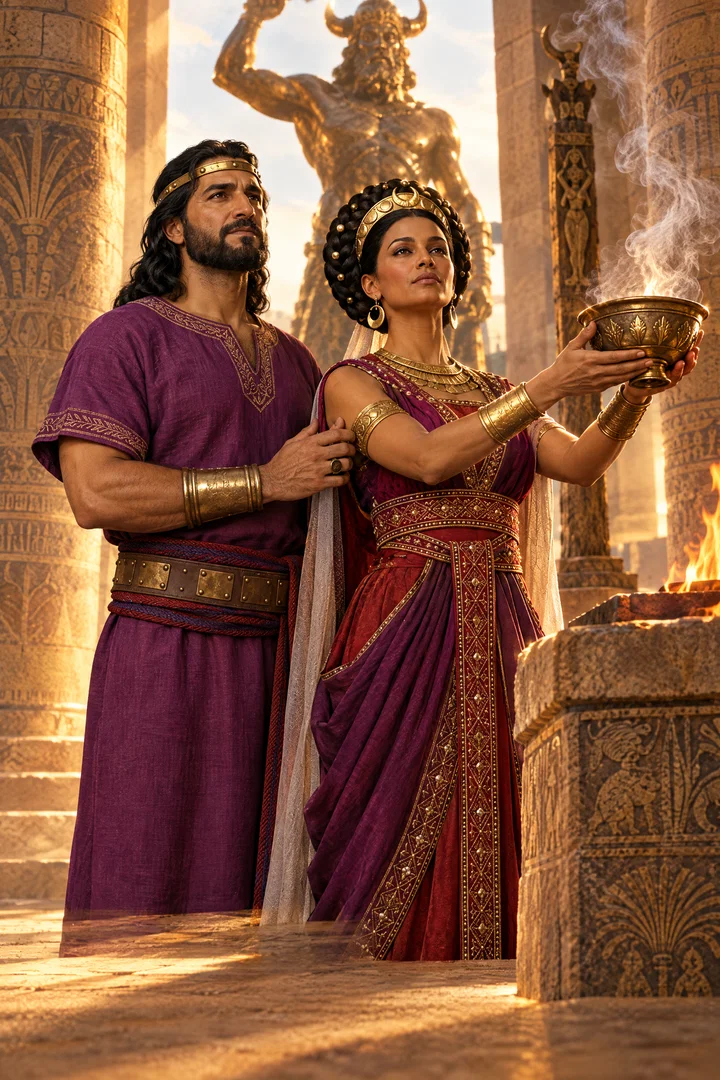
And he reared up an altar for Baal in the house of Baal, which he had built in Samaria.
Translations
American King James Version, King James Version, KJV Cambridge Paragraph Bible, Revised Version, American Standard Version
And he reared up an altar for Baal in the house of Baal, which he had built in Samaria.
And he erected an altar for Baal in the house of Baal, which he had built in Samaria.
and raiseth up an altar for Baal, in the house of the Baal, that he built in Samaria;
And he reared up an altar for Baal in the house of Baal, which he built in Samaria.
And he reared an altar unto Baal,—in the house of Baal, which he built in Samaria.
Berean Standard Bible, Majority Standard Bible
First, Ahab set up an altar for Baal in the temple of Baal that he had built in Samaria.
He raised up an altar for Baal in the house of Baal, which he had built in Samaria.
And he put up an altar for Baal in the house of Baal which he had made in Samaria.
Also he reared vp an altar to Baal in the house of Baal, which he had buylt in Samaria.
Douay-Rheims (Challoner revision)
And he set up an altar for Baal in the temple of Baal, which he had built in Samaria,
Pictures
Cross-references 20 of 30
- 1 Kings 18:19
Now therefore send, and gather to me all Israel unto mount Carmel, and the prophets of Baal four hundred and fifty, and the prophets of the groves four hundred, which eat at Jezebel’s table.
Elijah confronts the Baal worship promoted under Ahab.
- 1 Kings 18:17-18
And it came to pass, when Ahab saw Elijah, that Ahab said unto him, Art thou he that troubleth Israel?
Elijah names Ahab’s forsaking God and following Baal as the cause of Israel’s trouble.
- 1 Kings 18:21
And Elijah came unto all the people, and said, How long halt ye between two opinions? if the LORD be God, follow him: but if Baal, then follow him. And the people answered him not a word.
Elijah calls Israel to choose between following the Lord and Baal.
- 2 Kings 10:27
And they brake down the image of Baal, and brake down the house of Baal, and made it a draught house unto this day.
Jehu destroys the Baal temple that Ahab built in Samaria.
- 1 Kings 21:25-26
But there was none like unto Ahab, which did sell himself to work wickedness in the sight of the LORD, whom Jezebel his wife stirred up.
Ahab’s idolatry and Jezebel’s influence are described.
- Exodus 20:3
Thou shalt have no other gods before me.
Baal worship violates the command to have no other gods.
- Revelation 2:20
Notwithstanding I have a few things against thee, because thou sufferest that woman Jezebel, which calleth herself a prophetess, to teach and to seduce my servants to commit fornication, and to eat things sacrificed unto idols.
Jezebel represents tolerated apostate teaching that seduces believers.
- 1 Kings 17:1
And Elijah the Tishbite, who was of the inhabitants of Gilead, said unto Ahab, As the LORD God of Israel liveth, before whom I stand, there shall not be dew nor rain these years, but according to my word.
Elijah announces drought as judgment for Baal worship.
- 1 Kings 18:4
For it was so, when Jezebel cut off the prophets of the LORD, that Obadiah took an hundred prophets, and hid them by fifty in a cave, and fed them with bread and water.)
Jezebel’s persecution of the Lord’s prophets led Obadiah to hide and feed them.
- 2 Kings 9:1-10
And Elisha the prophet called one of the children of the prophets, and said unto him, Gird up thy loins, and take this box of oil in thine hand, and go to Ramoth-gilead:
Jehu is anointed to destroy Ahab’s house and end Baal worship.
- 1 Kings 19:18
Yet I have left me seven thousand in Israel, all the knees which have not bowed unto Baal, and every mouth which hath not kissed him.
God preserves seven thousand who have not worshiped Baal.
- 1 Kings 12:28-33
Whereupon the king took counsel, and made two calves of gold, and said unto them, It is too much for you to go up to Jerusalem: behold thy gods, O Israel, which brought thee up out of the land of Egypt.
Ahab went further in Jeroboam’s idolatrous way.
- 1 Kings 19:1-2
And Ahab told Jezebel all that Elijah had done, and withal how he had slain all the prophets with the sword.
Jezebel threatens Elijah after his conflict with Baal worship.
- 1 Kings 18:1-2
And it came to pass after many days, that the word of the LORD came to Elijah in the third year, saying, Go, shew thyself unto Ahab; and I will send rain upon the earth.
Elijah’s drought confronts Ahab’s established Baal worship.
- 1 Kings 18:40
And Elijah said unto them, Take the prophets of Baal; let not one of them escape. And they took them: and Elijah brought them down to the brook Kishon, and slew them there.
Elijah slew the prophets of Baal whom Ahab fostered.
- Amos 8:14
They that swear by the sin of Samaria, and say, Thy god, O Dan, liveth; and, The manner of Beer-sheba liveth; even they shall fall, and never rise up again.
Those who swear by Samaria’s false god will fall and never rise again.
- Deuteronomy 17:3
And hath gone and served other gods, and worshipped them, either the sun, or moon, or any of the host of heaven, which I have not commanded;
Prohibits worship of other gods and heavenly bodies.
- 1 Kings 16:25
But Omri wrought evil in the eyes of the LORD, and did worse than all that were before him.
Omri’s evil is contrasted with Ahab’s greater wickedness.
- Zephaniah 1:4
I will also stretch out mine hand upon Judah, and upon all the inhabitants of Jerusalem; and I will cut off the remnant of Baal from this place, and the name of the Chemarims with the priests;
Foretells cutting off the remnant of Baal.
- 2 Kings 17:16
And they left all the commandments of the LORD their God, and made them molten images, even two calves, and made a grove, and worshipped all the host of heaven, and served Baal.
Baal worship accompanied abandoning all the LORD’s commandments.
Commentary
Each commentary is drawn from primary sources: the writings of Ellen G. White and Adventist pioneers and periodicals. Each commentary is separate. Its own words are not a quotation; follow the references to read the source passages.
Ellen G. White
11 sources
The verse records that Ahab built a house or temple for Baal in Samaria and reared up an altar for Baal inside it, thereby publicly establishing Baal worship in the capital.3T 262.2PK 114.2RH Aug 7, 1913RH Aug 14, 1913RH Sep 16, 1873 In doing so he openly replaced the worship of Jehovah with heathen idolatry and helped lead Israel into widespread apostasy.RH Aug 7, 1913RH Aug 14, 1913RH Sep 16, 1873 He did this in connection with taking to wife Jezebel, an idolatrous woman devoted and given to idolatry.PK 114.2Ms 29, 1911, par. 37 She was the daughter of Ethbaal king of the Zidonians, who was high priest of Baal, and Ahab then served Baal and worshiped him.PK 114.2
The act exposes Ahab's weakness in moral power, his selfish and unprincipled nature, his lack of a high sense of sacred things, and his being without a high standard of right-doing.3T 262.3PK 115.1 His selfish nature could not appreciate God's mercies to Israel, nor his own obligation to God as guardian and leader of the chosen people.3T 262.3PK 115.1 It shows the controlling influence of Jezebel, a woman of decided character and positive temperament whose determined spirit molded Ahab and his character.3T 262.3PK 115.1 She gained more power over him than God had, and his marriage to her brought disaster on himself and on the nation.PK 115.1Ms 29, 1911, par. 37 By that union they both became special agents of Satan to lead God's people into idolatry and terrible apostasy, she leading him into Baal worship and through him leading Israel into idolatry.3T 262.3Ms 29, 1911, par. 37
The building of that altar formed part of Israel's departure from the living God under Ahab's blighting rule, corrupting their ways before Him and provoking the Lord.3T 262.2PK 115.2 His adoption and advancing of Baal and Ashtoreth worship dishonored God among the nations, helped lead the nation into widespread apostasy, and led it to forfeit God's protecting care, so that the widespread apostasy called for judgments to fulfill God's purposes for Israel.RH Aug 7, 1913RH Aug 14, 1913RH Sep 16, 1873 The verse marks a daily lessening of the fear of God and loss of reverence and godly fear until none dared openly oppose the prevailing blasphemy.3T 262.3PK 115.2 The dark shadow of apostasy covered the whole land, and blind blasphemous idolatry became conspicuous everywhere in multiplied idolatrous temples, consecrated groves and temples where the works of men's hands were placed to be worshiped, images of Baalim and Ashtoreth everywhere to be seen, and altars of Baal and priests of Baal sacrificing to the sun, moon, and stars.3T 262.3PK 115.2 The air was polluted with the smoke of sacrifices offered to false gods, and hill and vale resounded with the drunken cries of a heathen priesthood.PK 115.2
It shows Israel's ingratitude in giving God no thanks for His benefits, ascribing all the bounties of Heaven to the favor of their gods instead of to God the Giver.3T 262.3 Those bounties were the running brooks, the streams of living waters, the gentle dew, and the showers of rain which refreshed the earth and caused the fields to bring forth abundantly.3T 262.3 Though this idolatry made the days when Elijah and Elisha acted their part dark and troublous, when wickedness had reached a fearful pass, God still sent His prophets to the nation with messages of warning and still had men He used in fighting the battles of Zion.RH Aug 14, 1913Ms 29, 1911, par. 37Ms 31, 1889, par. 77 He chose Elijah as a preacher of righteousness, ruled and guided by the Holy Spirit, who working under God's direction accomplished a grand and noble work.Ms 31, 1889, par. 77 Yet neither king nor people heeded him but regarded him as a messenger of evil, and when God at last sent drought upon the land as judgment the people did not discern its object or humble their hearts, but at Jezebel's instigation blamed the prophets of Jehovah for the calamity and put many holy men to death for their testimony.Ms 29, 1911, par. 37
The apostasy set up in Samaria is being repeated in the present age, for the age of Elijah had its Ahabs and its Jezebels and the present age has them too and is as verily one of idolatry.PK 177.1 Though there may be no outward shrine and no image for the eye to rest upon, thousands follow the gods of this world after riches, fame, pleasure, and pleasing fables that permit men to follow the inclinations of the unregenerate heart.PK 177.1 Having a wrong conception of God and His attributes is as truly serving a false god as the worshipers of Baal did.PK 177.1 Many who claim to be Christians have allied themselves with influences unalterably opposed to God and His truth, and are thus led to turn away from the divine and to exalt the human.PK 177.1 For those living at the end of the world this record has special significance, bringing inspiration and courage to stand for the right in the midst of apostasy.PK 177.1
Sources
Pioneers and periodicals
45 sources
Ahab gave false worship a public, organized and royal home by building a temple for Baal in his capital Samaria and setting up an altar to him inside it.RH Aug 7, 1913RH May 25, 1916ST Jul 20, 1904 In doing so he forsook the living God Jehovah for open heathen idolatry, going beyond Jeroboam's golden calves that broke the second commandment to break the first by replacing Jehovah with another god, and doing worse to provoke God than Omri and all the kings before him.RH Aug 7, 1913RH Jul 26, 1906ST Feb 2, 1882ST Oct 22, 1894ST Sep 8, 1881 Disobeying God's command against union with the ungodly, he married Jezebel daughter of Ethbaal king of the Zidonians, a devoted worshipper of Baal and Ashtoreth, and under her control served Baal, supported his prophets and persecuted Jehovah's prophets.RH Jul 26, 1906RH Nov 7, 1912ST Apr 15, 1897ST Dec 10, 1902 His idolatry dishonored God, forfeited His protecting care and made national calamity imminent, calling for Elijah's mission to reprove sin, expose Baal's impotence and call the people back to obedience.ST Feb 2, 1882RH Dec 4, 1913ST Jun 23, 1898ST Apr 15, 1880RH Sep 9, 1862 Their unlawful union stands as fornication and a type of the later unlawful union of the church with the world in church-and-state persecution during the Dark Ages, and Baal as sun-worship whose sign of Sunday is still exalted shows that departures from God's law widen into paganism and will fall under judgment in the last days.ST Aug 22, 1900ST Dec 10, 1902ST Aug 7, 1901ST Sep 4, 1901
Historical Setting and Details
Ahab built a house or temple for Baal in Samaria and reared up an altar for Baal inside it, thereby establishing Baal worship in Samaria and giving this false worship a public, organized place in Israel.RH May 25, 1916ST Jul 20, 1904ST Feb 2, 1882 The building of an altar to Baal in a temple built for Baal marked the kingdom's idolatry and openly replaced worship of Jehovah with heathen idolatry, helping lead Israel into widespread apostasy.RH Aug 7, 1913RH May 25, 1916 Baal was the sun-god worshiped by the Phoenician and Canaanitish nations, and Ahab's turn to Baal came after Israel had forsaken Baal worship under Samuel and served the Lord alone. Ahab's evil course in this helped provoke the Lord God of Israel to anger, and his idolatry, not Elijah's rebuke, was the cause of Israel's trouble.ST Feb 2, 1882 His support of Baal worship illustrates the false religion promoted under his rule and the union of religion and the state, with Ahab and Jezebel standing as a type of later church-and-state governments that persecute those who remain faithful to God.ST Aug 22, 1900
The act belongs to the history of Israel's kings after Israel and Judah divided, tracing the succession from Jeroboam through Omri to Ahab, with the account of his reign and the work of Elijah following.ST Apr 26, 1910ST Jul 30, 1885 Ahab was the wicked king of Israel following Nadab, Baasha, Elah, Zimri and Omri, and his establishment of Baal worship in Samaria produced the prophets of Baal whom Elijah, God's great and mighty prophet, slew when Israel itself ought to have done it.ST May 20, 1913 It belongs to a record of general moral decline in Israel and Judah, in which the people also failed when their leaders failed to lead them in right ways.ST Apr 26, 1910 Samaria was the capital Omri had built, and Ahab reigned there after Omri, placing his worship of Baal there during his reign after Omri.ST Apr 17, 1907 His reign came after the two-generation house of Baasha and the strong but wicked reign of Omri the builder of Samaria, and showed Ahab as weak and wicked, dominated in his Baal worship by his idolatrous wife, wanting to serve God but also to please people and make a royal display.ST Apr 17, 1907
The temple was immense, a large fortified-looking place able to hold a great crowd or thousands, lavishly decorated, containing a pillar and an image of the sun-god.RH Jul 26, 1906ST Jul 16, 1885 Four hundred and fifty priests or prophets of Baal served at its altars in attendance, and Ahab attended the worship and presented rich offerings.RH Jul 26, 1906ST Jul 16, 1885 Besides this, a grove was made in honor of Ashtoreth where four hundred priests or priests of Astarte ministered at Jezebel's expense and ate at Jezebel's table.RH Jul 26, 1906 Jezebel was the daughter of Ethbaal the sun-worshipping king of the Zidonians, Sidonians, Sidon and Tyre, herself a devoted sun-worshipper of Baal and Astarte trained from childhood by Baal's priests and seemingly a priestess of licentious rites, determined to introduce their worship into Israel and leading Ahab with Israel into horrible, cruel, licentious idolatry.RH Jul 26, 1906 Under the symbols of Jeroboam's calves Israel in a way still worshipped Jehovah and acknowledged His law, but under Jezebel there was utter separation from Jehovah, turning from union with God to union with the sinful world, whose fornication of abominable worship was the fitting outward emblem of deeper spiritual fornication in turning from God to Baal, the mightiest step in Israel's ruin which Ahab, not wholly bad himself, could not resist under his far stronger partner, followed by fierce persecution of those true to God until only seven thousand in Israel had not worshiped Baal.RH Jul 26, 1906
The history of Ahab's reign involved Israel's relations with Moab including Moab's subjection under Omri and its revolt after Ahab's death, which agrees with the biblical account of those relations on the Moabite Stone.RH Aug 4, 1910 The biblical account of Jezebel and Ahab in Samaria is corroborated by the unearthed palace of Jezebel, providing evidence about customs and daily life in Bible times.
Depth of National Apostasy
Ahab forsook the worship of the living God Jehovah and the God-given plan of worship pointing to Christ and the way of salvation from sin, turning to what was impure, untrue and degrading, the worship of the creature instead of the Creator.RH Aug 7, 1913RH Sep 16, 1873RH Jul 26, 1906RH Dec 4, 1913 By building a temple for Baal in Samaria and rearing up an altar inside it he openly replaced Jehovah with heathen idolatry and established Baal worship in Israel.RH Aug 7, 1913RH Sep 16, 1873RH Jul 26, 1906ST Sep 8, 1881RH Dec 4, 1913 The temple was immense, with four hundred and fifty priests or prophets of Baal in attendance, and beside it he made a grove in honor of Ashtoreth where four hundred priests ministered at Jezebel's expense.RH Jul 26, 1906 This open apostasy was followed by fierce persecution of those true to God until only seven thousand in Israel had not bowed to Baal, and it placed the land under heaven's interdiction so that national calamity was imminent.RH Jul 26, 1906RH Dec 4, 1913
In this Ahab walked in the way of Jeroboam but counted Jeroboam's sins a light thing and went beyond him to a greater degree.ST Sep 7, 1904ST Apr 17, 1901ST Jul 20, 1904 He did worse than Omri and all the kings of Israel before him, doing more to provoke the Lord God of Israel to anger than all before him, and his idolatry rather than any rebuke of it was the cause of Israel's trouble.ST Feb 2, 1882ST Oct 22, 1894ST Sep 7, 1904ST Jun 23, 1898ST Jul 20, 1904 His rearing up an altar for Baal in a house of Baal built in Samaria established sun worship, described as the root of false worship, and thereby surpassed his predecessors in wickedness.ST Oct 22, 1894ST Apr 17, 1901 This going from bad to worse illustrates the natural course of sin to grow luxuriantly like weeds without cultivation, which has only one remedy in being thoroughly uprooted and washed away by the blood of Christ.ST Jul 20, 1904
Jeroboam's sin was worship of God through golden-calf representations in violation of the second commandment, but Ahab went beyond it to a greater height of rebellion.RH Aug 14, 1868ST Sep 8, 1881RH Aug 1, 1871 By building a temple and altar for Baal in Samaria he openly set aside Jehovah and substituted another god for Jehovah, defying the first commandment.RH Aug 14, 1868ST Sep 8, 1881RH Aug 1, 1871 Under the symbols of Jeroboam's calves Israel in a way still worshipped Jehovah and acknowledged His law, but under Ahab and Jezebel there was utter separation from Jehovah. That choice of Baal carried Israel's rebellion further than image-worship and became the mightiest step in Israel's ruin.RH Aug 14, 1868
Baal was the Sidonian, Phoenician and Canaanitish sun-god, joined with Ashtoreth or Asherah the goddess of the moon, and his worship was Israel's greatest and worst idolatry.RH Jul 26, 1906ST Dec 24, 1896ST Sep 10, 1896ST Apr 17, 1907 Ahab's turn to Baal came after Israel had forsaken Baal worship under Samuel and served the Lord alone, and now under Jezebel's fostering on a royal scale it returned with support of prophets of Baal and Astarte and killing of Jehovah's prophets to corrupt the nation.ST Jun 6, 1900ST Apr 17, 1907 That worship was cruel, lustful and licentious nature-worship, part of a broader apostasy involving transgression of the commandments against idolatry, Sabbath-breaking and adultery.ST Jun 6, 1900STST Apr 17, 1907 The alliance that brought Israel into this worship ultimately ruined Ahab and his house, warning that joining oneself to those opposed to God brings spiritual harm unless the purpose is to turn them to God.ST
The verse belongs to a record of general moral decline and gradual downfall in which the people also failed when their leaders failed to lead them in right ways.ST Apr 26, 1910ST Sep 7, 1904 Such departure from God's law brought ruin, and rebellion against God led to captivity and exile from Zion.ST Dec 5, 1911ST Sep 18, 1901ST Righteousness exalts a nation, but such sin is a reproach to any people.ST Sep 7, 1904
Ahab Jezebel and Causes
Ahab in disobedience to the plain command against intermarriage with the ungodly took as wife Jezebel daughter of Ethbaal king of the Zidonians and Sidonians and of Tyre.RH Jul 26, 1906ST Dec 10, 1902 She was a devoted sun-worshipper of Baal the sun-god and Ashtoreth or Astarte the goddess of the moon, trained from childhood by Baal's priests and seemingly herself a priestess of licentious rites, determined to introduce that worship into Israel.RH Jul 26, 1906 By that unlawful union with a princess from outside his own people she led him and Israel away into false worship.
Under Jezebel's influence and control Ahab served and worshiped Baal, disregarding the Lord, and established Baal worship in Israel by the temple and altar in Samaria.ST Apr 15, 1897ST Oct 22, 1894ST Jun 6, 1900 She fostered Phoenician idolatry on a royal scale, bringing in Baal's priests and the worship of Asherah, supporting four hundred and fifty prophets or priests of Baal and four hundred priests or prophets of Astarte, and corrupting the land.RH Jul 26, 1906ST Apr 17, 1907ST Sep 8, 1898 He wickedly sold himself to the worship of many heathen gods and then forced that worship upon his people, whose ruling devotion was to one God under a half-theocratic rule.RH Nov 7, 1912 This was joined with killing Jehovah's prophets and fierce persecution of those true to God until only seven thousand in Israel had not worshiped Baal.RH Jul 26, 1906ST Apr 17, 1907
Ahab is weak and wicked, dominated in his Baal worship by his idolatrous and abominable wife, and could not resist his far stronger partner or paramour. He is not wholly bad in himself, but wanting to serve God while also pleasing the people and making a royal display.ST Apr 17, 1907 Though as man and prince he had more than average opportunity, and as clever statesman, skilled general and patriotic ruler shared in the peak of power and prosperity of Judah and Israel, this marks his moral cowardice and failure where he should have been strongest.RH Nov 7, 1912
His support of Baal worship illustrates the false religion promoted under his rule and the union of religion and the state.ST Aug 22, 1900 Because his building of the temple appeared to bring no immediate harm, it encouraged the reasoning that Jericho could also be rebuilt despite God's word.ST Apr 15, 1897 His going from bad to worse illustrates the natural course of sin to grow luxuriantly like weeds without cultivation, which has only one remedy in being thoroughly uprooted and washed away by the blood of Christ.ST Jul 20, 1904
Judgment and Elijah's Reform
Ahab's establishment of Baal worship in Samaria by building a temple and rearing an altar within it was part of his evil course that provoked the Lord God of Israel to anger, and that idolatry, not Elijah's rebuke, was the cause of Israel's trouble.ST Feb 2, 1882ST Jun 23, 1898 Under Ahab the nation directly abandoned the worship of Jehovah for Baal and Ashtoreth, which dishonored God among the nations and led Israel to forfeit His protecting care.RH Aug 14, 1913RH Dec 4, 1913 The land was thereby placed under heaven's interdiction, making national calamity and judgment imminent.RH Dec 4, 1913ST Jun 23, 1898 That widespread apostasy called for judgments to come upon Israel in order to fulfill God's purposes for the nation.RH Aug 14, 1913ST Jun 23, 1898
The idolatry spreading through Israel under Ahab was promoted from the throne and court, marking a departure and falling away from the worship of the true God.ST Apr 15, 1880RH Sep 9, 1862RH May 30, 1871 Under Ahab and Jezebel and her influence this Baal worship, which is sun worship, was established in Samaria by temple and altar.ST Apr 15, 1880RH May 30, 1871ST Mar 20, 1901 Elijah's mission was to oppose that idolatry and proclaim a work of reform.ST Apr 15, 1880RH Sep 9, 1862RH May 30, 1871 He was called to reprove sin, defend God's law, and call the people back to obedience to Jehovah and away from Baal.RH May 30, 1871ST Mar 20, 1901
That history belongs to the divided kingdom after Solomon, with Ahab as the wicked king of Israel following Nadab, Baasha, Elah, Zimri and Omri.ST May 20, 1913 His building a temple to Baal in Samaria and bringing in Baal's priests and the worship of Asherah through his marriage to Jezebel spread idolatry and corruption and produced the prophets of Baal.ST May 20, 1913ST Sep 8, 1898 The account thus sets the stage for Elijah's drought and contest, God's great and mighty prophet confronting Baal worship and exposing the impotence of Baal.ST May 20, 1913ST Sep 8, 1898 Elijah slew those prophets of Baal when Israel itself ought to have done it, and Ahab's promotion of Baal worship helps explain why Jezebel could later work anew on Baal's behalf after Carmel.ST May 20, 1913ST Aug 20, 1885
The building of the altar marked the climax of apostasy led by the kings, when Ahab forsook the worship of the living God and the God-given plan pointing to Christ and salvation, turning to the impure worship of the creature instead of the Creator and doing more to provoke God than all before him.RH Jul 26, 1906 Disobeying the command against intermarriage with the ungodly he took Jezebel daughter of Ethbaal king of the Zidonians and of Tyre, trained from childhood by priests of Baal the sun-god and Ashtoreth the moon-goddess to introduce their worship into Israel.RH Jul 26, 1906 He built an immense temple to Baal in Samaria with four hundred and fifty priests in attendance, and made a grove in honor of Ashtoreth where four hundred priests ministered at Jezebel's expense, followed by fierce persecution of the true till only seven thousand had not worshiped Baal.RH Jul 26, 1906 In that great apostasy of Elijah's days, even when idolatry was widespread, God preserved a faithful remnant who responded to the call of His prophet and remained true.RH Jul 26, 1906ST Sep 8, 1898
Prophetic Type and Last Days
Ahab stands as the representative of the people of God espoused to Him, while Jezebel, the sun-worshiping daughter of Ethbaal king of the Sidonians and wife of the king of Israel, stands as the representative, teacher and prophetess of the world in its most abominable religious phase, herself a devoted worshiper of Baal and Astarte and seemingly a priestess of licentious rites.ST Dec 10, 1902 Their unlawful union by marriage, by which she led Israel away from faithfulness into horrible, cruel and licentious idolatry, was fornication, with Elijah alone standing as God's true teacher against it.ST Dec 10, 1902 Under Jeroboam's calves Israel in a way still worshiped Jehovah and acknowledged His law, but under Jezebel in the house of Baal built in Samaria, a temple large enough to hold thousands and served by four hundred and fifty priests or prophets of Baal with four hundred priests of Astarte eating at her table, there was utter separation from Jehovah, a turning from union with God to union with the sinful world. That outward abominable worship was the fitting emblem of a deeper spiritual fornication in turning from God to Baal, the mightiest step in Israel's ruin, which Ahab, not wholly bad in himself, could not resist under his far stronger paramour.ST Dec 10, 1902
So Jezebel is a fitting type of heathen philosophy introduced into the Christian church, developing into the great apostasy of the Dark Ages and resulting in the Papacy, the union of church and state, the spiritual fornication set forth under Babylon.ST Dec 10, 1902 Those conditions of Ahab and Jezebel's time are a type of the future, fulfilled in the church of God during the Dark Ages, when superstition ran riot, man-made rules took the place of the word of God, saints and angels were worshiped instead of God, and God's word was made void by tradition. Her antitype in the Christian church taught and seduced God's servants to commit spiritual fornication by leading the church into unlawful union with the world and with the kings of the earth, and her teachings were suffered, tolerated and received.ST Dec 10, 1902 Ahab's support of Baal worship by temple and altar illustrates the false religion promoted under his rule and the union of religion and the state, and Ahab and Jezebel stand as a type of later church-and-state governments that persecute those who remain faithful to God, even as those not seduced by her witchcrafts were hunted and slain by her and her paramours, as God's children of old were hunted and slain by the typical Jezebel.ST Aug 22, 1900ST Dec 10, 1902
The sin of Samaria was Baal worship, which is sun-worship of which Sunday is still a sign, and in that worship all the commandments of God were forsaken.ST Sep 4, 1901 In the last days professed people of God forsake His law and exalt this sign of Baal, swearing that it is of the Lord while at the same time seeking for the words of the Lord, but they that swear by the sin of Samaria shall fall and never rise up again, for God will cut off the remembrance of Baal and those that swear by false gods.ST Sep 4, 1901 Ahab's establishing of open worship of the Sidonian Baal in Samaria became the culmination of Jeroboam's earlier departure from God, showing that a small alteration in worship widened into paganism that corrupted Israel and that departures from God and His law do not stop where people intend, especially when worship is made dependent on symbols and sensuous aids which can become hindrances.ST The idolatrous apostasy under Ahab, in which Jezebel promoted Baal worship and corrupted the nation to transgress God's commandments, belongs to the days of Elijah whose work foreshadows a later call for Elijah to come again.ST Aug 22, 1900ST Aug 7, 1901
Warning for Later Generations
Ahab sold himself to the worship of many heathen gods and then forced that worship upon his people, whose ruling devotion was to one God under a half-theocratic rule.RH Nov 7, 1912 This marks his moral cowardice and failure where he should have been strongest, though as a man and prince he had more than average opportunity.RH Nov 7, 1912 As a clever statesman, skilled general, and patriotic ruler he shared in the peak of power and prosperity of Judah and Israel, and all recorded of him as man and king, including this act, stands for the learning and profit of men and kings of later generations.RH Nov 7, 1912 His establishing of Baal worship in Samaria followed his marriage to Jezebel, and that alliance brought Israel into the cruel and lustful worship of Baal and ultimately ruined Ahab and his house.ST It warns that joining oneself to those opposed to God brings spiritual harm unless the purpose is to turn them to God.ST
Ahab used his kingship to establish Baal worship in Samaria and was thereby false to his trust.ST Jun 4, 1912 His royal office did not make him holy, for a divinely appointed position cannot change the heart or save and cleanse its holder, and service without Christ is empty.ST Jun 4, 1912 In the same way, descent from Jacob did not make wicked Ahab and the Baal-worshiping Israelites righteous or guarantee salvation.RH Jan 16, 1872
Sources