1 Kings 18:17
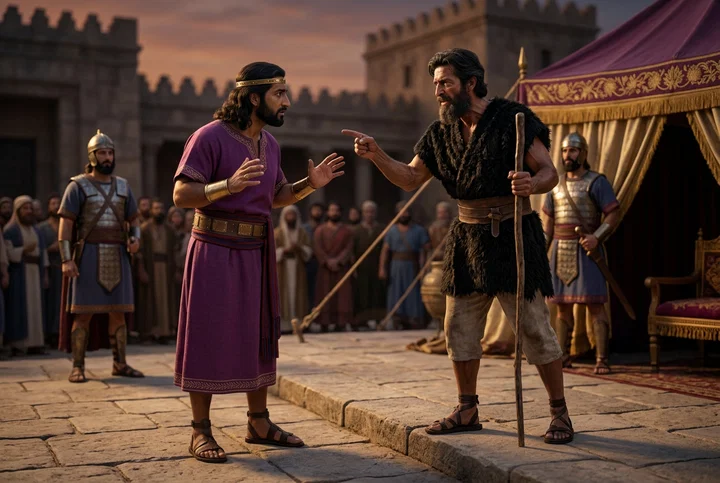
And it came to pass, when Ahab saw Elijah, that Ahab said unto him, Art thou he that troubleth Israel?
Translations
And it came to pass, when Ahab saw Elijah, that Ahab said to him, Are you he that troubles Israel?
King James Version, KJV Cambridge Paragraph Bible
And it came to pass, when Ahab saw Elijah, that Ahab said unto him, Art thou he that troubleth Israel?
And it came to pass, when Ahab saw Elijah, that Ahab said to him, Art thou he that troubleth Israel?
Revised Version, American Standard Version
And it came to pass, when Ahab saw Elijah, that Ahab said unto him, Is it thou, thou troubler of Israel?
and it cometh to pass at Ahab's seeing Elijah, that Ahab saith unto him, 'Art thou he — the troubler of Israel?'
And it came to pass when Ahab saw Elijah, that Ahab said to him, Is it thou, the troubler of Israel?
And it came to pass, when Ahab saw Elijah, that Ahab said unto him, Now, art, thou, troubling Israel?
Berean Standard Bible, Majority Standard Bible
When Ahab saw Elijah, he said to him, “ Is that you, O troubler of Israel?”
When Ahab saw Elijah, Ahab said to him, “ Is that you, you troubler of Israel?”
And when he saw Elijah, Ahab said to him, Is it you, you troubler of Israel?
And when Ahab saw Eliiah, Ahab said vnto him, Art thou he that troubleth Israel?
Douay-Rheims (Challoner revision)
And when he had seen him, he said: Art thou he that troublest Israel?
Pictures
Cross-references 20 of 33
- 1 Kings 17:1
And Elijah the Tishbite, who was of the inhabitants of Gilead, said unto Ahab, As the LORD God of Israel liveth, before whom I stand, there shall not be dew nor rain these years, but according to my word.
Elijah announced the drought that Ahab blamed on him.
- 1 Kings 18:21
And Elijah came unto all the people, and said, How long halt ye between two opinions? if the LORD be God, follow him: but if Baal, then follow him. And the people answered him not a word.
Elijah calls Israel to choose between following the Lord and following Baal.
- 1 Kings 19:1-2
And Ahab told Jezebel all that Elijah had done, and withal how he had slain all the prophets with the sword.
Jezebel threatens Elijah after Ahab reports his actions at Carmel.
- 1 Kings 18:38-39
Then the fire of the LORD fell, and consumed the burnt sacrifice, and the wood, and the stones, and the dust, and licked up the water that was in the trench.
God answers Elijah by fire, and the people acknowledge him as God.
- James 5:17-18
Elias was a man subject to like passions as we are, and he prayed earnestly that it might not rain: and it rained not on the earth by the space of three years and six months.
Elijah prayed for drought, and rain was withheld and then restored.
- Malachi 4:5-6
Behold, I will send you Elijah the prophet before the coming of the great and dreadful day of the LORD:
Elijah’s work against apostasy anticipates his promised coming before the day of the Lord.
- 1 Kings 21:25-26
But there was none like unto Ahab, which did sell himself to work wickedness in the sight of the LORD, whom Jezebel his wife stirred up.
Jezebel stirred Ahab to wickedness and idolatry.
- 1 Kings 16:31-33
And it came to pass, as if it had been a light thing for him to walk in the sins of Jeroboam the son of Nebat, that he took to wife Jezebel the daughter of Ethbaal king of the Zidonians, and went and served Baal, and worshipped him.
Ahab’s promotion of Baal worship explains the accusation that he troubled Israel.
- 1 Kings 18:22
Then said Elijah unto the people, I, even I only, remain a prophet of the LORD; but Baal’s prophets are four hundred and fifty men.
Elijah stands alone against Baal’s many prophets, provoking the charge that he troubled Israel.
- 1 Kings 18:1-2
And it came to pass after many days, that the word of the LORD came to Elijah in the third year, saying, Go, shew thyself unto Ahab; and I will send rain upon the earth.
Elijah is sent to meet Ahab as the drought nears its end.
- 1 Kings 19:18
Yet I have left me seven thousand in Israel, all the knees which have not bowed unto Baal, and every mouth which hath not kissed him.
Seven thousand in Israel remained faithful and had not worshiped Baal.
- 1 Kings 18:40
And Elijah said unto them, Take the prophets of Baal; let not one of them escape. And they took them: and Elijah brought them down to the brook Kishon, and slew them there.
The defeated prophets of Baal are slain after the contest on Carmel.
- 2 Kings 2:11
And it came to pass, as they still went on, and talked, that, behold, there appeared a chariot of fire, and horses of fire, and parted them both asunder; and Elijah went up by a whirlwind into heaven.
Elijah was taken up to heaven without dying.
- 1 Kings 18:41-45
And Elijah said unto Ahab, Get thee up, eat and drink; for there is a sound of abundance of rain.
Elijah’s appeal to God is followed by rain ending the drought.
- Matthew 17:11-12
And Jesus answered and said unto them, Elias truly shall first come, and restore all things.
Elijah’s reform typified John’s work.
- Luke 1:17
And he shall go before him in the spirit and power of Elias, to turn the hearts of the fathers to the children, and the disobedient to the wisdom of the just; to make ready a people prepared for the Lord.
John came in Elijah’s spirit and power to prepare a people for the Lord.
- 1 Kings 19:10
And he said, I have been very jealous for the LORD God of hosts: for the children of Israel have forsaken thy covenant, thrown down thine altars, and slain thy prophets with the sword; and I, even I only, am left; and they seek my life, to take it away.
Elijah describes the deadly persecution of the Lord’s prophets.
- 1 Kings 18:4
For it was so, when Jezebel cut off the prophets of the LORD, that Obadiah took an hundred prophets, and hid them by fifty in a cave, and fed them with bread and water.)
Jezebel sought to kill the Lord’s prophets.
- Luke 4:25
But I tell you of a truth, many widows were in Israel in the days of Elias, when the heaven was shut up three years and six months, when great famine was throughout all the land;
Gives the drought’s duration as three and a half years.
- John 1:21
And they asked him, What then? Art thou Elias? And he saith, I am not. Art thou that prophet? And he answered, No.
John denies being Elijah himself.
Commentary
Each commentary is drawn from primary sources: the writings of Ellen G. White and Adventist pioneers and periodicals. Each commentary is separate. Its own words are not a quotation; follow the references to read the source passages.
Ellen G. White
42 sources
When Ahab met Elijah in a famine sent as God's judgment for the idolatry into which he had led Israel, he angrily charged the prophet with bringing trouble on the nation.GC 590.1–2Ms 116, 1899, par. 3–6Ms 61, 1890, par. 43Ms 19, 1906, par. 3–5PK 129 The trouble had not come from Elijah but from Ahab and his father's house forsaking the Lord's commandments and following Baal, so that rain was withheld until the people turned back to God.GC 590.1–2Ms 116, 1899, par. 3–6Lt 46, 1891, par. 9–11 The exchange shows that a faithful reprover is often blamed for trouble caused by another's disobedience, while sin itself and evil resisting good are the real source of the trouble.Lt 46, 1891, par. 9–11RH Oct 22, 1901Lt 17a, 1891, par. 22–24TBC1882 47.2PK 139.4–140.1 That same accusation will be repeated against God's commandment keepers, who will be blamed for calamities because their obedience reproves transgressors.GC 590.1–2GC88 589.1–590.1 It will be declared that violation of the Sunday-sabbath has brought calamities and that those who present the claims of the fourth commandment are troublers preventing restoration to divine favor.GC88 589.1–590.1 Elijah did not flatter the king, evade the issue, or soften his message, but answered that Ahab was responsible, illustrating the duty to proclaim the truth the occasion demands despite the consequences.Ms 61, 1890, par. 43Ms 40, 1890, par. 92–94STBk 122.23T 278.1–218MR 244.3–245.2
Encounter and Setting
Ahab met Elijah at the end of three years without dew and rain that had brought great famine on the land, a period given as three years and a half in one account.Ms 116, 1899, par. 3–6Ms 19, 1906, par. 3–5ED 151.1–2 The drought and famine came as God's judgment and wrath for grievous sins and widespread idolatry, into which Ahab and Jezebel had led the people, when wickedness had become widespread and the Lord sent prophets to warn the nation.Ms 19, 1906, par. 3–5Ms 29, 1911, par. 37Ms 31, 1889, par. 77 Israel's rain was withheld until the people turned back to God, and the drought stood as a consequence of sin.PK 129Ms 29, 1911, par. 37 The charge Ahab brought at that meeting was false, for the trouble came from Ahab and his father's house forsaking the Lord's commandments and following Baal.Ms 116, 1899, par. 3–6PK 129Ms 29, 1911, par. 37
When Ahab saw Elijah he angrily confronted him with the question whether he was the one troubling Israel.Ms 61, 1890, par. 43GC88 589.1–590.1STBk 122.2 By it he charged the prophet with bringing trouble and calamity on Israel and the land under God's judgments.GC 590.1–2Ms 40a, 1890, par. 103–105STBk 122.2 The accusation misplaced responsibility, since Israel's troubles followed the people's abandonment of God and not Elijah's faithfulness.GC 590.1–2Ms 61, 1890, par. 43Ms 40a, 1890, par. 103–105 It came from a cruel, apostate king confronting God's messenger during apostasy and judgment, and Elijah would not flatter him, evade the issue, or conceal the reason for the judgments.Ms 61, 1890, par. 43STBk 122.2
Elijah's life was unsafe in Israel so that he had been forced to seek refuge outside Israel.Ms 19, 1906, par. 3–5PK 129.1–3 He was hunted and had to flee to save his life, and Ahab would have put him to death if God had not in a special manner preserved him.Ms 19, 1906, par. 3–5SG1 40.2 Ahab was afraid of Elijah and dared not oppose him, and his fear left him unable to harm the prophet even as he spoke boldly as God's messenger.3T 278.1–2PK 139.2–3
Elijah was moved by the Spirit of God to rebuke a wicked king and an apostate people, working as a preacher of righteousness guided by the Holy Spirit under God's direction.GC88 606.1Ms 31, 1889, par. 77 He stood alone for God against Israel's idolatry and faithfully warned the nation, declaring the truth and warning the people of danger to their souls.ED 151.1–2ST Nov 17, 1909GC88 606.1 His undaunted courage was shown in a contest between life and death with the king, the priests and the people, in which he triumphed on Mount Carmel, where through faith idolatry was cast down.ED 151.1–2RH Oct 7, 1873 The rain that followed testified to blessings awaiting Israel, yet after such triumph over king, priests and people he still gave way to despondency and was awed into timidity.ED 151.1–2RH Oct 7, 1873
Cause of Israel's Trouble
The trouble charged to Elijah did not come from him but from Ahab and his father's house and family forsaking the Lord's commandments and following Baal and Baalim.GC 590.1–2Ms 116, 1899, par. 3–6Lt 46, 1891, par. 9–11Ms 29, 1911, par. 38–40Lt 17a, 1891, par. 22–24 Israel's drought was the consequence of sin, with rain withheld until the people turned back to God, and the accusation against the prophet reversed responsibility for apostasy under God's judgments.GC 590.1–2Ms 116, 1899, par. 3–6Lt 46, 1891, par. 9–11Lt 17a, 1891, par. 22–24Ms 40a, 1890, par. 103–105 Speaking plainly against wrongdoing did not make the reprover the source of the trouble, for the harm came from the wrongdoing itself.Lt 46, 1891, par. 9–11Lt 17a, 1891, par. 22–24Ms 40a, 1890, par. 103–105
Ahab knew the drought had come by God's word and providence and that the judgments rested on the land, yet he tried to shift responsibility to God's messenger.RH Sep 11, 1913PK 139.2–3ST Feb 17, 1898 Deceived by Satan and spiritually blinded, he blamed the faithful prophet for calamity and suffering instead of searching his own life and the lives of the people for its cause and repenting.Ms 19, 1906, par. 3–5ST Feb 17, 1898RH Sep 11, 1913 His question unconsciously revealed the feelings in his heart and his refusal to accept responsibility, since wrongdoers resist reproof because sin blinds them.RH Sep 11, 1913PK 139.2–3RH Sep 11, 1913
Many shared his view and believed God's prophets had caused the calamity and drought by reproving the people.Ms 29, 1911, par. 38–40Ms 29, 1911, par. 37 Jezebel and nearly all Israel treated Elijah's testimony against their worship as the cause of their troubles and misery rather than recognizing the drought as judgment from Jehovah.Ms 29, 1911, par. 38–40Ms 29, 1911, par. 37PK 126.1 They thought that removing him would appease their gods and end their suffering.PK 126.1
Blaming the Messenger
Ahab's question to Elijah shows the general rule that the one who reproves wrongdoing may be blamed for trouble caused by another's disobedience.Lt 46, 1891, par. 9–11Lt 17a, 1891, par. 22–24TBC1882 47.2 Speaking plainly against wrong did not make Elijah the source of Israel's trouble, for his warnings and faithfulness were not its cause.Lt 46, 1891, par. 9–11TBC1882 47.2ST Nov 17, 1909 The real trouble came from sin itself and from evil resisting good, not from the prophet who exposed it.SG1 40.2DA 306.1–2 Those who deliver divine warnings are often treated as the offenders, while transgression remains the true cause of judgment.TBC1882 47.2DA 306.1–2
Those who reject truth blame the messenger who exposes their sin instead of accepting responsibility and repenting.RH Oct 22, 1901PK 139.4–140.1RH Sep 11, 1913 When their errors are reproved they may feel mistreated and blame the reprover even when correction is necessary, suspecting and condemning those who expose sin.Lt 12, 1893, par. 1–3SG2 283.2–284.1Ms 4a, 1898, par. 15–16 They resist plain correction and reproof when truth is brought before them, especially when the church has departed from God.PK 139.4–140.1SG2 283.2–284.1 This resistance comes because sin blinds them, and the charge against the messenger reflects unwillingness to be disturbed by truth even when it exposes disobedience.RH Sep 11, 1913Ms 4a, 1898, par. 15–16
Faithful presentation of truth can bring division, and its messengers are often treated as enemies.RH Oct 22, 1901DA 306.1–2 Because Elijah stood for truth that reproved sin and error he was denounced as a troubler of Israel.GC 458.2GC88 458.2 Those who reprove sin and defend unpopular truth are often blamed as troublemakers by those resisting the truth.TBC1882 47.2GC 458.2GC88 458.2 Opposition may attack the messenger's character and motives and portray faithful witnesses as enemies of the community, though their fellowship with God and exposure of sin is not the cause of hostility but provokes those who cling to sin.GC 458.2DA 306.1–2
As Elijah, though God's servant, was blamed for troubling Israel, so Huss was accused of causing turmoil and blamed for the conflict stirred by his faithful testimony against religious wrongs.GC88 103.4GC 104.1 In the same pattern, as Ahab blamed Elijah for troubling Israel, Uriah wrongly regarded Brother White's reproof of wrongdoing as the cause of trouble instead of recognizing the unfaithful men's actions as the source.Lt 10, 1873, par. 8–9
Prophetic Repeating Accusation
The old charge that Elijah troubled Israel will be repeated on grounds equally well established against God's commandment keepers.GC 590.1–2GC88 589.1–590.1 As Ahab accused the prophet of bringing trouble while he and his father's house had brought it by forsaking the Lord's commandments and following Baal and Baalim, so the faithful will be blamed for calamities because their obedience reproves those who break God's law.GC 590.1–2GC88 589.1–590.1 When disaster comes the great deceiver will persuade men that those who serve God are causing these evils.GC88 589.1–590.1 The very class that has provoked Heaven's displeasure will charge all their troubles upon those whose obedience to God's commandments is a perpetual reproof to transgressors.GC 590.1–2GC88 589.1–590.1
It will be declared that men are offending God by violation of the Sunday-sabbath.GC88 589.1–590.1 That sin, it will be claimed, has brought calamities which will not cease until Sunday observance is strictly enforced.GC88 589.1–590.1 Those who present the claims of the fourth commandment, thus destroying reverence for Sunday, will be called troublers of the people, preventing their restoration to divine favor and temporal prosperity.GC88 589.1–590.1
As the wrath of the people is excited by these false charges, they will pursue a course toward God's ambassadors very similar to that which apostate Israel pursued toward Elijah.GC88 589.1–590.1
Faithful Response and Duty
When confronted with the charge of bringing trouble on the nation, Elijah did not flatter a cruel and apostate ruler, evade the issue, excuse his own work, soften his message, or conceal the reason for the divine judgments falling on the land.Ms 61, 1890, par. 43STBk 122.2TBC1882 47.2ST2 13.3STA 122.2 He answered directly that the responsibility lay not with the prophet but with Ahab and his father's house and family, because they had forsaken the Lord's commandments and followed Baal and Baalim.Ms 40, 1890, par. 92–94STBk 122.2TBC1882 47.2ST2 13.3STA 122.2 He was bound to tell the king this truth to his face rather than hide it, and to expose Israel's apostasy and defection from God so that the people might humble themselves before God and turn from it and back to Him.Ms 61, 1890, par. 43Ms 40, 1890, par. 92–94ST2 13.3STA 122.2
The encounter illustrates the duty to proclaim the truth the occasion demands, exposing wrongdoing even when those responsible accuse the one who exposes it.Ms 40, 1890, par. 92–9418MR 244.3–245.2 God's messenger must deliver God's message despite the consequences, speaking boldly in declaring the truth and warning the people of danger to their souls.Ms 40, 1890, par. 92–943T 278.1–218MR 244.3–245.2GC88 606.1 Moved to rebuke a wicked king and an apostate people, Elijah's plain rebuke of sin made him appear to be the troubler, though he was only faithful to his commission.3T 278.1–2GC88 606.1
God's workmen may still be blamed as troublers of Israel, but they must not act in ways that make the accusation true.Lt 18, 1895, par. 9–10 When met with contempt and reviling they must answer without unkind or discourteous words.Lt 18, 1895, par. 9–10
Sources
Pioneers and periodicals
114 sources
When Ahab met Elijah during the famine after rain had been withheld for three years and six months, he accused the prophet of bringing trouble on Israel.PGGC 80.2–3ST Nov 19, 1885ST Sep 9, 1889 Elijah was not the troubler, for the trouble came from Ahab and his father's house in forsaking the commandments of the Lord and following Baal.PGGC 80.2–3RH Dec 15, 1910RH Oct 19, 1916 The charge illustrates the faithfulness of a true prophet in reproving sin even in the king at risk of his life, since even kings are not exempt from rebuke.PGGC 80.2–3PGGC 80.1RH Jun 26, 1855 As Ahab blamed God's messenger for judgments he did not cause, so in the last days the small company true to the Ten Commandments will be accused of causing anarchy, strife and calamity and threatened with death for their faithfulness.RH Dec 14, 1905RH Dec 3, 1901ST Jan 18, 1916 Obedience to God can bring division when truth exposes wrong, but that division is not truth's fault, for transgression and departure from God's commandments are the root of trouble.ST Nov 8, 1905ST Sep 30, 1880ST Jul 18, 1878
Words and Historical Setting
The accusation was spoken when the two men met during the famine, after rain had been withheld for three years and six months because Israel had departed from true worship, at the time Ahab himself was searching for water.PGGC 80.2–3ST Nov 19, 1885ST Sep 9, 1889ST Apr 17, 1907 The drought had come because of widespread wickedness, flagrant transgression, sins and idolatry, and Elijah had sought to correct it and arouse the people to a sense of their sinfulness.PGGC 80.2–3ST Nov 19, 1885ST Sep 9, 1889 After three years without rain the idolatry continued and Ahab remained wicked, yet he voiced the view that Elijah was responsible for the people's troubles and had brought trouble on Israel.PGGC 80.2–3ST Nov 19, 1885ST Sep 9, 1889ST Apr 17, 1907 The coming test at Carmel would expose the consequences of turning to Baal.ST Apr 17, 1907
The meeting falls within the histories of the divided kingdoms of Israel and Judah, covering about eighty years from the revolt of the ten tribes to the death of Jehoshaphat, and within the history of Israel's kings after the division and the account of Elijah's extraordinary ministry.RH May 25, 1916ST Jul 30, 1885 It records Ahab's meeting with Elijah and the events leading to the assembly on Mount Carmel.ST Jun 29, 1904ST Aug 10, 1904 Elijah challenged Ahab to gather Israel with the prophets of Baal and Asherah, then called the people to choose whether to follow Jehovah or Baal.ST Aug 10, 1904ST Oct 31, 1911 His sign there demonstrated who the true God was, and God sent him with that message to confront Baal-worshiping Israel under Ahab.ST Jun 29, 1904ST Oct 31, 1911
To be called the one who troubles Israel was to be charged as a troubler who makes divisions and confusion in the community.RH Dec 6, 1864 The charge came because he tried to turn the people back to keeping the law of God which they had forsaken.RH Dec 6, 1864 It was a term of reproach, not evidence that he was at fault, for condemnation by insulting labels does not establish whether a person or doctrine is true.ST Jun 9, 1890ST Jan 10, 1906 Ahab spoke it with outward politeness, but that courteous manner was policy motivated by fear of the God who stood behind the prophet, not by genuine kindness.RH Dec 22, 1910
Ahab feared and hated Elijah, had long sought to destroy him and to kill him, and heard with astonishment mingled with terror that Elijah was coming to meet him.RH Aug 21, 1913RH Sep 30, 1873RH Jul 9, 1867 He instituted a most diligent search for the prophet's hiding place, sending messengers to all the surrounding nations and kingdoms far and near and requiring an oath from those kingdoms and nations that they knew nothing of his whereabouts, but the search was in vain and the prophet was safe.RH Aug 21, 1913 When told Elijah was coming he came with fear and trembling and a large retinue with imposing display of armies, because he knew Elijah would not expose his life without being guarded or bringing a terrible denunciation, and he remembered Jeroboam's withered arm and decided it was not safe to lift his hand against God's messenger.RH Sep 30, 1873 Though passionate and filled with hatred, he was powerless and unmanned in Elijah's presence and dared not harm him, and his question charging Elijah as the one troubling Israel spoke the language of his heart.RH Sep 30, 1873ST Mar 14, 1878 Elijah returned alone at God's command and bravely faced the king, and then ordered Israel to gather at Mount Carmel.ST Mar 14, 1878
Ahab likely meant that Elijah's prayer had brought the drought, just as Elijah's prayer later accompanied the return of rain after Baal was put away.RH Aug 8, 1871 The drought was a judgment on Israel's idolatry and a challenge to Baal, not wrongdoing by Elijah, and Elijah's declaration about it was vindicated at Mount Carmel.ST Jul 27, 1904 Israel had abandoned the true worship of God for Baal, the Phoenician sun-god, in its greatest and worst idolatry of worshiping the sun under that name.STST Sep 10, 1896 That following of Baal exposed the sun-god's inability to give rain, while the later test by fire falling from heaven as the sign between the prophets of Baal and the prophet of God was set on the Baal worshipers' own ground because Baal presided over fire, so that if he were true and living he would answer by consuming the sacrifice.ST Dec 29, 1909ST Jul 27, 1904 At that crisis Baal's 450 prophets had confused the minds of the people so that while they appeared desirous to be right they were wedded to what was contrary to God's commandments, and God laid upon Elijah, one lone faithful man, a definite unmistakable message of reform to separate from the general overspreading evil, radically change customs and worship, arouse moral sensibility, begin an era of moral reform, and save Israel from utter extinction as God's inheritance.ST
The confrontation is true history rather than pious legend or myth.ST Jan 24, 1906 It took place on Carmel, where Elijah seemed to stand without human support.ST Jul 1, 1880ST Nov 14, 1900 There he stood alone against the united priests of Baal and Astarte.ST Nov 14, 1900
True Cause of Trouble
Elijah was not the one who troubled Israel, for the trouble lay with Ahab and his father's house in forsaking the commandments of the Lord and following Baal and Baalim.PGGC 80.2–3RH Oct 19, 1916ST Jul 16, 1885ST Feb 10, 1904RH Feb 11, 1904 He stood for keeping God's commandments and sought to correct flagrant transgression and to arouse the people to a sense of their sinfulness.PGGC 80.2–3ST Jul 16, 1885RH Nov 7, 1912 The contest on Mount Carmel demonstrated where the fault lay, for the Lord answered by fire and the people acknowledged that the Lord is God, showing the trouble came from Israel's abandonment of the Lord and not from Elijah.RH Dec 15, 1910RH Oct 19, 1916ST Feb 10, 1904 Ahab's idolatry and enforcement of heathen worship were the source of Israel's moral and religious trouble, and the exchange illustrates how disobedience treats opposition to itself as the source of trouble.ST Jul 16, 1885ST Feb 10, 1904RH Nov 7, 1912
Elijah had rebuked idolatry led by Ahab and his father and had declared from the Lord that there would be no rain because of widespread wickedness.ST Nov 19, 1885ST Sep 9, 1889ST Feb 2, 1882 His warning did not cause their wrongdoing nor make him responsible for the resulting judgment, for he was God's messenger warning before judgment came.ST Nov 19, 1885ST Feb 2, 1882RH Feb 11, 1904 The withheld rain was a protest against Ahab's wickedness and a judgment on idolatry and a challenge to Baal, not wrongdoing by Elijah.ST Feb 2, 1882ST Jul 27, 1904RH Feb 11, 1904 That declaration about the drought was vindicated at Mount Carmel, where his faithful warning and stand for God were shown not to be the source of Israel's trouble.ST Nov 17, 1909ST Jul 27, 1904RH Feb 11, 1904
Instead of acknowledging himself as the cause, Ahab like a petulant child charged the trouble to the one trying to save him.RH Oct 22, 1901RH Sep 11, 1913ST Feb 2, 1882 He wanted peace on his own terms and sought an excuse for sin, because it is not easy to live under condemnation.RH Oct 22, 1901ST Feb 2, 1882 Though he knew God's word had brought the drought, he tried to blame the prophet for the judgments and refused responsibility, revealing the feelings of his heart.RH Sep 11, 1913ST Feb 17, 1898RH Jan 10, 1865 His pride was not yet humbled, and his spiritual blindness kept him from seeing that the calamity came through God's providence because the nation had forsaken God's commandments and worshiped Baal.RH Oct 22, 1901ST Feb 17, 1898RH Jan 10, 1865 With Jezebel and nearly all Israel he denounced Elijah as the cause of all misery, blaming God's messenger for their trouble and believing that if this stickler for the commandments were out of the way the anger of their gods would be appeased and trouble would cease.RH Sep 11, 1913ST Feb 2, 1882RH Dec 3, 1901
Elijah as Faithful Prophet
The charge lays bare the faithfulness of a true prophet in reproving sin, telling even the king of his wrongs at the risk of being slain by the king's command.PGGC 80.2–3RH Jan 10, 1865 True prophets do not withhold testimony from those high in authority, for even kings are not exempt from reproof.PGGC 80.1RH Jun 26, 1855 It is the duty of God's prophets and teachers to cry out against sins in high places and low, though for it they are disbelieved, derided and blamed.RH Jan 10, 1865RH Oct 22, 1914 Humility does not mean fearing rulers or shrinking from what is right, and reformers who rebuke wrong may be misjudged as enemies and disturbers rather than recognized as bearing truth.RH Apr 26, 1860 Elijah sought to correct flagrant transgression and arouse the people to a sense of sinfulness, and he did not flatter or evade the issue to protect himself but identified apostasy and called for humbling before God.PGGC 80.2–3RH Oct 22, 1914
He stood alone for true worship when 450 prophets of Baal were against him, with faith and courage to go against the current and do right though it brought the opposition and persecution of the world.ST Jul 4, 1878RH Mar 14, 1871 True laborers are few while false religious teachers are heaps and swarm everywhere, so God's people should not be discouraged when the present shows the same disproportion.RH Mar 14, 1871ST Nov 5, 1885 He stood for principle against nearly the whole nation, firm and uncontrollable by Ahab or Jezebel, when Baal worship was popular and established as the state religion.ST Nov 5, 1885RH Feb 28, 1907RH Jul 10, 1860 His willingness to venture in faith against king, priests and false prophets was met by God's presence and mighty work.ST Sep 17, 1896 God vindicated that solitary faithfulness when the prophets of Baal were slain, the wicked king and queen died, the apostate nation went into captivity, and Elijah was taken to heaven.ST Nov 5, 1885ST Sep 17, 1896
He witnessed against Ahab when the religious majority was wrong.RH Sep 10, 1872 His sharp taunt bidding the prophets of Baal cry louder to their dumb god, who might be gone on a journey or otherwise occupied, was righteous indignation, the same holy severity as Christ's woes against the scribes and Pharisees, showing that defenders of truth may use such forceful rebuke.RH Dec 17, 1857 He met the charge of troubling Israel with calm faith that looked to God to vindicate what is of God.ST Dec 7, 1904 What is truly planted by God does not need civil law and combined human power to protect it, but endures and is recognized by its intrinsic worth.ST Dec 7, 1904
He was God's devoted and earnest prophet who returned alone at God's command and bravely faced the king, whom he ordered to gather Israel to Carmel, and Ahab did not dare harm him.ST May 20, 1913ST Mar 14, 1878 He faithfully delivered God's message to Ahab and Jezebel even when refusal brought him sorrow, and he worked for Israel's salvation by warning king and people against apostasy.ST Apr 10, 1884ST Oct 28, 1908 He used the long drought for spiritual instruction to awaken conscience, confronting idolatry and rebellion that had brought the chastisement at the time appointed to punish idolatry and send rain.RH Jun 15, 1911RH Jul 9, 1867 Under God he slew the prophets of Baal, which Israel itself ought to have done, and he prayed for rain and the Lord answered his prayer.ST May 20, 1913 Great as he was, he afterward became discouraged through weariness, yet God translated him.ST May 20, 1913 Corrupt rulers and apostates regard true reformers as troublemakers because the call to turn from sin exposes prevailing wrongdoing, though the real trouble comes from forsaking God's commandments, not keeping them.RH Jul 9, 1867
His course opened in undaunted courage in a contest between life and death with the king, the priests and the people, in which he triumphed.RH Oct 7, 1873 That confrontation followed his first appearance to Ahab denouncing God's judgments because of the apostasy of king and nation.RH Oct 7, 1873 After such triumph he still gave way to despondency and was awed into timidity.RH Oct 7, 1873 The truth he proclaimed made Ahab his bitter enemy, while his intercessions marked him as God's faithful servant, and blaming God's servants as Israel blamed Moses and Aaron is a sin that brings evil.RH Jul 9, 1867RH Apr 27, 1905 His example is the pattern for those who speak for Christ's near coming before modern religious assemblies and are treated as enemies of the church, even to seeking the messenger's life.RH Mar 22, 1860
Exposing false teaching is falsely called stirring up strife and making divisions.RH Feb 9, 1869 The true troubling of God's people comes not from those who oppose and expose error but from those who teach it, such as that the bondage from which Christ frees men is the law of ten commandments.RH Feb 9, 1869 God's truth and its messengers provoke opposition because they expose and correct what is wrong.RH Jul 16, 1872 Ahab treated the false prophets who told him what he wanted to hear as friends, while the faithful prophet who rebuked him was his true friend.RH Aug 4, 1868
Last-Day Prophetic Parallels
Elijah's return to Ahab in the time of famine pictures the conditions just before the coming of Christ and the translation of the living righteous.ST Jul 30, 1885 Elijah confronting Ahab after Israel forsook God for Baal worship under Ahab and Jezebel rebuked the king for forsaking the commandments of God and called the people back to obey and keep all His law, and as a commandment-keeper preaching restoration of the commandments he is a type of God's true people in the last days who will keep the commandments, teach others to keep them, be persecuted for it, flee to the wilderness, be fed by angels, and be translated at Christ's coming.RH Mar 31, 1868 His record in 1 Kings 17-19 is a reformatory, converting work that represents John the Baptist typically and represents antitypically those who do a reformatory, converting work like Elijah and John before the great and dreadful day of the Lord, when God calls His faithful children to obedience in tithes and offerings and makes them up as His jewels to spare and save them.RH Jul 9, 1901 His opening of reform against Ahab in Israel's apostasy through Jezebel, the sun-worshiping Sidonian joined to the state, in reproving sin, preaching God's downtrodden truth, being very zealous for His law, and reproving the Baal sun-worshipers, was a type of John's work before Christ in the spirit and power of Elijah and a type of the final work before the great and terrible day of the Lord upon the world.ST Mar 20, 1901 That antitypical Jezebel is the great apostate church united with the state, and the antitypical Elijah work will appear not through one man to one country but through all God's true people to the world.ST Mar 20, 1901 His bold stand against the king with the many priests and false prophets against him showed a willingness to venture in faith that was met by God's presence and mighty work, and his translation to heaven makes him a type of the righteous of the last generation.ST Sep 17, 1896
Ahab blamed Elijah for the judgments afflicting Israel, and the same accusation will fall on those who honor God's law, who will be charged with causing judgments, natural convulsions, strife, and bloodshed though they do not cause them.RH Dec 14, 1905 Ahab and the groaning people blamed God's messenger after turning from God's commandments to serve Baal, rejecting warning and bringing blighting curses by their evil course, and thought that if this stickler for God's commandments were out of the way their trouble would cease.RH Dec 3, 1901 This is a parallel to the last days when unrest deepens, lives grow insecure and crime increases, the cause is sought in every direction but the right one, and all eyes center on the small company true to the Ten Commandments, who are accused of sowing anarchy and lawlessness for teaching that Sunday has no sacredness and are threatened with death for refusing to keep the first day instead of the seventh.RH Dec 3, 1901 Though Ahab was the transgressor for forsaking the Lord's commandments and Elijah was God's faithful prophet and not the cause of Israel's trouble, apostate religious powers will likewise blame the remnant and seek to destroy them for faithfulness to God's commandments.ST Jan 18, 1916 The calamity came because Israel turned from God to worship Baal while Elijah sought to bring them back to keeping God's commandments, so the charge misrepresented the cause, illustrating how God's servants who persist in obeying God may be blamed and persecuted for public calamities.
Ahab called Elijah a troubler of Israel because Elijah urged the people to keep God's commandments, but Elijah denied causing the trouble and laid it on those who forsook God's commandments, and the same charge is expected against those who proclaim Christ's second coming and the commandments including the true Sabbath, since disobedience and not the call to obedience is the real source of trouble.ST Dec 12, 1916 Opponents regard Sabbath-keeping Adventists as troublemakers as Ahab regarded Elijah, because they resist compulsory Sunday observance, and this hostility is likened to Ahab's hostility toward Elijah and Haman's toward Mordecai, pointing to a future conflict in which promoters of compulsory religion will seek to remove commandment keepers.RH Mar 18, 1915 The troubler charge is the way advocates of compulsory Sunday observance portray defenders of religious liberty and conscience as enemies, though those so labeled are in fact resisting religious coercion and are identified with the people who keep God's commandments.RH Mar 18, 1915 Seventh-day Adventists working in Washington against the Lord's Day Alliance campaign for Sunday observance are likewise called troublers because they oppose what the Alliance calls the Christian Sabbath.RH Aug 20, 1914 Elijah's presence was treated by Ahab as an annoyance, supplying the comparison for Sabbath keepers whose faithful warnings disturb those content with an apostate church and its false peace.RH Mar 11, 1862 The phrase troublers of Israel is applied to Seventh-day Adventists who oppose compulsory Sunday observance, placing them in the role of Elijah confronting Ahab.RH Mar 18, 1915
Elijah meeting paganism as the first division of Babylon, which works through empires to compel false worship and persecute true worshipers, was charged with troubling Israel because of loyalty to God and His law, and he answered by rebuking the pagan worshipers for following Baal in sun-worship instead of holding to God's law and worship.ST His flight for his life for three and a half years proves the persecuting mark of that pagan system.ST The record of Israel's apostasy into Baal worship and the confrontation with Baal's prophets shows Israel's abandonment of God as the cause of its trouble despite Ahab's accusation, belonging to a great apostasy in which the backsliding Israel of God still left a faithful remnant who responded to the prophet's call, and those coming out of apostasy form the remnant.ST Aug 20, 1894 Ahab as Israel's unfaithful king confronting Elijah, the lone voice against departure from God, presents Elijah as the type of God's true teacher in the apostasy associated with Jezebel. Elijah's condemning voice exposing Ahab's unfaithfulness is the pattern for God's message of salvation and protest against the latter-day apostate confederacy, which that message will trouble so that the power will seek to destroy God's people just as Ahab, urged on by Jezebel, sought to silence Elijah.ST Apr 30, 1912 That time when God's people were joined with the world in general worldly idolatry, chiefly Baal or sun-worship, led in seduction from truth by Jezebel the daughter of Ethbaal the sun-worshiping Zidonian king through an unholy union of church and state that trod down God's law and persecuted the prophet and Jehovah's true worshipers, with its individuals, little country and people, is a type of the world and of all who profess His name in the last days, needing both Elijah's day and John's day together to typify the work and character of God's servants in calling people back to true worship and obedience.ST Aug 7, 1901
Elijah's miracle showing the true God and leading the people to serve Him is the mark Satan will counterfeit to turn people from God toward disobedience.ST Dec 16, 1889 Elijah bringing fire from heaven distinguished the true prophet from Baal's false prophets, and this supplies the precedent for the two-horned beast's predicted miracle, in which the false prophet will imitate Elijah's sign to claim divine approval for worshiping the beast and its image and receiving its mark, and will invoke Elijah's killing of Baal's prophets to make a death decree against refusers seem justified. Satan had not in the past brought fire from heaven by his own power because God restrained him, and Elijah's contest with Baal's prophets is an instance of that restraint, proving that the publicly witnessed satanic miracle of fire in Revelation 13 had not already occurred.RH Jun 22, 1869
Doctrine and Scripture Connections
Elijah's answer to the charge of troubling Israel upheld obedience to God's commandments, for the trouble had come because the king and his father's house had forsaken those commandments.ST Feb 10, 1904 The confrontation at Carmel was a contest over the first commandment, to teach a people led to worship Baal who the only true God was, until fire from heaven showed that He alone was God.RH Jul 30, 1901 Ahab had chosen Baal in place of the God of Israel and thereby set aside the first commandment, distinct from Jeroboam's setting up golden calves as representations of the God who brought Israel out of Egypt.RH Aug 14, 1868 Elijah also reproved violations of the second commandment and stood against Israel's departure from the worship and Sabbath of Jehovah for Baal and the practices upheld by Ahab and the prophets of Baal.ST Nov 7, 1895RH Mar 22, 1864
The history surrounding the accusation is the history of Ahab's wife Jezebel, who slew the Lord's prophets, led Ahab into idolatry, and fed and supported the prophets of Baal.RH Aug 7, 1860ST Jan 15, 1880 That history supplies the figurative name Jezebel for the papal abominations and for the corrupting and persecuting influence condemned in the messages to Pergamos and Thyatira.RH Jun 17, 1862RH Feb 12, 1857ST Jan 15, 1880 She is identified as the queen who opposed the Lord's prophets and promoted idolatry, making her a fitting figure for the idolatry and persecution condemned in Thyatira.RH Oct 16, 1856RH Aug 7, 1860 The account to which the accusation belongs, in which the heavens were stayed from rain and then rain descended again in answer to prayer, stands as proof that God answers prayer.RH Nov 21, 1912
The exchange shows an earthly conflict over loyalty to God and His commandments, in which Ahab accused Elijah while Elijah confronted the king over Israel's departure, an example of the continuing conflict between Christ's cause and opposition to God.ST Nov 8, 1905 Faithfulness to God can bring division and be blamed for trouble, as keeping the seventh day is blamed for causing trouble and division, yet such division is foretold and expected and does not excuse disobedience.ST Sep 30, 1880RH Sep 17, 1857 Ahab accused Elijah of bringing trouble and division on Israel, but Elijah answered that Ahab and his family had brought the trouble by forsaking the Lord's commandments, so obedience provokes conflict only by exposing disobedience and the blame belongs to those who reject God's commands.ST Jul 18, 1878RH Feb 7, 1916RH Apr 4, 1865 Division caused by truth is therefore not truth's fault, for transgression and departure from God's commandments, not obedience, are the root of trouble, and whether truth brings peace or conflict depends on how people respond.ST Jul 18, 1878RH Feb 7, 1916RH Apr 4, 1865
Application to Faithful Believers
The faithful reprover is falsely blamed for trouble while the real trouble lies with those who do wrong, for Elijah did not trouble Israel but Ahab and his father's house troubled it by forsaking the commandments of the Lord and following Baalim.ST Mar 6, 1893RH Dec 6, 1864RH Aug 6, 1857 So when a pastor in discharge of duty protests young people holding a dance in a hall where beer is sold, the trouble is due not to the pastor but to those determined to have it.ST Mar 6, 1893 The same accusation falls when missionaries charge those teaching the Bible as an infallible guide with causing strife, when a heresy hunter charges a modern orthodox preacher with troubling Israel, and when a defender of the Sabbath is labeled a disturber.RH Sep 8, 1904ST Jul 25, 1911RH Jun 25, 1908
Every reformer God sends who presses home new or timely truths and special rebukes for sin, putting God's requirements before men's interests and customs, is branded a troubler of Israel.RH Apr 26, 1860RH Jun 16, 1874 The charge treats God's warning, always given just in the right time, as turning the present order upside down, and tries to silence the prophet by demanding his evidence and how he knows more than others.RH May 5, 1859 It appeals to the old established character of Baal worship, to the thousands who hold it, and to the great, noble, influential, polished prophets and priests of Baal, against the reformer as a rough unpopular man, asking why so important a matter was not found out before and not revealed to men of influence.RH May 5, 1859RH May 30, 1871 Reform is uphill work against inherited tradition and customary belief, and this branding by the powers of darkness against faithful preaching has always happened.RH Apr 26, 1860RH Jun 16, 1874RH May 30, 1871 Unwelcome truth disturbs conscience, so Noah, Lot, Moses, the prophets, Christ at His advent, and early Christians under Rome were all accused of troubling the world, and Adventists warning of approaching desolation are accused in the same way for the same reason.ST Mar 19, 1885
After a reform is carried by self-denial, sacrifice and love of principle to compel recognition and grow popular, it gains followers for popularity and not for truth, leaders dare not press anything more than the people accepted for popularity, and even the original reform cannot be preached in the simplicity and dignity with which it arose because that has become unpopular.ST Oct 30, 1884 Then the one who still presses those principles will be slighted, then counted a troubler of Israel, then ostracized and forced outside his former communion, so his work must begin again in weakness, humility, self-denial, reproach and separation because it is unpopular.ST Oct 30, 1884 Being called a troubler does not mean a person is doing wrong, and reproachful names do not establish truth.RH Mar 31, 1859RH Oct 20, 1859 Elijah stood in defense of the law of God and for righteousness against the king's course, urging the people to return to keeping God's commandments instead of Baal worship, and was treated as a disturber of the peace and a threat to the commonwealth.RH Mar 31, 1859RH Oct 20, 1859RH May 25, 1876
The same false charge is renewed against the few who keep all the commandments of God including the seventh-day Sabbath and try to turn others back to them and awaken interest in keeping it, whom popular ministers and professors accuse of making disturbance in community, confusion in society, and division in families because their work breaks up old customs and crosses ease and pleasure.RH Mar 31, 1859RH Dec 6, 1864 Truth by nature divides good from bad as Christ divided households, and people who oppose God's commandments blame the righteous for the trouble caused by their own resistance to truth.RH Aug 6, 1857 Faithful warnings that disturb false peace, open condemnation of popular wrongs, and rebukes of worldly conformity in dress, sanctuaries and worship should continue, for silence would be blameworthy inconsistency, rejecting or resenting truthful correction that reveals sin only exposes the need to repent, and those who separate from popular errors learn to justify Elijah.RH Mar 19, 1901
Blaming God's servants, as Israel blamed Moses and Aaron, is a sin that brings evil, while rebuke is an act of mercy meant for good.RH Jul 9, 1867ST Oct 7, 1897 So Paul's call for the Jews to repent before King Agrippa exposed their need to turn to God though they resented it, just as Israel's own course made Elijah's rebuke necessary.ST Oct 7, 1897 The ancient troubler in Israel also supplies the image of a domineering church member whose demand for deference brings trouble, an influence that may belong to a woman as well as a man.RH Oct 2, 1856 Judas applied the troubling-Israel label to Jesus when he offered to help the priests find Him, though Jesus was being betrayed rather than shown to be the cause of Israel's troubles.ST Dec 17, 1912
Sources