1 Samuel 15:17
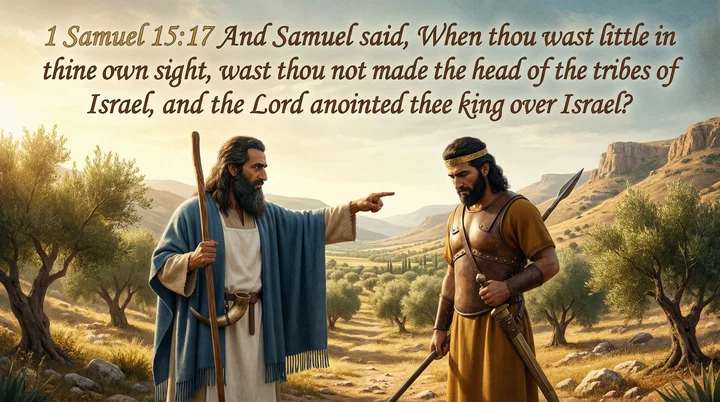
And Samuel said, When thou wast little in thine own sight, wast thou not made the head of the tribes of Israel, and the LORD anointed thee king over Israel?
Translations
And Samuel said, When you were little in your own sight, were you not made the head of the tribes of Israel, and the LORD anointed you king over Israel?
And Samuel said, When thou wast little in thine own sight, wast thou not made the head of the tribes of Israel, and the LORD anointed thee king over Israel?
And Samuel said, When thou wast little in thine own sight, wast thou not made the head of the tribes of Israel, and the Lord anointed thee king over Israel?
And Samuel said, When thou wast little in thy own sight, wast thou not made the head of the tribes of Israel, and the LORD anointed thee king over Israel?
And Samuel said, Though thou wast little in thine own sight, wast thou not made the head of the tribes of Israel? And the LORD anointed thee king over Israel;
And Samuel said, Though thou wast little in thine own sight, wast thou not made the head of the tribes of Israel? And Jehovah anointed thee king over Israel;
And Samuel saith, 'Art not thou, if thou [art] little in thine own eyes, head of the tribes of Israel? and Jehovah doth anoint thee for king over Israel,
And Samuel said, Was it not when thou wast little in thine eyes that thou [becamest] the head of the tribes of Israel, and Jehovah anointed thee king over Israel?
And Samuel said, Was it not, when, little, thou wast in thine own eyes, that thou wast made, head of the tribes of Israel,—and that Yahweh anointed thee to be king over Israel?
Berean Standard Bible, Majority Standard Bible
And Samuel said, “ Although you were once small in your own eyes, have you not become the head of the tribes of Israel? The LORD anointed you king over Israel
Samuel said, “Though you were little in your own sight, weren’t you made the head of the tribes of Israel? The LORD anointed you king over Israel;
And Samuel said, Though you may seem little to yourself, are you not head of the tribes of Israel? for the Lord with the holy oil made you king over Israel,
Then Samuel saide, When thou wast litle in thine owne sight, wast thou not made the head of the tribes of Israel? for the Lord anointed thee King ouer Israel.
Douay-Rheims (Challoner revision)
And Samuel said: When thou wast a little one in thy own eyes, wast thou not made the head of the tribes of Israel? And the Lord anointed thee to be king over Israel.
Pictures
Cross-references 20 of 21
- 1 Samuel 15:22-23
And Samuel said, Hath the LORD as great delight in burnt offerings and sacrifices, as in obeying the voice of the LORD? Behold, to obey is better than sacrifice, and to hearken than the fat of rams.
Obedience is better than sacrifice, and Saul’s rebellion led to his rejection as king.
- 1 Samuel 15:3
Now go and smite Amalek, and utterly destroy all that they have, and spare them not; but slay both man and woman, infant and suckling, ox and sheep, camel and ass.
God commands Saul to destroy the Amalekites completely.
- 1 Samuel 15:9
But Saul and the people spared Agag, and the best of the sheep, and of the oxen, and of the fatlings, and the lambs, and all that was good, and would not utterly destroy them: but every thing that was vile and refuse, that they destroyed utterly.
Saul spared Agag and the best livestock, failing to follow God’s command.
- 1 Samuel 10:1
Then Samuel took a vial of oil, and poured it upon his head, and kissed him, and said, Is it not because the LORD hath anointed thee to be captain over his inheritance?
Samuel anoints Saul as king over Israel.
- 1 Samuel 15:26-28
And Samuel said unto Saul, I will not return with thee: for thou hast rejected the word of the LORD, and the LORD hath rejected thee from being king over Israel.
Saul’s disobedience leads to his rejection as king and the loss of the kingdom.
- 1 Samuel 8:7
And the LORD said unto Samuel, Hearken unto the voice of the people in all that they say unto thee: for they have not rejected thee, but they have rejected me, that I should not reign over them.
Israel’s demand for a king is described as rejecting God as ruler.
- 1 Samuel 13:8-14
And he tarried seven days, according to the set time that Samuel had appointed: but Samuel came not to Gilgal; and the people were scattered from him.
Saul offers the sacrifice before battle and is rebuked for disobedience.
- 1 Samuel 28:6-7
And when Saul enquired of the LORD, the LORD answered him not, neither by dreams, nor by Urim, nor by prophets.
Saul’s rejection precedes his seeking a medium when the Lord does not answer him.
- 1 Samuel 9:21
And Saul answered and said, Am not I a Benjamite, of the smallest of the tribes of Israel? and my family the least of all the families of the tribe of Benjamin? wherefore then speakest thou so to me?
Saul responds modestly when told of his honor.
- 1 Samuel 15:11
It repenteth me that I have set up Saul to be king: for he is turned back from following me, and hath not performed my commandments. And it grieved Samuel; and he cried unto the LORD all night.
The Lord rejects Saul for turning back from following him.
- 1 Samuel 16:1-13
And the LORD said unto Samuel, How long wilt thou mourn for Saul, seeing I have rejected him from reigning over Israel? fill thine horn with oil, and go, I will send thee to Jesse the Beth-lehemite: for I have provided me a king among his sons.
The next chapter recounts David’s anointing after Saul’s rejection.
- 1 Samuel 15:24-25
And Saul said unto Samuel, I have sinned: for I have transgressed the commandment of the LORD, and thy words: because I feared the people, and obeyed their voice.
Saul confesses disobedience, admits fearing the people, and asks Samuel for pardon.
- 1 Samuel 9:16
To morrow about this time I will send thee a man out of the land of Benjamin, and thou shalt anoint him to be captain over my people Israel, that he may save my people out of the hand of the Philistines: for I have looked upon my people, because their cry is come unto me.
God directs Samuel to anoint Saul as ruler over Israel.
- 1 Samuel 10:20-26
And when Samuel had caused all the tribes of Israel to come near, the tribe of Benjamin was taken.
Saul is chosen publicly and initially holds back from the honor.
- 1 Samuel 15:28
And Samuel said unto him, The LORD hath rent the kingdom of Israel from thee this day, and hath given it to a neighbour of thine, that is better than thou.
The kingdom is taken from Saul and given to another.
- 2 Samuel 12:7
And Nathan said to David, Thou art the man. Thus saith the LORD God of Israel, I anointed thee king over Israel, and I delivered thee out of the hand of Saul;
God reminds David that he anointed him king over Israel.
- 1 Samuel 9:1
Now there was a man of Benjamin, whose name was Kish, the son of Abiel, the son of Zeror, the son of Bechorath, the son of Aphiah, a Benjamite, a mighty man of power.
Introduces Saul, chosen as Israel’s first king.
- 1 Samuel 31:4
Then said Saul unto his armourbearer, Draw thy sword, and thrust me through therewith; lest these uncircumcised come and thrust me through, and abuse me. But his armourbearer would not; for he was sore afraid. Therefore Saul took a sword, and fell upon it.
Saul ended his life by his own hand
- 1 Chronicles 10:13
So Saul died for his transgression which he committed against the LORD, even against the word of the LORD, which he kept not, and also for asking counsel of one that had a familiar spirit, to enquire of it;
Saul’s death is attributed to disobeying the LORD and consulting a familiar spirit.
- 1 Samuel 16:14
But the Spirit of the LORD departed from Saul, and an evil spirit from the LORD troubled him.
the Spirit left Saul after rejection
Commentary
Each commentary is drawn from primary sources: the writings of Ellen G. White and Adventist pioneers and periodicals. Each commentary is separate. Its own words are not a quotation; follow the references to read the source passages.
Ellen G. White
17 sources
When Saul regarded himself as small and incapable, God Himself raised him up to lead the tribes and anointed him as king.SG4 73.3–74.4PP 630.4–631.24T 608.1 Being little in his own sight meant he held a low estimate of himself and was willing to be taught and guided. Samuel recalled that humble beginning to expose how far Saul had fallen into pride, self-will, and self-justification when he spared the best of Amalek while claiming to have obeyed God.Ms 7, 1886, par. 10–11Lt 46, 1891, par. 12–15SG4 73.3–74.41SP 362.3–363.4Lt 10, 1873, par. 23–26 No claim of religious purpose could excuse that act, because obedience is valued above sacrifice, and his excuses brought divine rejection.Ms 7, 1886, par. 10–11EDFCP 14.1–15.1 His honor and success could continue only as he stayed humble, distrusted his own judgment, and sought divine wisdom, for turning to self-sufficiency perverts judgment and separates a person from God.EDFCP 23.1TCBMP 203.14T 560.1–2CH 433.3
Saul's Humble Elevation
To be little in one's own sight is to hold a humble opinion of one's own capabilities and to be willing to be instructed and teachable, and for that reason Saul was made head of the tribes of Israel and anointed king. At the time of his choice he was deficient in knowledge and experience, and though he had many good qualities he had serious defects of character, so God granted him the Holy Spirit as guide and helper and placed him where he could learn, receive guidance, and develop the qualities requisite for ruling Israel. In the same way God still calls people to serve because they recognize their need for instruction, offering grace and wisdom to those who accept it.
Because he was little in his own sight, the Lord made him head of the tribes of Israel and anointed him king, so that his position and authority came wholly from God's appointment, showing that God alone has power to raise a person to greatness.SG4 73.3–74.4PP 630.4–631.24T 608.1CH 433.3 Humility rather than self-importance is therefore the safe attitude, for when people recognize their weakness and rely on Him He gives them strength and their work can succeed.4T 608.1CH 433.3 So Brother Sanborn was made an instrument in teaching others the truth while little in his own eyes, in contrast to his later weakened and less wisely directed work.Lt 10, 1867, par. 2
Samuel Confronts Disobedience
The command given to Saul was to execute judgment upon Amalek and destroy them completely, yet he disobeyed by sparing and keeping the best of the animals.Ms 7, 1886, par. 10–11Lt 10, 1873, par. 23–26 Even in disobedience he insisted he had kept the command, claiming the animals had been kept to be offered to God.Ms 7, 1886, par. 10–11 The surviving sheep and oxen themselves proved he had not obeyed, exposing how a person can justify disobedience while still claiming loyalty to God.STSE 116.2–117.1
Samuel therefore recalled Saul's elevation from humility in order to confront that disobedience.Lt 46, 1891, par. 12–15SG4 73.3–74.41SP 362.3–363.4 When Saul was little in his own eyes the Lord had made him head over the tribes of Israel and anointed him king, and Samuel set that appointment against his present failure to obey concerning Amalek.Lt 46, 1891, par. 12–15SG4 73.3–74.41SP 362.3–363.4 The contrast highlighted how the once lowly man had given way to prideful self-exaltation, choosing his own course and reasoning and defending himself with self-justification instead of obeying God.Lt 46, 1891, par. 12–15SG4 73.3–74.41SP 362.3–363.4 That reminder showed his position and authority had come wholly from God, making his rebellion especially grievous in light of the privilege he had received.PP 630.4–631.2
No religious offering could excuse such disobedience, for obedience matters more than sacrifice.Ms 7, 1886, par. 10–11 His disobedience and excuses kindled God's anger and brought judgment, leading to God's rejection of him as king.Ms 7, 1886, par. 10–11EDFCP 14.1–15.1Lt 10, 1873, par. 23–26 His denial of wrongdoing, his refusal to confess when confronted with plain facts, and his claim that he was misused and ill-treated forms a pattern repeated in others, as seen in a young man who followed the same course.Lt 28a, 1893, par. 1–3
Humility Secures Divine Guidance
Saul's continuance in success and honor depended entirely on his remaining little in his own sight, not trusting to his own strength and judgment, which would make him move impulsively and commit grave errors, but seeking constantly to be guided by divine wisdom and advancing only as providence opened the way. Under the influence of divine grace sought in that humility, every good quality in him would have gained strength while evil traits steadily lost their power. To be little in one's own eyes is to be beloved by God, for humility marked Saul's time of closeness to God, while growing self-esteem accompanied his separation from Him.2T 297.1
Humility is what allows God to use a person for His glory and to guide that person with His counsel.EDFCP 23.1 By contrast, self-sufficiency and taking authority that God has not given lead to mistakes and make a person a channel of darkness.EDFCP 23.1 The verse therefore warns against becoming self-sufficient after success, since Saul was made king when he was humble in his own eyes and his appointment and anointing were joined to that former lowliness.TCBMP 203.1 Remaining small means staying humble rather than trusting one's own ability and judgment, keeping God's honor rather than personal glory central, and being willing to seek counsel from others.TCBMP 203.1Lt 15, 1862, par. 19–21
Recognizing one's weakness and depending on God are essential, for when people remain humble and lean on Him He gives them strength and their efforts and work can succeed.4T 560.1–2CH 433.3 When they turn their minds from Him their judgment is perverted, their wisdom becomes foolishness, and Satan can distort their thoughts and judgment.4T 560.1–2CH 433.3
Sources
Pioneers and periodicals
55 sources
Samuel reproved Saul for sparing Agag and the best of the flocks when the command was to utterly destroy Amalek, while Saul claimed he had obeyed and offered the excuse that the animals were kept for sacrifice.RH Dec 9, 1915RH Oct 25, 1864ST Apr 23, 1902ST Feb 10, 1904ST May 9, 1878 He reminded him that when he regarded himself as little and teachable the Lord chose him, gave him His Spirit, and made him head of the tribes and anointed king, so his honor and authority came wholly from God.ST Sep 20, 1883ST Jun 25, 1885ST Apr 24, 1901ST Jul 2, 1885 That lowly beginning contrasted with his later pride and self-will showed his disobedience was inexcusable, for position gave him no leave to revise the command.ST Apr 3, 1884ST Jun 25, 1885ST Feb 19, 1885ST Jul 2, 1885ST Mar 5, 1912 Because he rejected the word of the Lord the Lord rejected him from being king, withdrew His Spirit, and gave the kingdom to another, with his downfall dating from that failure.RH Dec 9, 1915RH Oct 8, 1861ST Aug 12, 1889ST Dec 12, 1895ST Dec 11, 1884 The verse teaches that obedience is the highest worship and delights God more than sacrifice, so that rebellion is as witchcraft and stubbornness as idolatry, and partial obedience that falls short of or goes beyond His word is rebellion that forfeits blessing.RH Dec 9, 1915RH Mar 23, 1916ST Dec 12, 1895ST Dec 30, 1903ST May 9, 1878
Historical Setting and Background
1 Samuel 15:17 belongs to Samuel's reproof of Saul for disobeying the command to utterly destroy Amalek, and for his rejection from being king.RH Dec 9, 1915RH Oct 8, 1861RH Oct 3, 1907 God had commanded Saul to utterly destroy Amalek — man and woman, infant and suckling, ox and sheep, camel and ass — and to leave nothing alive either man or beast.RH Dec 9, 1915ST May 9, 1878 Saul saved Agag the king alive and the best of the sheep and oxen and fatlings and lambs and all that was good, destroying only what was vile and refuse.RH Dec 9, 1915RH Oct 25, 1864ST May 9, 1878 He yet claimed he had obeyed the commandment of the Lord, and his claim did not make his actions obedience.ST May 9, 1878RH Oct 3, 1907 Israel was a theocracy with God as its political and spiritual head, acting through prophet or priest so that the people were executors of His will, and Saul and Israel were rebuked and punished for disobeying God by sparing part of the people they had been commanded to destroy.RH Oct 21, 1862
The Amalekites were the Lord's bitter enemies and a curse to all the nations they came in contact with.ST Sep 20, 1899 They were judged for their treacherous ambush of Israel at Rephidim after Israel left Egypt, when they smote the hindmost, even all that were feeble when faint and weary.ST Apr 23, 1902 Agag was their king, whom Saul captured alive and brought to Gilgal.ST Sep 20, 1899ST Apr 23, 1902 Haman was a direct descendant of that Agag and thus an Amalekite, and Mordecai was a Benjamite of the very tribe of Saul who had destroyed the Amalekite nation.ST Apr 23, 1902 Haman's scheme to destroy all the Jews because one Jew would not bow to him was therefore vengeance for that destruction and a continuation of the original native Amalekite treachery and cruelty.ST Apr 23, 1902
When confronted, Saul professed to have kept the commandment and to keep His commandments while in heart having utterly turned back from the Lord, self-deceived in his ideas of obedience.ST May 9, 1878ST Oct 31, 1895 He offered the exceedingly lame pretext that the people had spared the best sheep and oxen to sacrifice to the Lord, though the express command to destroy them was positive evidence God did not want them.RH Dec 9, 1915RH Oct 25, 1864ST Oct 31, 1895 That would have been an offering by the people of what did not belong to them which could not properly be called a sacrifice, with the real design being a great jollification to glorify their own achievement.ST Oct 31, 1895 He laid blame upon the people, confessing at last that he had transgressed the commandment of the Lord because he feared the people and obeyed their voice, for self-defense is always the resort of the unregenerate heart and self-righteousness leads people to excuse wrongdoing.ST Feb 10, 1904ST May 9, 1878ST Oct 31, 1895 He treated his own judgment as ground for exception to God's command, was haughty, offered only miserable excuses, cast blame for his own misdeeds upon others, and refused correction.RH Jul 3, 1856RH Oct 28, 1915 Samuel confronted him with proof he had not obeyed the command to utterly destroy the Amalekites and all they had but had spared the sheep and oxen, and at Gilgal slew the captured Agag himself.ST Apr 23, 1902ST Oct 31, 1895
Humble Rise to Kingship
To be little in his own sight was to have a humble opinion of his own capabilities and to regard himself as insignificant and willing to be instructed.ST Sep 20, 1883 At the time of the divine choice he was deficient in knowledge and experience, having many good qualities yet serious defects of character, and he was a man of good standing in private life.ST Sep 20, 1883ST Dec 8, 1881ST Jul 28, 1881ST Dec 16, 1880 His humility and teachable spirit were the reason he was made head of the tribes of Israel and anointed king, for God calls those who recognize their need for instruction and offers grace and wisdom to those who accept it. He was then considered, with his general excellence, the fittest man in Israel to become king.ST Sep 20, 1883
Because he was humble and teachable the Lord chose him, granted him the Holy Spirit as guide and helper, and placed him in a position where he could develop the qualities requisite for a ruler of Israel.RH Nov 3, 1868 God chooses and can teach and help those who remain humble, and He led Saul while he was humble.RH Nov 3, 1868ST Apr 29, 1903 He sustains any man upon whom He places a burden as long as that man trusts God and is willing to be led by Him.ST Apr 29, 1903
From that lowly view of himself the Lord raised him, made him head of the tribes of Israel and anointed him king over Israel.ST Jun 25, 1885ST Apr 24, 1901ST Jul 2, 1885ST Mar 24, 1898ST Jul 17, 1884 His authority and honored position came from the Lord and not from himself, and the reminder of his former lowliness set against his later disobedience shows his rejection of God's command was inexcusable.ST Jun 25, 1885ST Jul 2, 1885ST Mar 24, 1898 Israel was a theocracy with God as its political and spiritual head, commanding the people through prophet or priest as executors of His will.RH Oct 21, 1862
His success and honor in that high position depended on remaining humble, not trusting to his own strength and judgment, which would make him move impulsively and commit grave errors, but seeking constantly to be guided by divine wisdom and advancing as God's providence opened the way. Under the influence of divine grace every good quality would gain strength while evil traits would steadily lose their power.
He lost that humility to self-exaltation, arrogance, pride and self-will.ST Apr 3, 1884ST Feb 19, 1885ST Jul 13, 1904RH Nov 2, 1905 He treated the prophets as unimportant and presumed that God should conform to his terms, forgot that his position and success depended on God and acted as though he had made his own fortune, and even when reproved sought public honor as policy rather than changing course.ST Feb 19, 1885ST Jul 17, 1884 When exalted he departed from the Lord, forgetting dependence on God after receiving great blessing.RH Aug 12, 1875ST Jul 17, 1884 Because he could not bear high honor he became wicked, overbearing, tyrannical and cruel when elevated to the throne.ST Dec 8, 1881ST Jul 28, 1881ST Dec 16, 1880 His failure to rule wisely and his disregard for God's Spirit turned his possible honorable career into a disgraceful and ruinous one, ending in lamentable death.ST Apr 3, 1884ST Feb 19, 1885
Disobedience Reproof and Rejection
Samuel's reminder that when Saul was little in his own sight the Lord made him head of the tribes of Israel and anointed him king sets his humble beginning and God-given elevation against his later disobedience and self-justification.ST Aug 31, 1882ST Jun 25, 1885ST Jul 2, 1885RH Nov 2, 1905 That kingship came from the Lord and not from himself, so his honored position gave him no leave to revise the command, to spare Agag and the valuable cattle and then persuade himself he had obeyed.ST Jun 25, 1885ST Jul 2, 1885ST Mar 5, 1912 The confrontation shows his rejection of God's command was inexcusable, for disobedience joined to foolish pride cannot be replaced by a man's preferred version of obedience offered as honoring God.ST Aug 31, 1882ST Mar 5, 1912RH Nov 2, 1905
The sparing of Amalek was not an isolated fault but the culmination after an interval of time of a gradually developed character of disobedience and rebellion that made him no longer worthy of the place he occupied.ST Aug 12, 1889ST Dec 11, 1884ST Sep 15, 1898RH Feb 6, 1879 His lack of humility had already led him to presume by acting as priest and offering sacrifices, which had brought the word that his rule should not continue, and that same spirit led him to presume further by sparing Agag and the best livestock.ST Aug 12, 1889RH Mar 10, 1874 The command to utterly destroy the Amalekites and all they had was therefore his second great test and his final test whether he would honor and obey the Lord in return, and his failure showed he had turned back from following the Lord.ST Aug 12, 1889ST Dec 11, 1884ST Jun 13, 1906 That failure revealed complete and settled apostasy and an incorrigible heart, so that his probation was closed and the Spirit withdrawn while he was still in the full vigor of life.ST Sep 15, 1898ST Jun 13, 1906
Because Saul rejected the word of the Lord, the Lord rejected him from being king, took the kingdom from him, and raised up another to take his place.RH Dec 9, 1915RH Oct 8, 1861ST Dec 12, 1895ST Dec 11, 1884 His downfall is dated from that tested disobedience over Amalek, when pride made refusal certain and faith failed through trusting human wisdom and judgment instead of God's power, and the result was loss of throne and soul.RH Dec 9, 1915ST Jul 13, 1904ST Feb 4, 1897 Through presumption the Spirit of God left him, and he lived on in that unhappy state until he ended his life by his own hand, dying apart from God as a lost man and finally refused by the Lord.RH Dec 9, 1915ST Feb 4, 1897
That rejection brought the anointing of David the son of Jesse, for Saul's express disobedience in executing wrath upon Amalek showed selfishness, obstinacy and rashness totally unlike the noble spirit David later showed in refusing to retaliate against Saul. Though Saul had been set as king upon the ruins of Samuel's rejected administration after the people rejected God's government as administered by Samuel and demanded a king, Samuel grieved over his downfall and did not rejoice as a politician actuated by desire for worldly honors would have done.ST Jun 13, 1906 Saul had recklessly thrown away not only his own bright prospects but also those of his family.ST Jun 13, 1906 When confronted he was haughty, offered only miserable excuses, cast blame upon others and refused correction, whereas David though king saw his sinfulness, humbled himself, confessed and cried for mercy and obtained it because God delights in mercy; the Spirit could reprove David and lead him right again, but Saul resisted so God was left to leave him to himself and could do no more for him, and Saul lost kingdom, life, and all.RH Oct 28, 1915
Obedience Better Than Sacrifice
The Lord demands obedience as the purest and highest worship, for which no substitute of man's devising can stand.RH Mar 23, 1916ST Dec 12, 1895ST Aug 27, 1902 Thus saith the Lord is the only guide and standard, no matter how pleasing or humanly reasonable any other course may appear.RH Mar 23, 1916ST Dec 12, 1895 Obeying His voice delights Him more than burnt offerings and sacrifices and the fat of rams.RH Mar 23, 1916ST Dec 30, 1903ST Aug 27, 1902 Saul claimed to have carried out the command yet spared animals for sacrifice, supposing that offering the spared things could excuse his deviation, but he treated exact obedience as unimportant and lost the kingdom through disobedience.ST Aug 24, 1888RH Dec 20, 1870ST Aug 27, 1902 God's commands cannot be altered to suit human judgment or convenience.ST Aug 24, 1888RH Dec 20, 1870
To obey is better than sacrifice and to hearken than the fat of rams, for rebellion is as the sin of witchcraft and stubbornness is as iniquity and idolatry.RH Dec 9, 1915ST May 9, 1878ST Apr 17, 1879 Sacrifice not accompanied by obedience is an abomination in His sight.RH Dec 9, 1915ST Aug 27, 1902 Saul was rejected from being king for disobedience in worship, for leaving his plain assigned duty to do something more distinctively religious.RH Dec 9, 1915ST May 9, 1878ST Apr 17, 1879 He was sent to destroy the sheep and oxen but kept them to sacrifice, thinking fat animals and delightful worship would please God more than finishing the work commanded him, and God is still displeased when plain duty is shirked under plea of religious service.ST May 9, 1878ST Apr 17, 1879 No excuse for disobedience will be accepted and no justification for transgression exists, not royal majesty, not offerings made to the poor, not pressure of public opinion, while transgression leads to death.ST May 9, 1878ST Aug 27, 1902
Selective and partial obedience is rebellion.ST Oct 17, 1895ST Nov 9, 1915ST Jun 1, 1915 Willingness to do some of God's commandments but not all robs of all blessing, for breaking one makes one guilty of all.ST Oct 17, 1895ST Nov 9, 1915 It is easier to keep all of God's law by His help and the blessing of heaven than to attempt to keep part in one's own strength.ST Nov 9, 1915 It is unsafe either to fall short of or go beyond God's revealed will.RH Oct 25, 1864ST Jun 1, 1915RH Dec 20, 1870 By keeping what he had been told to destroy Saul diminished the Lord's word, and by proposing an uncommanded sacrifice he added to it.RH Oct 25, 1864ST Jun 1, 1915
Whole-hearted obedience shows loyalty, while costly offerings may express only selfish ambition.ST Oct 17, 1895ST Aug 12, 1889 Offerings were meant to express loyalty through willingly giving up one's own possessions.ST Aug 12, 1889ST Aug 12, 1889 Keeping Amalek's spoil on the reasoning that those animals could be used for required sacrifices while one's own property remained untouched could never be acceptable sacrifice.ST Aug 12, 1889ST Aug 12, 1889ST Oct 31, 1895 Keeping forbidden spoil for that purpose was covetousness, selfishness and disobedience in the highest degree.ST Aug 12, 1889ST Aug 12, 1889 It would have been an offering by the people of what did not belong to them and could not properly be called a sacrifice, with the real design being self-glorification of their own achievement, and the pretext that the animals were kept for sacrifice was exceedingly lame since the express command to destroy them was positive evidence God did not want them.ST Aug 12, 1889ST Oct 31, 1895
Being chosen, honored, anointed and made king did not excuse rebellion, nor did position give leave to revise God's command.RH Mar 17, 1904ST Mar 5, 1912ST Jul 29, 1889 Saul followed his own idea of the command instead of its plain meaning, persuaded himself he had obeyed, and for this was rejected, lost the kingdom, and was finally refused.RH Mar 17, 1904ST Mar 5, 1912ST Jul 29, 1889 What looks small is not small when God has commanded otherwise, and questioning or setting aside what He commands has serious consequences.ST Dec 30, 1903ST Aug 24, 1888 Refusing to amend the wrong when shown puts a person on the downward path to eternal destruction.ST Dec 30, 1903 The same principle condemns changing the Sabbath, since God spoke what He meant and meant what He spoke.ST Dec 30, 1903
Warnings and Practical Lessons
The verse shows the wisdom of God in preparing men for glory by first leading them through poverty and humiliation, for Saul was made head of Israel and anointed king while he was little in his own sight.RH Nov 3, 1868RH Dec 10, 1861ST Dec 8, 1881ST Jul 28, 1881ST Dec 16, 1880 God chooses and can teach and help those who remain humble, and He may call people to serve because they recognize their need for instruction and will accept grace and wisdom, placing them where they can learn and receive guidance.RH Nov 3, 1868RH Dec 10, 1861 No man should seek honor or ask for it until humility has prepared him, and had Saul spent many years in the school of deep humiliation he would have been a very different king.ST Dec 8, 1881ST Jul 28, 1881ST Dec 16, 1880 Saul was then a man of good standing in private life with a humble view of himself and a teachable spirit, but he could not bear high honor and when elevated to the throne became wicked, overbearing, arrogant and cruel.ST Dec 8, 1881ST Jul 28, 1881ST Dec 16, 1880 His disobedience in sparing Agag brought the loss of his kingdom, as serious as disobeying through Moses, and warns against pride and calls for humility before God.RH Dec 10, 1861
The verse illustrates the danger of receiving great blessings and then forgetting dependence on God, for Saul when humble and submissive was made king, but when exalted he departed from the Lord.RH Aug 12, 1875 Seeking exaltation and honor can end in harm rather than good. He forgot that his position and success depended on God and acted as though he had made his own fortune, and through self-will and disobedience he was rejected.ST Jul 17, 1884 He made light of messages sent to reform him, and even then sought public honor from Samuel as a matter of policy rather than changing his course.ST Jul 17, 1884
The command to utterly destroy Amalek, man and woman, infant and suckling, ox and sheep, camel and ass, was his second great test and final test whether he would honor and obey the Lord in return, but he saved the king alive and the best of the sheep and oxen and fatlings and lambs and all that was good, destroying only what was vile and refuse.RH Dec 9, 1915ST Jun 13, 1906 His faith failed because he followed human wisdom and trusted human judgment instead of God's power, pleading fear of the people and that the best was spared to sacrifice, though sacrifice for a worthy purpose was still transgression.RH Dec 9, 1915ST Feb 4, 1897 To obey is better than sacrifice and to hearken than the fat of rams, for rebellion is as the sin of witchcraft and stubbornness is as iniquity and idolatry, and because he rejected the word of the Lord the Lord rejected him from being king with loss of throne and soul.RH Dec 9, 1915ST Feb 4, 1897 His failure showed complete and settled apostasy with an incorrigible heart turned back from following the Lord, so his probation was closed while still in full vigor of life, showing it is possible to pass the line of hope and divine forbearance.ST Jun 13, 1906 Because of his presumption opposite to faith the Spirit of God left him and was withdrawn, and he lived on unhappy until he ended his life by his own hand, dying apart from God as a lost man.RH Dec 9, 1915ST Jun 13, 1906 As his kingdom was in danger of being rent from him for disobedience, so those who now cling to their idols are warned their kingdom is in like danger.RH Oct 8, 1861
The account of Saul and Agag calls for complete consecration that searches out and slays the Agags, leaving no cherished sin or competing loyalty untouched when giving oneself wholly to God.RH Feb 17, 1859 Saul's disobedience thwarted God's plan as it affected his own welfare.
Sources