1 Samuel 15:28
And Samuel said unto him, The LORD hath rent the kingdom of Israel from thee this day, and hath given it to a neighbour of thine, that is better than thou.
Translations
And Samuel said to him, The LORD has rent the kingdom of Israel from you this day, and has given it to a neighbor of yours, that is better than you.
King James Version, Revised Version
And Samuel said unto him, The LORD hath rent the kingdom of Israel from thee this day, and hath given it to a neighbour of thine, that is better than thou.
And Samuel said unto him, The Lord hath rent the kingdom of Israel from thee this day, and hath given it to a neighbour of thine, that is better than thou.
And Samuel said to him, The LORD hath rent the kingdom of Israel from thee this day, and hath given it to a neighbor of thine, that is better than thou.
And Samuel said unto him, Jehovah hath rent the kingdom of Israel from thee this day, and hath given it to a neighbor of thine, that is better than thou.
And Samuel saith unto him, 'Jehovah hath rent the kingdom of Israel from thee to-day, and given it to thy neighbour who is better than thou;
Then Samuel said to him, Jehovah has rent the kingdom of Israel from thee to-day, and has given it to thy neighbour, who is better than thou.
And Samuel said unto him, Yahweh hath rent the kingdom of Israel from off thee, to-day,—and will give it unto a neighbour of thine, who is better than thou.
Berean Standard Bible, Majority Standard Bible
So Samuel said to him, “ The LORD has torn the kingdom of Israel from you today and has given it to your neighbor who is better than you.
Samuel said to him, “ The LORD has torn the kingdom of Israel from you today, and has given it to a neighbor of yours who is better than you.
And Samuel said to him, The Lord has taken away the kingdom of Israel from you this day by force, and has given it to a neighbour of yours who is better than you.
Then Samuel saide vnto him, The Lord hath rent the kingdome of Israel from thee this day, and hath giuen it to thy neighbour, that is better then thou.
Douay-Rheims (Challoner revision)
And Samuel said to him: The Lord hath rent the kingdom of Israel from thee this day, and hath given it to thy neighbour who is better than thee.
Pictures

Cross-references 20 of 24
- 1 Samuel 15:23
For rebellion is as the sin of witchcraft, and stubbornness is as iniquity and idolatry. Because thou hast rejected the word of the LORD, he hath also rejected thee from being king.
Saul’s disobedience leads God to reject him as king.
- 1 Samuel 16:1-13
And the LORD said unto Samuel, How long wilt thou mourn for Saul, seeing I have rejected him from reigning over Israel? fill thine horn with oil, and go, I will send thee to Jesse the Beth-lehemite: for I have provided me a king among his sons.
God rejects Saul and chooses David to succeed him as king.
- 1 Samuel 15:3
Now go and smite Amalek, and utterly destroy all that they have, and spare them not; but slay both man and woman, infant and suckling, ox and sheep, camel and ass.
God’s command to destroy Amalek is the command Saul disobeyed.
- 1 Samuel 15:22
And Samuel said, Hath the LORD as great delight in burnt offerings and sacrifices, as in obeying the voice of the LORD? Behold, to obey is better than sacrifice, and to hearken than the fat of rams.
Obedience is better than sacrifice, explaining the rejection and loss of the kingdom.
- 1 Samuel 13:8-14
And he tarried seven days, according to the set time that Samuel had appointed: but Samuel came not to Gilgal; and the people were scattered from him.
Saul’s first presumption brought Samuel’s reproof and the loss of his dynasty.
- 1 Samuel 16:14
But the Spirit of the LORD departed from Saul, and an evil spirit from the LORD troubled him.
Saul loses the Spirit as David is anointed to take his place.
- 1 Samuel 15:13-15
And Samuel came to Saul: and Saul said unto him, Blessed be thou of the LORD: I have performed the commandment of the LORD.
Saul claims obedience while excusing the animals spared against the command.
- 1 Samuel 15:8-9
And he took Agag the king of the Amalekites alive, and utterly destroyed all the people with the edge of the sword.
Saul captures Agag and spares him and the best cattle.
- 1 Chronicles 10:13
So Saul died for his transgression which he committed against the LORD, even against the word of the LORD, which he kept not, and also for asking counsel of one that had a familiar spirit, to enquire of it;
Saul’s death followed his disobedience and seeking counsel from a familiar spirit.
- 1 Samuel 13:14
But now thy kingdom shall not continue: the LORD hath sought him a man after his own heart, and the LORD hath commanded him to be captain over his people, because thou hast not kept that which the LORD commanded thee.
God chooses a man after his own heart to replace Saul.
- 1 Samuel 15:11
It repenteth me that I have set up Saul to be king: for he is turned back from following me, and hath not performed my commandments. And it grieved Samuel; and he cried unto the LORD all night.
Saul’s disobedience leads God to reject him as king.
- 1 Samuel 15:24
And Saul said unto Samuel, I have sinned: for I have transgressed the commandment of the LORD, and thy words: because I feared the people, and obeyed their voice.
Saul confesses that he disobeyed God because he feared the people and obeyed them.
- 1 Samuel 15:35
And Samuel came no more to see Saul until the day of his death: nevertheless Samuel mourned for Saul: and the LORD repented that he had made Saul king over Israel.
The account says the Lord regretted making Saul king.
- 2 Samuel 12:7
And Nathan said to David, Thou art the man. Thus saith the LORD God of Israel, I anointed thee king over Israel, and I delivered thee out of the hand of Saul;
David is identified as king after Saul was rejected.
- 1 Samuel 15:17
And Samuel said, When thou wast little in thine own sight, wast thou not made the head of the tribes of Israel, and the LORD anointed thee king over Israel?
Saul’s earlier humility contrasts with his disobedience.
- 1 Samuel 16:2
And Samuel said, How can I go? if Saul hear it, he will kill me. And the LORD said, Take an heifer with thee, and say, I am come to sacrifice to the LORD.
Saul watched Samuel to frustrate the rejection decree.
- Esther 3:10
And the king took his ring from his hand, and gave it unto Haman the son of Hammedatha the Agagite, the Jews’ enemy.
Haman is called an Agagite, connecting him with Agag.
- 1 Samuel 15:14
And Samuel said, What meaneth then this bleating of the sheep in mine ears, and the lowing of the oxen which I hear?
The surviving animals show Saul’s disobedience.
- 1 Samuel 28:6-7
And when Saul enquired of the LORD, the LORD answered him not, neither by dreams, nor by Urim, nor by prophets.
After the Lord rejected Saul, he sought counsel from a medium.
- 1 Samuel 31:4
Then said Saul unto his armourbearer, Draw thy sword, and thrust me through therewith; lest these uncircumcised come and thrust me through, and abuse me. But his armourbearer would not; for he was sore afraid. Therefore Saul took a sword, and fell upon it.
Saul’s decline ends in death by his own hand.
Commentary
Each commentary is drawn from primary sources: the writings of Ellen G. White and Adventist pioneers and periodicals. Each commentary is separate. Its own words are not a quotation; follow the references to read the source passages.
Ellen G. White
9 sources
The declaration belongs to the account of Saul's commission to destroy Amalek, a judgment delayed for four hundred years because of Amalek's attack on Israel and continued wickedness.PP 627.3 His repeated disobedience and disregard for God's express commands cost him his right to rule, and his second transgression proved him unfit to be king.Lt 12a, 1888, par. 12–13 He denied wrongdoing until the facts were undeniable, then failed to confess his sin and instead regarded himself as mistreated.Lt 28a, 1893, par. 1–3
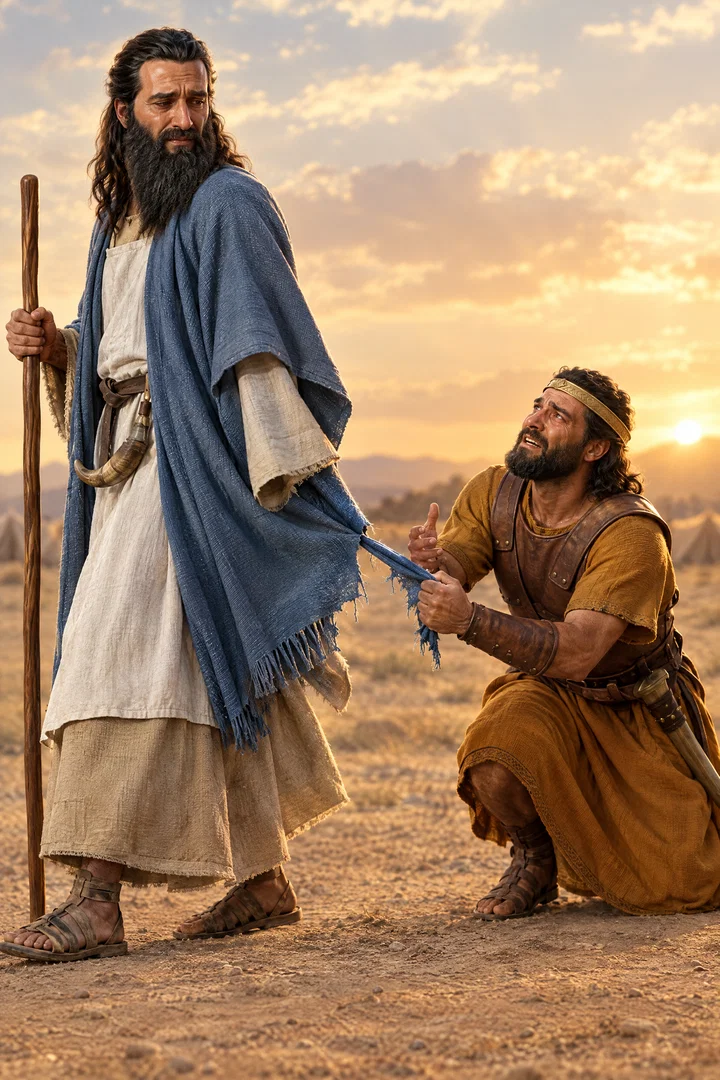
Because he rejected the word of the Lord, the Lord rejected him as king and removed the kingdom from him.PP 631.4–632.11SP 366.2–367.2 The tearing of Samuel's mantle as Saul grasped it confirmed the declaration and served as a sign that the kingdom was taken away.PP 631.4–632.1 The Lord's decision to remove him was firm and would not change, unlike Saul himself.1SP 366.2–367.2
The kingdom was taken from him and given to a better neighbor, to a better successor, pointing to another who was later identified as David.1SP 366.2–367.2SG4 78.2PP 652.1 Saul recognized David as the man who would reign in his place.PP 652.1 The declaration made Saul recognize his true condition, but his fear-driven admission and request for pardon was not true repentance, since he cared more about receiving public honor than gaining God's forgiveness and favor.SG4 77.1–3
Saul knew he had been rejected because of his wicked course.SG4 78.2 He repeatedly foretold his own dethronement and the loss of royal honor for his descendants, who would perish because of his sins, speaking with distracted intensity before his lords and the people.SG4 78.2 His insistence on his own way led to the loss of his kingdom and honor, and those who persist in having their own way as he did face loss and finally the loss of the soul.Lt 13, 1892, par. 8–10
Sources
Pioneers and periodicals
49 sources
God commanded Saul to utterly destroy Amalek without sparing people or livestock, but he spared King Agag alive and kept the best sheep, oxen and all that was good, and on that day the kingdom was rent from him and given to a neighbor better than he, David the son of Jesse.RH Dec 9, 1915RH Oct 18, 1853ST Dec 11, 1884RH Mar 10, 1874RH Oct 25, 1864 To obey is better than sacrifice and to hearken than the fat of rams, while rebellion is as the sin of witchcraft and stubbornness as iniquity and idolatry, so even disobedience for a seemingly worthy purpose is transgression.RH Mar 23, 1916RH Dec 9, 1915ST Dec 30, 1903 God requires literal obedience to the plain letter of His commands rather than following a human idea of their spirit, and sparing what He commanded to destroy cannot be excused by offering it back to Him as a sacrifice.ST Jun 25, 1885RH Oct 25, 1864ST Jul 29, 1889ST Jul 13, 1915 Saul's acknowledgment was worldly sorrow and not godly repentance, for he blamed the people, sought honor before the elders, and grieved the loss of character and kingly standing rather than hating sin itself.ST Nov 21, 1892ST Feb 10, 1904ST Mar 3, 1881RH Jun 5, 1900 Because of presumption the Spirit of God left him, his rejection was final and his house lost its prospects, and his decline into unhappiness and despair stands as a solemn warning against treating God's commands lightly.RH Dec 9, 1915RH Oct 18, 1853ST Feb 19, 1885ST Aug 23, 1899
Context and Plain Meaning
God had commanded Saul to utterly destroy Amalek, people and livestock without sparing anything, but Saul spared King Agag alive and kept the best sheep, oxen, fatlings, lambs and all that was good, destroying utterly only what was vile and refuse.RH Dec 9, 1915RH Mar 10, 1874RH Oct 25, 1864RH Oct 8, 1861ST Jul 29, 1889 He excused keeping what God had commanded to destroy by claiming the best animals were spared to sacrifice to the Lord, and he claimed to have obeyed while reasoning against the plain command and substituting his own ideas.ST Jun 25, 1885ST Jun 20, 1906ST Jul 13, 1915ST Oct 30, 1884 He followed his own idea of the spirit of the command instead of its plain letter, and even with a seemingly worthy purpose that keeping was transgression.RH Dec 9, 1915ST Jul 29, 1889ST Jul 13, 1915 His failure in perfect obedience called down God's displeasure, for going beyond or falling short of revealed will is presumption and danger of departing from God's word.RH Mar 10, 1874RH Oct 25, 1864ST Dec 30, 1903
The sentence pronounced that day was that the Lord had rent the kingdom of Israel from Saul and had given it to a neighbour better than he, meaning Saul lost the kingship because he rejected the Lord's word and disobeyed.RH Oct 18, 1853ST Dec 11, 1884ST Jul 2, 1885ST Apr 11, 1911ST Apr 15, 1913 The better neighbour and chosen successor was David the son of Jesse, whom the Lord chose as better than Saul.ST Jul 2, 1885 The tearing of Samuel's mantle served as the sign of this sentence of removal.ST Aug 31, 1882 Samuel showed courage in later life by standing before Israel's mighty king to his face and pronouncing God's sentence of rejection, as the boy who had faithfully delivered a painful message to Eli grew into a man able to do the same to a king.ST Mar 14, 1906ST Nov 14, 1895 Afterward Saul watched the prophet's movements as though to frustrate the decree by hindering him, which explains Samuel's fear that Saul would kill him if he went to anoint another king.ST Nov 14, 1895
Saul was a Benjamite king, once a humble young man signally blessed and honored when anointed by the Lord's command, whose elevation and outward advantages did not secure his kingdom.ST Apr 23, 1902ST Jun 13, 1906 He became proud of his royal dignity, dismissive of Samuel and the prophets, and presumptuous enough to expect God to accept terms he set, and his pride and self-will grieved away the Spirit of God.ST Aug 31, 1882ST Feb 19, 1885RH Feb 25, 1873 Had he ruled wisely and kept the prophetic spirit he had received, his career could have been honorable instead of ruinous, but what appeared good became a curse while God uses humble people and circumstances to accomplish His purposes.ST Feb 19, 1885 His pride in his own achievements overlooked that God, not Saul, was Israel's strength.ST Aug 31, 1882
Saul destroyed the Amalekite nation as punishment for Amalek's treacherous ambush of faint and weary Israel at Rephidim after Egypt, but captured Agag alive and brought him to Gilgal, where Samuel slew him.ST Apr 23, 1902 Samuel grieved over Saul's downfall, showing a good spirit, for a mere politician moved by desire for worldly honors would have rejoiced to see the fall of one set up on the ruins of his own rejected administration.ST Jun 13, 1906 Saul had become king because the people rejected God's government as administered through Samuel and demanded a king, and he recklessly threw away his own bright prospects and those of his family.ST Jun 13, 1906
Obedience Better Than Sacrifice
The account teaches that to obey is better than sacrifice and to hearken than the fat of rams, while rebellion is as the sin of witchcraft and stubbornness as iniquity and idolatry.RH Mar 23, 1916RH Dec 9, 1915ST Dec 30, 1903 The command was to utterly destroy Amalek, people and livestock without sparing anything, but the king was spared alive and the best sheep, oxen, fatlings, lambs and all that was good were kept, destroying utterly only what was vile and refuse, with the excuse that the best had been spared to sacrifice to God.RH Dec 9, 1915 Even with a seemingly worthy purpose that keeping was transgression of the commandment, and for that presumption the kingdom was rent away.RH Dec 9, 1915ST Dec 30, 1903 Though the act seemed small, it was treated as rebellion, the blessing of the kingdom was removed, and the one who rebelled lived on in that unhappy state until ending life by his own hand, dying apart from God as a lost man.RH Dec 9, 1915ST Dec 30, 1903
God requires literal obedience to the plain letter of His commands, not obedience to a human idea of their spirit.RH Oct 25, 1864ST Jul 29, 1889 Saul followed his own idea of the spirit of the command to utterly destroy the Amalekites and all that they had instead of its plain letter, saving the best of the sheep and oxen to sacrifice to the Lord as if doing better than required.RH Oct 25, 1864ST Jul 29, 1889 Going beyond or falling short of revealed will called down displeasure, and for that spirit he was rejected, had the kingdom taken away, and was finally left with the Lord having nothing whatever to do with him.RH Oct 25, 1864ST Jul 29, 1889 The spirit of obedience to the Sabbath command likewise consists in actual observance of its letter, the seventh day set apart and hallowed to commemorate creation, and this condemns substituting a rival institution for it.ST Jul 29, 1889
Disobeying a clear command cannot be excused as an attempt to honor God in some other way.ST Jun 25, 1885ST Jul 13, 1915 There was no misunderstanding or lack of knowledge of the direction to destroy the Amalekites; there was reasoning against a plain command and substituting of own ideas, thinking an offering to God's work would cover disobedience.ST Jun 25, 1885ST Jul 13, 1915 That presumption upon God's word caused the kingdom to slip from under his control and pass to one who would obey.ST Jun 25, 1885ST Jul 13, 1915 Obedience when it is difficult, not personal convenience or substitute service, is the test of allegiance.ST Jul 13, 1915
The failure revealed character, because though there was a claim to have obeyed, part of what was commanded to be destroyed had been spared.ST Jun 20, 1906 For that reason trust to obey was gone, and the loss of Israel's kingdom followed.ST Jun 20, 1906 The consequence makes the disobedience concerning Amalek a solemn warning against treating God's commands lightly.RH Oct 18, 1853 The chapter presents this removal of the kingdom and giving of it to another who was better as a striking lesson in disobedience for all of God's children.RH Oct 18, 1853
The presumption in keeping Agag and the best animals alive shows the danger of departing from God's word.RH Mar 10, 1874 The failure to obey concerning the Amalekites was a decisive test, while also forming part of a longer course of stubborn, self-willed conduct.RH Jul 24, 1860 Persistent disobedience led to loss of the kingdom when it was declared taken and given to another.RH Jul 24, 1860 Stubbornness and rebellion are grave sins with serious consequences.RH Jul 24, 1860
God means what He speaks and never made His work for man to mend.ST Dec 30, 1903ST Jun 1, 1915 Man should be satisfied to know what God commands without asking why.ST Dec 30, 1903 He is as particular about obedience to His written word in the nineteenth century as He was fifteen hundred years before Christ, so it is no safer now to add to His word or take from it.RH Oct 25, 1864ST Jun 1, 1915 His holy law must not be trampled underfoot while light is shining and the last call of mercy is sounding as His people prepare to meet the King in His beauty, for refusing to amend a small wrong when shown to be wrong puts one on the downward path to eternal destruction, which applies to changing the Sabbath.RH Oct 25, 1864ST Dec 30, 1903 Both diminishing from and adding to the word, sparing the best sheep and fatlings and lambs and oxen when commanded to utterly destroy all and spare nothing, then proposing to offer those animals as a great sacrifice, was offering sheep and oxen dedicated to the gods of Amalek instead of sheep and oxen dedicated to the God of Israel, which added insult to rebellion, and for this sin kingdom and life were lost, showing that God is particular and will not today accept an offering of what has been offered to heathen gods in place of what He has commanded.ST Jun 1, 1915
False Repentance and Downfall
Saul admitted he had done wrong, yet he blamed the people and pleaded fear of them as if they had compelled his disobedience, shifting blame instead of honestly owning his sin, and he did not renounce self or make full confession.ST Aug 31, 1882ST Nov 21, 1892ST Feb 10, 1904 Even after hearing that the Lord had taken the kingdom of Israel from him and given it to one better than he, with the tearing of Samuel's mantle as the sign of the sentence, his immediate plea was for Samuel to honor him before the elders and worship with him, seeking public standing as policy rather than changing his course.ST Aug 31, 1882ST Nov 21, 1892ST Jul 17, 1884 He stands as the most distinct instance of worldly sorrow as opposed to the godly sorrow that transforms life and conduct.ST Mar 3, 1881RH Jun 5, 1900 His apparent grief after the kingdom was rent from him was not hatred and loathing of sin because it is wrong, but sorrow for its result in loss — loss of character and forfeited kingly standing — with remorse beginning at the exposure of guilt before the world, and such sorrow from suffering or loss brings no genuine repentance and leads to death.ST Mar 3, 1881RH Jun 5, 1900
Though he knew the kingdom had been taken from him and his family, he did not humbly accept God's will but persisted in justifying himself and refusing to humble himself and do his duty.RH Apr 23, 1901RH Jun 18, 1867 His downfall dated from rejecting God's command, and his later repentance came too late to undo the judgment of rejection.ST Jul 13, 1904RH Apr 23, 1901 Though the kingdom could not be restored, repentance could still have brought him pardon and peace with God, while persisting in self-justification leads to a fearful end.RH Apr 23, 1901RH Jun 18, 1867 The sentence was final, ending his kingship and the prospects of his house, and it was followed by the anointing of David.ST Mar 31, 1909ST Jul 17, 1884
Through presumption in sparing alive the king and the best sheep, oxen, fatlings, lambs and all that was good while destroying utterly only what was vile and refuse, on the excuse of sparing the best to sacrifice to God, he rejected the word of the Lord, for to obey is better than sacrifice and to hearken than the fat of rams, while rebellion is as the sin of witchcraft and stubbornness as iniquity and idolatry.RH Dec 9, 1915ST Feb 19, 1885 Because of that presumption the Spirit of God left him, his self-willed course grieved away the prophetic spirit he had received, and the Lord had nothing to do with him and left him to himself.RH Dec 9, 1915ST Feb 19, 1885ST Dec 4, 1884 He had grown proud of his royal dignity, dismissive of Samuel and the prophets, and presumptuous enough to expect God to accept terms he set, when had he ruled wisely and kept that spirit his career could have been honorable instead of ruinous.ST Feb 19, 1885ST Aug 23, 1899ST Feb 25, 1897 His royal dignity and power could not excuse disobedience, and his attempt to justify himself did not undo his failure to follow God's explicit instruction to destroy Amalek.ST Aug 23, 1899ST Feb 25, 1897RH Feb 10, 1903 Losing the kingdom marked the start of a decline in which he lived on unhappy in that state until he ended in despair and died by his own hand apart from God as a lost man.RH Dec 9, 1915ST Aug 23, 1899RH Feb 10, 1903
His pride in his own achievements overlooked that God, not Saul, was Israel's strength, and that pride thrust him out of his kingdom.ST Aug 31, 1882RH Feb 25, 1873 Left to himself after rejecting truth, he later turned to a woman who consorted with the devil despite having condemned such practices before, showing how rejecting truth can lead an enlightened person to treat an outrageous sin as righteousness.ST Dec 4, 1884
Kingdom Given to David
After direct disobedience to God the kingdom was declared taken from Saul and given to another man, for obstinacy led the Lord to reject him as king and give the kingdom to a better successor.ST Sep 20, 1883ST Jan 17, 1906 That neighbor better than he was David the son of Jesse, whom God had chosen to receive the kingdom after Saul rejected God's command.ST Jul 22, 1886ST Jan 17, 1906 Saul himself later recognized David as the man God had chosen to succeed him.ST Sep 20, 1883
As Saul moved toward ruin through rebellion and forfeited Israel's throne, God's providence was preparing the successor while Saul's claim was being lost.RH Nov 17, 1874 David was being prepared through hardship to take his place.RH Nov 17, 1874 God took the kingdom from Saul and gave it to another because Saul had not obeyed God's command, and Samuel later anointed David, Saul's replacement, at Bethlehem.RH Jun 25, 1901ST Feb 17, 1904 Though already anointed, David remained uncrowned while fleeing Saul's anger, waiting for God to place him on Israel's throne in God's own time and way.RH Jun 25, 1901ST Feb 17, 1904
David trusted that this prophetic word would be fulfilled in God's own time and way, so he refused to kill Saul even when he had the opportunity and others urged him to do so.ST Jan 17, 1906 Saul's kingship being taken from him and given to another house stands in contrast to God's promise that David's son would not lose the throne in that way.ST Sep 10, 1896 David's royal line was promised to endure forever, a promise fulfilled in Christ.ST Sep 10, 1896
Links to Other Scriptures
Saul, a Benjamite king of Israel, destroyed the Amalekite nation as punishment for Amalek's treacherous ambush of faint and weary Israel at Rephidim after Egypt, but he captured King Agag alive and brought him to Gilgal, where Samuel slew him.ST Apr 23, 1902 The Amalekites were bitter enemies of the Lord, and this conflict connects to Haman as possibly a descendant of Agag.ST Sep 20, 1899ST Jan 20, 1898 Haman was a direct descendant of that Agag, and Mordecai was a Benjamite of Saul's own tribe, so Haman's plan to destroy all the Jews because Mordecai would not bow was vengeance by the remaining Agagite against Saul's people for Saul's destruction of Amalek.ST Apr 23, 1902 That scheme was a continuation of the original Amalekite cruelty, not fair justice.ST Apr 23, 1902 About five and one-half centuries stood between Saul's sparing of Agag and Haman, though the number of generations is unknown.ST Jan 20, 1898
Agag represents what must be decisively put away in complete consecration to God, so the call to slay the Agags evokes the rending of the kingdom from Saul.RH Feb 17, 1859 God rejected Saul from the kingdom because he disobeyed the command to utterly destroy the Amalekites and all that they had by sparing the best of the sheep and oxen to sacrifice to the Lord.ST Dec 30, 1903ST Jul 29, 1889 Though the act seemed small, God treated it as rebellion and removed the blessing of the kingdom from him, for to obey is better than sacrifice and to hearken than the fat of rams.ST Dec 30, 1903 God requires literal obedience to the plain letter of His commands rather than obedience to a human idea of their spirit, and Saul followed his own idea of the spirit instead of the letter, for which he was rejected, had the kingdom taken away, and was finally left with the Lord having nothing whatever to do with him.ST Jul 29, 1889 God means what He speaks and never made His work for man to mend, so man should be satisfied to know what God commands without asking why, and refusing to amend a small wrong when shown to be wrong puts one on the downward path to eternal destruction.ST Dec 30, 1903
The spirit of obedience to the Sabbath command therefore consists in actual observance of its letter, the seventh day set apart and hallowed to commemorate creation, and condemns substituting a rival institution for it, which applies to changing the Sabbath.ST Dec 30, 1903ST Jul 29, 1889 The verse belongs to the account in 1 Samuel 14 and 15 showing that obedience is better than sacrifice.RH Mar 23, 1916
Warning and Present Application
The rending of the kingdom from Saul for disobedience stands as a warning that the kingdom will likewise be taken from those who cling to what God has commanded to be destroyed.RH Oct 8, 1861RH Oct 8, 1861 The idols to be put away are such modern indulgences and fashions as tobacco, coffee, tea, and hoops, which must be abandoned rather than retained.RH Oct 8, 1861 Saul excused keeping alive Agag and sparing the cattle when commanded to destroy them utterly, and so those who excuse their cherished practices and idols instead of obeying risk losing the kingdom as he did.RH Oct 8, 1861
Going beyond or falling short of God's revealed will called down His displeasure upon Saul when he saved the best of the sheep and oxen to sacrifice as if doing better than required, and it is no safer now to add to His word or to take from it than it was long before.RH Oct 25, 1864 God is as particular about obedience to His written word in the nineteenth century as He was fifteen hundred years before Christ.RH Oct 25, 1864 His holy law must not be trampled underfoot while light is shining and the last call of mercy is sounding as His people prepare to meet the King in His beauty.RH Oct 25, 1864 Saul both diminished from the Lord's word by sparing the best sheep and fatlings and lambs and oxen of Amalek when commanded to spare nothing, and added to it by proposing to offer those animals as a great sacrifice to the Lord.ST Jun 1, 1915 That was to offer sheep and oxen dedicated to the gods of Amalek instead of sheep and oxen dedicated to the God of Israel, which added insult to rebellion, and for this sin he lost his kingdom and his life, showing that God will not today accept an offering of what has been offered to heathen gods in place of what He has commanded.ST Jun 1, 1915
Saul's elevation and outward advantages did not secure his kingdom once he disobeyed, for God took it from him and gave it to another. His case warns that what appears good may become a curse, while God uses humble people and circumstances to accomplish His purposes.
Sources