1 Samuel 16:9
Then Jesse made Shammah to pass by. And he said, Neither hath the LORD chosen this.
Translations
Then Jesse made Shammah to pass by. And he said, Neither has the LORD chosen this.
King James Version, Webster Bible, Revised Version
Then Jesse made Shammah to pass by. And he said, Neither hath the LORD chosen this.
Then Jesse made Shammah to pass by. And he said, Neither hath the Lord chosen this.
Then Jesse made Shammah to pass by. And he said, Neither hath Jehovah chosen this.
And Jesse causeth Shammah to pass by, and he saith, 'Also on this Jehovah hath not fixed.'
Then Jesse made Shammah pass by. And he said, Neither has Jehovah chosen this one.
Then Jesse made Shammah pass by,—and he said—Nor of this one, hath Yahweh made choice.
Berean Standard Bible, Majority Standard Bible
Next Jesse presented Shammah, but Samuel said, “ The LORD has not chosen this one either.”
Then Jesse made Shammah to pass by. He said, “ The LORD has not chosen this one, either.”
Then Jesse made Shammah come before him. And he said, The Lord has not taken this one.
Then Ishai made Shammah come. And he said, Neither yet hath the Lord chosen him.
Douay-Rheims (Challoner revision)
And Isai brought Samma, and he said of him: Neither hath the Lord chosen this.
Pictures
Cross-references
- 1 Samuel 16:13
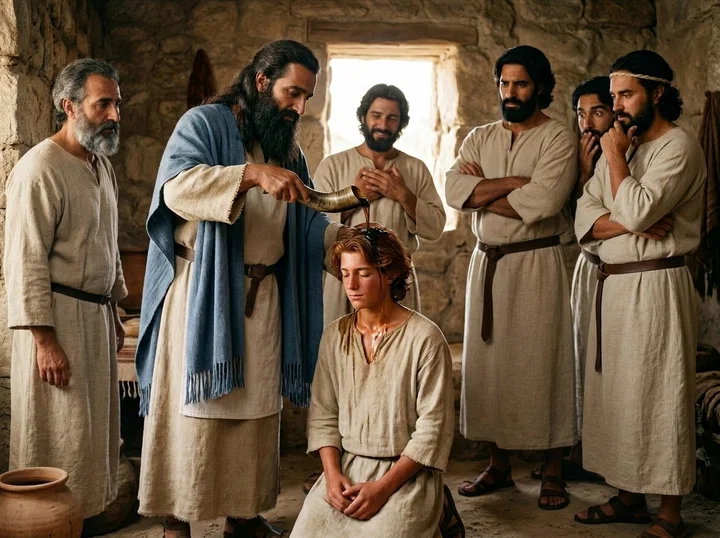
Then Samuel took the horn of oil, and anointed him in the midst of his brethren: and the Spirit of the LORD came upon David from that day forward. So Samuel rose up, and went to Ramah.
David is chosen and anointed after his brothers are passed over.
- 1 Samuel 16:1
And the LORD said unto Samuel, How long wilt thou mourn for Saul, seeing I have rejected him from reigning over Israel? fill thine horn with oil, and go, I will send thee to Jesse the Beth-lehemite: for I have provided me a king among his sons.
God provided himself a king in David
- Ruth 4:22
And Obed begat Jesse, and Jesse begat David.
Ruth's line leads to the anointed David
- Ruth 4:17
And the women her neighbours gave it a name, saying, There is a son born to Naomi; and they called his name Obed: he is the father of Jesse, the father of David.
Ruth's line leads to the anointed king
- Exodus 33:19
And he said, I will make all my goodness pass before thee, and I will proclaim the name of the LORD before thee; and will be gracious to whom I will be gracious, and will shew mercy on whom I will shew mercy.
Cited as another use of the Hebrew word for passing by.
- Psalms 89:19-37
Then thou spakest in vision to thy holy one, and saidst, I have laid help upon one that is mighty; I have exalted one chosen out of the people.
Affirms God’s enduring covenant with David.
- 2 Samuel 5:2
Also in time past, when Saul was king over us, thou wast he that leddest out and broughtest in Israel: and the LORD said to thee, Thou shalt feed my people Israel, and thou shalt be a captain over Israel.
Israel recognizes David as king and recalls God’s choice of him.
- 2 Samuel 7:8
Now therefore so shalt thou say unto my servant David, Thus saith the LORD of hosts, I took thee from the sheepcote, from following the sheep, to be ruler over my people, over Israel:
Names David as the ruler chosen from among the sheepfold.
- 1 Samuel 17:50
So David prevailed over the Philistine with a sling and with a stone, and smote the Philistine, and slew him; but there was no sword in the hand of David.
chosen as boy because he could slay Goliath
Commentary
Each commentary is drawn from primary sources: the writings of Ellen G. White and Adventist pioneers and periodicals. Each commentary is separate. Its own words are not a quotation; follow the references to read the source passages.
Ellen G. White
8 sources
Jesse brought forward Shammah, one of his older fine-looking sons, for Samuel to examine as the Lord's anointed king, and the word concerning him was that the Lord had not chosen him.1SP 367.3–368.1YCDCP 2.1ED 266.1–3RH Dec 24, 1908RH Feb 13, 1913 His passing by with the other sons and being refused belongs to the sifting in which none of those presented was selected.1SP 367.3–368.1YCDCP 2.1RH Feb 13, 1913
God instead chose David, the youngest, a lightly regarded shepherd boy, and appointed him to reign over Israel as Saul's successor.1SP 367.3–368.1ED 266.1–3RH Nov 11, 1915ED 254.2–3PP 698.2–3 The throne promised to him was the kingdom over which Saul had reigned.RH Dec 24, 1908RH Nov 11, 1915PP 698.2–3
Samuel was inclined to favor the elder sons for handsome countenance, fine stature, outward appearance and promise, yet they lacked the qualities God required in a ruler.1SP 367.3–368.1YCDCP 2.1ED 266.1–3RH Feb 13, 1913 David was chosen not for stature or appearance but for faithfulness and character, for simplicity and sincerity, and because he could be trained for the kingdom.1SP 367.3–368.1ED 266.1–3 The reason is that man looks on the outward appearance while the Lord looks on the heart and does not choose as man chooses, seeing capacities and worth that others overlook.1SP 367.3–368.1YCDCP 2.1ED 266.1–3RH Feb 13, 1913
That choice and the promise of the throne show that faith in God's promise can enable one who seems weak to stand against established human power.RH Dec 24, 1908RH Nov 11, 1915ED 254.2–3 So David the shepherd lad, holding God's promise of the throne, stood against Saul the established king when Saul sought to keep his power.RH Dec 24, 1908RH Nov 11, 1915ED 254.2–3
Abner knew of David's divine appointment to succeed Saul, yet after long hunting and pursuing David he remained unwilling for Jesse's son to succeed.PP 698.2–3 Under Saul's influence he despised the man God had chosen, and from ambition and revenge sought his own exaltation by raising up Ishbosheth and creating division in Israel.PP 698.2–3
The refusal of noble-appearing sons proves that human judgment by outward appearance cannot tell which young people are most promising or will render the best service to God.YCDCP 2.1RH Feb 13, 1913 Therefore only a few must not be picked out for thorough training while the rest are neglected.YCDCP 2.1RH Feb 13, 1913 All the youth need broad, general and thorough education to fit them for usefulness, that they may become laborers together with God.YCDCP 2.1RH Feb 13, 1913
Sources
Pioneers and periodicals
35 sources
At Bethlehem Samuel came on a divine mission to anoint one of Jesse's sons as king in Saul's place, and Jesse made Shammah to pass before him, but Samuel said the Lord had not chosen him, one of seven successive rejections that left Samuel perplexed until David was sent for from keeping his father's sheep.ST Nov 14, 1895ST Dec 22, 1914ST Apr 22, 1903ST Dec 15, 1898ST Feb 17, 1904 The Lord's mind was impressed on Samuel by silent, inward communication, for his own judgment was not enough and he judged by the Spirit of divine wisdom.ST Dec 22, 1914ST Apr 22, 1903ST Aug 10, 1904ST Dec 22, 1914ST Dec 22, 1914 The kingship remained first God's own, and he kept the right to choose Israel's king and chose David next after Saul, rejecting Shammah because man looks on the outward appearance but the Lord looks on the heart.ST Dec 12, 1895RH Aug 14, 1856ST Aug 19, 1889 David was the youngest of Jesse's eight sons, a shepherd lad who was anointed with the horn of oil in the midst of his brethren, after which the Spirit of the Lord came upon him, marking the beginning of his life as Israel's future king from whom the Messiah would descend.ST Oct 19, 1888ST Apr 22, 1903RH Nov 18, 1862ST Dec 30, 1913 Human judgment therefore cannot tell by outward appearance or stature which youth will render the best service to God, for the Lord chose David because he loved God, obeyed his parents, and faithfully cared for his father's sheep.RH Feb 13, 1913RH Nov 18, 1909RH May 9, 1907RH Aug 18, 1910
Context and Wording
The scene is Bethlehem, the city and home of David's family, where Samuel came on a divine mission to anoint one of Jesse's sons as king in Saul's place.ST Apr 22, 1903ST Dec 15, 1898ST Feb 17, 1904ST Aug 19, 1889 He came still grieving over Saul to carry out God's task of identifying and anointing the person God had chosen.ST Aug 19, 1889ST Aug 19, 1889 The seeking for the king God had provided was done quietly rather than publicly, at the offering feast following the sacrifice, and was kept secret for fear of Saul, so the sons did not understand its purpose.ST Nov 14, 1895ST Aug 19, 1889 Jesse made Shammah, one of seven sons who successively passed before Samuel and among Jesse's sons considered before David was brought and chosen, to pass by or pass before Samuel, the Hebrew word translated pass through allowing either sense.ST Nov 14, 1895ST Jul 2, 1885ST Apr 22, 1903ST Jun 19, 1884ST Oct 29, 1912 Shammah came with them as great-grandson of the believing Moabitess Ruth.ST Feb 17, 1904
Of Shammah Samuel said that the Lord had not chosen him to be king.ST Nov 14, 1895ST Jul 2, 1885ST Jun 19, 1884ST Aug 19, 1889 That verdict was one of seven successive rejections, each son met with the same word, and after the sons present had been rejected Samuel was left in perplexity until he asked whether another son remained.ST Nov 14, 1895ST Apr 22, 1903ST Dec 22, 1914 Then the youngest, David, a fifteen-year-old shepherd keeping his father's sheep, was sent for from the fields and anointed with the horn of oil in the midst of his brethren, after which the Spirit of the Lord came upon him from that day forward.ST Apr 22, 1903ST Dec 22, 1914 The Lord's mind that Shammah was not the chosen one was made known to Samuel during the examination quickly and accurately by silent, inward communication, without any recorded audible voice or command.ST Dec 22, 1914ST Dec 22, 1914ST Dec 22, 1914
Samuel's own judgment was not enough to identify the right person, so he judged by the Spirit of divine wisdom and discernment, which did not point to Shammah or any of the seven.ST Apr 22, 1903ST Aug 10, 1904 He needed the Holy Spirit's direct guidance to anoint the son God would identify.ST Aug 10, 1904ST Aug 19, 1889 Prophetic authority and infallibility therefore rest in divine inspiration and not in the prophet himself.ST Aug 10, 1904
God's Choice of David
The kingship was first God's own, with Himself as ruler, and it became David's only secondarily by the gift of God, for God kept for Himself the right to choose Israel's king and chose David next after Saul and before Christ, not by the people's choice.RH Aug 14, 1856 The Lord rejected Shammah because man looks on the outward appearance but the Lord looks on the heart, so the selection rested on the heart and on courage and character rather than handsome countenance, fine stature, or kingly appearance.RH Feb 13, 1913ST Dec 12, 1895ST Aug 19, 1889RH Dec 24, 1867 It was carried out quietly rather than publicly, contrasting human expectations with God's choice of the humble shepherd David as Israel's future king.ST Aug 19, 1889RH Dec 24, 1867 Samuel was inclined to judge by outward appearance, but the refusal of the noble-looking sons proved human judgment cannot tell which youth will render the best service to God.RH Feb 13, 1913
Saul had been fit when the Lord chose him, for his heart was changed, and the fault lay with himself and developed later.ST Dec 12, 1895 Saul was of kingly appearance while David was not, and the poorest in appearance may be one with whom the Lord delights to dwell.ST Dec 12, 1895 David was the youngest of Jesse's eight sons, a fifteen-year-old shepherd lad from Bethlehem of the tribe of Judah keeping his father's sheep, who was sent for after seven sons successively passed before Samuel and left him in perplexity, and who was anointed with the horn of oil in the midst of his brethren, after which the Spirit of the Lord came upon him from that day forward.ST Oct 19, 1888ST Apr 22, 1903RH Nov 18, 1862ST Apr 28, 1914 The passing by and rejection of Shammah belongs to the first of three steps taken by God's instruction and revelation by which David ascended to complete dominion over all Israel, making him at this point anointed and Spirit-guided but not yet crowned.ST Apr 22, 1903
God had chosen David to be king over Israel long before Saul's death, within the waning of Saul's house and the calling of David.ST Jun 19, 1884ST Apr 15, 1913 The choice came after Saul forfeited his right to the throne by disobedience and was made known through the prophet as a prophecy to be fulfilled in God's own time and way.ST Jan 17, 1906 Saul was rejected from being king and lost his kingdom and fell in disgrace because he added stubbornness to rebellion when he failed to utterly destroy the Amalekites, pertinaciously following a way of his own that he thought best, not knowing his throne and kingdom hung on that test, which was only one link in a long course of obstinacy and self-will.RH Jul 24, 1860 Rebellion and stubbornness are heinous sins that close the avenues of the heart and keep angels waiting, and stubbornness bids good angels depart from the stubborn person to attend upon some David instead.RH Jul 24, 1860
David showed implicit faith in the promise of the throne by waiting through danger and opposition before his promised rule, and by refusing to lift his hand to take Saul's life even when Saul, the established king who sought to keep his power, hunted him like a wild beast and he was urged to kill him.RH Dec 24, 1908RH Nov 11, 1915ST Jan 17, 1906RH Mar 4, 1873 God amply repaid David for his faith, for when the time came He inclined the hearts of the truest, bravest, and most skilful men of all the tribes of Israel to join David's army.ST Jan 17, 1906 Samuel's words and the anointing marked the beginning of David's life as Israel's future king and remained with him as assurance of the calling God had given him, although his later course and years of exile were unknown to him.ST Dec 30, 1913 The Messiah was to descend from David, not from any of his seven older brothers, so Jesus is identified as David's descendant, David's reign is associated with Israel's revival and the promised everlasting throne, and Bethlehem as the city and home of David's family where David was anointed establishes Bethlehem as the city of David and explains why Joseph, being of the house and family of David, went there with Mary to be registered.ST Oct 19, 1888RH Nov 18, 1862ST Dec 15, 1898 God's choosing of David from among his brothers and of Jesse's family for a special work did not guarantee David's eternal salvation and did not mean the brothers passed by were condemned.ST Apr 10, 1907
Lessons for Life
Human judgment cannot tell by outward appearance, stature, or natural ability which youth will be most promising and will render the best service to God.RH Feb 13, 1913RH May 9, 1907 Samuel was inclined to judge by handsome countenance and fine stature and outward appearance, but the Lord does not see as man sees, for man looks on the outward appearance and the Lord looks on the heart.RH Feb 13, 1913RH May 9, 1907 Shammah was one of the noble-looking sons of Jesse brought to be examined as the anointed of the Lord and refused, showing that human judgment may overlook someone whom God chooses.RH Feb 13, 1913RH Aug 18, 1910 A youth who seems unlikely to parents and others may therefore be chosen by God, and choice cannot be limited to a few.RH Feb 13, 1913RH Aug 18, 1910
The Lord in searching for a boy who would make a good king when he became a man passed by all the tall, noble-looking boys and rejected outward appearance.RH Nov 18, 1909 He chose David because David loved to work, sang while he worked, obeyed his father and mother, loved God, and took good care of his father's sheep and therefore could slay Goliath.RH Nov 18, 1909 The same searching continues now, as God looks for boys and girls he can use who get ready by doing home duties faithfully.RH Nov 18, 1909 Because Jesse's family did not know which son the Lord would choose, every child's education should be continued since any one of them may be called to God's work, and all the youth need thorough education that they may be fitted for usefulness and become laborers together with God.RH Feb 13, 1913RH Dec 18, 1913 Parental decisions can affect whether a child is prepared for that work.RH Aug 18, 1910
David was slighted by his father Jesse from his earliest youth, the beginning of a life tried in the furnace of affliction.RH Jul 1, 1862 In the passing of Jesse's sons before Samuel, David was chosen and anointed instead, and the disappointment of being passed over helps explain the envy that later shaped his eldest brother's words to David.RH Sep 3, 1901 Eliab was a proud, handsome man of splendid proportions and handsome face who could be polite and courteous upon occasions and had fondly hoped to reign as king over the chosen men of Israel.ST Aug 17, 1904 When the prophet's anointing oil was poured upon David's youthful head instead, Eliab ever since cherished bitter hatred, jealousy and envy toward his youngest brother and was accustomed at home to treating him with nothing but discourtesy.ST Aug 17, 1904
Sources