1 Samuel 16:10
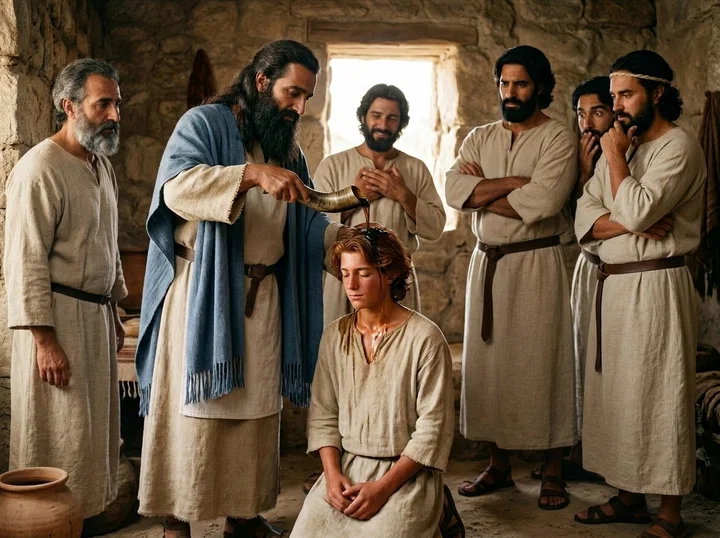
Again, Jesse made seven of his sons to pass before Samuel. And Samuel said unto Jesse, The LORD hath not chosen these.
Translations
Again, Jesse made seven of his sons to pass before Samuel. And Samuel said to Jesse, The LORD has not chosen these.
Again, Jesse made seven of his sons to pass before Samuel. And Samuel said unto Jesse, The LORD hath not chosen these.
Again, Jesse made seven of his sons to pass before Samuel. And Samuel said unto Jesse, The Lord hath not chosen these.
Again, Jesse made seven of his sons to pass before Samuel. And Samuel said to Jesse, The LORD hath not chosen these.
And Jesse made seven of his sons to pass before Samuel. And Samuel said unto Jesse, The LORD hath not chosen these.
And Jesse made seven of his sons to pass before Samuel. And Samuel said unto Jesse, Jehovah hath not chosen these.
And Jesse causeth seven of his sons to pass by before Samuel, and Samuel saith to Jesse, 'Jehovah hath not fixed on these.'
And Jesse made seven of his sons pass before Samuel. And Samuel said to Jesse, Jehovah has not chosen these.
So Jesse made seven of his sons pass before Samuel,—and Samuel said unto Jesse, Yahweh hath not made choice of these.
Berean Standard Bible, Majority Standard Bible
Thus Jesse made seven of his sons pass before Samuel, but Samuel told him, “ The LORD has not chosen any of these.”
Jesse made seven of his sons to pass before Samuel. Samuel said to Jesse, “ The LORD has not chosen these.”
And Jesse made his seven sons come before Samuel. And Samuel said to Jesse, The Lord has not taken any of these.
Againe Ishai made his seue sonnes to come before Samuel: and Samuel saide vnto Ishai, The Lord hath chosen none of these.
Douay-Rheims (Challoner revision)
Isai therefore brought his seven sons before Samuel: and Samuel said to Isai: The Lord hath not chosen any one of these.
Pictures
Cross-references
- 1 Samuel 15:26-28
And Samuel said unto Saul, I will not return with thee: for thou hast rejected the word of the LORD, and the LORD hath rejected thee from being king over Israel.
Saul’s rejection leads to God’s choice of David as king in his place.
- Ruth 4:22
And Obed begat Jesse, and Jesse begat David.
Names Jesse as David’s father and traces David’s ancestry to Ruth.
- 1 Samuel 17:50
So David prevailed over the Philistine with a sling and with a stone, and smote the Philistine, and slew him; but there was no sword in the hand of David.
David’s victory provoked Eliab’s jealous anger.
- 1 Chronicles 2:13-15
And Jesse begat his firstborn Eliab, and Abinadab the second, and Shimma the third,
Lists Jesse’s sons and names David seventh.
- 1 Samuel 16:1
And the LORD said unto Samuel, How long wilt thou mourn for Saul, seeing I have rejected him from reigning over Israel? fill thine horn with oil, and go, I will send thee to Jesse the Beth-lehemite: for I have provided me a king among his sons.
David received kingship by God's gift
- 1 Samuel 17:12
Now David was the son of that Ephrathite of Beth-lehem-judah, whose name was Jesse; and he had eight sons: and the man went among men for an old man in the days of Saul.
Jesse is said to have eight sons, raising the count question.
- Isaiah 11:1
And there shall come forth a rod out of the stem of Jesse, and a Branch shall grow out of his roots:
The promised ruler comes from Jesse’s line.
- 2 Samuel 5:2
Also in time past, when Saul was king over us, thou wast he that leddest out and broughtest in Israel: and the LORD said to thee, Thou shalt feed my people Israel, and thou shalt be a captain over Israel.
Israel recognized God’s earlier choice of David as king.
- Exodus 33:19
And he said, I will make all my goodness pass before thee, and I will proclaim the name of the LORD before thee; and will be gracious to whom I will be gracious, and will shew mercy on whom I will shew mercy.
Cited as another use of abar meaning pass by.
- Psalms 89:19-20
Then thou spakest in vision to thy holy one, and saidst, I have laid help upon one that is mighty; I have exalted one chosen out of the people.
God chooses David and establishes the covenant lineage from which the Messiah descends.
- Matthew 1:5-6
And Salmon begat Booz of Rachab; and Booz begat Obed of Ruth; and Obed begat Jesse;
Jesus’ genealogy traces his descent through Jesse and David.
- 2 Samuel 7:8
Now therefore so shalt thou say unto my servant David, Thus saith the LORD of hosts, I took thee from the sheepcote, from following the sheep, to be ruler over my people, over Israel:
The Lord took David from tending sheep to rule Israel.
- 1 Chronicles 2:16
Whose sisters were Zeruiah, and Abigail. And the sons of Zeruiah; Abishai, and Joab, and Asahel, three.
Names Jesse’s daughters and their family relationships.
- 1 Samuel 15:28
And Samuel said unto him, The LORD hath rent the kingdom of Israel from thee this day, and hath given it to a neighbour of thine, that is better than thou.
Saul is told the kingdom will be given to another.
- 1 Samuel 23:17
And he said unto him, Fear not: for the hand of Saul my father shall not find thee; and thou shalt be king over Israel, and I shall be next unto thee; and that also Saul my father knoweth.
Jonathan recognizes David is called to become king.
- 2 Samuel 7:12-16
And when thy days be fulfilled, and thou shalt sleep with thy fathers, I will set up thy seed after thee, which shall proceed out of thy bowels, and I will establish his kingdom.
God promises an enduring throne through David’s line.
- Revelation 22:16
I Jesus have sent mine angel to testify unto you these things in the churches. I am the root and the offspring of David, and the bright and morning star.
Jesus is called David’s offspring.
Commentary
Each commentary is drawn from primary sources: the writings of Ellen G. White and Adventist pioneers and periodicals. Each commentary is separate. Its own words are not a quotation; follow the references to read the source passages.
Ellen G. White
10 sources
Jesse made seven of his sons to pass one by one before Samuel for inspection, and the Lord gave no sign choosing any of them to be king in Saul's place.ED 265.2–31SP 367.3–368.1YCDCP 2.1PP 638.2–641.1RH Feb 13, 1913 After Eliab, the six other sons who were present passed by in turn, while Samuel watched with painful suspense to the last.YCDCP 2.1PP 638.2–641.1 He had judged by handsome countenance and fine stature that the elder son was the anointed, and he would have chosen the elder brothers, but he was left perplexed and bewildered when none was chosen, so he asked whether all the children were there and sent for the youngest who was keeping the sheep.ED 265.2–3YCDCP 2.1PP 638.2–641.1ED 266.1–3
The refusal shows that human judgment looks on outward appearance while the Lord looks on the heart, so noble appearance and outward promise do not reveal fitness or the qualities God values.ED 265.2–3YCDCP 2.1RH Feb 13, 1913 The noble-appearing older sons lacked what God required, and their pride and self-confidence contrasted with David's simplicity and sincerity and his readiness to be trained for the kingdom.ED 265.2–3YCDCP 2.1ED 266.1–3 His faithfulness and courage as a shepherd fitted him to become ruler.1SP 367.3–368.1 God had selected and appointed David, the youngest son of Jesse, a mere youth and shepherd lad called from the flock in the field, to receive the promise of the throne and succeed to the kingdom over which Saul had reigned.1SP 367.3–368.1YCDCP 2.1ED 254.2–3RH Nov 11, 1915RH Dec 24, 1908
Though utterly helpless in himself, David trusted the word of God and withstood Saul, the established monarch bent on holding fast his power, with the power of the whole world arrayed against him.ED 254.2–3RH Nov 11, 1915RH Dec 24, 1908 His stand witnesses that living faith in God's word triumphs over human power and policy in support of evil, and it marks the world's true nobility and royal line that youth today are called to join.ED 254.2–3RH Nov 11, 1915 Though Abner knew of the Lord's appointment of the son of Jesse to the throne, he despised the man God had chosen, was unwilling for him to succeed, and worked to divide Israel by raising up a rival king to exalt himself.PP 698.2–3 No one can tell by outward promise which youth will render the best service to God, so children who seem less promising must not be denied education, and the church must not select only a few for thorough training but must give general education to all, for they may have abilities suited to important service.ED 265.2–3YCDCP 2.1RH Feb 13, 1913
Sources
Pioneers and periodicals
36 sources
Jesse brought seven of his sons one by one before Samuel at the sacrificial feast in Bethlehem, while the purpose to anoint a new king was kept secret for fear of Saul so the sons did not understand why they were passing by.ST Nov 14, 1895ST Apr 22, 1903ST Aug 19, 1889 The Spirit of divine discernment rested on none of the seven, leaving even the experienced prophet perplexed and showing that human judgment cannot choose rightly without direct guidance from God.ST Apr 22, 1903ST Aug 10, 1904ST Aug 19, 1889 The one still absent was Jesse's youngest son David, a fifteen-year-old keeping his father's sheep, who was then fetched and anointed at the Lord's direction.ST Jul 2, 1885ST Apr 22, 1903RH Dec 24, 1867 The choice was not decided by tall and handsome outward appearance, as seen in Eliab, because the Lord looks on the heart and commended the least expected shepherd boy for his courage, character and faithfulness.ST Dec 12, 1895RH May 9, 1907 God thus reserved to Himself the right to provide Israel a king, passing by the seven to elect David to the special work of kingship and to become the channel of the promised Seed through whom Christ would come according to the flesh, an election to temporal service that did not decide eternal destiny.ST Oct 19, 1888RH Aug 14, 1856RH Nov 18, 1862ST Apr 10, 1907RH Jul 5, 1915
Passing Before Samuel
Seven of Jesse's sons in all were made to pass successively before Samuel at Bethlehem.ST Nov 14, 1895ST Apr 22, 1903 The passing took place at the sacrifice and offering feast for which Jesse and his sons were sanctified and called, and Samuel came under the ordinary occasion of sacrifice and quietly followed God's direction to identify the chosen one.ST Nov 14, 1895ST Apr 22, 1903ST Aug 19, 1889 The purpose to anoint a new king was kept secret for fear of Saul and to avoid confusion and rebellion, so the sons did not understand the meaning when they passed by.ST Nov 14, 1895ST Aug 19, 1889
The Hebrew word abar means to pass by or before, so Jesse's sons passed before Samuel rather than passing through something.ST Oct 29, 1912 The Spirit of divine wisdom and discernment pointed to none of the seven, leaving Samuel in perplexity and redirecting his sorrow into service of God's larger plans.ST Apr 22, 1903ST Aug 19, 1889 That perplexity prompted his inquiry whether all the children were present.ST Apr 22, 1903 Even a devoted and experienced prophet could not decide correctly without direct guidance from the Holy Spirit, since human judgment was inadequate and infallibility belonged to divine inspiration.ST Aug 10, 1904
The one not present was Jesse's youngest son David.ST Jul 2, 1885RH Dec 24, 1867 He was a fifteen-year-old shepherd keeping his father's sheep on the plains of Bethlehem, who was fetched from tending the sheep and anointed after the Lord directed Samuel to choose him.ST Jul 2, 1885ST Apr 22, 1903RH Dec 24, 1867 Bethlehem was the place of David where Samuel came and anointed him, making Bethlehem the city of David and the home city of his house.ST Oct 19, 1888ST Dec 15, 1898ST Feb 17, 1904ST Apr 28, 1914 David was born in Bethlehem in Judah, the great-grandson of Ruth the Moabitess.ST Feb 17, 1904 Because Joseph was of the house and family of David he went up to Bethlehem to be registered in the Roman enrollment with Mary.ST Dec 15, 1898
God's Choice of David
1 Samuel 16:10 belongs to the account of the Lord's rejection of Saul and God's choosing of David to take Saul's place as king.ST Sep 20, 1883ST Mar 31, 1909RH Dec 18, 1913 Although one of Jesse's sons had been chosen, none of the seven examined so far was the one, and David was the man God had chosen though Saul could not submit to that choice.ST Sep 20, 1883ST Dec 22, 1914ST Dec 22, 1914 God reserved to himself the right to choose the king of Israel by choosing David next after Saul and before Christ.RH Aug 14, 1856 The kingdom was first God's own and became David's only secondarily by the gift of God, for God said of David, I have provided me a king, and David had no first right of his own.RH Aug 14, 1856
The choice was not determined by outward appearance, for the Lord looks on the heart while people see outward qualities.ST Dec 12, 1895RH May 9, 1907 The tall, noble-looking, handsome appearance that misled Samuel and raised high hopes, especially in Eliab, did not commend or fit them for the Lord's choice.RH Feb 13, 1913RH Sep 3, 1901ST Aug 17, 1904 Eliab was a proud, handsome man of splendid proportions who fondly hoped to reign, yet God rejected him and the anointing oil was poured instead upon his youngest brother.RH Sep 3, 1901ST Aug 17, 1904 David, who was not kingly in appearance and was least expected, was commended to God by courage and character, showing that the poorest in appearance may be someone with whom the Lord delights to dwell.RH Feb 13, 1913ST Dec 12, 1895 Human judgment could not tell which young person would best serve God.RH Feb 13, 1913RH May 9, 1907
David the shepherd boy was chosen because he loved to work, sang while he worked, obeyed his father and mother, and loved God while faithfully caring for his father's sheep.RH Nov 18, 1909 That character is why he could slay Goliath.RH Nov 18, 1909 From his earliest youth David was tried in the furnace of affliction, being slighted and overlooked by his father.RH Jul 1, 1862
God's passing by seven sons of Jesse to choose David was an act of special temporal election to do special work as the channel of the promise through Judah and the family of Jesse, not a decree of eternal destiny.ST Apr 10, 1907 It did not insure David's eternal salvation, nor did the passing by of his brothers consign them to destruction.ST Apr 10, 1907 The Messiah's descent was to come through David, Jesse's youngest son, rather than through any of his seven elder brothers.RH Nov 18, 1862 David was chosen from Jesse's family and through him the promised Seed, Jesus Christ, came according to the flesh, and the promise of an enduring throne through David's line with a reign expected to bring renewal points to the coming Messiah.ST Oct 19, 1888RH Nov 18, 1862RH Jul 5, 1915
Promise and Christian Life
The passing by of the seven without choice prepared for the sending for the remaining youngest, whose coming anointing was the first of three distinct steps toward complete dominion over all Israel, in which he was anointed and Spirit-guided but not yet crowned.ST Apr 22, 1903 That episode gives the basis for the promise and anointing that he would become king after Saul, a promise and anointing he remembered during his early flight.ST Apr 22, 1903ST Dec 30, 1913
Though utterly helpless in himself, the shepherd lad to whom God gave promise of the throne trusted the word of God while Saul remained the established monarch bent on holding fast his power, and withstood the power of the whole world arrayed against him, proving that living faith in God's word triumphs over human power and policy in support of evil.RH Nov 11, 1915RH Dec 24, 1908 His promised fate remained hidden while he endured a tyrant's hatred, and he was to wait patiently for his appointed victory.RH Mar 4, 1873 He trusted that God would fulfill this choice in His own time, so he refused to kill Saul even when Saul pursued him and others urged him to do so.ST Jan 17, 1906 After his anointing and before he received the crown, he fled to Bethlehem to escape the wrath of Saul, who had turned away from God's leading to follow his own will.ST Feb 17, 1904
Through him God gave Israel messages of mercy, songs of praise, and prophecies of great things to come in unmatched poetry.ST Feb 17, 1904 Eliab was a proud, handsome man of splendid proportions who fondly hoped to reign, yet God rejected him and the anointing oil was poured instead upon his youngest brother in the presence of his brothers.RH Sep 3, 1901ST Aug 17, 1904 His envy of that selection later shaped his cruel words, and from that anointing onward he cherished bitter hatred and treated his young brother with nothing but discourtesy at home until his jealous anger broke out openly.RH Sep 3, 1901ST Aug 17, 1904 That failure to govern himself proved his utter unfitness to rule over any people.ST Aug 17, 1904
In the selection of David as king, human judgment could not tell which young person would best serve God, for noble appearance did not make the seven fit for the Lord's choice, since God sees the heart while people see outward qualities.RH Feb 13, 1913RH May 9, 1907 People must therefore not judge young people's potential by appearance.RH May 9, 1907 God may choose for His work and as a leader the overlooked, awkward boy whom parents or others would not select, and parental decisions about education and encouragement can affect whether he is prepared to serve.RH Aug 18, 1910
God's choice of a worker is almost sure to be different from human choice, for the Lord rejected those men would have selected and chose David, the one least expected, for a place in His work.RH Dec 18, 1913 No parent can therefore know beforehand which child God will call and must educate all the children, even at sacrifice, to prepare each one for God's call.RH Dec 18, 1913 God may reveal a person's appointed work through someone sent to speak for Him, as David was selected afterward through Samuel after the question whether all the children were present led to the youngest being brought forward.RH Jan 28, 1902 David's youth did not make him unimportant, as shown by the youngest of the denomination's schools having a great work to do, and God is still looking now for boys and girls who get ready for His work by doing home duties faithfully.RH Nov 18, 1909
Sources