1 Samuel 16:13
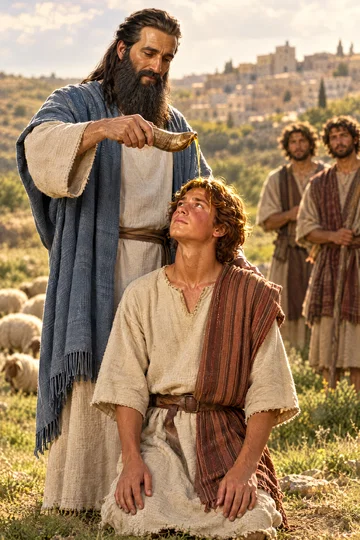
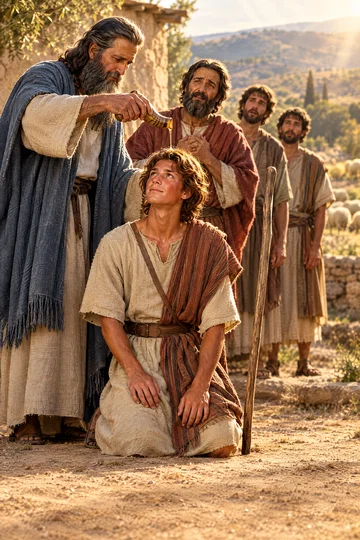
Then Samuel took the horn of oil, and anointed him in the midst of his brethren: and the Spirit of the LORD came upon David from that day forward. So Samuel rose up, and went to Ramah.
Translations
Then Samuel took the horn of oil, and anointed him in the middle of his brothers: and the Spirit of the LORD came on David from that day forward. So Samuel rose up, and went to Ramah.
Then Samuel took the horn of oil, and anointed him in the midst of his brethren: and the Spirit of the LORD came upon David from that day forward. So Samuel rose up, and went to Ramah.
Then Samuel took the horn of oil, and anointed him in the midst of his brethren; and the spirit of the Lord came upon David from that day forward. So Samuel rose up, and went to Ramah.
Then Samuel took the horn of oil, and anointed him in the midst of his brethren: and the Spirit of the LORD came upon David from that day forward. So Samuel arose, and went to Ramah.
Then Samuel took the horn of oil, and anointed him in the midst of his brethren: and the spirit of the LORD came mightily upon David from that day forward. So Samuel rose up, and went to Ramah.
Then Samuel took the horn of oil, and anointed him in the midst of his brethren: and the Spirit of Jehovah came mightily upon David from that day forward. So Samuel rose up, and went to Ramah.
And Samuel taketh the horn of oil, and anointeth him in the midst of his brethren, and prosper over David doth the Spirit of Jehovah from that day and onwards; and Samuel riseth and goeth to Ramath.
And Samuel took the horn of oil, and anointed him in the midst of his brethren. And the Spirit of Jehovah came upon David from that day forward. And Samuel rose up, and went to Ramah.
And Samuel took the horn of oil, and anointed him in the midst of his brethren. And the Spirit of Yahweh came mightily upon David, from that day forward. Then arose Samuel, and went his way unto Ramah.
Berean Standard Bible, Majority Standard Bible
So Samuel took the horn of oil and anointed him in the presence of his brothers, and the Spirit of the LORD rushed upon David from that day forward. Then Samuel set out and went to Ramah.
Then Samuel took the horn of oil and anointed him in the middle of his brothers. Then the LORD’s Spirit came mightily on David from that day forward. So Samuel rose up and went to Ramah.
Then Samuel took the bottle of oil, and put the oil on him there among his brothers: and from that day the spirit of the Lord came on David with power. So Samuel went back to Ramah.
Then Samuel tooke the horne of oyle, and anoynted him in the middes of his brethren. And the Spirit of the Lord came vpon Dauid, from that day forwarde: then Samuel rose vp, and went to Ramah.
Douay-Rheims (Challoner revision)
Then Samuel took the horn of oil, and anointed him in the midst of his brethren: and the spirit of the Lord came upon David from that day forward: and Samuel rose up, and went to Ramatha.
Pictures

Cross-references 20 of 54
- 1 Samuel 16:7
But the LORD said unto Samuel, Look not on his countenance, or on the height of his stature; because I have refused him: for the Lord seeth not as man seeth; for man looketh on the outward appearance, but the LORD looketh on the heart.
God looks at the heart rather than outward appearance when choosing David.
- 1 Samuel 24:6
And he said unto his men, The LORD forbid that I should do this thing unto my master, the LORD’s anointed, to stretch forth mine hand against him, seeing he is the anointed of the LORD.
David refuses to harm Saul, the Lord’s anointed.
- 2 Samuel 7:12-16
And when thy days be fulfilled, and thou shalt sleep with thy fathers, I will set up thy seed after thee, which shall proceed out of thy bowels, and I will establish his kingdom.
God promises David an enduring throne and kingdom through his chosen line.
- 1 Samuel 16:1
And the LORD said unto Samuel, How long wilt thou mourn for Saul, seeing I have rejected him from reigning over Israel? fill thine horn with oil, and go, I will send thee to Jesse the Beth-lehemite: for I have provided me a king among his sons.
God sends Samuel to anoint David as the chosen successor to Saul.
- 1 Samuel 9:15-17
Now the LORD had told Samuel in his ear a day before Saul came, saying,
The Lord identifies Saul for Samuel to anoint, as he later chooses David.
- 2 Samuel 5:3
So all the elders of Israel came to the king to Hebron; and king David made a league with them in Hebron before the LORD: and they anointed David king over Israel.
Samuel's anointing foretold David's anointing as king over all Israel.
- Acts 13:22
And when he had removed him, he raised up unto them David to be their king; to whom also he gave testimony, and said, I have found David the son of Jesse, a man after mine own heart, which shall fulfil all my will.
David is described as a man after God’s own heart.
- 2 Samuel 5:2
Also in time past, when Saul was king over us, thou wast he that leddest out and broughtest in Israel: and the LORD said to thee, Thou shalt feed my people Israel, and thou shalt be a captain over Israel.
Israel recognizes God’s earlier appointment of David as king.
- 1 Samuel 26:9-11
And David said to Abishai, Destroy him not: for who can stretch forth his hand against the LORD’s anointed, and be guiltless?
David refuses to strike Saul, the LORD’s anointed.
- Luke 1:32-33
He shall be great, and shall be called the Son of the Highest: and the Lord God shall give unto him the throne of his father David:
Jesus is promised David’s throne and an everlasting kingdom.
- 2 Samuel 7:8
Now therefore so shalt thou say unto my servant David, Thus saith the LORD of hosts, I took thee from the sheepcote, from following the sheep, to be ruler over my people, over Israel:
God recalls choosing David from tending sheep to rule Israel.
- Revelation 22:16
I Jesus have sent mine angel to testify unto you these things in the churches. I am the root and the offspring of David, and the bright and morning star.
Jesus is identified as David’s offspring.
- 1 Samuel 15:28
And Samuel said unto him, The LORD hath rent the kingdom of Israel from thee this day, and hath given it to a neighbour of thine, that is better than thou.
Samuel declares Saul’s kingdom given to a better neighbor, whom Samuel anoints as king.
- 1 Samuel 13:14
But now thy kingdom shall not continue: the LORD hath sought him a man after his own heart, and the LORD hath commanded him to be captain over his people, because thou hast not kept that which the LORD commanded thee.
Calls David a man after God’s own heart.
- 1 Samuel 18:11
And Saul cast the javelin; for he said, I will smite David even to the wall with it. And David avoided out of his presence twice.
Saul attempts to kill David, whom God had chosen and anointed as king.
- 1 Samuel 19:10
And Saul sought to smite David even to the wall with the javelin; but he slipped away out of Saul’s presence, and he smote the javelin into the wall: and David fled, and escaped that night.
Saul tries to strike David with a spear.
- Psalms 89:19-20
Then thou spakest in vision to thy holy one, and saidst, I have laid help upon one that is mighty; I have exalted one chosen out of the people.
God’s anointing of David points to the Messiah through David.
- 1 Samuel 16:3
And call Jesse to the sacrifice, and I will shew thee what thou shalt do: and thou shalt anoint unto me him whom I name unto thee.
A sacrifice provided cover for David’s anointing.
- 2 Samuel 12:7
And Nathan said to David, Thou art the man. Thus saith the LORD God of Israel, I anointed thee king over Israel, and I delivered thee out of the hand of Saul;
Nathan identifies David as the one God anointed king over Israel.
- Psalms 78:70-72
He chose David also his servant, and took him from the sheepfolds:
David is chosen from the sheepfold to shepherd God’s people.
Commentary
Each commentary is drawn from primary sources: the writings of Ellen G. White and Adventist pioneers and periodicals. Each commentary is separate. Its own words are not a quotation; follow the references to read the source passages.
Ellen G. White
20 sources
Samuel passed by David's seven older brothers because the Lord had chosen none of them, then had David summoned from keeping the sheep and anointed him with the horn of oil in the midst of his brethren before returning to Ramah with his appointed work done.PP 638.2–641.1 The anointing appointed David as God's chosen ruler to succeed Saul and reign over Israel in his place.1SP 367.3–368.1SG4 77.4–78.1PP 698.2–3 The Lord did not judge as man judges by stature and handsome appearance, but refused the noble-appearing elder sons and chose the youngest, a ruddy shepherd youth, because He looks on the heart.1SP 367.3–368.1SG4 77.4–78.1YCDCP 2.1PP 638.2–641.1RH Feb 13, 1913 From that day forward the Spirit of the Lord came upon David and rested on him, giving him a prudent and understanding heart and carrying him forward in wisdom, piety, contemplation and devotion.1SP 367.3–368.1SG4 77.4–78.1PP 642.2 The anointing was kept secret yet gave David intimation of his high destiny, laying on him a sacred trust as king that sustained him to be true to God's purpose amid coming perils, temptations and Saul's pursuit.ST Nov 16, 1888PP 641.2PP 674.2
Anointing Setting and Significance
Samuel anointed David only after his seven older brothers had passed before him for inspection and the Lord had chosen none of them, so the youngest was summoned from keeping the sheep.PP 638.2–641.1 He was ruddy, of beautiful countenance and goodly to look to, a handsome, manly, modest shepherd boy who had proved brave and faithful in the humble office of shepherd and was now chosen to be captain of God's people.PP 638.2–641.1 Samuel took the horn of oil and anointed him in the midst of his brethren, from among them, and the Spirit of the Lord came upon David from that day forward, after which Samuel rose up and returned to Ramah with a relieved heart, having accomplished his appointed work.PP 638.2–641.1
The errand was kept secret even from the family of Jesse, and David was anointed in secret.PP 641.2 The anointing was an intimation to him of the high destiny awaiting him, given so that amid all the varied experiences and perils of his coming years the knowledge would inspire him to be true to the purpose of God to be accomplished by his life.PP 641.2
The anointing made David God's chosen ruler in place of Saul, the youngest son of Jesse called from faithful and courageous service as a shepherd to lead His people, and from that time the Lord gave him a prudent and understanding heart.1SP 367.3–368.1SG4 77.4–78.1 The Lord appointed David the son of Jesse to the throne of Israel to succeed Saul and reign over Israel, and that divine choice made him pre-eminently qualified to bear the responsibilities of the kingdom.PP 698.2–3 Abner, Saul's commander-in-chief, knew of this appointment, yet was unwilling for David to succeed to the kingdom.PP 698.2–3
The anointing marked David as the righteous one whom the Lord had chosen to save Israel and to rule in place of Saul, as God's chosen deliverer.SG4 83.1 God had left Saul to his own guilty course, while Israel's suffering under a ruler who dared to commit murder and slay God's chosen gave living evidence to what extremes of guilt and crime a king who rebels against God and is governed by his own passions will go.SG4 83.1
Samuel's anointing was prophetic of what would take place at David's public inauguration as king.PP 701.1–3 At Hebron the sacred oil put upon David's brow fulfilled that earlier anointing, when by solemn rite he was consecrated to his office as God's vicegerent.PP 701.1–3 There he received the scepter and the diadem, and Israel received a king by divine appointment.PP 701.1–3
God's Choice and Endowment
Samuel was sent to find the Lord's anointed and had to learn not to judge by stature or appearance.1SP 367.3–368.1YCDCP 2.1RH Feb 13, 1913 He looked on the handsome countenance and fine stature of Jesse's eldest son and took them as the mark of God's choice.YCDCP 2.1RH Feb 13, 1913 The Lord refused that son and all the noble-appearing older sons who passed before him, for man looks on the outward appearance but the Lord looks on the heart.1SP 367.3–368.1YCDCP 2.1RH Feb 13, 1913
The Lord chose instead David, the youngest son of Jesse, a mere youth and shepherd of the sheep called from the field and from tending his father's sheep.SG4 77.4–78.1YCDCP 2.1PP 638.2–641.1RH Feb 13, 1913 He was ruddy, of a beautiful countenance and goodly to look to, a handsome, manly, modest shepherd boy.PP 638.2–641.1 His faithful service in that humble place had shown courage and humility.1SP 367.3–368.1SG4 77.4–78.1PP 638.2–641.1
The elder brothers, though impressive in appearance, were set aside for the kingdom because they were proud, self-centered and self-confident and lacked the qualifications seen as essential in a ruler of God's people.ED 266.1–3 David, whom they lightly regarded, had preserved the simplicity and sincerity of his youth.ED 266.1–3 He was little in his own sight, and therefore could be trained by God for the responsibilities of the kingdom.ED 266.1–3
God saw in David one to whom He could impart His Spirit, for David was receptive to the Holy Spirit.Ms 163, 1902, par. 4 His life was rooted in faithful instruction at home in Bethlehem that prepared him in mind and heart.RH Oct 30, 1900 God in providence trained and prepared him for His service and purposes, and Christ shaped his character.Ms 163, 1902, par. 4 His brave and faithful service in the humble office of shepherd showed he was chosen to be captain of God's people.PP 638.2–641.1
David was strict in all the ceremonies of the Jewish religion and distinguished by boldness and unwavering trust in God.SG4 85.2–3 He possessed remarkable fidelity and reverence, firmness, humility, love of justice, and decision of character, with a sincere and fervent religious character.SG4 85.2–3 These traits qualified him to carry out God's high purposes, to instruct Israel in their devotions, and to rule them as a generous and wise monarch.SG4 85.2–3 While he was true to God with these exalted traits God called him a man after His own heart.SG4 85.2–3 Exalted to the throne, his course contrasted with the kings of other nations in abhorring idolatry and zealously keeping Israel from being seduced into it by surrounding nations, so he was greatly beloved and honored by his people.SG4 85.2–3
From that day forward the Lord gave David a prudent and understanding heart, and the Spirit of the Lord rested on him and endowed him.1SP 367.3–368.1SG4 77.4–78.1PP 642.2RH Oct 30, 1900 That Spirit carried him forward from strength to strength and from knowledge to knowledge.PP 642.2 It enriched his opportunities for contemplation and meditation with wisdom and piety that made him beloved of God and angels.PP 642.2 As he contemplated the perfections of his Creator, clearer conceptions of God opened before his soul, obscure themes were illuminated, difficulties were made plain, and perplexities were harmonized.PP 642.2 Each ray of new light called forth fresh bursts of rapture and sweeter anthems of devotion to the glory of God and the Redeemer.PP 642.2 His talents, as precious gifts from God, were employed to extol the glory of the divine Giver.PP 642.2 The love that moved him, the sorrows that beset him, the triumphs that attended him, and his beholding of the love of God in all the providences of his life became themes for active thought that made his heart throb with more fervent adoration and gratitude and his voice and harp ring out with richer melody and more exultant joy, preparing him in the beauty and vigor of young manhood to take a high position with the noblest of the earth.PP 642.2
Promise Sustaining Life and Service
The verse shows a shepherd lad holding God's promise of the throne while standing before Saul, the established monarch determined to keep his power.RH Nov 11, 1915ED 254.2–3RH Dec 24, 1908 His trust in God's word while powerless against worldly authority shows faith standing against human power and policy.RH Nov 11, 1915RH Dec 24, 1908 The anointing laid on him a sacred trust as king of Israel.ST Nov 16, 1888PP 674.2 Remembering that calling, that Samuel had anointed him, and God's past victories and protection held him to that trust even when his faith in God's promises staggered and Saul sought his life.ST Nov 16, 1888PP 674.2
That remembrance strengthened him to refuse to join the Philistines and the enemies of his people against Saul and Israel, for he would not betray his sacred trust or endanger his salvation.ST Nov 16, 1888PP 674.2 After the anointing he grew in favor with God and man and set his heart more fully than ever to do God's will, with new themes for thought.PP 643.3 His time in the king's court showed him the responsibilities of royalty, the temptations besetting Saul's soul, and the character and dealings of Israel's first king.PP 643.3
Seeing the glory of royalty shadowed with sorrow and knowing Saul's household was far from happy in private life brought troubled, anxious thoughts about the future to the one anointed to be king.PP 643.3 While absorbed in deep meditation and harassed by anxiety, he turned to his harp and called forth strains that elevated his mind to God as the Author of every good, and the dark clouds that seemed to shadow the horizon of his future were dispelled.PP 643.3 The verse also means human judgment cannot tell by outward appearance which one of a family or which youth will prove most promising and render the best service to God.YCDCP 2.1ED 266.1–3RH Feb 13, 1913
God sees in many a child whom parents would pass by capabilities far above those revealed by others thought to possess great promise, and no one can decide what is great and what is small among life's possibilities.ED 266.1–3RH Feb 13, 1913 Therefore selecting only a few for special discipline is not enough.YCDCP 2.1ED 266.1–3RH Feb 13, 1913 The whole mass of youth and every child needs thorough general education and training for usefulness, places of responsibility, and the highest service as laborers together with God.YCDCP 2.1ED 266.1–3RH Feb 13, 1913
Sources
Pioneers and periodicals
75 sources
Samuel came to Bethlehem to sacrifice and under cover of that work anointed Jesse's youngest son David, a ruddy shepherd youth, with a horn of oil in the midst of his brethren, then rose up and went to Ramah.ST Nov 14, 1895ST Jul 10, 1901ST Apr 22, 1903ST Aug 19, 1889ST Mar 1, 1910 The act was kept secret for fear of Saul so as not to stir rebellion, for David was anointed but not yet crowned while Saul still held the throne.ST Nov 14, 1895ST Jul 10, 1901ST Aug 19, 1889 God himself chose David out of his father's house and tribe of Judah to be king in Saul's place, refusing the elder handsome sons men would have chosen, for man looks on outward appearance but the Lord looks on the heart.ST Jul 2, 1885ST Jun 19, 1884ST Aug 10, 1904RH May 9, 1907 From that day forward the Spirit of the Lord came upon David with power to guide, empower and qualify him for his calling, marking his appointment to kingship and his rise as prophet-king.ST Nov 14, 1895ST Dec 22, 1914ST Apr 22, 1903RH Jun 8, 1911RH May 5, 1859 Anointed king before he took the throne, David is a type of Christ the Anointed who was appointed to David's throne while earthly rulers still continue, with the promise pointing forward to Messiah the son of David according to the flesh.ST Apr 11, 1911RH Jul 5, 1915ST Dec 1, 1887ST Dec 1, 1887RH May 5, 1859
Place Time and Ceremony
The anointing took place at Bethlehem, David's birthplace and home, afterward called the city of David.ST Jul 10, 1901ST Feb 17, 1904RH Jul 20, 1905ST Mar 1, 1910 That Bethlehem connection explains why one of David's house later went there to be registered, since Joseph being of the house and family of David belonged to Bethlehem and went there with Mary.ST Dec 15, 1898 Samuel came to Bethlehem to sacrifice, the elders of the town trembled at his coming, and he sanctified Jesse and his sons and called them to the sacrifice.ST Jul 10, 1901 Under cover of that ordinary sacrificial work he anointed the one God named, God sending him to Bethlehem under cover of his ordinary work of offering sacrifice.ST Aug 19, 1889
Samuel anointed David with a horn of oil in the midst of his brethren, pouring holy oil on his youthful head and setting him above his envious brothers.ST Apr 22, 1903ST Aug 17, 1904ST Mar 1, 1910 Then he rose up and went to Ramah.ST Apr 22, 1903 The act was kept quiet and secret for fear of Saul, instead of being made public, so it would not cause open confusion or stir up national rebellion.ST Nov 14, 1895ST Aug 19, 1889 It was not God's purpose to bring David to the kingdom prematurely, and to the brothers present it seemed only an incidental feature of the feast and none understood its meaning.ST Nov 14, 1895ST Aug 19, 1889
Jesse had eight sons, seven of whom were first presented to Samuel, after which David the youngest and eighth was brought in from keeping the sheep and anointed alone among his brothers.RH Feb 18, 1873RH Nov 18, 1862RH Sep 3, 1901 This does not mean Jesse had only seven sons, for 1 Samuel 17:12 explicitly says he had eight.RH Feb 18, 1873 He was slighted and overlooked by his father and brothers from his earliest youth, chosen despite being overlooked and taken from the sheepfold to become king.RH Jul 1, 1862ST Jul 21, 1909 David was a youth at the time, probably not twenty years old and elsewhere described as fifteen, a ruddy shepherd lad keeping his father's sheep on the hills around Bethlehem.ST Nov 14, 1895ST Apr 22, 1903RH Dec 24, 1867
The anointing came not long after the Lord rejected Saul and his family as the royal line from whom should come the kings of Israel and finally the Messiah.ST Nov 14, 1895ST Jul 10, 1901ST Mar 31, 1909 Saul had added stubbornness to rebellion by failing to utterly destroy the Amalekites and pertinaciously following his own way, crowning a long course of obstinacy and self-will in a test deciding his destiny on which hung his throne and kingdom as far as he and his family were concerned.RH Jul 24, 1860 Saul still held the throne, so David was anointed but not yet crowned, anointed and Spirit-guided but not crowned.ST Apr 22, 1903ST Feb 17, 1904 Conflict with the Philistines followed probably within a few months.ST Nov 14, 1895 God directed Samuel to Bethlehem to do this purposeful work while Samuel was grieving over Saul, as a mercy to turn him from personal sorrow to God's plans.ST Aug 19, 1889
God's Choice of David
The anointing shows God exercising his reserved right to choose Israel's king, first choosing Saul and then providing himself a king in David after Saul and before Christ.ST Sep 20, 1883ST Jun 19, 1884RH Aug 14, 1856 The kingdom was first God's own, with God himself as ruler, and it became David's only secondarily by gift, for God said he had provided himself a king, and David had no first right to it in himself.RH Aug 14, 1856 That choice was connected with God's announcement that he would give the kingdom to another, and Saul and Jonathan recognized David as the one called to the throne.ST Sep 20, 1883
God chose David, Jesse's youngest son, out of all his father's house and out of the tribe of Judah to be Israel's second king in Saul's place, rather than the people's choice.ST Jul 2, 1885ST Jul 16, 1885ST Nov 18, 1903 He was chosen while keeping sheep and directed to be anointed as king among his brothers, and from that day forward the Spirit of the Lord came upon him.ST Jul 2, 1885 He was the great-grandson of Ruth the believing Moabite, anointed at Bethlehem to be king in place of Saul.RH Dec 18, 1913 God had chosen him long before Saul's death, and the tribes later acknowledged his kingship when they remembered this long-standing choice.ST Jun 19, 1884
Outward appearance did not determine David's fitness or commend him as king; though poor in appearance and a mere shepherd youth, his courage and character did.ST Dec 12, 1895 The Lord saw his heart and delighted to dwell with him, seeing in the ruddy youth a man after his own heart.ST Dec 12, 1895RH Dec 24, 1867 Human judgment would have chosen otherwise, for Samuel's judgment was deceived by appearance when he thought Jesse's eldest son Eliab was the Lord's chosen.ST Aug 10, 1904 The handsome countenance and fine stature of the eldest made him appear to be the anointed, but the Lord refused him and all the noble-looking sons, for man looks on outward appearance but the Lord looks on the heart.RH Feb 13, 1913RH May 9, 1907 David's selection therefore teaches that a young person's appearance does not reveal the possibilities or usefulness God sees.RH May 9, 1907
A prophet's reliability rests on divine inspiration, not on his own judgment, for without the Holy Spirit's direct guidance even an experienced, devoted prophet can decide wrongly.ST Aug 10, 1904 Choosing the king was a grave responsibility in which Samuel needed further divine direction when each presented son was rejected.ST Dec 22, 1914ST Dec 22, 1914 No audible voice is recorded in how God made his will known so quickly and accurately, but a silent communication of the divine will, the mystery of God's voice, made the choice known to Samuel.ST Dec 22, 1914ST Dec 22, 1914 God's choosing of David to do a special temporal work was God's act alone; it was temporal and special, and it did not insure David's eternal salvation nor consign the brothers who were passed by to destruction.ST Apr 10, 1907
The anointing illustrates that God chooses humble, unlikely people whom people would not select, as when a shepherd boy from Bethlehem was chosen to be king over Israel rather than someone favored for learning or status.RH Aug 18, 1910RH Apr 11, 1854ST Mar 17, 1887RH Dec 18, 1913 God called David from the sheepfold and placed him on Israel's throne and could make such an unlikely choice a leader in his work.RH Aug 18, 1910ST Mar 17, 1887 The power to accomplish the work comes from God, not from the person or the means he uses.ST Mar 17, 1887
Anointing and Spirit Given
Samuel's anointing transferred the crown from Saul to David, marking David's appointment to kingship and his rise as prophet-king during Samuel's prophetic administration.RH Jun 8, 1911 The anointing was done by God's direction to be king, following the pattern by which all the kings of Israel were anointed to that office, with Samuel as the one God chose to speak and act for Him in giving David his appointed work among his brethren.RH May 5, 1859RH Jan 28, 1902 The English word anointed in the verse is the word rendered Christ in the Greek Septuagint.ST Jul 20, 1904 The anointing means appointment to kingship on David's earthly throne.RH May 5, 1859
From that day forward the Spirit of the Lord came upon David with power and rested on him and guided him, marking his appointment and empowering him for his calling and mission.ST Nov 14, 1895ST Dec 22, 1914ST Apr 22, 1903 The Spirit gave him an understanding and prudent heart and qualified him for the work ahead, illustrating that God equips those He calls for their assigned work.ST Aug 19, 1889 Thereafter he grew great with the Lord God of hosts with him.RH Mar 25, 1909 David's receiving the Spirit was his receiving the gift and baptism of the Holy Spirit.ST Oct 10, 1900
That baptism is not a remarkable outward demonstration to be waited for at some indefinite future time.ST Oct 10, 1900 The Spirit's coming did not exempt David from temptation, trial, and tribulation.ST Oct 10, 1900 About three years later he was still deprived of his just rights, hiding in a dark cave in the wilderness as captain over distressed, indebted, and discontented men, with daily trial and tribulation in maintaining peace and harmony among them.ST Oct 10, 1900 Just so, Christ's fiercest temptations came immediately after He had been anointed by the Spirit of God.ST Oct 10, 1900
At Saul's rejection the good angels attending him were bidden to depart from him and attend upon David instead.RH Jul 24, 1860 From the anointing David's career is contrasted with Saul's downward course as an ever-rising one, amid the events through which God's providence shaped the nation and preserved the promise of the Seed.ST Apr 11, 1911
Training Waiting and Trial
David had been trained not in war but as a humble, true and brave shepherd, caring for the tender ones of the flock, contemplating God's works and singing praises with his harp while engaged in faithful, uncomplaining, active and useful everyday labor.ST Nov 14, 1895ST Apr 29, 1908RH Sep 3, 1914ST Oct 18, 1877ST Mar 15, 1910 That willingness to serve and faithfulness in ordinary work preceded his greater honor, fitted him for a leading position in the nation and prepared him in mind and heart for the serious responsibilities of ruling Israel.ST Nov 14, 1895ST Apr 29, 1908RH Jul 14, 1910ST Oct 18, 1877 He was called from tending his father's sheep and anointed king because Israel needed a ruler, illustrating that he was called to his future work while engaged in ordinary labor.RH Jul 14, 1910RH Sep 3, 1914ST Oct 18, 1877
God works by means with deep and wisely laid plans that train a man long before his work, and God tests those he intends for prominent work.RH Aug 22, 1865 David was anointed but did not at once wear the crown, for he must first tend the flock and then suffer as the victim of hatred and envy before he could reign.RH Aug 22, 1865 The anointing therefore began a long period of trial years before he took the throne, during which he lived as a fugitive for his life.RH Dec 24, 1867ST Aug 8, 1906 After entering Saul's royal household he faced danger and had to flee Saul's attempts to kill him into a strange land, serving Saul, enduring without complaint and remaining tender toward his enemy.RH Dec 24, 1867
David trusted that God would bring the prophecy of the throne to fulfillment in his own time and way, so though anointed king and knowing the kingdom was his he did not seize it by removing Saul.ST Jan 17, 1906RH Nov 30, 1916RH Jul 15, 1875 He refused to take Saul's life even when he had opportunity and was urged to do so, endured persecution without retaliation, and still respected Saul as placed in position by God.ST Jan 17, 1906RH Jul 15, 1875RH Nov 18, 1873 That restraint teaches respect for God's appointments even when the officeholder is wicked and determined to keep power.RH Nov 18, 1873
Remembering the anointing, God's past victories and protection, and Samuel's prophetic assurance sustained David when his future was still largely unknown.ST Nov 16, 1888ST Aug 24, 1888ST Dec 30, 1913 It strengthened him to refuse to join the Philistines against Saul and betray his sacred trust, to seek divine instruction while fleeing, and to stand powerless against worldly authority in faith in God's word against human power and policy.ST Nov 16, 1888RH Nov 11, 1915RH Dec 24, 1908ST Aug 24, 1888 The same awareness of divine help through the Spirit of the Lord upon the shepherd youth drove away his fear when he faced Goliath.ST Nov 21, 1895 His anointing as future king and great prophet through whom blessed promises and wisdom would come made him a target, for Satan knew it and worked through Saul's seemingly erratic course, satanic spirit and persistent attempts to take his life to forestall that work.ST Mar 30, 1904RH Nov 28, 1912 Yet God delivered him from Saul's repeated treachery when he nearly fell into his hands, and his survival preserved his future prophetic writings of promise and encouragement and his son's wonderful teachings of wisdom.ST Mar 30, 1904RH Nov 28, 1912ST Jul 31, 1893
Eliab had hoped to be chosen, but Samuel passed him over and anointed David with oil after calling him from tending the sheep, and the choice stirred Eliab's envy.RH Sep 3, 1901ST Aug 17, 1904 From that anointing Eliab cherished bitter hatred and jealousy toward his youngest brother and treated him with habitual discourtesy at home, which later appeared in contemptuous words to David.RH Sep 3, 1901ST Aug 17, 1904 That jealousy broke out without restraint or decency when the boy defeated the giant of Gath, when Eliab forgot his company manners and made a spectacle of himself before thousands of Israel's chosen men and the Philistines.ST Aug 17, 1904 His failure to govern himself showed his utter unfitness to rule over any people, though he was a proud, handsome man of splendid proportions who had fondly hoped to reign as king and who could be polite and courteous on occasions.ST Aug 17, 1904
Messianic Line and Prophecy
The anointing in the midst of his brethren marked David alone, and none of his seven elder brothers, as the one through whom Messiah would derive his origin, for Jesse had eight sons with David the youngest and Jesus Christ fulfills this as the son of David.RH Nov 18, 1862ST Oct 15, 1896 That choosing continued the family line through which the promised Seed would come, running from Abraham to Isaac rather than Ishmael, to Jacob rather than Esau, to Judah among the twelve sons, to Jesse among the families of Judah, to David among the sons of Jesse, and then to Solomon among the sons of David.ST Oct 15, 1896 Being so chosen as earthly progenitors of the Messiah did not shut the others out of salvation, nor did it assure the salvation of those chosen.ST Oct 15, 1896
David is the one through whom the promised Seed, Jesus Christ, comes according to the flesh.ST Apr 11, 1911RH Jul 5, 1915 His career from the choosing, when Samuel anointed him and the Spirit of the Lord came upon him from that day, is contrasted with Saul's downward course as an ever-rising one, amid the events through which God's providence shaped the nation and preserved the promise of the Seed.ST Apr 11, 1911RH Jul 5, 1915
Samuel's anointing of David at Bethlehem came after the Lord rejected Saul and his family as the royal line from whom should come the kings of Israel and finally the Messiah.ST Oct 19, 1888ST Jul 10, 1901 Samuel came to sacrifice, the elders of the town trembled at his coming, he sanctified Jesse and his sons and called them to the sacrifice, and there he anointed David, a shepherd's son from Bethlehem, as Israel's future king, and the Spirit of the Lord came upon David from that day forward.ST Oct 19, 1888ST Jul 10, 1901 His reign was expected to bring renewed life to Israel, and the promise of an enduring throne pointed forward to the Messiah who would come from David's line.ST Oct 19, 1888ST Jul 10, 1901
The Spirit that came upon him from his anointing forward gave light to his inner vision with prophetic sight of the coming Redeemer in His earth-hood and divinity combined.ST Feb 17, 1904RH Dec 15, 1859 Through him, the great-grandson of Ruth the believing Moabite maiden born in Bethlehem, God gave to Israel in unapproachable poetry messages of mercy, songs of praise, and prophecies of great things yet to be.ST Feb 17, 1904RH Dec 15, 1859 As a boy shepherd keeping flocks that seldom strayed on the dewy hills girding Bethlehem, playing his harp amid the sheep-folds there as a shepherd bard pouring out deep and strong inspired song, he beheld the same Orb of Prophecy afterward bursting in visible light upon the shepherds at Bethlehem at Christ's birth.ST Feb 17, 1904RH Dec 15, 1859 At that anointing he was anointed but not yet crowned, and he afterward fled to Bethlehem to escape the wrath of Saul, who had turned from God's leading to take counsel of his own will.ST Feb 17, 1904
Type of Christ's Kingship
David was anointed king before he took the throne, making him a type of Christ, who was born to be king but had not yet literally begun to exercise the kingly office.ST Dec 1, 1887 He was king in reality from the moment of anointing even though he did not take the throne until later, paralleling Christ who was Prophet, Priest, and King from the time the Holy Spirit descended on Him at the Jordan when God acknowledged Him as Son and appointed Him ruler.ST Sep 20, 1910 If the Jews had accepted the Messiah they would have had these three offices in Him, as Christians do.ST Sep 20, 1910 His anointing while Saul still held the throne pictures Christ appointed as king while earthly governments continue to rule and before He has taken up His kingly office.ST Dec 1, 1887
The anointing was appointment to kingship on David's earthly throne after the pattern by which Israel's kings were appointed, and that throne is Messiah's own proper throne.RH May 5, 1859 It points to Jesus as Christ, meaning Anointed, the anointed king for David's throne, whose future reign there is made certain by His present exaltation as Lord at God's right hand with power and authority to make His enemies His footstool.RH May 5, 1859
Guidance for Believers Today
After the anointing David went back obediently to the same shepherd work, and that obedience and humility in the fear of the Lord was true greatness.ST Nov 14, 1895 He had been trained not in war but as a humble shepherd, caring for the tender ones of the flock, contemplating the works of God, and singing praises with his harp, lessons that fitted him for a leading position in the nation.ST Nov 14, 1895 He was a youth probably not twenty years old, anointed at Bethlehem in the midst of his brethren not long after the rejection of Saul, but the act was kept secret for fear of Saul so that to those present it seemed only an incidental feature of the sacrifice feast and none understood its meaning, while to David it meant much, for the Spirit of the Lord came upon him with power from that day forward.ST Nov 14, 1895 The contrast is solemn: after Saul disobeyed God and lost the kingdom, David was anointed among his brothers and the Spirit came upon him, showing the consequences of disobedience and the importance of obeying God's commands.RH Oct 18, 1853 God kept the anointing quiet instead of public so it would not cause open confusion or stir up national rebellion, because it was not His purpose to bring David to the kingdom prematurely, but sent Samuel to Bethlehem under cover of his ordinary work of offering sacrifice to anoint the one God would name.ST Aug 19, 1889 Samuel's willing obedience in that present duty while grieving over Saul shows that those who walk willingly and obediently in present duty can rest secure that God will light up the future with His counsel when it comes.ST Aug 19, 1889
God was searching for a boy who would make a good king when he became a man, passing by all the tall, noble-looking boys and picking David.RH Nov 18, 1909 David was picked because he loved to work, sang while he worked, obeyed father and mother, loved God, and took good care of his father's sheep, which fitted him to slay Goliath.RH Nov 18, 1909 God is still looking for boys and girls now to do His work, and children get ready to help Him by doing their work well at home as David did.RH Nov 18, 1909 Human judgment would have chosen otherwise, for when Jesse's noble sons passed by, the handsome countenance and fine stature of the eldest made him appear to be the anointed, but the Lord refused him and all the noble-looking sons, for man looks on the outward appearance but the Lord looks on the heart, and chose David, the youngest son, a mere youth called from the field.RH Feb 13, 1913 No one can tell by outward appearance which one of a family or which youth will prove most promising and render best service to God, so selection of a few for thorough training is not enough.RH Feb 13, 1913RH Dec 18, 1913 Since no one knows which child the Lord will choose, for the Lord chooses for a place in His work one whom people would not select, parents should plan even at sacrifice to continue the education of all children and youth in general education and higher schooling after church-school work at home is finished, and not of only one child, to fit them for usefulness and places of responsibility as laborers together with God.RH Feb 13, 1913RH Dec 18, 1913
Though anointed to be king, David still respected Saul, whom God had placed in his position, and would not harm him, which teaches respect for God's appointments even when the officeholder is wicked and determined to keep power.RH Nov 18, 1873 As a shepherd lad trusting God's promise of the throne while facing Saul the established king determined to keep his power, his example shows that trust in God's word can sustain a person who is powerless against worldly authority.RH Nov 11, 1915 Anointed for a heaven-appointed future, David as a wise shepherd kept that destiny hidden and endured a tyrant's hatred while waiting for his time to prevail.RH Mar 4, 1873 That waiting shows faith in God's word standing against human power and policy.RH Dec 24, 1908RH Mar 4, 1873
Sources