1 Samuel 24:3
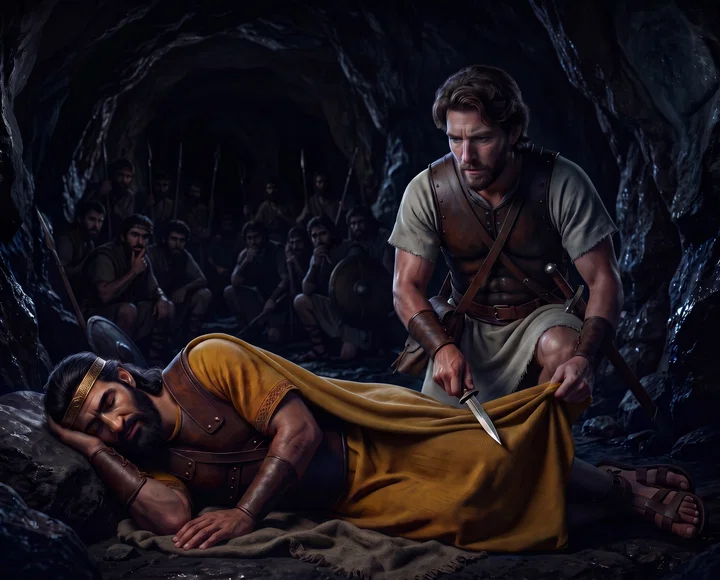
And he came to the sheepcotes by the way, where was a cave; and Saul went in to cover his feet: and David and his men remained in the sides of the cave.
Translations
American King James Version, King James Version, KJV Cambridge Paragraph Bible
And he came to the sheepcotes by the way, where was a cave; and Saul went in to cover his feet: and David and his men remained in the sides of the cave.
And he came to the sheep-cotes by the way, where was a cave; and Saul went in to cover his feet: and David and his men remained in the sides of the cave.
Revised Version, American Standard Version
And he came to the sheepcotes by the way, where was a cave; and Saul went in to cover his feet. Now David and his men were abiding in the innermost parts of the cave.
and he cometh in unto folds of the flock, on the way, and there [is] a cave, and Saul goeth in to cover his feet; and David and his men in the sides of the cave are abiding.
And he came to the sheepfolds by the way, where was a cave; and Saul went in to cover his feet; and David and his men were abiding in the recesses of the cave.
And he came into the sheep-folds by the way, there, being a cave, which Saul entered, to cover his feet,—David and his men, in the hinder part of the cave, having taken up their abode.
Berean Standard Bible, Majority Standard Bible
Soon Saul came to the sheepfolds along the road, where there was a cave, and he went in to relieve himself. And David and his men were hiding in the recesses of the cave.
He came to the sheep pens by the way, where there was a cave; and Saul went in to relieve himself. Now David and his men were staying in the innermost parts of the cave.
And on the way he came to a place where sheep were kept, where there was a hollow in the rock; and Saul went in for a private purpose. Now David and his men were in the deepest part of the hollow.
Then Saul tooke three thousande chosen men out of all Israel, and went to seeke Dauid and his men vpon the rocks among the wilde goates.
Douay-Rheims (Challoner revision)
And he came to the sheepcotes, which were in his way. And there was a cave, into which Saul went, to ease nature: now David and his men lay hid in the inner part of the cave.
Pictures
Cross-references
- 1 Samuel 24:10-12
Behold, this day thine eyes have seen how that the LORD had delivered thee to day into mine hand in the cave: and some bade me kill thee: but mine eye spared thee; and I said, I will not put forth mine hand against my lord; for he is the LORD’s anointed.
David explains that he spared Saul and shows the cut robe as proof of innocence.
- 1 Samuel 26:7-11
So David and Abishai came to the people by night: and, behold, Saul lay sleeping within the trench, and his spear stuck in the ground at his bolster: but Abner and the people lay round about him.
David again refuses to harm Saul when he has the opportunity.
- 1 Samuel 24:16-17
And it came to pass, when David had made an end of speaking these words unto Saul, that Saul said, Is this thy voice, my son David? And Saul lifted up his voice, and wept.
Saul weeps and acknowledges David’s greater righteousness.
- 1 Samuel 26:21
Then said Saul, I have sinned: return, my son David: for I will no more do thee harm, because my soul was precious in thine eyes this day: behold, I have played the fool, and have erred exceedingly.
Saul admits his sin after David spared him.
Commentary
Each commentary is drawn from primary sources: the writings of Ellen G. White and Adventist pioneers and periodicals. Each commentary is separate. Its own words are not a quotation; follow the references to read the source passages.
Ellen G. White
2 sources
David and his men were concealed in the sides of the cave when Saul entered it alone, with no awareness that they were there.PP 661.2–3 His sudden and solitary appearance put the king entirely within their reach and handed them an opening to kill him.PP 661.2–3 The scene sets David, a young shepherd to whom God had promised the throne, over against Saul, the reigning king bent on holding onto his power.ED 254.2–3 Saul's exposed entry by himself therefore became a test of whether David would treat his enemy's vulnerability as permission to take his life.PP 661.2–3 David refused to lift his hand against Saul because Saul was the Lord's anointed, rejecting the killing that his men urged upon him.PP 661.2–3 The account thus shows trust in God's word standing firm when confronted by opposing human power.ED 254.2–3
Sources
Pioneers and periodicals
16 sources
Saul was hunting David to take his life with three thousand chosen men, pursuing him relentlessly like a wild beast, when he came alone to the sheepcotes among the rocks of the wild goats at En-gedi and went into a limestone cave to cover his feet and rest, while David and his men lay concealed in the sides of the same cave so that his persecutor was completely in his power.ST Apr 7, 1909RH Jun 25, 1901ST Sep 9, 1889ST Jun 15, 1904 Overruling providence brought Saul there, and it looked as if God had delivered him into David's hand to do with as seemed good, making it a test of whether David would spare the Lord's anointed.RH Jun 25, 1901ST Sep 9, 1889ST Jul 24, 1884 Though urged to slay the king, David would not lay hands on him but only crept up and cut off the skirt of his coat, and even for that his tender conscience smote him.ST Jul 24, 1884ST Jun 15, 1904 By holding up the cut-off skirt David proved there was no evil in his hand and returned good for evil, with power to move even Saul to confess that David was more righteous than he and had rewarded him good for evil.RH Sep 26, 1871ST Jul 24, 1884ST Jun 15, 1904 The account teaches patient endurance under persecution, that it is safe to commit one's cause to God rather than take vengeance, and that a soft answer still turns away wrath.ST Apr 9, 1912ST Apr 7, 1909ST Jul 24, 1884
Setting in Saul's Pursuit
Saul was hunting David to take his life with three thousand chosen men, pursuing him in relentless jealous wrath from valley to valley and from mountain to mountain, year after year, far and near.RH Jun 25, 1901ST Sep 9, 1889ST Jul 24, 1884ST Apr 22, 1903 He drove David out destitute and forsaken into the fastnesses of the mountains, hunting him like a flea or a partridge and like a wild beast.ST Jun 15, 1904RH Dec 6, 1906ST Apr 22, 1903 The pursuit was blind and cruel, for Saul as an apostate king still holding the throne had determined to prevent David of another family and tribe from succeeding him.ST Sep 9, 1889ST Jul 24, 1884ST Apr 22, 1903
The meeting came at the sheepcotes by the way among the rocks of the wild goats at En-gedi, in the limestone caves of that region in the wilderness of Judah.RH Jun 25, 1901ST Sep 9, 1889ST Jun 15, 1904ST Dec 30, 1913 There David and his companions and attendants lay concealed in the sides of the same cave.ST Apr 7, 1909RH Jun 25, 1901ST Sep 9, 1889ST Jul 24, 1884RH Dec 6, 1906 Saul came in alone to cover his feet, resting perhaps in the mouth of the cavern in the heat of the day and then retiring farther inside where, being weary, he fell asleep.RH Jun 25, 1901ST Sep 9, 1889ST Jul 24, 1884ST Jun 15, 1904 In that position his cruel enemy was completely within David's power, with David and his men remaining hidden in the sides of the cave.RH Jun 25, 1901ST Jul 24, 1884ST Jun 15, 1904RH Dec 6, 1906
Only the overruling providence of God kept the search from succeeding and brought Saul into that place where he could see the wickedness of his conduct as compared with David whom he was trying to slay.RH Jun 25, 1901ST Sep 9, 1889 From a human standpoint it looked as if God had delivered David's personal enemy into his hand, as God had promised that David might do to him as seemed good to him.RH Jun 25, 1901ST Sep 9, 1889ST Jul 24, 1884 It was a test of what was in David's heart, whether he would display Christlike character by sparing the Lord's anointed who had thrown a javelin at him and was hunting his life.RH Jun 25, 1901ST Sep 9, 1889ST Jul 24, 1884 The verse stands in 1 Samuel 23 to 25 as teaching returning good for evil, and belongs to the long history of Saul's wicked career recorded in 1 Samuel 14 to 31, including the account of Saul's final reign, showing how one once humble before God became eminent in wickedness.RH Mar 23, 1916ST Sep 20, 1883ST Apr 9, 1912 The same cave in which David once hid from Saul in the wilderness of Judah later sheltered David again during his flight from Absalom.ST Dec 30, 1913
Returning Good for Evil
The cave encounter is the first of two times David saved the life of Saul when his bitterest enemy and persecutor was fully in his power, showing mercy and magnanimity instead of harm.RH Sep 26, 1871ST Apr 11, 1911ST Feb 17, 1904 Though driven out destitute and forsaken and hunted year after year, David remained loyal and refused to retaliate against a personal enemy or take vengeance into his own hands.ST Feb 17, 1904ST Apr 7, 1909ST Apr 22, 1903 His refusal to strike when he had power and opportunity revealed a noble character that would not harm the Lord's anointed.ST Feb 17, 1904ST Apr 22, 1903
Though his men urged him to slay the king while the opportunity lay before him, David would not lay hands on the Lord's anointed even though the anointing oil was upon his own head also.ST Jul 24, 1884ST Jun 15, 1904 He only crept up with sword in hand and cut off the skirt of Saul's coat, a single fold of his mantle, instead of taking vengeance.ST Jul 24, 1884ST Jun 15, 1904 Even for that small act his tender conscience smote him.ST Jul 24, 1884
By afterward holding up the cut-off skirt to prove there was neither evil nor transgression in his hand and that he had not sinned against Saul, David proved he bore Saul no malice and returned good for evil.ST Jul 24, 1884ST Jun 15, 1904 The influence of that humble consistent conduct was so strong that it moved even Saul's heart.RH Sep 26, 1871ST Jul 24, 1884ST Jun 15, 1904 Saul confessed David was more righteous than he, lifted up his voice and wept, and declared David had rewarded him good whereas he had rewarded David evil.ST Jul 24, 1884ST Jun 15, 1904
The account is a striking example of patient endurance under persecution, teaching that it is safe to commit one's cause to God rather than take vengeance.ST Apr 9, 1912ST Apr 7, 1909ST Jul 24, 1884 It shows love for an enemy in a soft answer that turns away wrath, and that pacific argument still produces such grand results today.ST Jul 24, 1884ST Jun 15, 1904 That melting of the king by proof of no malice holds as a lesson for the present.ST Jul 24, 1884ST Jun 15, 1904
The deed proves David's disposition was not cruel but Christian, noble, brave, determined, cool, yet tender and kind.RH Sep 26, 1871RH Dec 6, 1906ST Apr 22, 1903 He was one who could form a worthy purpose and hold steadily to it through disheartening experiences, waiting for the right cause and moment to act instead of moving rashly.RH Dec 6, 1906RH Dec 4, 1913 Those sterling qualities stood him in good stead during forty long years as king in bringing a strong united kingdom from a disorganized confederation of tribes.RH Dec 6, 1906 His wisdom in opposing Saul stands with Noah at the Flood, Abraham in Canaan, Moses in Egypt, John the Baptist at the annunciation, Paul before the Roman tribunal, and Elijah in opposing Jezebel's scheme, showing that being possessed body, mind, and soul by a purpose is the chief qualification of a true missionary.RH Dec 6, 1906RH Dec 4, 1913
By contrast the same record shows noble traits still remained in Saul though his character was stained with envy, jealousy, crime, and cruelty.ST Feb 19, 1885 He might have won the favor of God and man if he had cultivated the noble traits and eradicated the evil, put God and his people first, kept self-love out of his heart, set a watch over his passions, refused place to envy, jealousy, and cruelty, and sought God continually for grace and wisdom in government.ST Feb 19, 1885 Instead he persisted in self-will until ruin overtook him, showing lack of faith, forgetting God, neglecting the welfare of his people, and seeking only to sustain his own kingly dignity and gratify his personal vanity.ST Feb 19, 1885
Sources