1 Samuel 24:4
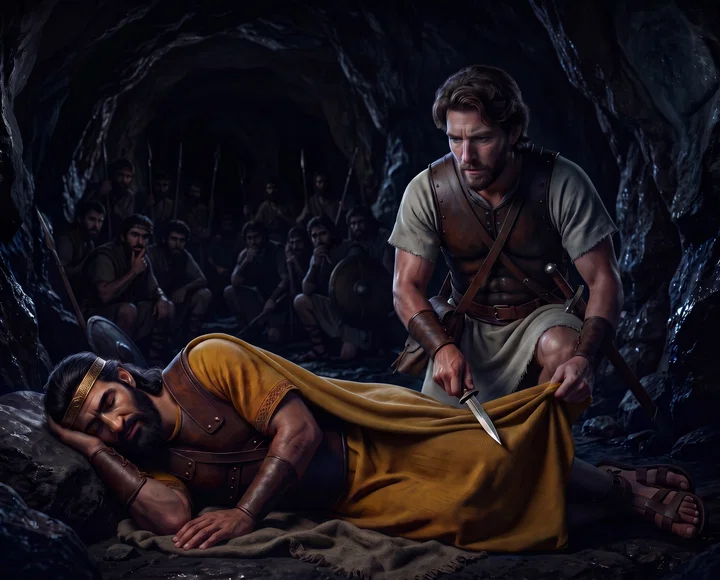
And the men of David said unto him, Behold the day of which the LORD said unto thee, Behold, I will deliver thine enemy into thine hand, that thou mayest do to him as it shall seem good unto thee. Then David arose, and cut off the skirt of Saul’s robe privily.
Translations
And the men of David said to him, Behold the day of which the LORD said to you, Behold, I will deliver your enemy into your hand, that you may do to him as it shall seem good to you. Then David arose, and cut off the skirt of Saul’s robe privately.
And the men of David said unto him, Behold the day of which the LORD said unto thee, Behold, I will deliver thine enemy into thine hand, that thou mayest do to him as it shall seem good unto thee. Then David arose, and cut off the skirt of Saul’s robe privily.
And the men of David said unto him, Behold the day of which the Lord said unto thee, Behold, I will deliver thine enemy into thine hand, that thou mayest do to him as it shall seem good unto thee. Then David arose, and cut off the skirt of Saul’s robe privily.
And the men of David said to him, Behold the day of which the LORD said to thee, Behold, I will deliver thy enemy into thy hand, that thou mayest do to him as it shall seem good to thee. Then David arose, and privately cut off the skirt of Saul's robe.
And the men of David said unto him, Behold, the day of which the LORD said unto thee, Behold, I will deliver thine enemy into thine hand, and thou shalt do to him as it shall seem good unto thee. Then David arose, and cut off the skirt of Saul’s robe privily.
And the men of David said unto him, Behold, the day of which Jehovah said unto thee, Behold, I will deliver thine enemy into thy hand, and thou shalt do to him as it shall seem good unto thee. Then David arose, and cut off the skirt of Saul’s robe privily.
And the men of David say unto him, 'Lo, the day of which Jehovah said unto thee, Lo, I am giving thine enemy into thy hand, and thou hast done to him as it is good in thine eyes;' and David riseth and cutteth off the skirt of the upper robe which [is] on Saul — gently.
And David's men said to him, Behold the day of which Jehovah said to thee, Behold, I will give thine enemy into thy hand, that thou mayest do to him as it shall seem good to thee. And David arose, and cut off the skirt of Saul's robe secretly.
So David’s men said unto him—Lo! the day of which Yahweh said unto thee—Lo! I am about to deliver up thine enemy, into thy hand: therefore shall thou do unto him, as shall be good in thine eyes. And David arose, and cut off the corner of the robe which belonged to Saul, by stealth.
So David’s men said to him, “ This is the day about which the LORD said to you, ‘Behold, I will deliver your enemy into your hand, that you may do with him as you wish.’”Then David crept up secretly and cut off a corner of Saul’s robe.
So David’s men said to him, “ This is the day about which the LORD said to you, ‘Behold, I will deliver your enemy into your hand, that you may do with him as you wish.’” Then David crept up and stealthily cut off a corner of Saul’s robe.
David’s men said to him, “Behold, the day of which the LORD said to you, ‘Behold, I will deliver your enemy into your hand, and you shall do to him as it shall seem good to you.’” Then David arose and cut off the skirt of Saul’s robe secretly.
And David's men said to him, Now is the time when the Lord says to you, I will give up your hater into your hands to do with him whatever seems good to you. Then David, getting up, took the skirt of Saul's robe in his hand, cutting off the end of it without his knowledge.
And hee came to the sheepecoates by the way where there was a caue, and Saul went in to do his easement: and Dauid and his men sate in the inward parts of the caue.
Douay-Rheims (Challoner revision)
And the servants of David said to him: Behold the day, of which the Lord said to thee: I will deliver thy enemy unto thee, that thou mayest do to him as it shall seem good in thy eyes. Then David arose, and secretly cut off the hem of Saul’s robe.
Pictures
Cross-references
- 1 Samuel 26:8-11
Then said Abishai to David, God hath delivered thine enemy into thine hand this day: now therefore let me smite him, I pray thee, with the spear even to the earth at once, and I will not smite him the second time.
David again refuses to kill Saul when he has the opportunity.
- Romans 12:19
Dearly beloved, avenge not yourselves, but rather give place unto wrath: for it is written, Vengeance is mine; I will repay, saith the Lord.
The surrounding account urges leaving retribution to God.
- 2 Samuel 16:10-12
And the king said, What have I to do with you, ye sons of Zeruiah? so let him curse, because the LORD hath said unto him, Curse David. Who shall then say, Wherefore hast thou done so?
David refuses to retaliate against Shimei and entrusts his affliction to the LORD.
- 1 Samuel 26:21
Then said Saul, I have sinned: return, my son David: for I will no more do thee harm, because my soul was precious in thine eyes this day: behold, I have played the fool, and have erred exceedingly.
Saul acknowledges his sin after David spares him.
- Psalms 57:1
Be merciful unto me, O God, be merciful unto me: for my soul trusteth in thee: yea, in the shadow of thy wings will I make my refuge, until these calamities be overpast.
David seeks refuge in God while fleeing Saul.
- Acts 13:22
And when he had removed him, he raised up unto them David to be their king; to whom also he gave testimony, and said, I have found David the son of Jesse, a man after mine own heart, which shall fulfil all my will.
David is called a man after God’s own heart.
- Romans 12:20-21
Therefore if thine enemy hunger, feed him; if he thirst, give him drink: for in so doing thou shalt heap coals of fire on his head.
David answers Saul’s hostility with restraint and goodness.
Commentary
Each commentary is drawn from primary sources: the writings of Ellen G. White and Adventist pioneers and periodicals. Each commentary is separate. Its own words are not a quotation; follow the references to read the source passages.
Ellen G. White
9 sources
Saul was seeking David's life and pursuing him so that David feared for his life, when Saul came unattended into the wilderness cave where David and his men of war lay hidden.MH 484.21SP 383.2–384.2 The encounter set David, a shepherd lad with God's promise of the throne and utterly helpless in himself, against Saul the established monarch bent on holding fast his power.MH 484.21SP 383.2–384.2ED 254.2–3 David's men treated Saul's presence in their power as proof that God had given permission and opportunity to kill him and to do to him as seemed good and as David pleased, and they urged David to use his advantage.PP 661.2–3MH 484.2MH 485.2MH 485.11SP 374.2
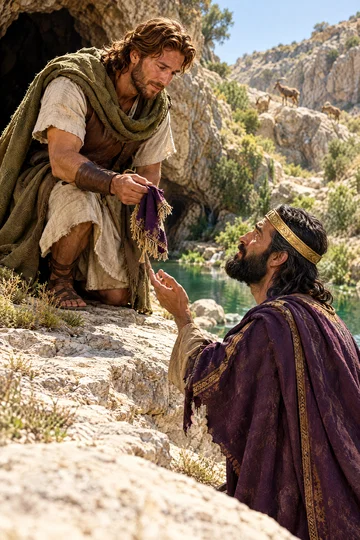
David did not accept that conclusion and refused to stretch out his hand to strike, kill, or harm Saul and restrained his men from doing so.PP 661.2–3MH 484.2MH 485.1SG4 91.11SP 383.2–384.2 His refusal rested on the fact that Saul was the Lord's anointed, made king over Israel by God's command even though the Lord had declared the kingdom should be taken from him for disobedience, and even though David himself had been chosen to rule.MH 484.21SP 374.2 His restraint reflected humble obedience to God and the warning of conscience not to harm the Lord's anointed.PP 661.2–31SP 374.2 David arose secretly and cut off only a piece of Saul's robe as evidence to prove that he could have taken Saul's life but chose not to harm him.PP 661.2–3SG4 91.11SP 383.2–384.2PP 736.3–4
Afterward David's conscience troubled him and he repented and reproached himself even for damaging the king's garment and showing that disrespect to the Lord's anointed.PP 661.2–3SG4 91.11SP 383.2–384.2PP 736.3–4 The episode is evidence of David's regard for human life and his restraint toward Saul and Saul's house.PP 736.3–4 Though utterly helpless in himself, David trusted the word of God and withstood the power of the whole world, witnessing to the power of God's word against human power and policy in support of evil.ED 254.2–3
David's tender, courteous, forbearing conduct teaches not to take into human hands the work of judging, correcting, or removing men in responsibility, which belongs to God, especially since every life record will soon pass in review before God.MH 484.2 David did not let anger or the chance for revenge control him, and his refusal to retaliate when wronged means forbearance under wrong, control of spirit, and victory over self.MH 485.2MH 485.1 That victory is rather than guarding feeling or reputation, living to save souls, keeping oneness with Christ and fellowship of the Spirit undisturbed by what others think or do, and patiently suffering when doing well, which is acceptable with God.MH 485.2
Sources
Pioneers and periodicals
24 sources
Saul was hunting David with three thousand chosen men among the rocks and caves of En-gedi, and when Saul went into the cavern to rest and sleep, David and his men were hidden inside within reach of him.RH Jun 23, 1868ST Apr 11, 1911ST Sep 9, 1889RH Dec 6, 1906ST Apr 22, 1903 David's companions took Saul's helpless arrival as the promised giving of his enemy into his hand to do with as he saw fit, and pressed him to rid himself of his foe.RH Jun 23, 1868ST Apr 11, 1911RH Jun 25, 1901 Instead David arose and secretly cut off only the skirt or corner of Saul's robe and did him no harm.RH Jun 23, 1868ST Apr 11, 1911RH Jun 25, 1901 He would not lift his hand against Saul because Saul was the Lord's anointed, and he refused the short-cut to the throne by killing him, leaving his protection, advancement and judgment to God to bring him to the kingdom in His own time and way.RH Jun 23, 1868RH Jun 25, 1901RH Nov 30, 1916ST Sep 9, 1889ST Jul 24, 1884 The deed stands as a remarkable returning of good for evil in faith, patience, mercy and tender conscience, for David spared Saul, showed the cut robe as proof, and made a gentle appeal that moved even Saul to weep and confess his sin.RH Mar 23, 1916RH Sep 26, 1871ST Jul 24, 1884ST Jan 17, 1906
Encounter in the Cave
Saul pursued David, the outlawed husband of his own daughter, among the crags and precipices of the mountains about En-gedi with three thousand chosen men, blinded by fiendish rage.ST Sep 9, 1889 David had been driven by Saul into the fastnesses of the mountains and the limestone caves of that region for protection.ST Sep 9, 1889RH Dec 6, 1906 Only the overruling providence of God kept the search from succeeding.ST Sep 9, 1889
Saul was an apostate king still holding the throne who, when he learned that David of another family and tribe was likely to be his successor, hunted David with an army far and near year after year to take his life.ST Apr 22, 1903 He hunted him like a flea or a partridge.ST Apr 22, 1903
When Saul rested in the mouth of the cavern during the heat of the day and went farther inside and fell asleep, David and his attendants lay concealed inside.ST Sep 9, 1889 Looked at from a human standpoint, God had led Saul there to deliver him into David's hand.ST Sep 9, 1889 David's men interpreted Saul's arrival within reach as the promised delivery of his enemy into his hand to do as he saw fit and urged him to use the opportunity to rid himself of his foe.RH Jun 23, 1868RH Jun 25, 1901ST Sep 9, 1889ST Jul 24, 1884ST Jun 15, 1904 They treated God's promise to deliver Saul into David's hand as an opportunity to kill him.ST Apr 11, 1911RH Jun 25, 1901ST Jul 24, 1884
David arose and secretly cut off only a piece, corner, edge or skirt from Saul's robe and did not kill or harm him.RH Jun 23, 1868ST Apr 11, 1911RH Jun 25, 1901ST Jul 24, 1884ST Jun 15, 1904 He secretly cut only the edge while Saul was in his power.ST Apr 11, 1911RH Jun 25, 1901RH Nov 11, 1873
At that time David as Saul's servant had been humble and obedient with a life above reproach, and his faithfulness to God stood in marked contrast to Saul's rebellious course and constantly rebuked him.ST Sep 9, 1889 Saul had fully determined to leave no effort untried to have David slain, and that policy controlled the whole of his later life.ST Sep 9, 1889 David's escapes were in some instances so clearly miraculous as to show the direct providence of God, yet in self-idolatry Saul sacrificed justice, humanity, and truth to unholy ambition and pride.ST Sep 9, 1889
The verse belongs to the long history recorded in 1 Samuel 14-31 of Saul's wicked career, which shows with astonishment how one once the humble servant of God became eminent in wickedness.ST Sep 20, 1883 There were noble traits in the character of Saul that, if cultivated with envy, jealousy and cruelty eradicated, might have won the favor of God and man.ST Feb 19, 1885 He persisted in self-will and lack of faith in God until ruin overtook him.ST Feb 19, 1885
Loyalty Patience and Mercy
David would not lift his hand against Saul because Saul was the Lord's anointed and the holder of an appointed position, and to strike him, despite his wickedness and his threat to David's life, would have been an atrocious offense and rebellion against the order God had established.RH Jun 23, 1868RH Jun 25, 1901STRH Nov 11, 1873ST Apr 22, 1903 He therefore refused to harm Saul when his men treated Saul's arrival within reach in the cave as the promised opportunity to do as he saw fit to his enemy, and he secretly cut off only a piece, corner or edge of Saul's robe.RH Jun 23, 1868RH Jun 25, 1901ST Jul 24, 1884STRH Nov 11, 1873 Even that small act troubled his conscience and drew his own self-blame, because it could weaken respect for Saul.ST Jul 24, 1884RH Nov 11, 1873
He left his protection, future advancement, cause and judgment in God's hands, trusting that God would act in his own time.RH Jun 23, 1868ST Apr 11, 1911ST Apr 9, 1912ST His mercy and magnanimity in cutting only the robe illustrated that willingness to leave his cause with God rather than take vengeance while Saul pursued him.ST Apr 11, 1911ST Apr 7, 1909ST Nov 11, 1880 When he had Saul in his power he would not harm him or seek his destruction, for personal prayer and action were not to serve selfish desire or retaliation.ST Feb 17, 1904 It is safe to commit one's cause into God's hands.ST Apr 9, 1912
The opportunity could be read as permission to take a short-cut to the throne by removing Saul and claiming the kingdom, but David refused his followers' counsel to kill Saul and seize it.RH Nov 30, 1916ST Sep 9, 1889ST Jan 17, 1906 Since the Lord had chosen and anointed him to be king and prophesied his becoming king, he concluded that the Lord would bring him to the throne according to his own will and in his own way and time.RH Nov 30, 1916ST Sep 9, 1889ST Jan 17, 1906 By cutting off only the skirt of the robe and then paying homage to Saul as the Lord's anointed, he testified to his loyalty to God and vindicated himself from accusation of wickedness.ST Sep 9, 1889 He spared Saul's life so that the treachery and wickedness of the king might be made manifest to all and so that God might work out his own will and judge between David and his enemies, and by this course he gained a far greater victory than if he had slain Saul.ST Sep 9, 1889
The deed is a most remarkable instance of returning good for evil, proving that his disposition was not cruel.RH Mar 23, 1916RH Sep 26, 1871 It shows faith, patience, generous kindness, mercy, magnanimity, forbearance and a tender conscience, for David bore Saul no malice and repaid evil with good.RH Jun 23, 1868ST Jul 24, 1884ST Nov 11, 1880 He resisted the chance to kill Saul when his men said the opportunity to defeat his enemy had come, secretly cutting off part of the robe instead, and his restraint let him later show Saul the proof that he had spared him.ST Jun 15, 1904RH Dec 24, 1867ST Nov 11, 1880 That peaceful, gentle appeal rebuked Saul, answered David's accusers, and illustrated how a peaceable response can turn an enemy away from anger.RH Jun 23, 1868ST Jun 15, 1904 Its practical Christian conduct was so powerful that it moved even Saul's heart to weep and acknowledge David's righteousness, to confess that he had sinned and played the fool, and to promise to do David no more harm, though David would not trust Saul's apparent repentance and rested in God while enduring affliction.RH Sep 26, 1871ST Jul 24, 1884ST Jun 15, 1904RH Dec 24, 1867
The restraint gives readers an example of religious integrity.RH Jun 23, 1868 It also shows the ability to form a worthy purpose and cling to it with an unfaltering grip, holding steadily to purpose and refusing to turn aside even when driven into the fastnesses of the mountains with his persecutor wholly within his power.RH Dec 6, 1906 It reveals the sterling qualities of heart seen when God chose David as boy and young man — brave, determined, cool yet tender and kind — which stood him in good stead through forty years in bringing a disorganized confederation of tribes into a strong, united kingdom and making him one of the most eminent rulers of all time.RH Dec 6, 1906 His wisdom in waiting for his right cause for action instead of striking rashly matches Elijah's wisdom in watching from his retreat in Gilead for ten years and waiting for his cause before denouncing apostate Israel.RH Dec 4, 1913
Sources