1 Samuel 24:9
And David said to Saul, Wherefore hearest thou men’s words, saying, Behold, David seeketh thy hurt?
Translations
And David said to Saul, Why hear you men’s words, saying, Behold, David seeks your hurt?
King James Version, KJV Cambridge Paragraph Bible
And David said to Saul, Wherefore hearest thou men’s words, saying, Behold, David seeketh thy hurt?
And David said to Saul, Why hearest thou men's words, saying, Behold, David seeketh thy hurt?
Revised Version, American Standard Version
And David said to Saul, Wherefore hearkenest thou to men’s words, saying, Behold, David seeketh thy hurt?
And David saith to Saul, 'Why dost thou hear the words of man, saying, Lo, David is seeking thine evil?
And David said to Saul, Why dost thou listen to words of men, saying, Behold, David seeks thy hurt?
Then said David to Saul, Wherefore shouldst thou hearken unto the words of the sons of earth, saying,—Lo! David is seeking thy hurt?
Berean Standard Bible, Majority Standard Bible
and said to Saul, “ Why do you listen to the words of men who say, ‘ Look, David intends to harm you’?
David said to Saul, “ Why do you listen to men’s words, saying, ‘ Behold, David seeks to harm you’?
And David said to Saul, Why do you give any attention to those who say that it is my desire to do you wrong?
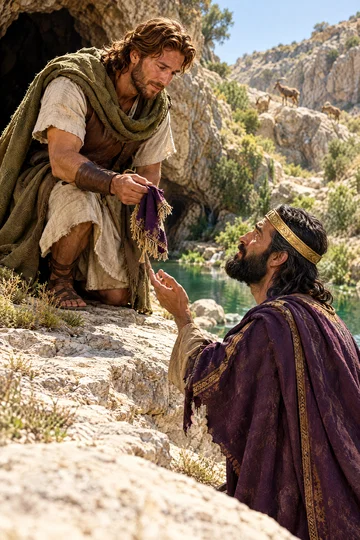
Dauid also arose afterward, and went out of the caue, and cryed after Saul, saying, O my lorde the King. And when Saul looked behinde him, Dauid inclined his face to the earth, and bowed himselfe.
Douay-Rheims (Challoner revision)
And said to Saul: Why dost thou hear the words of men that say David seeketh thy hurt?
Pictures

Cross-references
- 1 Samuel 26:11
The LORD forbid that I should stretch forth mine hand against the LORD’s anointed: but, I pray thee, take thou now the spear that is at his bolster, and the cruse of water, and let us go.
David again refuses to harm Saul, the Lord’s anointed.
- 1 Samuel 18:7-8
And the women answered one another as they played, and said, Saul hath slain his thousands, and David his ten thousands.
gives motive for Saul's hatred
- 1 Samuel 26:21
Then said Saul, I have sinned: return, my son David: for I will no more do thee harm, because my soul was precious in thine eyes this day: behold, I have played the fool, and have erred exceedingly.
Saul repents after David spares him.
- Romans 12:19
Dearly beloved, avenge not yourselves, but rather give place unto wrath: for it is written, Vengeance is mine; I will repay, saith the Lord.
David left judgment and repayment to God rather than harming Saul.
- 2 Samuel 16:10-12
And the king said, What have I to do with you, ye sons of Zeruiah? so let him curse, because the LORD hath said unto him, Curse David. Who shall then say, Wherefore hast thou done so?
David refuses retaliation against Shimei and leaves judgment to the LORD.
- 1 Samuel 18:10-11
And it came to pass on the morrow, that the evil spirit from God came upon Saul, and he prophesied in the midst of the house: and David played with his hand, as at other times: and there was a javelin in Saul’s hand.
shows murderous attempts without provocation
- 1 Samuel 18:14-15
And David behaved himself wisely in all his ways; and the LORD was with him.
David’s wise conduct shows he did Saul no wrong.
- 1 Samuel 22:9-19
Then answered Doeg the Edomite, which was set over the servants of Saul, and said, I saw the son of Jesse coming to Nob, to Ahimelech the son of Ahitub.
Saul acts on an informer's accusation and destroys Nob.
Commentary
Each commentary is drawn from primary sources: the writings of Ellen G. White and Adventist pioneers and periodicals. Each commentary is separate. Its own words are not a quotation; follow the references to read the source passages.
Ellen G. White
2 sources
David confronted Saul with the question why he gave ear to the talk of men who claimed David was seeking to do him injury.PP 662.1–2 The charge was untrue, for in the cave David had Saul in his power and could have taken his life.PP 662.1–2 Instead he spared him, and that sparing proved his innocence and gave him ground to appeal to it.PP 662.1–2
He spoke not as a rival claimant but as a shepherd youth clinging to God's promise that he should inherit the throne.ED 254.2–3 Against him stood Saul as the established monarch, resolved to retain his power, leaving David utterly helpless in human terms.ED 254.2–3 Yet he trusted God's word rather than force or stratagem.ED 254.2–3 That stand held firm against the power of the whole world and remains a witness that God's word is mightier than all human power and policy enlisted on the side of evil.ED 254.2–3 By such faithfulness he took his place among the world's true nobility and royal line, to which the youth of today are summoned to belong.ED 254.2–3
Sources
Pioneers and periodicals
16 sources
David asks Saul why he listens to men's false claims that he seeks the king's harm, denying that he intends any hurt to him.ST Sep 9, 1889RH Mar 23, 1916ST Sep 20, 1883 He was wholly innocent toward Saul, having served him humbly, obediently, faithfully and wisely, fearing God, honoring the king and remaining loyal in word, act and motive.ST Sep 9, 1889ST Sep 20, 1883ST Apr 9, 1912 He spoke when he had Saul in his power yet refused to harm the Lord's anointed or take vengeance, and by showing the piece of the robe he had cut off he proved he had done no evil or transgression against him.RH Sep 26, 1871ST Apr 11, 1911ST Feb 17, 1904ST Sep 9, 1889ST Jun 15, 1904 In this mercy he left his cause in God's hands, trusting that if God had chosen him to be king God would bring him to the throne in His own way and time and would judge between him and his enemies.ST Apr 11, 1911ST Apr 7, 1909ST Sep 9, 1889 His calm, respectful and tender appeal returned good for evil and bore no malice, so that Saul was moved to weep and confess that David was more righteous and that he himself had sinned and played the fool.RH Sep 26, 1871ST Jun 15, 1904RH Dec 6, 1906
Setting and Meaning
David's question confronts Saul for listening to men's words that falsely claimed David was seeking his harm, and denies that any such intent existed.ST Sep 9, 1889ST Sep 20, 1883ST Apr 11, 1911ST Apr 9, 1912ST Apr 7, 1909 The appeal asks why the king believes the accusation when David has done him no wrong and no injustice.RH Mar 23, 1916ST Sep 20, 1883ST Apr 11, 1911ST Apr 9, 1912ST Apr 7, 1909 David had served as a humble and obedient servant whose life was above reproach, and as the most faithful and efficient of Saul's servants he performed every duty without neglect.ST Sep 9, 1889ST Sep 20, 1883ST Apr 9, 1912 He acted wisely and successfully, feared God and honored the king, and remained just toward Saul in all words and acts and true toward him in every motive of the heart, with perfect integrity in which no fault could be found.ST Sep 9, 1889ST Sep 20, 1883ST Sep 9, 1889 He had never raised a hand against Saul but had remained loyal.ST Sep 9, 1889ST Sep 20, 1883ST Apr 9, 1912ST Sep 9, 1889
The words were spoken when Saul was fully in David's power, yet David refused to harm the Lord's anointed, to take vengeance, or to seek his persecutor's destruction.RH Sep 26, 1871ST Apr 11, 1911ST Feb 17, 1904ST Sep 9, 1889ST Jul 24, 1884 Though persecuted and pursued, he showed mercy and magnanimity toward his enemy and left his cause in God's hands rather than retaliating.RH Sep 26, 1871ST Apr 11, 1911ST Feb 17, 1904ST Apr 7, 1909ST Sep 9, 1889 The sparing of his bitterest enemy happened not only here but a second time in 1 Samuel 26.RH Sep 26, 1871 As proof that he had done no evil or transgression, David pointed to the piece of Saul's robe he had cut off, and by that token cleared himself of the charge of wickedness.ST Sep 9, 1889ST Jun 15, 1904
Saul gave ear to the accusations because he had fully determined to leave no effort untried to have David slain, and that policy controlled his later life.ST Sep 9, 1889 Even when David's escapes were so clearly miraculous as to show the direct providence of God, Saul in self-idolatry sacrificed justice, humanity, and truth to unholy ambition and pride.ST Sep 9, 1889 His relentless hatred and long effort to take David's life by pretended friendship and open assassination had no provocation and no excuse, and he knew it.ST Sep 20, 1883 It was inspired by envy, the same base principle that caused the patriarchs to sell Joseph and Cain to kill Abel, ruling in a heart departed from God that had lost tenderness of conscience, accountability, humility, uprightness, and dependence on God, and had become great in its own eyes, rash, self-sufficient, and tyrannical.ST Sep 20, 1883
The setting is that of an apostate king still holding the throne and trying to prevent David's succession by pursuing him far and near year after year with an army to take his life, hunting him like a flea or a partridge.RH Dec 6, 1906ST Apr 22, 1903 David was driven for protection into the fastnesses of the mountains, though at times his persecutor was wholly within his power.RH Dec 6, 1906ST Apr 22, 1903 Despite a history stained with envy, jealousy, and crime, noble traits still remained in Saul that could have won him the favor of God and man if cultivated and the evil traits eradicated, giving reason to pity more than detest him.ST Feb 19, 1885 He persisted instead in self-will, lack of faith, self-love, envy, jealousy, and cruelty until ruin overtook him.ST Feb 19, 1885
Whatever doubts David had previously held about his standing with Saul were now gone, and he clearly understood their relations.ST Sep 9, 1889 He also clearly recognized his own ultimate right to the kingdom, a conclusion many in Israel had likewise reached, so that a provisional court was already gathering about him.ST Sep 9, 1889 In these circumstances the encounter sets forth the widely different principles on which David and Saul acted.ST Sep 9, 1889 Saul afterward threw away his life in battle with the Philistines, and David was then anointed and crowned king over part of Israel at Hebron and afterward anointed a third time as king over all Israel.ST Apr 22, 1903
Trust and Example
The question belongs to David's mercy and magnanimity toward Saul his enemy in leaving his cause in God's hands rather than taking vengeance on the one who pursued him.ST Apr 11, 1911ST Apr 7, 1909ST Sep 9, 1889 Though Saul's life was in his hands, he spared the Lord's anointed and cleared himself of the charge of seeking Saul's hurt by showing the piece of the robe he had cut off.ST Sep 9, 1889ST Jun 15, 1904 He trusted that if God had chosen him to be king, God would bring him to the throne in His own way and time and would judge between him and his enemies, so that sparing Saul was a greater victory than killing him.ST Apr 7, 1909ST Sep 9, 1889 That sparing of his bitterest enemy happened not only here but twice, with the second time in 1 Samuel 26.RH Sep 26, 1871
In so doing he returned good for evil and proved that his disposition was not cruel.RH Mar 23, 1916RH Sep 26, 1871 That humble Christian conduct practically illustrated the word of God.RH Sep 26, 1871 His calm, respectful appeal rather than vengeance showed he bore no malice, for though hunted with an army he pointed to the cut-off piece of robe as proof he had done no evil or transgression.ST Jun 15, 1904RH Dec 6, 1906 This peaceful argument and soft answer moved Saul to weep and admit that David was more righteous in repaying evil with good, bringing reconciliation and turning away anger.ST Jun 15, 1904 His course was so powerful that it moved even Saul's heart to confess that he had sinned and played the fool.RH Sep 26, 1871
His holding steadily to his purpose through disheartening experiences, though driven into the fastnesses of the mountains and though his persecutor was at times wholly within his power, revealed the sterling qualities of heart seen by God who looked on his heart in choosing him king.RH Dec 6, 1906 He was brave, determined, cool, yet tender and kind, one who could form a worthy purpose and cling to it with unfaltering grip with body, mind, and soul.RH Dec 6, 1906 Those qualities stood him in good stead through forty years in bringing a disorganized confederation of tribes into a strong, united kingdom.RH Dec 6, 1906 That ability to select and hold a worthy purpose is the chief qualification of a true missionary.RH Dec 6, 1906 His wise dealing in answering Saul directly about men's words is an example of wisdom in opposing evil, equaled by Elijah watching Jezebel's invasion with foreign priests and seeing liberty betrayed and Jehovah's altars thrown down, yet waiting in Gilead for his cause before bringing final denunciation and shutting up the heavens by his word.RH Dec 4, 1913
Sources