1 Samuel 26:11
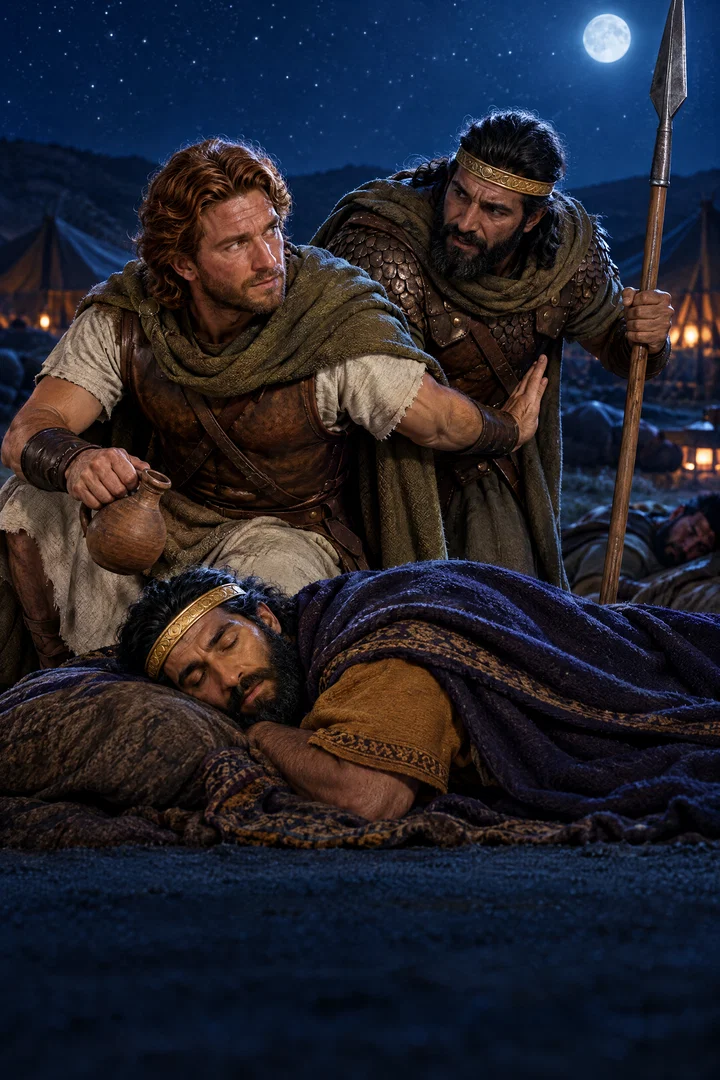
The LORD forbid that I should stretch forth mine hand against the LORD’s anointed: but, I pray thee, take thou now the spear that is at his bolster, and the cruse of water, and let us go.
Translations
The LORD forbid that I should stretch forth my hand against the LORD’s anointed: but, I pray you, take you now the spear that is at his bolster, and the cruse of water, and let us go.
The LORD forbid that I should stretch forth mine hand against the LORD’s anointed: but, I pray thee, take thou now the spear that is at his bolster, and the cruse of water, and let us go.
The Lord forbid that I should stretch forth mine hand against the Lord’s anointed: but, I pray thee, take thou now the spear that is at his bolster, and the cruse of water, and let us go.
The LORD forbid that I should stretch forth my hand against the LORD'S anointed: but, I pray thee, take thou now the spear that is at his bolster, and the cruse of water, and let us go.
The LORD forbid that I should put forth mine hand against the LORD’S anointed: but now take, I pray thee, the spear that is at his head, and the cruse of water, and let us go.
Jehovah forbid that I should put forth my hand against Jehovah’s anointed: but now take, I pray thee, the spear that is at his head, and the cruse of water, and let us go.
far be it from me, by Jehovah, from putting forth my hand against the anointed of Jehovah; and, now, take, I pray thee, the spear which [is] at his pillow, and the cruse of water, and we go away.'
Jehovah forbid that I should stretch forth my hand against Jehovah's anointed! But now take, I pray thee, the spear that is at his head, and the cruse of water, and let us go.
Far be it from me, of Yahweh, that I should thrust forth my hand against the anointed of Yahweh! Now, therefore, take, I pray thee, the spear that is at his head, and the cruse of water, and let us go our way.
But the LORD forbid that I should stretch out my hand against the LORD’s anointed. Instead, take the spear and water jug by his head, and let us go.”
But the LORD forbid that I should extend my hand against the LORD’s anointed. Instead, take the spear and water jug by his head, and let us go.”
The LORD forbid that I should stretch out my hand against the LORD’s anointed; but now please take the spear that is at his head and the jar of water, and let’s go.”
Never will my hand be stretched out against the man marked with the holy oil; but take the spear which is by his head and the vessel of water, and let us go.
The Lord keepe mee from laying mine hand vpon the Lordes anointed: but, I pray thee, take now the speare that is at his head, and the pot of water, and let vs goe hence.
Douay-Rheims (Challoner revision)
The Lord be merciful unto me, that I extend not my hand upon the Lord’s anointed. But now take the spear, which is at his head, and the cup of water, and let us go.
Pictures
Cross-references
- 1 Samuel 24:6-7
And he said unto his men, The LORD forbid that I should do this thing unto my master, the LORD’s anointed, to stretch forth mine hand against him, seeing he is the anointed of the LORD.
David again refuses to harm Saul, the Lord’s anointed.
- 2 Samuel 1:14
And David said unto him, How wast thou not afraid to stretch forth thine hand to destroy the LORD’s anointed?
David refuses to harm the LORD’s anointed and condemns the man who struck Saul.
- 1 Samuel 16:13
Then Samuel took the horn of oil, and anointed him in the midst of his brethren: and the Spirit of the LORD came upon David from that day forward. So Samuel rose up, and went to Ramah.
David is anointed as king yet refuses to seize the kingdom from Saul.
- 1 Samuel 26:21
Then said Saul, I have sinned: return, my son David: for I will no more do thee harm, because my soul was precious in thine eyes this day: behold, I have played the fool, and have erred exceedingly.
Saul admits David spared him and confesses his wrongdoing.
- 2 Samuel 1:17-27
And David lamented with this lamentation over Saul and over Jonathan his son:
David lamented Saul and Jonathan after refusing to harm Saul.
- Deuteronomy 32:35
To me belongeth vengeance, and recompence; their foot shall slide in due time: for the day of their calamity is at hand, and the things that shall come upon them make haste.
The passage echoes the teaching that vengeance belongs to the Lord.
- Matthew 26:52
Then said Jesus unto him, Put up again thy sword into his place: for all they that take the sword shall perish with the sword.
Jesus stopped his followers from defending him with violence.
- Romans 12:19
Dearly beloved, avenge not yourselves, but rather give place unto wrath: for it is written, Vengeance is mine; I will repay, saith the Lord.
The passage says to leave repayment to God.
- Acts 13:22
And when he had removed him, he raised up unto them David to be their king; to whom also he gave testimony, and said, I have found David the son of Jesse, a man after mine own heart, which shall fulfil all my will.
God removes Saul and raises David as king.
- 1 Samuel 26:20
Now therefore, let not my blood fall to the earth before the face of the LORD: for the king of Israel is come out to seek a flea, as when one doth hunt a partridge in the mountains.
David describes being hunted like a partridge in the mountains.
Commentary
Each commentary is drawn from primary sources: the writings of Ellen G. White and Adventist pioneers and periodicals. Each commentary is separate. Its own words are not a quotation; follow the references to read the source passages.
Ellen G. White
4 sources
This took place after Saul had slain the Lord's priests, when Abiathar the son of Ahimelech escaped and fled to David, who received him with the promise that whoever sought David's life sought his life also but with David he would be in safeguard, while Saul still hunted David.PP 660.1 David had served Saul obediently, and his humble, irreproachable, faithful conduct rebuked Saul's rebellious course, while Saul made the slaying of David the great object of his life.1SP 374.2 David often had Saul in his power and was urged by the men he commanded to slay him, yet he refused because God had anointed Saul, even though David knew he himself was chosen of God to rule Israel, thus respecting God's choice of ruler.1SP 374.2SG4 83.2
On this occasion Saul lay asleep in his night camp with his spear stuck in the ground and a cruse of water at his head, surrounded by Abner and soldiers locked in slumber.PP 668.2–3 David had entered the camp with Abishai under cover of darkness, and when Abishai asked permission to strike Saul dead at once with the spear, David forbade him to stretch out his hand against the Lord's anointed and remain guiltless.PP 668.2–3 In refusing he would not take vengeance into his own hands but left Saul's judgment to the Lord, who would smite him, or let his day come to die, or let him perish in battle.PP 668.2–3SG4 83.2 Instead of killing Saul he ordered the spear and the cruse of water to be taken as proof and withdrew, and they escaped unseen and unheard because a deep sleep from the Lord had fallen on the whole camp, showing how easily the Lord can weaken the strongest, remove prudence from the wisest, and baffle the skill of the most watchful.PP 668.2–3 Rather than strike Saul, David chose to find refuge among the Philistines and by his prudent, humble course made even his enemies to be at peace with him, remaining there until Saul's death.1SP 374.2
Sources
Pioneers and periodicals
18 sources
David spared Saul's life for the second time when Saul fell into his power, refusing to strike him himself or to allow Abishai or another to do it, but taking the spear and water jar at his head and going away.RH Sep 26, 1871ST Jul 24, 1884STST Apr 22, 1903 At the time Saul was a wicked, rejected and apostate king who was hunting David like a wild beast with an army, while David had already been anointed to succeed him yet remained a hated and hunted outlaw.ST Aug 13, 1896ST Jan 17, 1906ST Nov 29, 1910 The refusal was a refusal to take vengeance into his own hands, leaving his cause and all judgment with God and trusting God in his own time and way to deliver him and fulfill the promise of his kingship without help from himself.ST Aug 13, 1896ST Apr 11, 1911ST Apr 9, 1912ST Jan 17, 1906 It was returning good for evil, showing mercy, magnanimity, patient endurance under persecution, and courage joined with self-control, tenderness and nobility of character.RH Sep 26, 1871ST Apr 11, 1911ST Apr 7, 1909 Those whom God has openly chosen and placed in responsible positions are in a special sense His instruments and therefore sacred to be honored for their position even when they have fallen low morally or spiritually, so no one should take it upon himself to injure, depose or overthrow a ruler by force even in self-defense, but should respect God's appointments and leave judgment and removal to God.ST Aug 13, 1896ST Sep 3, 1894STRH Nov 4, 1873RH Nov 18, 1873
Setting and Action
The verse belongs to the closing part of 1 Samuel that ends with the sad death of Saul after he followed the instruction of the spiritualist medium, the woman with a familiar spirit, a miserable end for one strong and noble in his youth that brings regret.ST Apr 22, 1913
It records the second of two times David spared Saul's life, part of a pattern in which on several occasions he refused to harm Saul when Saul fell into his power.RH Sep 26, 1871ST Apr 22, 1903
At the time Saul was an apostate, wicked, tyrannical king still holding the throne, though he had forfeited his right to it by disobedience and had been rejected by God.ST Aug 13, 1896ST Jan 17, 1906ST Nov 29, 1910ST Apr 22, 1903RH Nov 18, 1873 Having learned David was likely to be his successor, he sought David's life and pursued and hunted him like a wild beast with an army year after year.ST Aug 13, 1896ST Jan 17, 1906ST Apr 22, 1903 At the same time David had already been anointed king in Saul's place through the prophet, yet he remained a hunted, despised, hated outlaw.ST Aug 13, 1896STST Jan 17, 1906RH Nov 18, 1873 Though he had the power and opportunity to change the course of the conflict and was urged to let Saul be killed, he refused to kill Saul himself and would not consent for Abishai or another to do it, but took the spear that was at his bolster and the cruse of water and left.ST Aug 13, 1896ST Jul 24, 1884STST Jan 17, 1906ST Nov 29, 1910
David's conduct moved Saul to acknowledge that David had valued his life and that Saul had acted foolishly and wrongly.RH Sep 26, 1871 David's refusal to turn against Saul extended to his own people, and his later course was consistent with it, since much of his time was spent fighting Israel's enemies.ST
Trusting God for Deliverance
The verse shows David returning good for evil by sparing the life of his bitter enemy Saul, and doing so twice.RH Sep 26, 1871ST Apr 11, 1911ST Jul 24, 1884 It shows him choosing mercy and magnanimity toward his enemy rather than harming one he regarded as the Lord's anointed.ST Apr 11, 1911ST Apr 7, 1909ST Nov 11, 1880 His refusal to let Abishai kill Saul when Saul lay within their power, but instead to take the spear and the cruse of water and leave, displayed patient endurance under persecution and forbearance toward his adversary.ST Apr 7, 1909ST Jul 24, 1884ST Nov 11, 1880 His firm holding to his purpose not to harm his persecutor when he had opportunity combined courage and self-control with tenderness, kindness, and nobility of character.RH Sep 26, 1871RH Dec 6, 1906 His conduct moved Saul to acknowledge that David had valued his life and that Saul himself had acted foolishly and wrongly.RH Sep 26, 1871
The verse shows David refusing to take vengeance into his own hands and remaining loyal while committing his cause and fate to God.ST Apr 11, 1911ST Apr 9, 1912RH Apr 23, 1901 He would not raise his hand against Saul even though Saul was wicked, rejected by God, and seeking his life, and even though David himself had already been anointed king in his place, nor would he consent for another to kill Saul.ST Aug 13, 1896STST Nov 29, 1910 He left all judgment with God, trusting God to bring deliverance and believing God needed no help from him to deal with Saul.ST Apr 11, 1911RH Apr 23, 1901ST Nov 29, 1910 He knew God in His own time would bring to nothing all those who had conspired against him and kept him back from his own right.ST Though hunted, despised, hated, and an outlaw with power to change the course of the conflict against a tyrannical king, he would not lift his hand against the ruler over him but trusted God to judge and remove rulers in His own time, even in self-defense.ST Aug 13, 1896STST Nov 29, 1910
His refusal to lift his hand to take Saul's life when he had the opportunity and was urged to do it showed implicit faith that the prophecy of his kingship would be fulfilled in God's own time and way.ST Jan 17, 1906 Saul had forfeited his right to the throne by disobedience and God had chosen David for that position through the prophet, while Saul was hunting David like a wild beast year after year.ST Jan 17, 1906 God amply repaid that faith by inclining the hearts of the truest, bravest, and most skillful men of all the tribes of Israel to join David's army when the time came.ST Jan 17, 1906
His refusal to take revenge after long and sore persecution, trusting God to bring about his deliverance, revealed an indwelling Saviour and love for his enemy.RH Apr 23, 1901 His loyal heart and trust in God give courage that victory by faith is present now and all the way along.RH Apr 23, 1901 For unless Christ is victorious in a person through faith and submission He is not revealed in the life, and no light, help, or comfort is given to others.RH Apr 23, 1901
Honoring God's Anointed Rulers
Those whom God has openly chosen and placed in responsible positions are in a special sense His instruments and therefore sacred, to be respected, venerated and honored for the position He gave them and protected even by a man of war accustomed to violence and bloodshed.ST Sep 3, 1894RH Nov 18, 1873 That honor is owed to the instrument because of the place in which God placed him even when he has fallen low morally or spiritually, without imitating his human frailties and mistakes.ST Sep 3, 1894 Subordinates who disregard this rule meet immediate and severe retribution.ST Sep 3, 1894 David honored Saul as the Lord's anointed and refused to stretch forth his hand against him because of the position God had given him, even though Saul was wicked, rejected and apostate and Samuel had already anointed David as future king in his place.ST Aug 13, 1896ST Apr 9, 1912ST Apr 22, 1903RH Nov 18, 1873 Though Saul was an apostate king still holding the throne who, learning David was likely to be his successor, pursued and hunted him with an army year after year to take his life, David on several occasions would not harm him when he had both the power and the opportunity, would not consent for Abishai or another to kill him, but remained loyal and committed his cause to God.ST Aug 13, 1896ST Apr 9, 1912ST Apr 22, 1903
The verse teaches submission to the government over him, refusing to resist or overthrow a ruler by force even in self-defense.ST Aug 13, 1896ST Though himself already anointed as king, yet hunted, despised and hated by Saul, David would not lift his hand against Saul because Saul was the Lord's anointed.ST Aug 13, 1896ST He left Saul's fate and all judgment with God, trusting God to judge and remove rulers in His own time.ST Aug 13, 1896ST He knew God in His own time would bring to nothing all those who had conspired against him and kept him back from his own right.ST
The same restraint applies to opposition against leaders chosen for God's work: even if they have departed from God and should be removed, people should not take it upon themselves to depose or injure those placed in authority by God, but should respect God's appointments, leave their removal to God, and wait for God's time.RH Nov 4, 1873RH Nov 18, 1873 David's sparing of his enemy under persecution is an example for God's servants to follow.ST Jul 24, 1884 When Saul lay within their power while pursuing him, David refused to let Abishai kill him, but took the spear and the cruse of water and left, showing patient endurance under persecution.ST Jul 24, 1884
Sources