1 Samuel 24:8
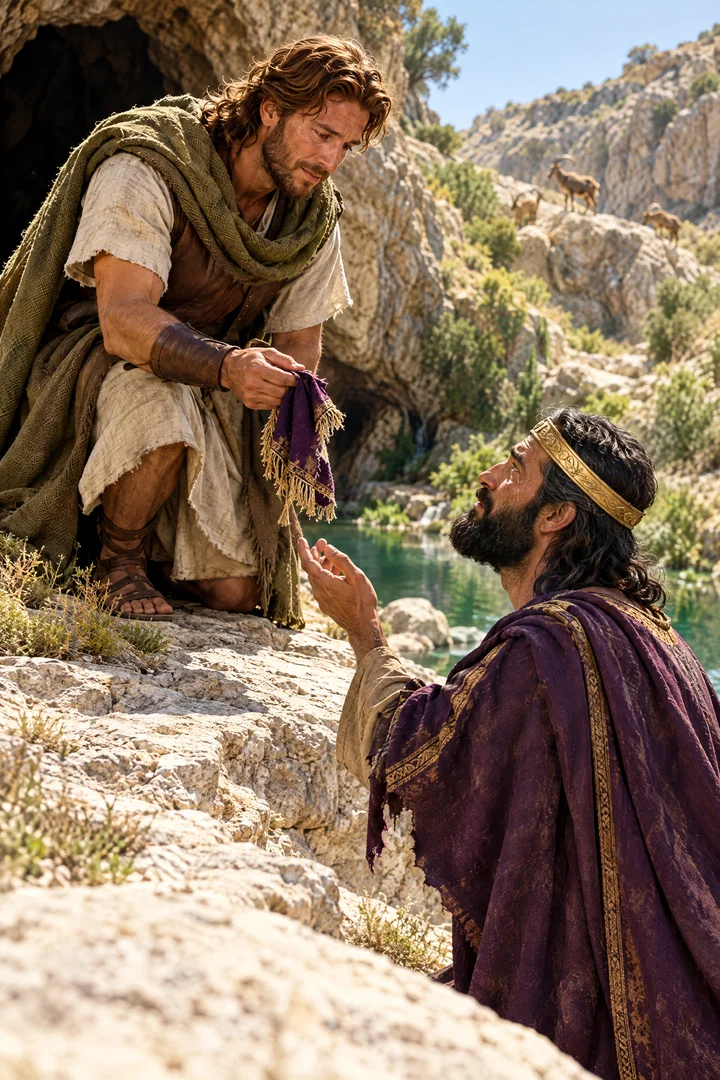
David also arose afterward, and went out of the cave, and cried after Saul, saying, My lord the king. And when Saul looked behind him, David stooped with his face to the earth, and bowed himself.
Translations
American King James Version, King James Version
David also arose afterward, and went out of the cave, and cried after Saul, saying, My lord the king. And when Saul looked behind him, David stooped with his face to the earth, and bowed himself.
KJV Cambridge Paragraph Bible, Webster Bible
David also rose afterward, and went out of the cave, and cried after Saul, saying, My lord the king. And when Saul looked behind him, David stooped with his face to the earth, and bowed himself.
Revised Version, American Standard Version
David also arose afterward, and went out of the cave, and cried after Saul, saying, My lord the king. And when Saul looked behind him, David bowed with his face to the earth, and did obeisance.
and David riseth afterwards, and goeth out from the cave, and calleth after Saul, saying, 'My lord, O king!' And Saul looketh attentively behind him, and David boweth — face to the earth — and doth obeisance.
David also arose afterwards, and went out of the cave, and cried after Saul, saying, My lord the king! And when Saul looked behind him, David bowed with his face to the earth, and did obeisance.
Then David rose up, afterwards, and went forth out of the cave, and cried out after Saul, saying—My lord, O king! And, when Saul looked about behind him, David inclined his face to the earth, and bowed himself down.
Berean Standard Bible, Majority Standard Bible
After that, David got up, went out of the cave, and called out to Saul, “ My lord the king!”When Saul looked behind him, David bowed facedown in reverence
David also arose afterward, and went out of the cave and cried after Saul, saying, “ My lord the king!”When Saul looked behind him, David bowed with his face to the earth, and showed respect.
And after that David came out of the hollow rock, and crying after Saul said, My lord the king. And when Saul gave a look back, David went down on his face and gave him honour.
So Dauid ouercame his seruants with these words, and suffered them not to arise against Saul: so Saul rose vp out of the caue and went away.
Douay-Rheims (Challoner revision)
And David also rose up after him: and going out of the cave cried after Saul, saying: My lord the king. And Saul looked behind him: and David bowing himself down to the ground, worshipped,
Pictures
Cross-references
- 1 Samuel 26:7-11
So David and Abishai came to the people by night: and, behold, Saul lay sleeping within the trench, and his spear stuck in the ground at his bolster: but Abner and the people lay round about him.
David again refuses to kill Saul when he has the opportunity.
- 1 Samuel 24:17-19
And he said to David, Thou art more righteous than I: for thou hast rewarded me good, whereas I have rewarded thee evil.
Saul admits David acted righteously and repaid evil with good.
- 1 Samuel 26:21
Then said Saul, I have sinned: return, my son David: for I will no more do thee harm, because my soul was precious in thine eyes this day: behold, I have played the fool, and have erred exceedingly.
Saul confesses after David spared him.
- 1 Samuel 24:14
After whom is the king of Israel come out? after whom dost thou pursue? after a dead dog, after a flea.
David compares Saul’s pursuit to hunting a flea.
- 1 Peter 2:23
Who, when he was reviled, reviled not again; when he suffered, he threatened not; but committed himself to him that judgeth righteously:
Christ’s example of bearing wrong without retaliation is reflected in David’s conduct.
- 1 Samuel 26:20
Now therefore, let not my blood fall to the earth before the face of the LORD: for the king of Israel is come out to seek a flea, as when one doth hunt a partridge in the mountains.
David compares Saul’s pursuit of him to hunting a partridge in the mountains.
Commentary
Each commentary is drawn from primary sources: the writings of Ellen G. White and Adventist pioneers and periodicals. Each commentary is separate. Its own words are not a quotation; follow the references to read the source passages.
Ellen G. White
1 source
At this moment David was only a shepherd lad, yet he held God's promise of the throne, and he stood against Saul as the established monarch bent on holding fast to his power.ED 254.2–3 Utterly helpless in himself, he trusted God's word, and by that trust he withstood the power of the whole world.ED 254.2–3 His stand bears witness to the power of God's word over human power and policy when they are employed in support of evil.ED 254.2–3 He therefore belongs to the world's true nobility, its royal line, in which the youth of today are called to take their places.ED 254.2–3
Sources
Pioneers and periodicals
16 sources
After sparing Saul in the cave, David came out behind him, called after him as his lord the king, and stooped with his face to the earth and bowed before him in deference, humility and obedience.ST Sep 9, 1889ST Apr 11, 1911ST Sep 9, 1889 Saul was then in relentless pursuit of David to take his life with an army far and near, and David had just had his persecutor at his mercy and spared him.ST Apr 7, 1909ST Jul 24, 1884RH Dec 6, 1906 It was the first of two times David had Saul in his power and refused to harm him because he was the Lord's anointed, refusing to take vengeance into his own hands.RH Sep 26, 1871ST Feb 17, 1904ST Apr 22, 1903 The verse teaches returning good for evil, in that David saved the life of his bitterest enemy, sought no harm to his personal persecutor, and proved his disposition bore no malice or cruelty.RH Mar 23, 1916RH Sep 26, 1871ST Feb 17, 1904 He honored Saul as his rightful ruler and would not lift his hand against him even while Saul sought to kill him, loyal to God and confident God would make him king in His own time, showing it is safe to commit one's cause to God and leave it in His hands.ST Sep 20, 1883ST Apr 11, 1911ST Apr 9, 1912ST Sep 9, 1889
David Honors His Pursuer
David came out of the cave behind Saul and cried after him, addressing him as my lord the king, and when Saul looked behind him David stooped with his face to the earth and bowed himself before him with deference, humility, and obedience.ST Sep 9, 1889ST Apr 11, 1911ST Sep 9, 1889 Even though Saul was his enemy and was determined to kill him, David treated him with respect and mercy and magnanimity as his king and as his servant's rightful ruler.ST Sep 9, 1889ST Apr 11, 1911ST Sep 9, 1889 He did this with full understanding of the relation between himself and the king and with clear knowledge of his own ultimate right to the kingdom.ST Sep 9, 1889 Many in Israel had also come to recognize that right, and a provisional court was already gathering around him, so his humble bowing displayed a principle of action widely different from Saul's.ST Sep 9, 1889
The setting was Saul's relentless pursuit of David to take his life, pursuing him with an army far and near year after year after learning that David of another family and tribe would succeed him on the throne he still held.ST Jul 24, 1884RH Dec 6, 1906ST Apr 22, 1903 David had been driven for protection into the fastnesses of the mountains, and he had just had his persecutor wholly at his mercy and had spared him rather than taking vengeance into his own hands.ST Apr 7, 1909ST Jul 24, 1884RH Dec 6, 1906ST Apr 22, 1903 That sparing was the first of two times David spared Saul when he had him in his power, having both power and opportunity to harm him.RH Sep 26, 1871ST Feb 17, 1904ST Apr 22, 1903 He refused to harm him because Saul was the Lord's anointed, would not seek the destruction of his personal persecutor, and would not take vengeance into his own hands.RH Sep 26, 1871ST Feb 17, 1904ST Apr 22, 1903
His restraint came before Saul threw away his life in battle with the Philistines.ST Apr 22, 1903 It came before David was anointed and crowned king over part of Israel at Hebron for about seven years.ST Apr 22, 1903 It came before David was anointed a third time as king over all Israel to reign gloriously from Jerusalem and Mount Zion with all enemies subdued and the dominion of Israel greatly enlarged.ST Apr 22, 1903 The chapter also shows noble traits still present in Saul's character.ST Feb 19, 1885 If those noble traits had been cultivated while envy, jealousy, and crime were eradicated, he might have won the favor of God and man, but he persisted in self-will until ruin overtook him.ST Feb 19, 1885
Returning Good For Evil
The verse teaches returning good for evil, for David saves the life of his bitterest enemy when he has him in his power and does not seek the destruction of his personal persecutor.RH Mar 23, 1916RH Sep 26, 1871ST Feb 17, 1904 Having the opportunity to harm Saul yet sparing him and then addressing him respectfully and bowing before him, David proves his disposition is not cruel and bears no malice but answers persecution with patience and goodness.RH Sep 26, 1871ST Feb 17, 1904ST Jul 24, 1884 This was the first of two times he spared Saul, and such humble, consistent Christian conduct practically illustrated the word of God with an influence so strong that it moved even the heart of Saul.RH Sep 26, 1871ST Jul 24, 1884
David honors Saul as his rightful ruler and acts justly and loyally toward him, not raising his hand against him even while Saul as his relentless enemy seeks his life.ST Sep 20, 1883ST Apr 9, 1912 His conduct shows loyalty to God and confidence that God would make him king in his own time rather than gaining the throne by killing Saul.ST Apr 11, 1911ST Sep 9, 1889 Coming out of the cave, addressing Saul as king, and bowing before him illustrates David's mercy and magnanimity toward his enemy and the lesson of leaving one's cause in God's hands, for it is safe to commit one's cause to God.ST Apr 11, 1911ST Apr 9, 1912ST Sep 9, 1889
His calm, respectful, patient appeal, showing the piece cut from Saul's robe as proof he had spared him when he could have killed him, turns Saul from anger to grief and acknowledgment that David has treated him better than Saul treated David.RH Sep 26, 1871ST Jun 15, 1904 That humble reverence after sparing Saul, addressing him with respect and humility though Saul is hunting him as an enemy and had been at his mercy, shows David bore him no malice.ST Jul 24, 1884ST Jun 15, 1904 Such a gentle, peaceable, consistent Christian response can disarm hostility, as its influence moved even Saul's heart.RH Sep 26, 1871ST Jul 24, 1884ST Jun 15, 1904
David's humble reverence after sparing Saul reveals the sterling qualities of heart seen in him as a boy and young man when chosen to be king, brave, determined, cool yet tender and kind, with power to form a worthy purpose and hold steadily to it through disheartening persecution.RH Dec 6, 1906 Though driven for protection into the fastnesses of the mountains, and though his persecutor was at times wholly within his power, David would not harm him but followed him out of the cave and honored him as his rightful ruler.RH Dec 6, 1906 That same power to choose and hold a worthy purpose through forty long years enabled him to make a disorganized confederation of tribes into a strong, united kingdom and to become one of the most eminent rulers of all time, and it is the same power that makes a true missionary.RH Dec 6, 1906 The verse thus models wise, restrained opposition to evil that waits for its right cause for war and its right time to act instead of using an advantage to harm, going out of the cave and bowing with face to the earth before his king, the same timely wisdom shown when Elijah watched Jezebel's apostasy from Gilead and waited for his cause to denounce it.RH Dec 4, 1913
Sources