1 Samuel 26:25
Then Saul said to David, Blessed be thou, my son David: thou shalt both do great things, and also shalt still prevail. So David went on his way, and Saul returned to his place.
Translations
Then Saul said to David, Blessed be you, my son David: you shall both do great things, and also shall still prevail. So David went on his way, and Saul returned to his place.
King James Version, KJV Cambridge Paragraph Bible, Webster Bible
Then Saul said to David, Blessed be thou, my son David: thou shalt both do great things, and also shalt still prevail. So David went on his way, and Saul returned to his place.
Revised Version, American Standard Version
Then Saul said to David, Blessed be thou, my son David: thou shalt both do mightily, and shalt surely prevail. So David went his way, and Saul returned to his place.
And Saul saith unto David, 'Blessed [art] thou, my son David, also working thou dost work, and also prevailing thou dost prevail.' And David goeth on his way, and Saul hath turned back to his place.
And Saul said to David, Blessed be thou, my son David: thou shalt certainly do [great things], and shalt certainly prevail. And David went on his way, and Saul returned to his place.
Then said Saul unto David—Blessed, be thou, my son David, thou shalt both, do, and shalt, prevail. And David went on his way, but, Saul, returned unto his own place.
Berean Standard Bible, Majority Standard Bible
Saul said to him, “ May you be blessed, David my son. You will accomplish great things and will surely prevail.”So David went on his way, and Saul returned home.
Then Saul said to David, “ You are blessed, my son David. You will both do mightily, and will surely prevail.”So David went his way, and Saul returned to his place.
Then Saul said to David, May a blessing be on you, David, my son; you will do great things and without doubt you will overcome. Then David went on his way, and Saul went back to his place.
Then Saul said to Dauid, Blessed art thou, my sonne Dauid: for thou shalt doe great things, and also preuaile. So Dauid went his way, and Saul returned to his place.
Douay-Rheims (Challoner revision)
Then Saul said to David: Blessed art thou, my son David: and truly doing thou shalt do, and prevailing thou shalt prevail. And David went on his way, and Saul returned to his place.
Pictures
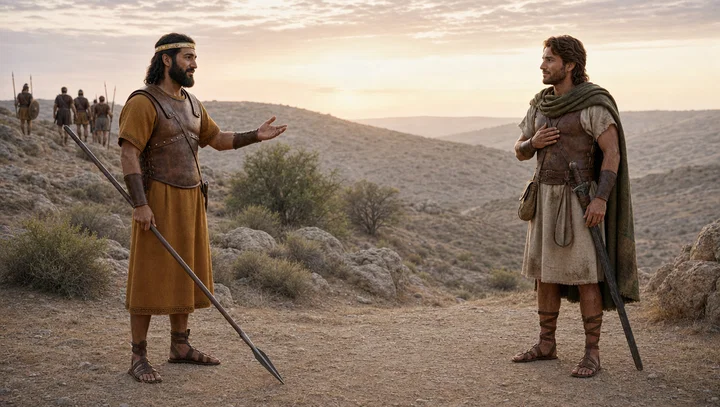

Cross-references
- 1 Samuel 26:21
Then said Saul, I have sinned: return, my son David: for I will no more do thee harm, because my soul was precious in thine eyes this day: behold, I have played the fool, and have erred exceedingly.
Saul confesses his wrong after David spares him and recognizes David valued his life.
- 1 Samuel 26:9-11
And David said to Abishai, Destroy him not: for who can stretch forth his hand against the LORD’s anointed, and be guiltless?
David refuses to harm Saul when he has the opportunity.
- 1 Samuel 24:17-20
And he said to David, Thou art more righteous than I: for thou hast rewarded me good, whereas I have rewarded thee evil.
Saul recognizes David’s goodness after David spared his life.
- 1 Samuel 24:6
And he said unto his men, The LORD forbid that I should do this thing unto my master, the LORD’s anointed, to stretch forth mine hand against him, seeing he is the anointed of the LORD.
David refuses to harm Saul, the Lord’s anointed.
- 2 Samuel 5:3-5
So all the elders of Israel came to the king to Hebron; and king David made a league with them in Hebron before the LORD: and they anointed David king over Israel.
David is anointed king over all Israel after ruling at Hebron.
- 2 Samuel 2:4
And the men of Judah came, and there they anointed David king over the house of Judah. And they told David, saying, That the men of Jabesh-gilead were they that buried Saul.
David is first crowned king over part of Israel.
Commentary
Each commentary is drawn from primary sources: the writings of Ellen G. White and Adventist pioneers and periodicals. Each commentary is separate. Its own words are not a quotation; follow the references to read the source passages.
Ellen G. White
1 source
This was Saul's farewell blessing spoken to David after David spared his life for the second time.PP 671.1–2 The second sparing left a still deeper impression on Saul than the first and drew from him a more humble acknowledgment of his fault.PP 671.1–2 He was astonished and subdued by David's kindness in respecting the life of his sovereign as king.PP 671.1–2 In the blessing Saul declared that David would do great things and would still prevail.PP 671.1–2 David did not trust the change to last and would not again place himself in Saul's power, having no hope that Saul would long continue in that frame of mind.PP 671.1–2
Sources
Pioneers and periodicals
7 sources
After David spared Saul's life a second time, the two parted with David going on his way and Saul returning to his place.RH Mar 23, 1916RH Sep 26, 1871ST Apr 11, 1911 David had refused to raise his hand against the Lord's anointed though Saul was in his power.ST Apr 9, 1912ST Apr 22, 1903 At that parting Saul blessed David, calling him blessed as his son.RH Mar 23, 1916RH Sep 26, 1871 He acknowledged that David would do great things and would still prevail, accomplishing great things and continuing to prevail.RH Mar 23, 1916RH Sep 26, 1871ST Apr 11, 1911ST Apr 9, 1912RH Dec 6, 1906
The parting stands near the close of Saul's reign and course, in the final stage when God finally rejects the disobedient.RH Mar 23, 1916ST Apr 9, 1912 Saul still held the throne at that time and kept trying to prevent David from succeeding him, pursuing him repeatedly despite David's loyalty.ST Apr 9, 1912ST Apr 22, 1903 Saul's acknowledgment was fulfilled when David later became king, first over part of Israel and then over all Israel.ST Apr 22, 1903
David's returning of good for evil in sparing his jealous enemy who was pursuing him to slay him moved Saul's heart.RH Sep 26, 1871ST Apr 7, 1909 It shows David's mercy and magnanimity toward his enemy, and his loyalty in not harming Saul despite Saul's attempts to kill him.ST Apr 11, 1911ST Apr 9, 1912 His steadfastness under persecution illustrates steadfast, brave, cool, tender, and kind firmness of purpose even when his persecutor was within his power.RH Sep 26, 1871RH Dec 6, 1906 His utter refusal to take vengeance into his own hands shows his hope and trust in God.ST Apr 11, 1911ST Apr 7, 1909 It shows the safety of leaving one's cause and outcome in God's hands rather than seizing them for oneself.ST Apr 11, 1911ST Apr 9, 1912
Sources