2 Kings 23:13
And the high places that were before Jerusalem, which were on the right hand of the mount of corruption, which Solomon the king of Israel had builded for Ashtoreth the abomination of the Zidonians, and for Chemosh the abomination of the Moabites, and for Milcom the abomination of the children of Ammon, did the king defile.
Translations
American King James Version, Webster Bible, Darby Translation
And the high places that were before Jerusalem, which were on the right hand of the mount of corruption, which Solomon the king of Israel had built for Ashtoreth the abomination of the Zidonians, and for Chemosh the abomination of the Moabites, and for Milcom the abomination of the children of Ammon, did the king defile.
King James Version, KJV Cambridge Paragraph Bible
And the high places that were before Jerusalem, which were on the right hand of the mount of corruption, which Solomon the king of Israel had builded for Ashtoreth the abomination of the Zidonians, and for Chemosh the abomination of the Moabites, and for Milcom the abomination of the children of Ammon, did the king defile.
And the high places that were before Jerusalem, which were on the right hand of the mount of corruption, which Solomon the king of Israel had builded for Ashtoreth the abomination of the Zidonians, and for Chemosh the abomination of Moab, and for Milcom the abomination of the children of Ammon, did the king defile.
And the high places that were before Jerusalem, which were on the right hand of the mount of corruption, which Solomon the king of Israel had builded for Ashtoreth the abomination of the Sidonians, and for Chemosh the abomination of Moab, and for Milcom the abomination of the children of Ammon, did the king defile.
And the high places that [are] on the front of Jerusalem, that [are] on the right of the mount of corruption, that Solomon king of Israel had built to Ashtoreth abomination of the Zidonians, and Chemosh abomination of Moab, and to Milcom abomination of the sons of Ammon, hath the king defiled.
and, the high places that were before Jerusalem, which were on the right hand of the mount of destruction, which Solomon king of Israel had built unto Ashtoreth—the abomination of the Zidonians, and unto Chemosh—the abomination of the Moabites, and unto Milcom—the disgusting thing of the sons of Ammon, did the king defile;
Berean Standard Bible, Majority Standard Bible
The king also desecrated the high places east of Jerusalem, to the south of the Mount of Corruption, which King Solomon of Israel had built for Ashtoreth the abomination of the Sidonians, for Chemosh the abomination of the Moabites, and for Milcom the abomination of the Ammonites.
The king defiled the high places that were before Jerusalem, which were on the right hand of the mountain of corruption, which Solomon the king of Israel had built for Ashtoreth the abomination of the Sidonians, and for Chemosh the abomination of Moab, and for Milcom the abomination of the children of Ammon.
And the high places before Jerusalem, on the south side of the mountain of destruction, which Solomon, king of Israel, had made for Ashtoreth, the disgusting god of the Zidonians, and for Chemosh, the disgusting god of Moab, and for Milcom, the disgusting god of the children of Ammon, the king made unclean.
Moreouer the King defiled the hie places that were before Ierusalem and on the right hand of the mount of corruption (which Salomon the King of Israel had buylt for Ashtoreth the idole of the Zidonians, and for Chemosh the idole of the Moabites, and for Milchom the abomination of the children of Ammon)
Douay-Rheims (Challoner revision)
The high places also that were at Jerusalem on the right side of the Mount of Offence, O which Solomon king of Israel had built to Astaroth the idol of the Sidonians, and to Chamos the scandal of Moab, and to Melchom the abomination of the children of Ammon, the king defiled.
Pictures
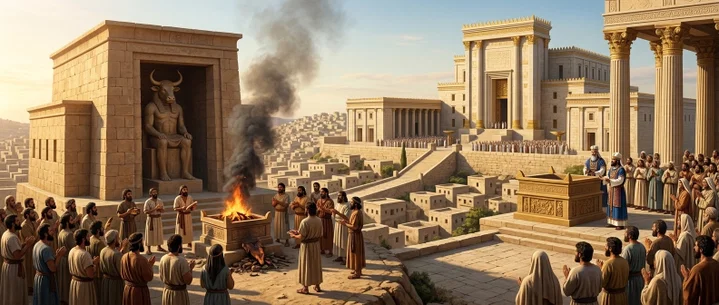
Cross-references
- 1 Kings 11:7
Then did Solomon build an high place for Chemosh, the abomination of Moab, in the hill that is before Jerusalem, and for Molech, the abomination of the children of Ammon.
Solomon built the high places Josiah defiled.
- 1 Kings 13:2
And he cried against the altar in the word of the LORD, and said, O altar, altar, thus saith the LORD; Behold, a child shall be born unto the house of David, Josiah by name; and upon thee shall he offer the priests of the high places that burn incense upon thee, and men’s bones shall be burnt upon thee.
The prophecy naming Josiah was fulfilled during his reign.
- 2 Kings 22:8
And Hilkiah the high priest said unto Shaphan the scribe, I have found the book of the law in the house of the LORD. And Hilkiah gave the book to Shaphan, and he read it.
Finding the law led Josiah to recognize Judah’s disobedience and destroy idolatrous sites.
- 2 Chronicles 34:3-7
For in the eighth year of his reign, while he was yet young, he began to seek after the God of David his father: and in the twelfth year he began to purge Judah and Jerusalem from the high places, and the groves, and the carved images, and the molten images.
Josiah removes idols and high places in both accounts.
- 2 Kings 23:4-7
And the king commanded Hilkiah the high priest, and the priests of the second order, and the keepers of the door, to bring forth out of the temple of the LORD all the vessels that were made for Baal, and for the grove, and for all the host of heaven: and he burned them without Jerusalem in the fields of Kidron, and carried the ashes of them unto Beth-el.
Josiah removes and destroys objects and practices of Baal and Ashtoreth worship.
- 2 Kings 18:4
He removed the high places, and brake the images, and cut down the groves, and brake in pieces the brasen serpent that Moses had made: for unto those days the children of Israel did burn incense to it: and he called it Nehushtan.
Hezekiah likewise threw down idolatrous worship.
- 1 Kings 8:22-53
And Solomon stood before the altar of the LORD in the presence of all the congregation of Israel, and spread forth his hands toward heaven:
Solomon prayed at the temple dedication before later falling into idolatry.
- Isaiah 44:17
And the residue thereof he maketh a god, even his graven image: he falleth down unto it, and worshippeth it, and prayeth unto it, and saith, Deliver me; for thou art my god.
Both describe worship of a man-made idol as an abomination.
Commentary
Each commentary is drawn from primary sources: the writings of Ellen G. White and Adventist pioneers and periodicals. Each commentary is separate. Its own words are not a quotation; follow the references to read the source passages.
Ellen G. White
8 sources
The high places were idol shrines and images for Ashtoreth the abomination of the Zidonians, and for Chemosh the abomination of the Moabites, and for Milcom, also called Moloch or Molech, the abomination of the children of Ammon, which Solomon built for his foreign, heathen, idolatrous wives and their gods to please them.RH Mar 10, 1910Ms 47, 1898, par. 38RH Mar 10, 1910Ms 40, 1898, par. 14–16 The builder was Solomon, the greatest king to wield a scepter, honored and applauded as wisest among kings, thrice called the beloved of God, pure and elevated in character with unexampled piety and wisdom, entrusted with the temple, who offered the prayer at its dedication and wrote Proverbs, after a manhood of glorious promise.Ms 47, 1898, par. 31–32Ms 40, 1898, par. 14–16 He built them after cherishing pride of political power, encouraging alliances with pagan kingdoms, and forming marriage alliances with daughters of pagan worshipers who led him away from God, breaking through the barriers God erected to preserve Israel, whom God had singled out as depositaries of sacred truth for the world, from idolatry.RH Mar 10, 1910Ms 40, 1898, par. 14–16 His wisdom was thus mingled with chaff, and his idolatry was mingled with his religious principles.RH Mar 10, 1910Ms 40, 1898, par. 14–16
The high places stood on the hill before Jerusalem on the right hand of the mount of corruption, on the southern eminence and slopes of the Mount of Olives, also called the Mount of Offense, opposite the temple of God on Mount Moriah across the ravine of Jehoshaphat and the Kidron, or Kedron, channel, above groves of myrtle and olive trees.RH Mar 10, 1910PK 402.6Ms 47, 1898, par. 31–32Ms 40, 1898, par. 14–16Lt 8b, 1891, par. 12–15 They were imposing, unseemly, gigantic, huge images and altars of wood and stone that peered above the trees and impiously confronted the temple, making a mount of offense and memorial stones of apostasy.Ms 47, 1898, par. 31–32Ms 40, 1898, par. 14–16Lt 8b, 1891, par. 12–15 The large images and buildings remained there for more than three centuries as lasting evidence and witnesses to his wrongdoing and apostasy, bearing testimony that he became a humiliating wreck, even after his repentance.PK 402.6Ms 47, 1898, par. 31–32
The youthful reformer Josiah in religious zeal defiled them, giving commandment that every building and idol should be destroyed and swept away.RH Mar 10, 1910Ms 47, 1898, par. 31–32Ms 40, 1898, par. 14–16Lt 8b, 1891, par. 12–15 The images were demolished and removed, and the broken, defaced fragments were rolled down into the Kidron channel, leaving the shrines a mass of ruins.RH Mar 10, 1910PK 402.6Ms 47, 1898, par. 31–32 Though the destruction was partial and debris still peered above the trees confronting the temple, the shrines were left in ruins.RH Mar 10, 1910Ms 47, 1898, par. 31–32Ms 40, 1898, par. 14–16
The broken fragments and masses of ruins remained visible into Christ's day, long after Solomon's reign, known in Israel as the Mount of Offense.Ms 47, 1898, par. 38RH Mar 10, 19107MR 74.1–3 Strangers in after generations asking what the ruins confronting the temple meant were told of Solomon's idol worship.Lt 8b, 1891, par. 12–15 They testified to his apostasy and showed his idolatry left a lasting mark beyond his reign, even after his repentance.RH Mar 10, 1910Ms 40, 1898, par. 14–16 The verse shows the power of influence in mingling error with truth, and gives evidence that a man who separates from obedience to God separates from wisdom and righteousness, becoming a tool of Satan and a slave to impulse with blunted sensibilities, seared conscience, and clouded perceptions.RH Mar 10, 1910Ms 40, 1898, par. 14–16
Sources
Pioneers and periodicals
20 sources
Solomon built idol shrines on the heights east of Jerusalem for Ashtoreth of the Sidonians, Chemosh of Moab, and Milcom of Ammon to please his heathen wives after they led him into apostasy.RH Mar 10, 1910RH Mar 31, 1910RH May 6, 1909ST Oct 22, 1894 Their polluting rites gave the hill the name mount of corruption or offense, and the buildings stood for more than three centuries as lasting evidence of his wrongdoing.RH Mar 10, 1910RH Mar 31, 1910ST Oct 22, 1894RH Nov 12, 1872 Josiah defiled, broke down, burned and demolished them when he was twenty-six after the long-lost book of the law was found, renewing the covenant and restoring the worship of God.ST Jan 20, 1904ST Jan 24, 1884ST May 10, 1910ST Oct 22, 1894 His work was the greatest reformation in Hebrew history, striking at every form of idolatry and sun worship and allowing no rival to God however beautiful, costly or long-established.ST Jan 20, 1904ST Jan 24, 1884RH Jun 29, 1911RH Nov 12, 1872 As Baal and Ashtoreth and the honor of the sun had then supplanted the worship of Jehovah, so now the worship of the beast and his image and the honor of the day of the sun are supplanting it, calling for a new reformation that removes heathen custom and establishes true worship.ST Jan 20, 1904ST Jun 12, 1907ST Feb 3, 1898ST Dec 24, 1885
Shrines Built and Defiled
The high places before Jerusalem on the right hand of the mount of corruption were sanctuaries Solomon king of Israel built on the prominent heights of Olivet opposite Jerusalem and the temple for the gods of his foreign wives.RH Mar 10, 1910RH Mar 31, 1910 They were for Ashtoreth the abomination of the Zidonians, and for Chemosh the abomination of Moab, and for Milcom or Molech, also called Moloch, the divine king of the Ammonites.RH Mar 31, 1910RH May 6, 1909ST Oct 22, 1894ST Jul 2, 1885 Josiah defiled them as part of his thorough removal of Judah's idolatry and restoration of the worship of God, destroying monuments of long-standing idolatry.RH May 6, 1909ST Oct 22, 1894ST Jul 2, 1885 By calling these idols abominations the verse shows idolatry and false gods are abominations in God's sight.RH May 6, 1909
Solomon built them through alliances and marriages with heathen nations in an effort to please his wives, after his heathen wives led him into apostasy.RH Mar 10, 1910RH Mar 10, 1910 In this he let idolatry mingle with his religious principles.RH Mar 10, 1910 Their rites gave the hill the name mount of corruption, meaning offense.RH Mar 31, 1910 That name and Olivet were used for the whole eminence until the Christian era, when the name was confined to its southernmost peak.RH Mar 31, 1910
The buildings and images stood for generations as lasting evidence of his wrongdoing even after his repentance. They were preserved for more than three centuries and four hundred years as fine-art galleries of beauty and skill.RH Nov 12, 1872 Their ruins remained visible into the time of Christ and were known in Israel as the Mount of Offense, testifying to Solomon's apostasy and leaving a lasting mark beyond his reign.RH Mar 10, 1910
The verse falls within the final section of Kings' account of the monarchy from Solomon's accession to the Babylonian Captivity.ST Dec 9, 1897 It covers Judah after the ten tribes had been swept away.ST Dec 9, 1897 Its history of Judah's rulers shows rulers sometimes turned from God to idolatry and brought calamity on themselves and their people.ST May 5, 1909
The king who defiled them was Josiah at twenty-six, after the long-lost book of the law, the long-lost Bible, was found.RH Nov 12, 1872 He defiled and destroyed, broke down, burned, and demolished the idolatrous high places, shrines, images, and monuments.ST May 10, 1910ST Oct 22, 1894ST Jul 2, 1885RH Nov 12, 1872 He ordered them destroyed with their broken pieces rolled into the Kidron channel, leaving the shrines in ruins.RH Mar 10, 1910 It was a thorough reform from limit to limit of the country and a bright example, a bright chapter, of a good king turning the people back to God and restoring His worship.ST May 10, 1910ST Jul 2, 1885RH Nov 12, 1872
Reformation Pattern and Call
Josiah's defiling of the high places belongs to the greatest reformation in Hebrew history and to a historic revival.ST Jan 20, 1904 After Huldah warned Judah of the consequences of unfaithfulness, he renewed the covenant to obey God's commandments and the people joined him.ST Jan 24, 1884RH Jun 29, 1911 The Bible was read to the people and brought conviction of national sin.ST Jan 24, 1884 The Passover was then kept according to the book as unlike any held since the days of the judges.ST Jan 24, 1884
He found Chemosh of Moab and Milcom of Ammon among ten forms of idolatry and iniquity polluting the temple and the people.ST Jan 20, 1904 He struck at Baal worship and sun worship and at the low, sensual religions the people loved.RH Jun 29, 1911 He destroyed all existing relics of idolatry, defiled the idol altars and sites, banished the many idols, and removed the places used for their worship.ST Jan 20, 1904RH Jun 29, 1911ST Jul 2, 1885 He also degraded priests of Jehovah who had corrupted His worship.ST Jan 20, 1904
Josiah was a good, devoted, zealous reformer, one of two such men of God among the seven kings from Hezekiah to Zedekiah.ST Jun 3, 1913 He fulfilled the prophecy recorded in 1 Kings 13.ST Jun 3, 1913 Yet he could not check the downward trend, and after his sad death the kingdom of Judah soon fell before Nebuchadnezzar. He was the last king of Jerusalem who obeyed the Lord's commandments and kept His statutes, his reign ending in 607 BC, after which the people could no longer keep the release year or Jubilee and the Jubilee count stopped.SMV 22.1–24.1ST Jun 3, 1913
The high places show that people had come to look upon mountains as protectors, deliverers, and places of refuge.RH Nov 7, 1912 The heathen gave this a religious significance and placed the polluting symbols of idolatrous worship upon hills and mountains.RH Nov 7, 1912 Whenever Israel was ruled by wicked, sensual kings this heathen idea was carried out throughout the realm and the people went after Baal and Ashtoreth, whose altars were on the high places.RH Nov 7, 1912 When a king who feared and served the true God came to the throne the hill groves of idolatry were hewn down and the mountain altars were overthrown, and the people learned righteousness and sought the true place of refuge.RH Nov 7, 1912
The throwing down of Solomon's temples for false worship proves that when God's people were nearest to Him there was the least outward expression in mere stone and wood.ST Jun 12, 1907 What God desires is beauty of character in souls and not architectural beauty, and God Himself was thereby recognized.ST Jun 12, 1907 The removal of heathen worship and sun worship calls for eliminating heathen customs and establishing true worship.ST Feb 3, 1898 That reform applies to village shrines where people burn incense, make vows, and feast.ST Feb 3, 1898 Sabbath-keeping is a sign of such reform because the Sabbath signifies that God sanctifies.ST Feb 3, 1898
His zeal was thorough from limit to limit of the country, done at twenty-six after the long-lost Bible was found, with the hammer of an iconoclast leaving no relic unbroken though the shrines had been preserved four hundred years as fine-art galleries of beauty and skill.RH Nov 12, 1872 It persisted despite curses, loss of priestly offices, overturned customs, pleas of art and beauty, and sentiment against narrow Puritanism.RH Nov 12, 1872 Zeal for the Lord God allows no compromise or rivalry with God, however beautiful or costly or long-established.RH Nov 12, 1872 When the Bible is found by the heart it plucks up root and fibre, sees danger where others feel secure, guards against incipient evils, and crushes the eggs of the serpent.RH Nov 12, 1872
In Josiah's days the worship of Baal and Ashtoreth and the honor of the sun had supplanted the worship and honor of Jehovah.ST Dec 24, 1885 So now the worship of the beast, which is the papacy, and his image, which is the so-called National Reform, and the honor of the venerable day of the sun are fast supplanting the worship and honor of Jehovah.ST Dec 24, 1885 His action is therefore a pattern calling for a new reformation to confront the evils of the present day and to meet practical missionary problems.ST Jan 20, 1904ST Dec 24, 1885
Sources