2 Kings 23:4
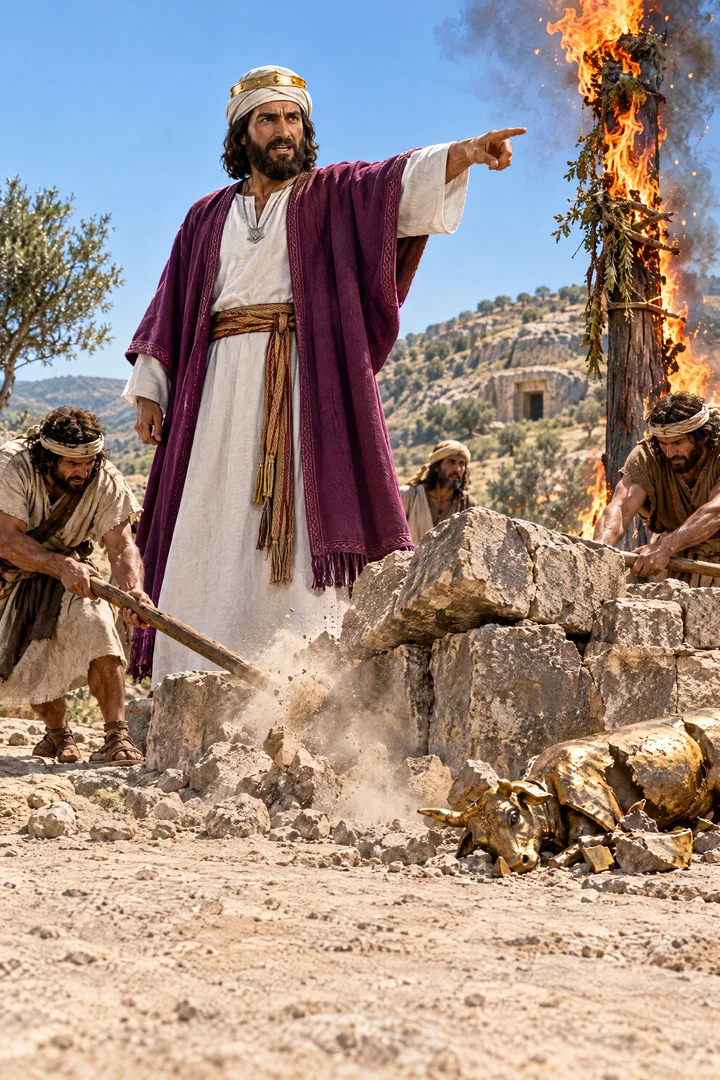
And the king commanded Hilkiah the high priest, and the priests of the second order, and the keepers of the door, to bring forth out of the temple of the LORD all the vessels that were made for Baal, and for the grove, and for all the host of heaven: and he burned them without Jerusalem in the fields of Kidron, and carried the ashes of them unto Beth-el.
Translations
And the king commanded Hilkiah the high priest, and the priests of the second order, and the keepers of the door, to bring forth out of the temple of the LORD all the vessels that were made for Baal, and for the grove, and for all the host of heaven: and he burned them without Jerusalem in the fields of Kidron, and carried the ashes of them to Bethel.
And the king commanded Hilkiah the high priest, and the priests of the second order, and the keepers of the door, to bring forth out of the temple of the LORD all the vessels that were made for Baal, and for the grove, and for all the host of heaven: and he burned them without Jerusalem in the fields of Kidron, and carried the ashes of them unto Beth-el.
And the king commanded Hilkiah the high priest, and the priests of the second order; and the keepers of the door, to bring forth out of the temple of the Lord all the vessels that were made for Baal, and for the grove, and for all the host of heaven: and he burnt them without Jerusalem in the fields of Kidron, and carried the ashes of them unto Beth-el.
And the king commanded Hilkiah the high priest, and the priests of the second order, and the keepers of the door, to bring forth out of the temple of the LORD all the vessels that were made for Baal, and for the grove, and for all the host of heaven: and he burned them without Jerusalem in the fields of Kidron, and carried the ashes of them to Beth-el.
And the king commanded Hilkiah the high priest, and the priests of the second order, and the keepers of the door, to bring forth out of the temple of the LORD all the vessels that were made for Baal, and for the Asherah, and for all the host of heaven: and he burned them without Jerusalem in the fields of Kidron, and carried the ashes of them unto Beth-el.
And the king commanded Hilkiah the high priest, and the priests of the second order, and the keepers of the threshold, to bring forth out of the temple of Jehovah all the vessels that were made for Baal, and for the Asherah, and for all the host of heaven, and he burned them without Jerusalem in the fields of the Kidron, and carried the ashes of them unto Beth-el.
And the king commandeth Hilkiah the high priest, and the priests of the second order, and the keepers of the threshold, to bring out from the temple of Jehovah all the vessels that are made for Baal, and for the shrine, and for all the host of the heavens, and he burneth them at the outside of Jerusalem, in the fields of Kidron, and hath borne their ashes to Beth-El.
And the king commanded Hilkijah the high priest, and the priests of the second order, and the doorkeepers, to bring forth out of the temple of Jehovah all the vessels that had been made for Baal, and for the Asherah, and for all the host of the heavens; and he burned them outside Jerusalem in the fields of Kidron, and carried the ashes of them to Bethel.
Then the king commanded Hilkiah the high priest, and the priests of the second order, and the keepers of the entrance-hall, to bring forth, out of the temple of Yahweh, all the vessels that had been made for Baal and for the Sacred Stem, and for all the army of the heavens,—and he burned them up outside Jerusalem, in the fields of Kidron, and carried the ashes of them to Bethel;
Berean Standard Bible, Majority Standard Bible
Then the king commanded Hilkiah the high priest, the priests second in rank, and the doorkeepers to remove from the temple of the LORD all the articles made for Baal, Asherah, and all the host of heaven. And he burned them outside Jerusalem in the fields of Kidron and carried their ashes to Bethel.
The king commanded Hilkiah the high priest, and the priests of the second order, and the keepers of the threshold, to bring out of the LORD’s temple all the vessels that were made for Baal, for the Asherah, and for all the army of the sky; and he burned them outside of Jerusalem in the fields of the Kidron, and carried their ashes to Bethel.
Then the king gave orders to Hilkiah, the chief priest, and to the priests of the second order, and to the keepers of the door, to take out of the house of the Lord all the vessels made for Baal and for the Asherah and for all the stars of heaven; and he had them burned outside Jerusalem in the fields of Kidron, and took the dust of them to Beth-el.
Then the King commanded Hilkiah the hie Priest and the priests of the second order, and the keepers of the doore, to bring out of ye Temple of the Lord all the vessels that were made for Baal, and for the groue, and for all the hoste of heauen, and he burnt them without Ierusalem in the fieldes of Kedron, and caryed the pouder of them into Beth-el.
Douay-Rheims (Challoner revision)
And the king commanded Helcias the high priest, and the priests of the second order, and the doorkeepers, to cast out of the temple of the Lord all the vessels that had been made for Baal, and for the grove, and for all the host of heaven: and he burnt them without Jerusalem in the valley of Cedron, and he carried the ashes of them to Bethel.
Pictures
Cross-references
- 2 Kings 21:5
And he built altars for all the host of heaven in the two courts of the house of the LORD.
Manasseh set up host-of-heaven altars that Josiah later removed.
- 1 Kings 13:1-2
And, behold, there came a man of God out of Judah by the word of the LORD unto Beth-el: and Jeroboam stood by the altar to burn incense.
Josiah fulfills the man of God’s prophecy to Jeroboam.
- 2 Chronicles 34:4
And they brake down the altars of Baalim in his presence; and the images, that were on high above them, he cut down; and the groves, and the carved images, and the molten images, he brake in pieces, and made dust of them, and strowed it upon the graves of them that had sacrificed unto them.
Describes the removal and destruction of idols.
- 2 Kings 18:4
He removed the high places, and brake the images, and cut down the groves, and brake in pieces the brasen serpent that Moses had made: for unto those days the children of Israel did burn incense to it: and he called it Nehushtan.
Both kings destroyed objects of idolatrous worship.
- 2 Kings 22:16-17
Thus saith the LORD, Behold, I will bring evil upon this place, and upon the inhabitants thereof, even all the words of the book which the king of Judah hath read:
Huldah foretells judgment for idolatry before Josiah’s reforms.
- 2 Kings 22:3-13
And it came to pass in the eighteenth year of king Josiah, that the king sent Shaphan the son of Azaliah, the son of Meshullam, the scribe, to the house of the LORD, saying,
The rediscovered book of the law precedes and strengthens Josiah’s reforms.
- 2 Kings 23:15-20
Moreover the altar that was at Beth-el, and the high place which Jeroboam the son of Nebat, who made Israel to sin, had made, both that altar and the high place he brake down, and burned the high place, and stamped it small to powder, and burned the grove.
Josiah continues the purge by destroying Bethel’s altar and high places.
- 2 Chronicles 35:1-19
Moreover Josiah kept a passover unto the LORD in Jerusalem: and they killed the passover on the fourteenth day of the first month.
Records Josiah’s religious reforms and observance.
- 1 Kings 18:21
And Elijah came unto all the people, and said, How long halt ye between two opinions? if the LORD be God, follow him: but if Baal, then follow him. And the people answered him not a word.
Elijah calls Israel to choose between following the LORD and Baal.
- 2 Chronicles 34:8
Now in the eighteenth year of his reign, when he had purged the land, and the house, he sent Shaphan the son of Azaliah, and Maaseiah the governor of the city, and Joah the son of Joahaz the recorder, to repair the house of the LORD his God.
Josiah’s temple repairs accompany his purification of the temple.
- 1 Kings 11:5-7
For Solomon went after Ashtoreth the goddess of the Zidonians, and after Milcom the abomination of the Ammonites.
Solomon established worship of foreign gods in Judah.
- 2 Kings 23:10
And he defiled Topheth, which is in the valley of the children of Hinnom, that no man might make his son or his daughter to pass through the fire to Molech.
Josiah defiled Topheth to prevent worship of Molech there.
- Psalms 106:28-29
They joined themselves also unto Baal-peor, and ate the sacrifices of the dead.
Israel joined pagan worship and provoked God.
- 2 Kings 22:2
And he did that which was right in the sight of the LORD, and walked in all the way of David his father, and turned not aside to the right hand or to the left.
Josiah’s faithful reign precedes his reformation.
Commentary
Each commentary is drawn from primary sources: the writings of Ellen G. White and Adventist pioneers and periodicals. Each commentary is separate. Its own words are not a quotation; follow the references to read the source passages.
Ellen G. White
1 source
The cleansing described here did not stand alone but followed a deliberate proposal that those highest in authority should unite in solemn covenant before the Lord to cooperate together in bringing about a reformation.Ms 14, 1903, par. 21 That covenant commitment was the foundation for the decisive action that followed, linking leadership unity with practical purification.Ms 14, 1903, par. 21 Immediately before the command was given, the king took his stand by a pillar and entered into covenant to walk after the Lord.Ms 14, 1903, par. 21 In that covenant he pledged to keep His commandments and His testimonies and His statutes with all heart and with all soul, in harmony with the words written in the book, and all the people stood to the covenant with him.Ms 14, 1903, par. 21
What followed was the resulting work of cleansing, carried out under royal command.Ms 14, 1903, par. 21 The king directed Hilkiah the high priest, together with the priests of the second order and the keepers of the door, to bring out of the temple of the Lord everything that had been made for Baal and for the grove and for the host of heaven.Ms 14, 1903, par. 21 Those idolatrous vessels were removed from the sacred house and then burned outside Jerusalem in the fields of Kidron.Ms 14, 1903, par. 21 Their ashes were carried away to Bethel, completing the removal of defilement from the temple precincts.Ms 14, 1903, par. 21
Sources
Pioneers and periodicals
17 sources
The king ordered Hilkiah the high priest with the second-order priests and the doorkeepers to carry every idolatrous vessel out of the Lord's temple, burn them outside Jerusalem in the Kidron fields, and take their ashes to Bethel.ST Jul 2, 1885 Those vessels had been made for Baal, for the grove or Asherah, and for all the host of heaven, meaning the sun, moon and stars and the wider sun worship that had filled the temple.ST Jan 20, 1904ST Aug 20, 1894RH Jun 29, 1911 The cleansing came after the rediscovered law was read to the people and brought conviction of national sin, and it fulfilled hundreds of years later the word spoken by the man of God to Jeroboam.RH Jun 29, 1911ST May 10, 1910ST Jun 3, 1913RH Nov 12, 1872 It was one step in a thorough national reform that ended idol worship, purified the temple, threw down idolatrous shrines and groves, and restored the worship of the Lord, showing how far Israel had turned in bringing pagan images and practices into God's house.ST Aug 20, 1894ST Nov 5, 1912ST Jul 2, 1885ST Dec 24, 1885 That resolute, uncompromising destruction of even beautiful and longstanding idolatry stands as the pattern for a present reformation that puts away heathen customs and sun worship, keeps the Sabbath as the sign of sanctification, and refuses the later exaltation of the beast, its image and Sunday observance.ST Jan 20, 1904ST Jul 2, 1885RH Nov 12, 1872ST Feb 3, 1898ST Dec 24, 1885
Josiah's Temple Cleansing
The verse belongs to the history of the remaining kingdom of Judah after the ten tribes had been swept away, within the account of the kings from Solomon's accession through the Babylonian captivity.ST Dec 9, 1897 It stands as the one bright chapter amid the wicked and weak closing reigns of the kings of Judah, showing the reformation conducted under the good king Josiah supported by his godly priests and counselors.ST May 10, 1910
The cleansing followed the rediscovery of the law and Huldah's counsel, belonging to Josiah's reform when he broke up and burned idols, idolatrous shrines, and groves.RH Jun 29, 1911 It was part of a revival in which the Bible was read to the people and they were brought to feel the nation's sin. That Bible-led removal of idolatry was uncompromising, breaking down idolatrous objects and places even when they were beautiful, longstanding, or bound up with people's customs and livelihoods, as part of the campaign to cleanse the land of idolatry.RH Nov 12, 1872
The king commanded Hilkiah the high priest, the priests of the second order, and the keepers of the door to bring the idolatrous vessels out of the temple of the LORD.ST Jul 2, 1885 Those vessels were then burned outside Jerusalem in the fields of Kidron, and their ashes were carried to Bethel.ST Jul 2, 1885 The work removed idolatrous objects even from the Lord's temple in a thorough and resolute effort to abolish idolatry and restore the worship of God.ST Jul 2, 1885
The vessels removed and destroyed were made for Baal, for the grove or Asherah or sacred pole, and for all the host of heaven.ST Jan 20, 1904RH Jun 29, 1911ST Nov 5, 1912 The host of heaven meant the sun, moon, and twelve constellations.ST Oct 22, 1894 The wider purge covered associated worship of Tammuz, Molech, and other pagan sun worship, including horses and chariots devoted to the sun and the image of Baal, with Israel having brought images associated with child worship and pagan practices into the temple.ST Aug 20, 1894RH Jun 29, 1911 It belonged to the greatest reformation recorded in Hebrew history, when Josiah cleansed the temple and people from at least ten forms of idolatry and iniquity polluting them, including worship of Baal and Astarte, Asherah abominations, sodomites, Tophet or Moloch, Chemosh of Moab, Milcom of Ammon, calf worship at Bethel, consulting familiar spirits, and offering incense in high places, destroying all existing relics of idolatry, defiling idol altars and sites, and degrading priests who had corrupted true worship.ST Jan 20, 1904 In heathen belief that host was held to represent departed human souls made divine along with a higher class of demons never joined to a human body.ST Oct 22, 1894
Josiah was the last king of Jerusalem who obeyed the Lord's commandments and kept His statutes.SMV 22.1–24.1 His reign ended in 607 B.C., when the keeping of release years and Jubilees ceased.SMV 22.1–24.1
Prophecy Fulfilled and Worship Restored
The cleansing fulfilled the prophecy spoken by the man of God to Jeroboam, also described as given by the disobedient prophet in 1 Kings 13, fulfilled hundreds of years later just as the Lord declared it would.ST May 10, 1910ST Jun 3, 1913
The removal and destruction of the vessels used in worship of Baal and other false gods was one step in a national reform that ended idolatrous worship and restored the worship of the Lord.ST Nov 5, 1912ST Jul 2, 1885 Josiah purified the temple by removing and destroying the vessels used for Baal, the Asherah, and the host of heaven, as part of restoring the temple and its worship through a thorough reformation.ST Nov 5, 1912ST Jul 2, 1885 He broke up and burned idols, idolatrous shrines, and groves in a revival in which the Bible was read to the people and they were brought to feel the nation's sin. His reformation threw down idolatrous temples and cleared idolatrous vessels and worship so that God Himself was recognized.ST Jul 2, 1885ST Jun 12, 1907
The verse shows how far Israel had turned from the true God, bringing images associated with Baal, Tammuz, Molech, and other pagan sun worship into the temple, turning to child worship and pagan practices whose vessels were removed and destroyed under the king's command.ST Aug 20, 1894RH Nov 7, 1912 Under wicked, sensual kings Israel took up the heathen idea that mountains are protectors, deliverers, and places of refuge, went after Baal and Ashtoreth whose altars were on the high places, and set the polluting symbols of idolatrous worship upon the hills and mountains, even bringing vessels made for Baal and for the grove and for the host of heaven into the temple of the Lord.ST Aug 20, 1894RH Nov 7, 1912 The godly king brought those vessels out and burned them, hewed down the hill groves of idolatry, and overthrew the mountain altars.RH Nov 7, 1912 These forms of worship had displaced the worship and honor due to Jehovah.ST Aug 20, 1894ST Dec 24, 1885
By that cleansing the people learned righteousness and sought the true place of refuge instead of false mountain refuges.RH Nov 7, 1912 The reform proves that when God's people are nearest to Him there is the least outward expression in mere stone and wood, because what God desires is beauty of character and transformed souls, not architectural beauty, poetry of worship, symbolism, or grand elaborately ornamental edifices.ST Jun 12, 1907
Pattern for Present Reform
Josiah's work was the greatest reformation recorded in Hebrew history, a thorough and resolute effort to abolish idolatry and restore the worship of God by commanding the priests and doorkeepers to bring out of the temple all vessels made for Baal, for the Asherah or grove, and for the host of heaven, then burning them outside Jerusalem and carrying their ashes to Bethel.ST Jan 20, 1904ST Jul 2, 1885 That cleansing removed at least ten polluting forms of idolatry and iniquity, including worship of Baal and Astarte, Asherah abominations, sodomites, Tophet or Moloch, Chemosh of Moab, Milcom of Ammon, calf worship at Bethel, consulting familiar spirits, and offering incense in high places.ST Jan 20, 1904 It destroyed all existing relics of idolatry, defiled idol altars and sites, and degraded priests who had corrupted true worship.ST Jan 20, 1904 It was uncompromising, breaking down idolatrous objects and places even when they were beautiful, longstanding, or bound up with people's customs and livelihoods.ST Jul 2, 1885RH Nov 12, 1872 It stands as the pattern for a new reformation to confront the evils of the present day.ST Jan 20, 1904
That reform is applied as the pattern for removing heathen customs and sun worship and establishing true worship.ST Feb 3, 1898 Keeping the Sabbath belongs to that pattern, as the sign that God sanctifies, accompanied by a marked reform in life.ST Feb 3, 1898 The displacement of the worship and honor due to Jehovah by Baal, Asherah, and the heavenly host illustrates the later exaltation of the beast, its image, and Sunday observance.ST Dec 24, 1885
The reform confronted the low, sensual religions the people loved, including Baal worship, grove worship, and worship of the host of heaven with its sun worship brought into the temple. It could not check their downward trend, and after his sad death the kingdom of Judah soon fell before Nebuchadnezzar. A good king who turns to God breaks down false worship, though such a reform can later be reversed when another king restores the abominations.RH May 18, 1869
Sources