2 Kings 23:15
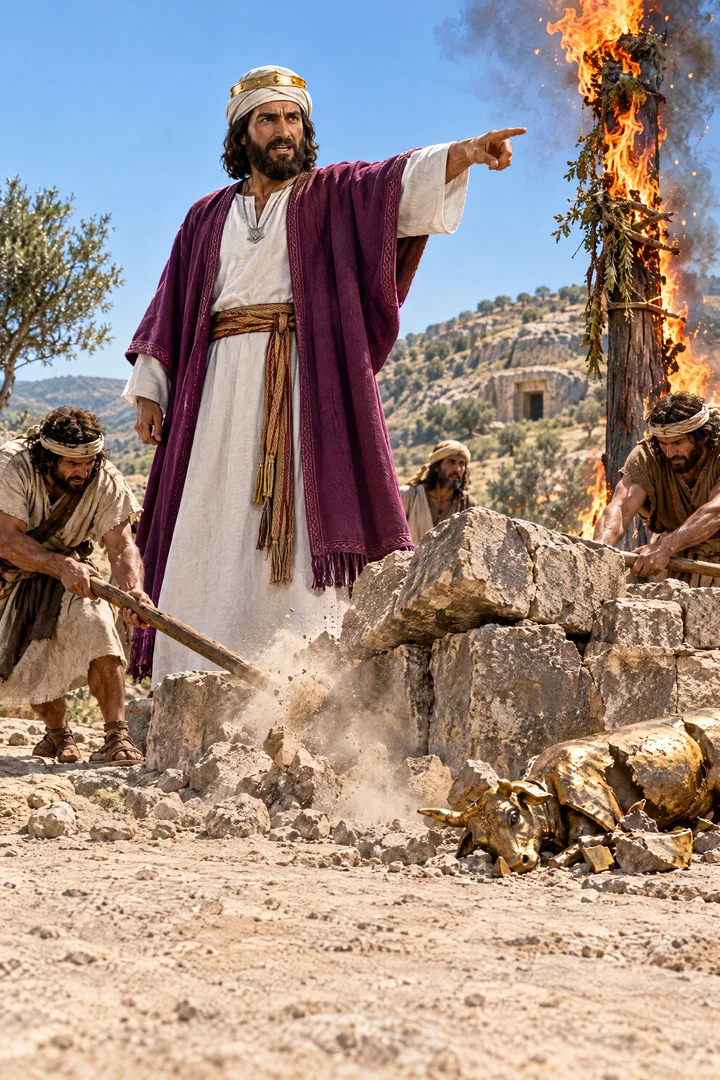
Moreover the altar that was at Beth-el, and the high place which Jeroboam the son of Nebat, who made Israel to sin, had made, both that altar and the high place he brake down, and burned the high place, and stamped it small to powder, and burned the grove.
Translations
Moreover the altar that was at Bethel, and the high place which Jeroboam the son of Nebat, who made Israel to sin, had made, both that altar and the high place he broke down, and burned the high place, and stamped it small to powder, and burned the grove.
Moreover the altar that was at Beth-el, and the high place which Jeroboam the son of Nebat, who made Israel to sin, had made, both that altar and the high place he brake down, and burned the high place, and stamped it small to powder, and burned the grove.
Moreover the altar that was at Beth-el, and the high place which Jeroboam the son of Nebat, who made Israel to sin, had made, both that altar and the high place he brake down, and burnt the high place, and stampt it small to powder, and burnt the grove.
Moreover, the altar that was at Beth-el, and the high place which Jeroboam the son of Nebat, who made Israel to sin, had made, both that altar and the high place he broke down, and burned the high place, and stamped it small to powder, and burned the grove.
Moreover the altar that was at Beth-el, and the high place which Jeroboam the son of Nebat, who made Israel to sin, had made, even that altar and the high place he brake down; and he burned the high place and stamped it small to powder, and burned the Asherah.
Moreover the altar that was at Beth-el, and the high place which Jeroboam the son of Nebat, who made Israel to sin, had made, even that altar and the high place he brake down; and he burned the high place and beat it to dust, and burned the Asherah.
and also the altar that [is] in Beth-El, the high place that Jeroboam son of Nebat made, by which he made Israel sin, both that altar and the high place he hath broken down, and doth burn the high place — he hath beat it small to dust, and hath burnt the shrine.
Moreover the altar that was at Bethel, the high place that Jeroboam the son of Nebat, who caused Israel to sin, had made, both that altar and the high place he broke down; and burned the high place, stamped it small to powder, and burned the Asherah.
moreover also, the altar that was in Bethel, the high place which Jeroboam son of Nebat made, wherewith he caused, Israel, to sin,—even that altar, and the high place, brake he down,—and burned the high place, crushing it to powder, and burned a Sacred Stem.
Berean Standard Bible, Majority Standard Bible
He even pulled down the altar at Bethel, the high place set up by Jeroboam son of Nebat, who had caused Israel to sin. Then he burned the high place, ground it to powder, and burned the Asherah pole.
Moreover the altar that was at Bethel and the high place which Jeroboam the son of Nebat, who made Israel to sin, had made, even that altar and the high place he broke down; and he burned the high place and beat it to dust, and burned the Asherah.
And the altar at Beth-el, and the high place put up by Jeroboam, the son of Nebat, who made Israel do evil, that altar and that high place were pulled down; and the high place was burned and crushed to dust and the Asherah was burned.
Furthermore the altar that was at Beth-el, and the hie place made by Ieroboam the sonne of Nebat, which made Israel to sinne, both this altar and also the hie place, brake he downe, and burnt the hie place, and stampt it to powder and burnt the groue.
Douay-Rheims (Challoner revision)
Moreover the altar also that was at Bethel, and the high place, which Jeroboam the son of Nabat, who made Israel to sin, had made: both the altar, and the high place he broke down and burnt, and reduced to powder, and burnt the grove.
Pictures
Cross-references
- 1 Kings 13:2
And he cried against the altar in the word of the LORD, and said, O altar, altar, thus saith the LORD; Behold, a child shall be born unto the house of David, Josiah by name; and upon thee shall he offer the priests of the high places that burn incense upon thee, and men’s bones shall be burnt upon thee.
Foretells Josiah’s destruction and defilement of Bethel’s altar.
- 2 Chronicles 34:3-7
For in the eighth year of his reign, while he was yet young, he began to seek after the God of David his father: and in the twelfth year he began to purge Judah and Jerusalem from the high places, and the groves, and the carved images, and the molten images.
Josiah purged idolatry and destroyed its shrines.
- 2 Kings 22:2
And he did that which was right in the sight of the LORD, and walked in all the way of David his father, and turned not aside to the right hand or to the left.
Josiah’s destruction of the altar reflects his commitment to do what was right.
- 2 Chronicles 35
Moreover Josiah kept a passover unto the LORD in Jerusalem: and they killed the passover on the fourteenth day of the first month.
Parallel account of Josiah’s reign and work.
- 1 Kings 12:32
And Jeroboam ordained a feast in the eighth month, on the fifteenth day of the month, like unto the feast that is in Judah, and he offered upon the altar. So did he in Beth-el, sacrificing unto the calves that he had made: and he placed in Beth-el the priests of the high places which he had made.
Jeroboam established an altered festival at Bethel for worship at the altar.
- 1 Kings 12:28
Whereupon the king took counsel, and made two calves of gold, and said unto them, It is too much for you to go up to Jerusalem: behold thy gods, O Israel, which brought thee up out of the land of Egypt.
Records the golden calf set up for Israel’s worship.
- 1 Kings 12:31
And he made an house of high places, and made priests of the lowest of the people, which were not of the sons of Levi.
Jeroboam established unauthorized priests and a worship system that Josiah later destroyed.
- 1 Kings 12:27
If this people go up to do sacrifice in the house of the LORD at Jerusalem, then shall the heart of this people turn again unto their lord, even unto Rehoboam king of Judah, and they shall kill me, and go again to Rehoboam king of Judah.
Jeroboam feared losing the people and established rival worship centers.
- 1 Kings 13:33
After this thing Jeroboam returned not from his evil way, but made again of the lowest of the people priests of the high places: whosoever would, he consecrated him, and he became one of the priests of the high places.
Jeroboam continued his unauthorized priest-making at the high places.
- 2 Kings 18:4
He removed the high places, and brake the images, and cut down the groves, and brake in pieces the brasen serpent that Moses had made: for unto those days the children of Israel did burn incense to it: and he called it Nehushtan.
Hezekiah also removed high places and broke down idolatrous objects.
- 2 Kings 17:28
Then one of the priests whom they had carried away from Samaria came and dwelt in Beth-el, and taught them how they should fear the LORD.
Bethel’s sanctuary persisted after Samaria fell.
- 2 Kings 22:16-17
Thus saith the LORD, Behold, I will bring evil upon this place, and upon the inhabitants thereof, even all the words of the book which the king of Judah hath read:
Huldah’s prophecy of judgment prompted Josiah’s reforms against idolatry.
- 2 Kings 22:8
And Hilkiah the high priest said unto Shaphan the scribe, I have found the book of the law in the house of the LORD. And Hilkiah gave the book to Shaphan, and he read it.
Temple repair led to finding the lost book of the law.
Commentary
Each commentary is drawn from primary sources: the writings of Ellen G. White and Adventist pioneers and periodicals. Each commentary is separate. Its own words are not a quotation; follow the references to read the source passages.
Ellen G. White
4 sources
The altar at Bethel and the high place were what Jeroboam the son of Nebat, who made Israel to sin, had made.PK 402.3–5RH Jul 29, 1915PK 401.2–402.2 Josiah broke down both that altar and the high place, burned the high place, and stamped it small to powder.PK 402.3–5RH Jul 29, 1915PK 401.2–402.2 He also burned the grove, the sacred grove at Bethel, and this destruction fulfilled literally the prophecy spoken centuries earlier that a king named Josiah would desecrate and defile that altar.PK 402.3–5RH Jul 29, 1915PK 401.2–402.2
That prophecy had been spoken long before in the presence of Jeroboam, and the place was profaned as foretold.PK 402A The altar was polluted as foretold when Josiah turned, saw the sepulchers in the mount, took the bones out of the sepulchers, and burned human bones upon the altar, according to the word of the Lord proclaimed by the man of God from Judah against the altar of Bethel.PK 402.3–5PK 401.2–402.2 When told that the marker he saw was the sepulcher of that man of God, Josiah commanded to let him alone and let no man move his bones, so his bones were left alone with the bones of the prophet that came out of Samaria.PK 402.3–5
Sources
Pioneers and periodicals
18 sources
Josiah demolished the idolatrous altar and hill shrine at Bethel erected by Jeroboam son of Nebat to lead Israel into sin, grinding it to dust by fire along with its sacred grove.RH Jul 29, 1915RH Apr 7, 1910ST Jun 3, 1913 He did so when the rediscovered book of the law was read in the eighteenth year of his reign, prompting him to renew the covenant and purge Judah and Bethel of Baal, Ashtoreth and sun worship.ST Jan 24, 1884ST Jun 3, 1889ST Feb 14, 1906RH Nov 7, 1912ST Dec 24, 1885 The act completed exactly what a prophet had announced against that altar more than three hundred years before, naming Josiah by name.RH Jul 29, 1915RH Feb 12, 1861ST May 10, 1910RH Apr 7, 1910ST Dec 7, 1882 Though thorough, his cleansing could not turn back the nation's decline nor prevent its coming captivity under Nebuchadnezzar.ST Feb 14, 1906 The overthrow remains the model for a present cleansing, calling God's people to cast down modern idolatry and honor Him by keeping His law and Sabbath instead of the worship of the beast and the day of the sun.ST Jan 20, 1904RH Nov 7, 1912ST Jun 12, 1907ST Dec 24, 1885
Josiah's Reform at Bethel
Moreover the verse records that Josiah broke down both the altar and the high place at Bethel, burned the high place, stamped it small to powder, and burned the grove.RH Jul 29, 1915ST Jun 3, 1913 That altar and high place were those Jeroboam the son of Nebat had made, by which he made Israel to sin and led them away from God.RH Apr 7, 1910ST Jun 3, 1913 Over time the people came to regard its calf as God.RH Apr 7, 1910
The worship destroyed there was the supplanting of the worship of Jehovah by Baal and Ashtoreth and the honor of the sun.RH Nov 7, 1912ST Dec 24, 1885 Its altars stood on hills and mountains because of the heathen idea that mountains were protectors, deliverers, and places of refuge, an idea carried out throughout Israel under wicked, sensual kings.RH Nov 7, 1912 The destruction belongs to Josiah's reformation after the long-lost book of the law was found in the rubbish of the Temple in the eighteenth year of his reign and read.ST Jan 24, 1884ST Jun 3, 1889ST Feb 14, 1906 That recovered word exposed disobedience and led him to renew the covenant and restore worship according to the law.ST Jan 24, 1884ST Jun 3, 1889
The reform was thorough and wide-reaching, for Josiah cleansed the Temple and removed objects and places devoted to Baal and sun worship.ST Jan 20, 1904RH Jun 29, 1911ST Oct 22, 1894 It dealt with at least ten forms of idolatry and iniquity, including calf worship at Bethel, destroying all existing relics of that idolatry by breaking down, defiling, and burning.ST Jan 20, 1904RH Jun 29, 1911 Supported by godly priests and counselors, he degraded corrupt priests who had corrupted the worship of Jehovah and burned the bones of priests on their own altars.ST Jan 20, 1904ST May 10, 1910ST Feb 14, 1906 He carried the purging from Jerusalem to Bethel beyond Judah to the place of Israel's sin, a resolute reform carried out without turning aside from the path of duty.ST May 10, 1910ST Jul 2, 1885ST Feb 14, 1906
In history the verse falls in Judah's remaining kingdom after the ten tribes had been swept away.ST Dec 9, 1897 Bethel's sanctuary had then survived the kingdom of Samaria by about a century, marking the end of a sanctuary that had stood for roughly three hundred years.RH Apr 7, 1910 It was the one bright reformation amid the wicked and weak closing reigns of Judah.ST May 10, 1910 It was done under the last king of Jerusalem who obeyed the commandments and statutes, whose reign is placed as ending in 607 B.C., after which year-release and Jubilee observances ceased.SMV 22.1–24.1 Josiah did this work as a young reformer, made king at eight after a wicked father over a wicked and idolatrous people.ST Feb 14, 1906 He began at sixteen to seek after the God of David his father and gave the best part of his life to the Lord, purging idols from one end of the kingdom to the other.ST Feb 14, 1906 His revival brought the people to recognize the nation's sin.ST Feb 14, 1906
Prophecy Fulfilled After Centuries
The breaking down and burning of Jeroboam's altar and high place at Bethel, ground to powder, was the fulfillment of the prophecy uttered centuries before against that altar.RH Jul 29, 1915ST May 10, 1910ST Dec 7, 1882 The man of God had spoken it to Jeroboam, naming Josiah by name and declaring that he would desecrate the altar, and it came at last exactly as the Lord had declared.RH Jul 29, 1915ST May 10, 1910ST Dec 7, 1882 The prediction had been given more than three hundred years earlier, about three hundred and forty years before Josiah overthrew the altar and destroyed the place in his reign.RH Feb 12, 1861ST Dec 7, 1882 It was an exact and public fulfillment set forth as evidence for the authenticity of the Scriptures, marking the end of a sanctuary that had stood for roughly three hundred years and had survived the kingdom of Samaria by about a century.RH Feb 12, 1861RH Apr 7, 1910ST Dec 7, 1882
Zealous as it was, Josiah's breaking down and burning of what Jeroboam had established to lead Israel into sin could not stop Judah's spiritual decline nor prevent the kingdom's eventual fall to Nebuchadnezzar. Israel as a nation had sinned away her day of grace, yet Josiah, because he sought God while yet young, was not visited with the punishments that came upon the nation for her evil deeds.ST Feb 14, 1906 He died in battle while bravely defending his own land.ST Feb 14, 1906
Pattern for Present Reformation
The destruction at Bethel stands as the pattern for a new reformation needed to confront the evils and false faiths of the present day.ST Jan 20, 1904 It belongs to the greatest reformation recorded in Hebrew history, when the Temple and the people were cleansed from at least ten forms of idolatry and iniquity, including calf worship at Bethel.ST Jan 20, 1904 In that work all existing relics of idolatry were destroyed, the altar and high place at Bethel being broken down, defiled and burned, and the priests who had corrupted the worship of Jehovah being degraded.ST Jan 20, 1904 When God's people were reformed and God Himself was recognized, idolatrous temples were thrown down.ST Jan 20, 1904ST Jun 12, 1907
Josiah's example shows that devotion to duty and obedience to God bring success to young men.ST Feb 14, 1906 Made king at eight after a wicked father over a wicked and idolatrous people, he began at sixteen to seek after the God of David his father and gave the best part of his life to the work of the Lord.ST Feb 14, 1906 He purged Jerusalem of idols and carried reform from one end of the kingdom to the other to Bethel, breaking down the altar and the high place and burning the bones of the priests upon their own altars.ST Feb 14, 1906 In the eighteenth year of his reign he repaired the Temple, which led to finding the roll of the law so long lost in the rubbish of the Temple.ST Feb 14, 1906 Though Israel as a nation had sinned away her day of grace, Josiah because he sought God while yet young was not visited with the punishments that came on the nation for her evil deeds, though he died in battle bravely defending his own land.ST Feb 14, 1906
By overthrowing mountain altars and hewing down hill groves of idolatry, the God-fearing king turned the people to learn righteousness and to seek the true place of refuge.RH Nov 7, 1912 The altar and high place at Bethel were polluting symbols of idolatrous worship placed upon hills and mountains because the people looked upon mountains as protectors, deliverers, and places of refuge, a religious idea taken from the heathen.RH Nov 7, 1912 Under wicked, sensual kings that heathen idea was carried out throughout Israel, and the people went after Baal and Ashtoreth, whose altars were on the high places.RH Nov 7, 1912 Josiah broke down that hill worship because the worship of Baal and Ashtoreth and the honor of the sun had supplanted the worship and honor of Jehovah.RH Nov 7, 1912ST Dec 24, 1885 Even so now the worship of the beast, which is the papacy, and his image, which is the so-called National Reform, and the honor of the venerable day of the sun are fast supplanting the worship and honor of Jehovah, so the same call to honor God as Father and Master by keeping His law and His Sabbath applies.ST Dec 24, 1885
Sources