2 Kings 2:11
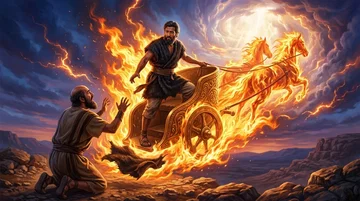
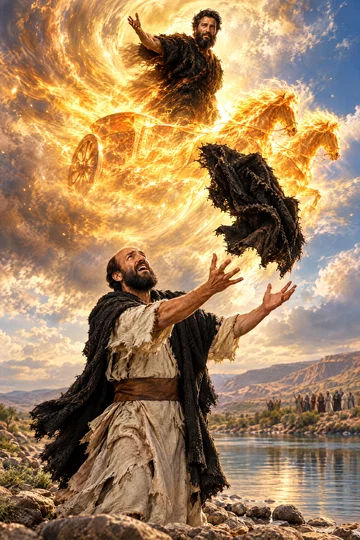
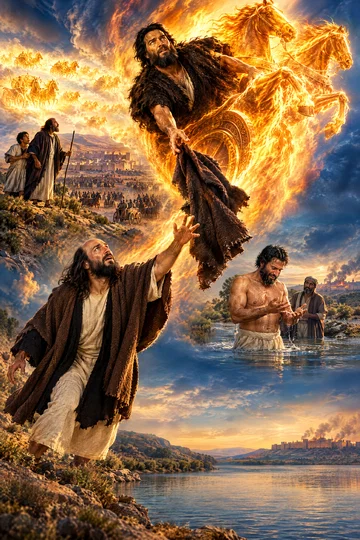
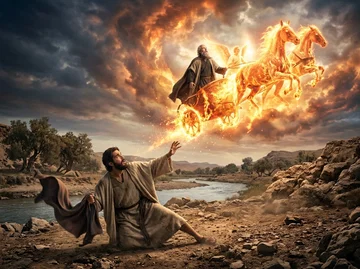
And it came to pass, as they still went on, and talked, that, behold, there appeared a chariot of fire, and horses of fire, and parted them both asunder; and Elijah went up by a whirlwind into heaven.
Translations
American King James Version, King James Version
And it came to pass, as they still went on, and talked, that, behold, there appeared a chariot of fire, and horses of fire, and parted them both asunder; and Elijah went up by a whirlwind into heaven.
KJV Cambridge Paragraph Bible, Webster Bible
And it came to pass, as they still went on, and talked, that behold, there appeared a chariot of fire, and horses of fire, and parted them both asunder; and Elijah went up by a whirlwind into heaven.
Revised Version, American Standard Version
And it came to pass, as they still went on, and talked, that, behold, there appeared a chariot of fire, and horses of fire, which parted them both asunder; and Elijah went up by a whirlwind into heaven.
And it cometh to pass, they are going, going on and speaking, and lo, a chariot of fire, and horses of fire, and they separate between them both, and Elijah goeth up in a whirlwind, to the heavens.
And it came to pass as they went on, and talked, that behold, a chariot of fire and horses of fire; and they parted them both asunder; and Elijah went up by a whirlwind into the heavens.
And it came to pass, as they were going on and on and talking, that lo! there was a chariot of fire, with horses of fire, which parted, those two, asunder,—and Elijah went up in a storm, into the heavens.
Berean Standard Bible, Majority Standard Bible
As they were walking along and talking together, suddenly a chariot of fire with horses of fire appeared and separated the two of them, and Elijah went up into heaven in a whirlwind.
As they continued on and talked, behold, a chariot of fire and horses of fire separated them; and Elijah went up by a whirlwind into heaven.
And while they went on their way, going on talking together, suddenly there were carriages and horses of fire separating them from one another and Elijah went up to heaven in a great wind.
And as they went walking and talking, beholde, there appeared a charet of fire, and horses of fire, and did separate them twaine. So Eliiah went vp by a whirle winde into heauen.
Douay-Rheims (Challoner revision)
And as they went on, walking and talking together, behold a fiery chariot, and fiery horses parted them both asunder: and Elias went up by a whirlwind into heaven.
Pictures

Cross-references 20 of 50
- Genesis 5:24
And Enoch walked with God: and he was not; for God took him.
Enoch, like Elijah, was taken by God without seeing death.
- Matthew 17:3
And, behold, there appeared unto them Moses and Elias talking with him.
Elijah appears with Moses and Jesus at the transfiguration.
- Hebrews 11:5
By faith Enoch was translated that he should not see death; and was not found, because God had translated him: for before his translation he had this testimony, that he pleased God.
Enoch, like Elijah, was taken without seeing death.
- Luke 9:30-31
And, behold, there talked with him two men, which were Moses and Elias:
Elijah, taken up to heaven, appears in glory and speaks with Jesus about his coming death.
- 1 Thessalonians 4:17
Then we which are alive and remain shall be caught up together with them in the clouds, to meet the Lord in the air: and so shall we ever be with the Lord.
Living believers are caught up to meet the Lord, as Elijah was taken up without dying.
- John 3:13
And no man hath ascended up to heaven, but he that came down from heaven, even the Son of man which is in heaven.
Elijah’s ascent does not contradict Christ’s unique descent and authority to reveal heavenly things.
- Malachi 4:5
Behold, I will send you Elijah the prophet before the coming of the great and dreadful day of the LORD:
Elijah’s translation prefigures the promised Elijah work before the day of the Lord.
- Acts 1:9
And when he had spoken these things, while they beheld, he was taken up; and a cloud received him out of their sight.
Jesus’ bodily ascension to heaven parallels Elijah’s being taken up.
- Mark 9:2-4
And after six days Jesus taketh with him Peter, and James, and John, and leadeth them up into an high mountain apart by themselves: and he was transfigured before them.
Elijah appears with Moses and Jesus at the transfiguration.
- 1 Kings 19:4
But he himself went a day’s journey into the wilderness, and came and sat down under a juniper tree: and he requested for himself that he might die; and said, It is enough; now, O LORD, take away my life; for I am not better than my fathers.
Elijah prayed to die, but God denied his request.
- 1 Kings 18:38-39
Then the fire of the LORD fell, and consumed the burnt sacrifice, and the wood, and the stones, and the dust, and licked up the water that was in the trench.
Fire from heaven consumes Elijah’s sacrifice, and Israel confesses the LORD as God.
- Luke 1:17
And he shall go before him in the spirit and power of Elias, to turn the hearts of the fathers to the children, and the disobedient to the wisdom of the just; to make ready a people prepared for the Lord.
John is promised to come in Elijah’s spirit and power.
- 2 Kings 6:17
And Elisha prayed, and said, LORD, I pray thee, open his eyes, that he may see. And the LORD opened the eyes of the young man; and he saw: and, behold, the mountain was full of horses and chariots of fire round about Elisha.
Both passages show fiery chariots revealed through opened spiritual sight.
- Psalms 68:17
The chariots of God are twenty thousand, even thousands of angels: the Lord is among them, as in Sinai, in the holy place.
God’s chariots are identified with thousands of angels, connected with Elijah’s heavenly ascent.
- 2 Kings 2:17
And when they urged him till he was ashamed, he said, Send. They sent therefore fifty men; and they sought three days, but found him not.
Fifty men searched for Elijah but found no trace of him after his translation.
- 1 Kings 19:19-21
So he departed thence, and found Elisha the son of Shaphat, who was plowing with twelve yoke of oxen before him, and he with the twelfth: and Elijah passed by him, and cast his mantle upon him.
Elisha leaves his former life to follow and serve Elijah.
- 1 Kings 18:21
And Elijah came unto all the people, and said, How long halt ye between two opinions? if the LORD be God, follow him: but if Baal, then follow him. And the people answered him not a word.
Elijah challenges Israel to choose whom to follow before his translation.
- 2 Kings 2:23-24
And he went up from thence unto Beth-el: and as he was going up by the way, there came forth little children out of the city, and mocked him, and said unto him, Go up, thou bald head; go up, thou bald head.
The youths mock Elisha by referring to Elijah’s ascent, and judgment follows.
- Matthew 17:11
And Jesus answered and said unto them, Elias truly shall first come, and restore all things.
Jesus says Elijah will come and restore all things.
- 2 Kings 2:2
And Elijah said unto Elisha, Tarry here, I pray thee; for the LORD hath sent me to Beth-el. And Elisha said unto him, As the LORD liveth, and as thy soul liveth, I will not leave thee. So they went down to Beth-el.
Elisha refuses to leave Elijah as they travel together.
Commentary part 1 of 2
Each commentary is drawn from primary sources: the writings of Ellen G. White and Adventist pioneers and periodicals. Each commentary is separate. Its own words are not a quotation; follow the references to read the source passages.
Ellen G. White
60 sources
As Elijah and Elisha still went on and talked together, a chariot of fire and horses of fire appeared and parted them, and Elijah went up by a whirlwind into heaven.PK 226.2–227.1ED 60.1–2Lt 12, 1897, par. 34–36 He was borne by angels in glory and triumph into the presence of God's glory to the throne on high, and did not die or come under the dominion of death but was taken alive to heaven.SG1 40.22RED 23.2LC1 127.2ED 151.1–2PK 228.1 His translation is a type of the saints who will be taken to heaven without seeing death, representing those alive on earth at Christ's second coming who will be changed from mortal to immortal.Lt 12, 1897, par. 34–362SP 336.2SG1 43.23RED 126.1 This explains why he could later appear with Moses at Christ's transfiguration, where Elijah represented the living saints to be changed to immortality while Moses represented those raised from the dead.1SP 343.1SG1 43.22SP 328.1–329.1DA 421.1–2PK 227.2 Together with Enoch, he shows what the whole race might become through faith in Jesus Christ, resisting Satan, remaining untainted amid moral pollution, and perfecting righteous character.2RED 23.2LC1 127.2RH Mar 3, 1874
Parting and Ascent
As they still went on and talked together, a chariot of fire and horses of fire appeared and parted the two men asunder, and Elijah went up by a whirlwind into heaven.PK 226.2–227.1ED 60.1–2Lt 12, 1897, par. 34–36Ms 114, 1901, par. 5–7Lt 12, 1897, par. 24–28 Elisha saw his departure, meeting the condition Elijah had given for receiving the requested double portion of his spirit, and the mantle fallen from Elijah became the sign of that succession.PK 226.2–227.1ED 60.1–2Ms 114, 1901, par. 5–7Lt 12, 1897, par. 24–28Ms 191, 1907, par. 17–20 His first act with the mantle confirmed that Elijah's spirit rested on him, and the fifty sons of the prophets had come to witness Elijah's honor and exaltation.ED 60.1–2Lt 12, 1897, par. 34–36Ms 191, 1907, par. 17–20 His translation is a type of the saints who will be taken to heaven without seeing death, and his final journey included those visits to the schools of the prophets.Lt 12, 1897, par. 34–36Ms 191, 1907, par. 17–20
He was borne by God's angels in glory and triumph, with celestial chariots accompanying him into the presence of God's glory to the throne on high.SG1 40.2ED 151.1–2EW 132.1DA 301.1–2ST Feb 5, 1902 He did not die or descend to the tomb but was taken alive when his work was finished, rather than left to perish in loneliness and discouragement in the wilderness.ED 151.1–2PK 228.1DA 301.1–2ST Feb 5, 1902 That translation followed a life of walking with God, reproving sin as God's prophet in a painful ministry, and fleeing for his life from those who sought to kill him, even hunted by his own people.SG1 40.2EW 132.1 Although his failure of faith cut short the work he had begun so that another prophet was appointed in his stead, God honored his faithful service and did not leave him to die in discouragement and solitude.ED 151.1–2PK 228.1
Just before being taken he visited the schools of the prophets, repeating important lessons and giving the students divine instruction.FE 512.2RH Mar 4, 1909RH Jan 11, 1912Ms 99, 1907, par. 2Ms 29, 1908, par. 4 He stressed that simplicity should shape every part of education, so they could receive heaven's mold and influence and go out to work in the Lord's ways.FE 512.2Ms 99, 1907, par. 2 After completing that work of visiting Israel's schools he ascended to the heavenly courts in a chariot of fire.RH Mar 4, 1909RH Jan 11, 1912Ms 29, 1908, par. 4
He had not yet been translated when, during the reign of Jehoram of Judah, he sent that king a written warning about his apostasy and its coming consequences.RH Jan 22, 1914PK 213.1–2 After the ascension Elisha went to the school of the prophets near Jericho.PK 230.2–3
Unlike Elisha, whose life ended after a lingering illness, Elijah was taken to heaven in a fiery chariot and did not die in that way.PK 263.3–264.1GW 116.2–3 God honored him with translation by a whirlwind, and his departure left Elisha facing the work that followed.PK 263.3–264.1GW 116.2–3
Succession by Elisha
As they walked and talked together, fiery chariot and horses appeared and separated them, and Elijah was carried away alive to heaven by a whirlwind.PK 226.2–227.1ED 60.1–2Ms 114, 1901, par. 5–7Lt 12, 1897, par. 24–28Ms 191, 1907, par. 17–20 Elisha witnessed that departure, and his seeing it met the condition Elijah had set for granting his request for a double portion of Elijah's spirit.PK 226.2–227.1Ms 114, 1901, par. 5–7Lt 12, 1897, par. 24–28ED 59.2–3Ms 191, 1907, par. 17–20 The mantle falling from Elijah became the sign of that succession to the prophet's work, and Elisha's receiving it confirmed the request had been granted.ED 60.1–2Lt 12, 1897, par. 24–28Ms 191, 1907, par. 17–20
Elisha stayed with Elijah through that final journey to its end, continuing with him after having faithfully served him in humble duties.ED 59.2–3Lt 64, 1897, par. 9–13 His departure marked the moment Elisha took his place.ED 60.1–2 His first act with the fallen mantle confirmed that Elijah's spirit rested upon him.ED 60.1–2
What Elisha received was a double portion of the spirit that had rested on Elijah, joining Elijah's power with gentleness, mercy, and Christlike compassion.Lt 93, 1902, par. 8–10 In that ordering, Elisha's gentle kindness was to exceed Elijah's severity.Lt 93, 1902, par. 1–7
Elijah had been chosen by God as a preacher of righteousness and guided by the Holy Spirit, and under God's direction he accomplished his work.Ms 31, 1889, par. 77 He educated Elisha to carry that work on, giving him opportunity to learn from his ministry.YGBCOEP 49.1RH Nov 19, 1903Ms 82, 1899, par. 6–7 That example is the pattern for experienced ministers to train younger workers to teach the truth and carry out gospel ministry.YGBCOEP 49.1RH Nov 19, 1903
The change from Elijah to Elisha illustrates that God provides the person suited to the needs of each time.Lt 93, 1902, par. 1–7
Translation Without Dying
Elijah did not die, did not descend to the tomb, and did not come under the dominion of death, but was taken alive to heaven without experiencing death.2RED 23.2LC1 127.2ED 151.1–2PK 228.12SP 336.2 He was taken by God's angels into the presence of His glory after his work was finished, taken up in a whirlwind rather than left to perish.ED 151.1–2PK 228.12SP 336.2SG1 43.2ST Nov 17, 1909 Although his failure of faith cut short the work he had begun and another prophet was appointed in his stead, God honored his faithful service and did not leave him to die in discouragement and solitude.ED 151.1–2PK 228.1ST Nov 17, 1909 He was not left to die in loneliness in the wilderness, but was carried in glory with celestial chariots to the throne on high.PK 228.1DA 301.1–2ST Feb 5, 1902
When he became discouraged in the wilderness and asked to die, the request was not granted because he still had important work to do before his translation.DA 301.1–2ST Feb 5, 1902ST Aug 28, 1898 Only when his work was finished was he taken up in glory.DA 301.1–2ST Feb 5, 1902ST Aug 28, 1898 He overcame Satan's temptations, stood untainted amid surrounding moral pollution, and perfected a righteous character in moral power and noble uprightness, and so was accounted worthy for translation.2RED 23.2LC1 127.2RH Mar 3, 1874 Satan was greatly disturbed by him because he could not bring him under death's dominion.RH Mar 3, 1874
Together with Enoch, Elijah shows what the whole race might become through faith in Jesus Christ, with Christ working with human effort and helping man to overcome Satan's power if they chose it.2RED 23.2LC1 127.2RH Mar 3, 1874 Through that help and cooperation they may resist Satan's temptations, remain untainted by surrounding moral corruption, and develop righteous character.2RED 23.2LC1 127.2RH Mar 3, 1874 Yet his miraculous translation in a chariot of fire and whirlwind did not make him greater or more honored than John the Baptist, who died alone in prison.DA 224.4–225.1MH 478.2ST Aug 17, 1915 Fellowship with Christ in suffering is itself a weighty trust and a high honor, and suffering for Christ is itself such a trust.DA 224.4–225.1MH 478.2ST Aug 17, 1915
Foreshadowing and Transfiguration
Elijah's being taken up by a whirlwind after the chariot and horses of fire parted him from Elisha is a type of the saints who will be taken to heaven without seeing death.Lt 12, 1897, par. 34–36 Elisha witnessed the departure, and the fifty sons of the prophets had come to see Elijah's honor and exaltation.Lt 12, 1897, par. 34–36
His translation represents those who will be alive on earth at Christ's second coming, who will be changed from mortal to immortal and taken to heaven without dying.2SP 336.23RED 126.1DA 421.1–2PK 227.2ST Jun 7, 1877 At the transfiguration he represented those who will be changed to immortality and taken to heaven without experiencing death at that coming.SG1 43.2DA 421.1–2PK 227.2 Together with Enoch he represents the commandment-keeping people of God who will be alive when Christ comes again, who will be glorified in the sight of those who hated them because they kept God's commandments, and who will be translated to heaven without seeing death as Enoch and Elijah were.ST Apr 8, 1875RH Apr 29, 1875
Because he did not see death but was conducted alive to heaven in a chariot of fire, he could later appear with Moses at Christ's transfiguration.1SP 343.12SP 328.1–329.1ST Jun 7, 18773RED 117.1–118.1ST Mar 31, 1881 There they met with Jesus as two heavenly messengers to speak with Him about His coming suffering and the completion of His mission at Jerusalem, and to bear to Him God's glory and light from the Father.1SP 343.12SP 328.1–329.1ST Jun 7, 18773RED 117.1–118.1SG4 58.2 On that mount Elijah represented those who will be alive at Christ's second coming and will be changed to immortality, while Moses represented those raised from the dead.SG1 43.2DA 421.1–2PK 227.2
He was one of two men favored by God above all others who ever lived on earth, chosen together with Moses to come in heavenly glory to Christ on the mount to comfort Him and talk with Him especially about His coming sufferings at Jerusalem.ST Jun 7, 1877 He was fit for this ministry because as a man he had lived on earth and experienced human sorrow and suffering and could sympathize with Jesus in His earthly trial.ST Jun 7, 1877 As a prophet to Israel he had represented Christ, and his work had been in a degree similar to that of the Saviour.ST Jun 7, 1877
Preparation and Application
God moved Elijah from place to place as He prepared him for translation, keeping him from settling into ease so that he would gain spiritual power.RH May 2, 19079MR 11.1–2GW 269.3Lt 59, 1901, par. 18–23 These changes of place disrupted his established habits and kept him from settling into familiar methods and customs, and they formed in him moral greatness and spiritual soundness.RH May 2, 19079MR 11.1–2GW 269.3Lt 59, 1901, par. 18–23 His influence through those movings was intended to help many people gain a wider, fuller, and more helpful spiritual experience.RH May 2, 19079MR 11.1–2GW 269.3Lt 59, 1901, par. 18–23
Just before he was taken to heaven he visited the schools of the prophets and repeated important lessons to the students, giving them divine instruction.FE 512.2Ms 99, 1907, par. 2 In that final instruction he taught that simplicity should shape every part of education, so that they could receive heaven's mold and influence and go out to work in the Lord's ways and serve in them.FE 512.2Ms 99, 1907, par. 2 His giving Elisha opportunity to learn from his ministry and educating him to carry on the work is the pattern for experienced ministers to train younger workers to learn how to teach the truth and carry out gospel ministry.YGBCOEP 49.1RH Nov 19, 1903Ms 82, 1899, par. 6–7
The ascension was a solemn event, when Elijah was taken up leaving his mantle with Elisha, and the youths of Bethel who had heard of it made it an object of ridicule and the subject of their jeers by telling Elisha to go up as Elijah had.EW 209.25T 44.2–45.1PK 235.2–236.1 That cry of "Go up" treated God's servant with contempt and thereby insulted God.EW 209.2 The young people who so mocked were mocking God and were punished, for their parents had taught them to mock, and mocking the saints' going up is likewise no small matter but brings God's plagues.EW 209.2SG1 154.1
Sources
Pioneers and periodicals
273 sources
Elijah was taken bodily and alive into heaven without dying or being buried, going up in the same body changed into immortal glory as a whirlwind bore him away when a chariot of fire and horses of fire appeared and parted him from Elisha.ST Sep 10, 1885STST Aug 27, 1885RH Jan 14, 1873RH Jan 26, 1869 The fiery chariot and horses were God's angels in organized companies for special service, forming the appearance that carried him to God's dwelling to make the ascent impressive to its witness.ST May 27, 1913ST Jan 31, 1911ST Apr 12, 1883 His going up shows heaven is a real definite place where God dwells and where redeemed men now live and serve.RH Jun 25, 1861RH Sep 18, 1855RH Nov 15, 1853RH Apr 13, 1876ST Apr 27, 1904 His translation is the type of what will happen to the righteous living at Christ's coming, who will be changed without seeing death and caught up, with Elijah representing the living translated class as Moses represents the resurrected.RH Apr 24, 1856ST Sep 7, 1904ST Sep 7, 1904ST Nov 23, 1915 It was the reward and culmination of a faithful life of standing for God's commandments against apostasy, overcoming and perfecting character through faith, and it stands as the pattern of character and readiness required of God's last-day people to be translated.RH Mar 3, 1874RH May 11, 1916ST Sep 17, 1896RH Jan 13, 1859RH Jan 10, 1865
Words and Setting
As Elijah and Elisha still went on together talking, there appeared a chariot of fire and horses of fire that parted them both asunder, and Elijah went up by a whirlwind into heaven, carried by celestial chariots to the throne on high, so the whirlwind alone is not the whole explanation.STST Aug 12, 1889ST Jul 15, 1880ST Dec 8, 1914RH Nov 9, 1916 The departure was a translation alive into heaven without dying, like Enoch whom God took, and is a type of those who will be translated without seeing death when Christ comes.STST Aug 12, 1889ST Dec 8, 1914ST Sep 10, 1885 Elisha saw the departure, fulfilling the set condition for receiving the requested double portion of Elijah's spirit.RH Nov 9, 1916ST Sep 10, 1885
The chariot and horses of fire were God's angels, the cherubim, organized agencies for special service appearing in companies in that form to minister through the earth.ST May 27, 1913ST Jan 31, 1911ST Apr 12, 1883ST May 12, 1909 They formed the chariot and fiery horses to take Elijah up and carry him to heaven, surrounding him like a flaming army that gave Elisha lasting encouragement in danger.ST Jan 31, 1911ST May 12, 1909ST The plural shows the Lord's great invisible army, the chariots of the true Israel with occupants invisible to the natural eye, ministering to His people and defending the faithful.ST Apr 12, 1883ST Sep 21, 1904 They were not literal vehicles and animals but appearances taken to make the ascent more impressive to its human witness, with Elisha fully understanding what the sons of the prophets could not fully grasp.ST May 12, 1909ST Sep 21, 1904
The verse speaks only of a chariot of fire and does not speak of chariots of iron or ships sailing in the air, an idea coming from mixing it with the chariots of iron in Judges 1:19 and Mother Shipton's prophecy.ST Apr 3, 1901 The ascent came about ten years after the flight from Jezebel and the Horeb experience, after crossing the Jordan, an event known in advance to Elisha and the prophetic students.STST Sep 21, 1904 Elijah in humility did not seek to be watched or honored, and the journey tested Elisha's faithfulness as successor, while God twice divided the Jordan to let them pass unhindered.ST
The verse marks the end of Elijah's prophetic ministry and career on earth after he had visited the schools of the prophets and given their students divine instruction, giving Elisha assurance as he began, and shows those schools continued after Samuel's day.RH Mar 4, 1909RH Jan 11, 1912ST Aug 20, 1902RH Mar 18, 1915 It marks the culmination of his life compared with his sudden appearance to confront sinful kings, after prophetic work and persecution God finally taking him to Himself with Elisha left as recognized successor through whom the power of the God of Israel stayed accessible.ST Aug 11, 1909RH Dec 6, 1906 The translation came only after Elijah finished his greatest work of overthrowing Jezebel and her system of teaching and reinstalling the Lord's prophets in school work by reorganizing the schools of Israel, following forty-two months hiding in the wilderness, meeting Ahab at Mount Carmel, and a later victory after regathering courage.RH Oct 15, 1901ST May 15, 1901
Elijah was not taken up by a chariot of fire when the drought began but remained on earth sharing the famine and danger facing the people.RH Oct 1, 1861 During Jehoram of Judah's reign he had not yet been translated and therefore sent the king a written warning about his apostasy.RH Jan 22, 1914 Elijah was translated in the year the inscription on the Moabite Stone was made, dating that stone to at least twenty-seven hundred years ago.RH Aug 12, 1875
The account is an actual event in God's word, written for instruction and profitable, a true Old Testament event among accounts critics described as pious legends and myths.ST Sep 10, 1885ST Jan 24, 1906 It is a real event in the Bible's record of miracles that cannot be discarded without undermining confidence in Scripture.RH Nov 28, 1907 Denying that Moses and Elijah ever ascended rejects a plain Thus saith the Lord by sophistry to suit custom, which is disguised infidelity bound to end disastrously.RH Apr 3, 1900
The mantle that fell from Elijah was his literal outer garment, which Elisha took and stood with on the bank of Jordan and smote the waters with as Elijah had done, proving the bodily nature of the translation.ST Oct 12, 1876 Elisha's seeing Elijah taken away was the set condition for receiving the requested double portion of Elijah's spirit, and his ability to see the fiery visitation proved his spiritual fitness.ST Aug 27, 1885RH Nov 9, 1916ST Sep 21, 1904RH Nov 9, 1916 He had to stay close, be earnest, pure, refined by God's purifying process, with controlled passions, strong faith and spiritual perception, surrendering sin with a heart perfect toward God, and he claimed the gift at once and took up the fallen mantle on returning to Jordan.RH May 27, 1909RH Nov 9, 1916RH Nov 16, 1916
Elisha met the condition for the double portion by keeping his master in sight without losing sight of him for an instant until the parting.ST Sep 21, 1904ST Jul 21, 1898 The words about seeing him taken were an incentive to watchfulness and prayer, and because he saw him he believed the double portion of a firstborn son in the faith was his, so he took the fallen mantle back to the Jordan to test the promise.ST Jul 21, 1898 Elisha was designated to continue Elijah's prophetic work before Elijah was taken, an exceptional case not a fixed pattern for choosing prophets.RH Aug 19, 1915 Elijah gave Elisha opportunity to learn from his ministry, showing experienced ministers are to give younger workers opportunity to learn to teach truth.RH Nov 19, 1903 Elisha faithfully followed Elijah, performed humble tasks, listened closely to his master, and chose the man of God over worldly pleasures and riches, and so was prepared for a higher position and received the mantle and a double portion of the Spirit.RH Nov 16, 1916
Elisha's succeeding to a double portion of his master's spirit is true following inward as well as outward, in contrast to Gehazi who stood to Elisha as Elisha had to Elijah yet did not gain his master's spirit but seeking Naaman's lucre gained it with leprosy.RH Dec 23, 1915 Elisha witnessed the separation and ascent and believed and taught that people could go up, and the taunt Go up refers to Elijah's ascent and shows that belief was mocked.ST Feb 24, 1881 Elisha declared his master had gone up, and forty children who mocked him crying go up thou bald head were torn by wild beasts.RH Dec 24, 1867 The same scorn is now aimed at the go-up doctrine by those mocking the promise of Christ's return in the clouds, as after the disappointment in 1844, and if God avenged mocking one old man over his master going up, far greater will be the portion of those mocking Christ's coming.RH Dec 24, 1867
God's power overcame the law of gravitation in Elijah, with divine laws elevating him above earth and carrying him to heaven.ST Feb 20, 1912 Elijah passed through life's storms by the connection between heaven and earth, represented as a ladder provided by Jesus, when separated from Elisha by the fiery chariot and horses as he ascended in a whirlwind.RH Dec 10, 1857 The ascent is pictured as an illuminated cloud moving through the sky, borne by the winds and filled with intense light, offered as one doubtful possible form of the sign announcing the approaching Son of man and his reign. Elijah's chariot in the heavens supplies an image which Russian peasants associate with St. Elias driving across the sky when it thunders and lightens.ST Jul 10, 1893 Elisha saw the horses and chariot conveying Elijah to glory because his spiritual senses were touched and opened to the spirit world, showing man by his spiritual nature can have open vision of the spiritual world and possesses a spiritual nature that lives and perceives beyond the physical body.RH Jan 7, 1873
Nature of Translation
Elijah was taken bodily and alive into heaven without dying and without leaving a body to be buried, without tasting death or seeing corruption, without burial or funeral, without lying in coffin and grave or passing through the tomb, which is different from death and burial.ST Sep 10, 1885STST Aug 27, 1885ST Aug 12, 1889RH Dec 6, 1864 His translation was not the ordinary experience of God's children, since others die and are buried as Elisha was, and it stands as a type of Christ's forerunner at both advents and of the living righteous taken at Christ's second coming.ST Sep 10, 1885ST Aug 12, 1889 He went up in the same mortal, natural body that had walked beside Elisha, changed and glorified into an immortal, incorruptible, spiritual body filled with God's life, his body being changed instantaneously, his blood-life giving way to spirit-life while remaining a real body and real life.ST Aug 27, 1885RH Jan 14, 1873RH Jan 26, 1869ST Aug 27, 1885ST Apr 29, 1897 Mortality was swallowed up in immortality, and it is that same body that later appeared on the mount of transfiguration and now stands in God's presence.ST Aug 27, 1885RH Jan 14, 1873ST Aug 27, 1885 The saints will likewise at the last trump be changed and taken whole into God's presence, which is what being absent from the mortal body and present with the Lord means.ST Aug 27, 1885ST Oct 12, 1876 He did not go up in his mortal earthly condition or leave his body behind, and his bodily taking makes him the representative of those alive at Christ's coming who will be changed in a moment in the twinkling of an eye, distinct from Moses who died and could appear alive only by resurrection.ST Aug 27, 1885ST Oct 12, 1876ST Apr 29, 1897
Elijah shared with Enoch alone the honor of translation without experiencing death, being one of only two men in history so taken, the only person besides Enoch so favored.ST Aug 12, 1889RH Apr 23, 1867ST Feb 13, 1912RH Oct 16, 1855 His case is an exception to the deaths of the other patriarchs and a favor better than death, an exception to the universal rule and reach of death which even Jesus submitted to, and an exception to the decree that all people die and return to dust without passing under death and the grave, with Enoch and the faithful alive at Christ's coming likewise exceptions.ST Aug 1, 1916RH Apr 23, 1867AS Nov 13, 1889RH Oct 16, 1855 His reaching the undying state by ascending to God's presence in a chariot of fire specially prepared to carry him there illustrates that life beyond the grave comes through life given by God, and proves salvation was available before the resurrection without implying another savior besides Christ.ST Aug 1, 1916AS Nov 13, 1889 His swift removal was not a sudden death, stroke of lightning, or misfortune but a blessed, glorious triumph over death and sin, entering the promised land free from grief, compared with Enoch's entrance.ST Sep 10, 1885ST Mar 14, 1878ST Mar 14, 1878ST Sep 10, 1885 It points to faithful followers sharing the future reign of the Prince of Peace and walking streets of gold, while translation and death are not the same but life as against going to the grave.ST Sep 10, 1885ST Mar 14, 1878ST Mar 14, 1878
Elijah was translated bodily and alive, in the same body with which he ascended, not as an immortal soul leaving the body at death.RH Aug 6, 1872RH Jan 23, 1866RH Dec 28, 1911RH Sep 5, 1854 Together with Enoch's translation, this presents God's way of taking people to heaven as taking them up bodily without passing through the tomb, as an example of immediate translation to be with God.RH Sep 5, 1854 His appearance at the transfiguration in that same ascended body gives no support to the claim that the dead survive as conscious immaterial souls, and proves no general rule about an intelligent immortal soul after death.RH Jan 14, 1873RH Aug 6, 1872 By contrast, those few who held otherwise taught that he left his robe of flesh behind with his mantle falling back as his body fell away, and went up as a disembodied spirit, which proves the immortality of the soul.ST Oct 12, 1876 Others taught that his natural body of flesh, blood and bones was not carried to heaven but was instantly resolved into its original gases, while he went up in a real spiritual body seen only by spiritual eyes, and that Christ's ascension was of the same kind.RH Nov 26, 1872 He is one of only two recorded exceptions to great men being laid in the grave by sin, since sin hinders and finally kills but does not make men great, while God's power works through humanity in spite of evil.ST Jul 31, 1901
Heaven and Present Life
Elijah's ascent shows heaven is a real place, the distant local dwelling-place of God, a definite place where God dwells and is present in a special sense, not merely spread throughout space.RH Jun 25, 1861RH Sep 18, 1855RH Feb 4, 1875RH Jun 25, 1861RH Mar 3, 1903 That heavenly habitation is identified as glory, to which his appearance in glory connects his ascent.RH Nov 15, 1853 It distinguishes God's omnipresence from the habitation to which the redeemed look, as also shown by Enoch's translation and Jesus' ascension, and it supports that God and Christ are personal beings rather than a presence dispersed everywhere or merely an appearance.RH Jun 25, 1861RH Jun 25, 1861RH Mar 3, 1903 His going up by whirlwind was a real, particular event with chariot and horses of fire separating him from Elisha, not merely an appearance or a dispersal through the universe.RH Jun 25, 1861RH Jun 25, 1861
He went bodily to heaven and now lives and serves there in redeemed flesh, together with Enoch and Moses and Christ who retains flesh with the nail prints.ST Apr 27, 1904 This proves heaven is a real tangible place and not merely a state or condition, where spiritual beings in bodily form and redeemed men who once lived on earth dwell and move.ST Apr 27, 1904 His removal from earth to heaven is an example of a saint taken to heaven, proving redeemed humans go there.ST Jul 15, 1880RH Dec 6, 1864RH Feb 4, 1875 It supports the conclusion that the immortal saints will also go there and that the earth will be emptied of its inhabitants at the advent.ST Jul 15, 1880RH Dec 6, 1864 His translation is evidence of a future life and that the saints will one day go to heaven.RH Feb 10, 1859RH Jan 13, 1859
He was carried away in raptured flight to heaven, arriving at the golden steps of His throne where he is seen by angels.ST Jan 15, 1880 He reached the undying state by ascending to God's presence in a chariot of fire specially prepared to carry him there.ST Aug 1, 1916ST Jan 21, 1913 His case is an exception to death as a dreamless sleep and illustrates that life beyond the grave comes through life given by God.ST Aug 1, 1916 He was translated to heaven to live and abide there, made immortal there, unlike a temporary vision of heaven.RH Apr 13, 1876RH May 18, 1869 He lives there still after being taken nearly a thousand years before Christ, and his appearing with Christ on the mount of transfiguration was a coming from that heaven to which he had been taken, showing Moses came from that same place in heaven.RH Apr 13, 1876RH Apr 5, 1870
He was taken bodily from earth by God and was not cast onto a mountain or into a valley and is not dead.RH Apr 24, 1856 He and Enoch remain away from earth until the resurrection and the destruction of the wicked, when the earth is renewed and they inherit it as their lasting home.RH Apr 24, 1856 He is now with Moses and Enoch as a representative of redeemed humanity and one of the first fruits with Jesus, among at least two holy men translated to be companions of God, Christ, and angels.ST Nov 16, 1888 His crossing from this life to the other side points to the future passage of the redeemed, who will cross over only after being recreated and changed to incorruption and immortality, and then see the source of life.ST Dec 17, 1894 The verse is used as an example of Elijah being taken up rather than left on earth, in contrast with the saints who will be received into heaven.RH Oct 21, 1858
God can miraculously guide a person from earthly life into heavenly existence as He took Elijah from earth to heaven.ST Jul 20, 1904ST May 20, 1913 Even though Elijah became discouraged when overcome by weariness, God translated him.ST May 20, 1913
Type of Second Coming
Elijah's translation is a type and example of what will happen to the righteous living at Christ's coming, who will be changed without seeing death and caught up to heaven rather than left on earth, when Christ returns in glory with angels and raises the righteous dead.RH Apr 24, 1856ST Sep 7, 1904ST Apr 26, 1905ST Dec 8, 1914 His experience just before translation represents in many points the experience of those who will be translated as he was.RH Apr 24, 1856ST Sep 7, 1904 He was taken bodily from earth by God and went up to heaven in a whirlwind after chariot and horses of fire separated him from Elisha, not cast onto a mountain or into a valley, and he is not dead.RH Apr 24, 1856ST Sep 7, 1904ST Dec 8, 1914 He and Enoch remain away from earth until the resurrection and destruction of the wicked, when the earth is renewed and they inherit it as their lasting home.RH Apr 24, 1856 His translation is how he came to appear with Jesus at the transfiguration.ST Apr 26, 1905ST Sep 7, 1904
Elijah represents those who will be translated alive without dying, in contrast to Moses who represents those raised from the dead, and together with Christ and the disciples on the mount of transfiguration they formed a miniature picture of Christ's second coming and the kingdom of God.ST Sep 7, 1904ST Nov 23, 1915ST Feb 13, 1896ST Jun 19, 1907ST Jul 23, 1885 At the transfiguration Elijah represented the living translated class while Moses represented those raised from the dead, showing the transfiguration was a miniature picture of Christ's kingdom and second coming.ST Sep 7, 1904ST Nov 23, 1915ST Feb 13, 1896RH Jan 14, 1873 Elijah never died but was taken to heaven bodily, and when he appeared on the mount with Moses to Christ he appeared as a material body, likely with the same body that went up by a whirlwind into heaven, not as an immaterial spirit.RH Jan 14, 1873 His translation together with Moses' resurrection from the dead represents in miniature the coming kingdom of glory with Christ the King, presenting the two classes in the coming kingdom — those raised from the dead and those translated without dying.ST Nov 23, 1915ST Feb 13, 1896ST Jun 19, 1907ST Jul 23, 1885
The Elijah who talked with Jesus on the mount was the same man who lived on earth and preached to Israel in Ahab's days, present whole in spirit, soul and body as a material body, not as a departed immortal spirit or disembodied soul living apart from the body.RH Apr 13, 1876ST Dec 2, 1880ST Mar 20, 1879RH Sep 8, 1859RH Jan 14, 1873 He appeared in his own person at the transfiguration, the same Elijah who lived among Israel, with Moses beside the glorified Christ as a preview and miniature representation of Christ coming into his kingdom with power and glory, distinct from Moses who represents the resurrected righteous sleeping in Jesus.RH Apr 13, 1876ST Dec 2, 1880RH Jan 14, 1873 He was translated bodily to heaven in a whirlwind without experiencing death, so his appearance does not show that a person's soul lives separately from the body after death and proves no general rule about an intelligent, immortal soul after death.ST Mar 20, 1879RH Sep 8, 1859RH Jan 14, 1873 He had not been dead for 900 years when he appeared, but came from earth in the same body he had there.RH Sep 8, 1859ST Jul 12, 1883
Elijah's translation is presented as a type of Christ's forerunner at both advents, a feature of his history that John the Baptist did not fulfill.ST Aug 12, 1889RH Jul 9, 1867 He escaped his persecutor and was taken to heaven without dying after chariot and horses of fire parted him from Elisha.ST Aug 12, 1889RH Jul 9, 1867 His case, together with Enoch's, shows that people could be taken to heaven without contradicting John 3:13.ST Aug 12, 1889 It is fulfilled in the experience of God's last-day reforming people, who remain alive until the Lord comes and are translated to heaven without tasting death.RH Jul 9, 1867
The image of Elijah ascending in a fiery chariot is applied to Christ's return as the returning Lord.RH Mar 1851RH Apr 10, 1866 His ascent in a chariot of fire pictures Jesus coming in a chariot of fire to take the faithful alive to heaven, and pictures the hoped-for summons to depart earth and rise to heaven.RH Mar 1851RH Apr 10, 1866 Elijah's coming from the heaven to which he was taken to appear with Christ on the mount shows Moses came from that same place in heaven, and both were equally real with no difference in physical condition though Moses died and entered heaven only by bodily resurrection while Elijah entered by bodily translation.RH Apr 13, 1876RH Dec 28, 1911 Elias went to heaven by bodily translation, not as an immortal soul leaving the body at death.RH Dec 28, 1911
Elijah did not die but was caught up alive, and was therefore literally present on the mount of transfiguration representing those alive at Christ's coming without tasting death.ST Jun 7, 1877RH Jan 8, 1875RH Oct 16, 1860 He was conducted alive in a chariot of fire as one of two men favored above all others, chosen with Moses to come in glory to comfort Christ about his mission and sufferings at Jerusalem.ST Jun 7, 1877RH Oct 16, 1860 He was fit because he had lived as a man with sorrow and suffering and could sympathize, and because as prophet he had represented Christ in similar work.ST Jun 7, 1877 He was later present as a bearer of light and glory from the Father, to talk of Christ's agony and cross and prayer for persecutors.ST Mar 31, 1881RH Jan 8, 1875 His translation followed a life of mighty prevailing prayer, as when Baal's hosts were bowed on Carmel's height, taking the chariot of flame and speeding away in raptured flight to heaven, alighting upon royal steps of gold before God's throne in his celestial Canaan.RH Jan 8, 1875
Elijah's translation supplies the image of fiery chariots for the glorious gathering of the redeemed, when Christ brings chariots and holy angels to escort repentant humanity to the Father's home into God's family.RH Mar 30, 1876RH Jan 5, 1911 The same cherubic chariots that carried Elijah are waiting to carry the Bride up, with the living caught up alive out of living homes to join the heavenly escort and see the King, never falling asleep.RH Mar 30, 1876 He was taken up alive into heaven in chariots of fire without dying, disappearing from the sight of men on earth, never to lie in coffin and grave.RH Mar 30, 1876 As Elijah was seen no more, living believers at Christ's coming will be caught up by heavenly escort to the marriage supper of the Lamb and will then descend with Christ and share the joys and glory of his reign on earth.RH Sep 7, 1869 Elijah's going to heaven is explained as his going to the Father, which he had foreknown, and his departure is a type of Christ's return to the Father.ST Jul 6, 1915
Elijah's translation proves a company can be redeemed from among living men without rising from a grave, identifying the 144,000 as that translated company as distinct from the innumerable resurrected saints caught up with them.RH Feb 12, 1901 He went up alive into heaven by translation from the earth without dying and without rising from a grave, one of only two persons ever so translated, the other being Enoch.RH Feb 12, 1901 Elijah's ascension, with Enoch's and the multitude taken up when Christ ascended, came before the gathering of the 144,000. First-fruits therefore means pre-eminent in character and station, not first in time.
Elijah's glorious ending without death distinguishes him from John the Baptist, whose career ended in eclipse when slain, so John and his times did not meet all the requirements of the type.ST Aug 7, 1901 Elijah was translated and did not see death, and his career ended gloriously.ST Aug 7, 1901 Elijah's role as type of John and of God's last-day people concerns character and power, not a person returning, so no man can claim to be Elijah in person.ST Aug 14, 1901 Elijah's completed preparatory work before translation supplies the character and pattern for the prophesied Elijah work in John the Baptist before Christ's first advent and for its ultimate counterpart heralding the second advent.RH Apr 5, 1870 His translation serves as a type of a people who will stand in his spirit and power before the great and dreadful day and be translated without seeing death.ST Jul 27, 1904RH Apr 5, 1870 He was a literal prophet who was translated to heaven after completing a definite preparatory work.RH Apr 5, 1870
Sources