2 Kings 4:1
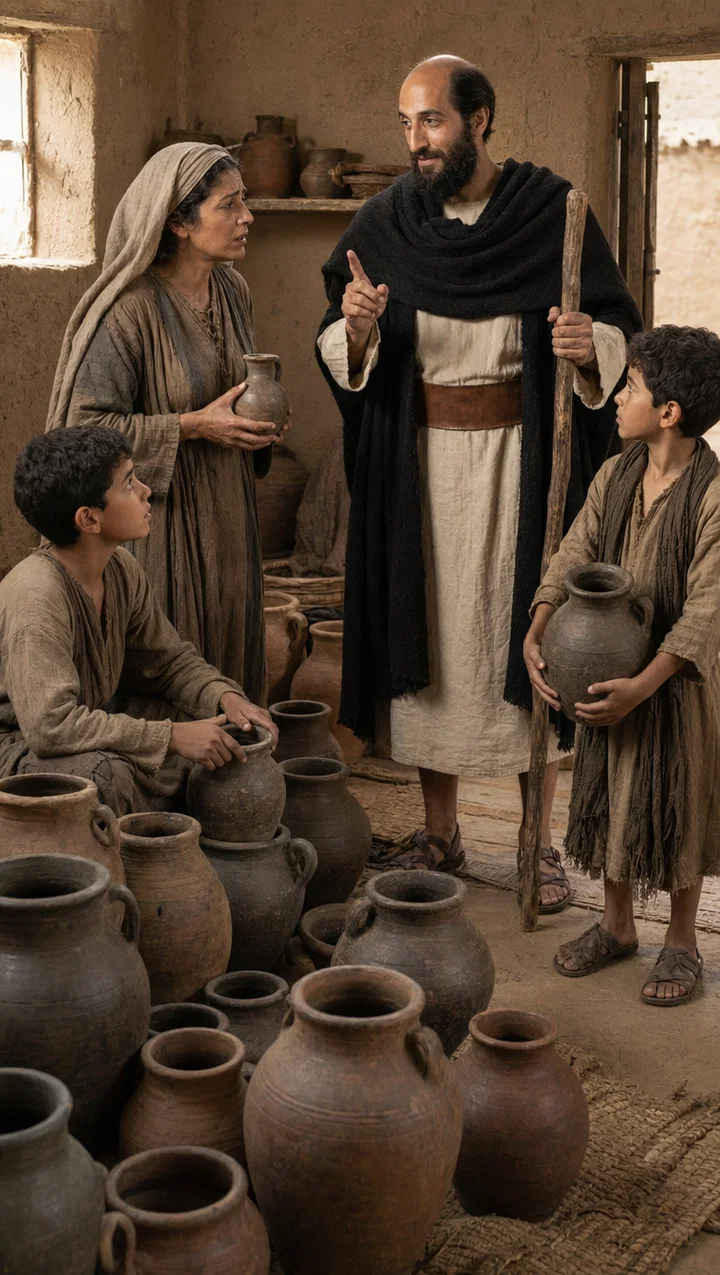
Now there cried a certain woman of the wives of the sons of the prophets unto Elisha, saying, Thy servant my husband is dead; and thou knowest that thy servant did fear the LORD: and the creditor is come to take unto him my two sons to be bondmen.
Translations
Now there cried a certain woman of the wives of the sons of the prophets to Elisha, saying, Your servant my husband is dead; and you know that your servant did fear the LORD: and the creditor is come to take to him my two sons to be slaves.
Now there cried a certain woman of the wives of the sons of the prophets unto Elisha, saying, Thy servant my husband is dead; and thou knowest that thy servant did fear the LORD: and the creditor is come to take unto him my two sons to be bondmen.
Now there cried a certain woman of the wives of the sons of the prophets unto Elisha, saying, Thy servant my husband is dead; and thou knowest that thy servant did fear the Lord: and the creditor is come to take unto him my two sons to be bondmen.
Now there cried a certain woman of the wives of the sons of the prophets to Elisha, saying, Thy servant my husband is dead; and thou knowest that thy servant feared the LORD: and the creditor hath come to take to him my two sons to be bond-men.
Now there cried a certain woman of the wives of the sons of the prophets unto Elisha, saying, Thy servant my husband is dead: and thou knowest that thy servant did fear the LORD: and the creditor is come to take unto him my two children to be bondmen.
Now there cried a certain woman of the wives of the sons of the prophets unto Elisha, saying, Thy servant my husband is dead; and thou knowest that thy servant did fear Jehovah: and the creditor is come to take unto him my two children to be bondmen.
And a certain woman of the wives of the sons of the prophets hath cried unto Elisha, saying, 'Thy servant, my husband, is dead, and thou hast known that thy servant was fearing Jehovah, and the lender hath come to take my two children to him for servants.'
And a woman of the wives of the sons of the prophets cried to Elisha saying, Thy servant my husband is dead, and thou knowest that thy servant feared Jehovah; and the creditor is come to take my two children to be bondmen.
Now, a certain woman of the wives of the sons of the prophets, made outcry unto Elisha, saying—Thy servant, my husband, is dead, and, thou, knowest that, thy servant, was one who revered Yahweh,—now, the creditor, hath come to take my two boys to himself as bondmen.
Berean Standard Bible, Majority Standard Bible
Now the wife of one of the sons of the prophets cried out to Elisha, “ Your servant, my husband, is dead, and you know that your servant feared the LORD. And now his creditor is coming to take my two children as his slaves!”
Now a certain woman of the wives of the sons of the prophets cried out to Elisha, saying, “ Your servant my husband is dead. You know that your servant feared the LORD. Now the creditor has come to take for himself my two children to be slaves.”
Now a certain woman, the wife of one of the sons of the prophets, came crying to Elisha and said, Your servant my husband is dead; and to your knowledge he was a worshipper of the Lord; but now, the creditor has come to take my two children as servants in payment of his debt.
And one of the wiues of the sonnes of the Prophets cryed vnto Elisha, saying, Thy seruant mine husband is dead, and thou knowest, that thy seruant did feare the Lord: and the creditour is come to take my two sonnes to bee his bondmen.
Douay-Rheims (Challoner revision)
Now a certain woman of the wives of the prophets cried to Eliseus, saying: Thy servant my husband is dead, and thou knowest that thy servant was one that feared God, and behold the creditor is come to take away my two sons to serve him.
Pictures
Cross-references
- 1 Kings 17:22
And the LORD heard the voice of Elijah; and the soul of the child came into him again, and he revived.
Elijah also raised a widow’s son from the dead before Christ.
- 1 Kings 17:9-16
Arise, get thee to Zarephath, which belongeth to Zidon, and dwell there: behold, I have commanded a widow woman there to sustain thee.
A widow’s meal and oil are miraculously increased.
- Luke 7:12-15
Now when he came nigh to the gate of the city, behold, there was a dead man carried out, the only son of his mother, and she was a widow: and much people of the city was with her.
Jesus raised a widow’s son and restored him to his mother.
- Leviticus 25:10
And ye shall hallow the fiftieth year, and proclaim liberty throughout all the land unto all the inhabitants thereof: it shall be a jubile unto you; and ye shall return every man unto his possession, and ye shall return every man unto his family.
The jubilee proclaims liberty, including release from servitude.
- Matthew 18:25
But forasmuch as he had not to pay, his lord commanded him to be sold, and his wife, and children, and all that he had, and payment to be made.
Both describe creditors taking debtors and their families into bondage.
Commentary
Each commentary is drawn from primary sources: the writings of Ellen G. White and Adventist pioneers and periodicals. Each commentary is separate. Its own words are not a quotation; follow the references to read the source passages.
Ellen G. White
1 source
The verse opens with a widow of a prophet crying out under the pressure of debt that threatened to take her two sons into bondage, and she was relieved by Elisha through a miracle of increase.ST Jan 14, 1886 She possessed only a single jar of oil, yet that oil kept flowing without failing while empty vessels remained to receive it.ST Jan 14, 1886 The supply continued vessel after vessel and ceased only when there were no more vessels to fill.ST Jan 14, 1886
The account teaches that divine gifts grow by being given away rather than by being held back.ST Jan 14, 1886 The Lord keeps furnishing means as His gifts are turned into channels for doing good.ST Jan 14, 1886 Giving therefore becomes the condition of continued supply, for provision follows impartation.ST Jan 14, 1886
Sources
Pioneers and periodicals
21 sources
A widowed wife of one of the prophetic students was left in grief and debt when her God-fearing husband died, with only a single jar of oil in hand and a creditor coming to take her two sons as bondservants under the law's limited service for debt.ST Dec 7, 1904ST May 13, 1908RH Jan 4, 1906ST Sep 28, 1904ST Sep 28, 1904 In her desperate appeal to Elisha he set her a work that tested her faith, telling her to borrow many empty vessels from her neighbors and pour from her one pot into them.ST Dec 7, 1904RH Sep 25, 1856ST Nov 19, 1885 The oil kept flowing until every vessel was full, limited only by the vessels she had provided, and by selling it she paid the whole debt, kept her sons from bondage, and had enough left to live on and begin anew.ST Jan 14, 1886RH Apr 14, 1904ST Jan 20, 1904RH Sep 25, 1856ST Nov 19, 1885 The provision shows God's care for his faithful poor, whose poverty does not lessen his regard, and that his gifts increase as they are imparted, waiting in large measure on those who bring plenty of vessels in faith.ST Dec 7, 1904RH Sep 25, 1856ST Nov 19, 1885 It proves how fully he approves honest dealing, working a miracle to provide for the payment of an honest debt rather than leaving it unpaid.RH Apr 14, 1904RH Jul 7, 1903
Widow's Plight and Setting
The verse belongs to the section 2 Kings 3-5 within the history running from 1 Kings to 2 Kings 20, a wonderfully interesting account in which Kings gives a fuller history of Israel than of Judah while Chronicles gives a fuller history of Judah than of Israel.ST May 3, 1910 It falls within the account of Elisha's godly life, during which God worked notable miracles and Elisha reproved and instructed backsliding Israel.ST May 13, 1908 Elisha was Elijah's devout pupil, and his experiences show the development produced by the prophets' educational system.ST Jun 7, 1899
It comes after Elisha parted the Jordan with Elijah's mantle, healed the bitter waters and barren ground at Jericho, and gave the word by which water came by the way of Edom without wind or rain to supply the kings of Israel, Judah, and Edom against Moab. The woman who cries to him is a widow of the wives of the sons of the prophets, one of the prophets' students.ST May 13, 1908ST Sep 28, 1904 Her husband was a servant of God who feared the Lord, whose character and piety were known to Elisha, having served among the prophets.ST Dec 7, 1904ST May 13, 1908ST Sep 28, 1904RH Sep 25, 1856ST Sep 28, 1904
Her husband has died grieving her and leaving a debt, and the creditor has come to take her two sons to be bondmen to pay the debt.ST Dec 7, 1904ST May 13, 1908RH Jan 4, 1906RH Sep 25, 1856 With only a single pot or jar of oil left, in desperate need she appeals to Elisha, pleading her husband's piety and her danger as grounds for his sympathy.ST Sep 28, 1904ST Sep 28, 1904 The threat reflects the practice of servitude for debt permitted under the law of Moses, which limited service to six years or until the jubilee.ST Sep 28, 1904ST Sep 28, 1904 Unlike heathen customs, it did not allow children to be sold without limit.ST Sep 28, 1904
Miracle of Increased Oil
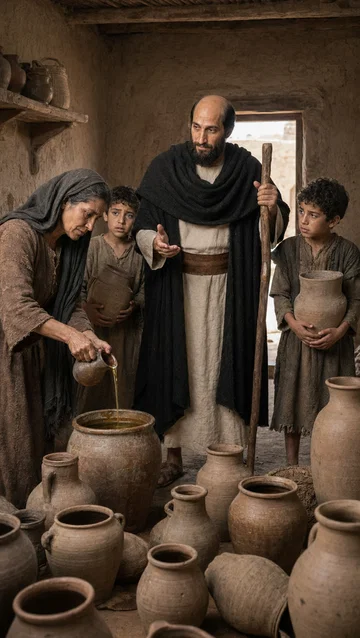
Elisha did not meet the widow's need by a word alone but by giving her and her sons work that tested their faith.ST Dec 7, 1904RH Sep 25, 1856 He directed her to borrow empty vessels from all her neighbors, to borrow not a few, and then to pour from her one pot into them.RH Sep 25, 1856ST Nov 19, 1885 She had only a single pot or jar of oil left, yet she was to keep pouring until the borrowed vessels were filled.ST Jan 14, 1886
Her small supply increased abundantly as she poured until every vessel she had was filled.ST Nov 19, 1885RH Jul 20, 1916 Its supply continued as long as there were empty vessels to receive it and was limited only by the vessels she provided.ST Jan 14, 1886ST Jan 20, 1904ST Nov 19, 1885 If she had provided more vessels there would have been more oil, for the oil never ceased its miraculous flow so long as a vessel remained to be filled.ST Jan 20, 1904ST Nov 19, 1885
By selling the oil she gathered enough to pay the entire debt and to keep her sons with her from bondage.RH Apr 14, 1904RH Sep 25, 1856RH Aug 26, 1915 What remained after the debt was paid was enough to support herself and her children and to begin life anew without further debt.RH Apr 14, 1904RH Sep 25, 1856 The debt had been incurred by her husband, but she willingly sought to repay it.RH Apr 14, 1904
The increase was a real work of God, not a myth or fancy. It stands with the increase of the widow's meal and oil and with the multiplication of the loaves for the multitude as miraculous provision to meet need.ST Jun 6, 1900 It shows that God can supply what His needy children require and that He works with people's feeble efforts.ST Jul 13, 1904
The account shows God's care for His faithful people including the poor, whose poverty in worldly goods does not diminish His regard for them, and that faith is their true wealth.RH Sep 25, 1856 His gifts increase as they are imparted when directed into channels of good.ST Jan 14, 1886 His large blessings wait on those who bring plenty of vessels, and the large fulfillment of His promises is limited by believers themselves and their own actions.ST Jan 20, 1904ST Nov 19, 1885 There may be no limit to the results of exercising faith in God's work, and the blessing that came to the family was the reward of faith.ST Dec 7, 1904RH Jul 20, 1916
Doctrine Duty and Hope
The account shows how God regards the paying of debts, proving that He so fully approves honest dealing that He worked a miracle to provide for payment.RH Jul 7, 1903 Honest debts must be paid rather than increased, with expenses curtailed and stronger effort put forth in comparatively prosperous times to round up financial matters before troublous times come.RH Jul 7, 1903 This is so that those taken to prison or made to suffer other affliction because of faith are not harassed by unpaid bills and taunts, and paying honest debts cultivates the principle of honesty and strengthens character.RH Jul 7, 1903 The provision is an example of completing the work needed to pay debts, including debts incurred by others and inherited, and of protecting the institutions entrusted to one's care.RH Apr 14, 1904 What is already in hand can, with God's blessing, become enough to meet a need and bring deliverance, which is applied to helping children be delivered from the bondage of sin.RH Aug 26, 1915
The chapter is used for comfort at a child's funeral, because the later account of Elisha restoring a dead boy to life points to hope beyond death.RH Jan 4, 1906 The chapter records the raising of the Shunammite's son from the dead before the resurrection of Christ, proving that Christ was not the first and only one raised from the dead.ST Mar 30, 1876ST Apr 30, 1896 His return from the dead was possible through the sacrifice of the Son of God already established in God's purpose though not yet accomplished.ST Oct 12, 1876 The resurrection was not merely a return to mortal life but depended on Christ's power and centered in him, and Christ is the first-fruits in rank and preeminence because the raising of all others depends on his power.ST Apr 30, 1896
Sources