2 Kings 4:2
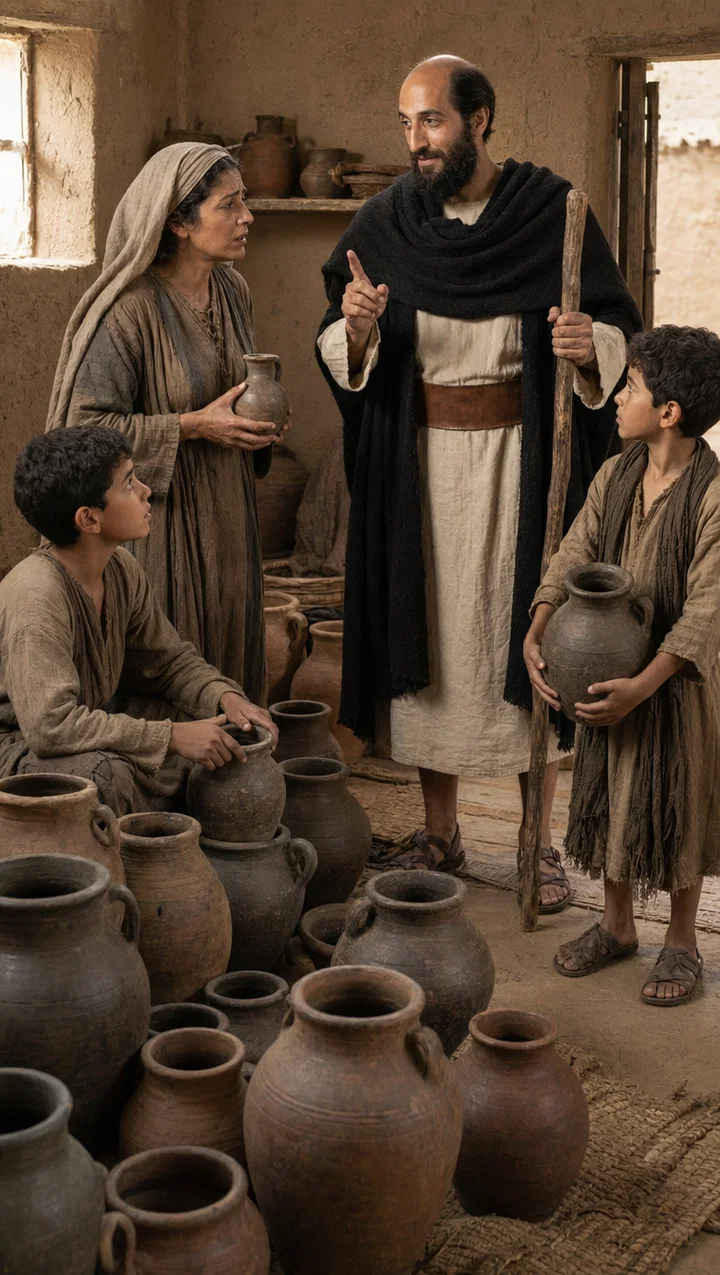
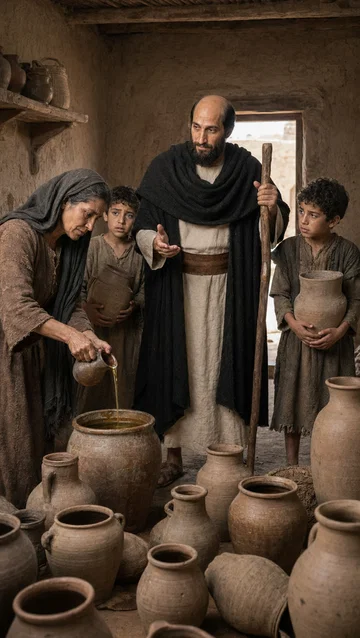
And Elisha said unto her, What shall I do for thee? tell me, what hast thou in the house? And she said, Thine handmaid hath not any thing in the house, save a pot of oil.
Translations
And Elisha said to her, What shall I do for you? tell me, what have you in the house? And she said, Your handmaid has not any thing in the house, save a pot of oil.
King James Version, KJV Cambridge Paragraph Bible
And Elisha said unto her, What shall I do for thee? tell me, what hast thou in the house? And she said, Thine handmaid hath not any thing in the house, save a pot of oil.
And Elisha said to her, What shall I do for thee? tell me, what hast thou in the house? And she said, Thy handmaid hath not any thing in the house, save a pot of oil.
And Elisha said unto her, What shall I do for thee? tell me; what hast thou in the house? And she said, Thine handmaid hath not any thing in the house, save a pot of oil.
And Elisha said unto her, What shall I do for thee? tell me; what hast thou in the house? And she said, Thy handmaid hath not anything in the house, save a pot of oil.
And Elisha saith unto her, 'What do I do for thee? declare to me, what hast thou in the house?' and she saith, 'Thy maid-servant hath nothing in the house except a pot of oil.'
And Elisha said to her, What shall I do for thee? Tell me, what hast thou in the house? And she said, Thy handmaid has not anything at all in the house but a pot of oil.
And Elisha said unto her—What shall I do for thee? tell me what thou, hast, in the house. And she said—Thy maid-servant hath, nothing at all, in the house, save a flask of oil.
Berean Standard Bible, Majority Standard Bible
“ How can I help you?” asked Elisha. “ Tell me, what do you have in the house?”She answered, “ Your servant has nothing in the house but a jar of oil.”
Elisha said to her, “ What should I do for you? Tell me, what do you have in the house?”She said, “ Your servant has nothing in the house, except a pot of oil.”
Then Elisha said to her, What am I to do for you? say now, what have you in the house? And she said, Your servant has nothing in the house but a pot of oil.
Then Elisha saide vnto her, What shall I do for thee? tell mee, what hast thou at home? And she sayd, Thine handmayd hath nothing at home, saue a pitcher of oyle.
Douay-Rheims (Challoner revision)
And Eliseus said to her: What wilt thou have me to do for thee? Tell me, what hast thou in thy house? And she answered: I thy handmaid have nothing in my house but a little oil, to anoint me.
Pictures
Cross-references
- Matthew 14:17-20
And they say unto him, We have here but five loaves, and two fishes.
God multiplies what little is available to provide abundantly.
- 2 Kings 4:34-35
And he went up, and lay upon the child, and put his mouth upon his mouth, and his eyes upon his eyes, and his hands upon his hands: and he stretched himself upon the child; and the flesh of the child waxed warm.
Elisha restores the Shunammite woman’s son through close personal contact.
- 1 Kings 17:17-22
And it came to pass after these things, that the son of the woman, the mistress of the house, fell sick; and his sickness was so sore, that there was no breath left in him.
A widow’s son was also raised before Christ.
- Mark 12:44
For all they did cast in of their abundance; but she of her want did cast in all that she had, even all her living.
Both show a poor widow giving all she has, so her small offering outweighs riches.
Commentary
Each commentary is drawn from primary sources: the writings of Ellen G. White and Adventist pioneers and periodicals. Each commentary is separate. Its own words are not a quotation; follow the references to read the source passages.
Ellen G. White
1 source
Elisha meets the widow with a direct question about what help he can give her.PK 235.1 He asks what he shall do for her and then asks what she still has in her house.PK 235.1 She answers that she has nothing in the house at all.PK 235.1 The single exception is a pot of oil, the small resource out of which her need will be met.PK 235.1
Sources
Pioneers and periodicals
22 sources
Elisha met a bereaved widow left with a debt that threatened her sons with bondage, who had nothing left in her house but a small pot of olive oil for daily use, and he asked what she had in order to make it the starting point for helping her.ST Dec 7, 1904ST Jan 20, 1904ST Apr 8, 1889RH Sep 25, 1856 That little oil was multiplied to fill all the empty vessels she and her sons in faith borrowed, and by selling it she could pay the whole debt and live with her children on what remained.RH Apr 14, 1904ST Apr 8, 1889RH Sep 25, 1856 The blessing was the reward of faith, showing that God works with even feeble efforts and that there may be no limit to the results of exercising it.ST Dec 7, 1904RH Jul 20, 1916ST Jul 13, 1904 His provision was abundance limited only by capacity to receive, for the oil did not cease while any vessel remained, and more vessels would have meant more oil.ST Jan 20, 1904ST Nov 19, 1885 The miracle shows the Lord's care for His poor who fear Him and His regard for honest dealing, that debts must be paid fully through industry, integrity and self-denial.RH Apr 14, 1904RH Jul 7, 1903RH Sep 25, 1856RH Jun 9, 1903
Widow's Plight and Miracle
2 Kings 4:2 belongs to the accounts of Elisha's miracles through which God worked and instructed Israel.ST May 13, 1908 These events are true and not legends or myths, as some critics claim.ST Jan 24, 1906 The account displays what the prophetic-school education could accomplish through Elisha as Elijah's devout pupil.ST Jun 7, 1899
The verse shows a bereaved widow appealing in distress after her husband's death left a debt that threatened her sons with bondage.ST Apr 8, 1889RH Sep 25, 1856 She answers God's question of what He can do for her by saying she has nothing in the house except a pot of oil.RH Sep 25, 1856ST Jul 21, 1909 In this time of loss God is presented as near and ready to hear an earnest response.ST Jul 21, 1909
The widow had nothing in her house except a pot of oil.ST Dec 7, 1904ST Jan 20, 1904 It was only a small pot of olive oil, yet even this little supply mattered greatly to the poor because olive oil was essential to daily life for cooking, lighting lamps, and making soap.ST Sep 28, 1904 She had no other household provision when she faced the debt and the threat of losing her sons to bondage.ST Apr 8, 1889RH Sep 25, 1856
Elisha asks what he shall do for her and what she has in the house, seeking what she can use as the starting point for help.ST Dec 7, 1904RH Apr 14, 1904RH Sep 25, 1856 The oil is the resource through which God plans to relieve the poor widow of debt.RH Apr 14, 1904 It becomes enough for the Lord to provide through Elisha's instruction.RH Sep 25, 1856
She was told to gather vessels and to borrow empty vessels, borrow not a few.RH Apr 14, 1904ST Nov 19, 1885 When she acted in faith and borrowed vessels as instructed, the small amount of oil was multiplied to fill every vessel and did not cease its flow so long as any vessel remained to be filled.ST Apr 8, 1889RH Sep 25, 1856RH Aug 26, 1915ST Nov 19, 1885RH Jul 20, 1916 Had she provided more vessels there would have been more oil, even to filling her neighbors' vessels.RH Aug 26, 1915ST Nov 19, 1885 By selling it she could pay the whole debt and live with her children on what remained, so her present need was met with provision left for the future and her children were delivered from bondage.RH Apr 14, 1904ST Apr 8, 1889RH Sep 25, 1856RH Aug 26, 1915
The chapter containing the verse also records the Shunammite woman's son being restored to life before Christ's resurrection.RH May 28, 1861ST Oct 12, 1876 His restoration is a real resurrection from the dead even though he was not raised to immortality.RH May 28, 1861 Such restorations to life before Christ's sacrifice was accomplished were made possible by virtue of the Son of God's sacrifice, already established in God's purpose.ST Oct 12, 1876 The widow's small supply of oil increasing as she poured it out is like the bread multiplying through being broken and distributed.ST Jun 6, 1900
Faith, Provision, and Duty
The pot of oil became the starting point for help that required the widow and her sons to act in faith, and the blessing to the family was the reward of that faith.ST Dec 7, 1904RH Jul 20, 1916ST Jul 13, 1904 There may be no limit to the results of exercising such faith in God's work, for when she borrowed vessels as instructed the small supply increased until all were filled.ST Dec 7, 1904RH Jul 20, 1916 God does not despise feeble human efforts but works with them to accomplish the miracle.ST Jul 13, 1904
God's blessings in the account provide abundance limited only by the capacity to receive.ST Jan 20, 1904ST Nov 19, 1885 The command to borrow empty vessels, borrow not a few, was an unlimited promise, and the oil did not cease its flow so long as any vessel remained to be filled.ST Nov 19, 1885 Had more vessels been provided there would have been more oil, so large fulfillment of His promises is limited by the believer's own readiness to bring plenty of vessels.ST Jan 20, 1904ST Nov 19, 1885 The oil kept flowing as long as there were vessels to receive it, illustrating that God supplies gifts as they are put to use in channels of good.ST Jan 14, 1886ST Nov 19, 1885
The account shows the Lord's care for His poor people who feared Him, and poverty in worldly goods does not prevent a person from being rich in faith.RH Sep 25, 1856 A humble home with nothing but a pot of oil whose value lies in its response to God's power to provide and increase is preferable to abundant wealth and grand possessions.RH Sep 25, 1856RH Jun 9, 1903 God can multiply oil to meet the need of His children, proving that all power, all wisdom, infinite love, and all the resources of the universe are His. Those who seek first the kingdom of God and His righteousness, walk uprightly, and take no anxious thought for the morrow can therefore trust Him to add food and drink and clothing and to withhold no good thing, even when they cannot see how He will do it.
God performed the miracle to enable the payment of debts, showing His regard for paying debts and His approval of honest dealing.RH Apr 14, 1904RH Jul 7, 1903 The oil provided enough to pay the whole debt with surplus for future support, teaching that honest debts must be met fully rather than stopping after paying only part.RH Apr 14, 1904RH Jul 7, 1903 This requires strict economy, industry, integrity, honesty, self-denial, and stronger effort, with comparatively prosperous times used to curtail expenses and round up financial matters before troublous times come.RH Jul 7, 1903 In this way believers will not face prison or other affliction for faith while also harassed with taunts over unpaid accounts.RH Jul 7, 1903
The question what hast thou in the house still applies to believers who feel too poor to take part because of years of crop failure and scarcely know what to offer their children for bread.RH Sep 9, 1902 Like the widow who had nothing save a pot of oil, they have something small, such as six or seven chickens or geese or feathers, to sacrifice to buy and pay for one book.RH Sep 9, 1902 They are to read that one book and, if careful, sell it to a friend, and with the money received buy another book and thus continue to work.RH Sep 9, 1902 Taking this part is needed for their own Christian development, opens the way to rejoicing, and brings signal blessing from the Lord.RH Sep 9, 1902 The one pot of oil is a small yielded thing God multiplies, God's gift within the breast today, His Spirit's power poured through a yielded person to fill many vessels not a few.RH Apr 24, 1900 This comes when a person is small enough to be used, still enough and low enough, seeing only Jesus and giving all, and through such a one He moves hearts, makes heathen hearts know His will, and hastes the coming of God's Son to reign.RH Apr 24, 1900
Sources